
Cocoon Project: Flood-Resilient Architecture Rooted in Kerala's Water Landscape
A shortlisted HEAL+ entry transforms step-wells, mangroves, and shipping containers into a layered system of flood resilience for Kerala.


What if the most effective flood defense wasn't a wall but an entire neighborhood redesigned to let water pass through it? The Cocoon Project takes that premise seriously, proposing a settlement model for Kerala where barrier walls, mangrove buffers, step-wells, and permeable dwelling units work in concert to absorb, redirect, and ultimately coexist with floodwater. Rather than fortifying against nature, the design choreographs a controlled relationship with it, treating recurring floods not as anomalies to resist but as cyclical events to accommodate.
Designed by Esha Savarnya, Yagvinder Mamoria, and Isaac Vaarzon Morel, the project was shortlisted in the HEAL+ competition, which called for regenerative housing solutions in flood-prone Kerala. The team identified four systemic vulnerabilities in existing settlements: weak structures that collapse under water pressure, unorganized layouts that complicate evacuation, poor road connectivity that obstructs emergency response, and inadequate drainage that causes post-flood stagnation and health hazards. The Cocoon Project addresses all four through a layered urban and architectural strategy.
A Master Plan Built Around Water, Not Against It
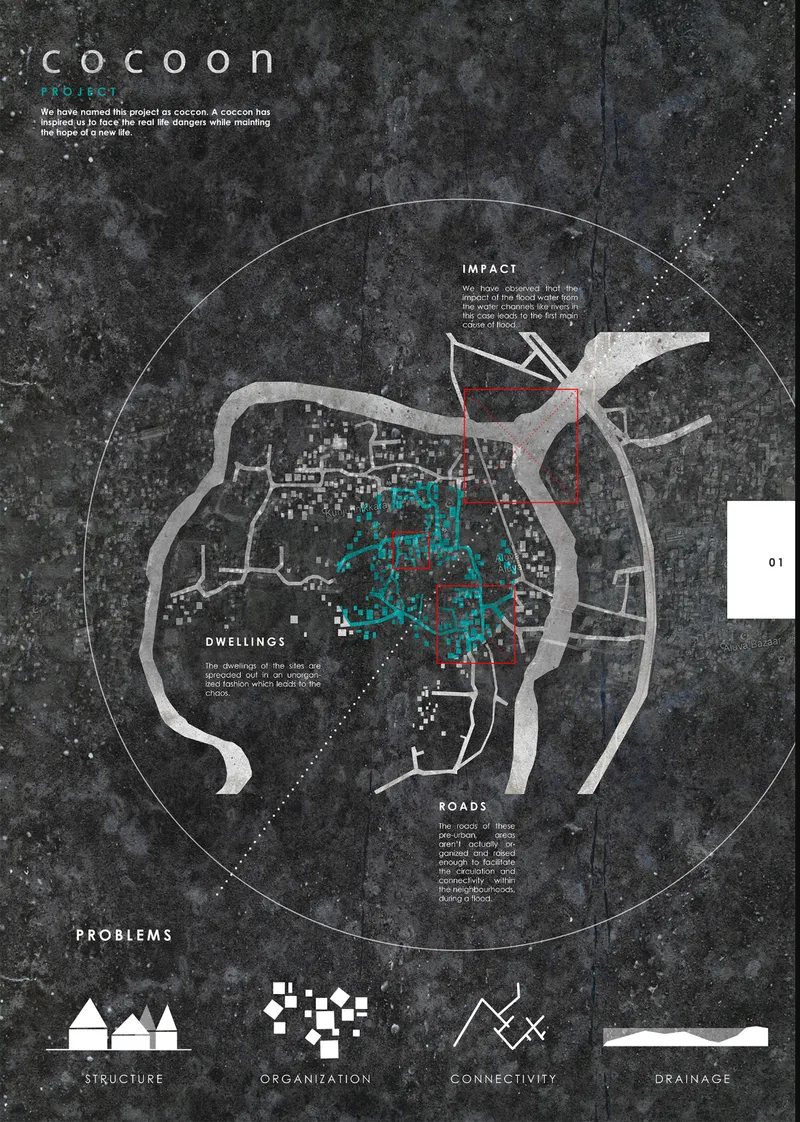
The site plan reveals the project's foundational logic: organize the settlement into a grid of clustered dwellings with clearly differentiated primary vehicular routes and inner pedestrian pathways. Impact zones, marked in turquoise and red, map out the anticipated flood reach, and the layout responds directly to these gradients. Dwellings are grouped around shared courtyards in clusters of 25 families, a scale chosen to foster collective safety, resource sharing, and efficient evacuation. The periphery is lined with mangrove plantations that decelerate water inflow before it reaches inhabited zones.
At the center of the neighborhood sits the step-well, functioning simultaneously as a water collector, a public landmark, and an early warning system. As water levels rise in the well, the community receives a visual and measurable signal of escalating flood conditions. Outside of flood periods, these same step-wells and their connected canals transform into recreational and communal gathering spaces, ensuring year-round utility from infrastructure that might otherwise sit dormant.
Layered Flood Mitigation: Barriers, Mangroves, and Canals

The diagram sheet lays out the project's multi-layered defense system with clarity. Barrier walls act as first-line retaining structures, strategically placed to redirect floodwaters toward canals and step-wells rather than into dwelling areas. Behind these walls, mangrove plantations slow water currents, a biophilic solution that merges ecological restoration with infrastructure performance. Elevated pathways run through the neighborhood, ensuring pedestrian mobility even when ground-level zones are submerged. The canals capture and channel excess water into reservoirs, creating a managed drainage network that prevents the stagnation responsible for post-flood contamination.
What makes this system compelling is its redundancy. No single element bears the full burden of flood protection. The barrier walls, mangroves, elevated paths, step-wells, and canals each address a different phase or intensity of flooding, and together they create a resilience gradient that degrades gracefully rather than failing catastrophically.
Clustered Courtyards and the Geometry of Community Safety

The isometric drawing shows how the dwelling clusters translate from plan to experience. Housing units line a public street flanked by trees, with a central community building anchoring the composition. The courtyard arrangement is not merely aesthetic; it structures evacuation routes, creates shared open ground for emergency staging, and maintains social cohesion by keeping families physically proximate. In a flood scenario, this layout means neighbors are within immediate reach of one another, and access to common services remains unobstructed.
The designers frame this as cultural continuity by design. Public spaces sustain social interaction during normal conditions and become critical support infrastructure during crises. The architecture holds both states without needing to transform; it simply shifts in emphasis from communal leisure to collective survival.
Dwelling Units That Let Water Through
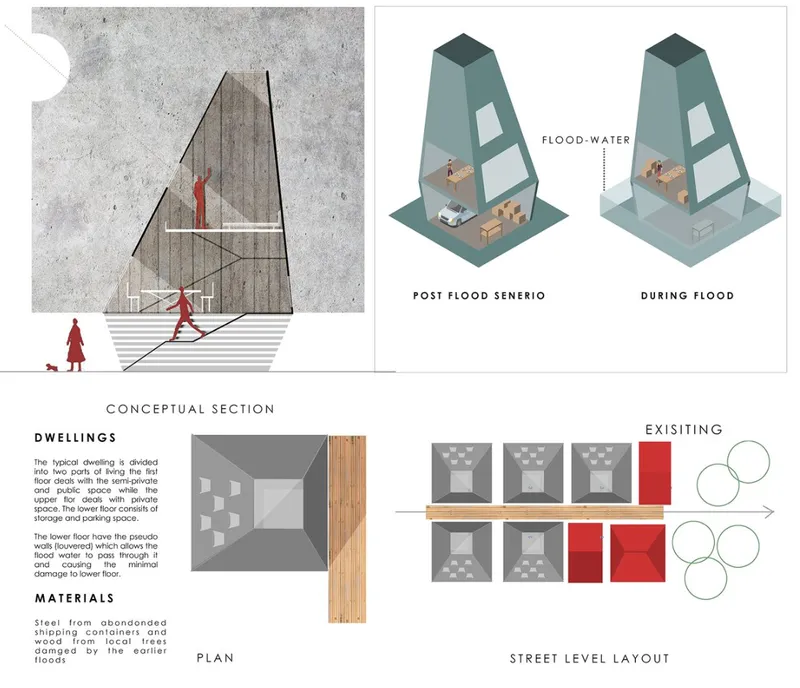
At the unit scale, the design commits to a two-part vertical division. Ground floors serve as storage and parking, deliberately sacrificial zones that accept water intrusion. Living spaces are elevated above anticipated flood levels. The section and plan drawings reveal pseudo walls at the lower level, permeable structures that allow controlled water passage rather than resisting it. This is a critical detail: by letting water move through the ground floor, the building avoids the hydrostatic pressure that causes conventional walls to buckle and collapse.
Material choices reinforce the project's sustainability agenda. Abandoned shipping containers and reclaimed wood are repurposed as primary construction elements, visible in the timber cladding shown in the drawings. The flood-water storage zones integrated into the dwelling's section add another layer of water management, capturing and holding floodwater at the building scale before it is released into the neighborhood's canal system. Each dwelling becomes a micro-infrastructure node within the larger resilience network.
Why This Project Matters
The Cocoon Project's strength lies in its refusal to treat flood resilience as a single technical problem with a single technical answer. Instead, it distributes resilience across scales, from the regional mangrove buffer to the neighborhood step-well to the permeable ground-floor wall of an individual dwelling. Each intervention is modest on its own; together, they form a system that is structurally redundant, ecologically restorative, and socially cohesive. The designers have understood that in Kerala's flood context, survival depends not just on building stronger but on building smarter, with communities organized to support each other and infrastructure designed to serve multiple purposes across seasons.
For a student team, the sophistication of thinking here is notable. The step-well as early warning device, the pseudo wall as pressure-release mechanism, the courtyard cluster as evacuation geometry: these are not decorative concepts but operational design decisions. The Cocoon Project demonstrates that resilient architecture doesn't require high-tech solutions or massive budgets. It requires a thorough reading of site conditions, a willingness to learn from traditional infrastructure like step-wells and mangroves, and the discipline to coordinate interventions across every scale of the built environment.
View the Full Project
About the Designers
Designers: Esha Savarnya, Yagvinder Mamoria, Isaac Vaarzon Morel
Enter a Design Competition on uni.xyz
uni.xyz runs architecture and design competitions year-round that reward proposals with spatial conviction and real site intelligence.
Project credits: Cocoon Heal by Esha Savarnya, Yagvinder Mamoria, Isaac Vaarzon Morel HEAL+ (uni.xyz).


Popular Articles
Popular articles from the community


Manzana Morphosis: Stretching Barcelona's Grid into a Living Landscape for 2050
A radical reworking of the Eixample manzana turns density into a tool for generous public space, vertical ecology, and environmental performance.


ETEH Reworks the Shared Spaces of São Domingos School in Brazil Around Timber, Color and Hanging Plants
At São Domingos School in Brazil, 436 m² of hall, refectory and library are recast with timber joinery, a yellow and blue code and trailing greenery.

FCC Arquitectura Expands a Portuguese Granite House with a Board-Marked Concrete Wing
In Portugal, JV House pairs a cleaned-up whitewashed and granite dwelling with a timber-shuttered concrete extension, courtyards and a garden pool.

Opera on the Sea: Driftwood Logic Shapes a Timber Opera House on Estonia's Coast
Trevor Orgill's opera house translates the entangled drift of floating timber into a civic building where wood, water, and music converge.

Similar Reads
You might also enjoy these articles

Aquadapt: An Underwater Habitat That Rewrites Its Rooms by the Hour
Curved modules ring the seabed while one shell shifts from breakfast room to cinema, farm and football pitch as residents' needs change.

Play: Fragments of Their World: Remembered Architecture Rebuilt as a Modular Playground for Refugee Camps
Tom Gardner abstracts domes, arches and towers from the homelands of displaced families into a kit of child-scaled play parts for camp settlements.
REBIRTH: A Circular Settlement Where Afghan Widows and Their Children Rebuild Life Together
A shortlisted Resile entry turns the circle into a protective ring of timber and brick, gathering homes, classrooms and gardens around a shared landscape.
The Main Dream: A Recycled Plastic Kit That Lets Refugee Children Build Their Own Playground
Thirty-centimetre interlocking cubes that connect on three axes turn play into construction, letting children author the spaces they occupy.

Comments (0)
Please login or sign up to add comments
No comments yet. Be the first to comment!