
Coil Kazuteru Matumura Architects Turns an Osaka Lodging House into a Tactile Retreat for Travelers
A 160 m² renovation in Miyakojima, Osaka layers fieldstone, timber screens, and tatami to recast a private lodging facility for global guests.


Private lodging in Japan occupies a peculiar middle ground between hotel hospitality and domestic life. The best examples don't simulate either: they offer something more intimate than a hotel and more considered than a home. Maki no Yado Miyakojima Riverside, a renovation by Coil Kazuteru Matumura Architects in a quiet residential pocket of Osaka's Miyakojima ward, tries to thread that needle. The client, a multi-venture operator spanning furniture manufacturing, cafés, and residential development, wanted the existing property reimagined to attract international visitors. What architect Kazuteru Matumura delivered is less a brand refresh than a material argument: that craft and atmosphere, not amenity checklists, earn occupancy.
At 160 m² the building is compact, and the renovation works within that constraint rather than against it. Every surface decision, from the fieldstone fireplace wall to the hammered brass hardware, carries weight precisely because the rooms are small enough to notice them. The result is a lodging facility that reads as a curated sequence of textures and light conditions rather than a floor plan with furniture.
Stone and Fire as Anchor
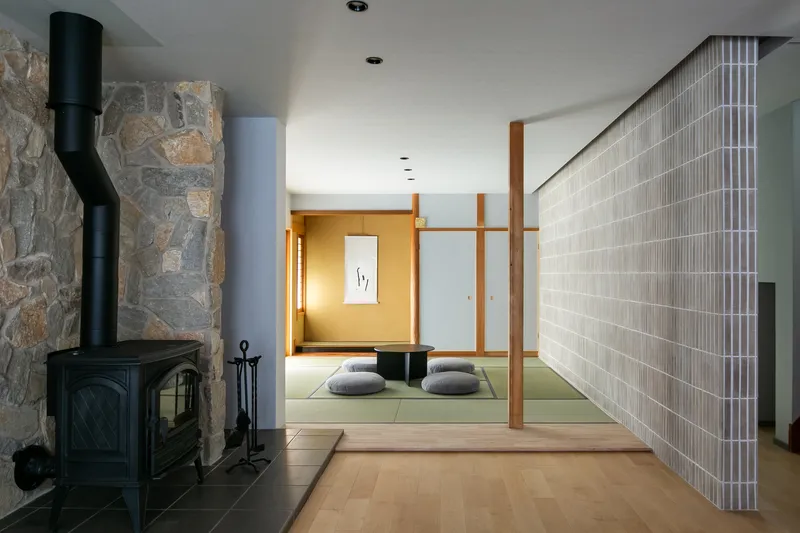
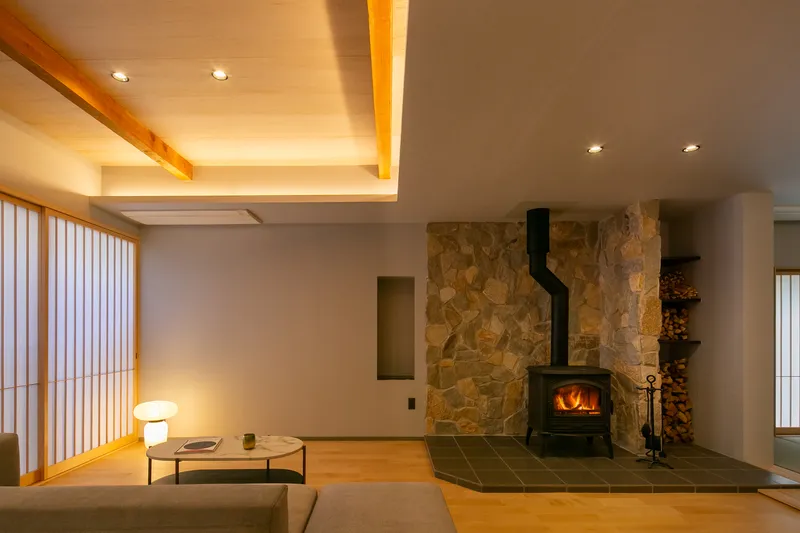
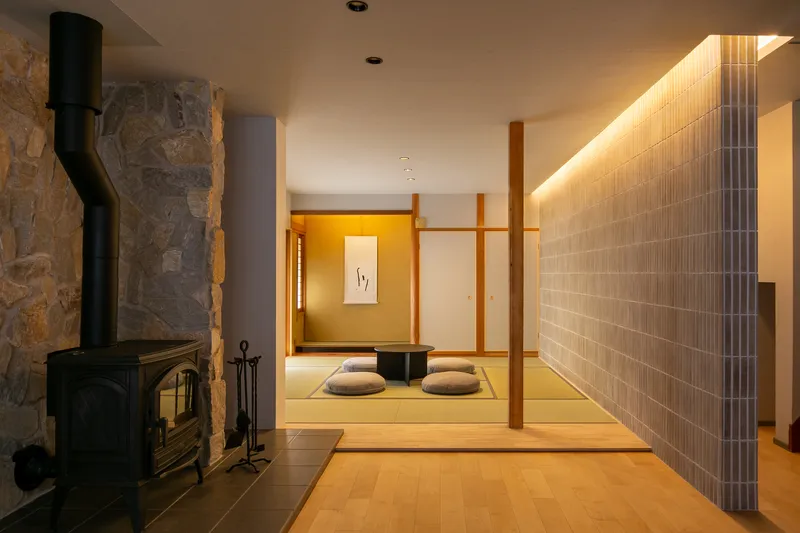
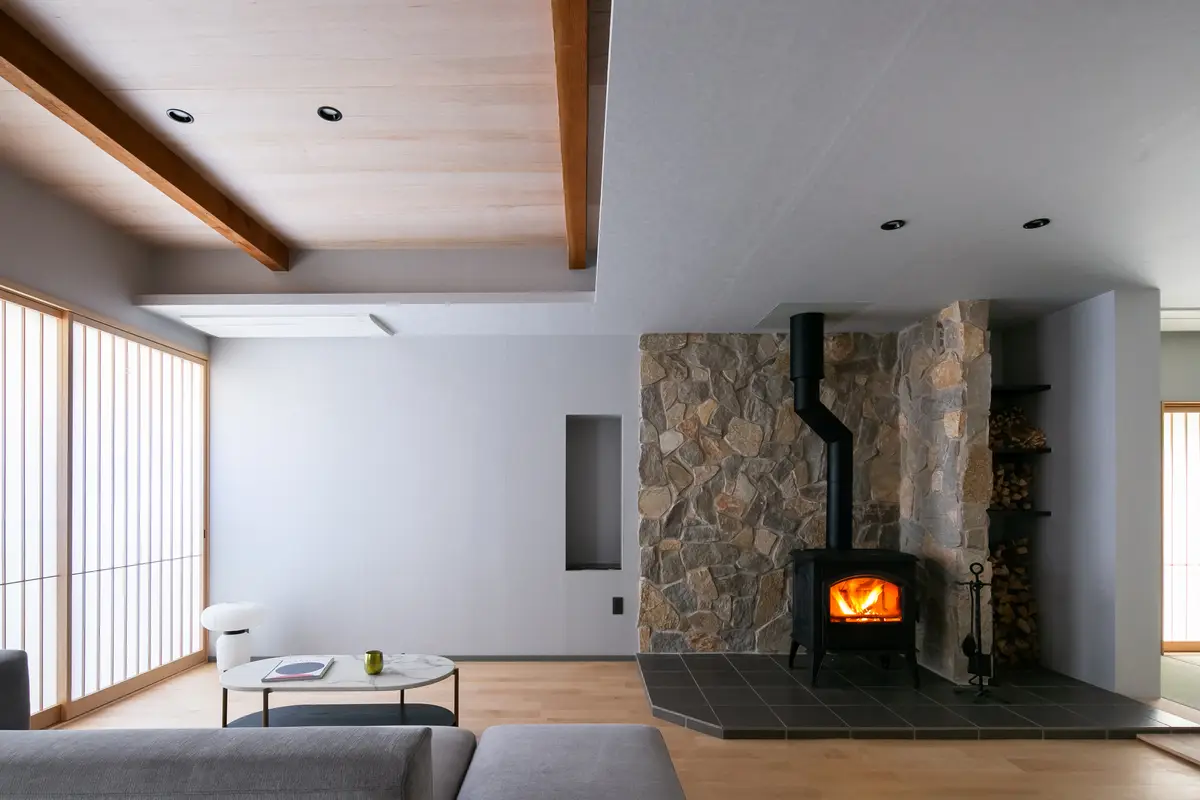
The living room's fieldstone wall is the single strongest gesture in the project. Rough, uncoursed, and anchored by a matte black woodstove, it establishes a gravity that the rest of the ground floor orbits. Cove lighting recessed into the ceiling washes the stone without flattening it, preserving shadow play across the irregular surface. It is a deliberately primitive element set inside a highly refined envelope, and the tension is productive.
From the tatami room beyond, the stone wall reads as a distant backdrop filtered through vertical timber slats, shifting its character depending on where you stand. The stove itself is almost sculptural, its blackness pulled tight against the pale mortar joints. For a lodging house targeting guests unfamiliar with Japanese spatial norms, this hearth provides a legible center, something universally welcoming.
Vertical Screens and Modulated Light
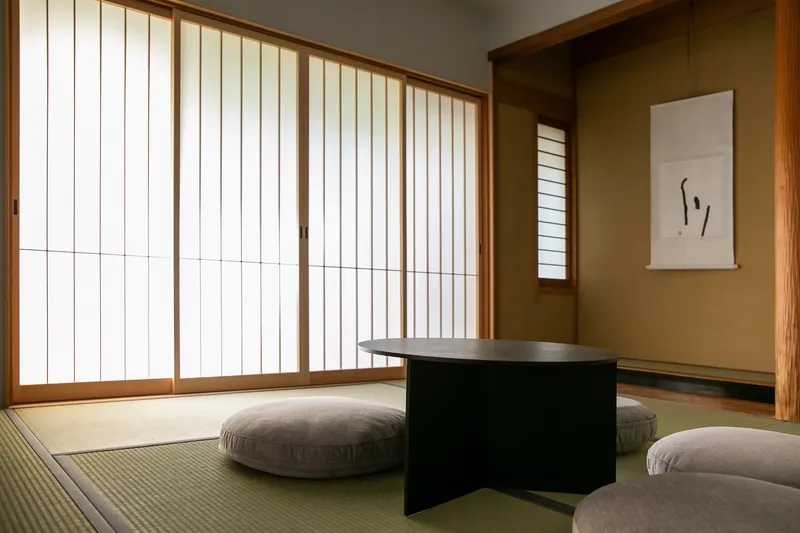
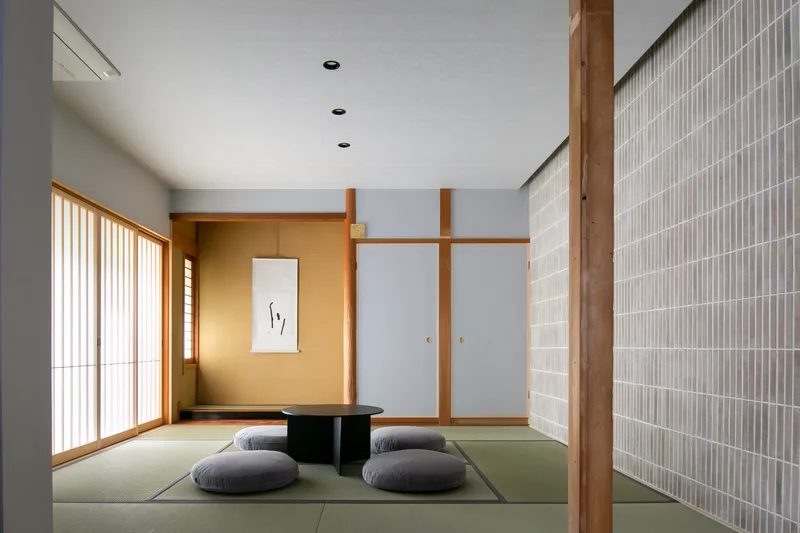
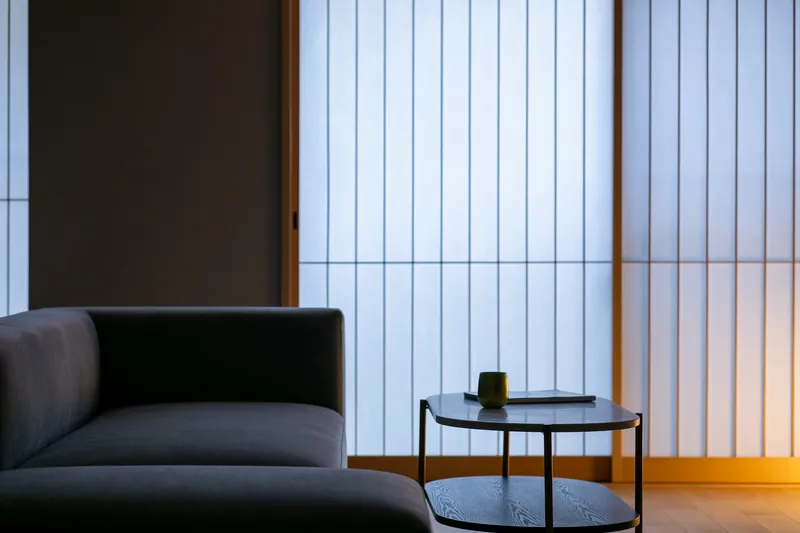
Vertical timber slats appear at nearly every boundary in the house: between rooms, along exterior windows, and as partitions that filter daylight into soft parallel stripes. Rather than using shoji screens alone, which would anchor the interiors to a single historical register, Matumura introduces these slatted planes as a contemporary reinterpretation of the traditional screen. They are thick enough to cast real shadow, spaced tightly enough to obscure direct views while remaining porous to air and light.
The tatami room benefits most. Floor cushions arranged around a low black table sit beneath a canopy of warm, filtered light that changes throughout the day. At dusk, as visible in the sofa alcove, the screens glow from backlit exterior light. The effect is atmospheric rather than dramatic, which feels exactly right for a lodging facility intended to slow visitors down.
Timber Structure on Display
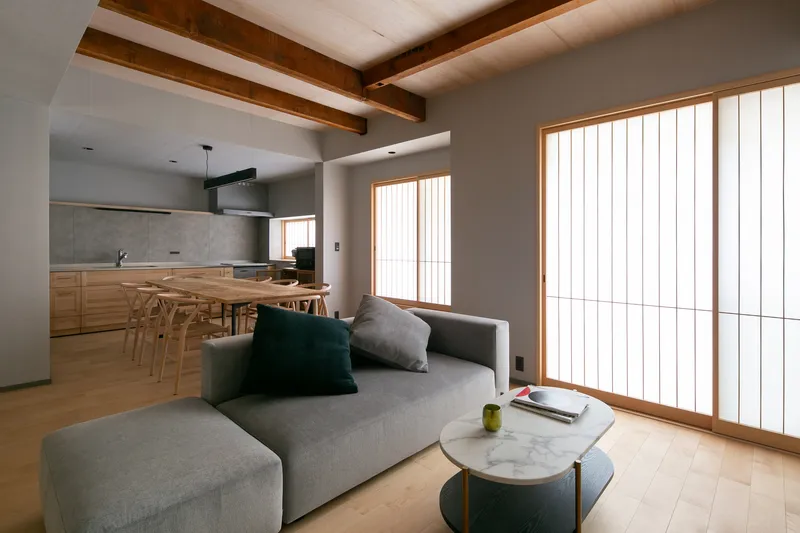
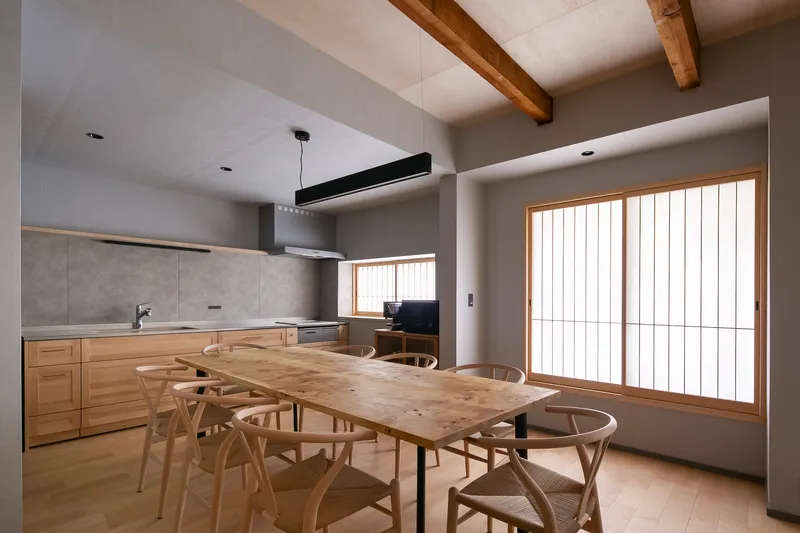
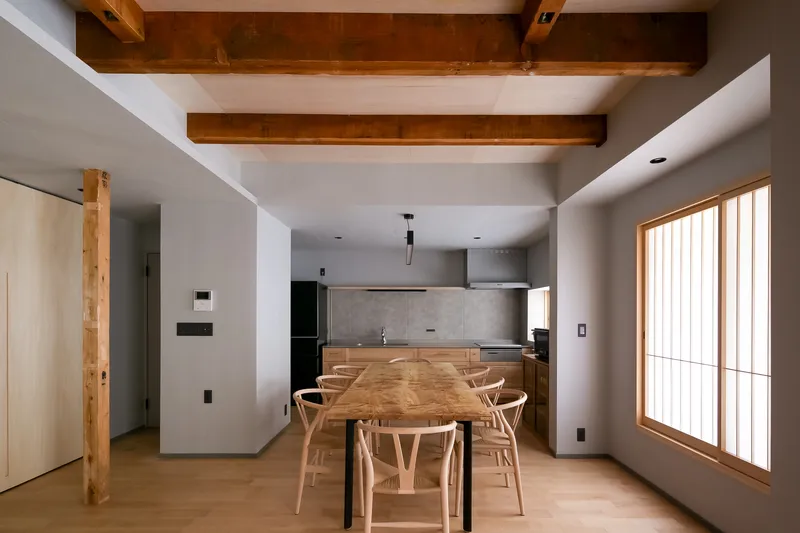
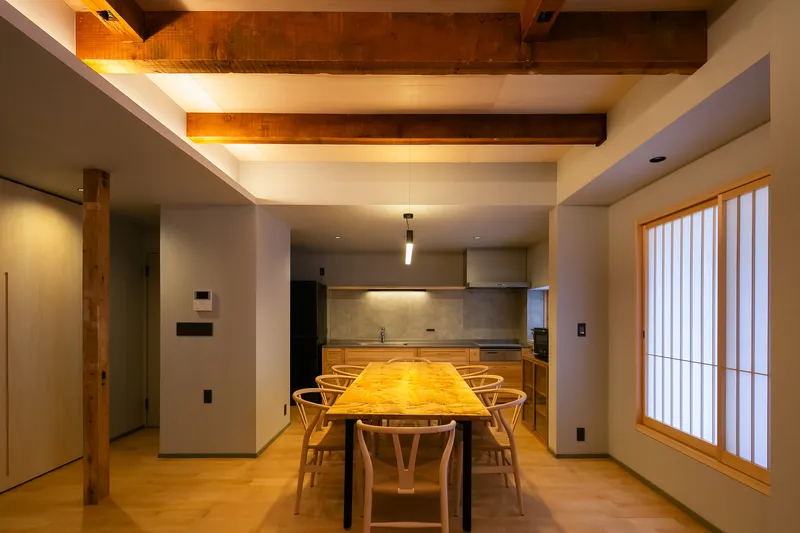
Exposed timber beams run the length of the dining and living areas, their warm grain contrasting with a concrete kitchen backsplash and recessed ceiling panels. The beams may be original structure revealed during renovation, or new members introduced to create the appearance of an older frame. Either way, they do useful work: they give the open plan a sense of rhythm and scale, breaking the ceiling into bays that correspond loosely to functional zones below.
Translucent sliding screens along the dining windows pair with these beams to produce a layered depth. Light enters through the screens, hits the underside of the beams, and scatters softly downward. The dining table, chairs, and kitchen counter sit in this diffused wash without competing for attention. It is a lesson in restraint: a renovation that reveals rather than adds.
Craft in the Details
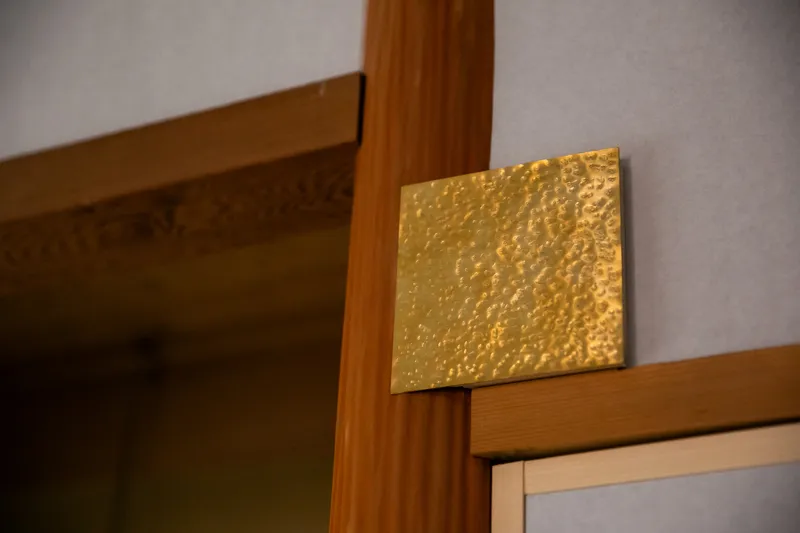
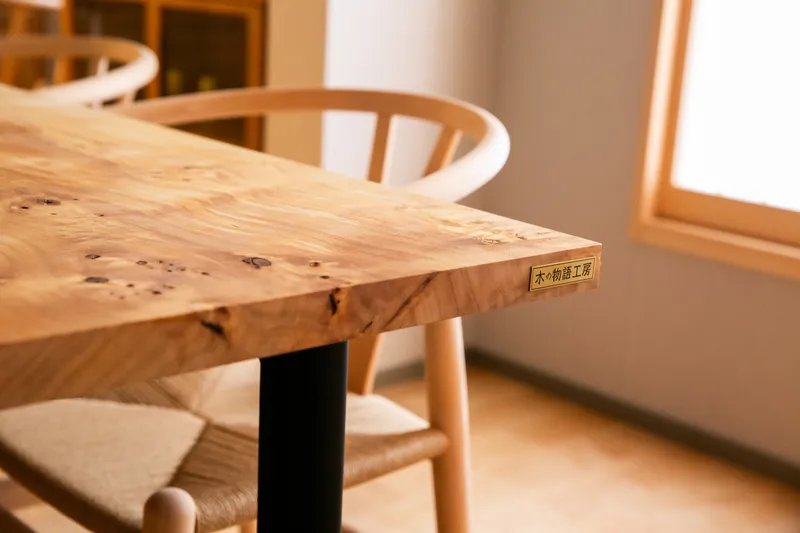
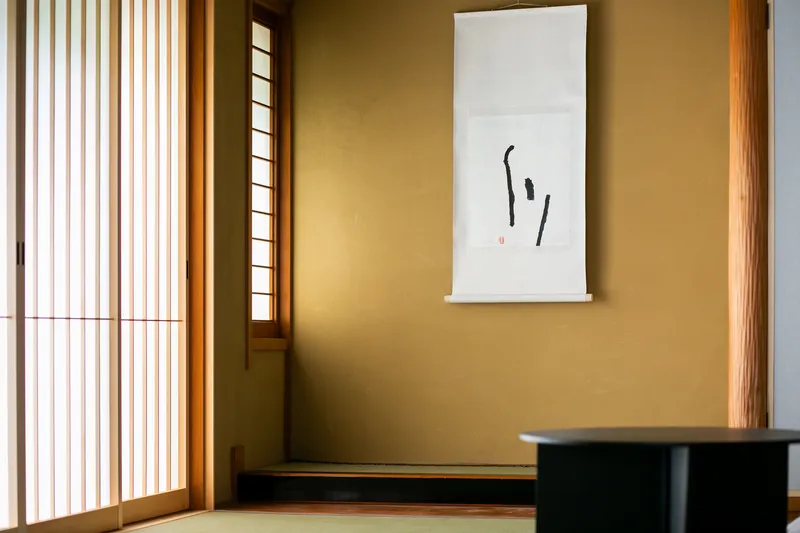
Zoom in and the project rewards close looking. A hammered brass plate is inset into a doorframe corner joint, protecting a high-wear point while doubling as ornament. The live-edge timber dining table meets black steel legs with a directness that announces its material origins. In the tatami alcove, an ochre wall hosts a scroll painting beside a slatted screen, composing a vignette that could be a still life.
These details matter more than usual because the building is a lodging facility. Guests touch door handles, sit at tables, and notice corners at close range. By investing in material specificity at the scale of a hand, the renovation distinguishes itself from properties that rely on mood lighting and neutrality alone. The client's background in furniture manufacturing likely helped: someone in the room understood wood.
Bathing Ritual and the Courtyard
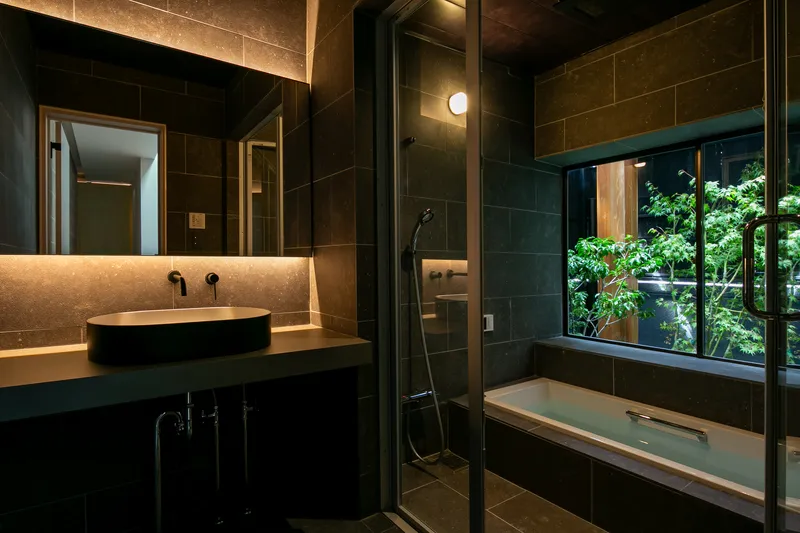
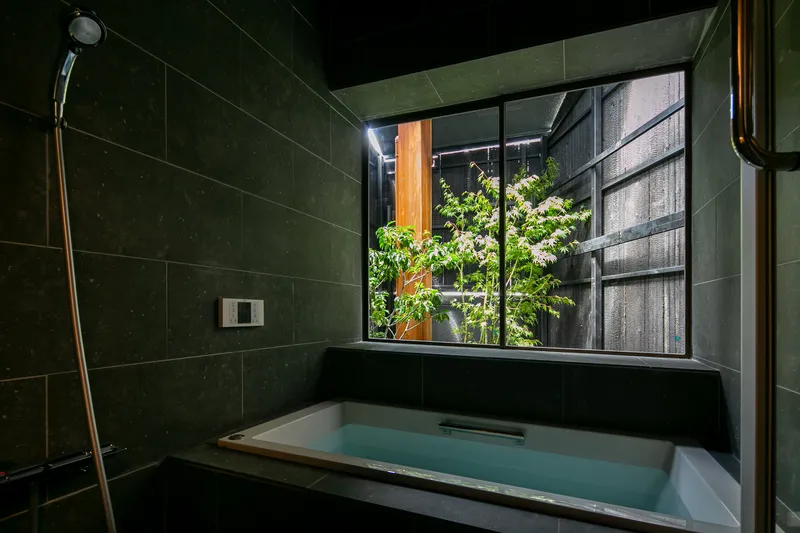
The bathroom is arguably the room that clinches the project's appeal to international visitors. A vessel sink and deep soaking tub face a window onto a planted courtyard, its greenery illuminated at night to create a private garden view from inside the bath. The composition is precise: tub edge, window sill, and garden plane align in a way that makes the small courtyard feel generous.
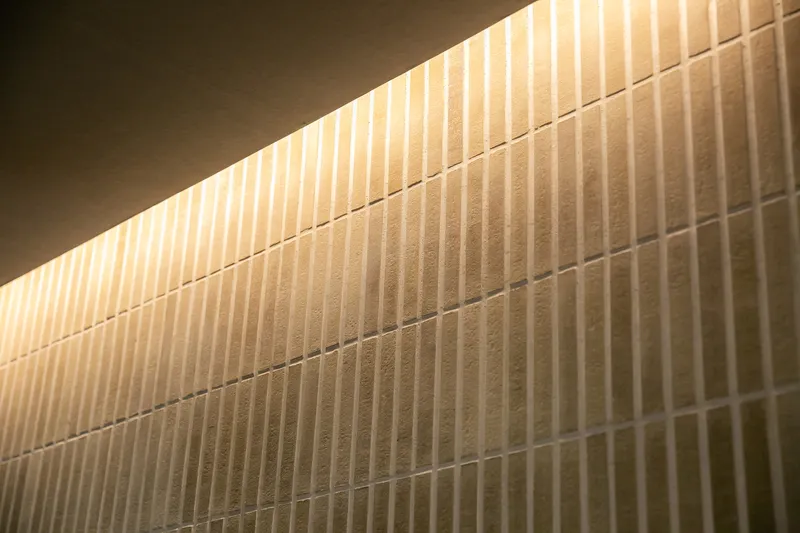
Nearby, a backlit wall of vertical ribbed tiles introduces a finer texture, with concealed linear lighting above creating a soft glow that washes downward. It is a quieter, more abstract surface than the fieldstone downstairs, calibrated for a room where relaxation is the explicit purpose. Together, the bathing suite and courtyard form a self-contained experience within the larger lodging, the kind of moment that earns a five-star review.
Entry as Compression
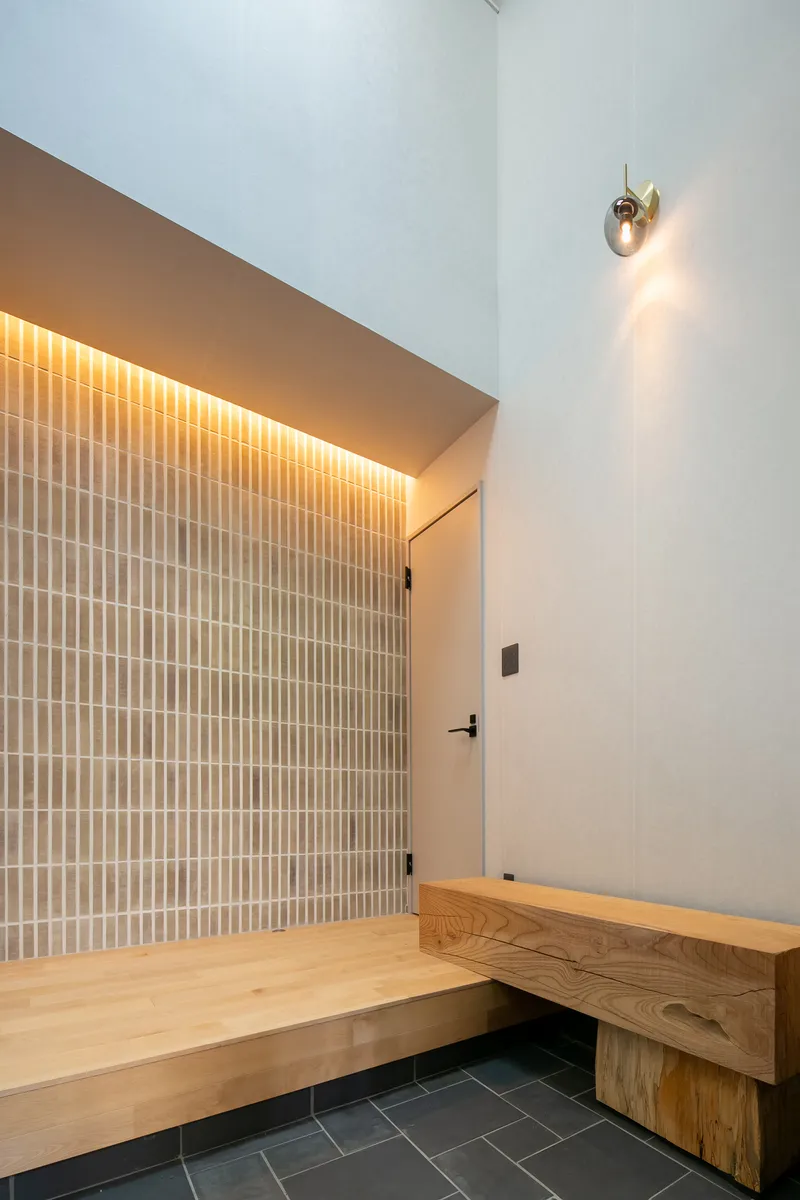
The entry vestibule sets the tone with a grey rectangular tile wall, recessed uplighting, a floating timber bench, and a dark slate floor. It is compact and deliberately muted, a compression chamber before the warmth of the living spaces beyond. The material palette here, cooler and harder than the timber and stone interior, signals transition. You are leaving the city and entering a different register of attention.
Viewed from the dining area looking back through the house, the spatial sequence becomes legible: kitchen, timber beams, slatted screens, and evening light stack into a layered composition. The renovation's restraint pays off in these through-views. Nothing competes, and the eye travels freely.
Plans and Drawings
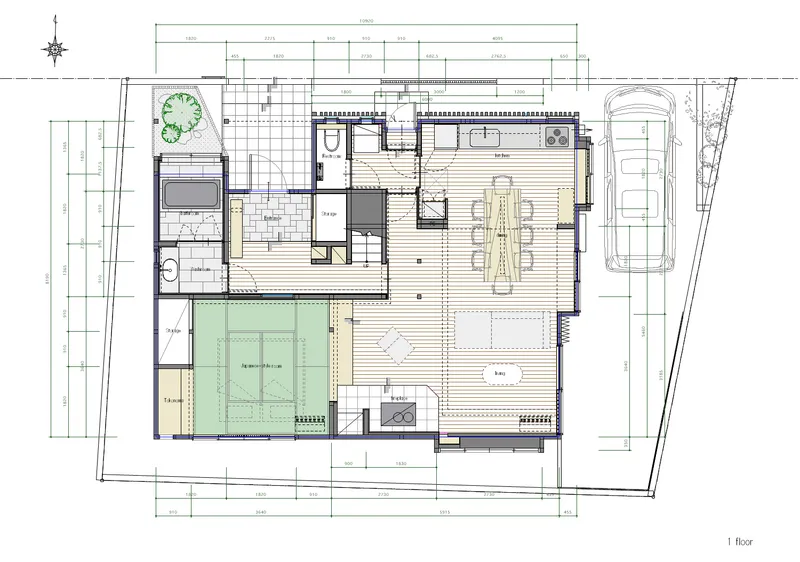
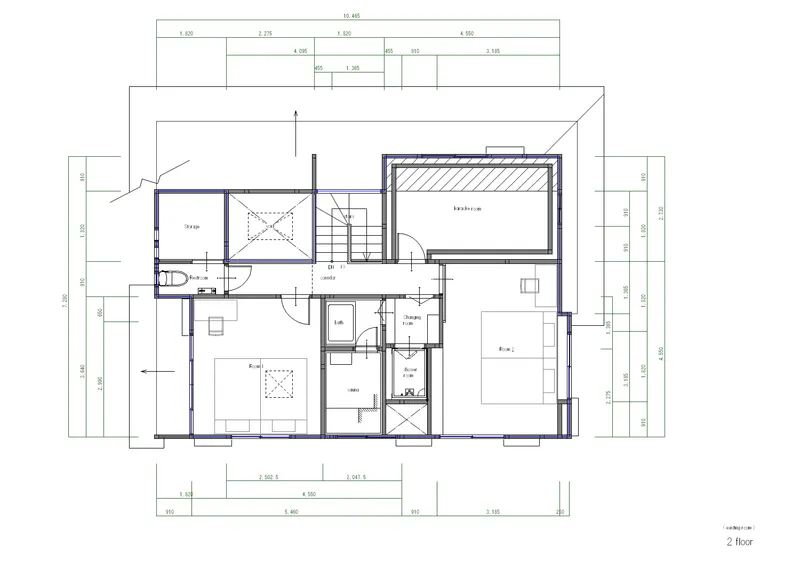
The first floor plan reveals a compact ground level organized around the tatami room, living area, and bathroom, with the planted courtyard tucked alongside the bathing spaces. It is a tight footprint where every room earns its place. The second floor accommodates bedrooms and a lofted sleeping area with an angled ceiling, keeping the ground level free for communal and bathing functions. The vertical separation between social and private zones is smart for a lodging use: guests can retreat upstairs without passing through the heart of the house.
Why This Project Matters
Japan's private lodging sector is booming, and much of it looks the same: white walls, blonde wood, a designer kettle. Maki no Yado Miyakojima Riverside pushes against that homogeneity by committing to material character. Fieldstone, hammered brass, live-edge timber, and ribbed tile give the 160 m² facility a specificity that generic minimalism cannot match. The renovation demonstrates that small-scale hospitality architecture can be as materially ambitious as any public building.
More broadly, the project illustrates how renovation can outperform new construction in atmospheric density. The existing structure's bones, its beams, its proportions, its relationship to the street, provide a starting point that no blank site could offer. Coil Kazuteru Matumura Architects worked with those constraints to produce a sequence of rooms that feel both inevitable and surprising. For architects designing lodging facilities in dense residential neighborhoods, this is a useful precedent: invest in surfaces, control the light, and trust the guest to notice.
Maki no Yado Miyakojima Riverside, designed by Coil Kazuteru Matumura Architects (lead architect: Kazuteru Matumura). Located in Osaka, Japan. 160 m². Completed in 2025. Photography by Mayu Morita.
About the Studio
Share Your Own Work on uni.xyz
If projects like this are the kind of work you want to make, uni.xyz is a place to publish your own, find collaborators, and enter design competitions.


Popular Articles
Popular articles from the community


ALGAL REALM: A Bio-Integrated Lunar Habitat Design for Life Beyond Earth
ALGAL REALM reimagines lunar habitat design with algae-powered life support, 3D-printed regolith, and vertical living for a lunar future.

Play: Fragments of Their World
Familiar architecture becomes modular playground design, creating safe spaces where displaced children can learn, connect, imagine and play.

Little Red Riding Hood: Architectural Design as a Journey Through Fear, Light, and Storytelling
Little Red Riding Hood reimagines the fairy tale through architectural design shaped by fear, light, scale, memory, uncertainty, and choice.

Hill & Cross Opera: Sculptural Opera House Architecture Shaped by Tallinn’s Landscape and Identity
Hill & Cross Opera reimagines opera house architecture in Tallinn through its sculptural hill, civic plaza, glass wave and a luminous cross.

Similar Reads
You might also enjoy these articles

Bao Huynh Watercolor Atelier: A Serene Art Retreat in Hội An
Bao Huynh Watercolor Atelier in Hội An blends multifunctional art spaces, sustainable design, local materials, and family-friendly living in a serene environment.

Atelier Macri Concept Store Interior Design by CASE-REAL
Atelier Macri store features a "ko" counter, walnut wood details, cork displays, blending retail, gallery, and seamless customer experiences.

Manuel Vargas Izquierdo Stadium and High-Performance Sports Center: Architectural Excellence in Jalpa de Méndez
The Manuel Vargas Izquierdo Stadium blends sustainable design, inclusive sports facilities, and cultural-inspired architecture, revitalizing Jalpa de Méndez’s public spaces.

KAKR Buluh Awar Hall: Revitalizing Community and Ecology Through Bamboo Architecture
Community built bamboo hall revitalizes Buluh Awar village, empowering youth, restoring ecology, celebrating vernacular craftsmanship through sustainable architecture and culture.


Comments (0)
Please login or sign up to add comments
No comments yet. Be the first to comment!