

Color Constellation: Star-Shaped Fabric Canopies You Can Climb Inside
Five spandex structures suspended from walls and ceiling transform a gallery into an immersive, touchable landscape of color and tension.


What happens when architecture stops asking you to look and starts asking you to push, pull, and crawl inside? Color Constellation answers that question with five star-shaped spandex structures hung from the walls and ceiling of a single room, each a different color and size, each soft enough to deform under the pressure of a hand. The installation collapses the distance between viewer and space entirely: you don't observe the architecture, you wear it.
Designed by Virginia Melnyk, Color Constellation was shortlisted for Architecture on the Clock. The project applies parametric architecture principles to a gallery-scale intervention, using flexible spandex fabric as both structure and surface. The result is a constellation of tensile canopies that visitors can enter, reshaping the forms in real time and experiencing color not as pigment on a wall but as an enveloping spatial condition.
Tensile Canopies Over Reflective Ground
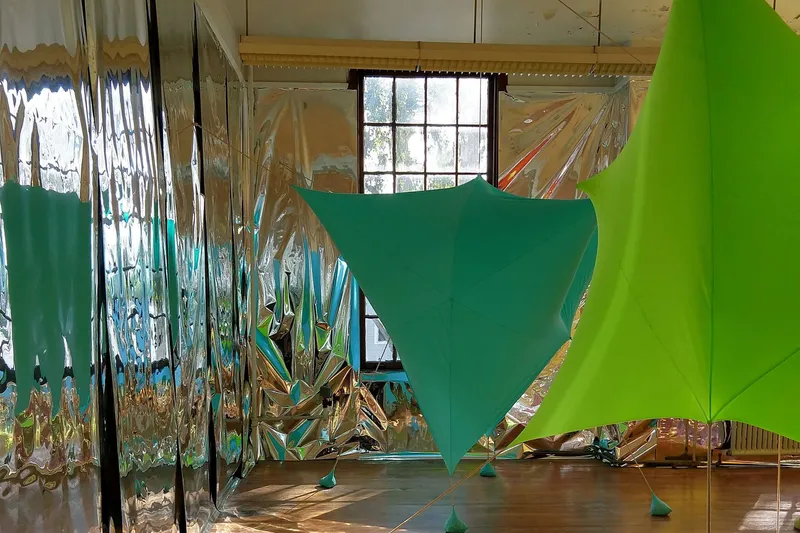
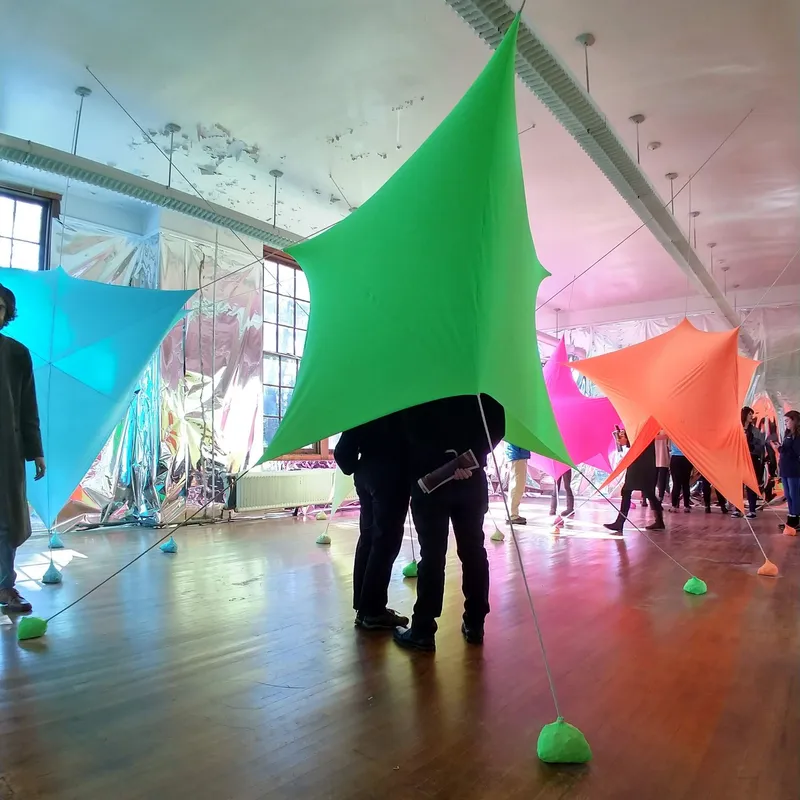
The installation reads differently depending on where you stand. From the entrance, the suspended fabric forms register as a colorful ceiling landscape, with green and teal canopies hovering above reflective foil panels that double the visual intensity of each hue. Beneath them, the gallery floor becomes a kind of terrain: visitors navigate between anchor points and guy lines, choosing which star to approach. Green resin weights pin the fabric taut, giving each canopy a precise, stretched geometry that belies the softness of the material.
The interplay between reflective surfaces and saturated fabric creates an optical depth that a flat gallery wall could never achieve. Light bounces unpredictably off the foil, casting tinted ambient glow across the space and onto visitors themselves. The architecture is atmospheric before it is structural.
Passageways Drawn in Red, Yellow, Green, and Blue
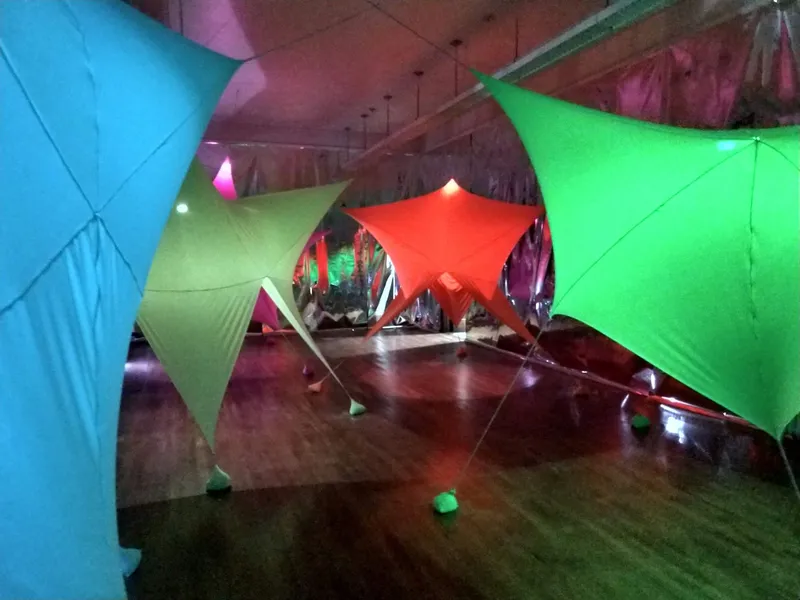
Seen at mid-height, the five stars begin to overlap and create passageways between them. Red, yellow, green, and blue canopies stretch across polished wooden flooring, their guy lines crossing to define corridors of color. Walking through the installation means transitioning from one chromatic environment to another, each shift perceptible not just visually but physically, as the fabric overhead changes in height and tension. The floor's warm wood finish grounds the experience, providing a stable datum against the dynamism above.
Taut Lines and Weighted Anchors as Structural Language
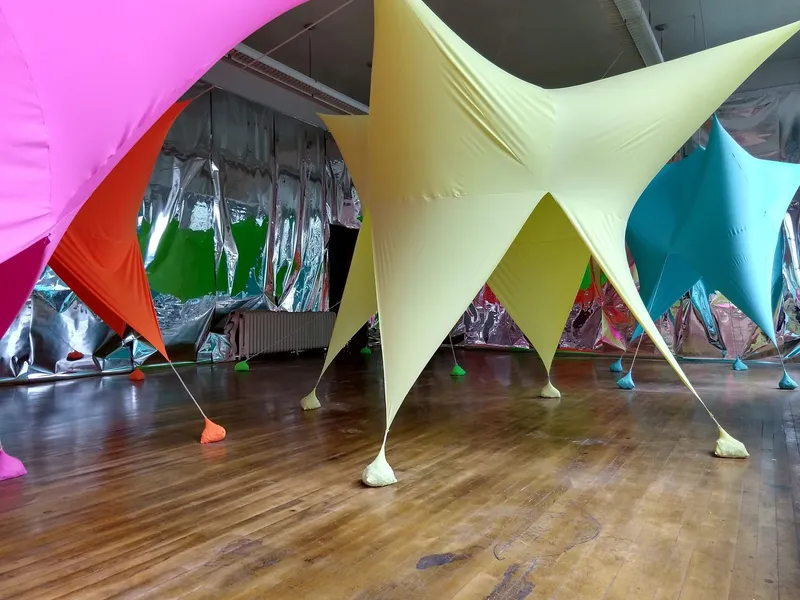
A close reading of the yellow star reveals the structural logic clearly. Taut guy lines radiate from the fabric's peaks and valleys to colored anchor weights on the floor, holding the spandex in its star shape through pure tension. There are no rigid frames, no hidden armatures. The form exists only because opposing forces keep it stretched. This is parametric thinking made legible: change one anchor point and the entire geometry shifts. The colored weights themselves serve double duty as functional hardware and wayfinding markers, reinforcing the installation's commitment to making every element both useful and sensory.
Inhabiting the Interior of a Color Field
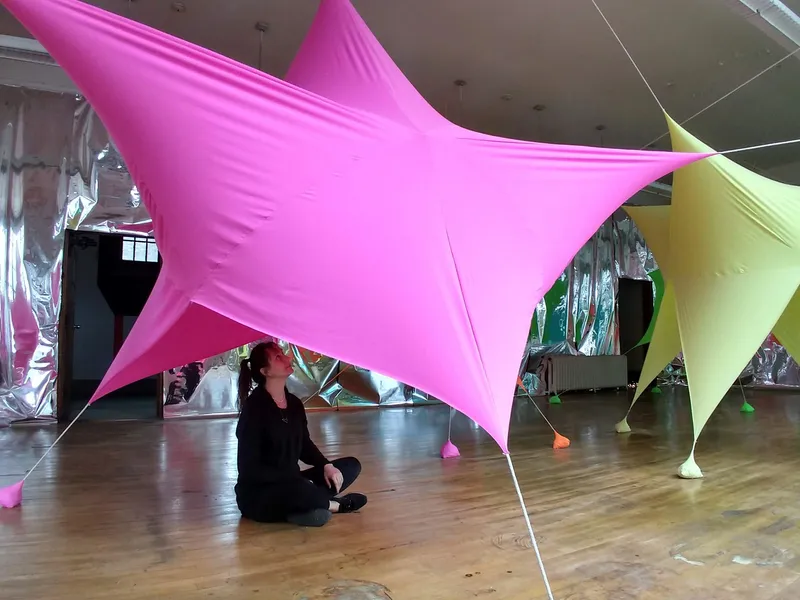
The most compelling moment comes when a visitor stops moving and sits beneath one of the canopies. Here, under a pink tensile membrane with a metallic curtain backdrop, the installation delivers on its central promise: total chromatic immersion. The fabric filters overhead light into a rosy wash that tints skin, clothing, and the surrounding air. Space ceases to be measured in meters and starts being measured in saturation. The participant is no longer looking at color; they are inside it, and the boundary between body and architecture softens to the point of ambiguity.
Why This Project Matters
Color Constellation makes a persuasive case that architecture does not need permanence or rigidity to be spatially powerful. Five pieces of spandex, a set of guy lines, and some resin weights produce an environment as immersive as any heavy-walled pavilion, and far more responsive to the people within it. The installation's participatory nature, where visitors reshape the forms by pushing and entering them, turns occupants into co-designers, collapsing the hierarchy between maker and user.
For experimental design discourse, the project's value lies in its directness. There is no elaborate fabrication sequence or digital rendering standing between the idea and the experience. Virginia Melnyk proposes that color, tension, and touch are sufficient architectural materials, and the shortlisting at Architecture on the Clock suggests the proposition lands. In a field often preoccupied with complexity, Color Constellation reminds us that spatial intensity can emerge from remarkably simple means.
View the Full Project
About the Designers
Designer: Virginia Melnyk
Enter a Design Competition on uni.xyz
uni.xyz runs architecture and design competitions year-round that reward proposals with spatial conviction and real site intelligence.
Project credits: Color Constellation by Virginia Melnyk Architecture on the Clock. (uni.xyz).


Popular Articles
Popular articles from the community


David Macias Steps a Doorless Stone and Plaster House Down a Tropical Colombian Hillside
In the humid hills of Colombia, Threshold House replaces the front door with an open void and terraces its 850 m² down the slope instead of fighting it.

David Ortega Stacks a Two-Story Mexico City Penthouse Around a Steel Stair and a Pergola-Shaded Roof Terrace
In Colonia Roma, a 300 m² penthouse uses oak joinery, a planted steel stair and a slatted roof pergola to make a new-build apartment feel like a house.

Architekt Andreas Gruber Scatters 23 Dark Timber Chalets Across a South Tyrolean Forest Edge
In Molini di Tures, Amonti Chalets breaks a resort into a hamlet of gabled timber houses, with parking, storage and services pushed into the slope.

Cube Design Draws an Ecological Corridor Between Two Shenzhen Hills with the Nankai Building
Beside Shenzhen's container docks, the Nankai Building pairs stacked balconies with a climbing green screen to connect two hillsides across its height.

Similar Reads
You might also enjoy these articles

Gil Mello Arquitetura Tilts a Single Roof Toward the Waterfalls on a Plateau Above Aiuruoca, Brazil
In Aiuruoca, Minas Gerais, a 200 m² house of local labor and reclaimed poles pairs a low valley veranda with a tall mountain one.

U.GA Architects Wraps an Oval Rooftop Pool in Curved Board-Formed Concrete on Busan's Jeollidan-gil
In Busan's Jeonpo-dong, a 454 m² mixed-use block stacks a neighborhood facility, guest rooms and an oval rooftop pool inside spiraling concrete walls.

Felipe Hess Arquitetos Turns a Blind Stone Wall to the Street and Opens a Brazilian House onto a Courtyard and Canal
A canal-front house in Brazil hides behind painted stone and planting, then opens to an olive-tree courtyard, a reed-ceilinged porch and a curving pool.
David Macias Steps a Doorless Stone and Plaster House Down a Tropical Colombian Hillside
In the humid hills of Colombia, Threshold House replaces the front door with an open void and terraces its 850 m² down the slope instead of fighting it.

Explore Art Installation Competitions
Discover active competitions in this discipline

Challenge to design a portable theatre

Deconstructivism - Illustration Design Challenge

Challenge to design a portable music platform

Challenge to design an open learning module for the elderly
Comments (0)
Please login or sign up to add comments
No comments yet. Be the first to comment!