

Communal Resilience: Clusters of 20 Families Designed to Outlast Kerala's Floods
A shortlisted HEAL+ entry reimagines flood-prone neighborhoods as self-sustaining clusters with floating agriculture, elevated platforms, and shared refuge


What if the unit of survival during a flood isn't the individual household but a cluster of twenty families? That premise drives Communal Resilience, a project that treats Kerala's recurring monsoon floods not as anomalies but as a permanent design parameter. Instead of armoring single buildings against water, the proposal reorganizes social and spatial relationships so that neighborhoods can shelter people, livestock, and livelihoods under one collective strategy. Floating agriculture systems, saltwater energy generation, elevated sanitary pods, and shared storage all sit within a master plan scaled to clusters of 20 families, five clusters forming a neighborhood of 100.
Designed by Menka Desai, Arancha Alvear, and Pratha Bhagat, the project was shortlisted in the HEAL+ competition, which called for regenerative housing solutions for Kerala's flood-affected communities. The site context is specific: a landscape of palm groves, paddy fields, and dense residential fabric where seasonal inundation displaces families year after year. Rather than proposing retreat, the designers embed resilience directly into the existing urban grain.
Red Pavilions Woven into the Palm Canopy
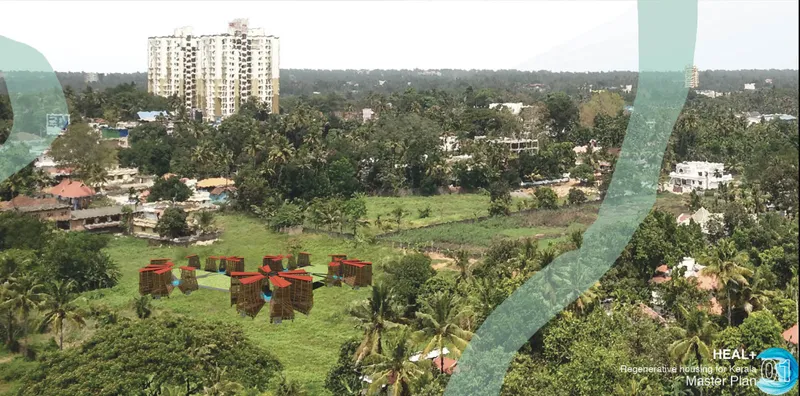
The aerial view reveals how the clusters sit within Kerala's characteristic landscape of coconut palms, green fields, and low-rise residential buildings. Red bamboo pavilions are grouped tightly but not uniformly, their rooflines reading as a single settlement rather than isolated shelters. The strategic distribution across the existing fabric means that refuge houses are always within reach of surrounding homes. During a flood event, these clusters become the gravitational center of the neighborhood: families converge on shared elevated platforms, bringing livestock and essential goods with them.
Critically, the master plan avoids tabula rasa. Clusters are inserted between existing structures and agricultural plots, preserving the productive landscape while adding a new layer of emergency infrastructure. Floating elements within each cluster allow portions of the settlement to rise with water levels, turning submersion from a catastrophe into a designed condition.
Timber Frame, Woven Walls, and a Logic of Assembly
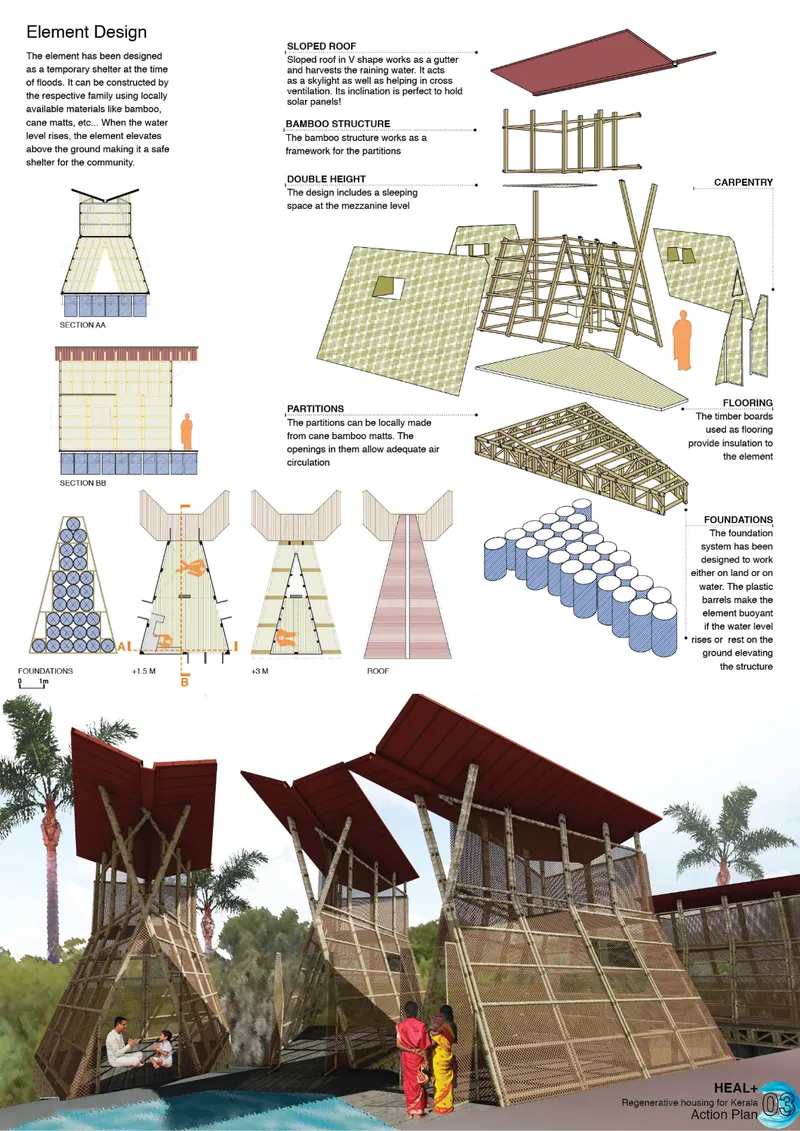
The exploded axonometric breaks the refuge house into its constituent parts: a sloped roof, a timber structural frame, woven partitions for enclosure, a raised floor system, and a foundation that anchors or floats depending on conditions. Each layer uses locally available materials, reinforcing the project's core argument that communal resilience depends on resources communities can actually access and maintain. The two human figures beside the built structures provide scale, showing a compact but inhabitable volume designed for shared use rather than private occupation.
The woven partitions are particularly significant. They offer enclosure without rigidity, allowing air movement in Kerala's humid climate while remaining lightweight enough to be assembled and repaired without specialized labor. The sloped roof sheds heavy monsoon rain efficiently, and the elevated floor plane keeps occupants above standing water during moderate flood events. When water rises further, the floating components activate. It is an architecture of thresholds: dry, wet, submerged, each anticipated and accommodated.
Cluster Plans That Center Gathering Over Isolation
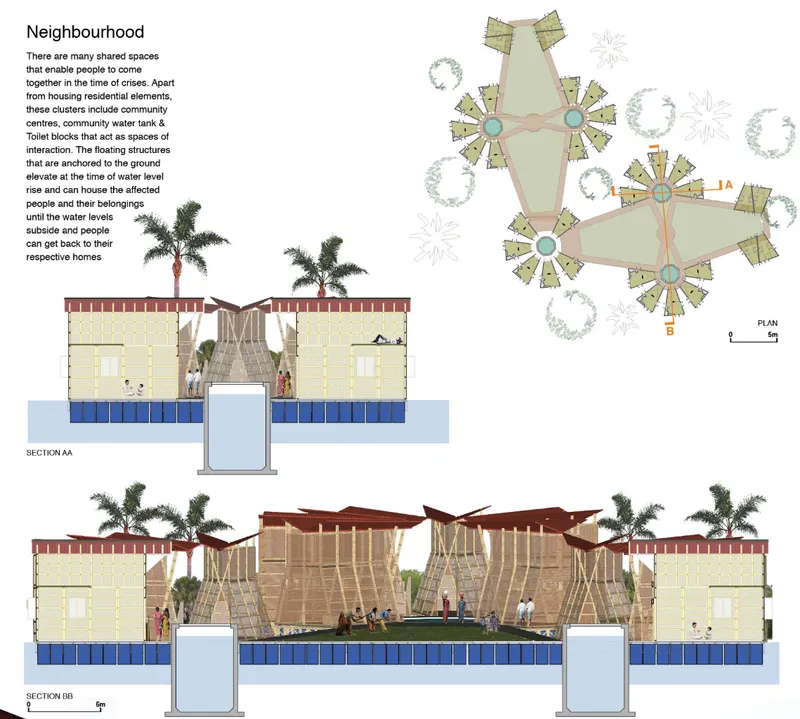
The plan and section drawings expose the social logic of the cluster. Shelters are arranged around a central gathering space, with elevated water tanks visible between palm trees along the perimeter. The sections confirm that the shared infrastructure, including rainwater harvesting tanks, floating sanitary pods, and community storage, occupies the core of each cluster rather than being pushed to the edges. This inversion matters: it ensures that the most critical resources are equidistant from every family and that the act of accessing water, sanitation, or stored food brings people into contact with one another.
The drawings also hint at the scalability the designers intend. Five of these clusters, each serving 20 families, tile together to form a neighborhood of 100 families. Shared community centers sit at the intersections between clusters, handling disaster response coordination, solid waste management, and long-term storage. The spatial grammar is simple enough to replicate across Kerala's diverse flood-prone geographies, from coastal lowlands to riverine plains.
Infrastructure as a Social Contract
Beyond the physical structures, Communal Resilience proposes a governance framework. Government subsidies support initial construction and ongoing maintenance. Awareness programs encourage communal living as a permanent mode of habitation, not merely an emergency protocol. Zoning regulations are rethought to reflect rising sea levels and shifting flood boundaries. The designers recognize that no amount of floating agriculture or saltwater energy generation will work if the social and political infrastructure doesn't follow. Architecture here is the visible half of a larger system that includes policy, community organization, and long-term adaptation planning.
Why This Project Matters
Flood resilience discourse tends to oscillate between two poles: expensive engineered defenses and post-disaster relief operations. Communal Resilience occupies a third position, designing the social unit itself as the primary infrastructure of survival. The cluster of 20 families is small enough to be self-organizing and large enough to pool meaningful resources. Floating sanitary pods, shared water tanks, and livestock shelters are not luxuries added after the fact; they are embedded in the original plan. The project argues that resilience is not a feature you bolt onto a building but a relationship you build between buildings and the people who inhabit them.
For Kerala, where monsoon flooding is an annual certainty rather than a statistical anomaly, this kind of thinking is overdue. Desai, Alvear, and Bhagat have produced a scheme that takes locally available materials, a clear social model, and a pragmatic understanding of water as both threat and resource, and woven them into architecture that treats community as the first line of defense. The HEAL+ shortlisting is well deserved: the proposal demonstrates that regenerative housing begins not with technology but with the decision to face disaster together.
View the Full Project
About the Designers
Designers: Menka Desai, Arancha Alvear, Pratha Bhagat
Enter a Design Competition on uni.xyz
uni.xyz runs architecture and design competitions year-round that reward proposals with spatial conviction and real site intelligence.
Project credits: Communal Resilience by Menka Desai, Arancha Alvear, Pratha Bhagat HEAL+ (uni.xyz).


Popular Articles
Popular articles from the community


Opera by the Sea Estonia: Three Shells Dissolving Architecture into Tallinn's Coastline
A winning opera house proposal replaces monumental form with interconnected shells that blur the boundary between building, park and Baltic Sea.
Faces of the Soviet Avant-Garde: Turning Moscow's Street Names into an Open-Air Museum
A network of sculptural installations across a Moscow residential district transforms forgotten architect names into spatial encounters with cultural memor

The Amber Palace Opera: A Geological Fiction Surfaces on Tallinn's Baltic Waterfront
Pierre Brillard reimagines a Baltic legend as a public landscape, opera house, and waterfront promenade rooted in Tallinn's coastal identity.

Manzana Morphosis: Stretching Barcelona's Grid into a Living Landscape for 2050
A radical reworking of the Eixample manzana turns density into a tool for generous public space, vertical ecology, and environmental performance.

Similar Reads
You might also enjoy these articles

Pixel Gardens: One Repeated Module Stacked Into a Terraced Social Housing Tower for Famagusta
Salem Bader's shortlisted housing tower builds a vertical neighbourhood from one repeated module, offsetting units to carve terraces, light and air.

Bao Huynh Watercolor Atelier: A Serene Art Retreat in Hội An
Bao Huynh Watercolor Atelier in Hội An blends multifunctional art spaces, sustainable design, local materials, and family-friendly living in a serene environment.

Atelier Macri Concept Store Interior Design by CASE-REAL
Atelier Macri store features a "ko" counter, walnut wood details, cork displays, blending retail, gallery, and seamless customer experiences.

Manuel Vargas Izquierdo Stadium and High-Performance Sports Center: Architectural Excellence in Jalpa de Méndez
The Manuel Vargas Izquierdo Stadium blends sustainable design, inclusive sports facilities, and cultural-inspired architecture, revitalizing Jalpa de Méndez’s public spaces.

Comments (0)
Please login or sign up to add comments
No comments yet. Be the first to comment!