

Community Pavilion by Vlad Sebastian Rusu + Studio 82: Multifunctional Public Architecture in Cluj-Napoca
The Community Pavilion in Cluj-Napoca is a flexible, translucent urban lantern blending nature, modern design, and multifunctional spaces for community events.


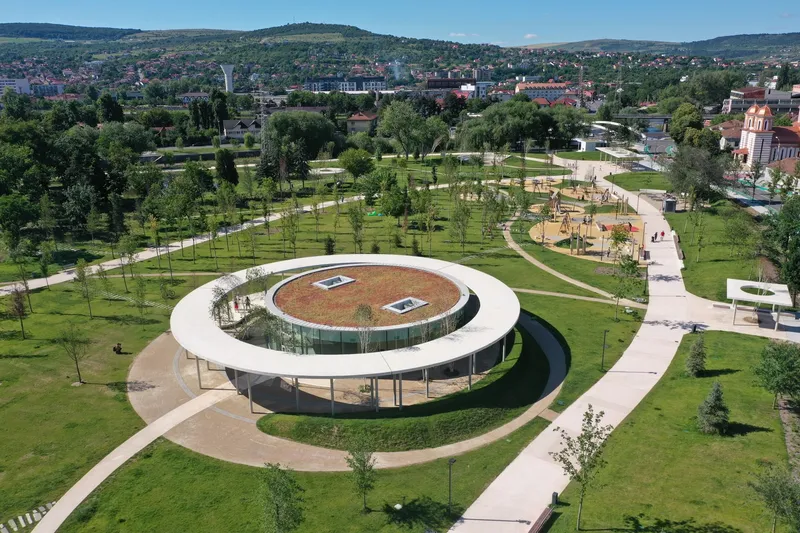
The Community Pavilion by Vlad Sebastian Rusu and Studio 82 stands as a beacon of multifunctional public architecture in Cluj-Napoca, Romania. Situated within the newly developed Feroviarilor (Railway) Park, the pavilion redefines the relationship between urban community spaces and natural surroundings, seamlessly blending contemporary design with ecological sensitivity.

Flexible Spaces for Community Engagement
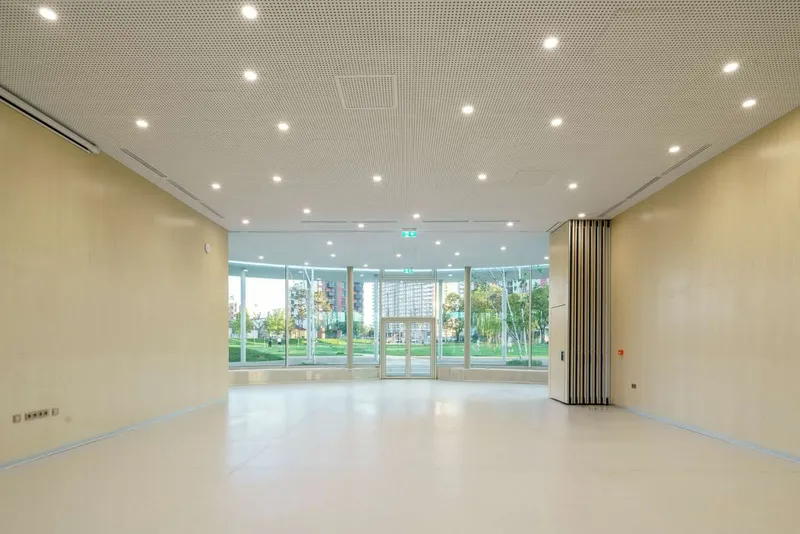
Designed as a multifunctional pavilion, the project accommodates a wide variety of community activities, including meetings, art exhibitions, concerts, workshops, and cultural events. With flexible floor plans and mobile partition walls, the pavilion adapts effortlessly to the scale and nature of each event, offering an inclusive and dynamic environment for local residents.
The architects prioritized spatial transparency and interior-exterior connectivity, ensuring that every angle of the pavilion maintains a dialogue with its surrounding park. This approach enhances the building’s flexibility while fostering a stronger sense of community engagement in Cluj-Napoca.


Day and Night: A Translucent Urban Lantern
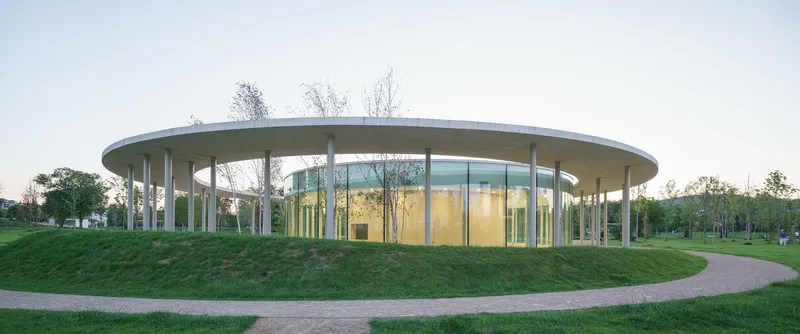
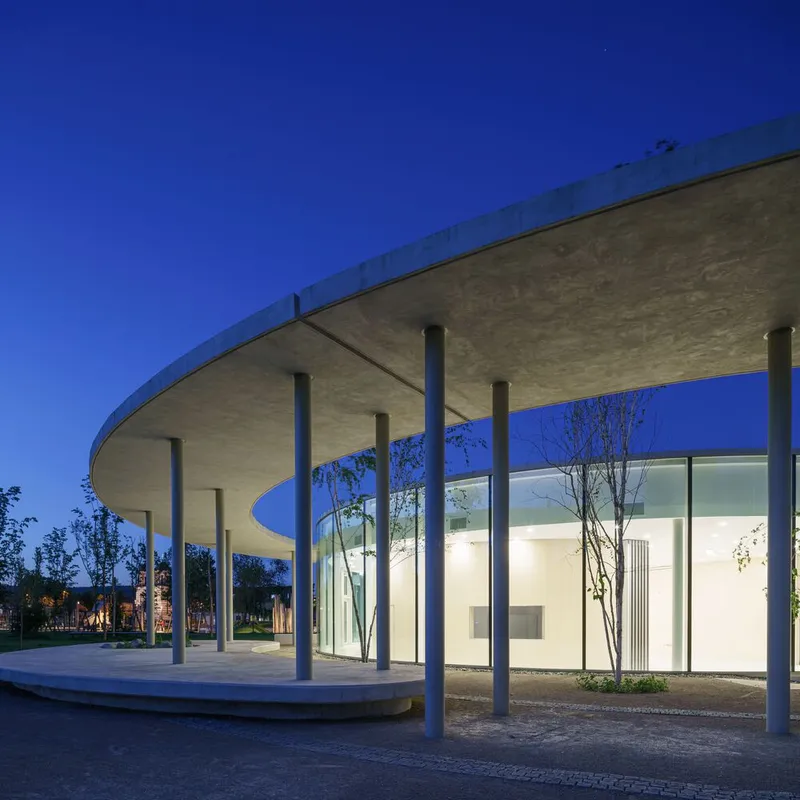
The pavilion’s form is deliberately designed to respond to natural light conditions throughout the day. By day, it appears as a translucent volume, with its contours merging into reflections of the surrounding birch vegetation in the glass facade. At night, the building transforms into a glowing urban lantern, illuminating the park and creating a safe, inviting space for evening events.
A continuous circular awning encircles the pavilion, providing shade during the day while subtly mediating the connection between indoor activities and the immediate outdoor neighborhood. The interstitial space between the pavilion and awning is carefully landscaped with birch trees, further integrating the structure into the park’s ecosystem.

Thoughtful Materials and Detailing
Materiality plays a crucial role in the pavilion’s identity. The exterior awning and seating are made from exposed concrete, chosen for its durability and natural patina over time. The metal structural pillars supporting the awning are rhythmically arranged to echo the irregular patterns of nearby tree vegetation.
Inside, the pavilion’s walls are clad in pine wood panels, combining natural warmth with acoustic porosity, essential for performances, talks, and other community gatherings. Careful attention was given to integrating technical infrastructure: ventilation, electrical systems, and sanitary facilities, without compromising the pavilion’s spatial clarity or visual cohesion.


Architectural Integration with Nature
The pavilion avoids a conventional “backside,” opting instead for uniform glazing along its circumference, creating an open, inviting presence from all viewpoints. Two symmetrical opaque cores discreetly house ancillary and technical spaces, maintaining a minimalist aesthetic while supporting functionality.
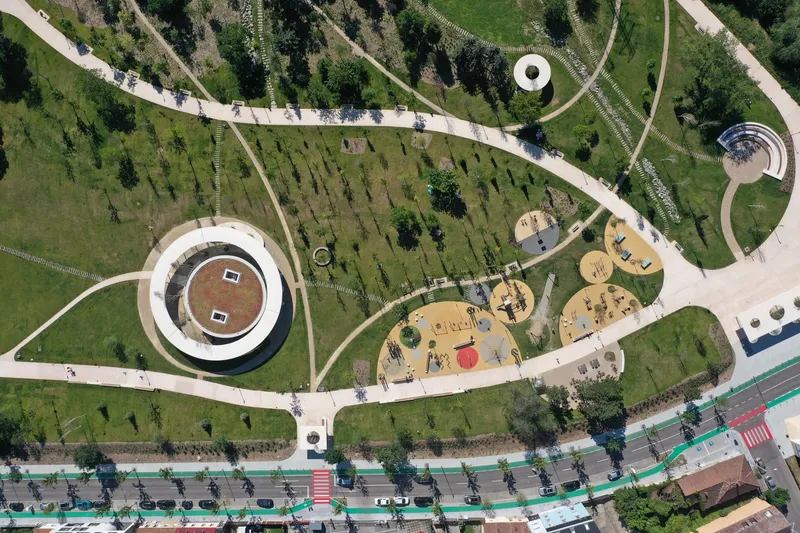

All photographs are works of Cosmin Dragomir


Popular Articles
Popular articles from the community


Faces of the Soviet Avant-Garde: Turning Moscow's Street Names into an Open-Air Museum
A network of sculptural installations across a Moscow residential district transforms forgotten architect names into spatial encounters with cultural memor
Tsunami Convergenics: Turning Catastrophic Ocean Forces into Underwater Housing Infrastructure
A speculative underwater settlement off the coast of Onagawa, Japan, treats tsunamis and typhoons as energy sources rather than threats.

The Amber Palace Opera: A Geological Fiction Surfaces on Tallinn's Baltic Waterfront
Pierre Brillard reimagines a Baltic legend as a public landscape, opera house, and waterfront promenade rooted in Tallinn's coastal identity.

Singing Woman: An Opera House That Performs Before the Curtain Rises
Ovidiu Cristian Pavel's conceptual opera house translates Estonia's choral identity into a sculpted waterfront landmark facing the Baltic Sea.

Similar Reads
You might also enjoy these articles


Hodi-Mandai Geram
Project Function: Preservation and revitalization of the Intangible heritage and socio-spatial identity of the Hodi by Housing, Cultural Memory Center, Sacred Grove, landscape, local tourism economy


Olio Towers: A Mid-Rise for Performers That Fuses Housing, Rehearsal, and Stage
Located blocks from Houston's Theater District, this modular tower stacks living units around a central performance atrium.

Oasis: Modular Green Housing Carved into Dhaka's Urban Fabric
A shortlisted Plugin Housing entry reclaims unauthorized settlements in Dhaka with stepped concrete volumes, green roofs, and ventilation-driven design.

Black Hole: A Floating Megastructure for the Post-Physical Era
Emiliano Mazzarotto envisions a spherical, self-scaling arena where e-sports, digital hotels, and holographic stadiums replace traditional public space.

Explore Romanian Architecture Competitions
Discover active competitions in this discipline

Challenge to reimagine the Iron Throne

Photograph architecture without architects

Illustrate the lost glory of Angkor Wat - Render Challenge

Design challenge to reuse E-waste
Comments (0)
Please login or sign up to add comments
No comments yet. Be the first to comment!