
Comoco Arquitectos Carves a Family Tomb from Verde Viana Marble in Coimbra
A 15-square-meter chapel in a Portuguese cemetery uses interlocking green marble and poetry to bridge life and death.


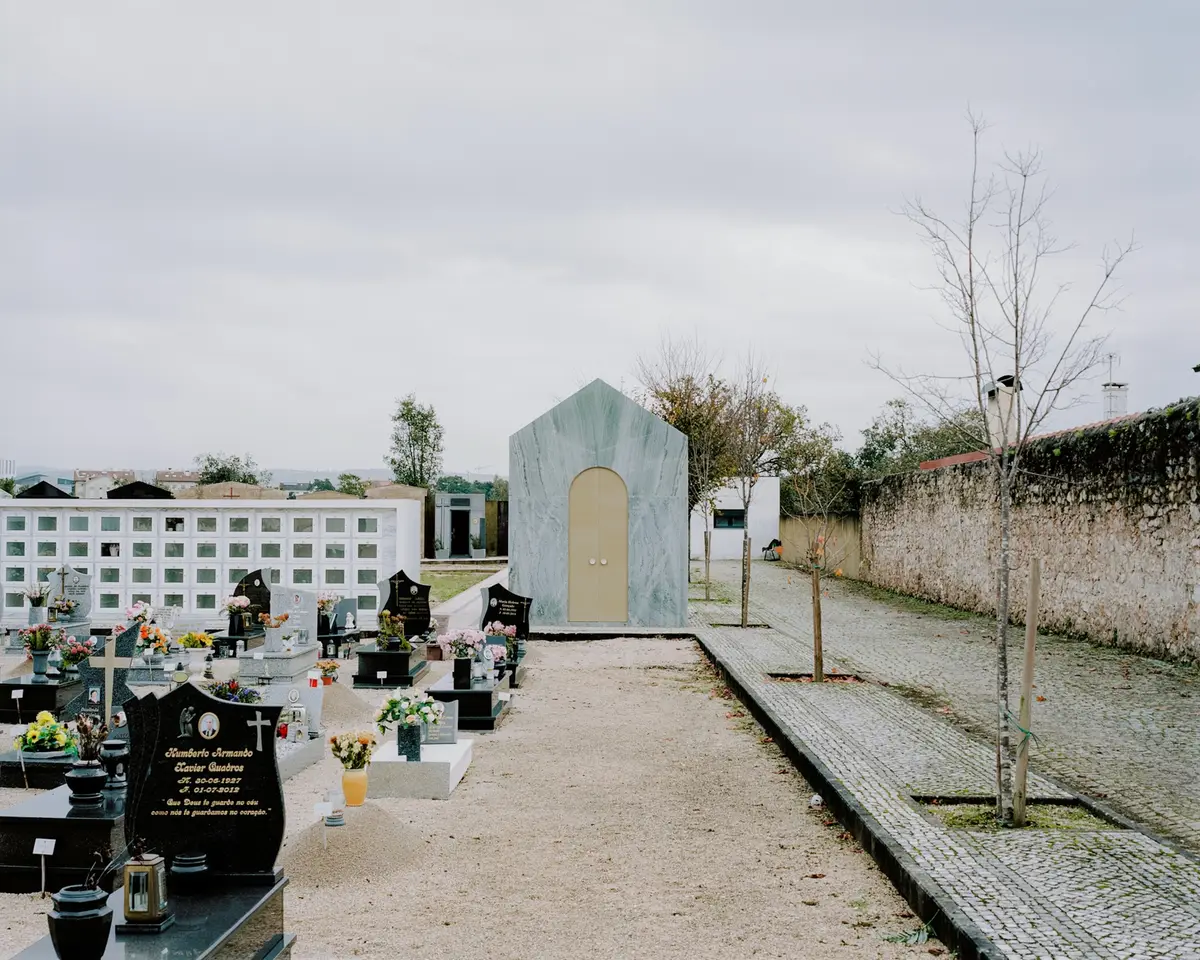
Funerary architecture has always carried an outsized burden: a tiny building must hold the weight of memory, grief, and whatever belief system its occupants subscribe to. At the cemetery of S. Martinho do Bispo in Coimbra, Comoco Arquitectos, led by Luís Miguel Correia, Nelson Mota, and Susana Constantino, has completed a 15-square-meter family tomb that takes this burden literally. The entire structure is assembled from Verde Viana marble, a Portuguese stone with deep green veining that shifts in color with rain and light, carved into interlocking blocks that hold themselves together through geometry rather than conventional cladding.
What makes the project genuinely interesting is the refusal to treat stone as skin. Every marble piece is both structure and surface, joined through notches and interlocking joints that follow a strict metric system. The result is a monolithic object that reads as a single carved mass from the outside, yet reveals its construction logic at every seam. Two poems, "Quando" by Sophia de Mello Breyner Andresen and "Ithaca" by Constantine Cavafy, are inscribed within at the family's request, embedding language into a building that is otherwise resolutely material.
A Stone Object Among Graves
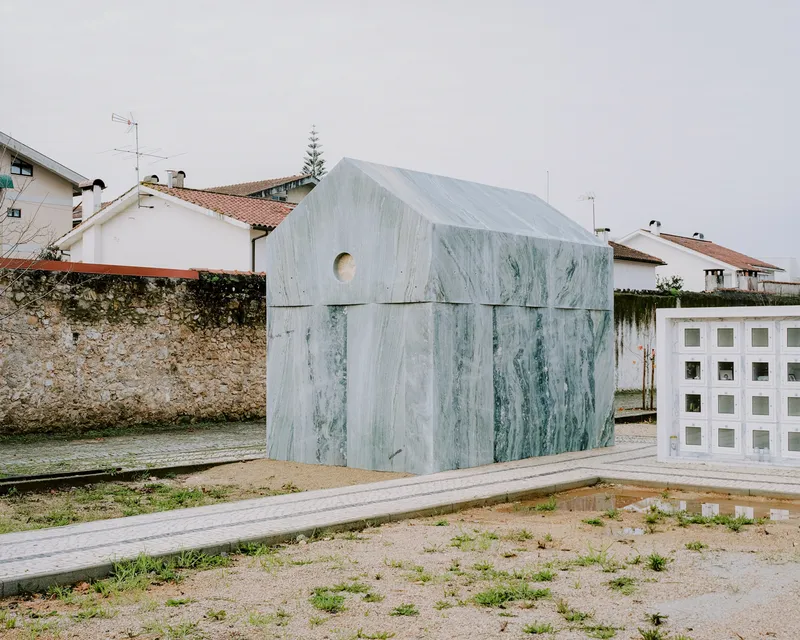
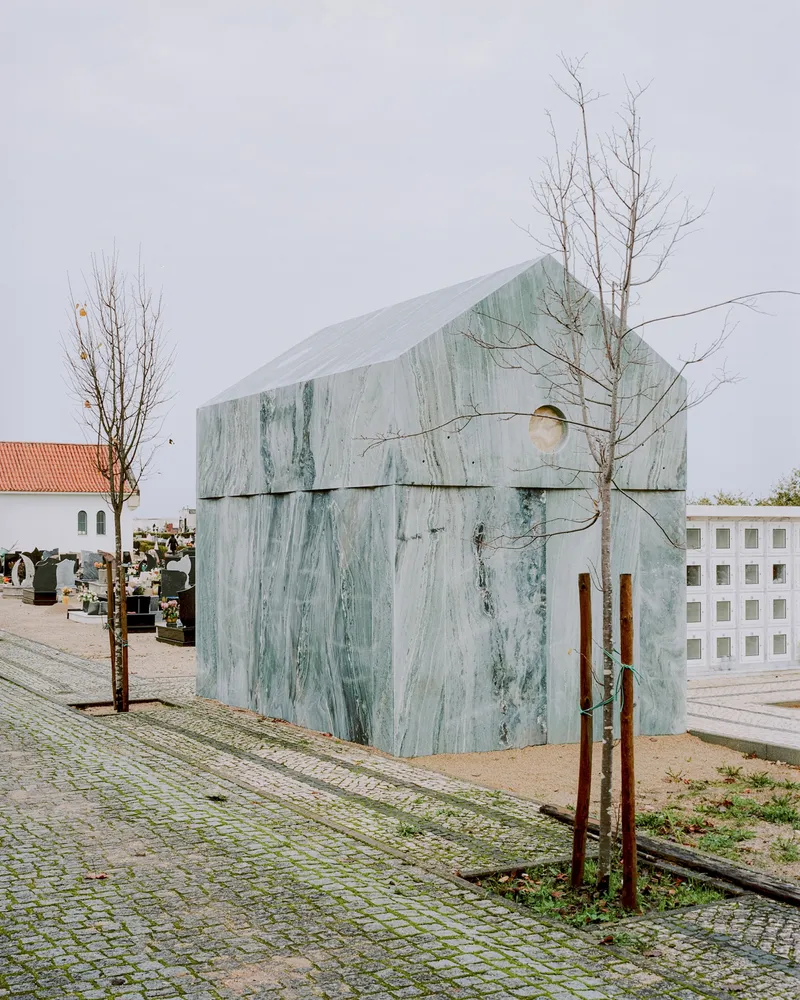
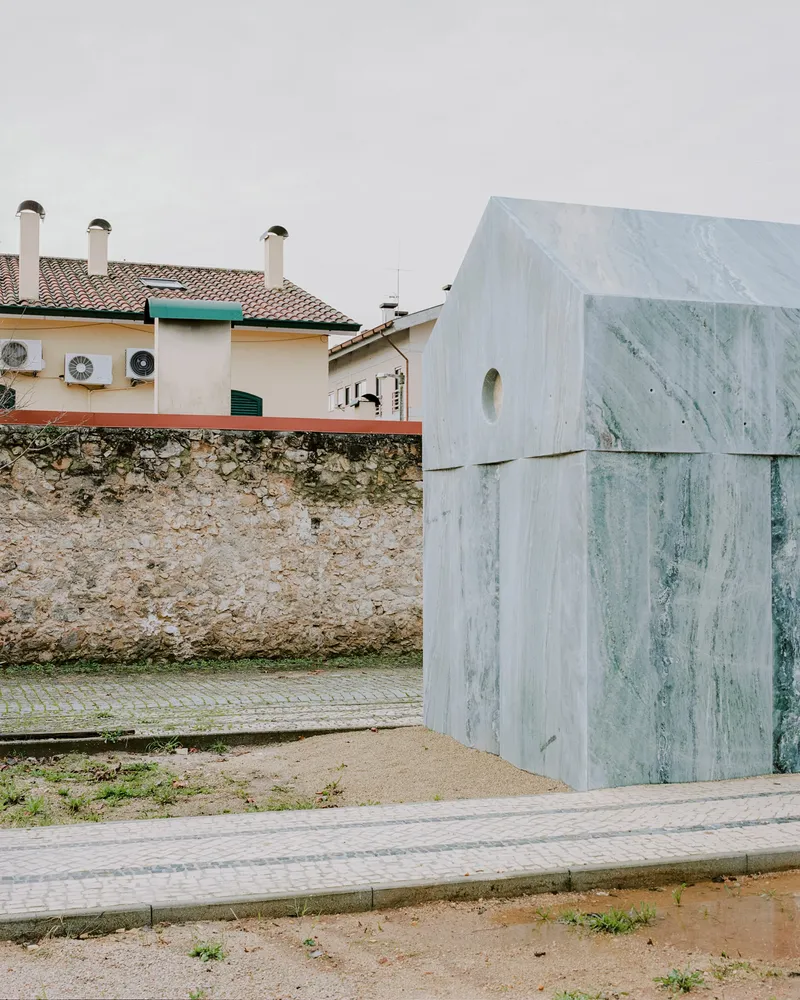
Set among modest graves, weathered boundary walls, and bare deciduous trees, the tomb reads as both familiar and alien. Its gabled profile is the oldest archetype for a house, a shelter, a place of rest. But the deep green veining of the Verde Viana marble, running in unpredictable white and emerald streaks across every panel, makes the volume feel geological rather than architectural. It belongs more to the ground than to the neighborhood of houses visible just beyond the cemetery wall.
The proportions are deliberately compact. At 15 square meters, the tomb is smaller than most bedrooms, yet the unbroken marble surfaces and the absence of any applied ornament give it a presence that belies its footprint. Comoco placed the structure on a cobbled plaza, granting it a threshold and a sense of arrival that most cemetery plots lack entirely.
Marble as Both Structure and Surface
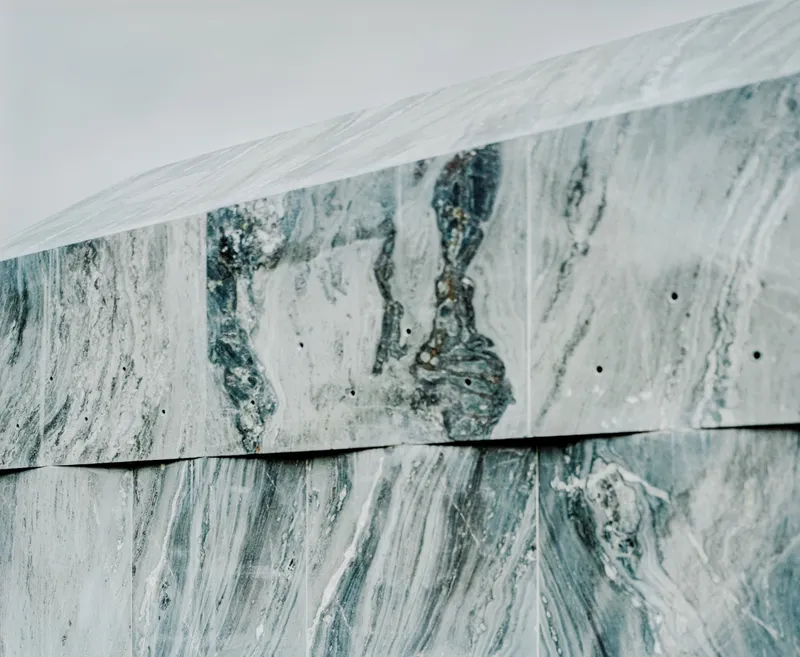
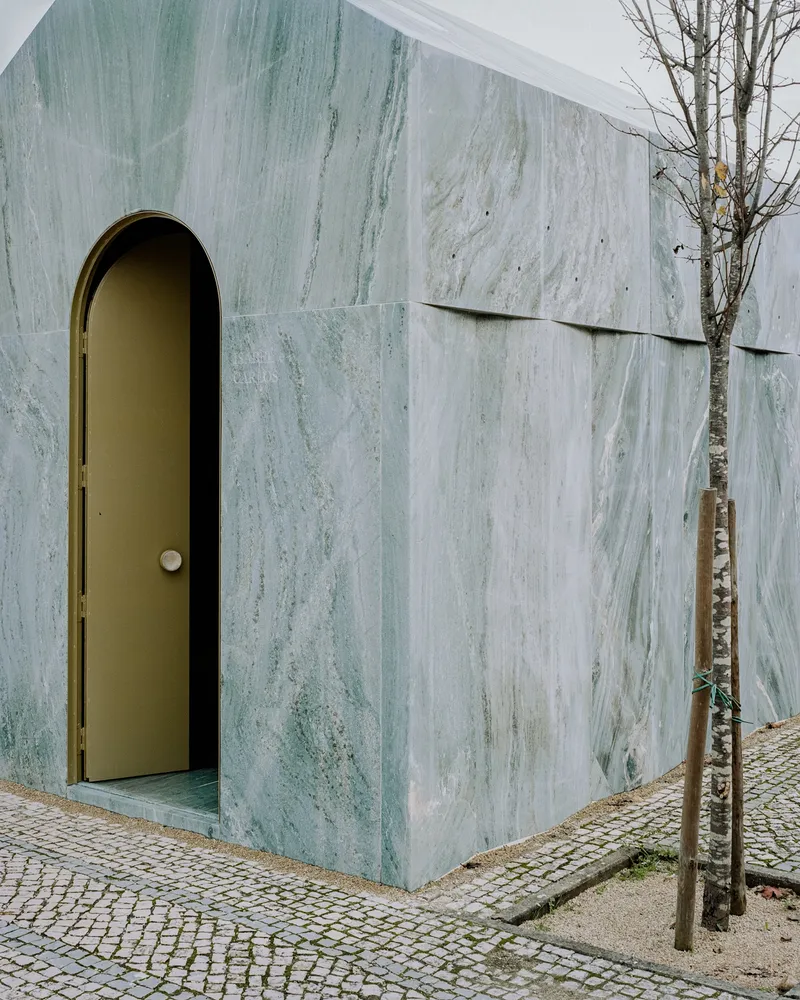
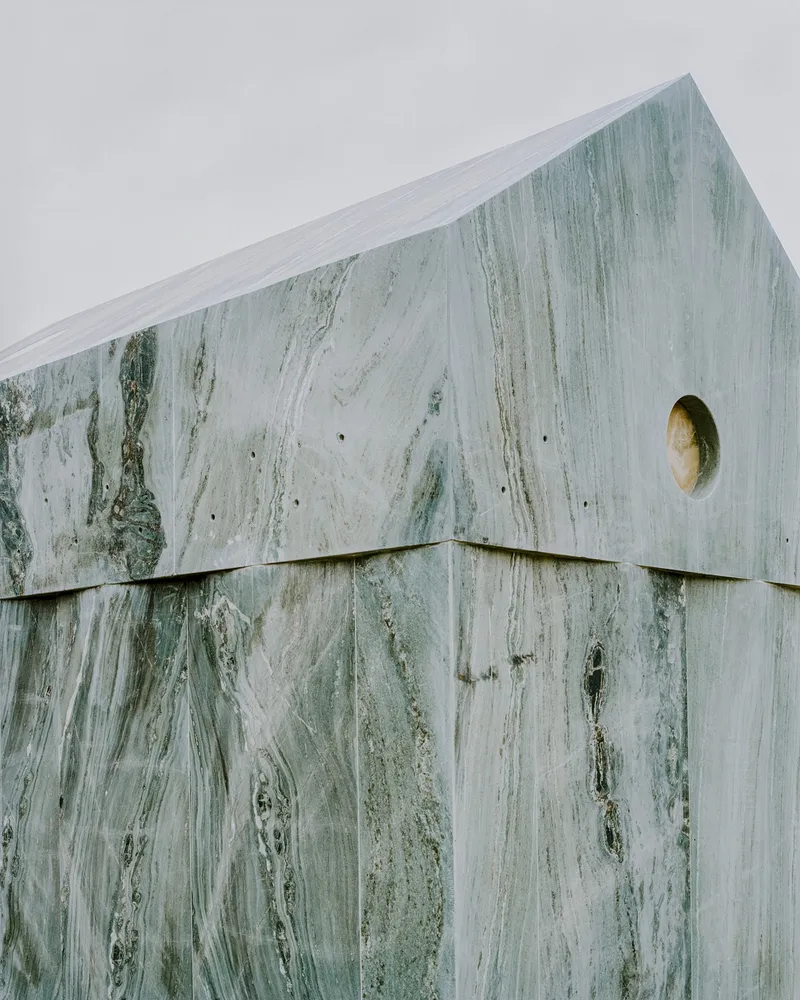
The critical move here is the construction system. Rather than applying marble slabs over a concrete or steel frame, Comoco designed each block to be a structural participant. Interlocking joints and notches allow the pieces to lock together, distributing loads through geometry. The horizontal panel joints visible on the exterior are not decorative reveals; they are the building's skeleton, exposed honestly.
Look closely at the corner details and you see how precise this system has to be. Every dimension follows a predefined metric, meaning each block was cut to tolerances that leave no room for adjustment on site. The veining of the stone, which runs continuously across joints in some areas, suggests that blocks were mapped before cutting to maintain visual continuity. That level of lapidary care elevates the project from architecture into something closer to cabinetmaking at building scale.
The Arched Doorway and the Threshold
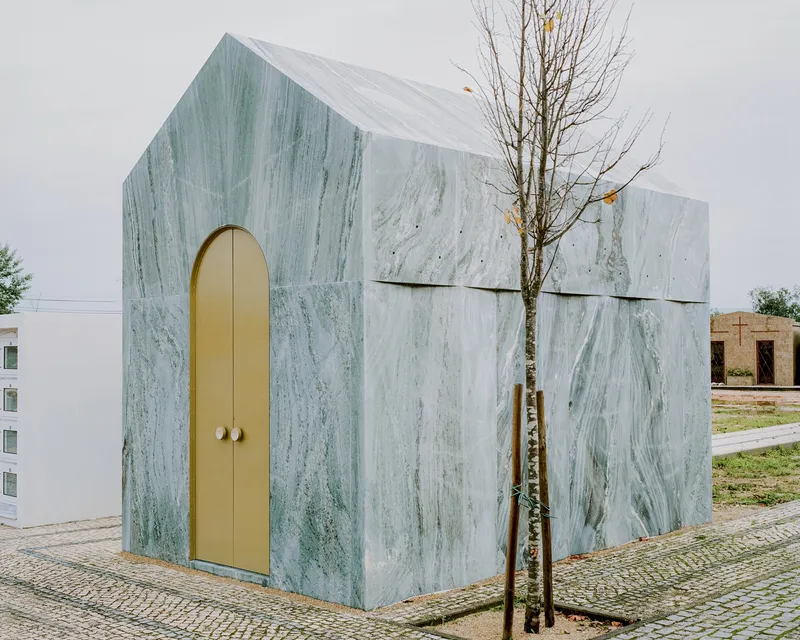
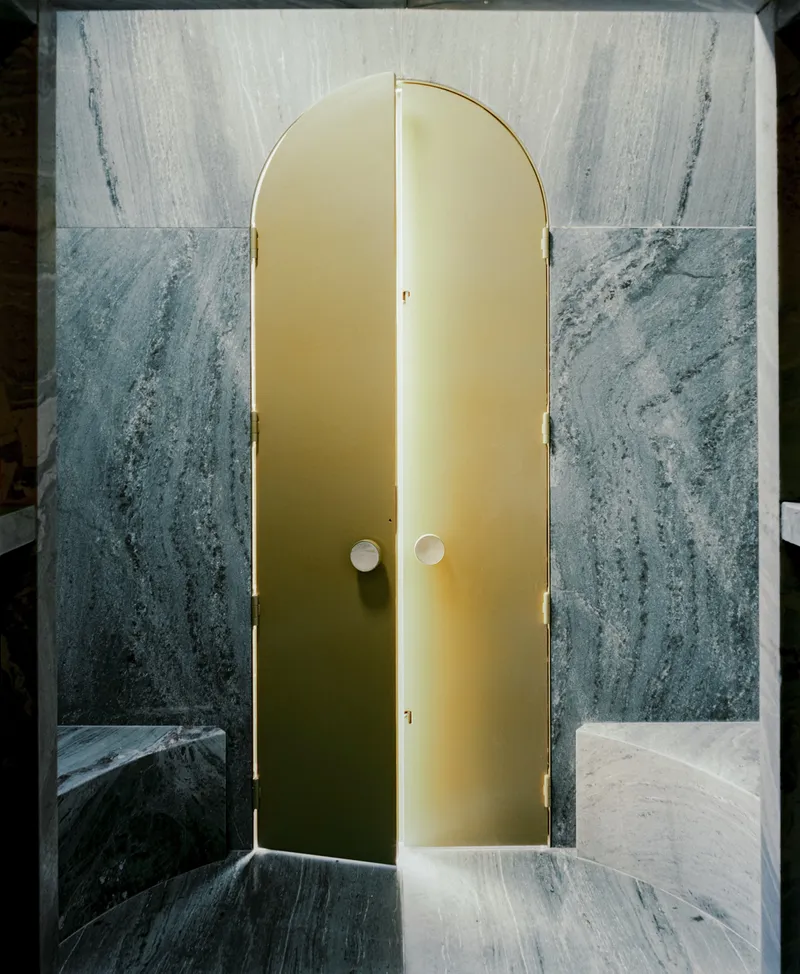
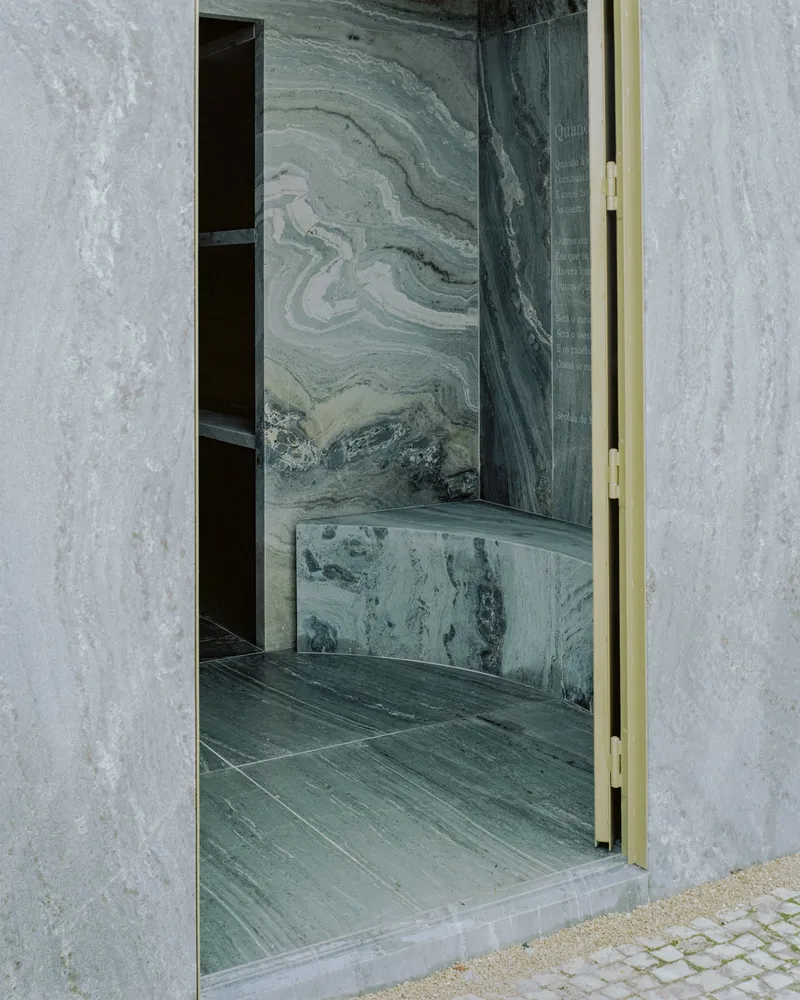
A single arched brass doorway punctuates the facade. The arch is not pointed or flat but a gentle curve that sits comfortably within the gabled form, recalling Romanesque precedent without mimicking it. The metallic door, warm in tone against the cool green stone, introduces the only material contrast on the exterior. It functions as a threshold between the public realm of the cemetery and the intensely private interior.
Stepping through that threshold, the marble shifts in character. The exterior panels are matte and weather-exposed; the interior surfaces, protected from rain, reveal the stone's full depth of veining. The transition from outside to inside is immediate and total, a passage from the living world to the contemplative space of memory that Comoco describes as occupying the "ambiguous territory between life and death."
Light Through Circular Openings
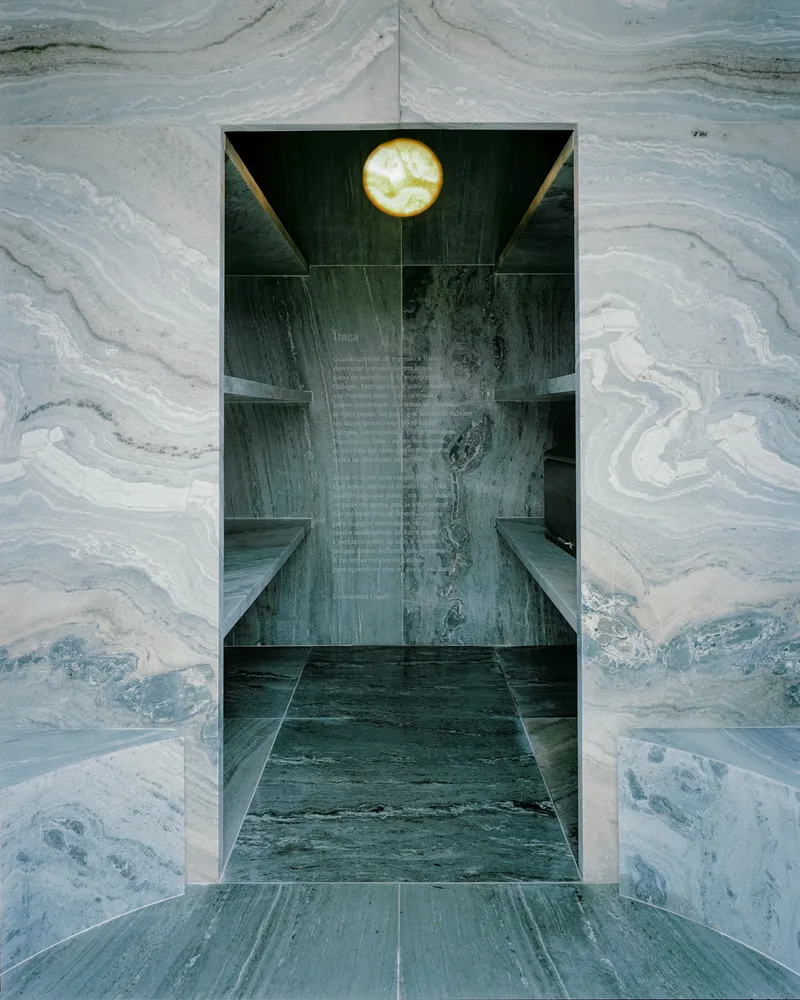
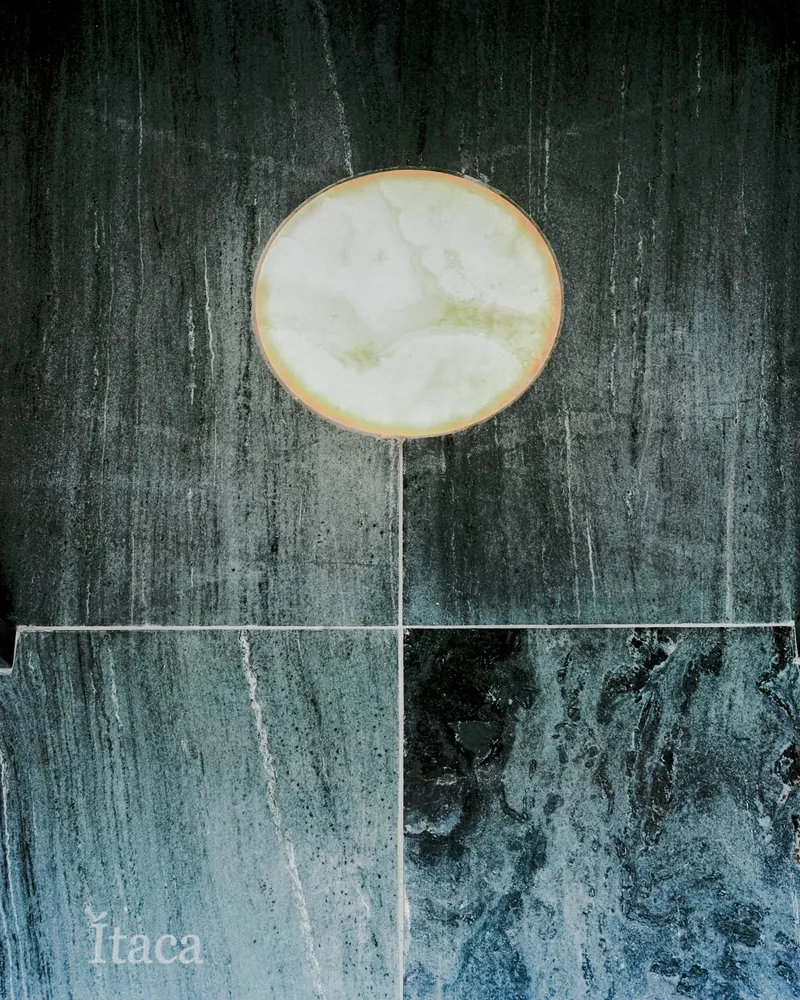
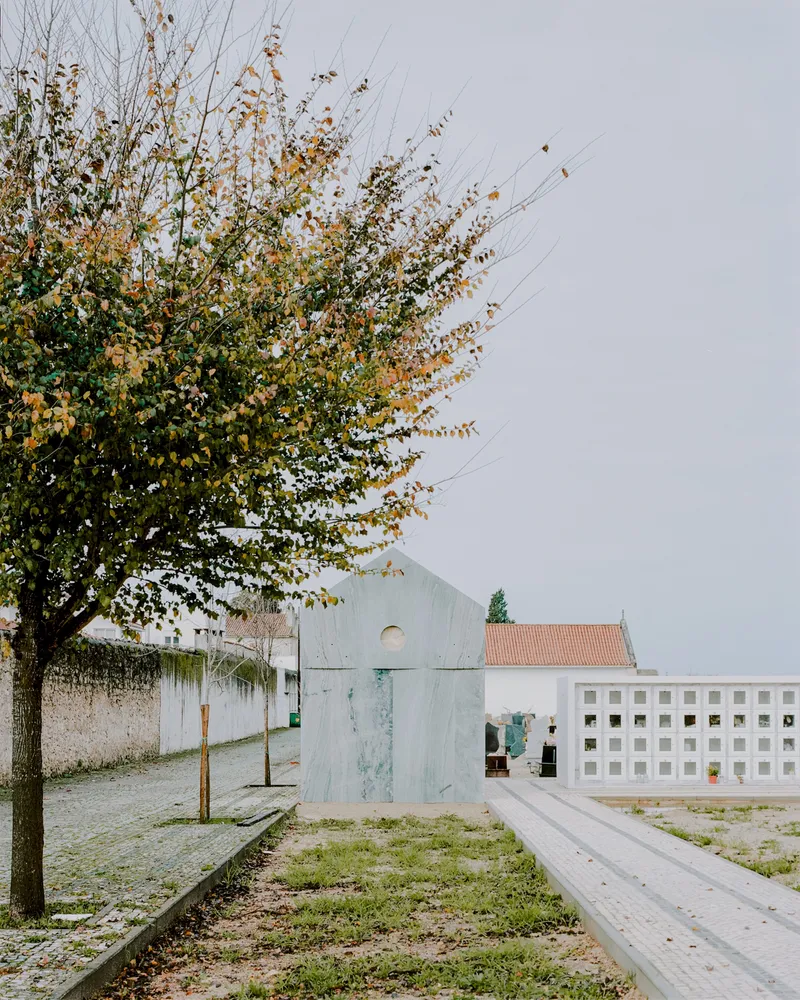
Two structuring axes, one longitudinal and one vertical, organize the interior. Circular openings placed along these axes admit natural light and air, turning each oculus into a controlled event. One opening near the gable peak acts almost as a lantern, casting a column of light downward into the vaulted space. Another, set into the wall, is lined with a disc of backlit alabaster with golden tones, transforming a ventilation perforation into something luminous and almost liturgical.
The circular motif recurs on the exterior too, where oculi punctuate the upper gable. These are not windows in any domestic sense. They are calibrated apertures that control how much of the outside world penetrates the tomb's interior. The effect is that light becomes the only moving element in a space otherwise defined by absolute stillness.
Building the Monolith
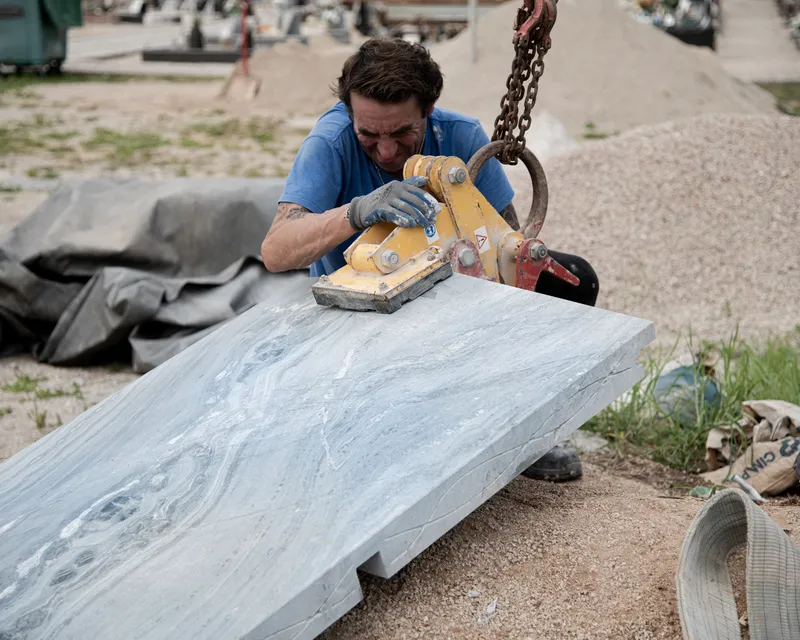
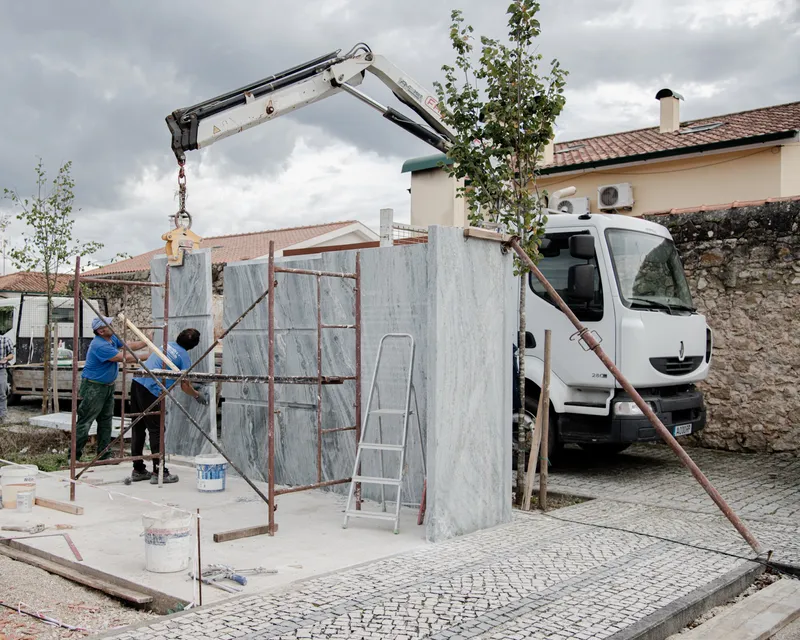
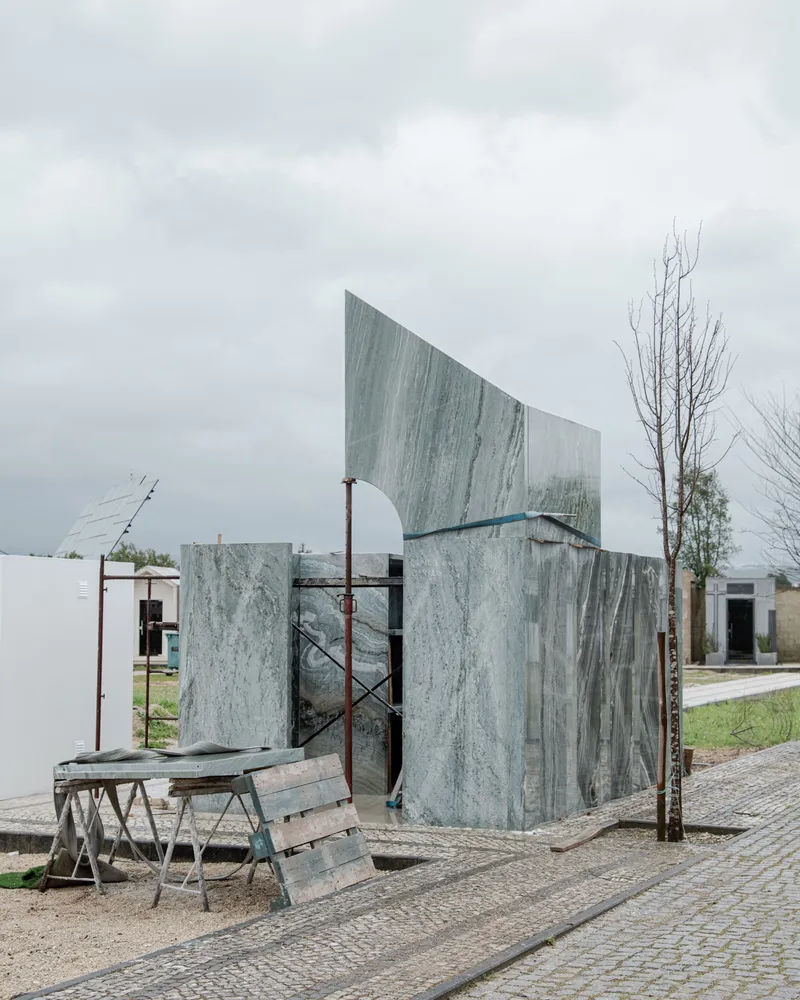
Construction photographs reveal just how labor-intensive the process was. Workers cut massive green marble slabs with chain saws in an outdoor yard, shaping blocks to the exact profiles needed for the interlocking system. Prefabricated marble-clad panels were then lifted into place by crane, each piece slotting into the one below it. The building went up like a three-dimensional puzzle, every move predetermined by the metric system Comoco established at the outset.
There is something instructive in seeing a 15-square-meter building require a crane truck and scaffolding. The weight of stone demands an infrastructure that timber or steel framing simply does not. But the payoff is permanence. This is a building designed to outlast its makers by centuries, and the choice of Verde Viana marble, a stone quarried in Portugal with proven longevity, anchors that ambition in regional material culture rather than imported spectacle.
The Cemetery as Context
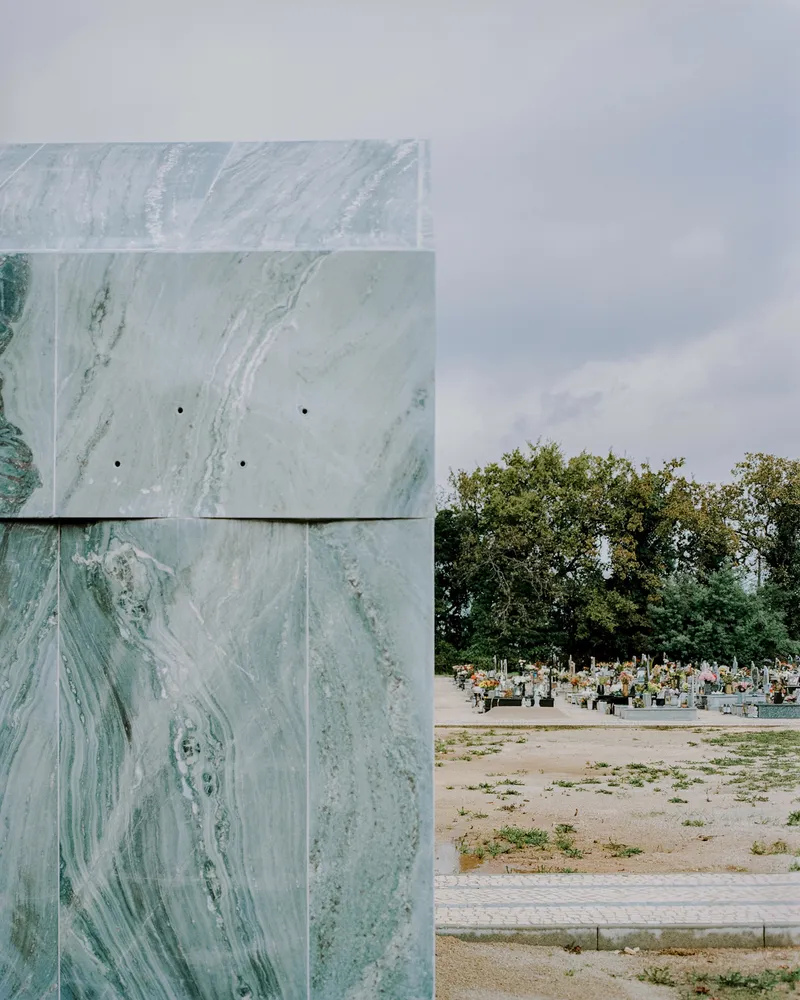
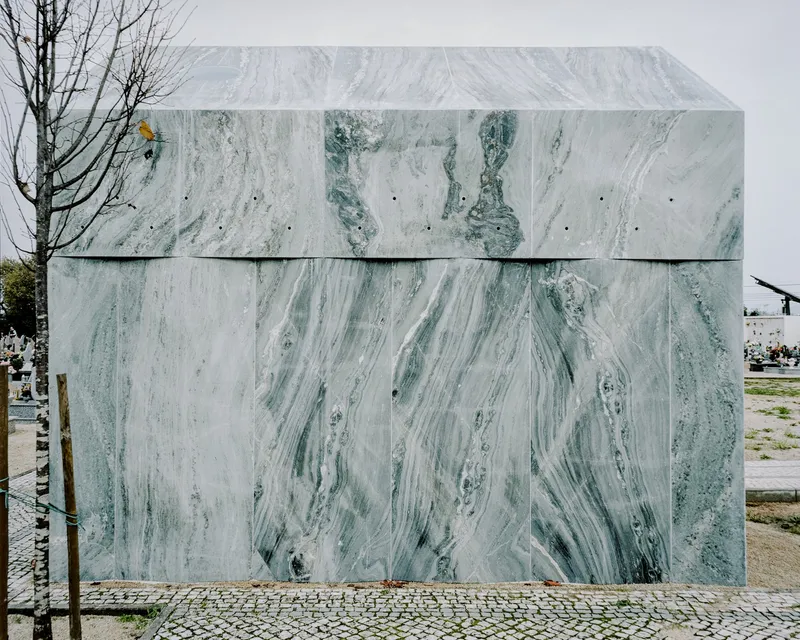
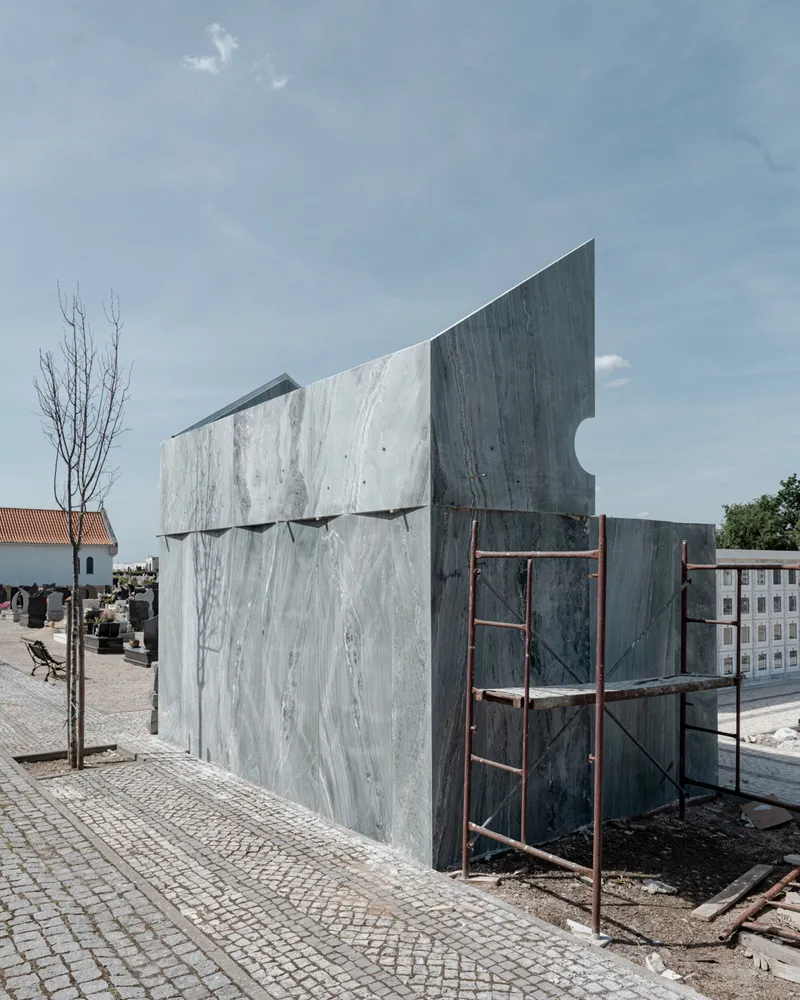
Cemeteries are strange architectural territories. They are public landscapes filled with private monuments, governed by codes of decorum that resist experimentation. The tomb at S. Martinho do Bispo respects those codes through its gabled profile and its modest scale, but subverts them through materiality. Most surrounding graves are rendered in grey granite or white limestone. The deep green marble sets this structure apart without shouting, a quiet assertion of difference that becomes more pronounced when rain darkens the stone and intensifies its veining.
From the rear, stripped of the arched doorway and its ceremonial front, the tomb reads as pure volume: horizontal joints, gabled silhouette, and the patient rhythm of stone courses. It could almost be a fragment of an ancient wall repurposed, something excavated rather than built. That ambiguity between old and new, found and made, is central to the project's power.
Plans and Drawings
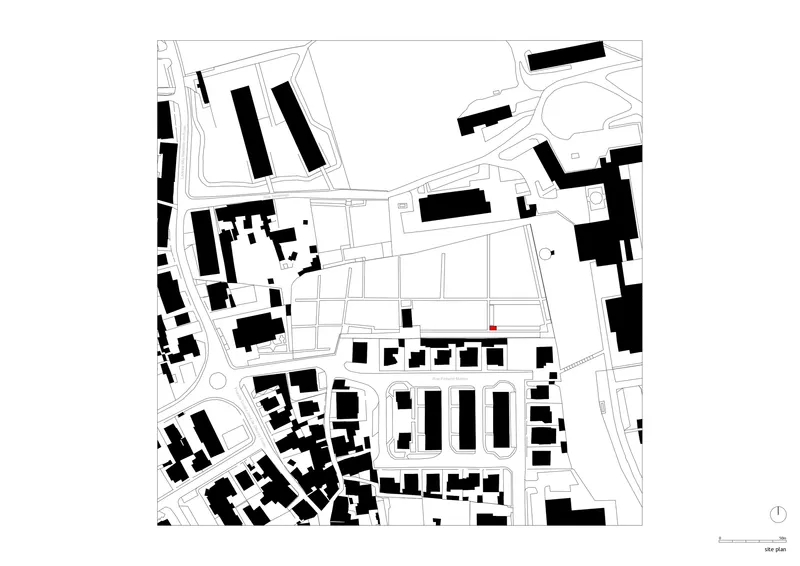
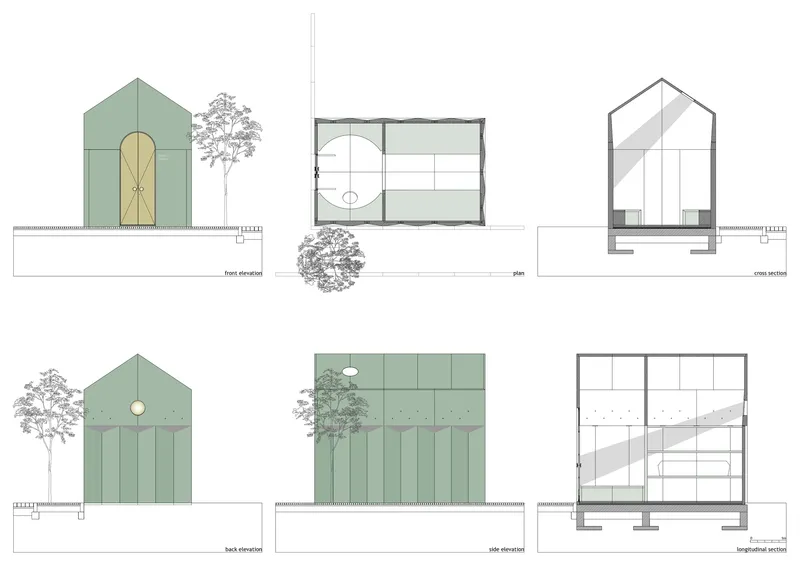
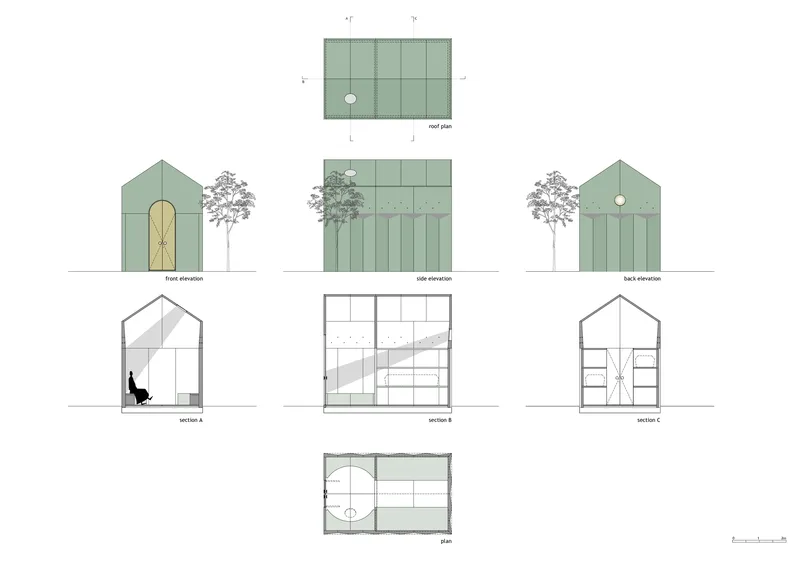
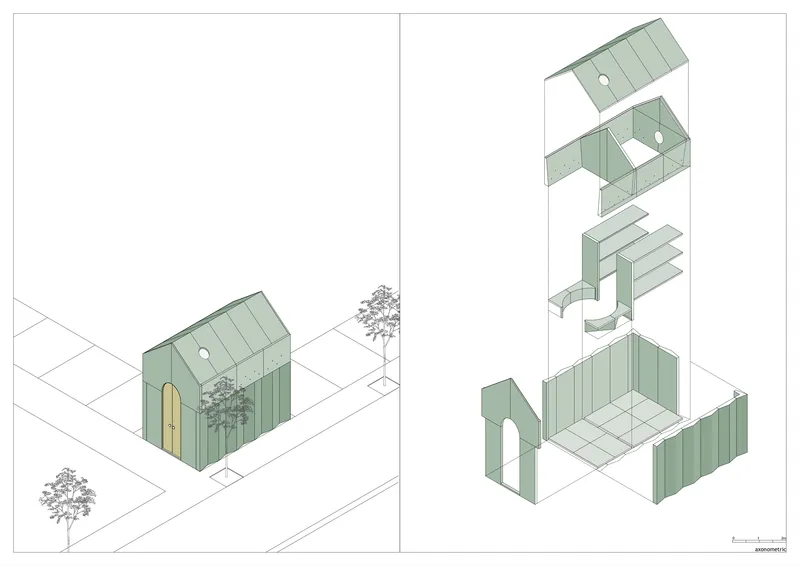
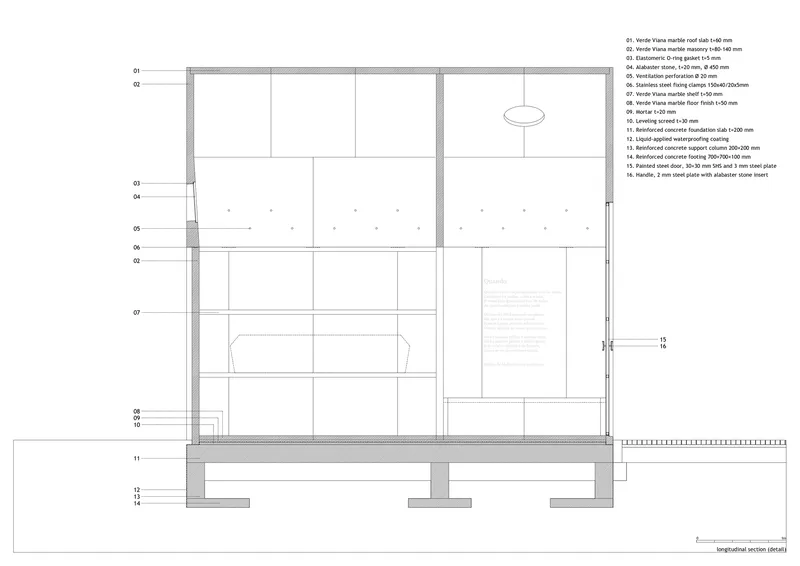
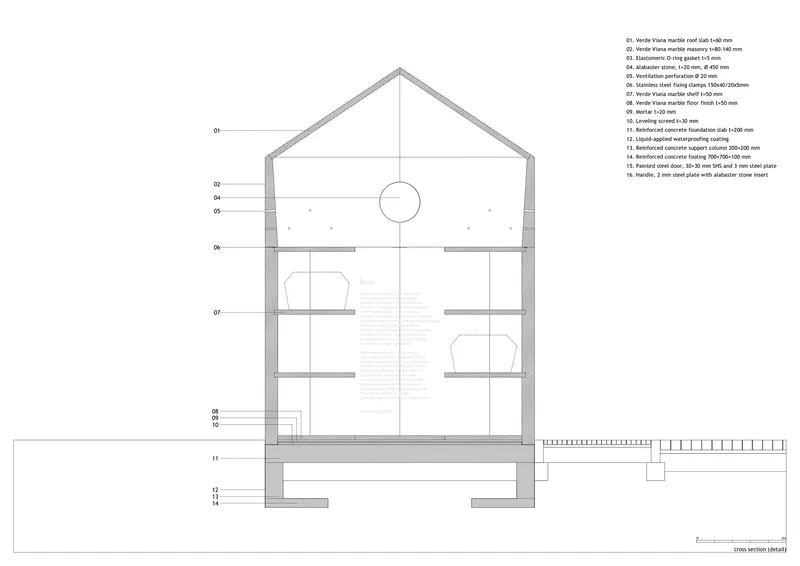
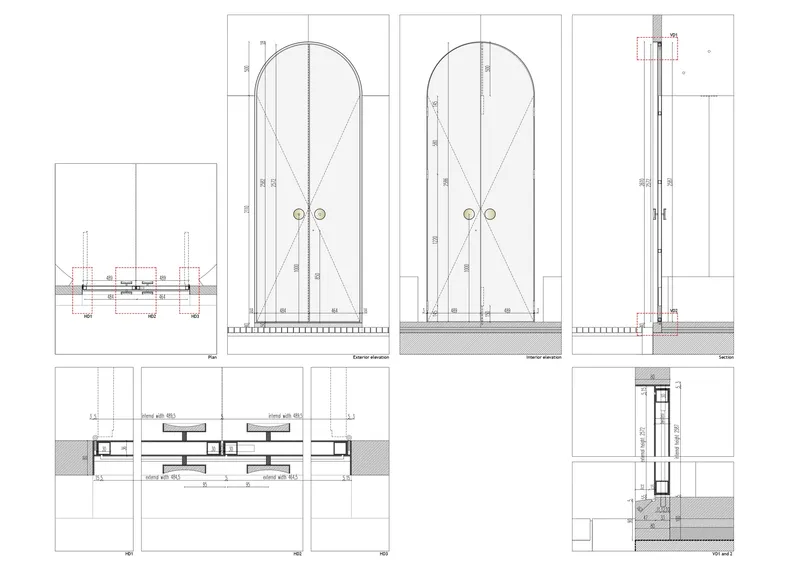
The drawing set confirms what the photographs suggest: every decision was premeditated. The site plan shows the tomb positioned within the cemetery's grid, claiming its plot with geometric precision. Elevations and sections reveal the circular openings as deliberate punctuations along the two structuring axes. The exploded axonometric is especially revealing, laying bare the layered assembly of interlocking marble pieces, brass door frames, and alabaster discs. Construction details of the arched window frames show the assembly layers in plan and section, documenting a level of craft coordination that most residential projects would never attempt.
The longitudinal section detail, with its dimension callouts and foundation drawings, underscores the structural ambition. Floor plates, stairs, and below-grade chambers are all resolved within the tight 15-square-meter footprint. Nothing is left to improvisation. The dimensional rigor required by the interlocking marble system demanded that every component be resolved on paper before a single stone was cut.
Why This Project Matters
In a discipline increasingly defined by speed and parametric complexity, the Family Tomb in Coimbra insists on slowness, craft, and material honesty. Comoco Arquitectos has produced a building where the construction system is the design concept, where Verde Viana marble is not a finish but a fact. The inclusion of poetry by Sophia de Mello Breyner Andresen and Constantine Cavafy adds a literary dimension without reducing the architecture to illustration; the words inhabit the stone the way inscriptions have inhabited tombs for millennia.
At 15 square meters, the project also reminds us that scale and significance are unrelated. The smallest buildings often carry the heaviest cultural freight, and funerary architecture, precisely because it must address permanence and meaning directly, strips away every alibi architects normally hide behind. What remains here is stone, light, and the careful joining of one to the other. That is enough.
Family Tomb in Coimbra by Comoco Arquitectos (Luís Miguel Correia, Nelson Mota, Susana Constantino). Located in Coimbra, Portugal. 15 m². Completed 2025. Photography by Frederico Martinho.
About the Studio
Share Your Own Work on uni.xyz
If projects like this are the kind of work you want to make, uni.xyz is a place to publish your own, find collaborators, and enter design competitions.


Popular Articles
Popular articles from the community


Hill & Cross Opera: Sculptural Opera House Architecture Shaped by Tallinn’s Landscape and Identity
Hill & Cross Opera reimagines opera house architecture in Tallinn through its sculptural hill, civic plaza, glass wave and a luminous cross.

The Musturak Paradise: Senior Living Architecture for a Connected Future in Temara, Morocco
The Musturak Paradise reimagines senior living architecture in Temara via private homes, social spaces, culture, community, and shared care.

ALGAL REALM: A Bio-Integrated Lunar Habitat Design for Life Beyond Earth
ALGAL REALM reimagines lunar habitat design with algae-powered life support, 3D-printed regolith, and vertical living for a lunar future.

Co-life: Sustainable Architecture for Age-Friendly Community Living
Co-life reimagines sustainable architecture for seniors through courtyards, rammed earth, shared gardens, and spaces designed for belonging.

Similar Reads
You might also enjoy these articles

Bao Huynh Watercolor Atelier: A Serene Art Retreat in Hội An
Bao Huynh Watercolor Atelier in Hội An blends multifunctional art spaces, sustainable design, local materials, and family-friendly living in a serene environment.

Atelier Macri Concept Store Interior Design by CASE-REAL
Atelier Macri store features a "ko" counter, walnut wood details, cork displays, blending retail, gallery, and seamless customer experiences.

Manuel Vargas Izquierdo Stadium and High-Performance Sports Center: Architectural Excellence in Jalpa de Méndez
The Manuel Vargas Izquierdo Stadium blends sustainable design, inclusive sports facilities, and cultural-inspired architecture, revitalizing Jalpa de Méndez’s public spaces.

KAKR Buluh Awar Hall: Revitalizing Community and Ecology Through Bamboo Architecture
Community built bamboo hall revitalizes Buluh Awar village, empowering youth, restoring ecology, celebrating vernacular craftsmanship through sustainable architecture and culture.

Explore Religious Building Competitions
Discover active competitions in this discipline

Design Challenge - Contemporary interpretation of a religious complex

Challenge to design mud housing for contemporary communities
Comments (0)
Please login or sign up to add comments
No comments yet. Be the first to comment!