
ZAOZUO Architecture Studio Builds Its Own Office from Plywood Logic and Compact Ambition
A small architecture studio in China turns a tight commercial unit into a layered workspace defined by plywood joinery and translucent screens.

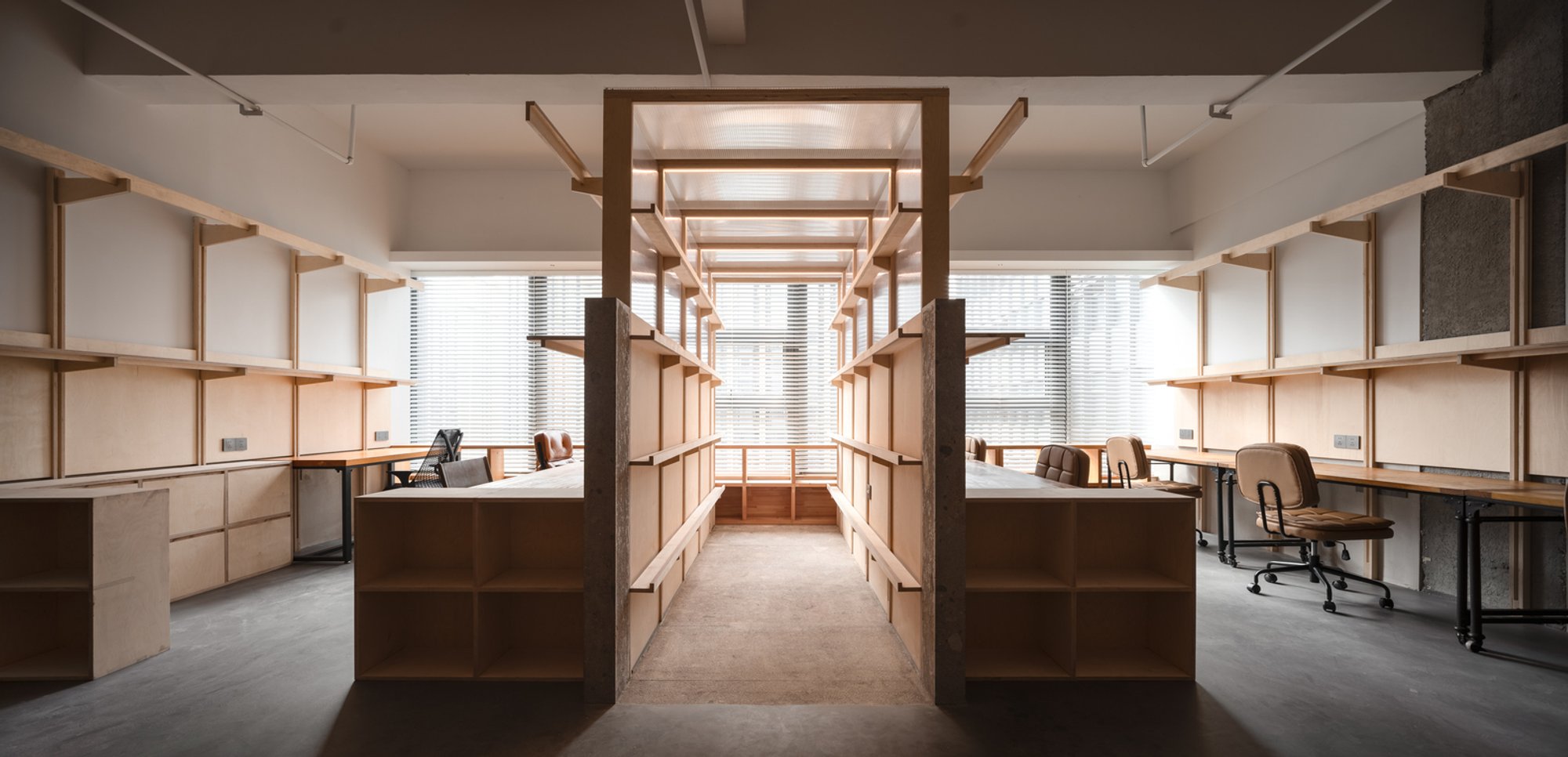
Architects designing their own offices face a particular kind of pressure. The space becomes a calling card, a proof of concept, a place where the studio's values have to survive daily contact with reality. ZAOZUO Architecture Studio took this challenge on with a compact commercial unit and built it out almost entirely in plywood: walls, desks, shelving, partitions, thresholds. The result is a workspace that reads less like an interior fitout and more like a piece of cabinetry scaled to architectural proportions.
What makes the project genuinely interesting is how it resolves density. Rather than defaulting to open plan minimalism, ZAOZUO layered the office into a series of nested rooms and corridors separated by translucent timber screens, built-in furniture, and carefully framed openings. The material palette is narrow, almost monastic, but the spatial variety is real. You move through the office the way you might move through a sequence of rooms in a traditional house, each one scaled and lit differently, each one doing specific work.
Entry and First Impressions
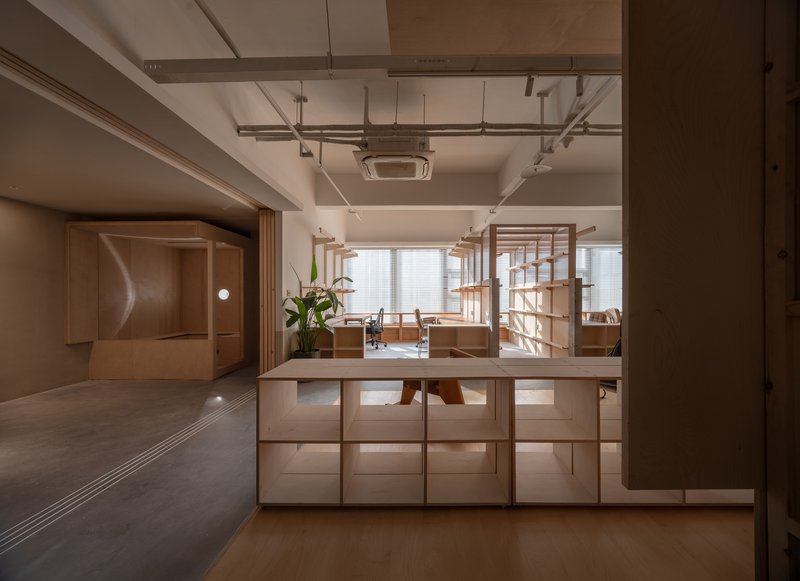
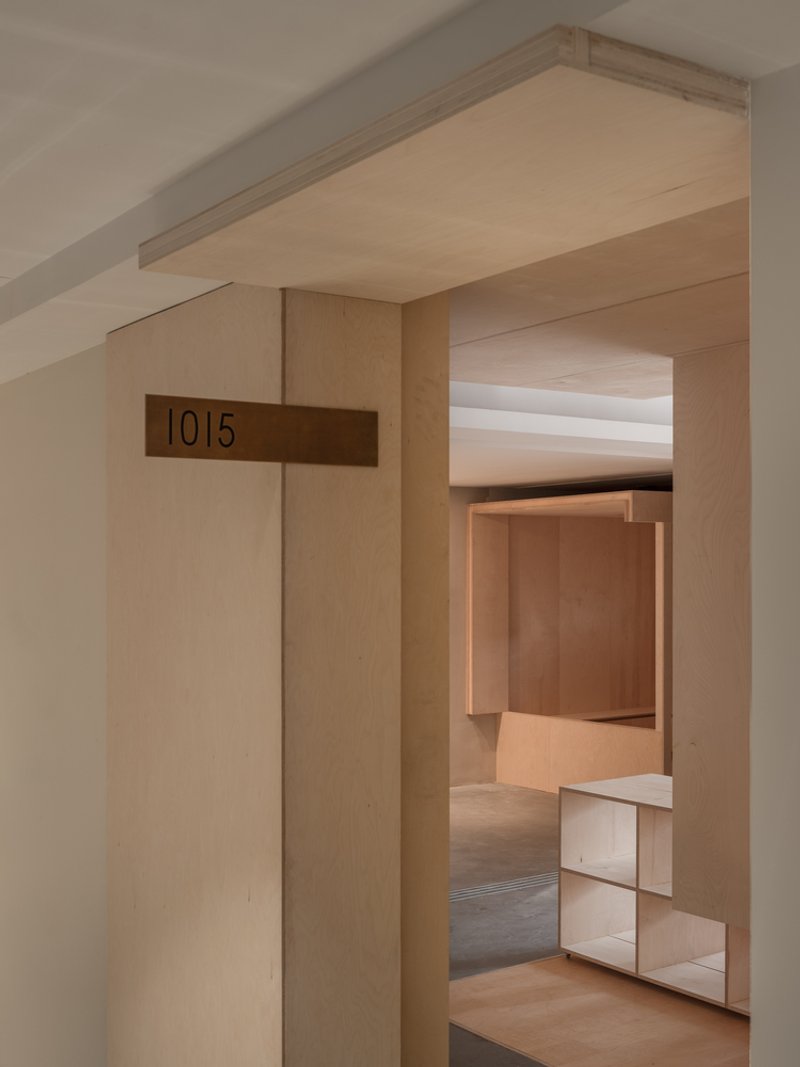
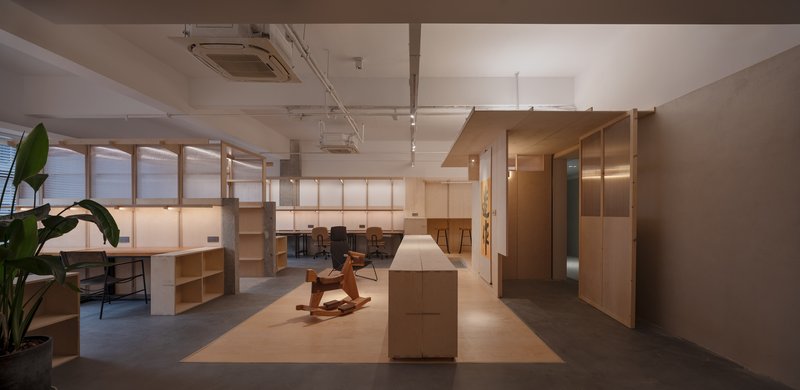
The entry sequence does a lot of work in a small footprint. A curved plywood portal with a low reception counter sets up the material language immediately, and numbered doorways framed by layered timber profiles give the threshold a sense of depth that belies its actual dimension. A rocking horse sculpture on a plinth in the hallway signals that this is a studio comfortable with personality, not just polish.
The corridor beyond the entry is narrow but highly resolved. Track lighting, plywood joinery, and elevator doors coexist without competing. ZAOZUO treats every surface as an opportunity for integrated storage or display, so even the circulation spine functions as working infrastructure.
The Plywood System
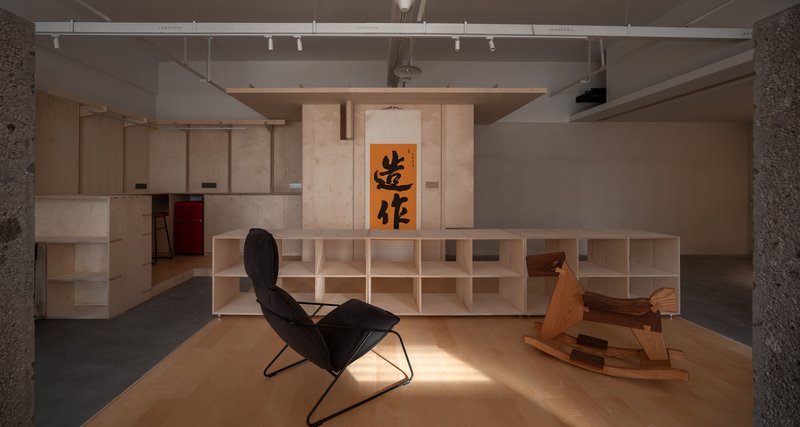
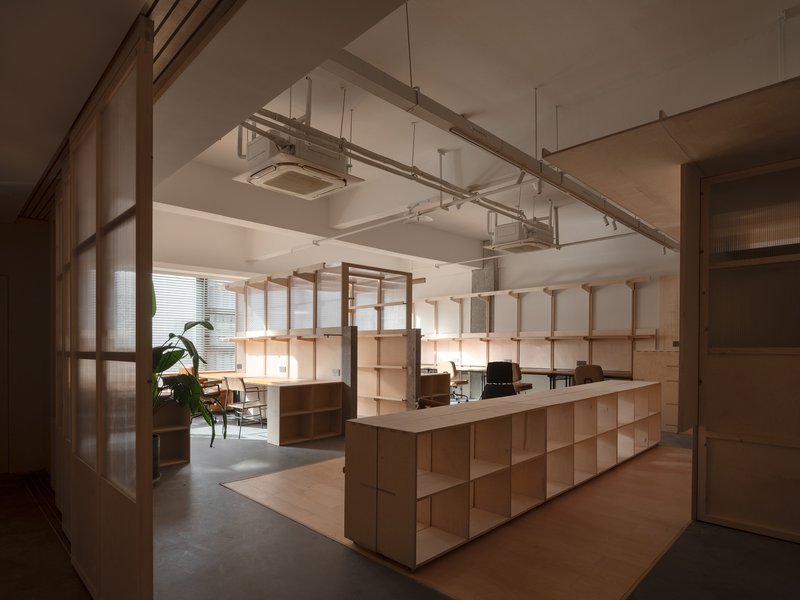
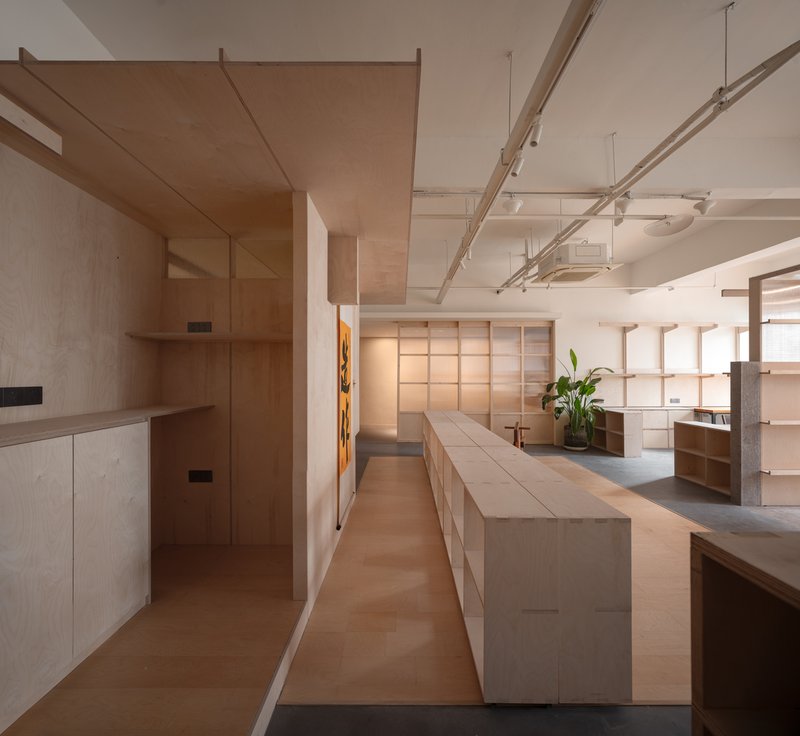
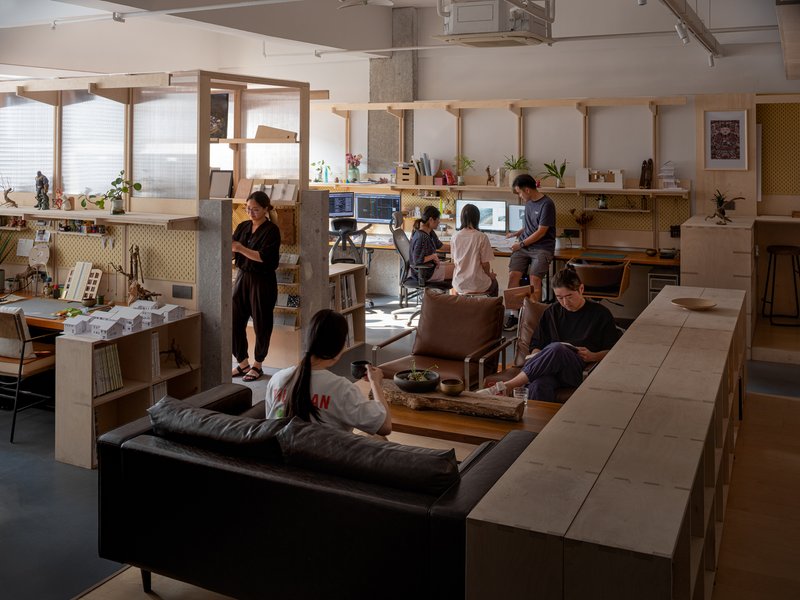
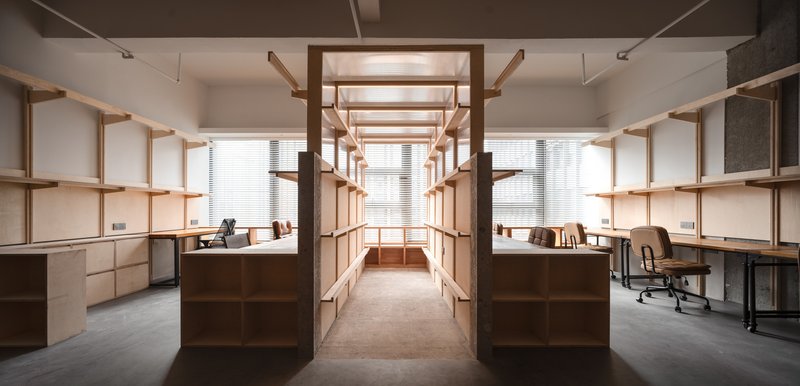
Plywood is doing everything here. It forms the shelving units, the workstation islands, the wall cladding, and the floor surface. The decision to commit so fully to a single material gives the office a visual coherence that more eclectic fitouts rarely achieve. Grid shelving integrated below long island desks turns storage into structure, and the warm tone of the wood softens what could be a harsh environment of exposed ceiling ducts and mechanical services.
Importantly, the plywood is not precious. It reads as a working material, not a luxury finish. The grain is visible, the edges are honest, and the joinery is utilitarian rather than decorative. This is furniture as architecture, or architecture as furniture, depending on where you stand.
Translucent Screens and Filtered Light
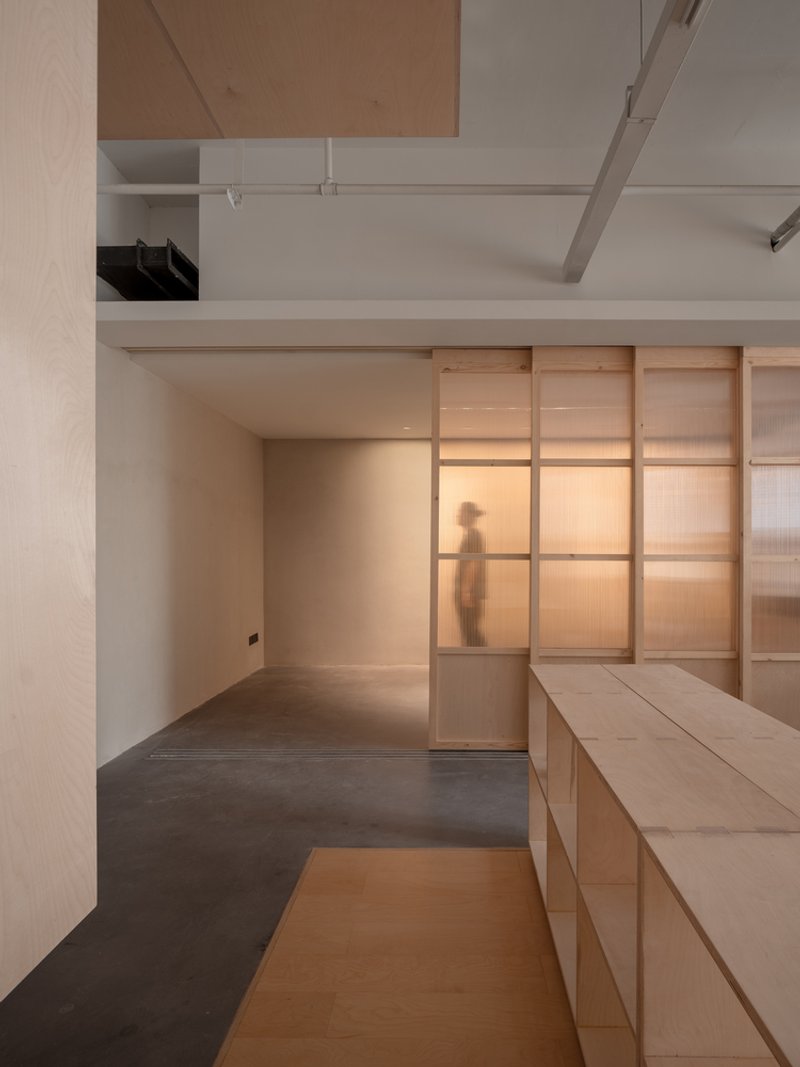
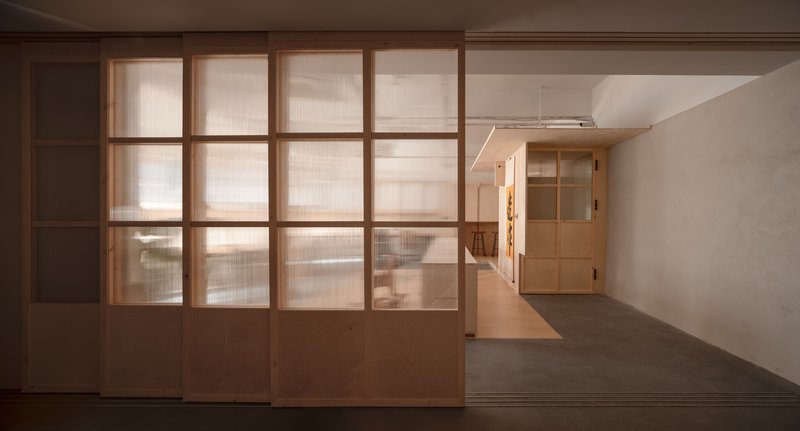
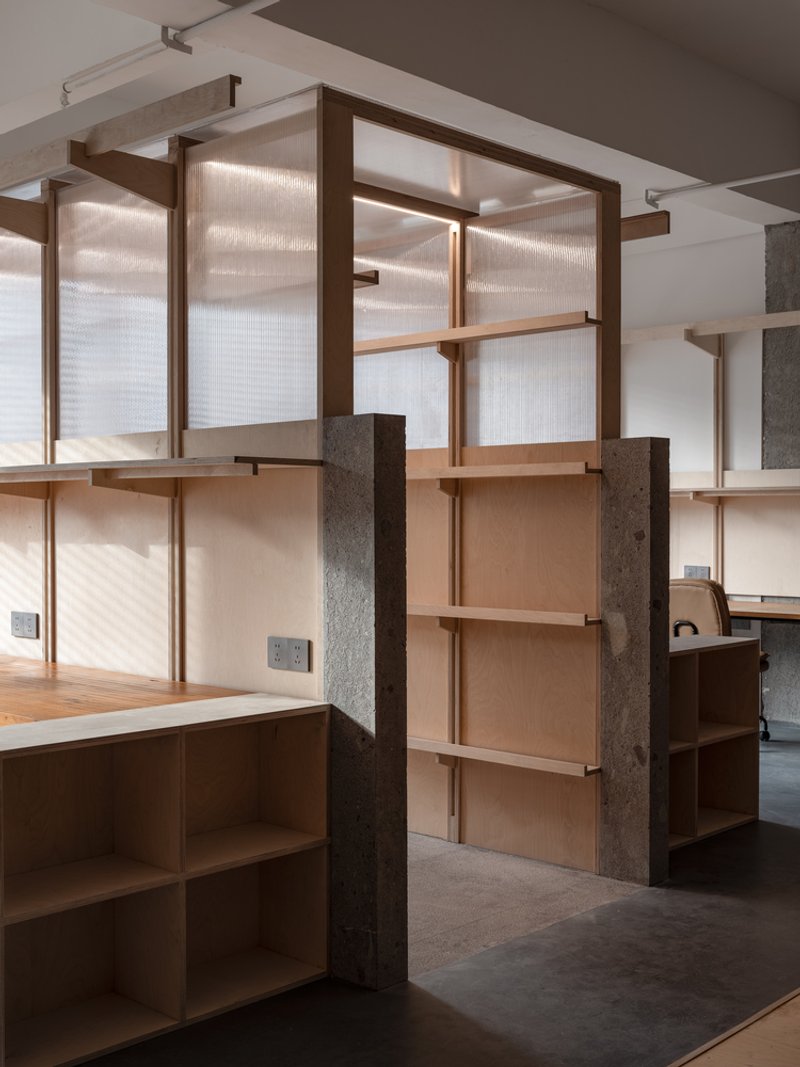
The translucent sliding panels and timber-framed partitions are the project's most distinctive spatial move. They divide rooms without closing them, filter daylight into soft gradients, and occasionally catch a human shadow to dramatic effect. The ribbed and gridded screens reference shoji traditions without copying them directly. They function as privacy devices, light modulators, and visual texture all at once.
In the open-plan workspace, these screens work alongside dark textured columns and diffused natural light to create zones of varying intimacy. You can be in the collective space while still feeling a degree of enclosure. It is a straightforward strategy, but ZAOZUO executes it with enough precision that the panels feel essential rather than decorative.
Workspaces and Alcoves
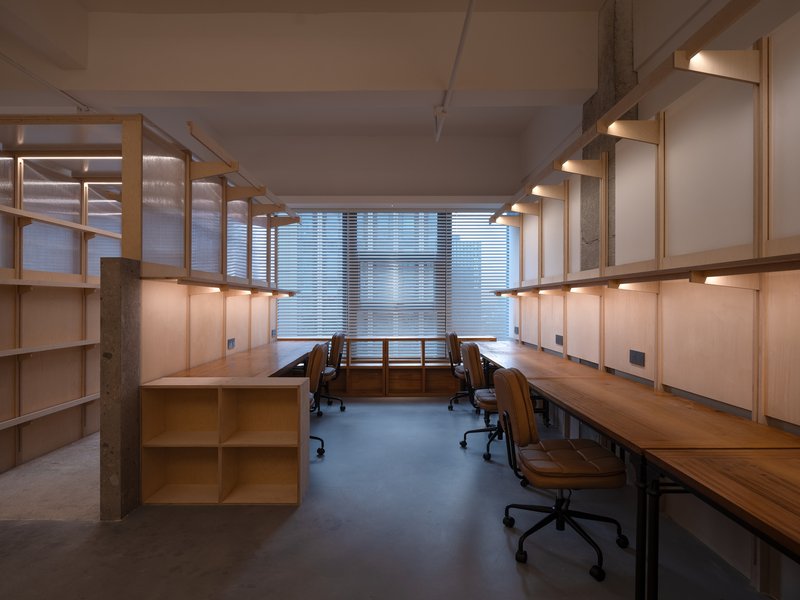
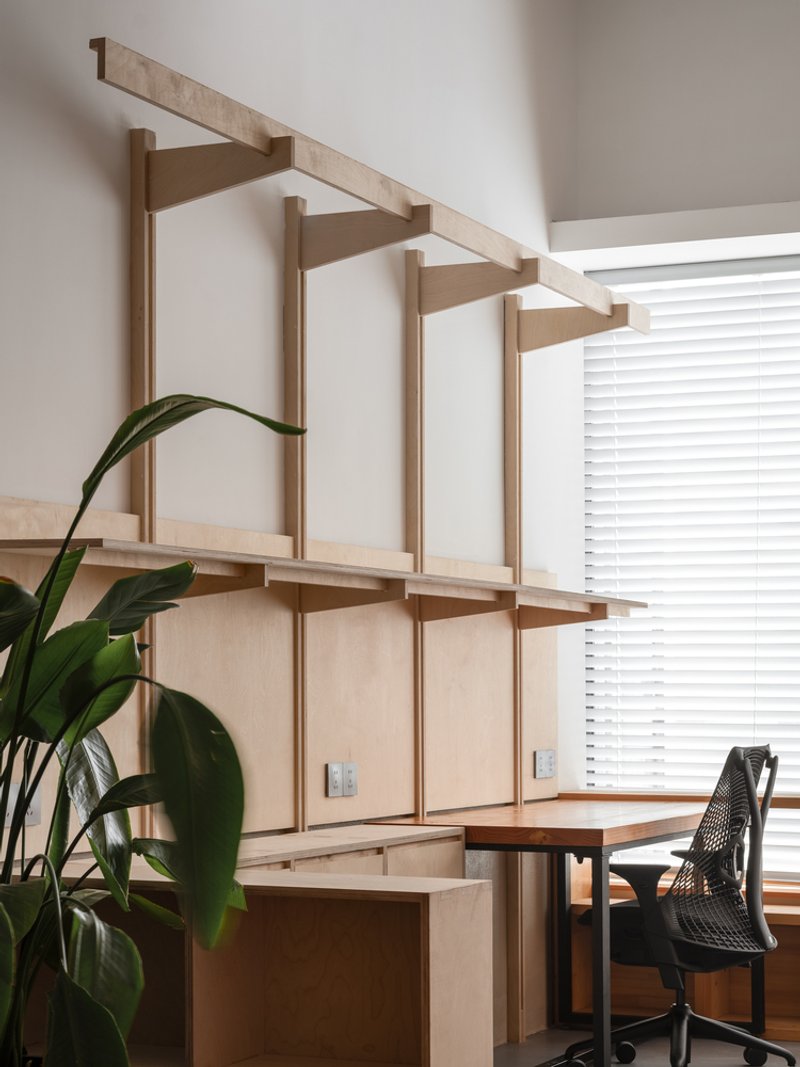
The individual work areas reveal the real intelligence of the layout. Desk alcoves with built-in plywood workstations and shelving sit alongside windows fitted with venetian blinds, giving occupants control over light and glare. Wall-mounted shelving integrates seamlessly with desk surfaces, so personal storage and work tools are always within arm's reach without cluttering the room.
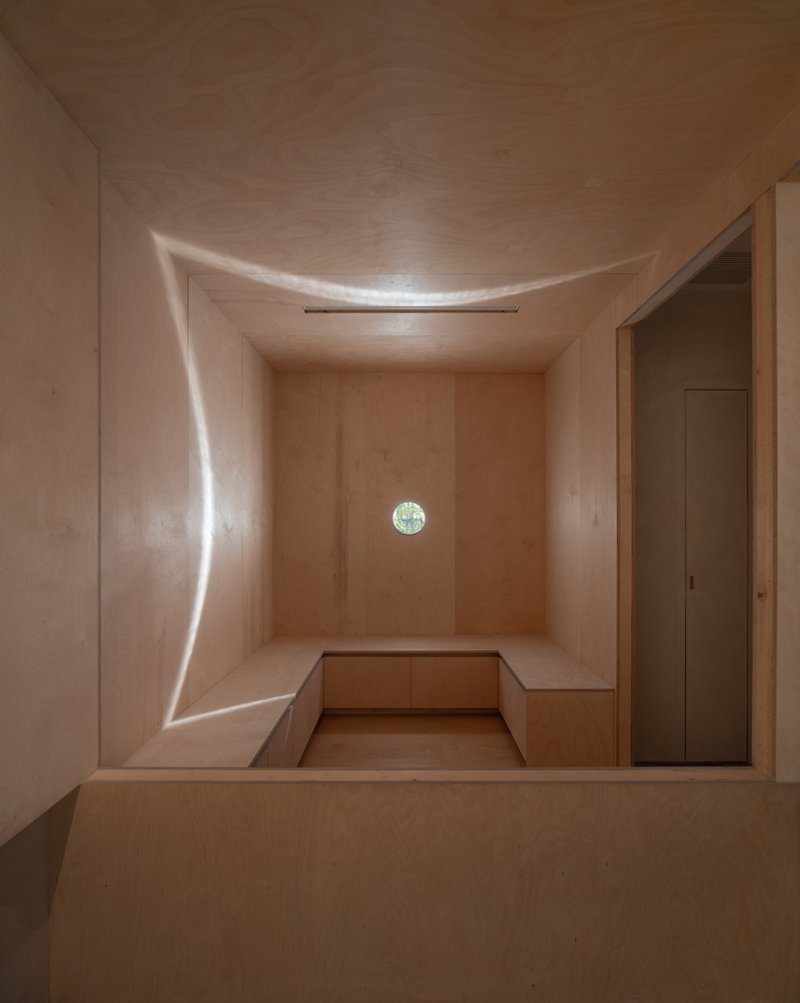
A plywood-lined alcove with built-in bench seating and a small circular window stands out as a quieter, more contemplative space. It reads almost like a reading nook smuggled into a commercial office. These moments of scaled-down domesticity are what lift the project above generic coworking aesthetics.
Meeting Rooms and Collective Spaces
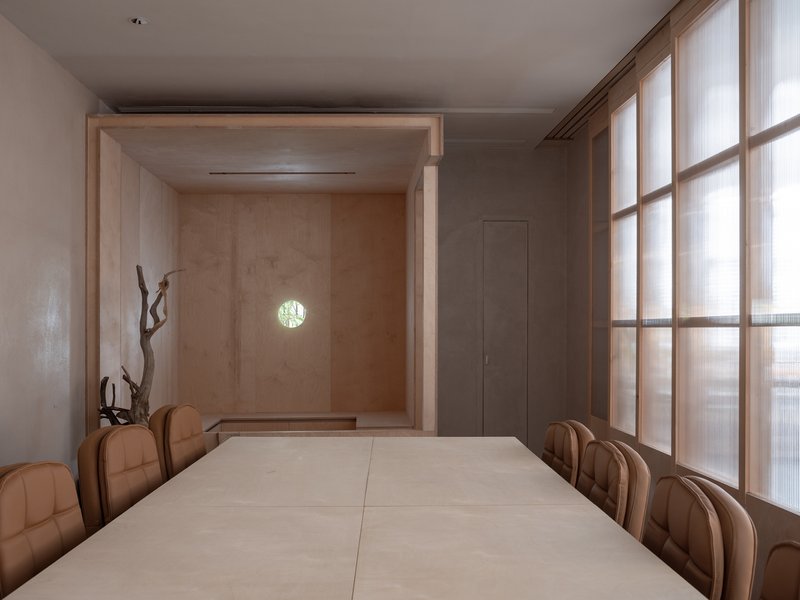
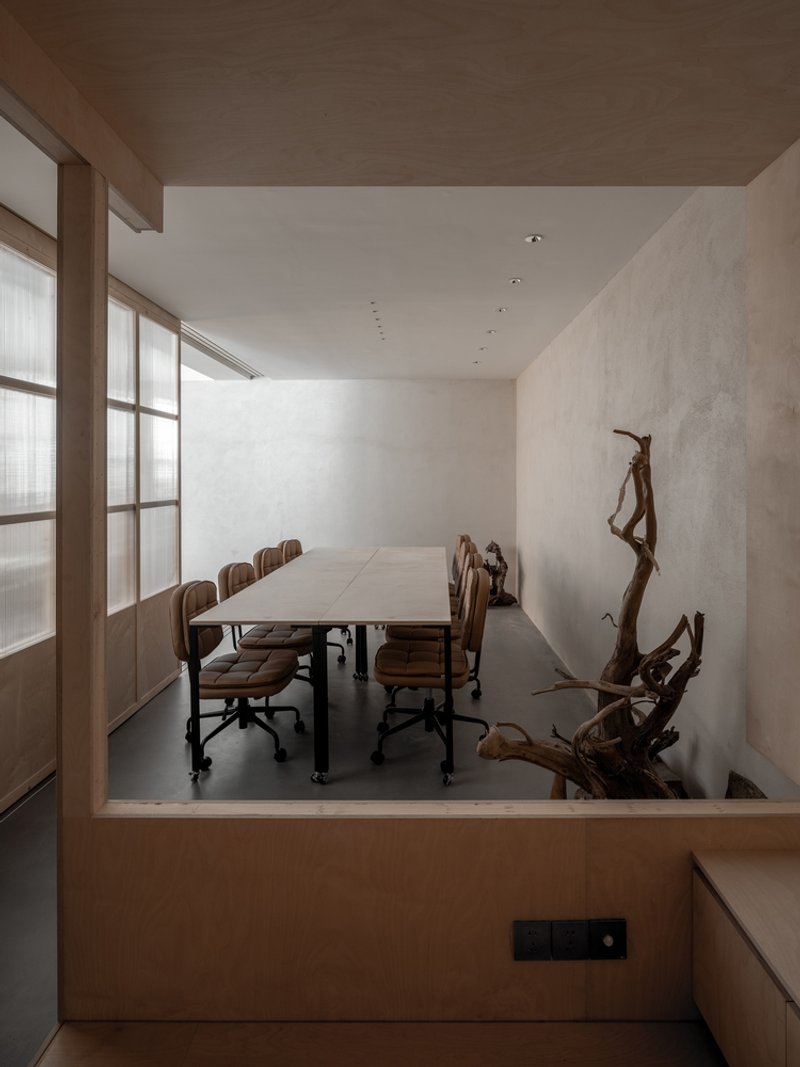
The conference room pairs upholstered chairs with translucent timber screens and a circular opening punched through a plywood wall. It is a small room that feels generous because of how light enters from multiple directions. A gnarled wood branch sculpture on the meeting table adds a raw, organic counterpoint to the precision of the joinery.
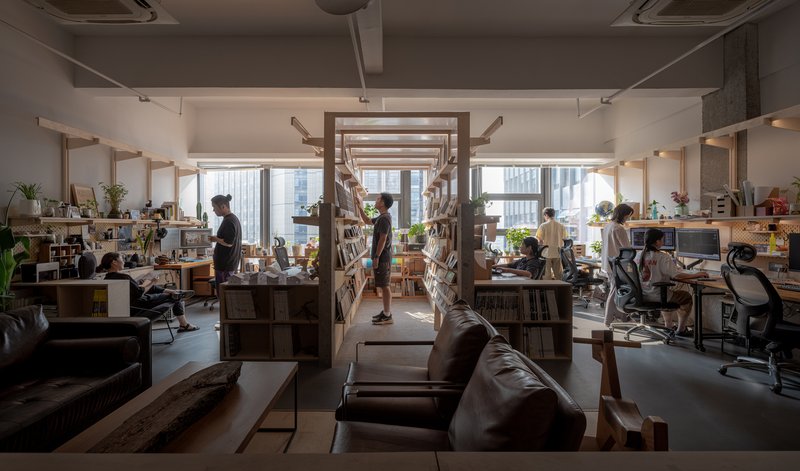
Elsewhere, leather seating mixed with open desks under generous natural light creates a more informal gathering zone. People are visible working, talking, moving. The office clearly operates as a social space, not just a production facility. ZAOZUO has designed for the culture of their practice, not just its logistics.
Kitchen, Stairs, and Details
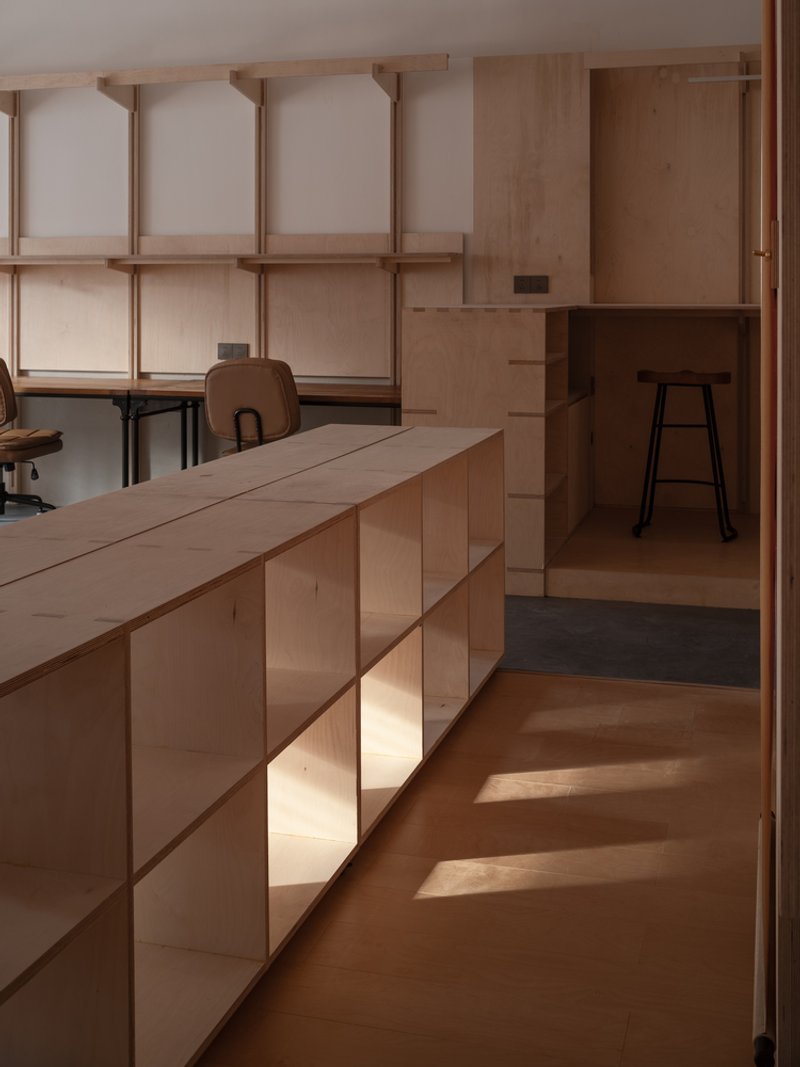
The kitchen area extends the plywood language into a domestic register. A light wood island and built-in shelving catch afternoon sunlight in a way that makes the space feel like it belongs in a well-considered apartment, not a commercial office. It is a small room, but it is one of the most photographable corners of the project, which says something about where the studio placed its priorities.
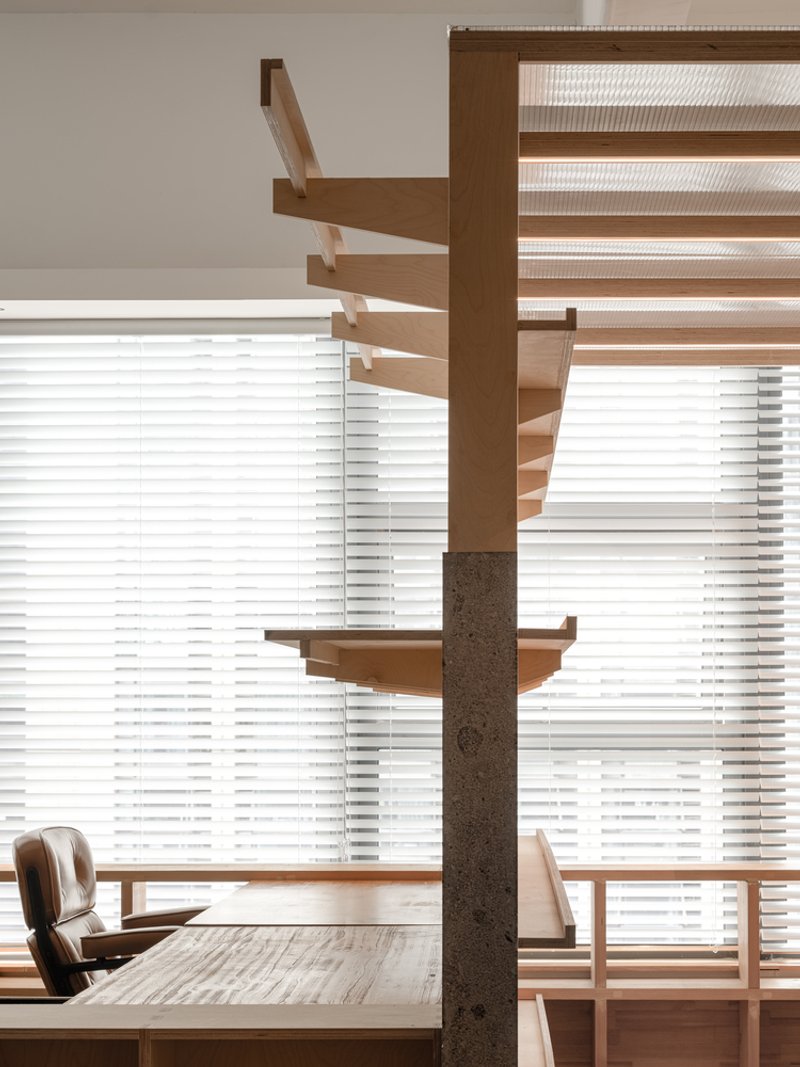
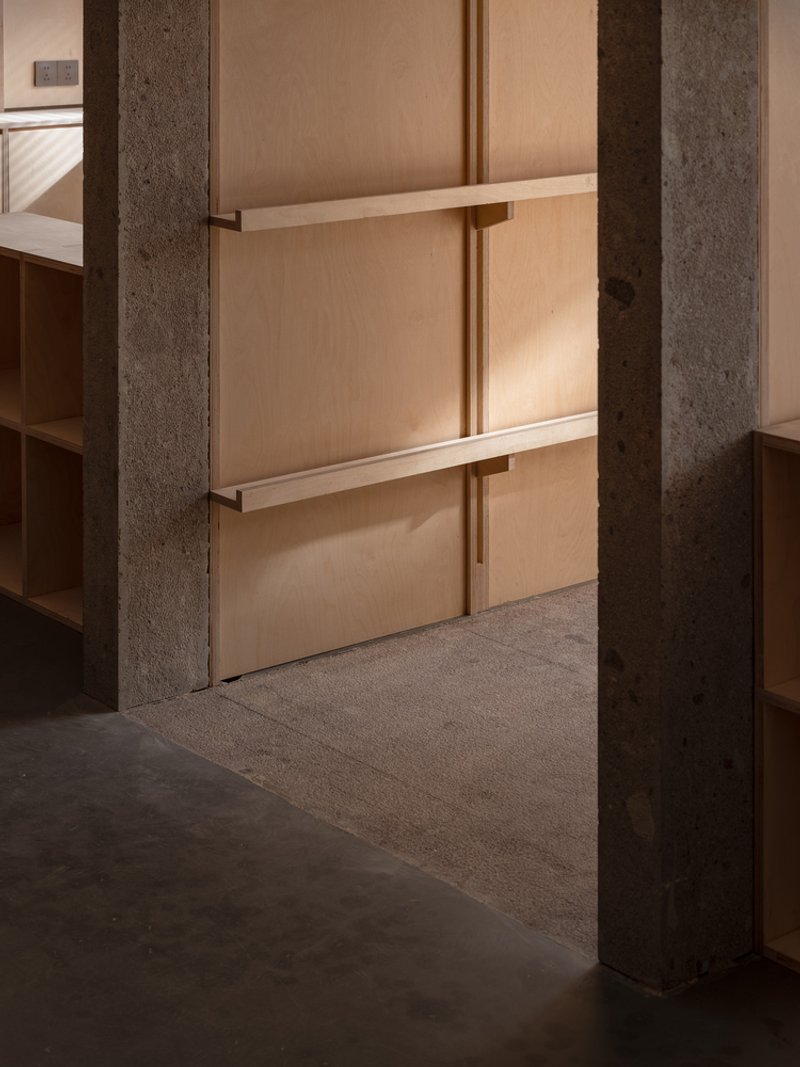
Cantilevered timber stair treads wrap around a concrete column, introducing the only moment of real structural drama. The detail is clean: no visible fixings, no safety railing competing for attention. Horizontal brass handles on timber shelving units nearby add a quiet material accent that keeps the palette from feeling monotonous.
Corridors and Depth
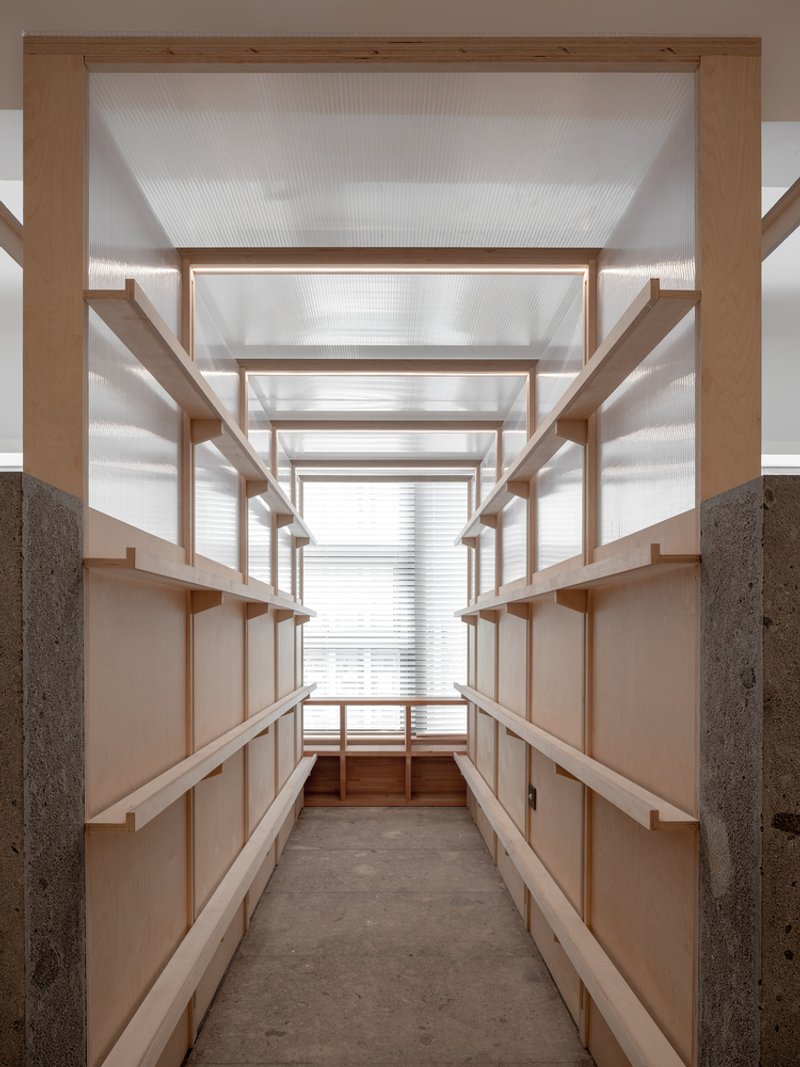
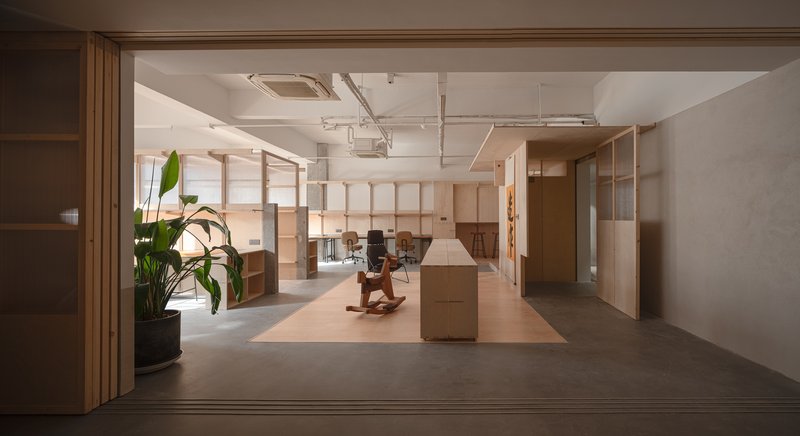
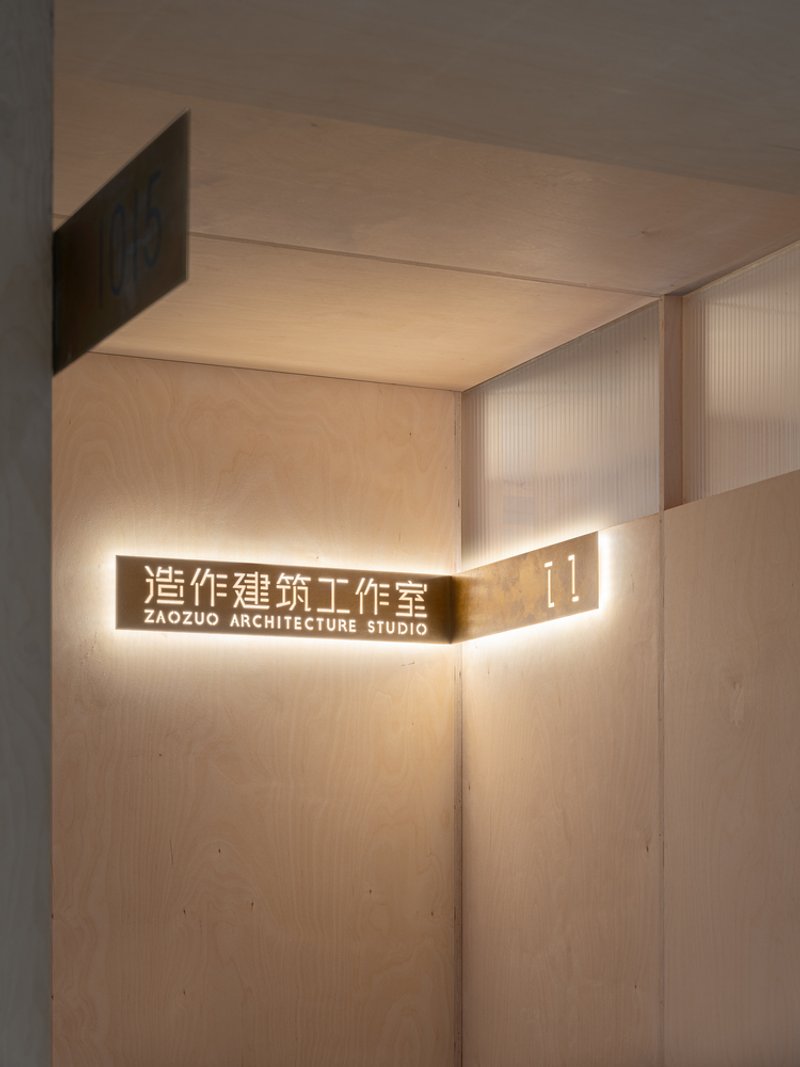
ZAOZUO's handling of corridors deserves particular attention. Narrow passages are lined with timber shelving and overhead beams that compress the space before releasing it into larger rooms. Framed doorways and translucent panels at the far end of hallways create a sense of perspective that makes the office feel significantly deeper than its plan suggests. A backlit signage panel mounted at a plywood wall corner with a ribbed partition alongside turns a utility moment into a wayfinding gesture.
Plans and Drawings
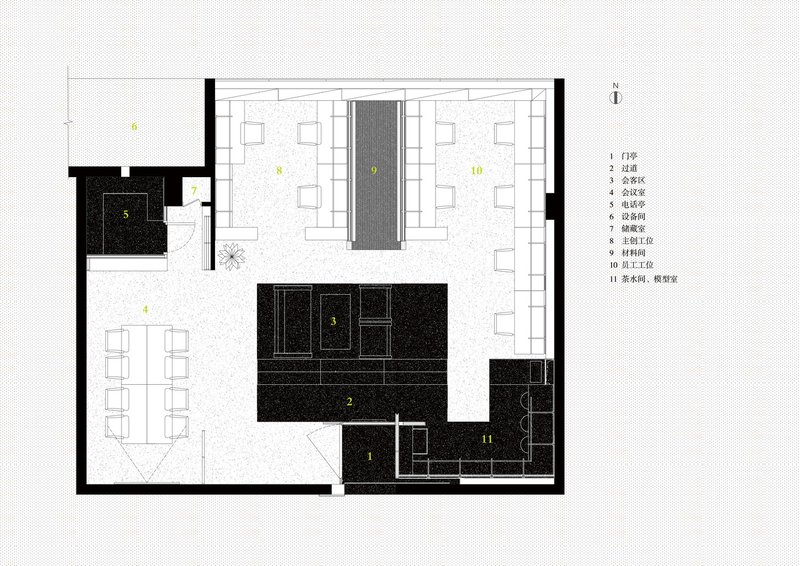
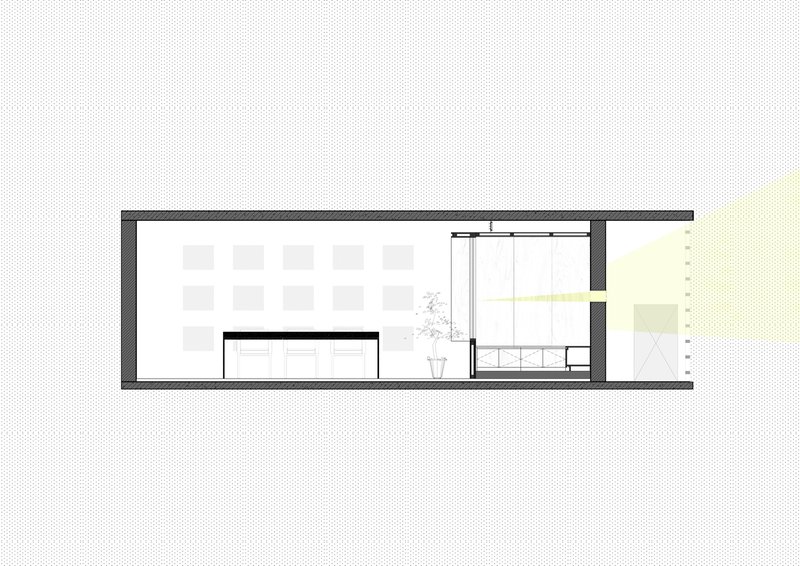
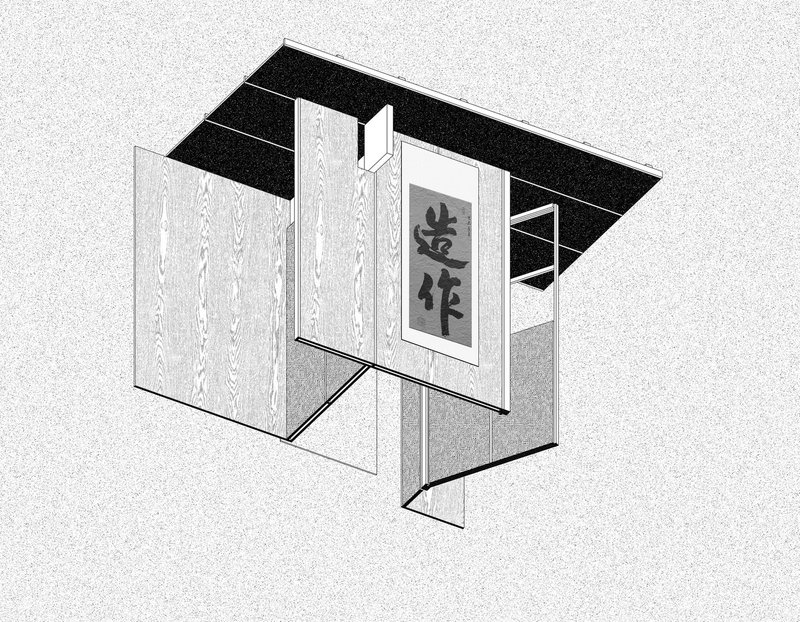
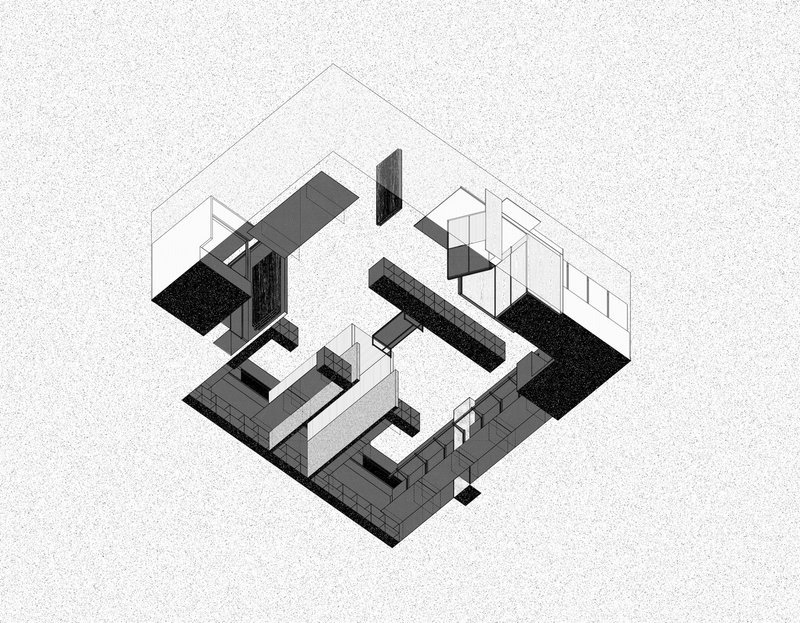
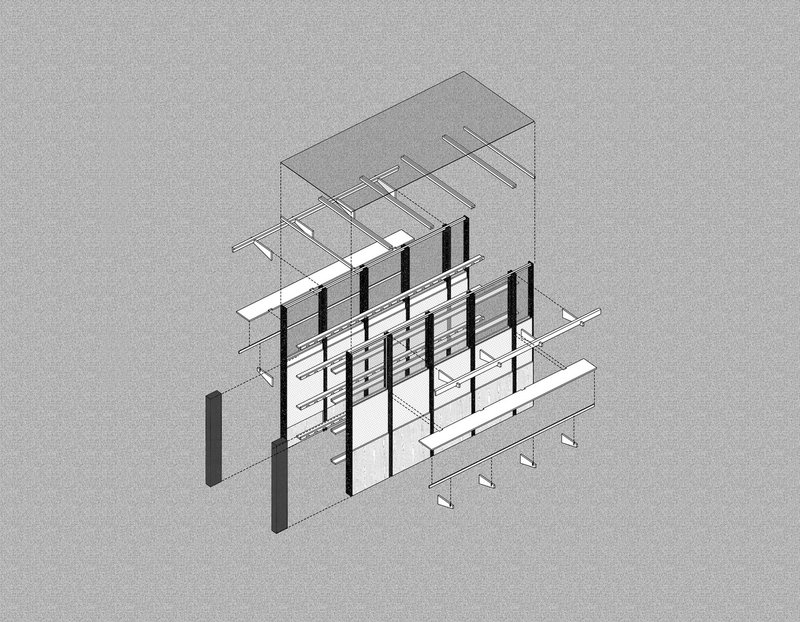
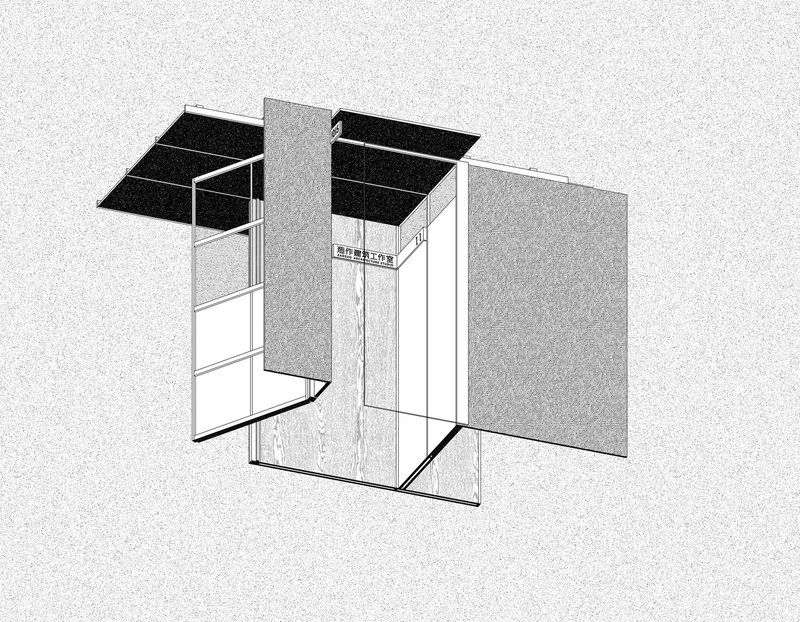
The floor plan confirms what the photographs suggest: the office is organized as a tight sequence of rooms along a central spine, with meeting spaces, workstations, and service areas distributed to maximize usable area. The section drawing reveals a double-height volume and a staircase connecting to an upper level, introducing vertical variety into what could easily have been a flat, single-floor layout.
Axonometric and isometric drawings break the project into its component systems: kitchen, dining area, circulation paths, structural columns, beams, and roof planes. The exploded axonometric is particularly revealing, showing how the layered timber frame system sits within and against the existing concrete structure. Pavilion-scale drawings with glazed walls and calligraphic signage hint at branded elements that connect the studio's architectural identity to its public-facing design.
Why This Project Matters
There is a long tradition of architects designing their own studios as manifestos. ZAOZUO's office sits comfortably in that lineage without overreaching. It does not try to be a gallery or a showroom. It tries to be a good place to work, and it succeeds through material discipline, spatial layering, and a willingness to treat every square meter as design territory. The plywood system is not revolutionary, but it is applied with a consistency and care that gives the whole project a sense of inevitability.
For small practices working within tight budgets and tighter floor plates, this office is a useful reference. It demonstrates that density does not have to mean compromise, that a single material can carry an entire project when handled with intelligence, and that the corridor between two rooms can be just as considered as the rooms themselves. ZAOZUO built a workplace that feels calm, specific, and intentional. That is harder than it looks.
Compact Office Design by ZAOZUO Architecture Studio. Photography by Qingshan Wu.
About the Studio
Share Your Own Work on uni.xyz
If projects like this are the kind of work you want to make, uni.xyz is a place to publish your own, find collaborators, and enter design competitions.




Popular Articles
Popular articles from the community

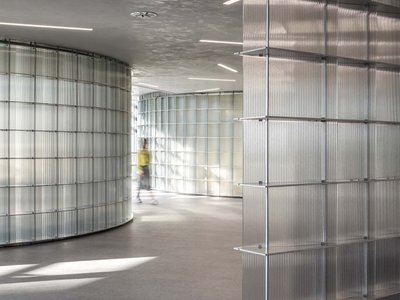
HCCH Studio Wraps a Shanghai High-Rise Office in Curved Walls of Translucent Glass
A 1,000 square meter fit-out in Lujiazui replaces the typical tech-office palette with layered glass, micro-cement, and quiet rigor.
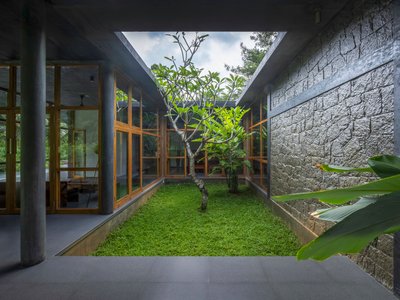
3dor Concepts Wraps a Kerala Home in Mirrored Concrete Arcs Around a Courtyard Tree
In the Western Ghats foothills of Thamarassery, a 270 m² single-story house uses two curved volumes to frame nature as its center.
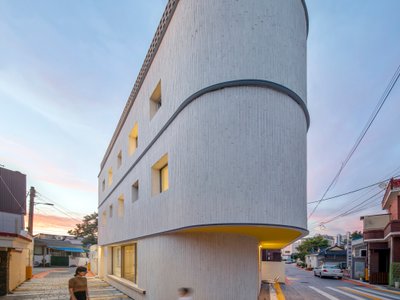
YOAP Architects Round a Corner in Yeongcheon with a Cylindrical Community Hub
A 197-square-meter brick and ribbed-clad tower turns a forgotten alley corner in South Korea into a public garden with a low threshold.

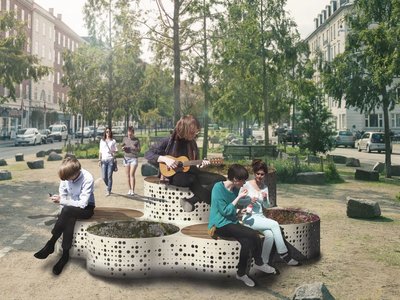
20 Most Popular Furniture Design Projects of 2025
Modular street systems, parametric benches, and insect hotels: the furniture design projects that captivated architects on uni.xyz in 2025.


Similar Reads
You might also enjoy these articles
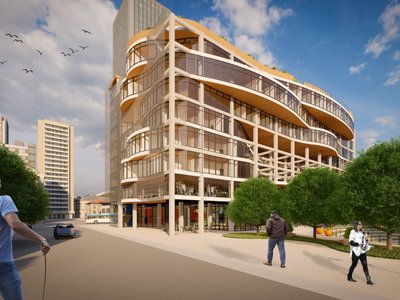
Olio Towers: A Mid-Rise for Performers That Fuses Housing, Rehearsal, and Stage
Located blocks from Houston's Theater District, this modular tower stacks living units around a central performance atrium.
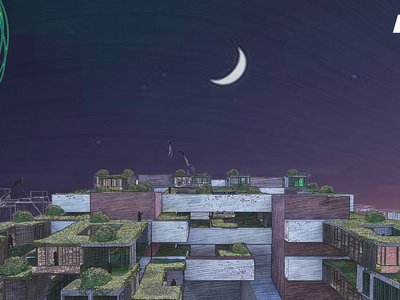
Oasis: Modular Green Housing Carved into Dhaka's Urban Fabric
A shortlisted Plugin Housing entry reclaims unauthorized settlements in Dhaka with stepped concrete volumes, green roofs, and ventilation-driven design.

Black Hole: A Floating Megastructure for the Post-Physical Era
Emiliano Mazzarotto envisions a spherical, self-scaling arena where e-sports, digital hotels, and holographic stadiums replace traditional public space.
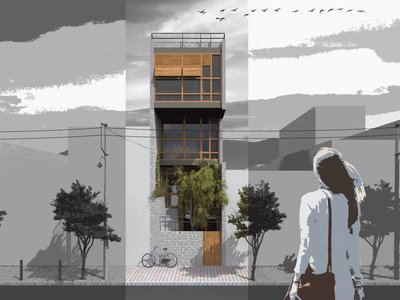
Compact & Sustainable Living in Piraeus: A Four-Level Family Home Built Around Light and Air
A narrow townhouse in one of Greece's densest port cities uses a central atrium and passive strategies to house three generations under one roof.


Explore Architecture Competitions
Discover active competitions in this discipline




The International Standard for Design Portfolios


The Global Benchmark for Architecture Dissertation Awards


The Global Benchmark for Graduation Excellence


Challenge to reimagine the Iron Throne
Comments (0)
Please login or sign up to add comments
No comments yet. Be the first to comment!