

Yotta in Yocta: Multigenerational Living Compressed into a Narrow Urban Infill
A People's Choice winner stacks three generations across three levels in one of Coimbatore's most congested neighborhoods.


What happens when a family of three generations needs to live on a site barely wider than a truck? You design vertically, you treat every wall as a working surface, and you let air and light do the heavy lifting. "Yotta in Yocta," subtitled "House for Need, Not for Greed," takes one of the narrowest infill plots imaginable in Coimbatore's Ukkadam district and turns it into a surprisingly livable home where grandparents, parents, and children each get their own floor, their own privacy, and their own relationship with daylight.
Designed by Godlin George G, Dhiliban Bala, and Devil Dayal from Hindusthan School of Architecture, the project won the People's Choice Award in the Nano Nest 2020 competition. The brief asked for compact housing solutions for dense cities, and this team responded with a proposal rooted in a real site, real climate data, and real family dynamics in one of Tamil Nadu's most congested urban zones.
A Sliver of Space Between Party Walls
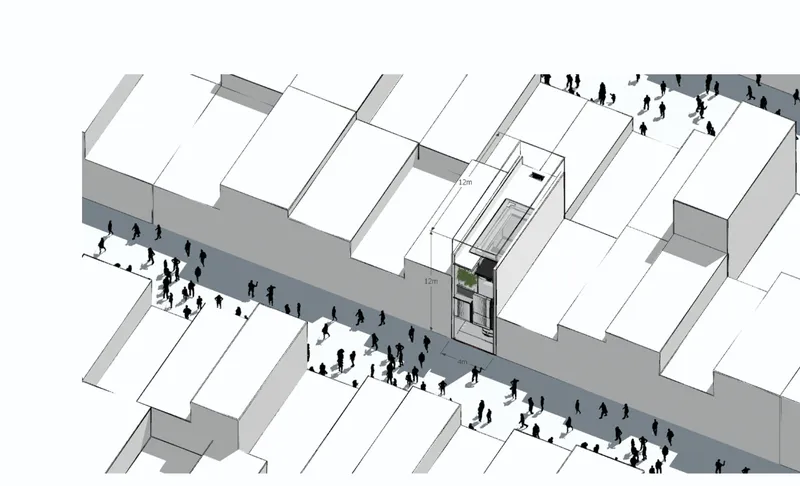
The axonometric view reveals the project's defining constraint: it is a narrow infill structure wedged between existing buildings on a tight urban plot near Ukkadam. Street-level pedestrians give a sense of scale, and the proportions are striking. The house is long, thin, and tall, rising three levels to claim vertical territory where horizontal space simply doesn't exist. This is not a conceptual exercise in minimalism; it is a direct response to the physical reality of Coimbatore's most populated neighborhoods, where open ground is essentially gone.
Three Floors, Three Generations, One Family
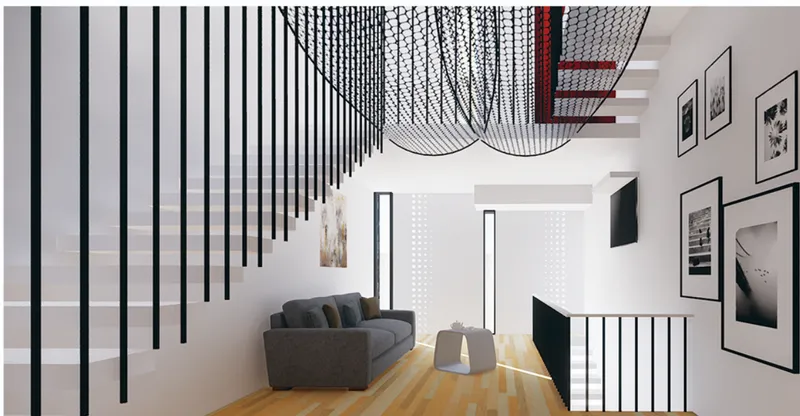
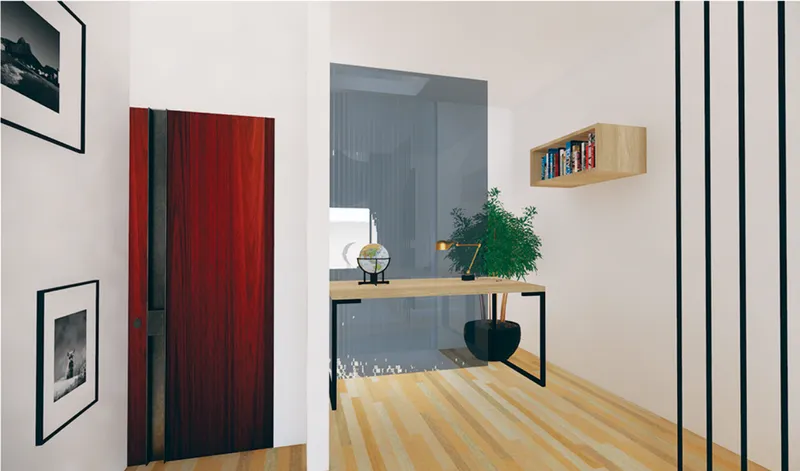
The vertical zoning strategy is the backbone of the design. The ground level is reserved for elderly family members, with parking, kitchen, and living spaces organized for accessibility. The first floor serves children, incorporating study areas, sleeping quarters, and play space. The second floor belongs to parents, positioned to maintain direct visual supervision of children's activities below. This layering isn't arbitrary; it maps family hierarchy and daily routine onto section, ensuring that the people who need the easiest access to the street get it, while those who need quiet and oversight occupy the upper levels.
The interior images show how this plays out spatially. A double-height living space uses suspended vertical black slats to modulate light and create visual depth without consuming floor area. The entry corridor, with its striped wood flooring, funnels movement efficiently from the street to the home's interior. Every surface works: walls carry photographs, floors define zones, and vertical elements filter both light and sight lines.
Slats, Screens, and Smog-Eating Walls
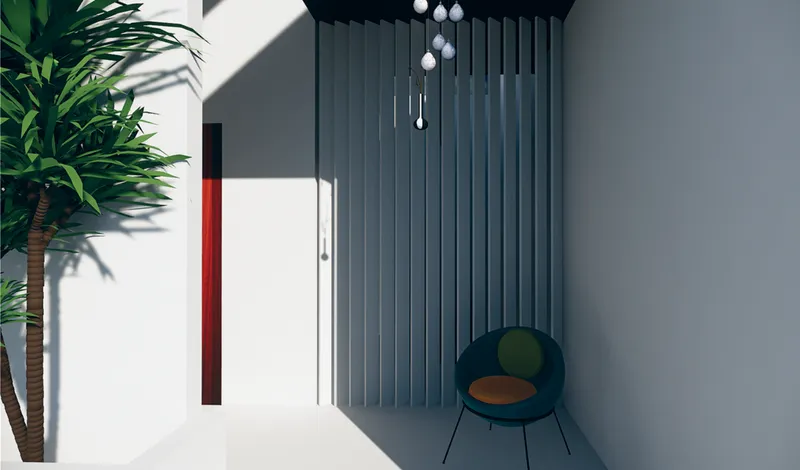
Privacy in a narrow infill plot is a genuine problem. The designers address it with vertical slat partitions that recur throughout the house, visible here as gray elements dividing the hallway from adjacent spaces. These louvres serve triple duty: they provide visual privacy, diffuse incoming light, and protect interiors from rain. On the southern facade, perforations function as both visual barriers and air vents, treated with photocatalytic Titanium Dioxide, a coating that actively absorbs smog and improves the air quality entering the home. In a city like Coimbatore, where traffic congestion meets tropical heat, this is not a gimmick; it is a practical environmental response.
Material choices reinforce the sustainability argument. Locally sourced eco-friendly materials account for 95% of the structure, significantly reducing the carbon footprint. Rainwater harvesting is integrated directly into the roof slab design, and a kinetic gate at the entrance submerges into the ground to optimize spatial use at street level. The stack effect is leveraged for thermal comfort, with open voids and courtyards pulling warm air upward and drawing cooler air in at the base.
Anatomy of Compression: Reading the Exploded Section
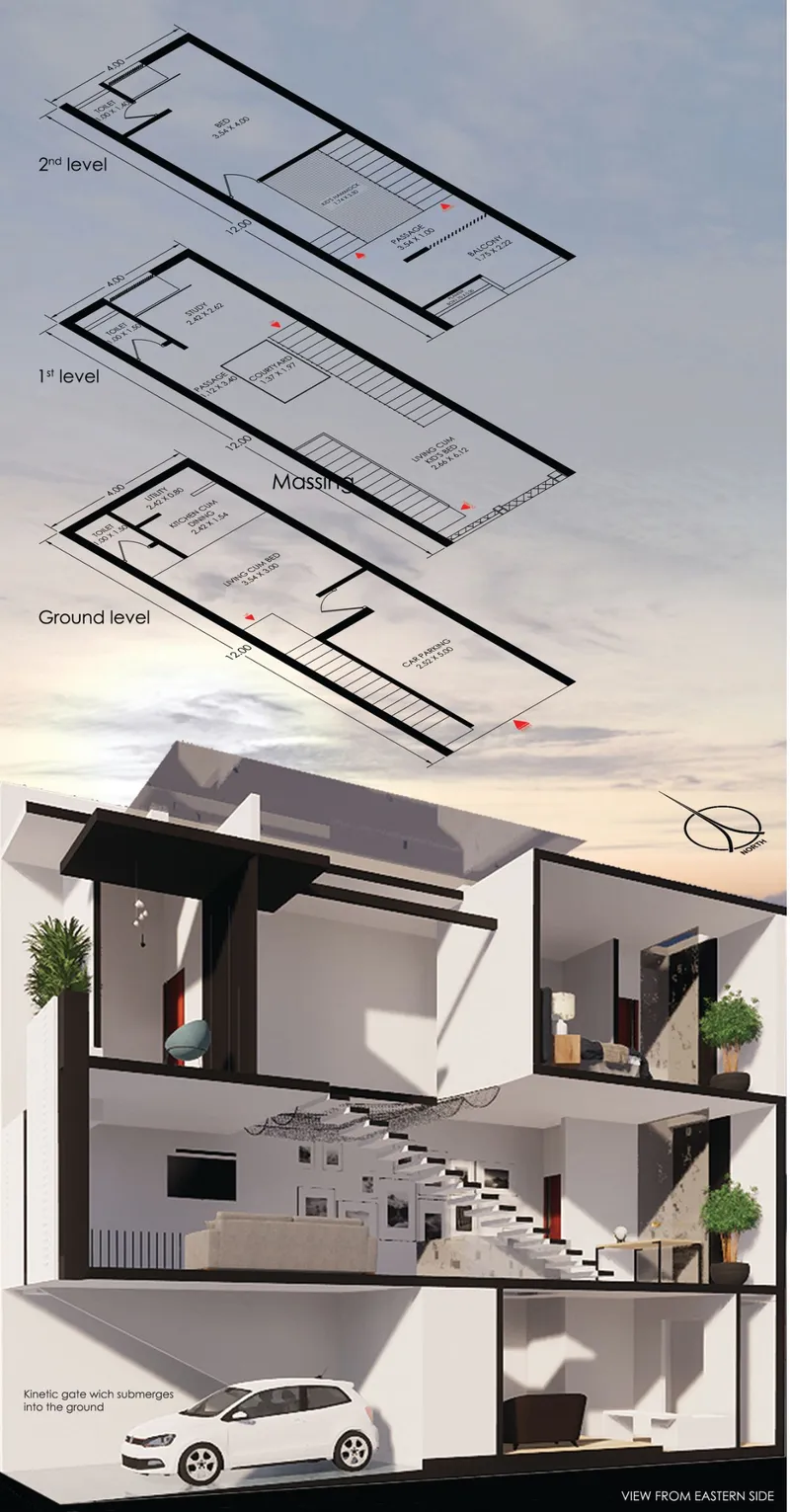
The exploded axonometric drawing makes the logic legible. Three floor plans hover above a sectional view, revealing how courtyards and open voids punch through the stack to enable vertical connectivity. Skylights and translucent glass panels deliver natural light to every level, and the voids allow family members to maintain visual contact across floors. A kid's hammock on the second floor provides recreational space within extremely limited square footage, a creative answer to the absence of outdoor play areas in dense neighborhoods. Coimbatore's tropical wet-and-dry climate is leveraged throughout: the section shows how natural ventilation pathways are designed into the building's bones, not bolted on as an afterthought.
Why This Project Matters
"Yotta in Yocta" succeeds because it refuses to treat compact housing as a lesser category of architecture. The designers have given each generation its own spatial identity within a single narrow volume, used climate and materiality as active design tools rather than compliance checkboxes, and produced a home that prioritizes emotional connectivity alongside physical comfort. The kid's hammock, the smog-eating wall, the submerging gate: these are not flourishes. They are precise interventions in a building where every square centimeter is accounted for.
As Indian cities continue to densify, the need for replicable prototypes like this one will only grow. The project's strength lies in its specificity: it is designed for a real site in Ukkadam, for a real climate, for real family structures. That grounding makes it more than a competition entry. It is a template, tested against the actual pressures of one of South India's most congested urban corridors, and it demonstrates that density and dignity are not mutually exclusive.
View the Full Project
About the Designers
Designers: Hindusthan School of Architecture, GODLIN GEORGE G, Dhiliban Bala, Devil Dayal
Enter a Design Competition on uni.xyz
uni.xyz runs architecture and design competitions year-round that reward proposals with spatial conviction and real site intelligence.
Project credits: Yotta in Yocta by Hindusthan School of Architecture, GODLIN GEORGE G, Dhiliban Bala, Devil Dayal Nano Nest 2020 (uni.xyz).


Popular Articles
Popular articles from the community


Opera by the Sea Estonia: Three Shells Dissolving Architecture into Tallinn's Coastline
A winning opera house proposal replaces monumental form with interconnected shells that blur the boundary between building, park and Baltic Sea.

Singing Woman: An Opera House That Performs Before the Curtain Rises
Ovidiu Cristian Pavel's conceptual opera house translates Estonia's choral identity into a sculpted waterfront landmark facing the Baltic Sea.
Extended Shell: Retrofitting Kolkata's Balconies as Living Urban Thresholds
A modular retrofit system recovers the social and environmental intelligence of Kolkata's historic verandas for contemporary Park Street residents.

The Amber Palace Opera: A Geological Fiction Surfaces on Tallinn's Baltic Waterfront
Pierre Brillard reimagines a Baltic legend as a public landscape, opera house, and waterfront promenade rooted in Tallinn's coastal identity.

Similar Reads
You might also enjoy these articles

Pixel Gardens: One Repeated Module Stacked Into a Terraced Social Housing Tower for Famagusta
Salem Bader's shortlisted housing tower builds a vertical neighbourhood from one repeated module, offsetting units to carve terraces, light and air.

Bao Huynh Watercolor Atelier: A Serene Art Retreat in Hội An
Bao Huynh Watercolor Atelier in Hội An blends multifunctional art spaces, sustainable design, local materials, and family-friendly living in a serene environment.

Atelier Macri Concept Store Interior Design by CASE-REAL
Atelier Macri store features a "ko" counter, walnut wood details, cork displays, blending retail, gallery, and seamless customer experiences.

Manuel Vargas Izquierdo Stadium and High-Performance Sports Center: Architectural Excellence in Jalpa de Méndez
The Manuel Vargas Izquierdo Stadium blends sustainable design, inclusive sports facilities, and cultural-inspired architecture, revitalizing Jalpa de Méndez’s public spaces.


Comments (0)
Please login or sign up to add comments
No comments yet. Be the first to comment!