
Contell-Martínez and Manuel Vega Plant a Hospital in an Industrial Zone South of Ontinyent
A 28,000-square-meter hospital in southern Spain treats its industrial surroundings with landscaped courtyards and exposed concrete structure.


Building a hospital on an industrial estate is not, on the face of it, a recipe for civic generosity. The New Ontinyent Hospital, designed by Contell-Martínez Arquitectos and Manuel Vega Arquitectos, sits at the southern edge of the municipality in the Casa Balones industrial area, a heterogeneous zone where warehouses and infrastructure compete for visual attention. The architects, led by Mª Dolores Contell Jurado and Juan Miguel Martínez López, chose not to wall off the context but to absorb it, letting the building's raw structural logic speak the same dialect as its surroundings while introducing courtyards, planted terraces, and generous ground-level porches that quietly elevate the site.
What makes the project worth studying is the way it distributes its 28,006 square meters across a composition of volumes that never reads as a single monolith. Lower horizontal blocks stitch together around internal courtyards while a taller tower anchors one end, and the entire assembly is threaded with landscape: olive trees, cypress, grasses, and wildflower meadows. The result is a hospital that feels more like a small campus than a machine, offering patients, staff, and visitors constant visual and physical connections to planted ground.
A Concrete Chassis for the Street
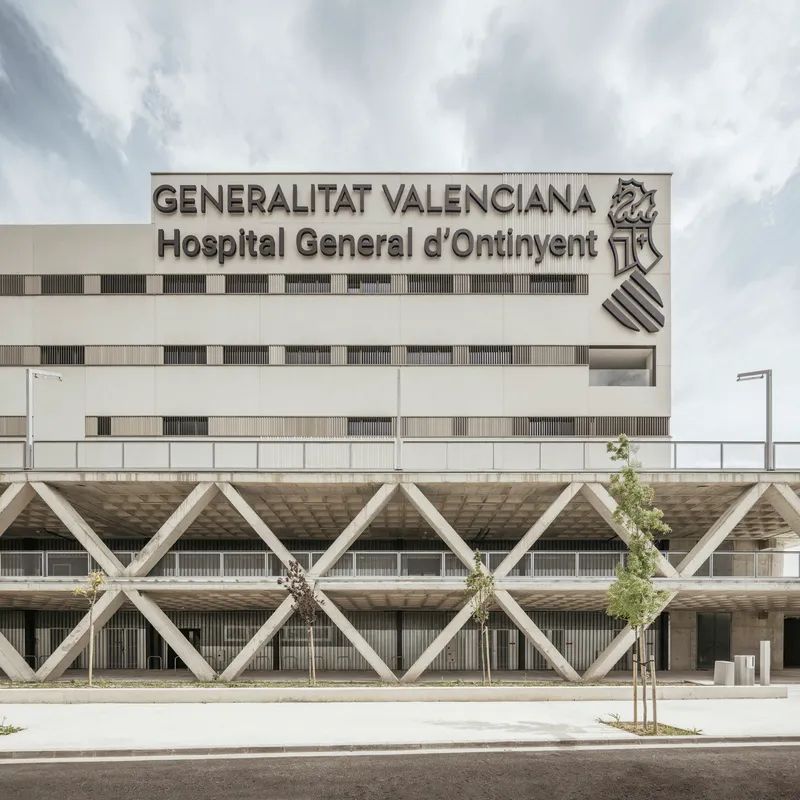
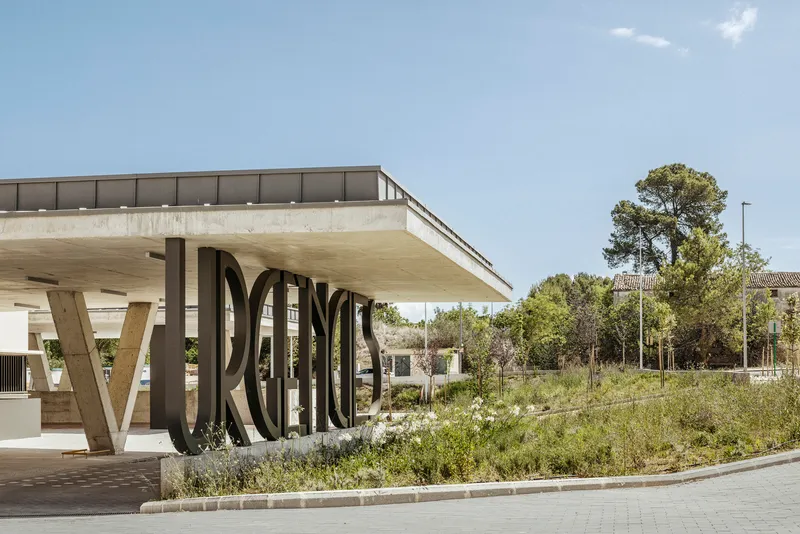
The street-facing facades announce the building's structural ambition without ceremony. Diagonal concrete bracing systems cross the lower volume like the exposed bones of a bridge, giving the hospital an industrial candor that acknowledges its neighborhood rather than pretending to sit in a park. At the entrance, a cantilevered concrete canopy on angled supports shelters visitors beneath a generous overhang, while a wildflower meadow softens the approach. Metal lettering sits directly on the raw concrete, no signage pylons, no corporate gloss.
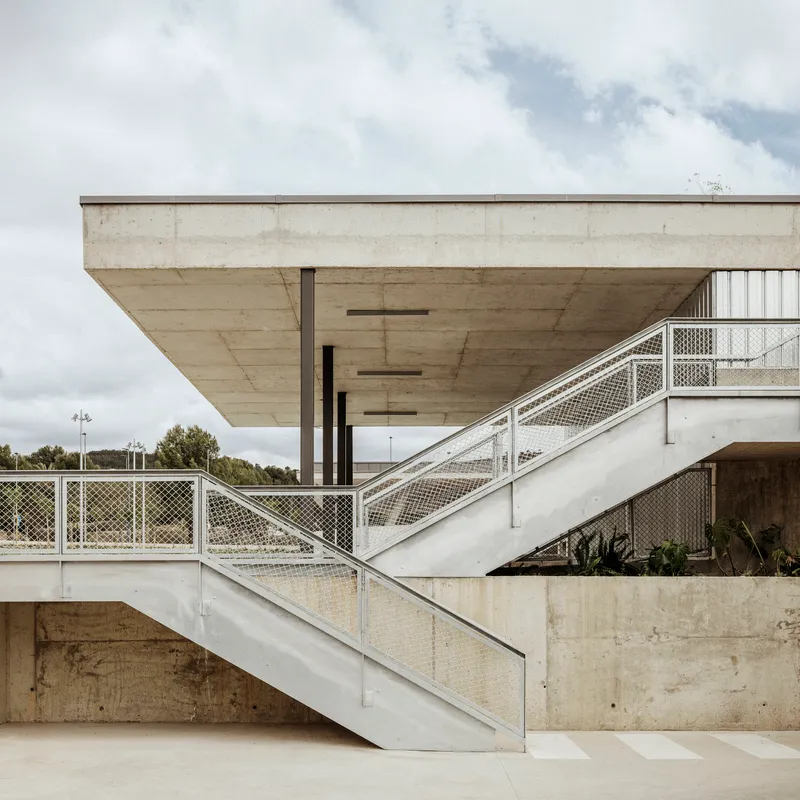
The exterior stair rising alongside the main volume reinforces this language: board-formed concrete treads, metal mesh railings, and a cantilevered soffit overhead. Every element is legible, every joint honest. The effect is a building that trusts its own construction to do the communicative work, and the trust is well placed.
Courtyards as Clinical Infrastructure
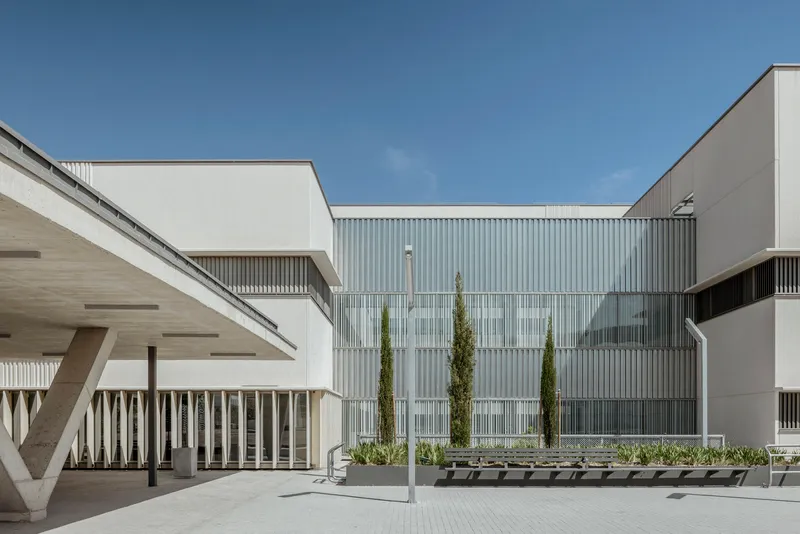
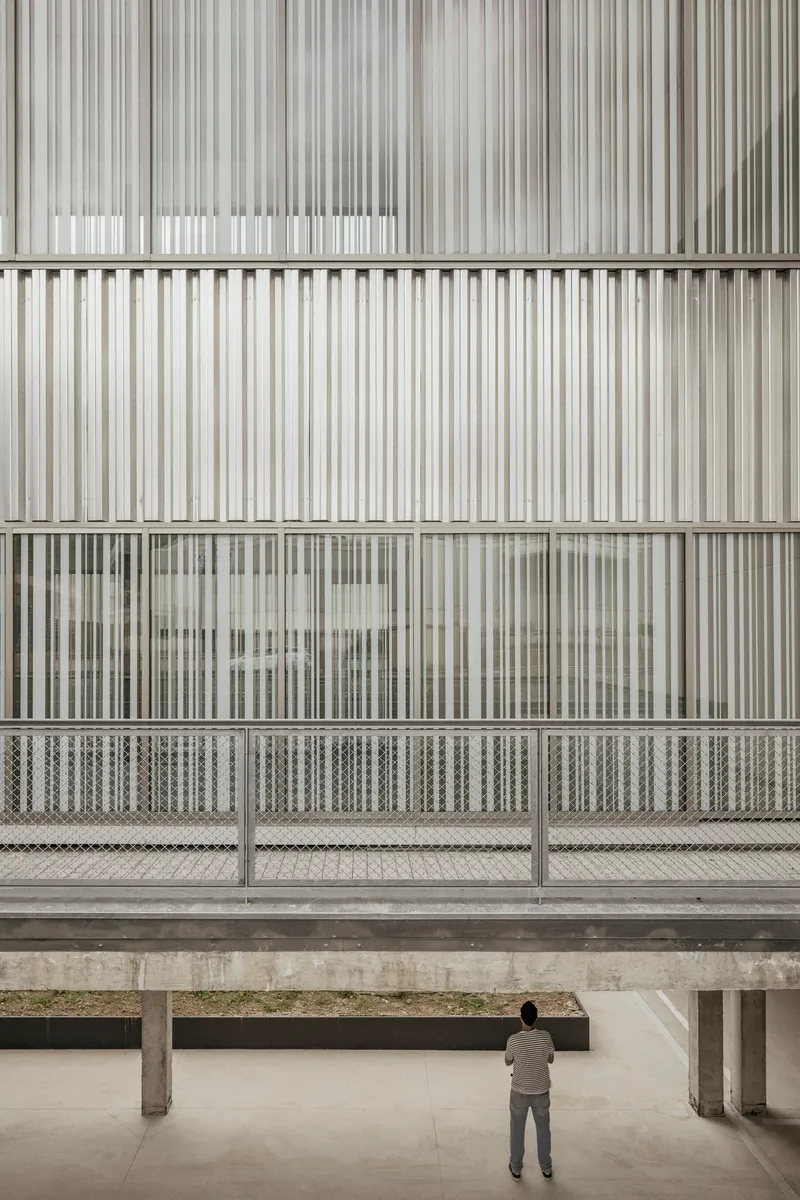
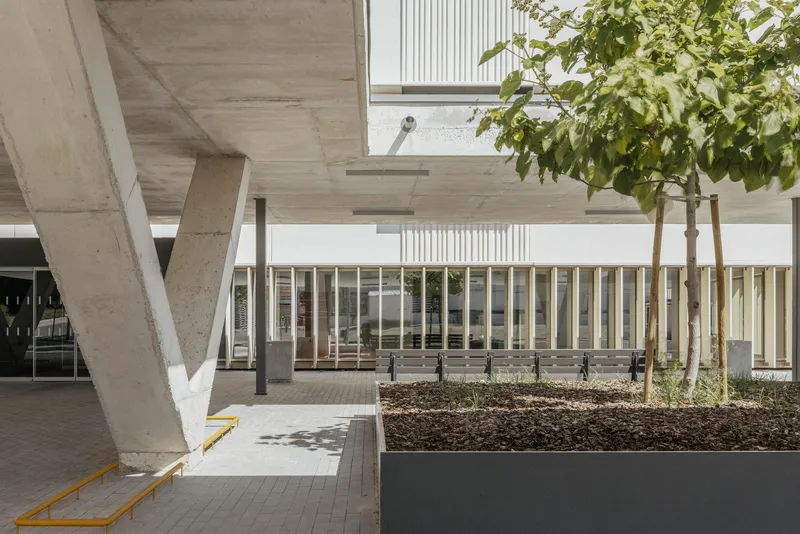
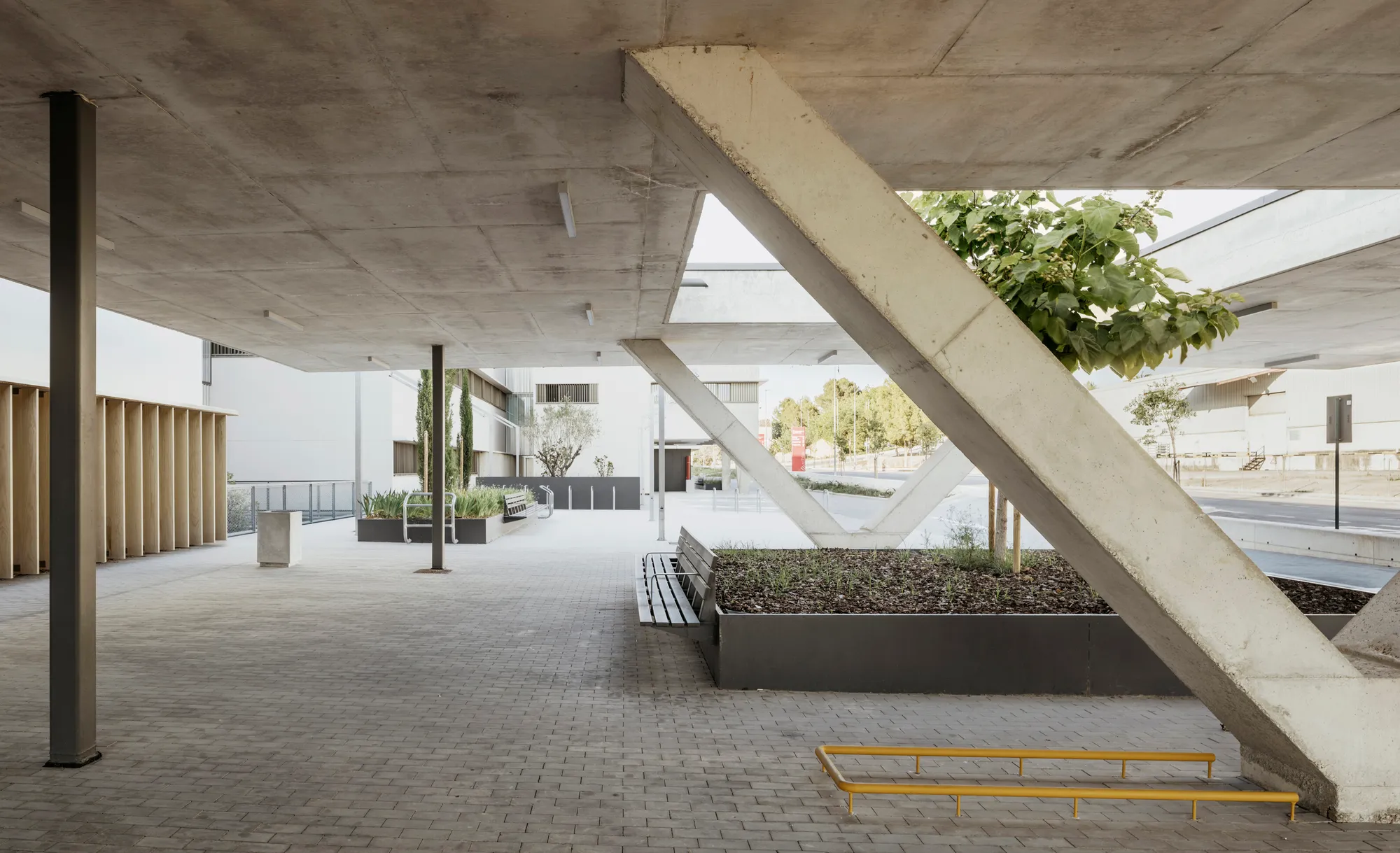
The courtyards are not decorative leftovers. They are the organizational engine of the plan. Surrounded by corrugated metal facades and vertical slat screens, these voids bring daylight deep into the floor plates and give orientation cues to anyone navigating the building. Cypress trees punctuate planted beds at ground level, and concrete benches create places to sit that are neither corridor nor waiting room. A visitor walking through the columned ground-level space beneath the piloti can see through the building from one courtyard to the next.
The concrete piloti supporting the flat slab roof overhead create a sheltered colonnade that doubles as circulation and pause space. Planted raised beds push up against the metal screen facade, blurring the line between inside and out. It is a strategy borrowed more from Mediterranean housing than from hospital typology, and it works precisely because it refuses to treat patients as people who need to be sealed indoors.
The Porch and the Ground Plane
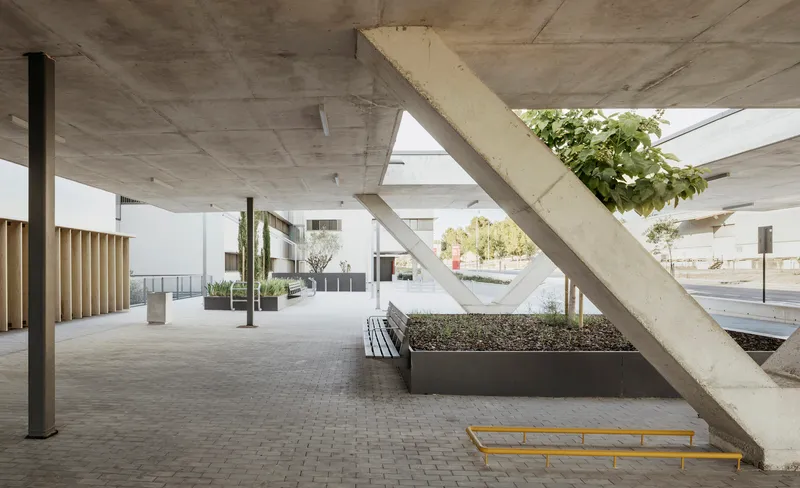
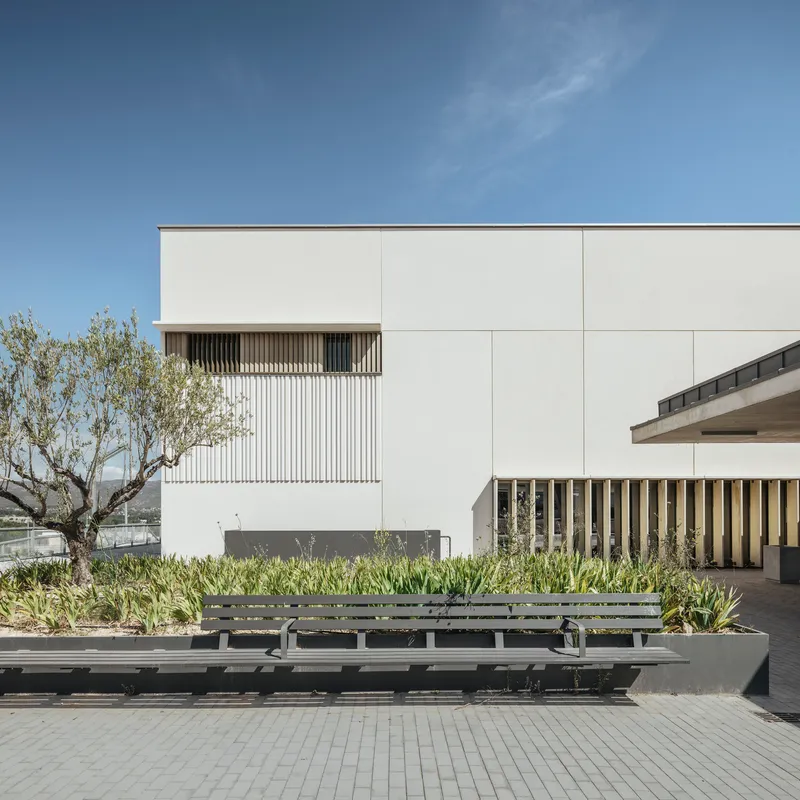
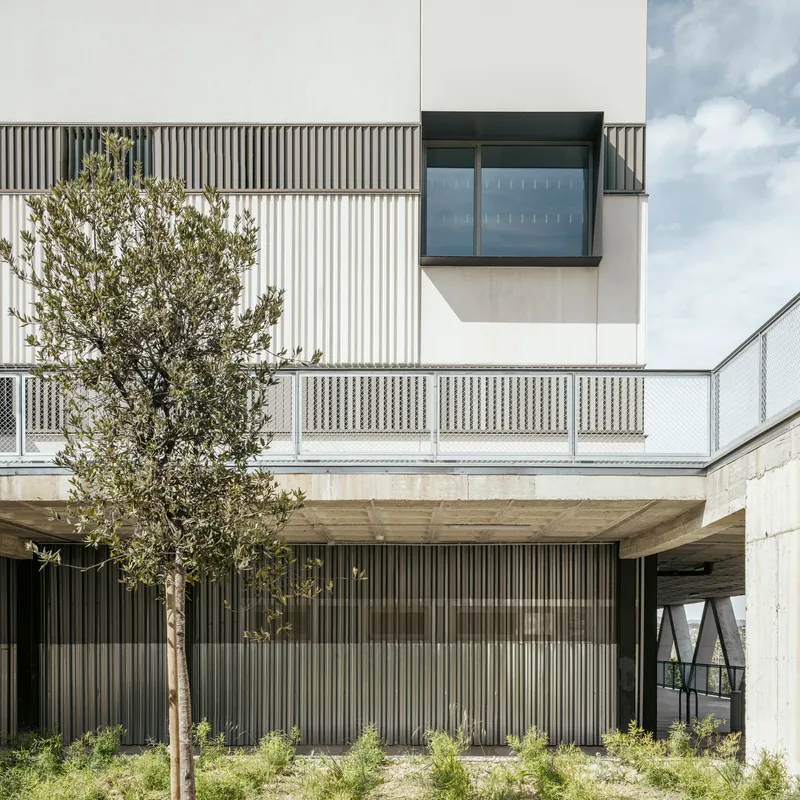
One of the strongest moments in the project is the covered porch formed by diagonal concrete columns, board-formed ceilings, and generous planted beds. The space reads as an extension of the landscape rather than an appendage of the building. Benches line the edges, and the rhythm of the columns gives the porch a cloister-like quality without the enclosure. Olive trees and grasses populate the raised planters along the white facade, and vertical slat screens filter light and views.
The treatment of the ground plane throughout the project is consistently attentive. Landscaped beds are never afterthoughts; they are built into the concrete structure, integral to the section. The corrugated metal facade of the upper volumes sits above these planted zones, creating a visual layering: mineral at the base, vegetable in the middle, metallic above.
Interior Warmth Within a Structural Frame
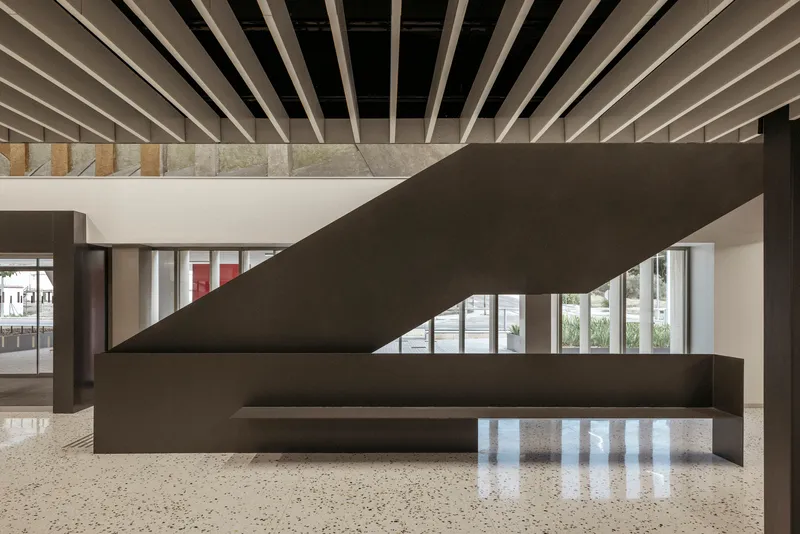
Inside, the material palette shifts. The lobby pairs a dark steel staircase and terrazzo floor with exposed timber ceiling joists, a combination that brings warmth without softness. The timber is structural and visible, not applied as a finish, and its rhythm across the ceiling gives the space a domestic scale despite its institutional dimensions.
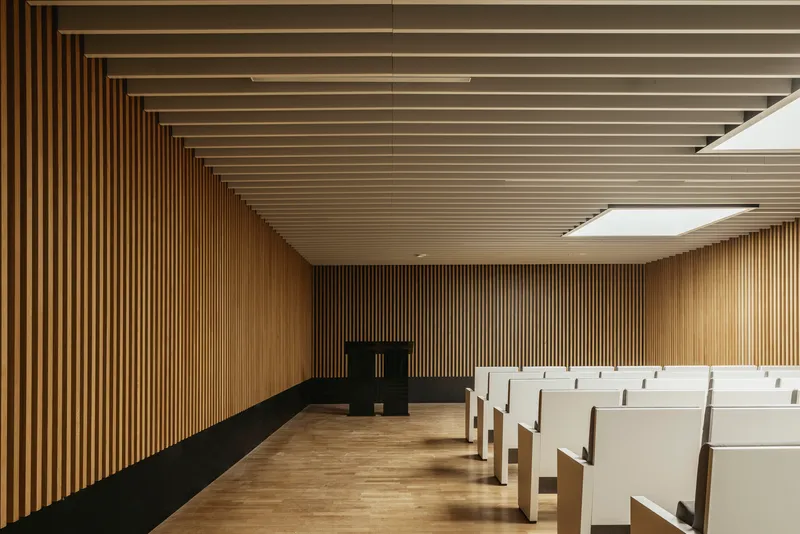
The assembly hall takes the timber further, lining walls and ceiling with vertical slats that absorb sound and create a unified volume. Rows of white seating sit beneath this wooden envelope, and the effect is calm without being sterile. It is one of the few moments where the building turns inward entirely, and the enclosure feels deliberate rather than defensive.
Plans and Drawings
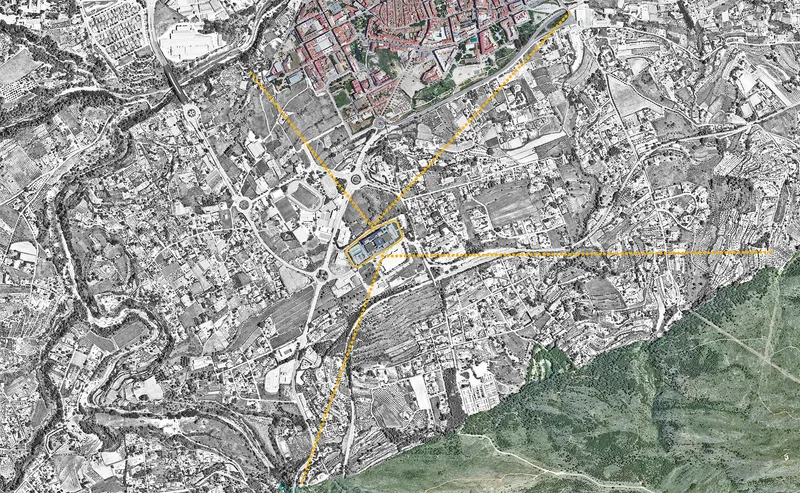
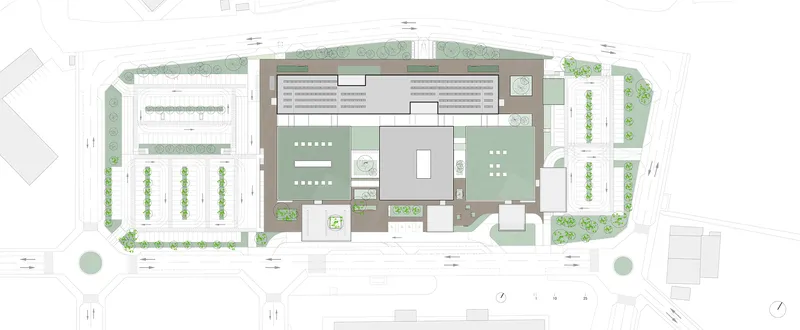
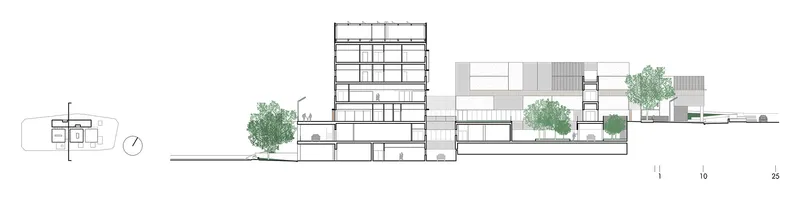
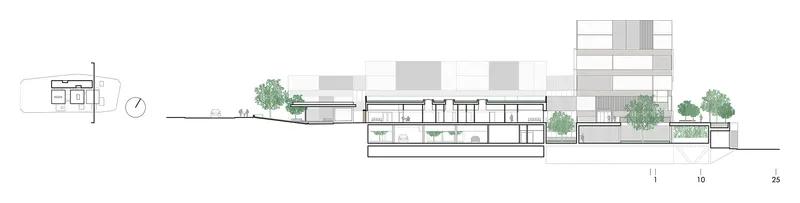
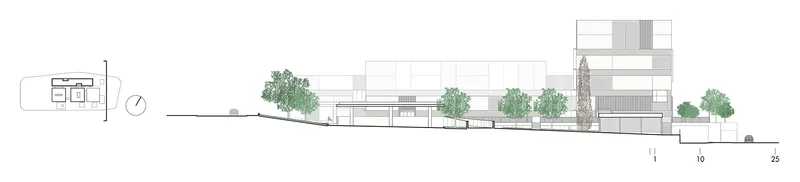
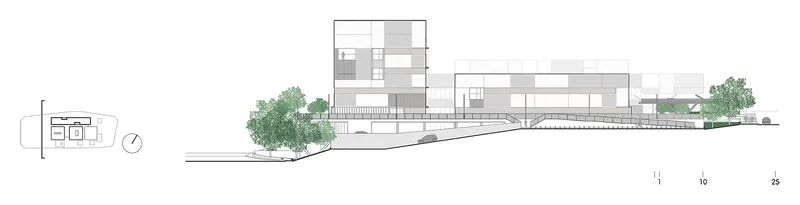
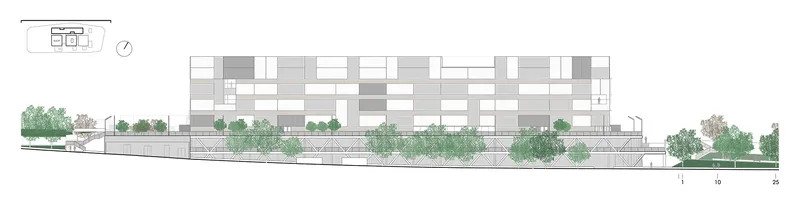
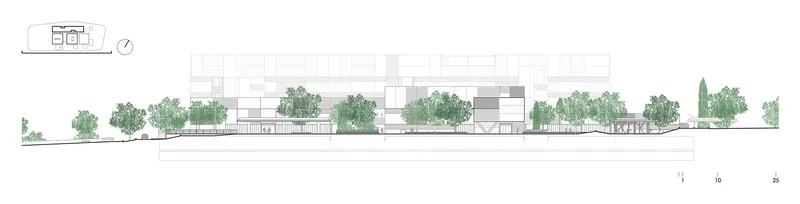
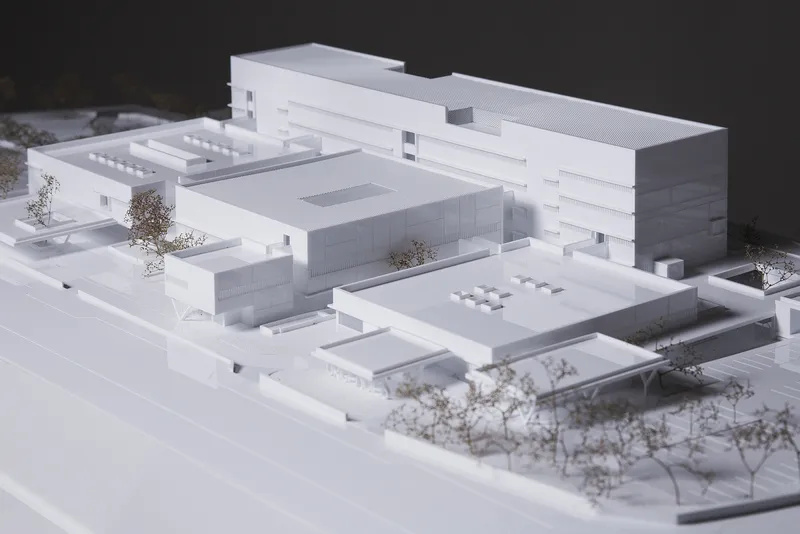
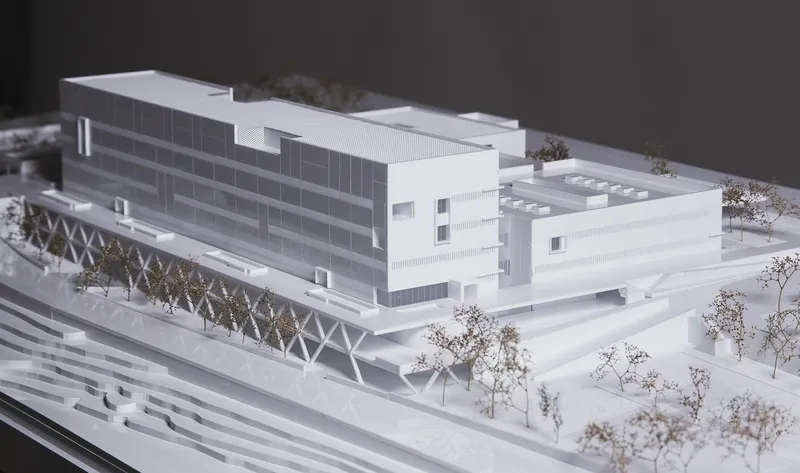
The site plans reveal the logic behind the campus-like distribution: the building complex wraps around internal courtyards with parking pushed to the perimeter, and a highlighted route through the urban fabric suggests the architects thought carefully about how the hospital connects to the town beyond its immediate plot. The sections are especially revealing. They show how the multi-story tower volume steps down to lower horizontal masses, with green roof terraces distributed across the composition at varying heights. One section catches the sloping terrain and a curved entry ramp, confirming that the ground plane is not flat but actively modulated.
The elevation drawings present a long, chequered facade rhythm with planted terraces at the base, while the physical models clarify the massing strategy: white volumes with flat roofs, internal courtyards, and miniature trees that preview the mature landscape. The diagonal truss structure visible in the model view of the multi-story block corresponds directly to the concrete bracing seen in the photographs, confirming that what you see on the street is what the engineers drew.
Why This Project Matters
Hospitals in industrial zones tend to retreat behind parking lots and defensive perimeters, treating their surroundings as a problem to be screened out. The New Ontinyent Hospital does the opposite. By distributing its mass across interconnected volumes, lacing courtyards through the plan, and exposing its concrete structure to the street, the building engages its context honestly. The landscaped ground plane and planted terraces do not erase the industrial setting; they complicate it, introducing a botanical layer that will grow and soften over years while the concrete and metal age on their own terms.
The collaboration between Contell-Martínez Arquitectos and Manuel Vega Arquitectos has produced a building that treats healthcare architecture as a civic opportunity rather than a technical obligation. Patients here are never far from a planted courtyard, a timber ceiling, or a view through a screened facade to the sky. In a discipline where efficiency often trumps experience, that persistent attention to the quality of the spaces between rooms is the project's most valuable contribution.
New Ontinyent Hospital, designed by Contell-Martínez Arquitectos and Manuel Vega Arquitectos. Lead architects: Mª Dolores Contell Jurado and Juan Miguel Martínez López. Located in Ontinyent, Spain. 28,006 m². Completed in 2024. Photography by Alejandro Gómez Vives and David Zarzoso.
About the Studio
Share Your Own Work on uni.xyz
If projects like this are the kind of work you want to make, uni.xyz is a place to publish your own, find collaborators, and enter design competitions.




Popular Articles
Popular articles from the community


Lunar Spiral: Space Architecture Shaped by the Mathematics of the Universe
Lunar Spiral reimagines space architecture through Fibonacci geometry, lunar regolith, levitating habitats, and self-sustaining Moon living.

Co-Life: Senior Housing Design That Reconnects Older Adults With the City
Co-Life reimagines senior housing design through healing gardens, shared streets, workshops, and a sustainable community across generations.

The Earth Pod: 3D Printed Homes for Resilient Refugee Communities
The Earth Pod reimagines refugee housing through 3D printed homes made from clay, combining resilience, self-sufficiency, and rapid shelter.

Riyadh For All: Intergenerational Urban Design for Active Aging in Rabat
Riyadh For All reimagines urban design in Rabat with intergenerational co-living, adaptive courtyards, and Moroccan cultural exchange today.


Similar Reads
You might also enjoy these articles

Bao Huynh Watercolor Atelier: A Serene Art Retreat in Hội An
Bao Huynh Watercolor Atelier in Hội An blends multifunctional art spaces, sustainable design, local materials, and family-friendly living in a serene environment.

Atelier Macri Concept Store Interior Design by CASE-REAL
Atelier Macri store features a "ko" counter, walnut wood details, cork displays, blending retail, gallery, and seamless customer experiences.

Manuel Vargas Izquierdo Stadium and High-Performance Sports Center: Architectural Excellence in Jalpa de Méndez
The Manuel Vargas Izquierdo Stadium blends sustainable design, inclusive sports facilities, and cultural-inspired architecture, revitalizing Jalpa de Méndez’s public spaces.

KAKR Buluh Awar Hall: Revitalizing Community and Ecology Through Bamboo Architecture
Community built bamboo hall revitalizes Buluh Awar village, empowering youth, restoring ecology, celebrating vernacular craftsmanship through sustainable architecture and culture.


Explore Public Building Competitions
Discover active competitions in this discipline



Challenge to design locus for the upliftment of human rights


Challenge to design public laboratory


Design challenge to reuse E-waste
Comments (0)
Please login or sign up to add comments
No comments yet. Be the first to comment!