
Coral Spine: An Angular Lattice Framework Engineered for Reef Regeneration
A triangulated underwater scaffold creates protected coral nurseries within geometric openings, merging structural logic with marine ecology.


Coral reefs don't need monuments. They need scaffolds. Coral Spine starts from that premise, proposing a triangulated lattice framework that doesn't mimic reef geometry but instead creates the precise spatial conditions for reef life to reclaim territory. The design reads as part infrastructure, part organism: angular, repetitive, and deliberately porous, it frames circular voids that function as protected nurseries where coral colonies can establish and grow without the pressures of open-water exposure.
Designed by Carlos Hernandez for the Underwater Web competition, Coral Spine addresses the accelerating loss of reef ecosystems through a structure that operates at the intersection of architecture and marine biology. Rather than a singular object dropped onto the seabed, the project envisions a modular system that can extend laterally, adapting to different reef topographies and degradation conditions. The result is a framework that performs structurally above and below the waterline, acknowledging that reef restoration is as much a spatial problem as it is a biological one.
Structural Iterations: From Geometry to Growth Logic


The design's formal language emerges from a clear iterative process. A sequence of structural diagrams traces the evolution of the angular lattice, beginning with simple triangulated modules and progressing toward a more complex, interlocking framework. Each iteration refines the relationship between solid members and void, calibrating the ratio of scaffold to open water. The plan drawing below reveals how these iterations resolve into a coherent layout: circular openings of varying diameter punctuate the lattice grid, each one sized to accommodate different stages of coral growth.
What's notable here is the growth sequence diagrammed at the bottom of the plan. Hernandez maps out how coral colonization would progress within these openings over time, moving from initial substrate attachment to full canopy coverage. The geometry isn't arbitrary; the circular voids concentrate water flow and light penetration in ways that accelerate biological recruitment. The lattice members themselves become substrates, their angular surfaces offering attachment points that flat or curved alternatives would not.
Above and Below: A Structure That Reads Differently at the Waterline

The nighttime rendering captures something essential about the project's dual identity. Above the surface, Coral Spine registers as a series of triangulated peaks, sharp and geometric against the sky. A small boat passes beneath, establishing scale and suggesting that the structure accommodates human navigation alongside ecological function. The floating geometry feels almost infrastructural, more breakwater than sculpture. But everything changes below the waterline, where those same triangulated forms dissolve into a submerged lattice teeming with biological possibility. The project refuses to be read from a single vantage point.
Coral Gardens Framed by Geometry


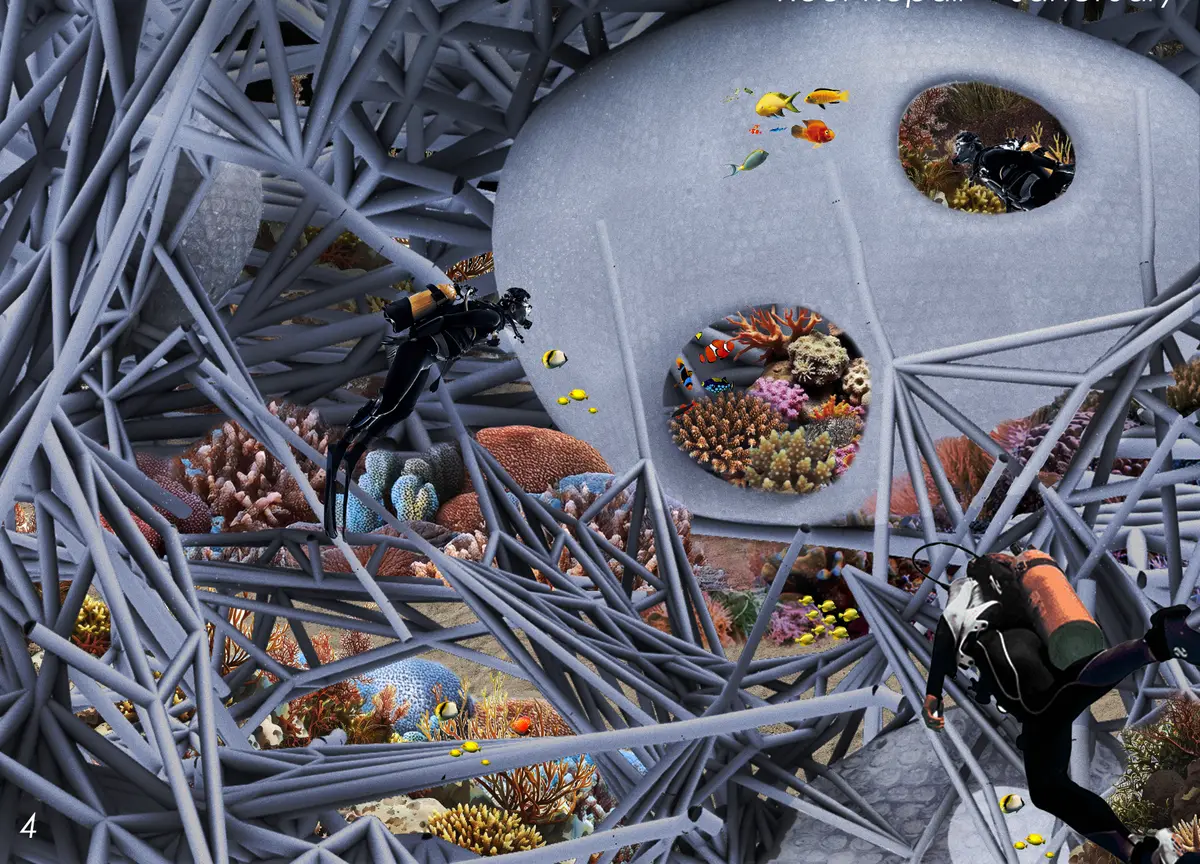
The aerial and underwater perspectives deliver the project's most compelling argument. From above, the lattice reads as a rigid, almost crystalline grid, but the circular openings it surrounds overflow with organic color: coral in pinks, oranges, and greens, fish schooling in loose clouds, divers navigating between the geometric and the biological. The contrast between the angular framework and the soft, irregular forms of marine life within it is striking. The structure doesn't dominate its inhabitants; it defers to them.
The top-down view of divers exploring the triangulated corridors reinforces the scale of the intervention. These are not small reef modules; they are architectural environments large enough to swim through, creating spatial sequences that shift from tight lattice passages to open coral gardens. The design suggests that restoration at this scale requires not just surface area for coral attachment but volumetric complexity, the kind of three-dimensional habitat structure that supports the full food web from juvenile fish to apex predators.
Why This Project Matters
Coral Spine stands apart from many reef restoration proposals because it treats the problem as fundamentally architectural. Too often, underwater interventions default to either sculptural gestures or simple block substrates. Hernandez's approach is more rigorous: the triangulated lattice is structurally efficient, modular, and calibrated to the biological processes it intends to support. The circular openings aren't decorative; they're functional nurseries whose geometry shapes water movement, light access, and species recruitment patterns.
The project also raises a productive question about the role of permanence in ecological design. The lattice is clearly engineered to persist, but its success is measured by how thoroughly it disappears beneath living coral. Architecture here is not the end product but the catalyst, a framework that succeeds precisely when it becomes invisible under layers of biological growth. For a competition focused on the underwater web, that inversion of architectural ambition feels exactly right.
View the Full Project
About the Designers
Designer: Carlos Hernandez
Enter a Design Competition on uni.xyz
uni.xyz runs architecture and design competitions year-round that reward proposals with spatial conviction and real site intelligence.
Project credits: Coral Spine by Carlos Hernandez Underwater Web (uni.xyz).


Popular Articles
Popular articles from the community


longwave studio Reorganizes a 112 m² Tainan Apartment Around the Daily Routines of a Family and Two Cats
In Tainan, Taiwan, birch plywood, rust-red furniture and a freestanding plaster wall link arrival, storage, work and family life in one apartment.

David Ortega Stacks a Two-Story Mexico City Penthouse Around a Steel Stair and a Pergola-Shaded Roof Terrace
In Colonia Roma, a 300 m² penthouse uses oak joinery, a planted steel stair and a slatted roof pergola to make a new-build apartment feel like a house.

Juan García Correa, John González and Claudia Rueda Sink a Circular Amphitheater into a Manizales Engineering Building
On the La Nubia campus in Manizales, Colombia, the S1 Building folds labs and offices into a hillside of ramped lawns that double as a campus route.

David Macias Steps a Doorless Stone and Plaster House Down a Tropical Colombian Hillside
In the humid hills of Colombia, Threshold House replaces the front door with an open void and terraces its 850 m² down the slope instead of fighting it.

Similar Reads
You might also enjoy these articles


Vereda Arquitetos Renovates a 40-Square-Meter Apartment Inside Niemeyer's Copan Building
A compact unit in São Paulo's most iconic residential tower gets a material overhaul that pairs exposed concrete with bold blue Formica.

Shakur's House: Exposed Brick as an Interior Organiser in a 168 m² Mashhad Residence
Brick moves indoors in this Mashhad residence, where masonry walls, glass partitions and teal planes sequence a compact home without closing it off.

Day and Night Park: A Time-Based Urban Newsstand in Beijing
A temporary urban newsstand in Beijing blending travel, light, and reading through poetic colors, compact form, and community-focused design.

Modernist Patio Renovation in El Masnou, Barcelona by Oliver Segura Arquitectura + Cebrià Arquitectura
Modernist patio renovation blending tradition and innovation with a movable pool, leveled floors, and Catalan materials in El Masnou.

Comments (0)
Please login or sign up to add comments
No comments yet. Be the first to comment!