
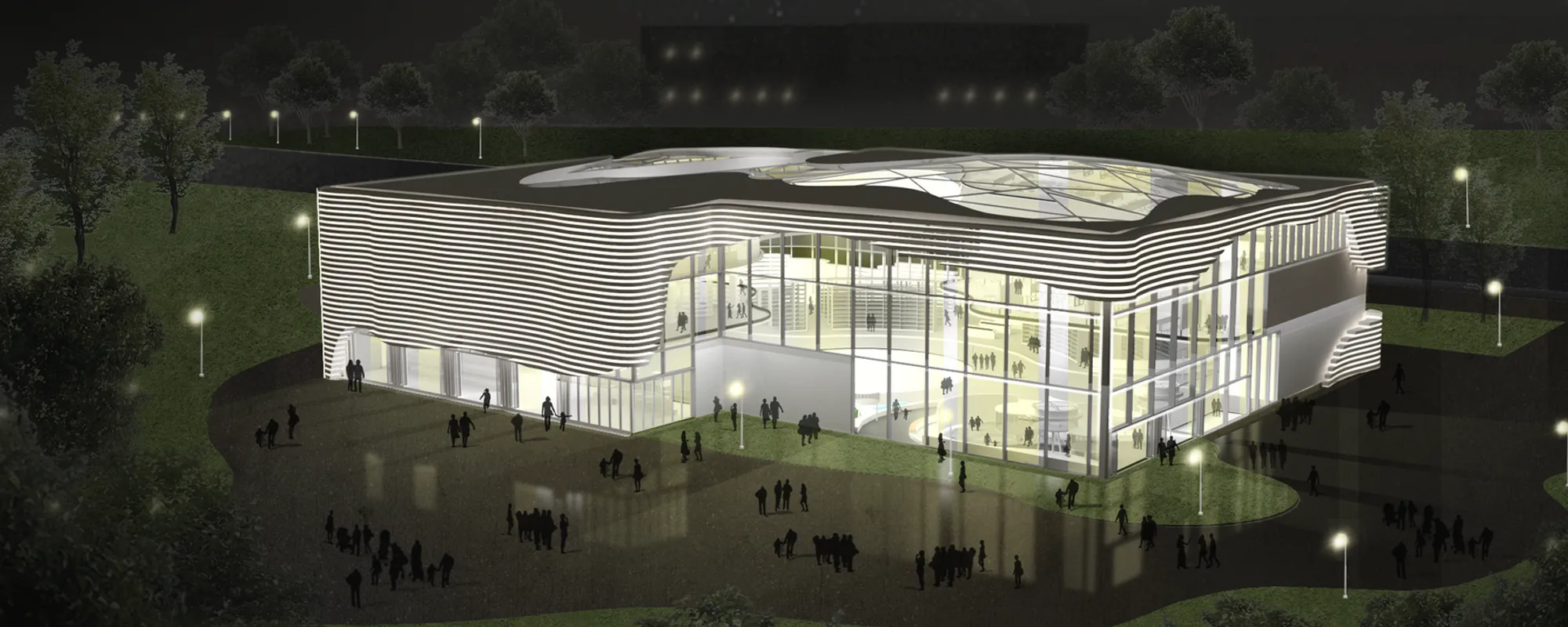
Core: A Library Modeled on the Human Heart's Circulatory Logic
An honorable mention in Libgen 2019, Core organizes every programmatic layer around a central nucleus that pumps knowledge through the city.


What if a library worked like a heart? Not as metaphor alone, but as organizational logic: a central chamber that pumps activity outward through connected vessels, each carrying a different kind of nourishment back to the urban body it serves. Core takes that analogy and builds it, literally, into a curvilinear structure where every programmatic zone orbits a singular nucleus called the Main Core. The result is a building that refuses to sit still, channeling visitors through children's zones, lecture halls, media centers, working spaces, a hotel, and a rooftop garden in one continuous circulatory loop.
Designed by 윤규 최, 예은 유, and Minyoung Choi, Core received an Honorable Mention in the Libgen 2019 competition. The brief asked designers to rethink the library for a digital age, and this team responded by positioning the library not as a repository but as a vital organ within the urban fabric, one whose failure would mean the city loses its pulse.
A Nucleus That Radiates Upward Through Stacked Social Layers
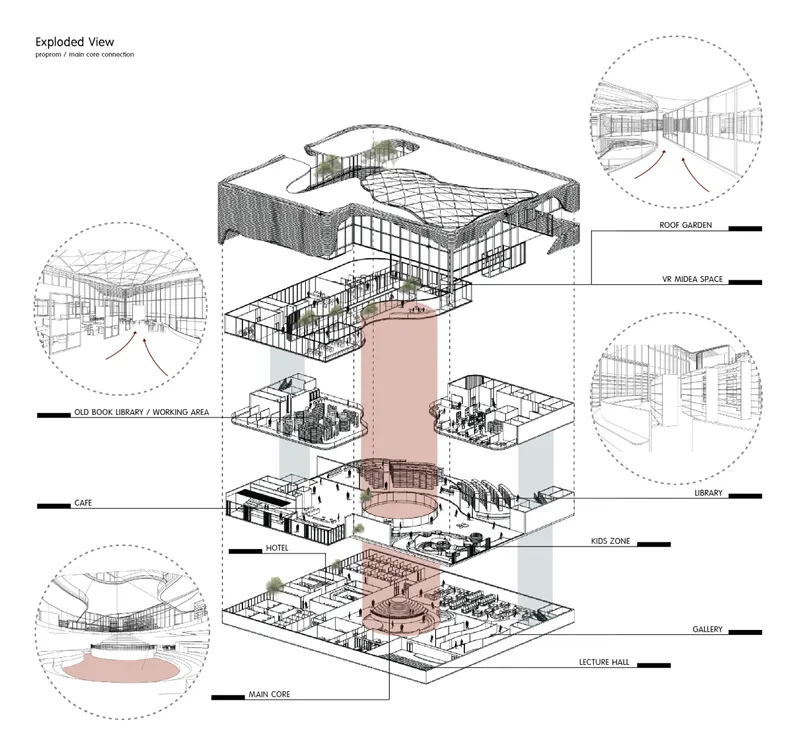
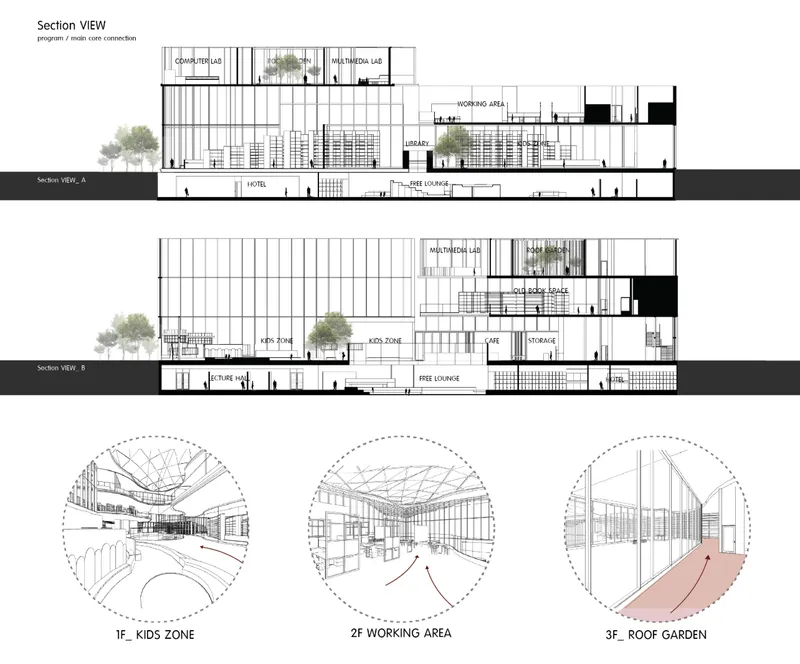
The exploded axonometric drawing makes the organizational strategy immediately legible. At the base sits the Main Core, the dense gravitational center from which every other program spirals outward and upward. Stacked above it are cultural and social nodes: library floors, a lecture hall, working spaces, a hotel component, and finally the open-air roof garden that crowns the structure. Each level is labeled and offset to show how it connects to the central spine, revealing a vertical logic that ensures no floor exists in isolation. The section drawing beside it confirms this reading from a different angle, showing how trees penetrate interior spaces and how the building breathes vertically, drawing natural light and greenery deep into its core.
Soft Geometry Against a Mountain Backdrop
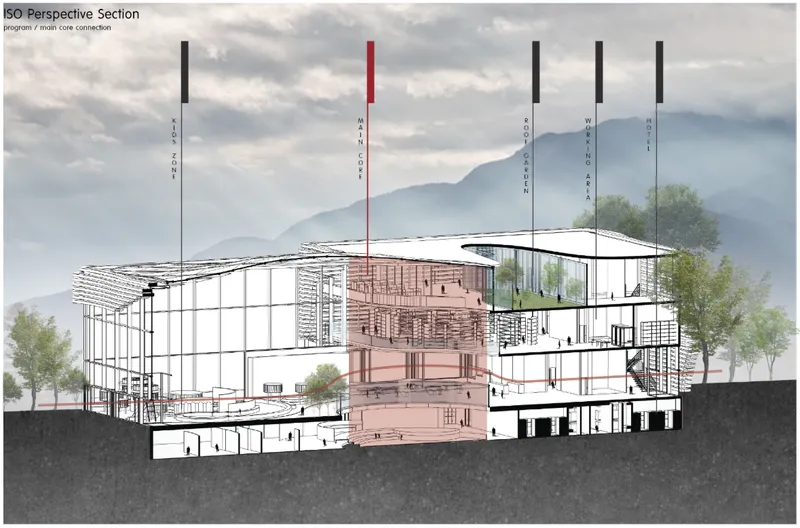
The perspective section is the project's most evocative image. A sweeping roof curves over layered interior volumes while misty mountains recede behind the building, placing Core in a landscape context that reinforces its organic ambition. The curvilinear façade, which the designers describe as mimicking the organic structure of the human heart, avoids hard edges in favor of flowing surfaces that promote fluid movement inside. Transparency dominates: walls dissolve into glass, and the boundary between interior learning space and exterior landscape softens to the point of near-erasure. The layered section beneath the roof shows how different programs stack and overlap, creating visual connectivity between floors so that a visitor on one level can always sense the activity happening on another.
Curved Ceilings and Collective Space at the Atrium Scale

Inside the double-height atrium, the curved ceiling becomes the dominant spatial feature. It arcs overhead in a continuous surface that pulls the eye forward and around, refusing the grid logic of conventional library interiors. People sit at white tables beneath this canopy, and the rendering captures a quality the designers clearly prioritized: collective belonging. The space is generous without being cavernous, scaled to encourage proximity between strangers. Light enters from multiple directions, washing the curved surfaces and lending them a warmth that counteracts the institutional coldness libraries often default to.
The Ground Floor as Urban Living Room
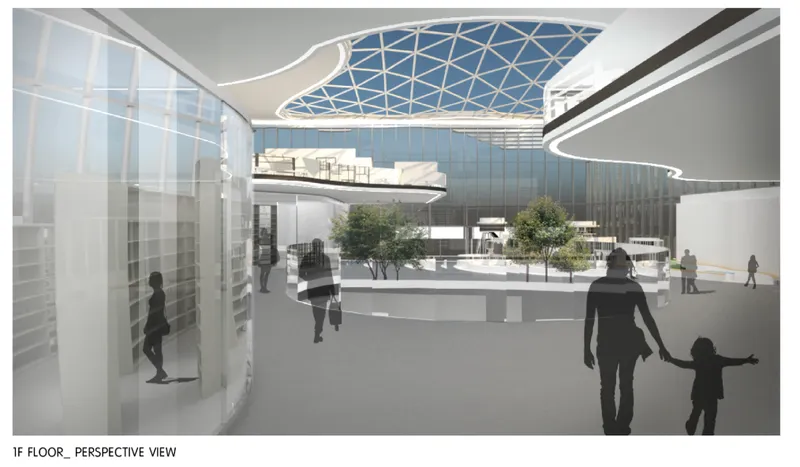
The ground floor rendering grounds the entire concept in a simple, powerful image: an adult holding a child's hand as they walk through a central courtyard planted with trees. This is the Main Core made tangible. It is not a lobby or a circulation desk; it is an urban living room, open and planted, where the building meets the city on equal terms. The site analysis behind the design studied weather patterns, overlapping community zones, and accessibility mapping to ensure this ground plane would be embedded in daily urban rhythms rather than set apart from them. Trees grow inside the courtyard, blurring the distinction between park and institution.
This is where Core's heart metaphor becomes most convincing. The ground floor is the left ventricle, the chamber that pushes oxygenated blood to the entire body. Every visitor who enters this courtyard is drawn into the building's circulatory system, carried upward through learning, culture, work, and rest before arriving at the rooftop garden for contemplation and release.
Why This Project Matters
Biological metaphors in architecture can easily remain superficial, producing buildings that look vaguely organic but function conventionally. Core avoids that trap by letting the heart analogy govern the plan, the section, and the circulation strategy simultaneously. The Main Core is not a decorative gesture; it is a spatial device that forces every programmatic element to maintain a relationship with the center, producing the kind of visual and physical connectivity that makes a building feel alive rather than assembled from parts.
For a competition asking what a library should become in the digital age, this team's answer is pointed: a library should become the organ the city cannot survive without. By stacking social, cultural, educational, and contemplative programs around a single circulatory spine and grounding the whole composition in an accessible, planted courtyard, 윤규 최, 예은 유, and Minyoung Choi make a case for the library as infrastructure, not amenity. Core does not store books. It circulates people, and in doing so, it circulates the knowledge, connection, and culture that keep a community's pulse steady.
View the Full Project
About the Designers
Designers: 윤규 최, 예은 유, Minyoung Choi
Enter a Design Competition on uni.xyz
uni.xyz runs architecture and design competitions year-round that reward proposals with spatial conviction and real site intelligence.
Project credits: Core by 윤규 최, 예은 유, Minyoung Choi Libgen 2019 (uni.xyz).



Popular Articles
Popular articles from the community


Conexión: Biophilic Design Reimagines High-Rise Living in Hong Kong
Conexión reimagines high-rise living in Hong Kong through biophilic design, green facades, shared spaces, daylight, water and nature within.

Play: Fragments of Their World
Familiar architecture becomes modular playground design, creating safe spaces where displaced children can learn, connect, imagine and play.

Hill & Cross Opera: Sculptural Opera House Architecture Shaped by Tallinn’s Landscape and Identity
Hill & Cross Opera reimagines opera house architecture in Tallinn through its sculptural hill, civic plaza, glass wave and a luminous cross.

The Ocean Hive: Sustainable Architecture for a Self-Sufficient Civilization at Sea
The Ocean Hive imagines sustainable architecture at sea, where modular habitats, algae, wave power and ocean waste sustain a growing colony.
Similar Reads
You might also enjoy these articles

Day and Night Park: A Time-Based Urban Newsstand in Beijing
A temporary urban newsstand in Beijing blending travel, light, and reading through poetic colors, compact form, and community-focused design.

Modernist Patio Renovation in El Masnou, Barcelona by Oliver Segura Arquitectura + Cebrià Arquitectura
Modernist patio renovation blending tradition and innovation with a movable pool, leveled floors, and Catalan materials in El Masnou.

Alto Residencial Coop: Cooperative Housing Development in Santiago de Compostela by Carbajo Barrios Arquitectos
A linear cooperative housing complex blending white volumes and perforated metal façades, enhancing community living, natural light, privacy, and urban integration.

Vil Genis School by BPA ARCHITECTURE – Massy, France
Vil Genis School in Massy, France, features sustainable design, south-facing classrooms, community integration, accessible spaces, and modern educational architecture.


Explore Community-Driven Architecture Competitions
Discover active competitions in this discipline



Challenge to design public laboratory


Challenge to design luxury tourism on rails


VR headsets Storefront design competition

Designing a staircase for a client
Comments (0)
Please login or sign up to add comments
No comments yet. Be the first to comment!