
Counterspace Resurrects Lost Gathering Spaces in Doha
Sumayya Vally's installation for Art Basel Qatar channels demolished sites of assembly across the Muslim world into sculptural form.


What does it mean to mourn a space? Not a building as monument, not a heritage site preserved in amber, but the social architecture of gathering: the courtyard where strangers became companions, the plaza where poetry was exchanged, the threshold between public and private life. At the inaugural Art Basel Qatar, Sumayya Vally and her Johannesburg-based studio Counterspace attempt an answer with In the Assembly of Lovers, an installation that conjures the ghosts of demolished, erased, or abandoned gathering places across the Muslim world.
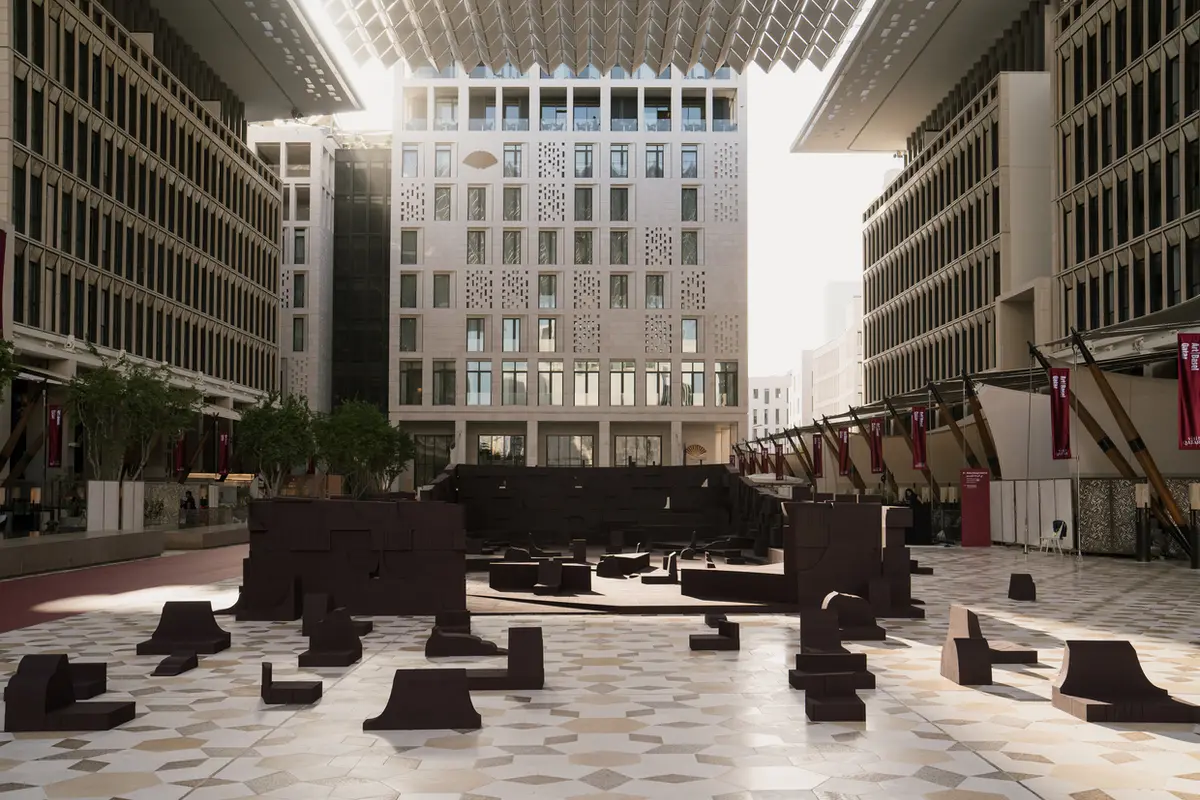
Situated within Doha's urban fabric, the project refuses the polished spectacle one might expect from an art fair commission. Instead, it operates through weight, shadow, and tactile encounter. Dark sculptural seating elements populate a public courtyard, their forms neither furniture nor monument but something between the two. Perforated stone facades, patterned paving, and narrow passages build an atmosphere that is less about looking and more about occupying. The installation is, at its core, an argument that architecture's most radical potential lies not in form but in congregation.
Bodies in Orbit

The primary gesture of the installation is the scattering of dark brown, almost bronze, sculptural objects across a stone plaza. These are not arranged on a grid or axis. They sit in loose constellations, like people who have gathered without a plan, drawn together by proximity and curiosity rather than by instruction. A stepped amphitheater wall rises along one edge, suggesting a stage or a place of address, but there is no clear front or back.
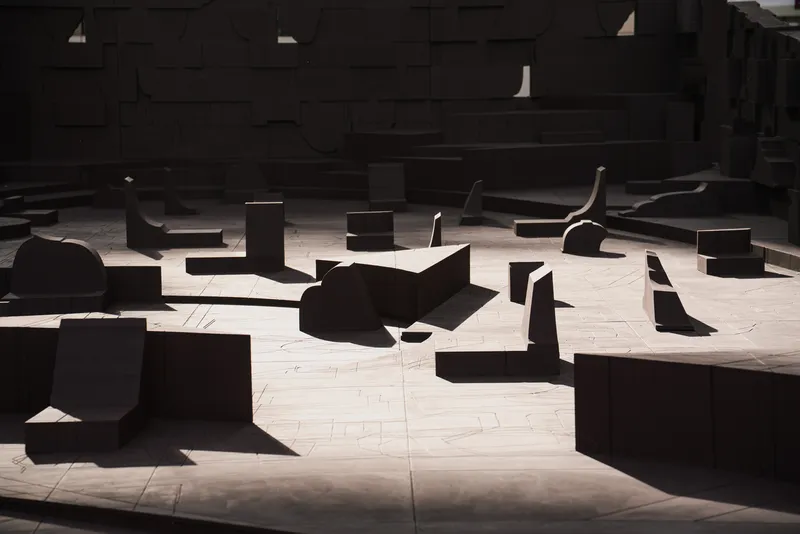
Seen in strong afternoon light, the elements cast long, sharp shadows across the pale paving. The silhouettes become a second drawing on the ground, doubling the population of the plaza. Vally understands that in hot climates, shadow is not decoration; it is infrastructure. The way these objects carve space from sunlight turns passive occupation into a physical negotiation with the environment.
The Threshold Condition
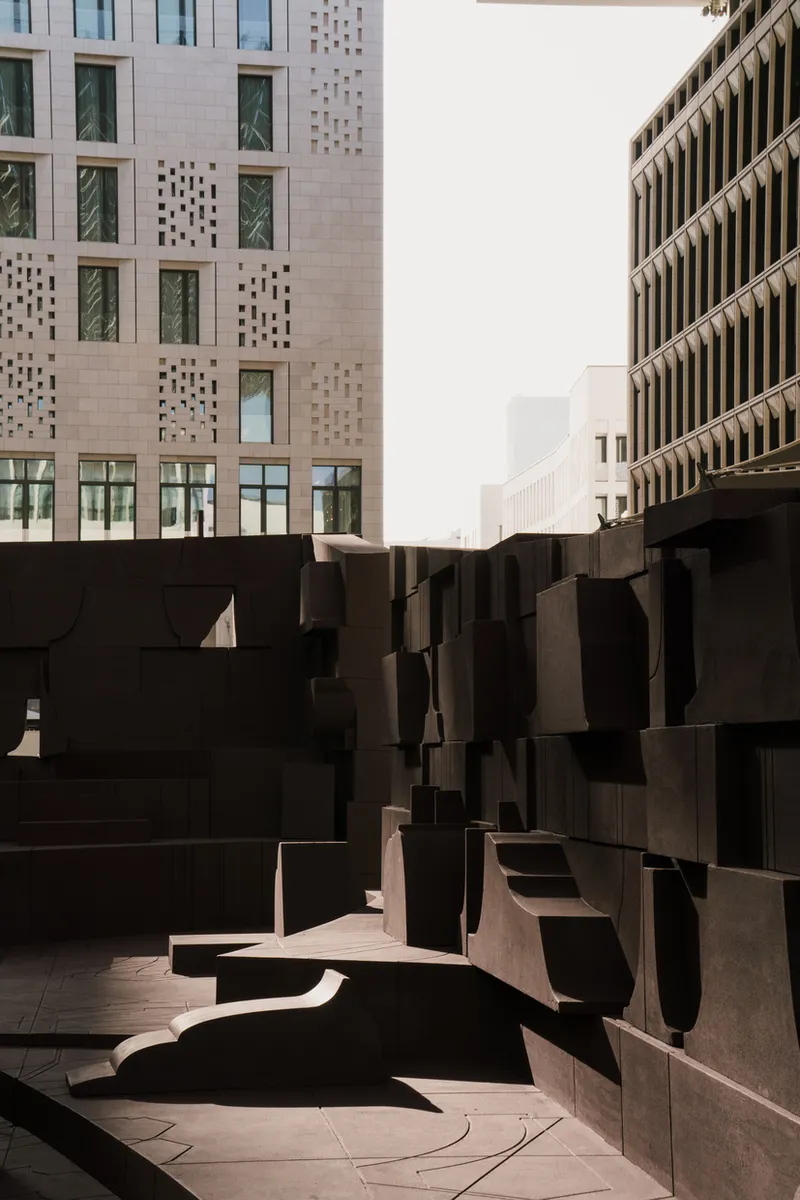
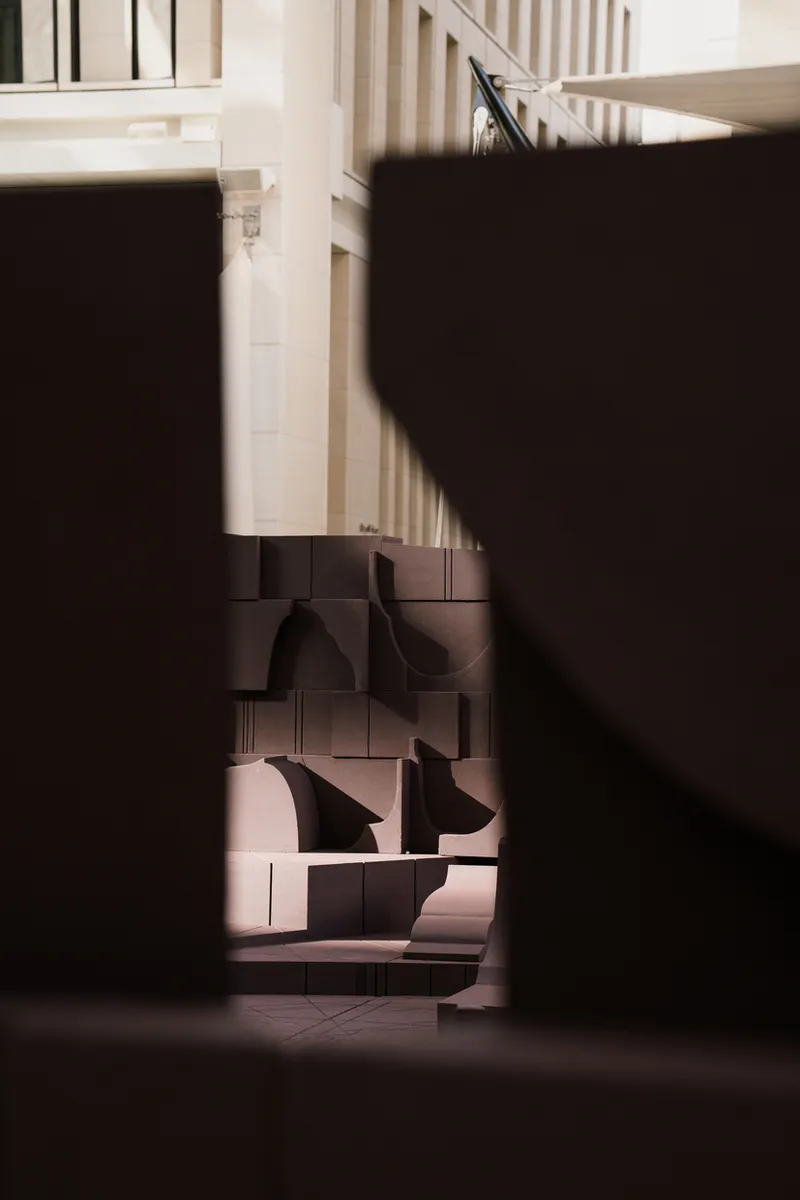
Counterspace has always been interested in edges: the places where one world slides into another. Here, narrow passages form between the sculpted seating blocks, creating moments of compression before the courtyard opens up again. You move through the installation the way you would move through a souk or a caravanserai, never quite sure when a corridor will release you into a clearing.
The perforated facades visible beyond the sculptural elements reinforce this reading. Light filters through stone screens, dappling the interior ground plane and blurring the line between enclosure and exposure. In one view, a striped building facade appears in the bright background like a stage flat, reminding you that this is an installation embedded within a real city, not sealed off from it. The haze of Doha's atmosphere only amplifies the sense of spatial ambiguity.
Material Memory
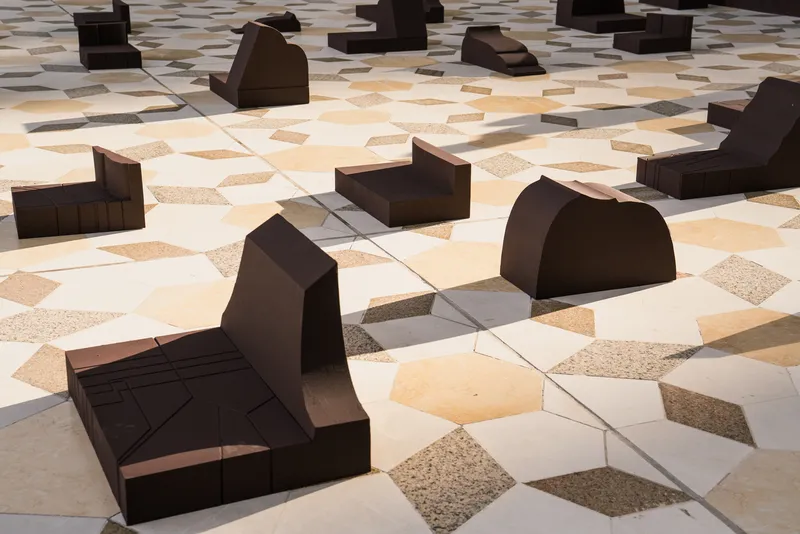
The ground plane deserves close attention. A geometric paving pattern interweaves stone and terrazzo tiles in a composition that references Islamic geometric traditions without replicating any single source. The dark bronze sculptural forms sit on top of this surface rather than growing from it, as if they have arrived from elsewhere and settled here temporarily. The tension between permanent ground and provisional object is deliberate.
At close range, the curved metal seating elements reveal their craftsmanship. They are not smooth or polished to a gallery finish. Their surfaces hold warmth in the afternoon sun, and their profiles suggest eroded stone or hand-shaped clay more than industrial fabrication. Vally has spoken about sourcing material and formal references from spaces that no longer exist. These objects carry that sense of displacement: they are simultaneously present and elegiac.
Testing the Idea at Scale


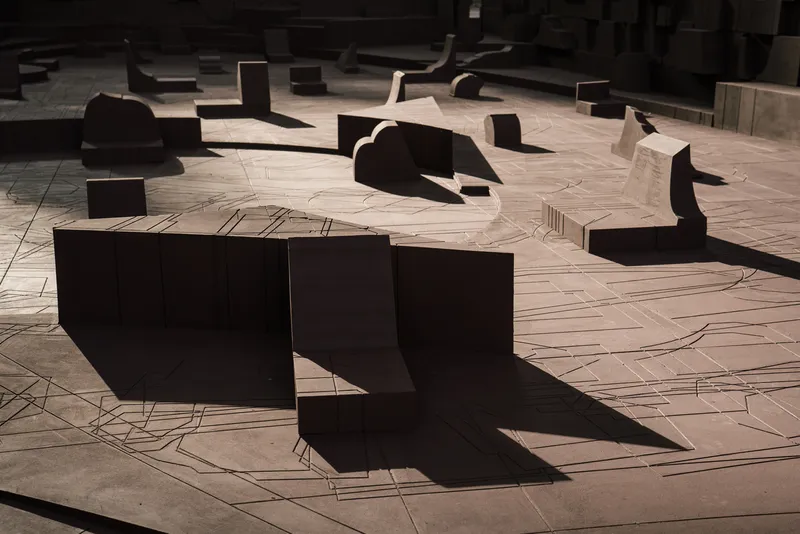
Two physical models reveal the thinking behind the installation's spatial logic. One, photographed under dramatic artificial lighting, shows interlocking angular volumes and courtyards that explain the project's massing. The other, a cardboard study model, features scalloped canopy elements viewed through a circular opening, evoking the kind of domed or vaulted interiors found in historic hammams, mosques, and madrasas.
These models matter because they demonstrate that Counterspace did not simply scatter objects in a plaza. The installation is excerpted from a larger spatial imagination, a fragment of a building type that could exist but does not, a composite of lost precedents. The circular aperture in the cardboard model is especially telling: it positions the viewer as a voyeur peering into a remembered interior, reinforcing the project's theme of absence and reconstruction.
Plans and Drawings


An axonometric drawing explodes the installation into its constituent layers: the patterned base plane, the structural supports, and the canopy elements above. The separation makes legible what is deliberately illegible in person, showing how the ground pattern, the seating objects, and the overhead elements relate to one another as a coordinated system rather than as isolated gestures.
The composite plan drawing is the most revealing document. It overlays multiple floors, columned halls, and curving interior walls in a single image, collapsing the plans of various referenced gathering spaces into one hybrid drawing. It reads as a palimpsest, a record of buildings that once existed rendered simultaneously and on top of one another. For Vally, the plan is not a technical document; it is an act of mourning and reclamation.
Why This Project Matters
Art fair installations can be thankless commissions. They operate under commercial pressure, tight timelines, and the expectation that architecture will serve as a photogenic backdrop for socializing and sales. In the Assembly of Lovers resists that framing by insisting on its own content. It is about something specific: the systematic erasure of communal spaces across the Muslim world, from Ottoman-era gathering halls to mid-century modernist civic plazas that have been demolished or privatized. The installation does not illustrate this thesis with wall text and timelines. It embodies it in form and atmosphere.
More broadly, the project extends Counterspace's ongoing investigation into how architecture can carry historical memory without resorting to pastiche or spectacle. Vally, who gained international attention through the 2021 Serpentine Pavilion, continues to refine a practice that treats lost spaces as living sources rather than nostalgic references. In Doha, a city often discussed in terms of wealth, novelty, and speed, her work asks a slow and uncomfortable question: what was here before, and what did we lose when it disappeared?
In the Assembly of Lovers, Art Basel Qatar by Counterspace (Sumayya Vally). Doha, Qatar, 2026. Installation and cultural architecture.
About the Studio
Share Your Own Work on uni.xyz
If projects like this are the kind of work you want to make, uni.xyz is a place to publish your own, find collaborators, and enter design competitions.


Popular Articles
Popular articles from the community


Manzana Morphosis: Stretching Barcelona's Grid into a Living Landscape for 2050
A radical reworking of the Eixample manzana turns density into a tool for generous public space, vertical ecology, and environmental performance.


David Ortega Stacks a Two-Story Mexico City Penthouse Around a Steel Stair and a Pergola-Shaded Roof Terrace
In Colonia Roma, a 300 m² penthouse uses oak joinery, a planted steel stair and a slatted roof pergola to make a new-build apartment feel like a house.

FCC Arquitectura Expands a Portuguese Granite House with a Board-Marked Concrete Wing
In Portugal, JV House pairs a cleaned-up whitewashed and granite dwelling with a timber-shuttered concrete extension, courtyards and a garden pool.

ETEH Reworks the Shared Spaces of São Domingos School in Brazil Around Timber, Color and Hanging Plants
At São Domingos School in Brazil, 436 m² of hall, refectory and library are recast with timber joinery, a yellow and blue code and trailing greenery.

Similar Reads
You might also enjoy these articles

LAVA Architecten Gives Vocational Education a Sawtooth-Roofed Face on a Mechelen School Campus
In Mechelen, Belgium, a 2,053 m² STEM school on a 6×6 m grid turns workshops and classrooms into rooms that can be rearranged as teaching changes.

KEMA Studio Turns a Derelict Marvila Attic into a 60 m² Lighthouse Apartment Above Lisbon
In Lisbon's Marvila district, a rebuilt roof, four skylights and two plywood volumes turn an unlivable attic into a bright home facing the Tagus.

Pixel Gardens: One Repeated Module Stacked Into a Terraced Social Housing Tower for Famagusta
Salem Bader's shortlisted housing tower builds a vertical neighbourhood from one repeated module, offsetting units to carve terraces, light and air.

Bao Huynh Watercolor Atelier: A Serene Art Retreat in Hội An
Bao Huynh Watercolor Atelier in Hội An blends multifunctional art spaces, sustainable design, local materials, and family-friendly living in a serene environment.

Explore Mourning Spaces Competitions
Discover active competitions in this discipline

Challenge to design a portable theatre

Challenge to design a portable music platform

Challenge to design an open learning module for the elderly
Comments (0)
Please login or sign up to add comments
No comments yet. Be the first to comment!