
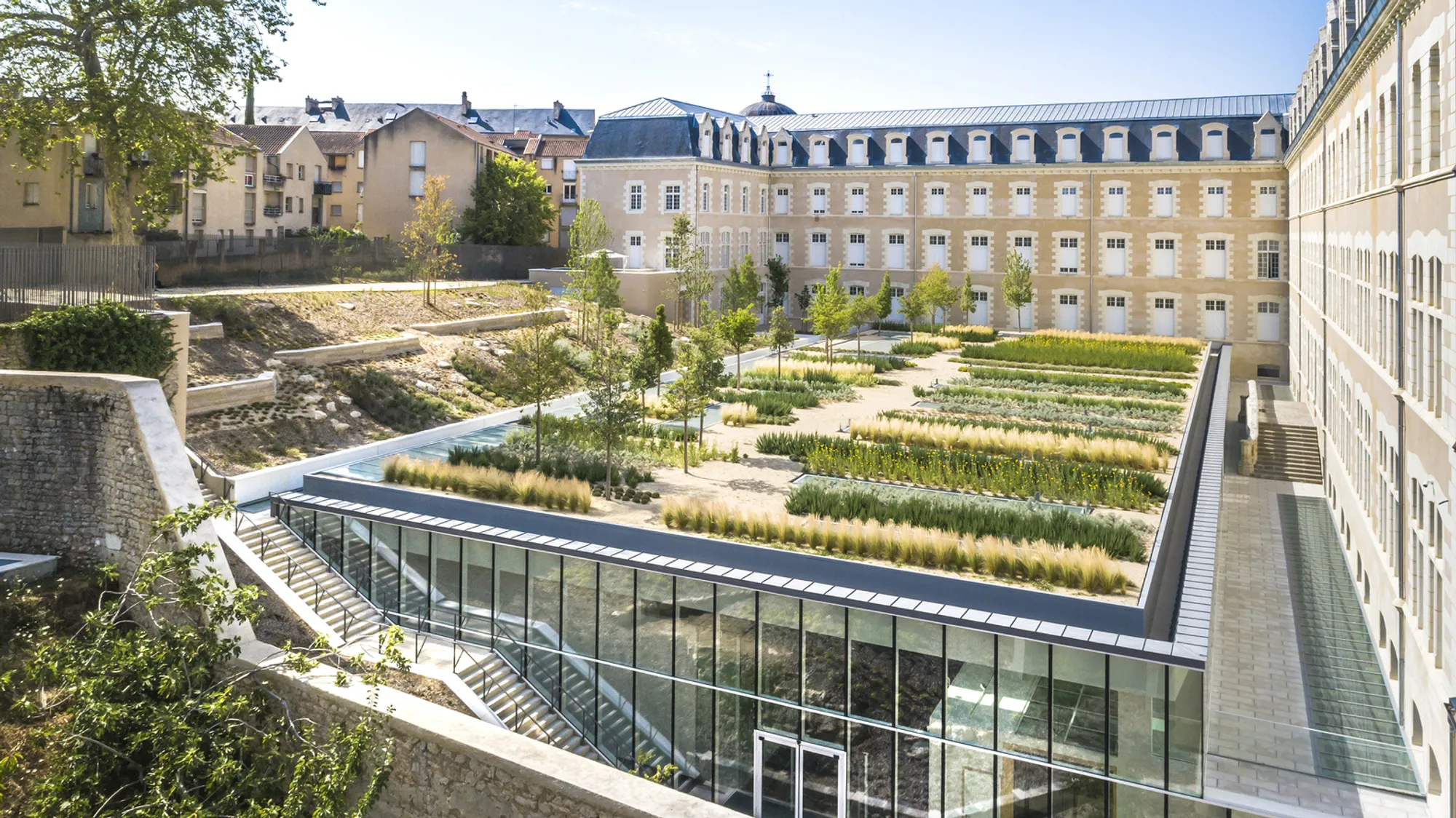
Courthouse of Poitiers by B+A Architectes – A Fusion of Heritage Preservation and Contemporary Judicial Architecture
Historic Neo-Gothic school transformed into modern courthouse, blending heritage preservation, judicial functionality, and contemporary design beneath a landscaped garden roof.


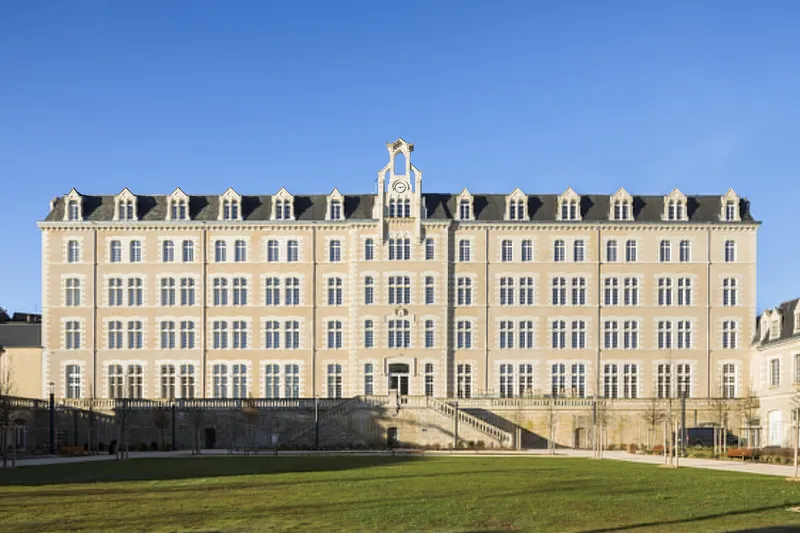
The Courthouse of Poitiers byB+A Architectes is a striking example of how heritage preservation and modern public architecture can coexist in perfect harmony. Located in the historic heart of Poitiers, France, the project transforms a 19th-century Neo-Gothic Jesuit school into a state-of-the-art judicial facility that unites multiple jurisdictions under one roof.
This 14,300-square-meter redevelopment preserves the symbolic gravitas expected of a courthouse while introducing functional innovations that meet the demands of a contemporary judicial system. The design balances architectural monumentality, functional efficiency, and public accessibility—all within a building that holds deep cultural significance for the local community.
From Jesuit School to Unified Judicial Center
The original building, constructed in 1864, was once a bustling educational institution for generations of Poitiers’ children. Abandoned for safety reasons, the school’s imposing structure sat quietly against the hillside of the city center, a powerful but dormant part of the urban fabric.
The Ministry of Justice initiated the transformation to consolidate Poitiers’ scattered courts, enhancing efficiency and interconnectivity. However, the challenge lay in converting a protected heritage site—designed for seclusion—into an open civic space that could embody the principles of transparency, fairness, and accessibility inherent to the judicial system.
Architectural Strategy – Integrating Old and New
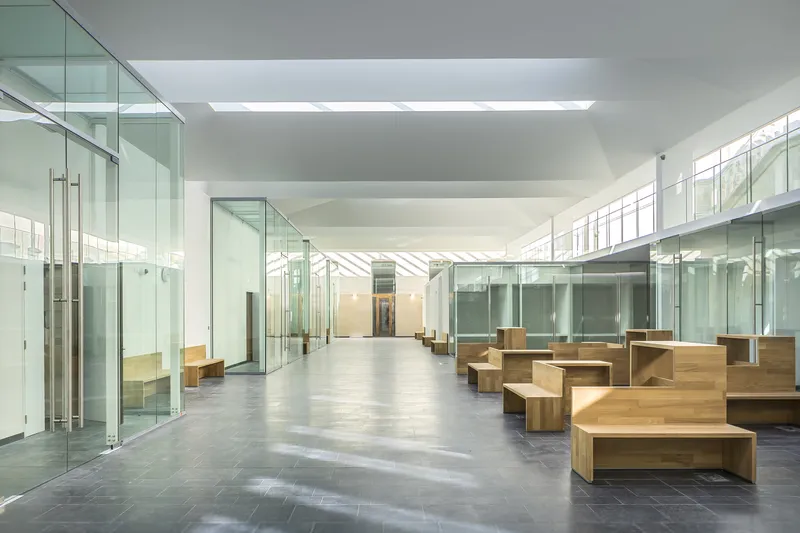
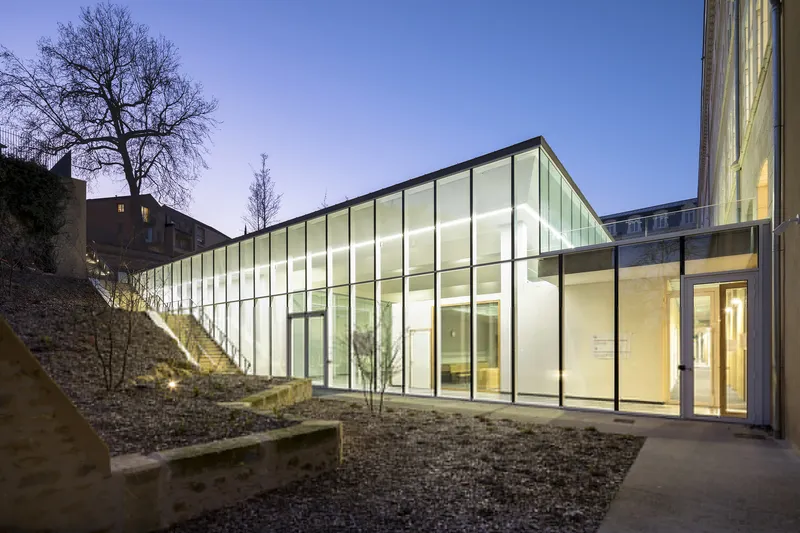
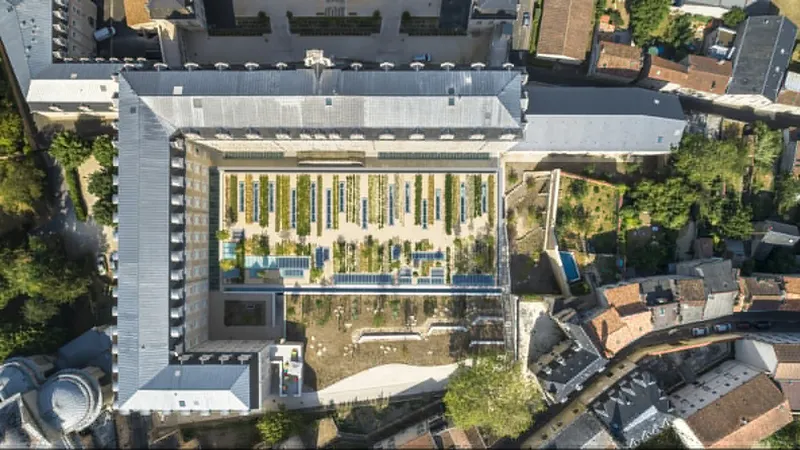
Rather than altering the original historic volume, B+A Architectes introduced a contemporary underground extension beneath the central garden. This addition houses 21 public courtrooms, a spacious waiting hall, and circulation routes for judges, defendants, and the public—ensuring separate, secure movement for each group without compromising heritage integrity.
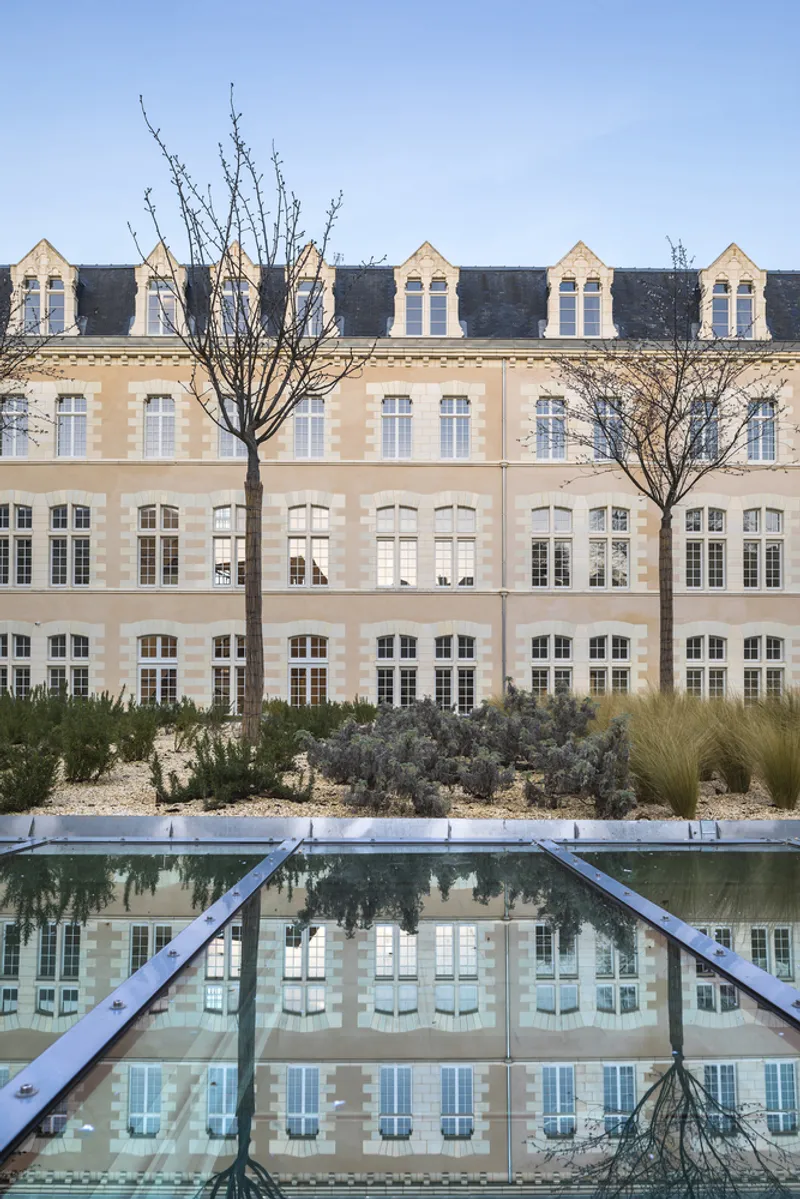
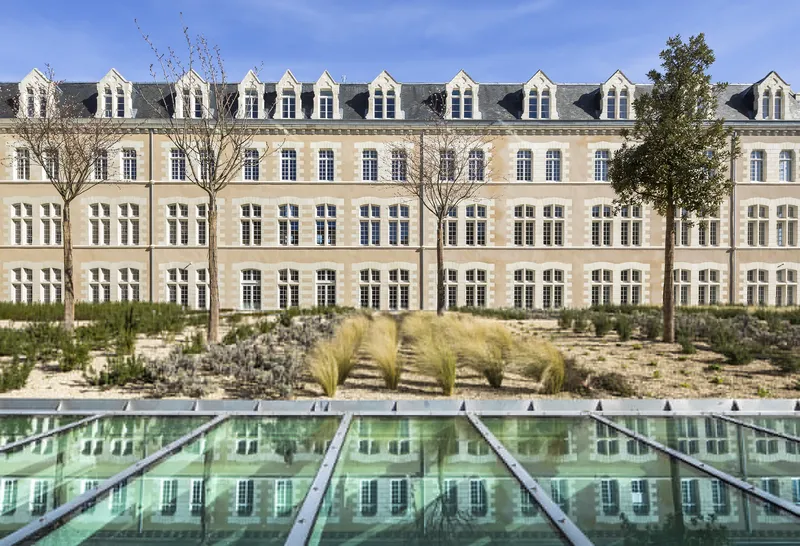
The new structure is topped with a planted roof and strategically placed skylights, which double as part of the landscape design while bringing abundant natural light into the subterranean courtrooms. The roof’s folded slab design provides the structural rigidity to span the main hall while incorporating soil layers for the garden above. Its angled ceiling diffuses sunlight and optimizes acoustic performance.

Materiality and Design Language
Inside the extension, limestone wall cladding recalls the rock layers removed during construction, creating a visual connection between the building’s modern intervention and its geological and historical context.
In the historic building, former classrooms have been converted into judicial offices, while wide corridors—once accommodating streams of pupils—now serve as internal streets connecting various legal departments.
The architecture embraces traditional craftsmanship while integrating state-of-the-art engineering solutions. This sensitive approach respects the Neo-Gothic heritage while introducing a refined, contemporary spatial language that enhances public experience.


Urban and Cultural Impact
By reintegrating the courthouse into the historic city center, the project reestablishes its role as a symbol of justice while reviving collective memory. For Poitiers, this is more than a judicial facility—it is an urban landmark, a restored cultural asset, and a testament to how adaptive reuse can preserve historical identity while serving modern civic needs.




Popular Articles
Popular articles from the community


The Earth Pod: 3D Printed Homes for Resilient Refugee Communities
The Earth Pod reimagines refugee housing through 3D printed homes made from clay, combining resilience, self-sufficiency, and rapid shelter.

The Ocean Hive: Sustainable Architecture for a Self-Sufficient Civilization at Sea
The Ocean Hive imagines sustainable architecture at sea, where modular habitats, algae, wave power and ocean waste sustain a growing colony.

Co-Life: Senior Housing Design That Reconnects Older Adults With the City
Co-Life reimagines senior housing design through healing gardens, shared streets, workshops, and a sustainable community across generations.

Riyadh For All: Intergenerational Urban Design for Active Aging in Rabat
Riyadh For All reimagines urban design in Rabat with intergenerational co-living, adaptive courtyards, and Moroccan cultural exchange today.


Similar Reads
You might also enjoy these articles


Hodi-Mandai Geram
Project Function: Preservation and revitalization of the Intangible heritage and socio-spatial identity of the Hodi by Housing, Cultural Memory Center, Sacred Grove, landscape, local tourism economy


Olio Towers: A Mid-Rise for Performers That Fuses Housing, Rehearsal, and Stage
Located blocks from Houston's Theater District, this modular tower stacks living units around a central performance atrium.

Oasis: Modular Green Housing Carved into Dhaka's Urban Fabric
A shortlisted Plugin Housing entry reclaims unauthorized settlements in Dhaka with stepped concrete volumes, green roofs, and ventilation-driven design.

Black Hole: A Floating Megastructure for the Post-Physical Era
Emiliano Mazzarotto envisions a spherical, self-scaling arena where e-sports, digital hotels, and holographic stadiums replace traditional public space.
Explore Courthouse Competitions
Discover active competitions in this discipline



Challenge to reimagine the Iron Throne


Photograph architecture without architects


Illustrate the lost glory of Angkor Wat - Render Challenge


Design challenge to reuse E-waste
Comments (0)
Please login or sign up to add comments
No comments yet. Be the first to comment!