

Courtyards and Chinampas: Flood-Resilient Water Urbanism for Kerala's River Island
A masterplan for 100 households on the Aluva river island integrates courtyard living with chinampa agriculture to absorb, filter, and slow floodwater.


When a river island floods, the conventional response is to build walls or retreat. The more radical move is to design a settlement that treats water not as an enemy but as infrastructure. On the Aluva river island in Kerala, a proposed masterplan for 100 households does exactly that, weaving together shared courtyards and chinampa floating gardens into a continuous waterflow network that retains, purifies, and gradually releases floodwater back into the river basin. The result is a neighborhood that gets more productive, not more damaged, when the monsoon arrives.
Developed by Mona zum Felde and Beke-Marleen Hörmann for the HEAL+ competition, the project draws on Kerala's coastal geography and the region's repeated exposure to devastating floods. Aluva sits on low-lying floodplains where urban expansion has steadily reduced infiltration capacity, rendering traditional water management obsolete. The designers respond by fusing Mesoamerican agricultural knowledge (the chinampa system) with the courtyard typology common to South Asian domestic life, producing a hybrid strategy that is simultaneously ecological, agricultural, and social.
A River Island Masterplan Organized by Water, Not Roads

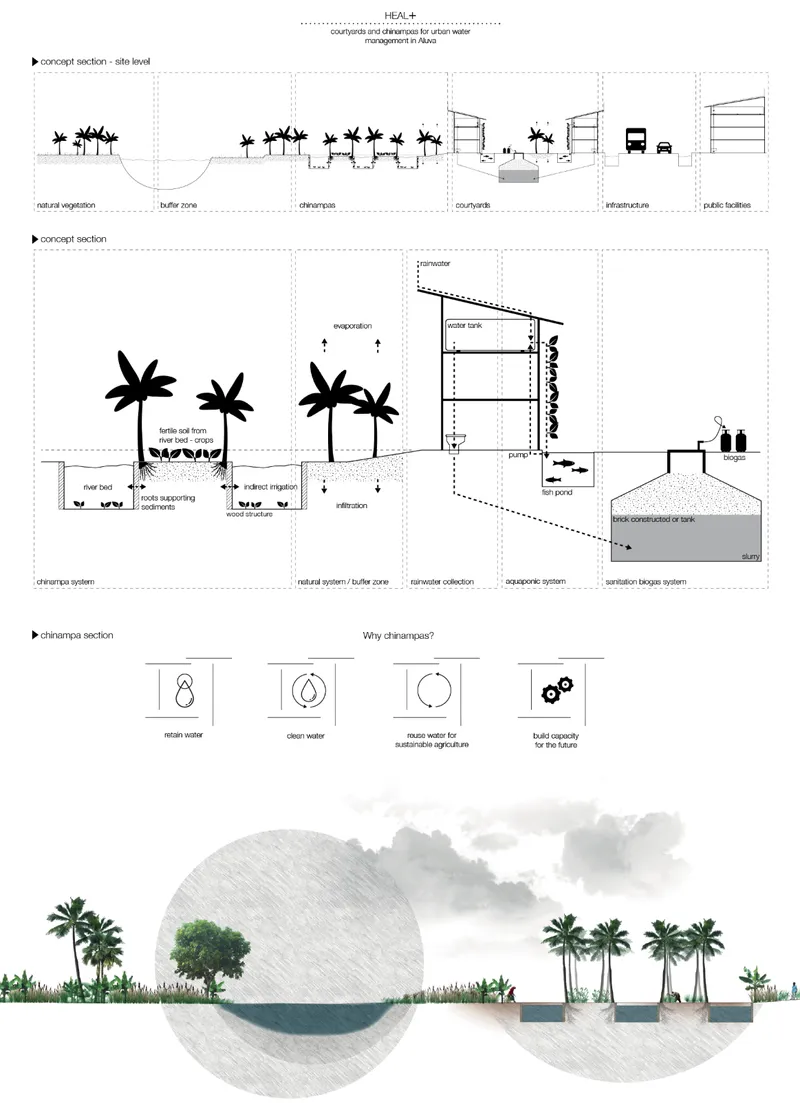
The site plan reveals how the settlement's residential clusters are sandwiched between agricultural fields and the winding course of the river, establishing buffer zones that absorb floodwater before it reaches homes. Rather than imposing a rigid street grid, the masterplan layers interventions at multiple scales: a river basin strategy that preserves natural vegetation and establishes waste treatment networks; a local level that nests courtyards and chinampas within community clusters; and a household level supported by biogas, aquaponic, and rainwater harvesting systems. The conceptual sections make the hydrological logic legible, showing how landscape zones, palm tree canopies, and graded terrain direct water through a sequence of retention, filtration, and slow discharge.
What distinguishes this layout from a standard green infrastructure diagram is its insistence on community agency. Residents are not passive beneficiaries of engineered wetlands; they participate in maintaining the chinampas, managing courtyard food production, and coordinating evacuation during extreme events. The masterplan aligns short-term strategies like evacuation planning with long-term goals including biodiversity enhancement, soil restoration, and pollution reduction.
Courtyards as Multifunctional Flood Buffers
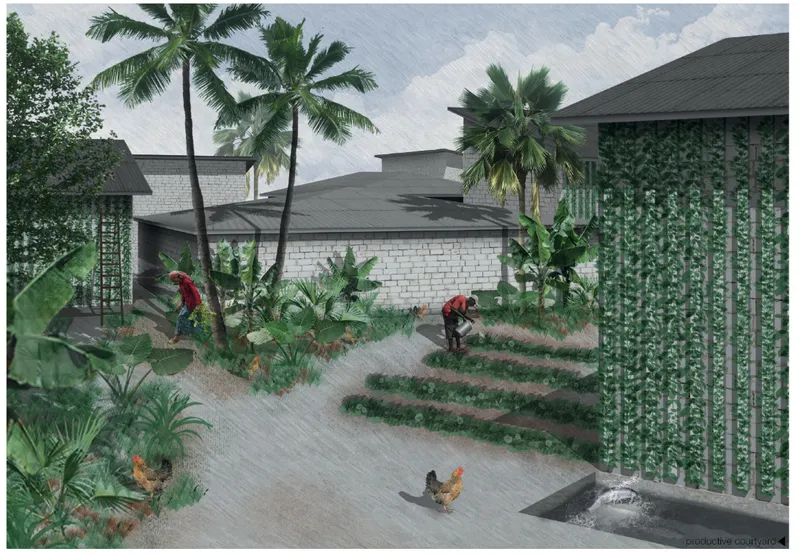
The courtyard view offers a glimpse into daily life at the heart of the proposal: workers tend vegetable beds beneath palm tree canopies while chickens roam freely. These courtyards are not decorative voids. They are designed as multifunctional hubs for food production, water collection, sanitation, and community gathering. Flexible in size, they adapt to the needs and capacities of the households they serve. During normal conditions they function as productive gardens and social spaces; during floods they convert into emergency hubs where residents can organize, store supplies, and manage water levels collectively.
The integration of chinampas into the river basin extends this logic beyond the residential clusters. These floating garden systems, inspired by ancient Mesoamerican practices, increase water retention, filter pollutants through their root structures, and provide fertile soil for sustainable agriculture. In Aluva's context, they act simultaneously as flood buffers and food sources, collapsing the boundary between landscape infrastructure and livelihood.
Shared Lanes That Prioritize People Over Vehicles
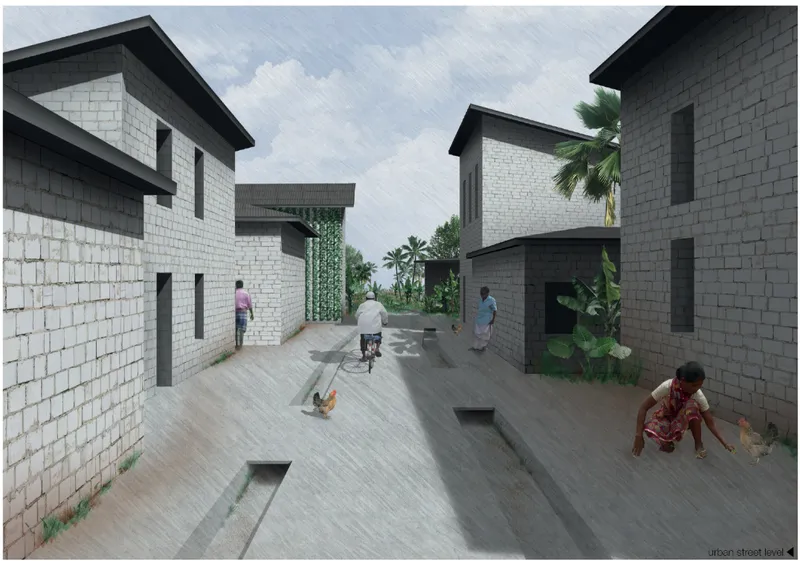
Between the masonry houses, narrow pedestrian lanes become the social glue of the settlement. Residents cycle, children play, and neighbors interact at a pace set by human movement rather than motor traffic. The ground plane reads as permeable, reinforcing the project's commitment to maximizing infiltration across every surface. These lanes also serve a practical role during flood events: because they are designed without curbs or barriers, water can sheet across them and be directed toward retention areas rather than pooling destructively around building foundations.
Vertical Gardens and Raised Beds for Year-Round Production
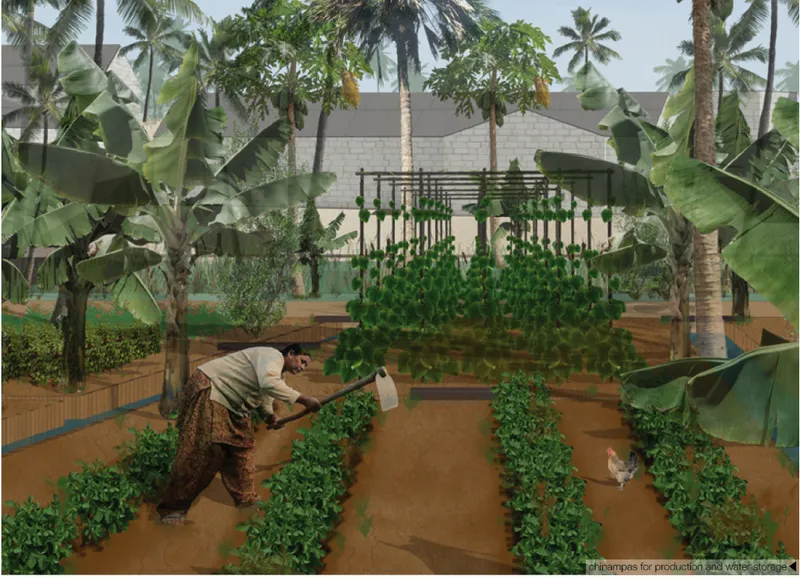
The community garden scene shows raised planting beds framed by banana trees and vertical greenery screens, a spatial arrangement that maximizes growing area on limited land while providing shade and wind protection. Combined with the aquaponic and rainwater harvesting systems described in the masterplan, these gardens reduce the settlement's reliance on external food supplies. The vertical screens also create microclimatic zones, lowering ambient temperatures and filtering dust from adjacent paths. In a settlement designed around water, these gardens close the nutrient loop: organic waste feeds biogas systems, whose byproducts enrich the soil, which in turn produces food and absorbs rainwater.
Why This Project Matters
Flood-resilient design too often defaults to hard engineering: raised foundations, concrete levees, pumped drainage. Zum Felde and Hörmann propose a softer, more integrated alternative where the settlement itself becomes the water management system. Every courtyard collects and filters; every chinampa retains and buffers; every lane infiltrates. The environmental benefits (improved infiltration, enhanced biodiversity, reduced runoff, pollution control) are inseparable from the social ones (strengthened community networks, safe evacuation spaces, shared responsibility). That inseparability is the project's real contribution.
Kerala will flood again. The question is whether its settlements will resist that reality or work with it. By embedding productive landscapes and communal infrastructure into the fabric of 100 households on the Aluva river island, this proposal offers a credible template for other vulnerable regions worldwide. It argues, convincingly, that the most resilient architecture is the kind that makes flooding useful.
View the Full Project
About the Designers
Designers: Mona zum Felde, Beke-Marleen Hörmann
Enter a Design Competition on uni.xyz
uni.xyz runs architecture and design competitions year-round that reward proposals with spatial conviction and real site intelligence.
Project credits: Courtyards and chinampas for urban water management in Aluva by Mona zum Felde, Beke-Marleen Hörmann HEAL+ (uni.xyz).


Popular Articles
Popular articles from the community

Temporary Home for Dogs: A Reversed Zoo Rethinks Animal Shelter Architecture
In Bucharest, a sinuous corridor and freed landscape flip the logic of containment, designing a shelter that works to make itself unnecessary.

Singing Woman: An Opera House That Performs Before the Curtain Rises
Ovidiu Cristian Pavel's conceptual opera house translates Estonia's choral identity into a sculpted waterfront landmark facing the Baltic Sea.
Tsunami Convergenics: Turning Catastrophic Ocean Forces into Underwater Housing Infrastructure
A speculative underwater settlement off the coast of Onagawa, Japan, treats tsunamis and typhoons as energy sources rather than threats.
Extended Shell: Retrofitting Kolkata's Balconies as Living Urban Thresholds
A modular retrofit system recovers the social and environmental intelligence of Kolkata's historic verandas for contemporary Park Street residents.

Similar Reads
You might also enjoy these articles

Pixel Gardens: One Repeated Module Stacked Into a Terraced Social Housing Tower for Famagusta
Salem Bader's shortlisted housing tower builds a vertical neighbourhood from one repeated module, offsetting units to carve terraces, light and air.

Bao Huynh Watercolor Atelier: A Serene Art Retreat in Hội An
Bao Huynh Watercolor Atelier in Hội An blends multifunctional art spaces, sustainable design, local materials, and family-friendly living in a serene environment.

Atelier Macri Concept Store Interior Design by CASE-REAL
Atelier Macri store features a "ko" counter, walnut wood details, cork displays, blending retail, gallery, and seamless customer experiences.

Manuel Vargas Izquierdo Stadium and High-Performance Sports Center: Architectural Excellence in Jalpa de Méndez
The Manuel Vargas Izquierdo Stadium blends sustainable design, inclusive sports facilities, and cultural-inspired architecture, revitalizing Jalpa de Méndez’s public spaces.

Comments (0)
Please login or sign up to add comments
No comments yet. Be the first to comment!