

Covent Garden Eco-District: Farming, Learning, and Living Under One Roof in London
A circular agriculture district stitches markets, rooftop farms, and learning libraries into Covent Garden's historic urban fabric.


What happens when you treat a city district not as a consumption machine but as a working farm? The Covent Garden Eco-District takes one of London's most iconic commercial quarters and rewires it around food production, education, and communal exchange. Brown roofing systems double as productive landscapes, transport-adjacent plots become community gardens, and a network of markets, workshops, and learning libraries pulls residents into the daily rhythm of growing, cooking, and eating together. It is a provocation: the idea that urban agriculture can be infrastructure, not ornament.
Titled "Urban Meal Mine: Patches to the People," the project was designed by Jamie Waugaman, Nate Halstead, and Anna Hargan. It received an Honorable Mention in the Urban Meal Mine competition, which challenged designers to rethink the relationship between cities and food systems. The team chose Covent Garden as their site, leveraging its historic identity as a market district to argue that agriculture never really left the neighborhood; it just needs new architecture to come back.
A Multi-Lobed Plan Organized Around Rail Infrastructure

The aerial site plan reveals the project's scale and strategic positioning. A multi-lobed station complex sits at the center, surrounded by railway lines and existing urban blocks. Rather than treating rail corridors as dead zones, the designers reclaim transport-adjacent plots as productive ground. The lobed geometry organizes distinct programmatic zones, including public and wholesale markets, residential units with integrated agricultural spaces, multi-use event lawns, and food courts showcasing locally grown produce, into a legible campus that radiates outward from the transit hub. The layout is deliberate: by anchoring the district to a major transportation node, the proposal ensures that both residents and visitors encounter the food system as soon as they arrive.
Existing Arches Meet a New Agricultural Concourse
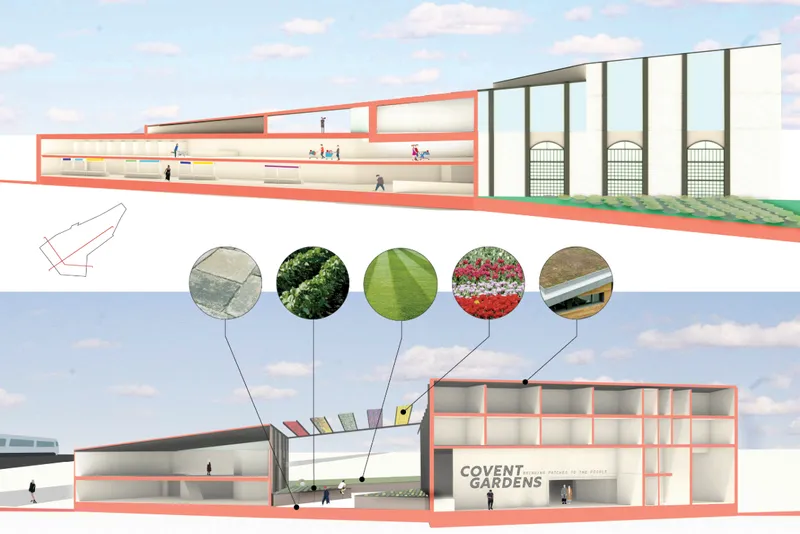
The sectional drawing is where the project's relationship with Covent Garden's built history becomes clear. A long horizontal concourse extends alongside existing arched structures, with material callouts indicating a careful negotiation between old masonry and new intervention. The section shows how the designers layer program vertically: market spaces at grade, learning libraries and workshops above, and brown roofing systems capping the composition with ecological insulation and rooftop cultivation. The decision to run the new concourse parallel to the historic arches, rather than replacing them, speaks to a respect for the site's identity. Covent Garden has been a market since the 1600s; the architecture here extends that lineage rather than erasing it.
A Glazed Canopy Shelters Rows of Cultivated Ground
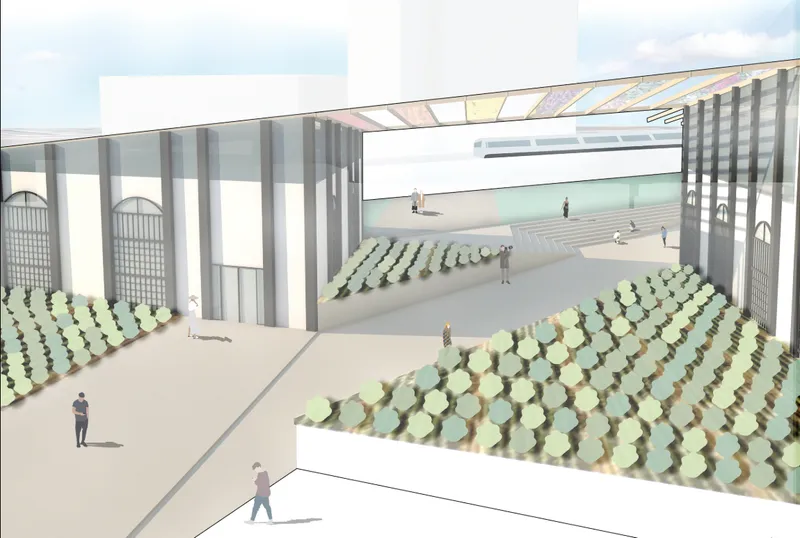
The interior rendering of the planted courtyard shows the moment where architecture and agriculture merge most directly. Rows of vegetation occupy the ground plane beneath a glazed canopy supported by structural columns, creating a controlled environment that extends growing seasons and protects crops from London's unpredictable weather. The space reads as part greenhouse, part public room. People circulate alongside planting beds, collapsing the distance between production and daily life. Community gardens like this one form a core piece of the district's circular model, where food grown on site feeds the adjacent markets and food courts, and organic waste cycles back into the soil.
Colorful Canopy Fins Define the District's Public Identity

A second courtyard rendering introduces a different material language: colorful canopy fins span above vertical columns, filtering light onto a green planted ground plane below. Where the glazed courtyard prioritizes climate control for cultivation, this space prioritizes social atmosphere. The fins create a dynamic pattern of shade and color that signals activity and invitation. It is easy to imagine this as the setting for the project's multi-use event lawn or an outdoor extension of the food court, a place where the shared experiences of cooking, dining, and gathering that the designers describe become spatial reality.
The contrast between the two courtyard typologies is a smart move. It demonstrates that urban agriculture architecture does not have to look like a single thing. A productive greenhouse and a festive market canopy serve different roles in the same food system, and the district needs both.
Why This Project Matters
The Covent Garden Eco-District matters because it refuses to treat urban food production as a fringe activity bolted onto existing buildings. Instead, it makes agriculture the organizing principle for an entire district, shaping the plan, the section, and the public realm. Brown roofs, community gardens, learning libraries, and wholesale markets are not add-ons; they are the program. By siting this intervention in Covent Garden, the designers ground their proposal in a place that already carries deep cultural associations with food and trade, making the argument feel less utopian and more inevitable.
At a moment when cities grapple with food insecurity, population density, and climate disruption, proposals like this one reframe resilience as something you can walk through and participate in. Waugaman, Halstead, and Hargan have outlined a circular model where resources cycle back into the community rather than leaving it. The real contribution is not a single building but a template: a set of spatial relationships between growing, learning, selling, and living that other cities could adapt. That template, rooted in specificity but designed for export, is exactly the kind of thinking urban design competitions should be producing.
View the Full Project
About the Designers
Designers: Jamie Waugaman, Nate Halstead, Anna Hargan
Enter a Design Competition on uni.xyz
uni.xyz runs architecture and design competitions year-round that reward proposals with spatial conviction and real site intelligence.
Project credits: URBAN MEAL MINE - PATCHES TO THE PEOPLE by Jamie Waugaman, Nate Halstead, Anna Hargan.



Popular Articles
Popular articles from the community

EW PARK: Sustainable Architecture Reimagines the Future of Urban Parking
EW PARK reimagines city parking as a modular wooden tower combining automation, solar energy, electric mobility, and adaptable urban design.

The Musturak Paradise: Senior Living Architecture for a Connected Future in Temara, Morocco
The Musturak Paradise reimagines senior living architecture in Temara via private homes, social spaces, culture, community, and shared care.

Conexión: Biophilic Design Reimagines High-Rise Living in Hong Kong
Conexión reimagines high-rise living in Hong Kong through biophilic design, green facades, shared spaces, daylight, water and nature within.

Co-Life: Senior Housing Design That Reconnects Older Adults With the City
Co-Life reimagines senior housing design through healing gardens, shared streets, workshops, and a sustainable community across generations.


Similar Reads
You might also enjoy these articles
The Musturak Paradise: Senior Living Architecture for a Connected Future in Temara, Morocco
The Musturak Paradise reimagines senior living architecture in Temara via private homes, social spaces, culture, community, and shared care.

The Leaf Center: Cultural Center Architecture for Social Integration in Amsterdam
Cultural center architecture becomes a bridge at The Leaf Center, connecting international students with Amsterdam through art and exchange.
Conexión: Biophilic Design Reimagines High-Rise Living in Hong Kong
Conexión reimagines high-rise living in Hong Kong through biophilic design, green facades, shared spaces, daylight, water and nature within.

Wander to Wonder: Modular Playground Design for Children in Kutupalong Refugee Camp
Wander to Wonder uses modular playground design to create flexible, imaginative play spaces for children in Kutupalong refugee camp.


Comments (0)
Please login or sign up to add comments
No comments yet. Be the first to comment!