

Crane Hub: Tower Cranes as Permanent Infrastructure for Urban Living
A proposal that transforms construction machinery into lasting architectural framework, merging building process with built form.


What if the cranes never left? Construction sites are typically understood as temporary conditions, chaotic interruptions on the way to a finished building. Crane Hub inverts that logic entirely, proposing that the yellow steel towers and booms of tower cranes become the permanent structural skeleton of an urban residential complex. The construction process doesn't precede the architecture; it is the architecture.
Designed by Yutianduxiu Hendu for the Hustle Hub 2019 competition, the project reimagines a dense urban housing cluster where cylindrical volumes are assembled, serviced, and reconfigured by cranes that remain rooted in the site permanently. The result is a provocative hybrid: part machine, part dwelling, staged somewhere between a shipyard and a vertical neighborhood.
Cranes That Stay: Scaffolding as Structure
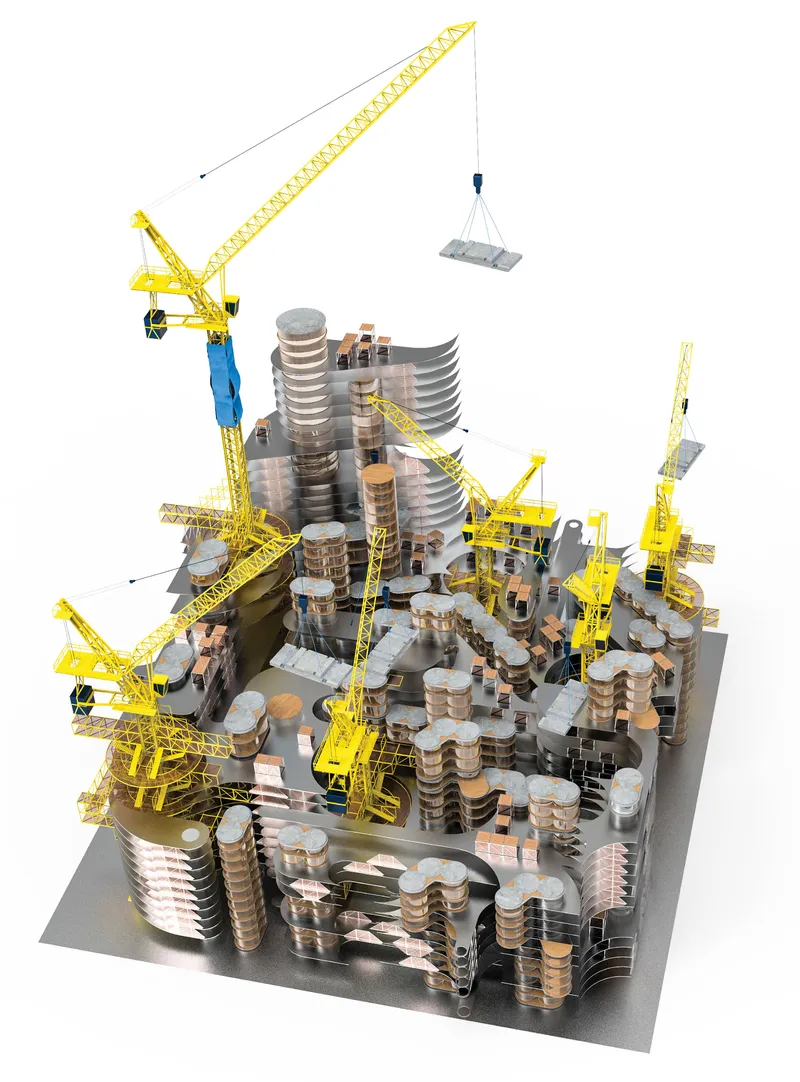
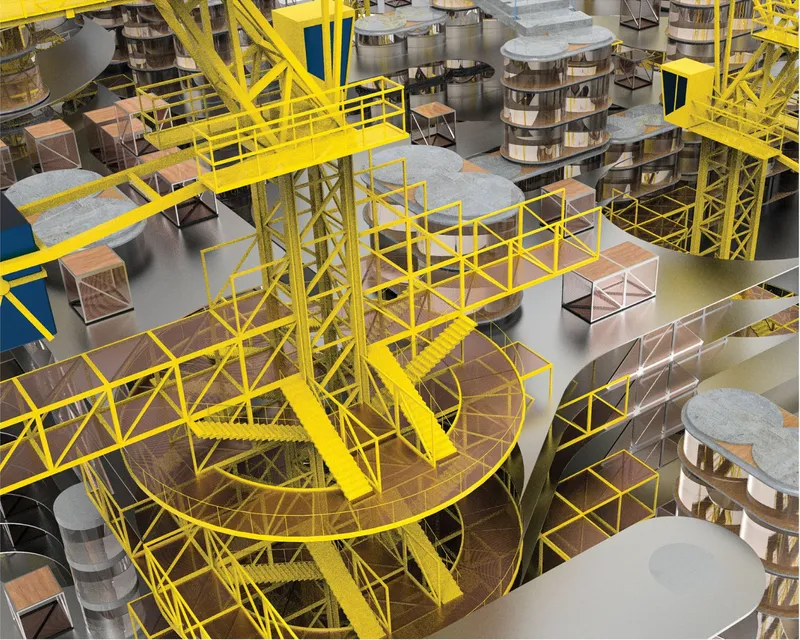
The physical model immediately communicates the project's central conceit. Yellow tower cranes don't hover at the edges of the site waiting to be dismantled; they punctuate the cluster of cylindrical living volumes, their booms extending over rooftops as if perpetually ready to lift, rotate, or replace a module. The cranes function as vertical circulation cores, structural masts, and service infrastructure all at once. Their lattice geometry contrasts sharply with the smooth metallic cylinders they surround.
Seen from overhead, the composition reads less like a housing block and more like an industrial organism. The yellow scaffolding towers punch through the field of cylinders with a visual authority that conventional columns never achieve. There is an honesty here that resonates: rather than concealing the means of assembly behind finished surfaces, the project celebrates the apparatus of making as the most legible element in the skyline.
Cylindrical Volumes Wrapped in Horizontal Bands
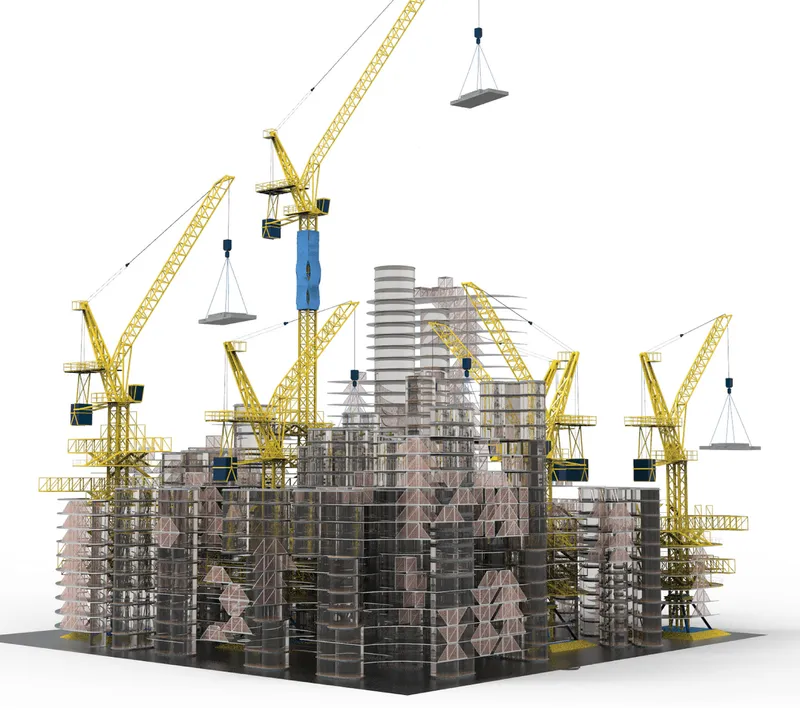
The dwelling units themselves take the form of stacked cylindrical towers, each clad in horizontal metal bands that give them a machined, almost nautical quality. Grouped tightly together, the towers create a dense vertical neighborhood where the gaps between volumes become narrow light wells and circulation corridors. The horizontal banding articulates floor levels without relying on conventional window punching, keeping the facade abstract and unified.
From above, the cylindrical footprints pack together with a geometric efficiency that rectilinear plans struggle to match. The circular plan eliminates corners, maximizing usable floor area while allowing the towers to nestle closely without creating dead zones. The metallic finish across the cluster reinforces the industrial vocabulary, tying each unit back to the crane infrastructure that delivered it.
Interior Connections: Yellow Steel Walkways and Spiral Ramps
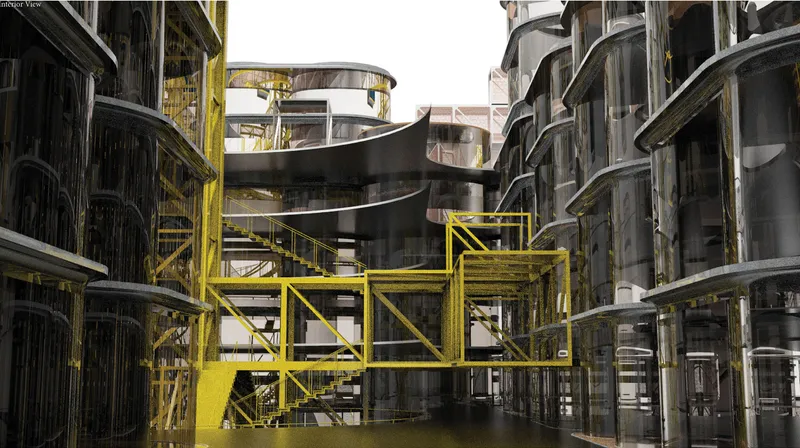
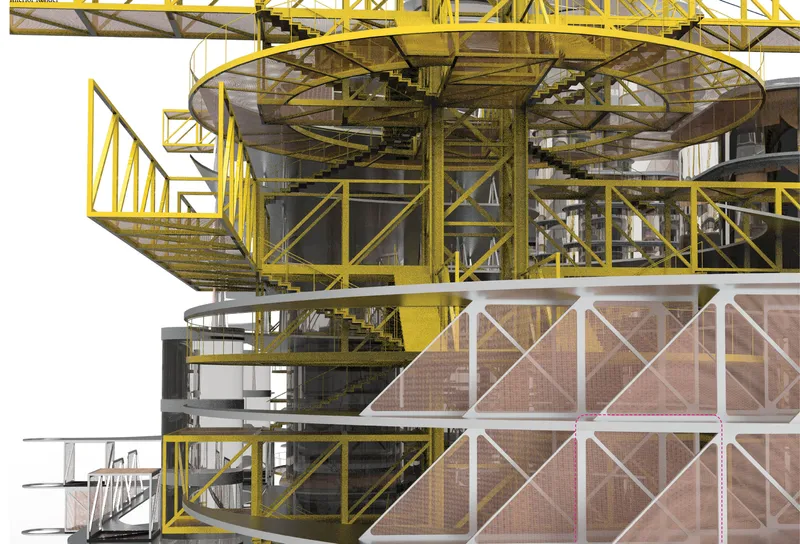
A view through the interior of the complex reveals how the cranes and cylinders coexist at close range. Yellow steel walkways bridge between translucent glass towers, while spiral ramps wind upward through the volumes, creating continuous vertical circulation without elevators. The yellow structural framework frames views through copper-toned facade panels, layering transparency, color, and depth in a way that feels simultaneously industrial and inviting.
The section model clarifies the spatial logic: crane platforms sit above the dwelling volumes, maintaining access to every unit from above. This is not decoration. The cranes are operational infrastructure, capable of swapping modules, delivering materials to upper floors, or reconfiguring the complex as needs change. The architecture is designed to be incomplete by default, always ready for its next intervention.
An Axonometric Logic of Assembly
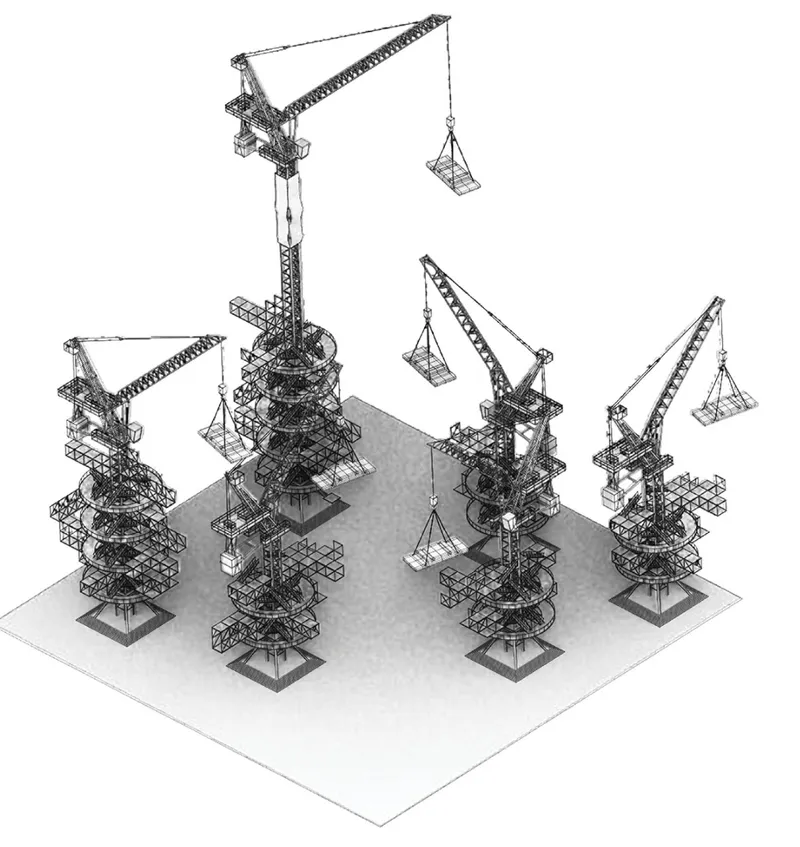
The axonometric drawing strips the project down to its generative diagram. Multiple tower cranes encircle a central tapered volume, their booms radiating outward like spokes. The drawing makes explicit what the models imply: the cranes are not peripheral to the design but central to it, defining the site's organizational geometry. Every dwelling unit falls within the reach of at least one crane, ensuring that the entire complex remains serviceable from its own embedded machinery.
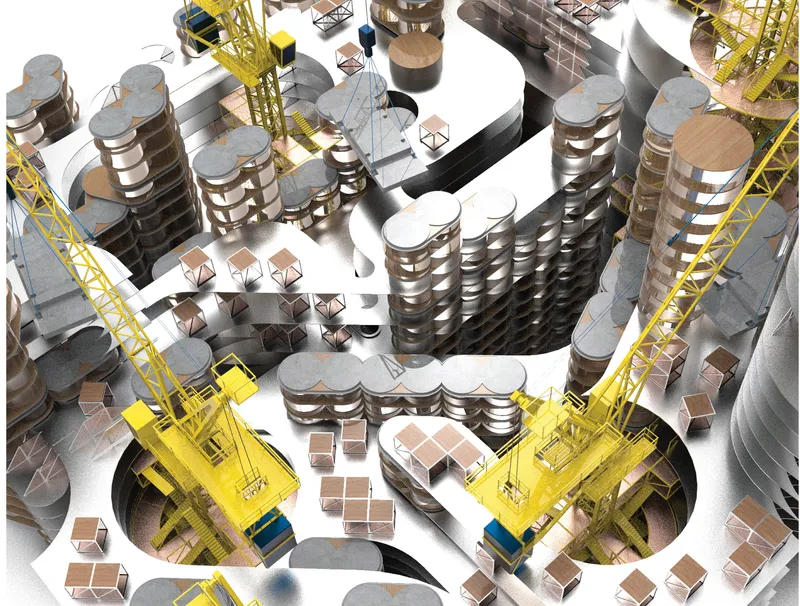
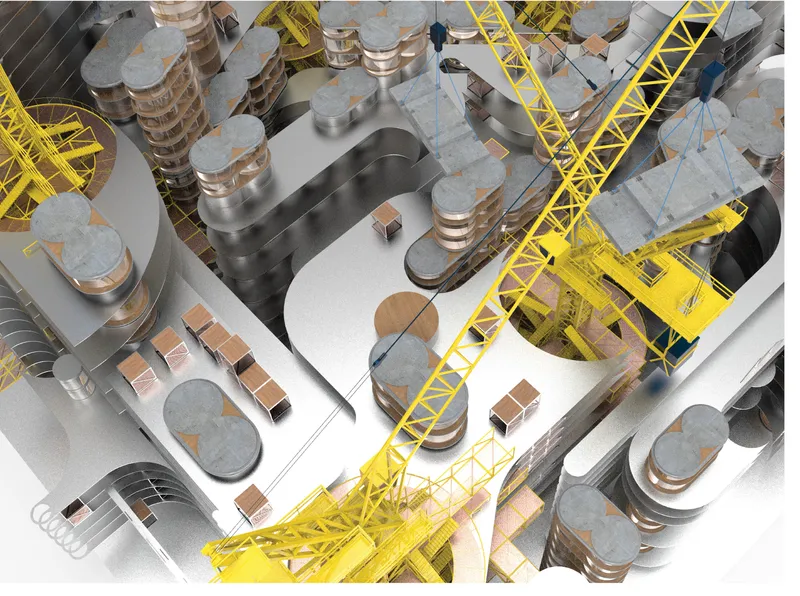
The aerial model view reinforces this reading at a more material level. Metallic cylindrical volumes and roof planes sit within a forest of yellow crane towers, the two systems interlocking rather than competing. The project proposes a radical form of adaptability: housing that can be built, unbuilt, and rebuilt without ever requiring external construction infrastructure, because the infrastructure lives on site permanently.
Why This Project Matters
Crane Hub challenges one of architecture's most deeply ingrained assumptions: that construction is a phase to be completed and forgotten. By embedding the crane into the building's permanent identity, Yutianduxiu Hendu proposes a model of housing that treats change as a feature rather than a failure. The building never reaches a final state because it was never designed to. That conceptual commitment, carried through every model, drawing, and detail, gives the project genuine intellectual weight.
At a moment when urban housing faces simultaneous demands for density, flexibility, and speed of delivery, the idea of self-servicing architecture deserves serious attention. Crane Hub may operate at the speculative end of the spectrum, but its core proposition is pragmatic: if buildings must constantly adapt, why not design the tools of adaptation into the building itself? The yellow cranes standing among the cylinders are not symbols of incompleteness. They are declarations that the architecture is always ready for what comes next.
View the Full Project
About the Designers
Designer: Yutianduxiu Hendu
Enter a Design Competition on uni.xyz
uni.xyz runs architecture and design competitions year-round that reward proposals with spatial conviction and real site intelligence.
Project credits: Crane Hub by Yutianduxiu Hendu Hustle Hub 2019 (uni.xyz).


Popular Articles
Popular articles from the community

Temporary Home for Dogs: A Reversed Zoo Rethinks Animal Shelter Architecture
In Bucharest, a sinuous corridor and freed landscape flip the logic of containment, designing a shelter that works to make itself unnecessary.

Singing Woman: An Opera House That Performs Before the Curtain Rises
Ovidiu Cristian Pavel's conceptual opera house translates Estonia's choral identity into a sculpted waterfront landmark facing the Baltic Sea.
Tsunami Convergenics: Turning Catastrophic Ocean Forces into Underwater Housing Infrastructure
A speculative underwater settlement off the coast of Onagawa, Japan, treats tsunamis and typhoons as energy sources rather than threats.

The Amber Palace Opera: A Geological Fiction Surfaces on Tallinn's Baltic Waterfront
Pierre Brillard reimagines a Baltic legend as a public landscape, opera house, and waterfront promenade rooted in Tallinn's coastal identity.

Similar Reads
You might also enjoy these articles

Play: Fragments of Their World: Remembered Architecture Rebuilt as a Modular Playground for Refugee Camps
Tom Gardner abstracts domes, arches and towers from the homelands of displaced families into a kit of child-scaled play parts for camp settlements.
REBIRTH: A Circular Settlement Where Afghan Widows and Their Children Rebuild Life Together
A shortlisted Resile entry turns the circle into a protective ring of timber and brick, gathering homes, classrooms and gardens around a shared landscape.
The Main Dream: A Recycled Plastic Kit That Lets Refugee Children Build Their Own Playground
Thirty-centimetre interlocking cubes that connect on three axes turn play into construction, letting children author the spaces they occupy.

Lunar Spiral: A Fibonacci-Driven Moon Settlement Rising from Shackleton Crater
Golden-spiral geometry organises buried infrastructure and orbiting habitable spheres into a lunar base designed to grow as life on the Moon expands.

Explore Construction Technology Competitions
Discover active competitions in this discipline

Challenge to visualize a collision of the future and past

Challenge to visualize future spaces of waste

Challenge to visualize slums of 2080

Challenge to illustrate the ruins of Petra
Comments (0)
Please login or sign up to add comments
No comments yet. Be the first to comment!