

Creating accessible spaces with style: Wraxall Yard by Clementine Blakemore Architects
Clementine Blakemore Architects has successfully repurposed a series of agricultural buildings that were once ignored and now transformed into an inclusive retreat and community asset.

 Photos
Lorenzo Zandri & Emma Lewis
Clementine Blakemore Architects (CBA) has refurbished a series of derelict farmhouse buildings in West Dorset into a rural retreat for holiday-makers, a workshop and a centre for community activities. Wraxall Yard, as the scheme is known, began in 2021 as a not-for-profit Community Interest Company, with the refurbishment of the farm buildings being completed in July 2022. The five holiday lets on the 250-acre organic farm can be booked all together as one.
The main focus of this project was to make it accessible for everyone, a place that would be a welcome break from the typical, often uninspiring accommodation options available for those with disabilities. To make sure this retreat was truly accessible, we worked closely with the Centre for Accessible Environments and held consultations to ensure that people with disabilities needs were catered for in an elegant, unobtrusive manner. As a result, there are no separate 'disabled' routes around the site and no ramps or handrails for wheelchair users either - instead, the site offers gentle, sloping means of access that are easy and pleasant to use.

Wraxall Yard exists on one level, eschewing the need for specialised stairways or lifts. Inside, space has been made for generous turning circles and clear access to windows and doors, with attention paid to making sure the accommodation doesn’t feel institutional or clinical. Case in point: grab-handles and rise-and-fall worktops have been carefully integrated into bathrooms and kitchens, meanwhile each accessible bedroom offers height-adjustable and profiling beds that have been designed with Douglas fir surround that match additional joinery and timber furniture. In addition, switches, handles, hooks and hanging rails have been placed at a height that is convenient and accessible for all, with door handles that are coated in a colour that will contrast with the frames to make them more visible.

Despite inheriting them in a state of decay, the agricultural buildings on the site boast considerable character, dating back to the mid-19th Century. Refurbished stone and brick dairy barns sit nearby a Grade I* listed church, with others arranged around a courtyard and flanked by a steel Dutch barn.
Much has been done to retain the timber and stone rural charm of the buildings on site, with wooden roof trusses being kept, repaired or, where necessary, replaced — being made from UK-grown Douglas fir in a sawn finish.
Moreover, the presence of truss beams internally has been amplified by exposing internal ceiling finishes (wood fibre insulation being situated above).
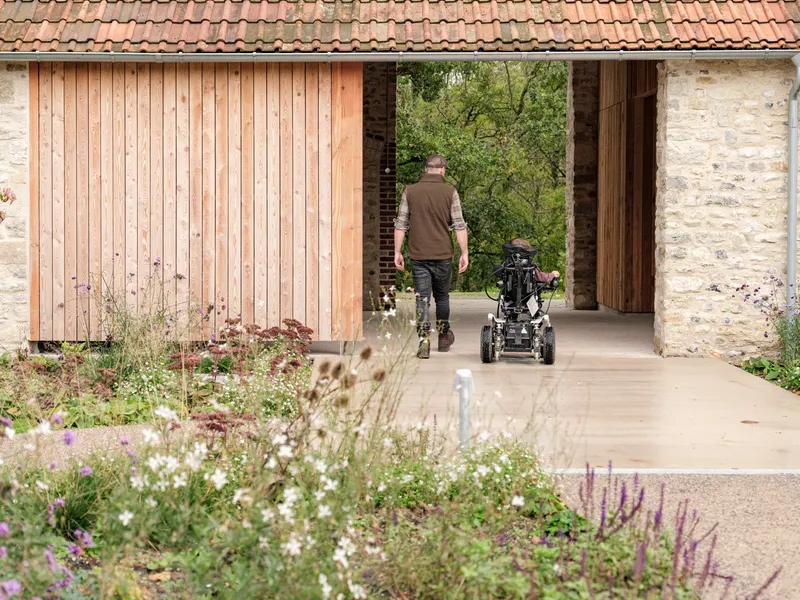
According to CBA, most of the external stone and masonry walls have been kept and repaired with salvaged or locally sourced stone, such as field flint, Portland, Purbeck, Forest marble, and chalk, set in lime mortar. The walls that have been retained have been insulated internally with cork that was applied directly with adhesive lime plaster.
“A renewable material made from harvested bark, the high vapour diffusivity of cork allows moisture to move through the envelope, preventing interstitial condensation,” said the architects in a statement.
“The courtyard walls were in a particularly bad state of repair, with some recent alterations, and so these were replaced with a new timber-framed wall clad externally with recycled stone from the site. The rhythm of the original walls, punctuated with brick piers, doorways and high-level clerestories, has been retained in the new elevations. Internally the junction between the columns and truss tie-beams are exposed, expressing the modest craftsmanship of this type of agricultural building.”
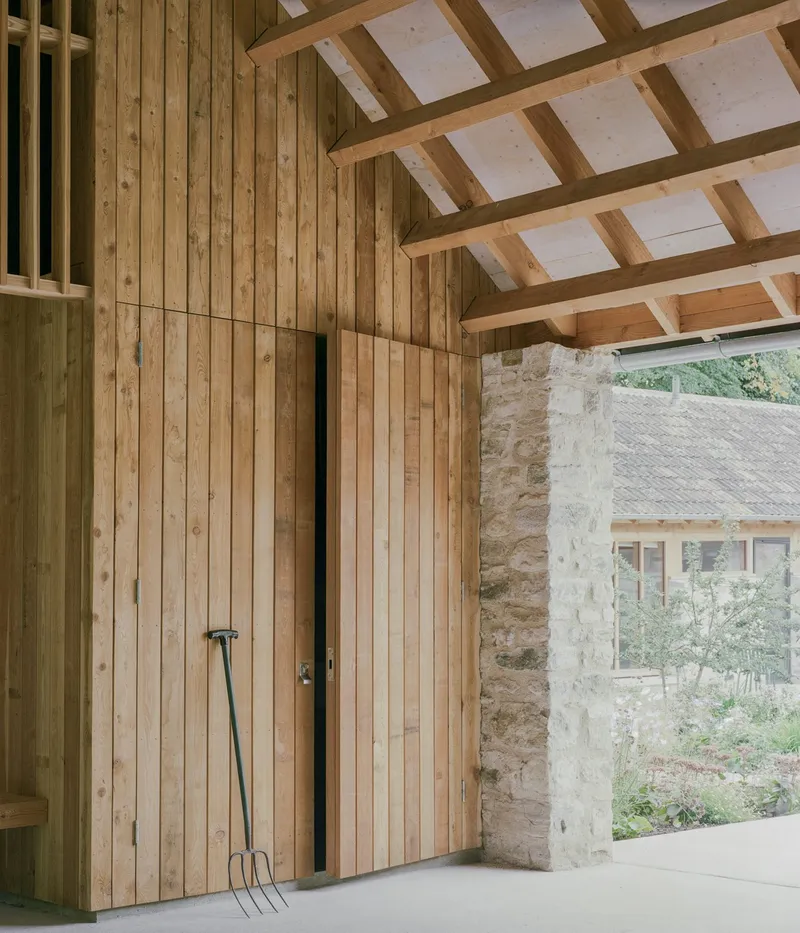
“Driven by the belief that everyone should have the opportunity to engage with farming and wildlife, the brief called for an ambitious renovation of the derelict site that would provide exemplary standards of accessibility and sustainability, without compromising the unique historic and agricultural character of the existing buildings,” said Nick Read, who runs Wraxall Yard with his daughter, Katie.
Approximately 60% of those who have visited Wraxall Yards since it opened are families with disabled members. Wraxall Yard is working with the local charity Green Island Trust to offer supported holidays to disabled people living in the area. The community space on the premises will also be used as part of a programme to help young people with mental health and/or addiction issues engage with the countryside. This is a great way for the local community to come together and support one another!
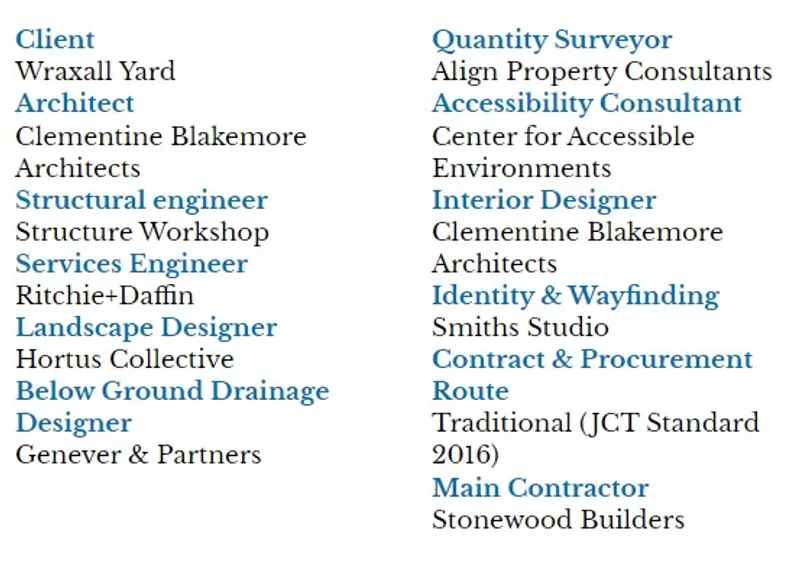
Credits
References (1)

Popular Articles
Popular articles from the community

Temporary Home for Dogs: A Reversed Zoo Rethinks Animal Shelter Architecture
In Bucharest, a sinuous corridor and freed landscape flip the logic of containment, designing a shelter that works to make itself unnecessary.
Faces of the Soviet Avant-Garde: Turning Moscow's Street Names into an Open-Air Museum
A network of sculptural installations across a Moscow residential district transforms forgotten architect names into spatial encounters with cultural memor

Manzana Morphosis: Stretching Barcelona's Grid into a Living Landscape for 2050
A radical reworking of the Eixample manzana turns density into a tool for generous public space, vertical ecology, and environmental performance.

The Amber Palace Opera: A Geological Fiction Surfaces on Tallinn's Baltic Waterfront
Pierre Brillard reimagines a Baltic legend as a public landscape, opera house, and waterfront promenade rooted in Tallinn's coastal identity.

Similar Reads
You might also enjoy these articles
116 Rokeby Building, Collingwood
Sustainable Collingwood office building featuring double-skin façade, natural ventilation, rooftop amenities, and carbon-neutral design focused on wellbeing and longevity.
Contemporary Apartment Renovation in Spain: RV House by BIAN Opens Up to the Sea
A minimalist 1930s apartment in Santander is transformed into a flexible, sea-facing home through contemporary Spanish renovation.
3 Marías House: A Contemporary Mediterranean Courtyard Retreat by Bajet Giramé + Burckhardt
Mediterranean courtyard home blending traditional architecture with modern design, terracotta flooring, flexible interiors, sustainable climate strategies, and garden integration.
NZ10 Apartment by auba studio: Adaptive Reuse in Palma de Mallorca
Adaptive reuse apartment transforms bakery into light-filled home with patios, privacy layers, and wood interiors enhancing urban living experience.

Explore Reclaimed Space Competitions
Discover active competitions in this discipline


Challenge to reimagine the Iron Throne

Photograph architecture without architects

Illustrate the lost glory of Angkor Wat - Render Challenge

Design challenge to reuse E-waste
Comments (0)
Please login or sign up to add comments
No comments yet. Be the first to comment!