

CSWADI Sculpts a Cloverleaf Pavilion for Chengdu's 2024 International Horticultural Exhibition
A 23,000 square meter undulating canopy of golden soffits and branching columns dissolves the boundary between building and botanical landscape in eastern


From the air, the Main Pavilion of the 2024 International Horticultural Exhibition reads less like architecture and more like a geological event: three lobed white volumes spreading across a green ridge between forest and lake, their rooflines rising and falling in sympathy with the surrounding Longquan Mountains. Designed by CSWADI, the 23,393 square meter building serves as the exposition's ceremonial anchor, hosting everything from the closing ceremony to permanent exhibition programming. Its formal ambition is clear from first glance, but the real story unfolds underneath, where golden soffits, branching columns, and generous glazing create an inhabited landscape that refuses to separate interior from exterior.
What makes the pavilion genuinely interesting is the tension between its monumental roof and the intimate, almost garden-like experience at ground level. The cloverleaf plan distributes program into three curving wings, each oriented toward different landscape conditions: waterfront, wetland, and forested hillside. Rather than competing with the botanical exhibition around it, the building absorbs the garden into its own body through courtyards, reflecting pools, and planted zones that colonize the space beneath the canopy. It is simultaneously the largest structure on site and, at the pedestrian scale, one of the most porous.
A Roof That Moves with the Mountains
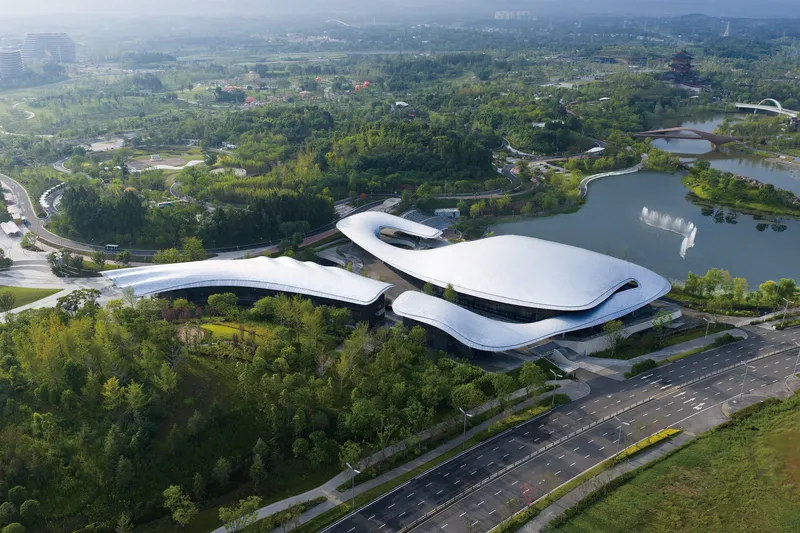
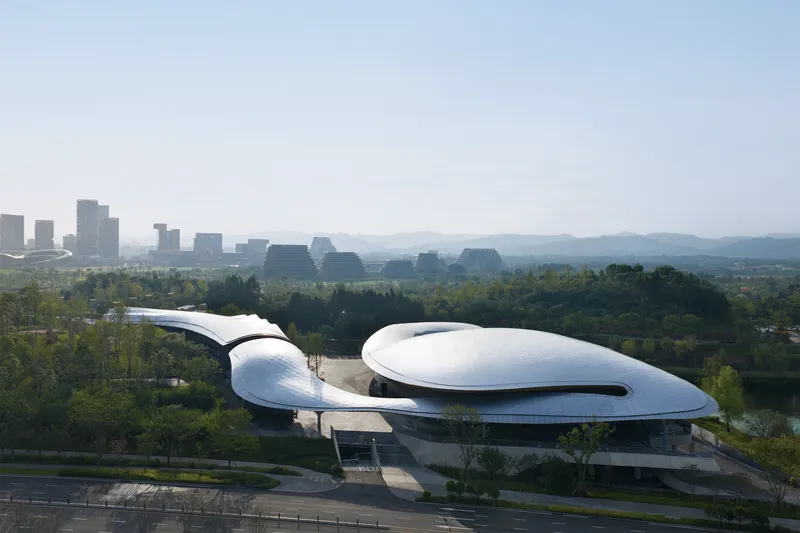
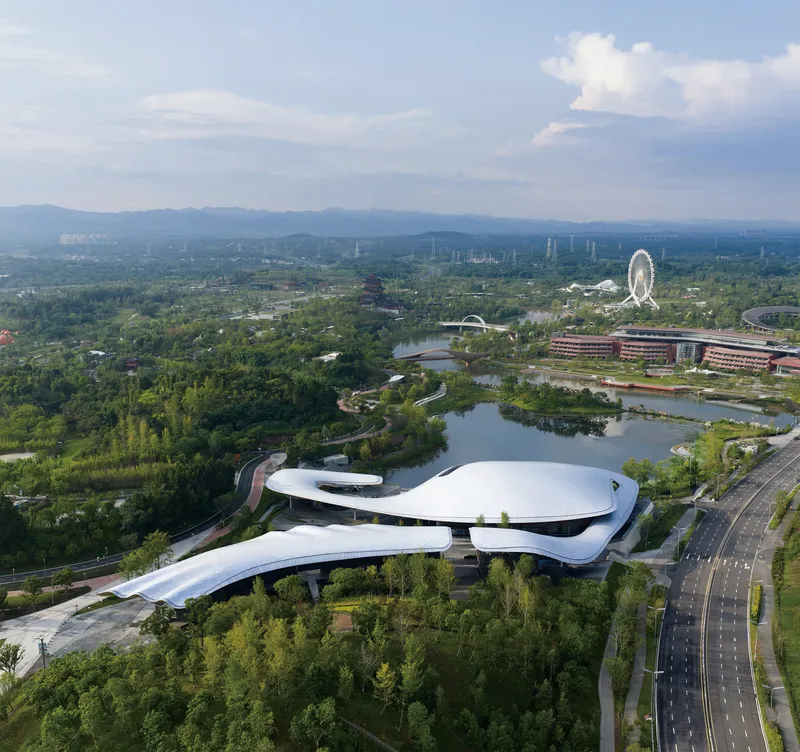
Seen from above, the pavilion's three lobes radiate outward from a shared center, their white surfaces curving in section to produce a rolling horizon that mirrors the distant mountain profile. The roof is the primary architectural gesture, and CSWADI calibrates its undulations so that no single ridgeline dominates. Instead, the building presents a constantly shifting silhouette that changes depending on your angle of approach. Against the haze of Chengdu's eastern plains, the white canopy reads as both artificial and topographic, a synthetic landform dropped into the park.
The decision to keep the roof white on top and golden underneath is more than cosmetic. From a distance, the pavilion recedes into the clouds and sky. Up close, the warm underside envelops visitors, creating a sheltered micro-atmosphere beneath each canopy wing. It is a rare case where a building's color strategy genuinely serves two distinct scales of experience.
Branching Columns and the Golden Canopy Below
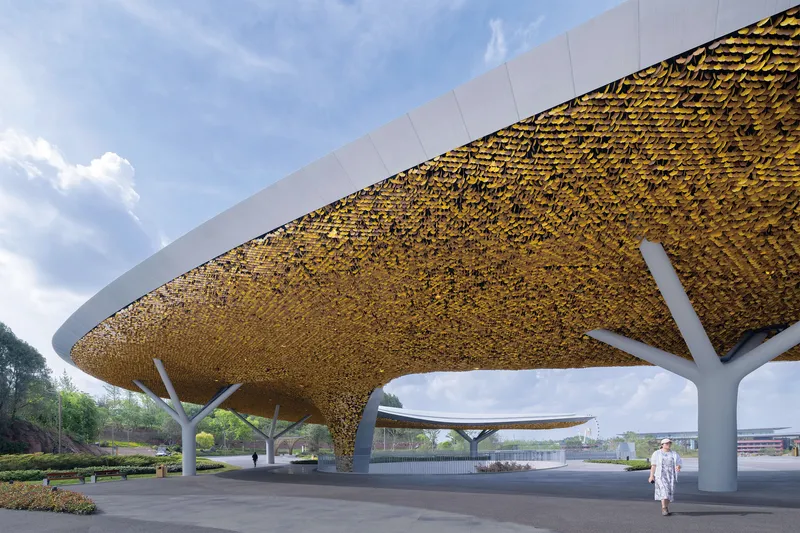
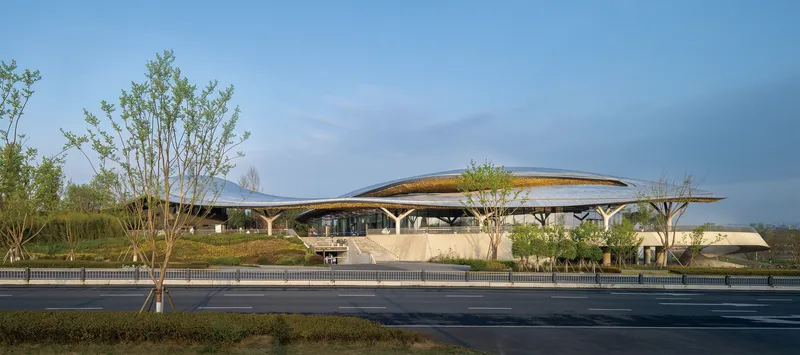
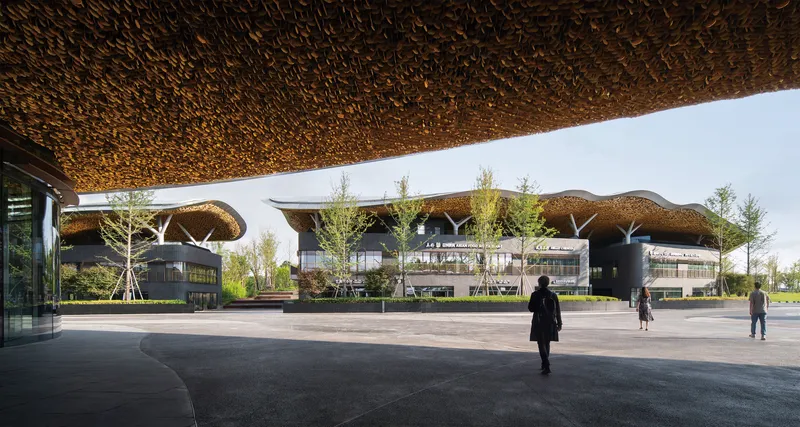
At the pedestrian level, the roof's weight vanishes. White branching columns, each splitting into multiple arms as they rise, distribute loads across a wide structural bay that keeps the ground plane open and fluid. The analogy to trees is intentional and, for once, not lazy: these columns genuinely function like canopy trees, sheltering a continuous plaza that blurs the line between covered exterior and unconditioned lobby. Visitors move through a spatial experience that is closer to walking through a grove than entering a conventional building.
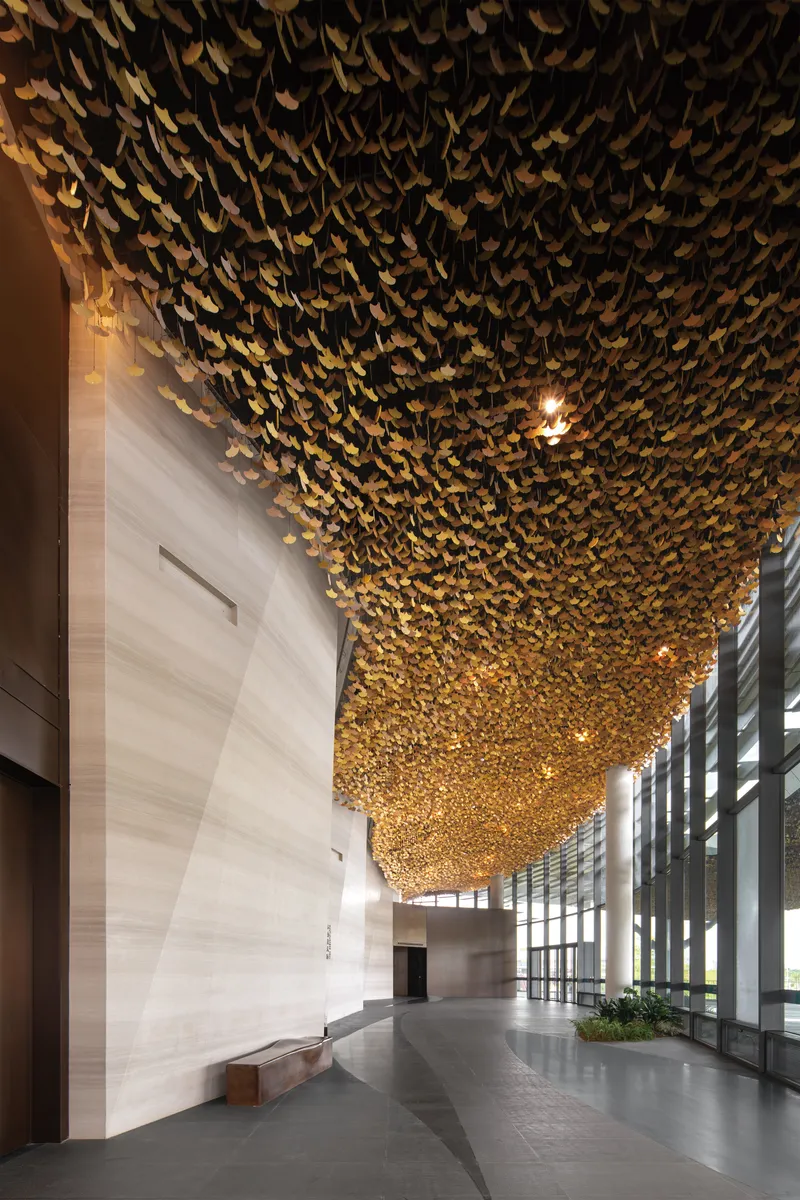
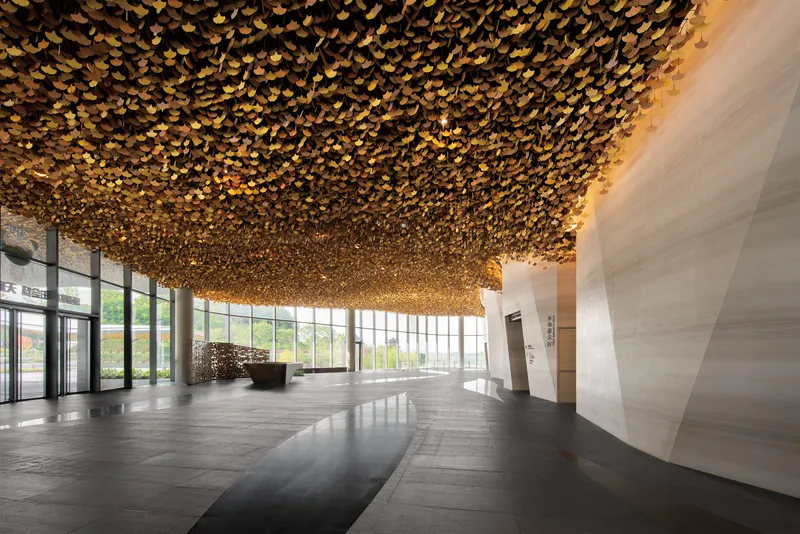
The golden scalloped soffit overhead is the pavilion's most photogenic surface, a textured, undulating plane that catches light and casts warm reflections onto the floor below. It gives the underside of the canopy a tactile richness that the smooth white exterior deliberately withholds. The contrast is productive: it draws people in and rewards proximity.
Arrival and Threshold
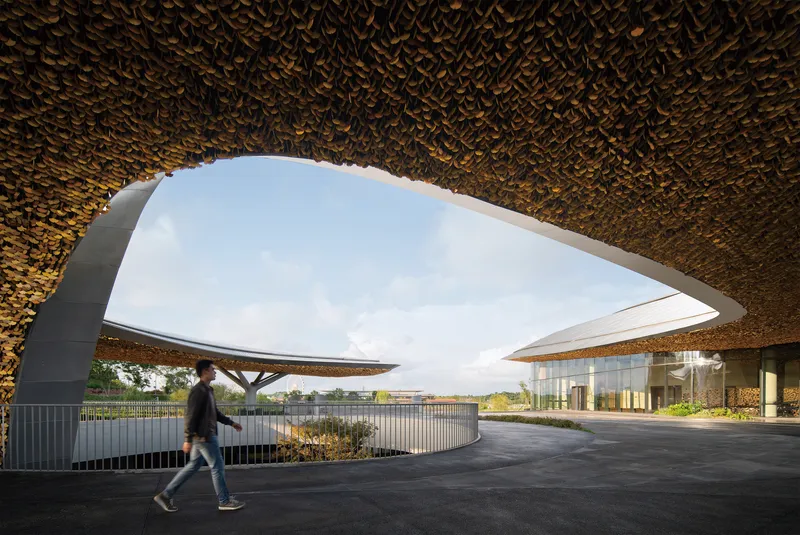
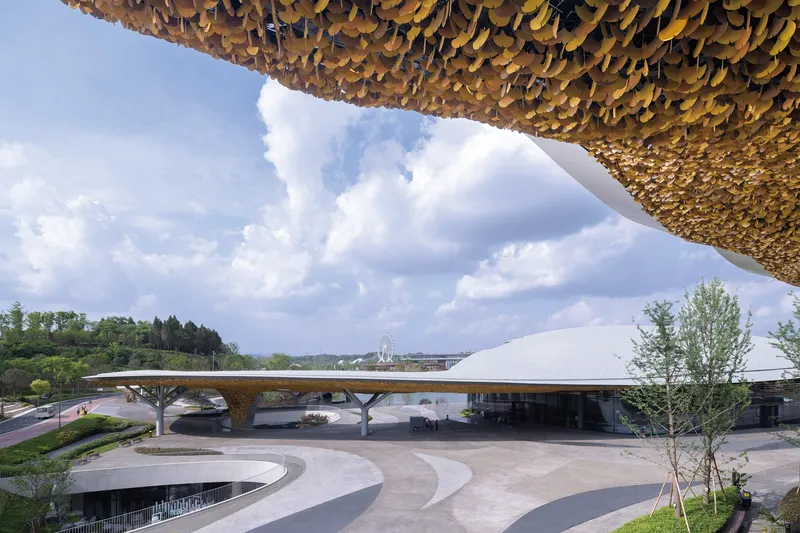
The covered entry drive gives arriving visitors their first encounter with the golden canopy at close range. A sweeping soffit stretches overhead while vehicles and pedestrians share a generous threshold zone that buffers the transition from road to exhibition. The scale is deliberate: tall enough to accommodate ceremonial arrivals, yet articulated with enough texture and column rhythm to keep the space from feeling like an airport drop-off.
Moving inside, the entrance lobby picks up the golden ceiling language and intensifies it. A cascading textured installation descends toward the polished stone floor, compressing the vertical dimension and pulling the eye forward into the deeper plan. The palette is restrained: dark stone, pale walls, and the persistent warmth of the golden overhead surface. It is hospitality architecture at exposition scale, engineered to welcome crowds without losing atmospheric control.
Interior Courtyards and the Garden Within
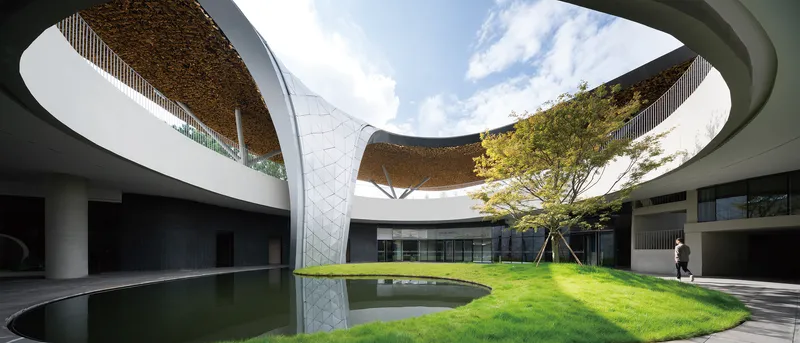
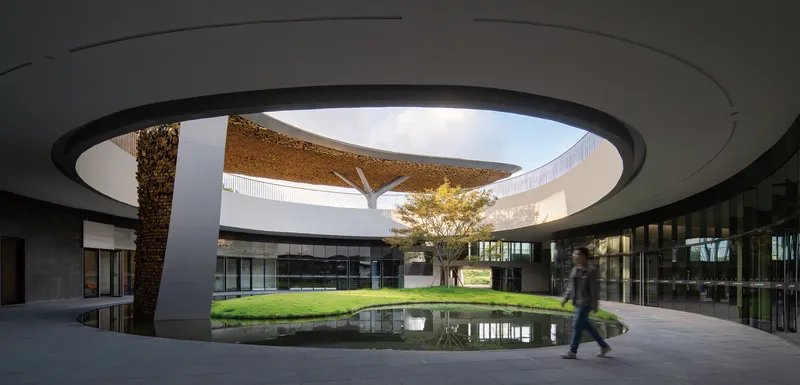
The pavilion's most compelling spatial move is the integration of open courtyards within the roofline. A circular reflecting pool, surrounded by lawn, sits beneath a canopy oculus that frames the sky and blurs the perimeter of the building. The planted soffit visible in the courtyard view suggests CSWADI treated the roof not as a barrier but as an inhabited surface, capable of supporting greenery on its underside edges. These gardens within the building give visitors a reason to pause, reorienting attention from the exhibition program back to the horticultural landscape that is the event's entire premise.
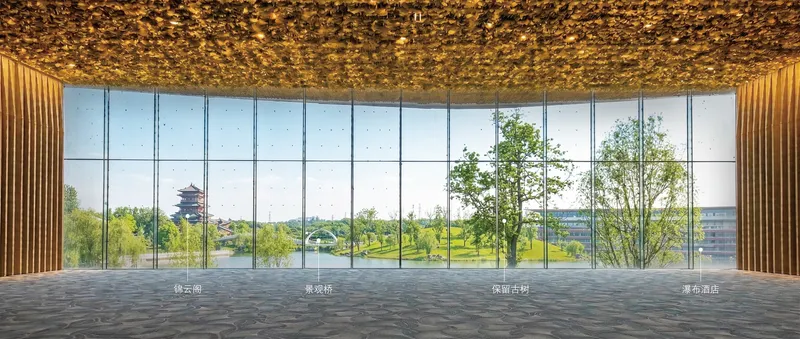
Views through floor-to-ceiling glass panels connect the interior to the wider park, pulling in sightlines to a distant pagoda and mature tree canopies beyond. The building never allows you to forget where you are. Every lobby, every corridor offers a composed view outward, treating the surrounding landscape as the most important exhibit.
Water, Dusk, and the Landscape Edge
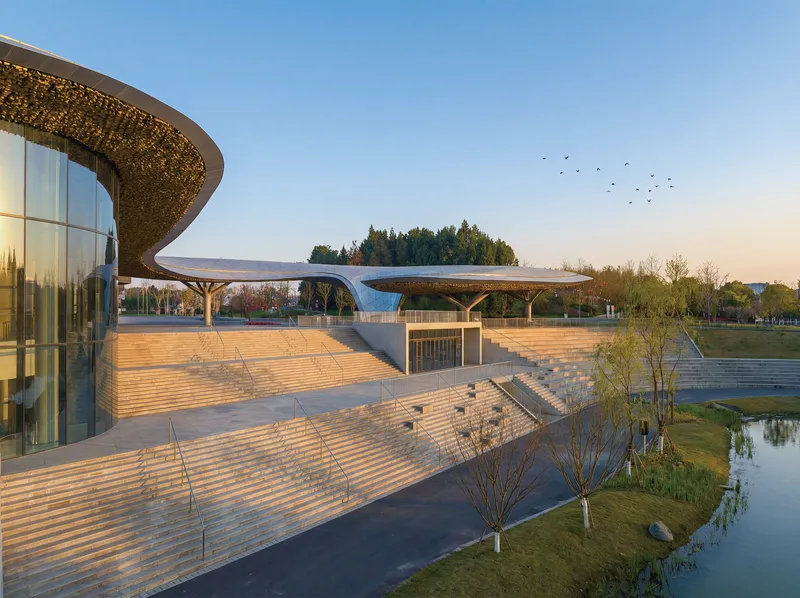
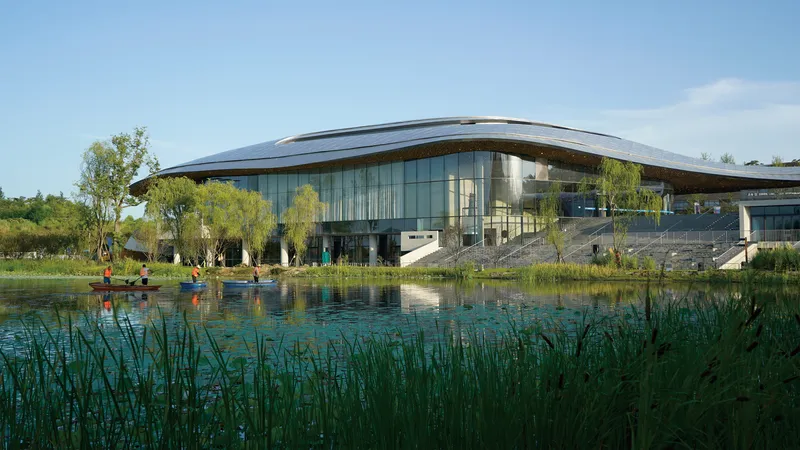
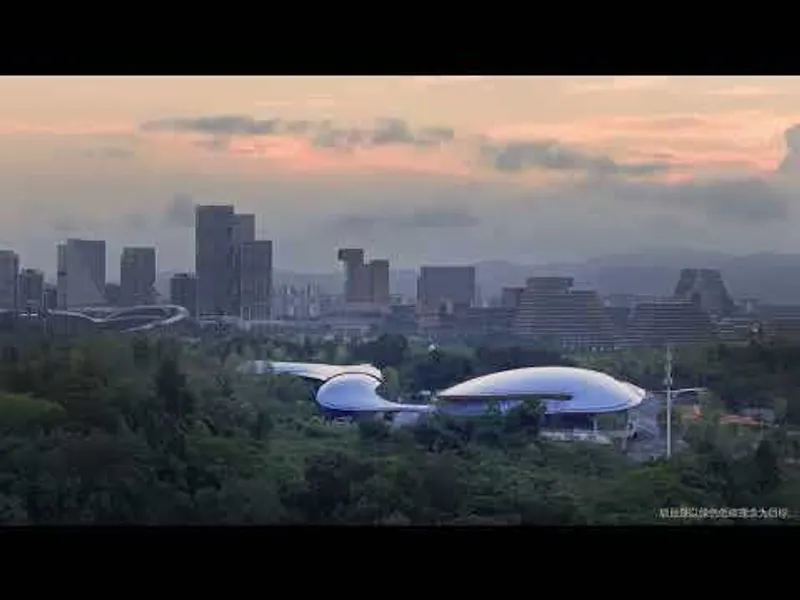
The pavilion's relationship to water is carefully choreographed. A timber deck plaza extends toward the lake's edge, offering an outdoor gathering space that doubles as a viewing platform at dusk. The curved glazed facades reflect in the adjacent pond, doubling the building's presence and softening its mass. At twilight, with birds in flight and the city skyline glowing in the distance, the architecture surrenders its formal authority to the landscape and becomes a frame for the scene rather than its subject.
The distant view of the cloverleaf roof nestled in greenery confirms what the plan suggests: this is a building designed to be absorbed by its site over time. As the surrounding parkland matures, the pavilion will increasingly read as a clearing in a forest, its white roofline the only signal of something monumental below.
Facade and Material Detail
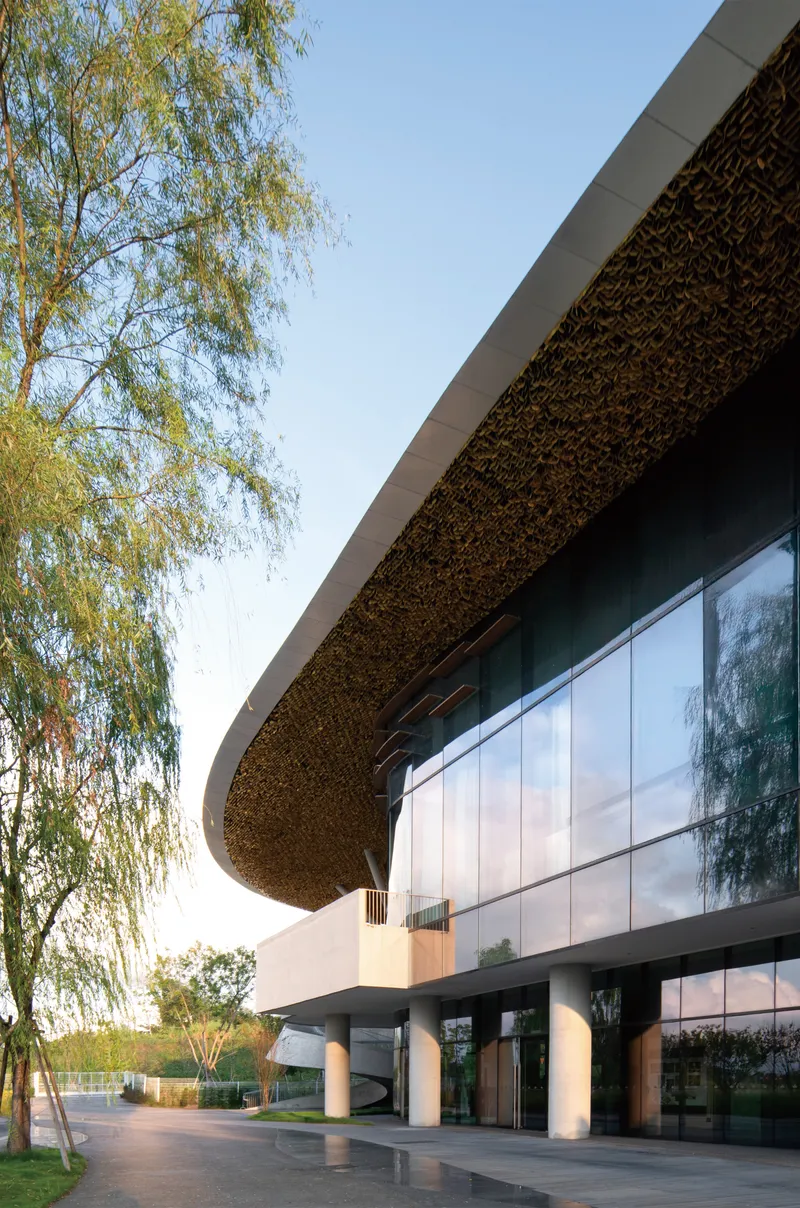
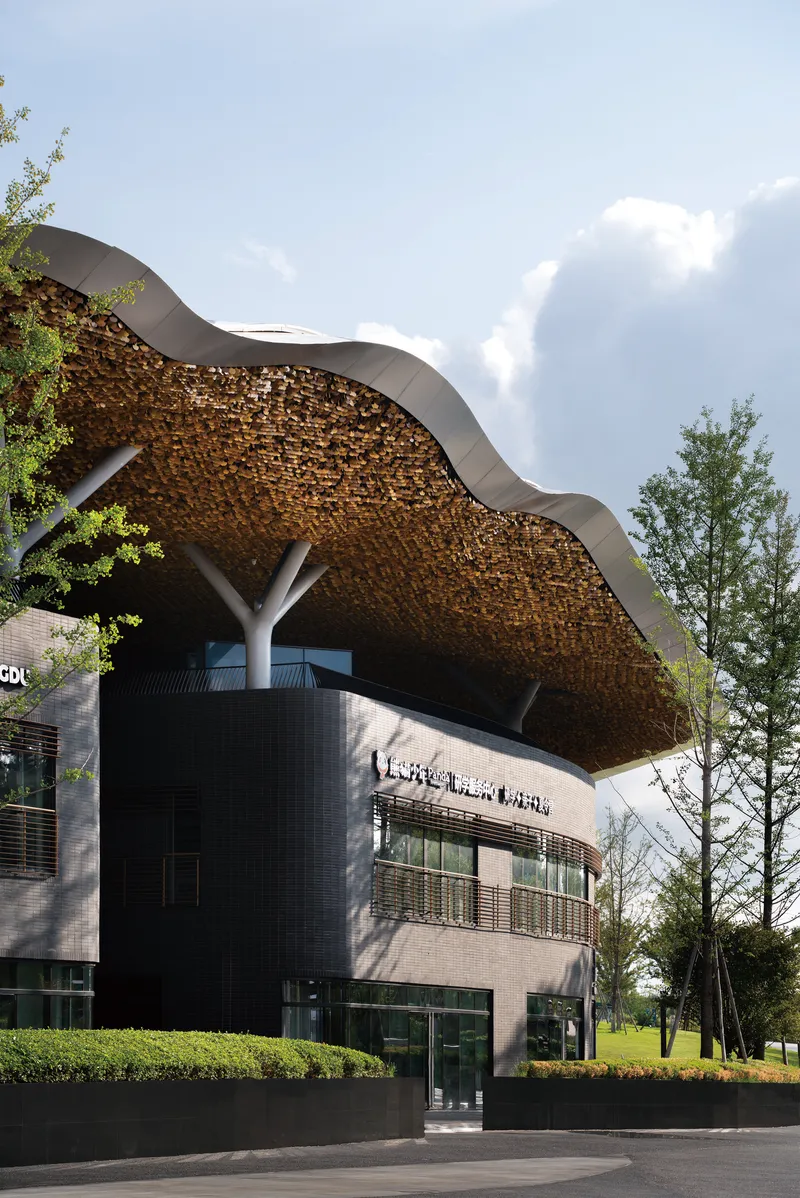
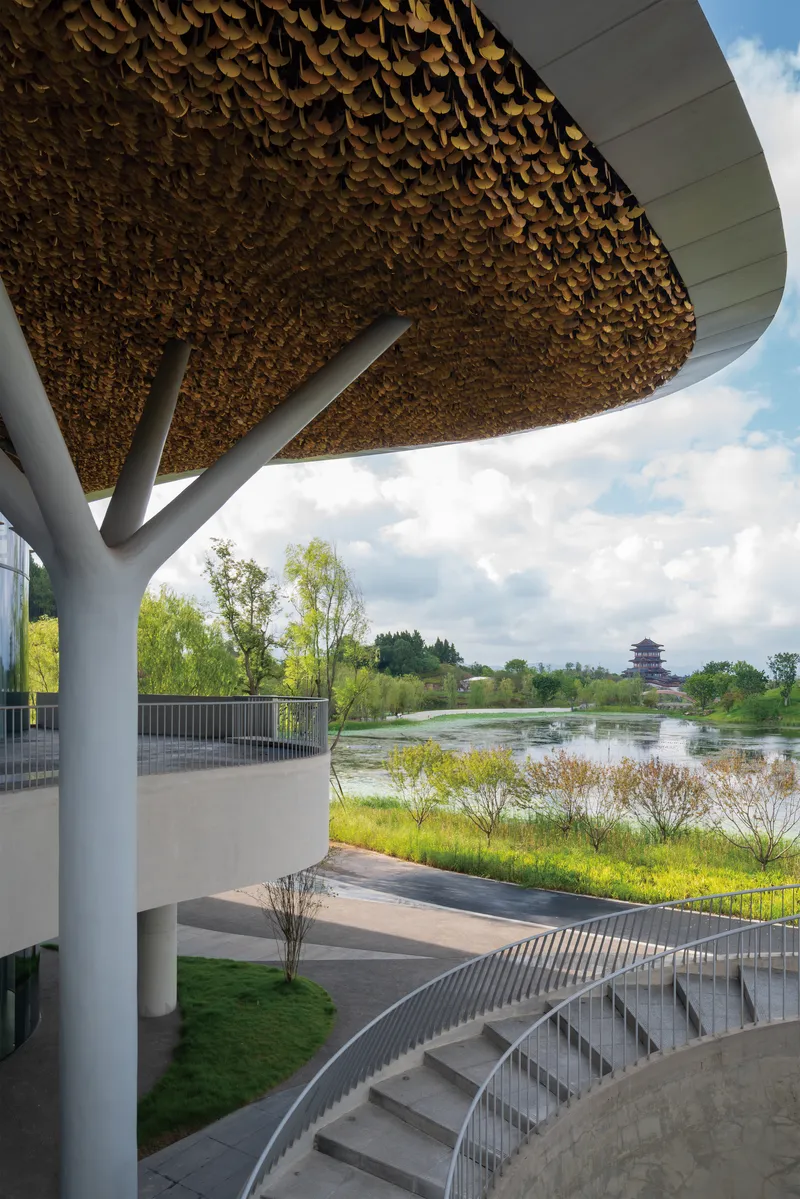
At closer range, the facade reveals a layered composition. Dark tile surfaces, glazed curtain walls, louvered screens, and the ever-present golden canopy create depth and shadow that the aerial views cannot communicate. Willow trees planted against the glass add a living layer that will change with the seasons. The woven roof canopy over the dark tile facade produces a particularly strong figure-ground contrast, lending the lower volumes a weightiness that anchors the floating roof above.
The exterior terrace beneath the scalloped roof edge is one of the pavilion's strongest moments. Looking out over a wetland toward a pagoda, the canopy's rippled edge crops the horizon like a theater proscenium. It is a quietly theatrical gesture, framing nature with just enough artifice to heighten the experience without overwhelming it.
Interior Atmosphere
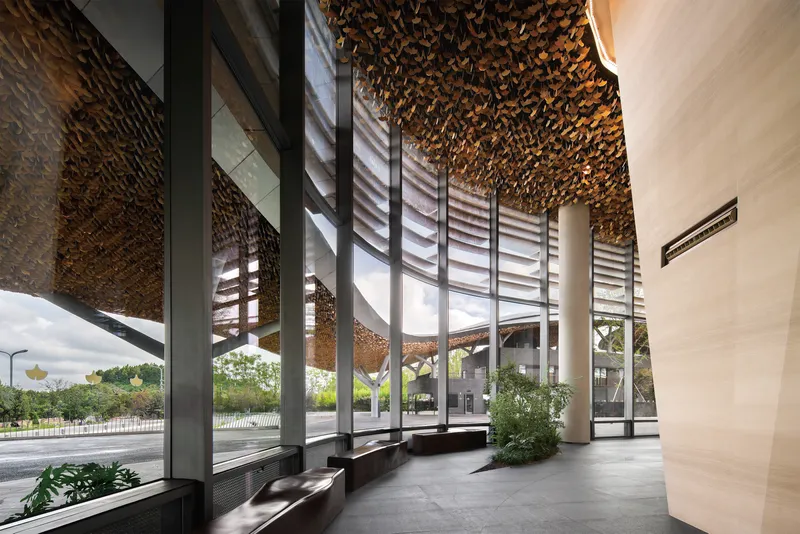
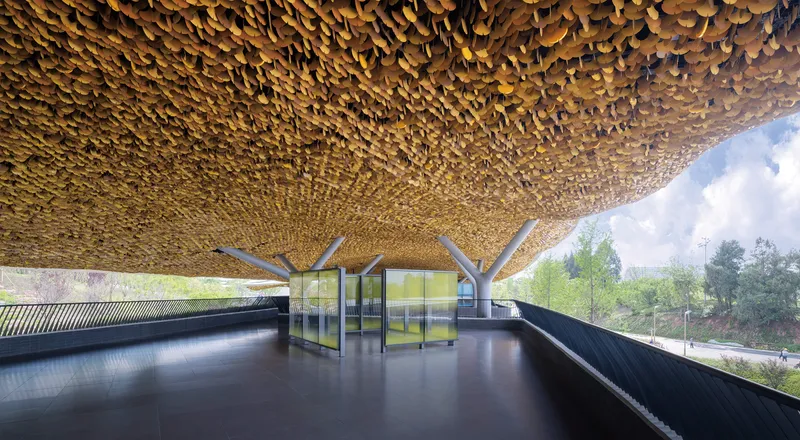
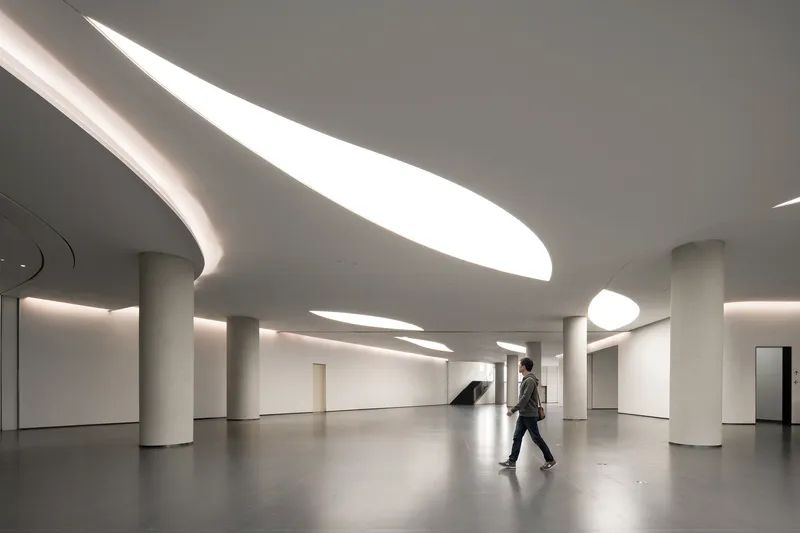
The interiors balance ceremony with comfort. Glass curtain walls bring daylight deep into the plan, while louvered screens modulate glare and create shifting shadow patterns across the floors. The golden ceiling, which dominates the exterior experience, continues inside with subtle variation: in some zones it appears as a continuous scalloped surface, in others as a more fragmented installation above dark stone floors. Curved skylights cut through the ceiling in key circulation zones, introducing overhead light that keeps the deepest parts of the plan from feeling subterranean.
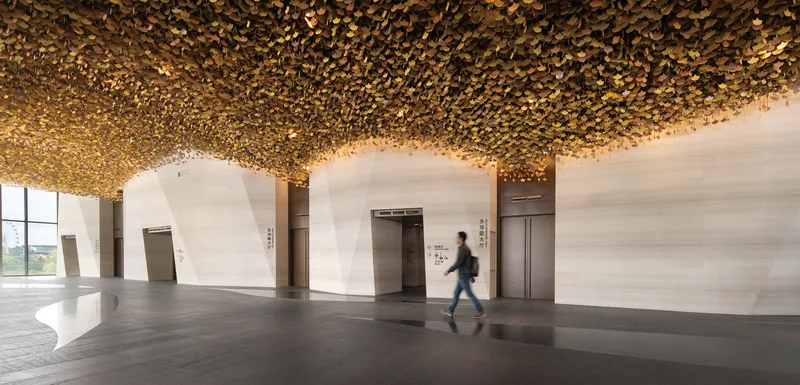
The elevator lobby and secondary corridors maintain the same material vocabulary: textured golden ceilings, pale stone walls, and careful lighting. There is a consistency here that speaks to disciplined execution across a very large building. Nothing feels like an afterthought, even in the back-of-house zones.
Plans and Drawings
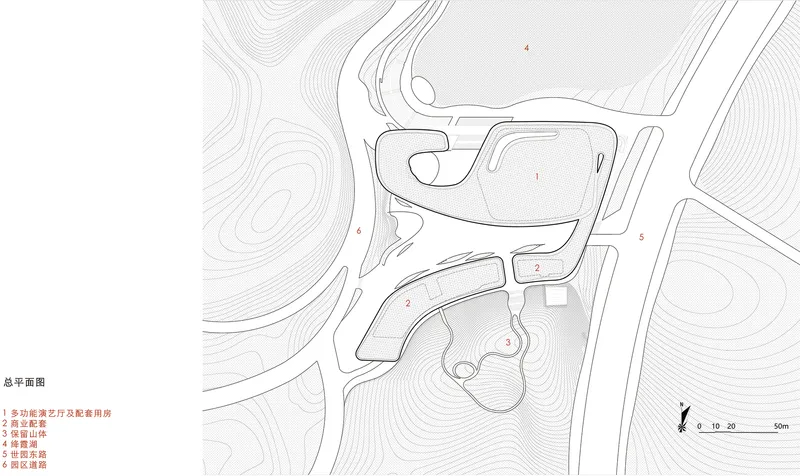
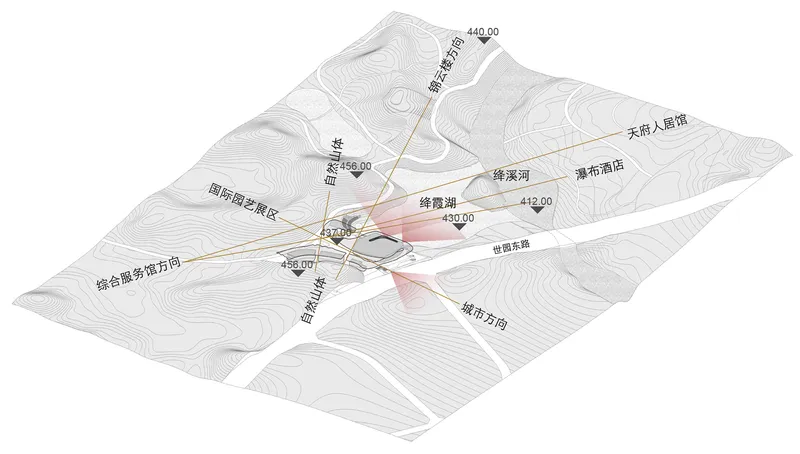
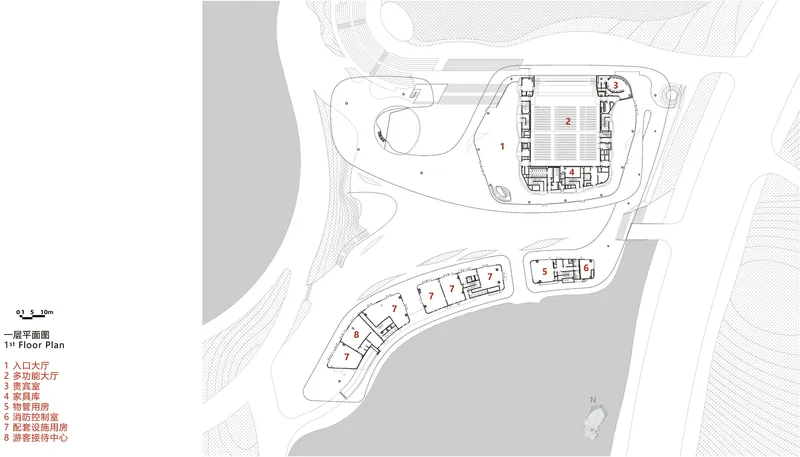
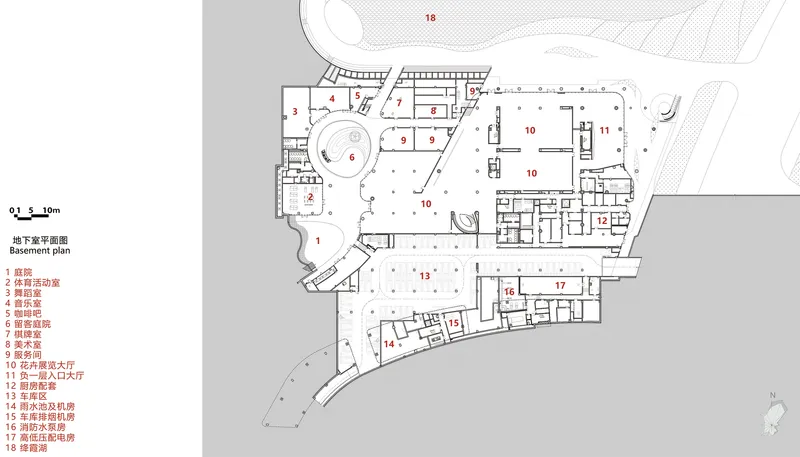

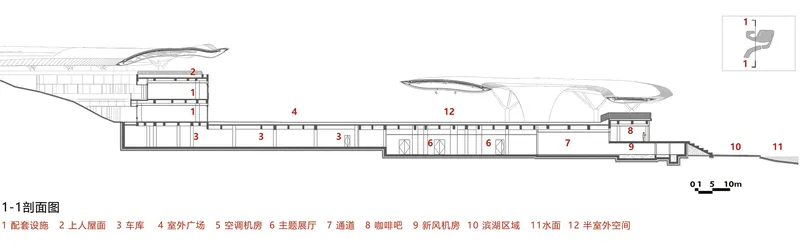
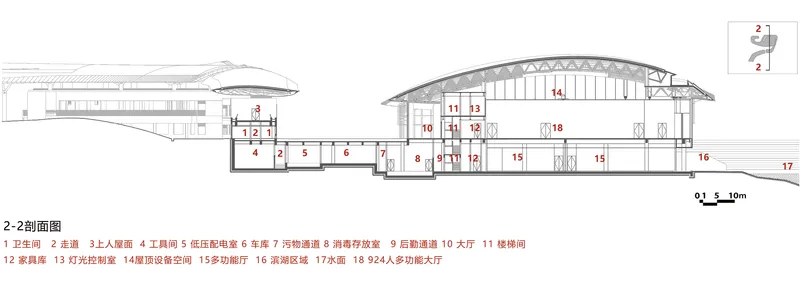
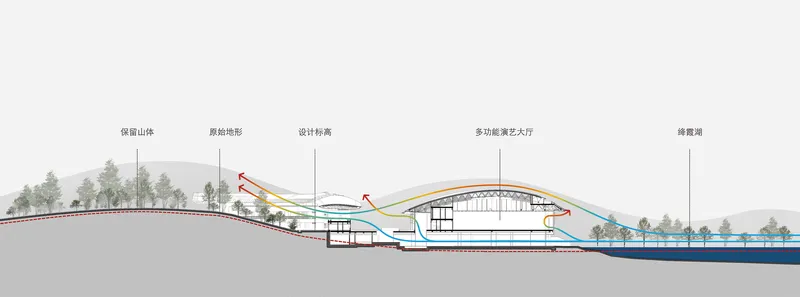
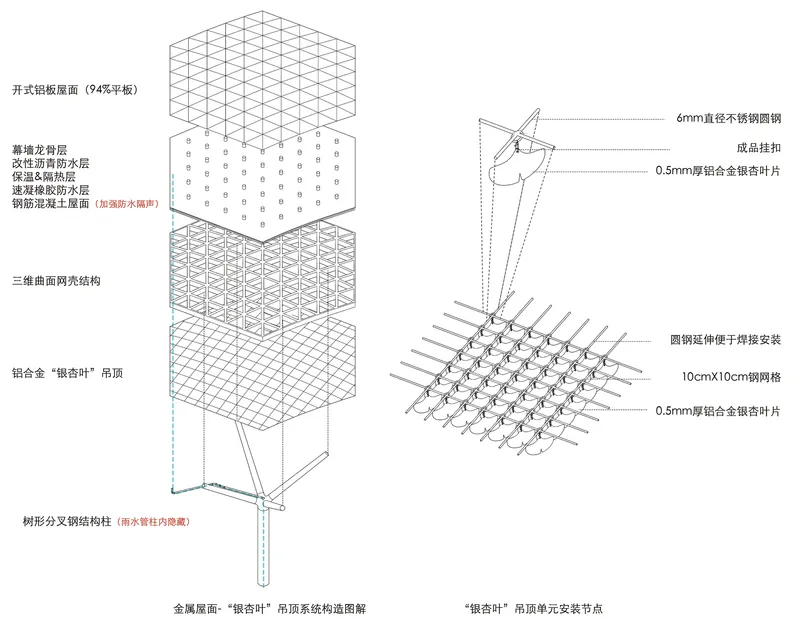
The site plan confirms the trilobed geometry and its integration with topographic contours and radiating pathways. The building is not imposed on the landscape but woven into it, with each lobe oriented along a different axis to engage a distinct edge condition. Floor plans reveal a surprisingly rational interior organization within the organic envelope: rooms and circulation routes follow clear logic despite the irregularity of the perimeter. The sections are the most revealing drawings, exposing the arched truss structures that span the gallery volumes and the dramatic variation in roof height across the building's length.
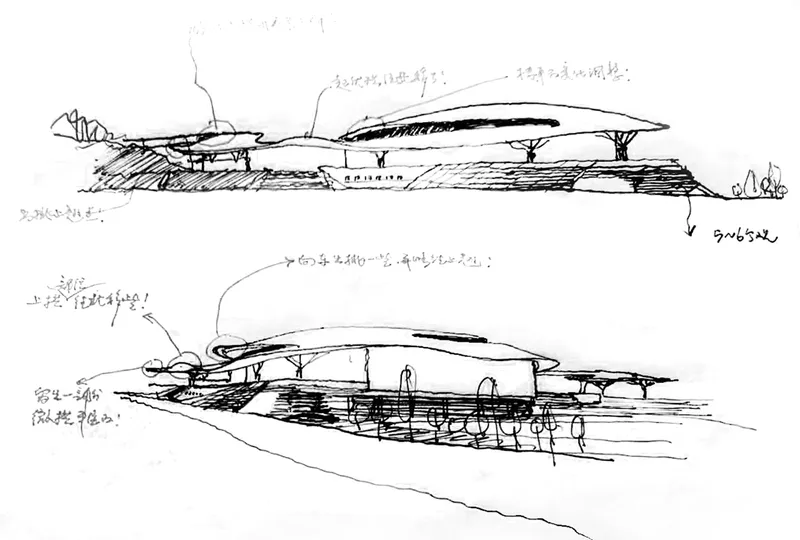
The axonometric detail drawing of the hexagonal roof structure and layered facade assembly shows how the golden surface is achieved: steel mesh cladding over a grid facade system, creating the textured, shimmering quality visible in the photographs. The concept sketches, with their loose wave-like forms above horizontal planes, demonstrate that the design intent held remarkably steady from early vision to built reality. That kind of fidelity between sketch and execution is rare at this scale.
Why This Project Matters
Expo pavilions are notoriously difficult to get right. They must perform at the scale of the city, function for massive crowds during the event, and ideally transition into useful civic infrastructure afterward. The Main Pavilion at Chengdu's 2024 Horticultural Exhibition succeeds on the first two counts through sheer spatial generosity: the porous ground plane, the layered canopy, and the embedded courtyards create a building that can absorb large numbers of people without feeling congested. The landscape integration is not superficial. By orienting each lobe toward water, forest, or wetland, CSWADI ensures that the building's primary experience is always a dialogue with its site, not a retreat from it.
The more lasting contribution may be the pavilion's argument for how large public buildings in subtropical climates can operate. The deep canopy overhangs, the layered facade systems, the planted courtyards, and the continuous shaded ground plane all work together to mitigate heat gain and create comfortable outdoor zones without relying exclusively on mechanical conditioning. If the building finds a meaningful second life after the expo closes, it will stand as evidence that monumental architecture and environmental intelligence are not mutually exclusive, even at 23,000 square meters.
Main Pavilion of the International Horticultural Exhibition 2024 Chengdu by CSWADI. Chengdu, China. 23,393 m². Completed 2024. Photography by 404NF STUDIO and Arch-Exist.
About the Studio
Share Your Own Work on uni.xyz
If projects like this are the kind of work you want to make, uni.xyz is a place to publish your own, find collaborators, and enter design competitions.


Popular Articles
Popular articles from the community

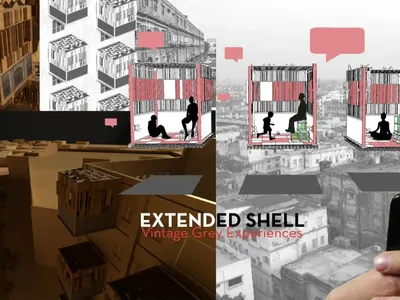
Extended Shell: Retrofitting Kolkata's Balconies as Living Urban Thresholds
A modular retrofit system recovers the social and environmental intelligence of Kolkata's historic verandas for contemporary Park Street residents.

Singing Woman: Contemporary Architecture Inspired by Estonia’s Voice and the Sea
Singing Woman turns Estonia’s song culture into flowing opera house architecture, blending public life, landscape, sea, and national memory.

The Amber Palace Opera: A Geological Fiction Surfaces on Tallinn's Baltic Waterfront
Pierre Brillard reimagines a Baltic legend as a public landscape, opera house, and waterfront promenade rooted in Tallinn's coastal identity.

Manzana Morphosis: Stretching Barcelona's Grid into a Living Landscape for 2050
A radical reworking of the Eixample manzana turns density into a tool for generous public space, vertical ecology, and environmental performance.

Similar Reads
You might also enjoy these articles

Bao Huynh Watercolor Atelier: A Serene Art Retreat in Hội An
Bao Huynh Watercolor Atelier in Hội An blends multifunctional art spaces, sustainable design, local materials, and family-friendly living in a serene environment.

Atelier Macri Concept Store Interior Design by CASE-REAL
Atelier Macri store features a "ko" counter, walnut wood details, cork displays, blending retail, gallery, and seamless customer experiences.

Manuel Vargas Izquierdo Stadium and High-Performance Sports Center: Architectural Excellence in Jalpa de Méndez
The Manuel Vargas Izquierdo Stadium blends sustainable design, inclusive sports facilities, and cultural-inspired architecture, revitalizing Jalpa de Méndez’s public spaces.

KAKR Buluh Awar Hall: Revitalizing Community and Ecology Through Bamboo Architecture
Community built bamboo hall revitalizes Buluh Awar village, empowering youth, restoring ecology, celebrating vernacular craftsmanship through sustainable architecture and culture.

Explore Chengdu Competitions
Discover active competitions in this discipline

Challenge to design a portable theatre

Challenge to design a portable music platform

Challenge to design an open learning module for the elderly

Bring back Drive In's
Comments (0)
Please login or sign up to add comments
No comments yet. Be the first to comment!