
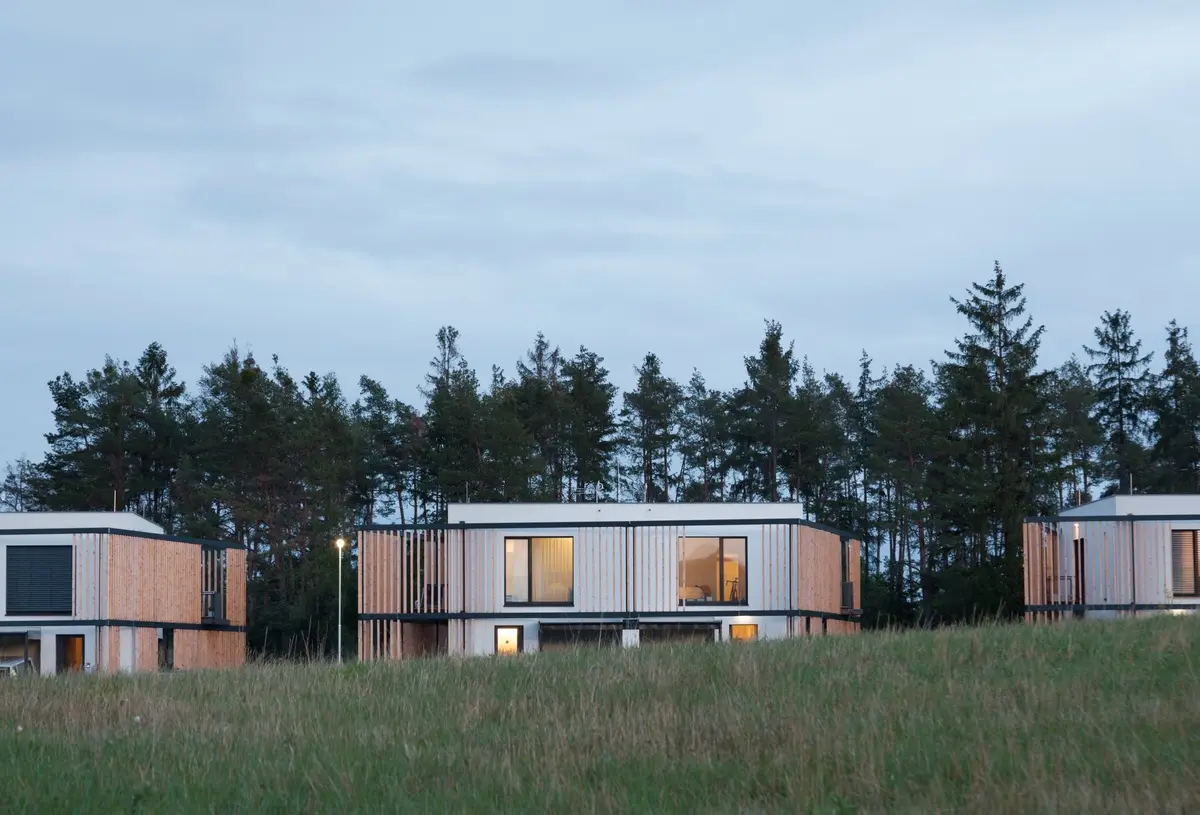
Cube in Cube: A Timber Veil That Turns Suburban Privacy into a Gradient
Jana Stachova wraps a white plastered house in a steel-framed slat screen near Dobris, trading solid walls for a calibrated filter of views and light.


Suburban housing usually answers the privacy question with a fence, a hedge or a blank side wall. Cube in Cube answers it with a second building. A compact white house sits inside a lighter, permeable cage of vertical timber slats held in a steel frame, and the gap between the two layers does the work that walls normally do. Privacy stops being a switch that is either on or off. It becomes a gradient you can walk through.
Designed by Jana Stachova and awarded a Jury Commendation in Habitats '20, the project sits near the spruce and pine forests of Dobris in the Czech Republic. Its brief is a familiar one: the steady push of individual housing onto the edges of growing cities, where repetitive layouts tend to trade spatial quality for density. Stachova keeps the economics intact with a semi-detached, two-storey type that a developer could build in series, then spends her design effort on the layer that decides how each household meets its neighbours.
A Screen Hung from Steel, Not a Wall
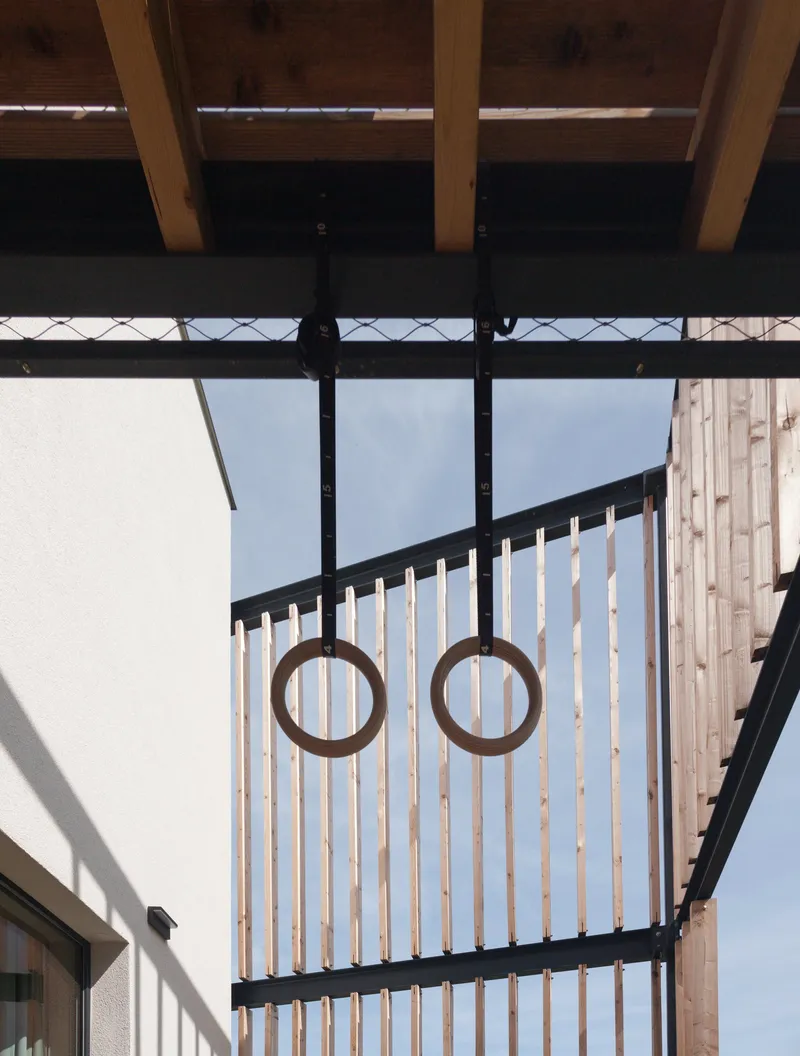
This close view isolates the project's key component: a slender steel beam carrying a run of timber slats against open sky. The screen is suspended, not load-bearing, and that matters. Because it hangs off a frame, it can wrap the upper level and run out over terraces and balconies without thickening the house itself. Hanging from the same beam is a pair of wooden gymnastic rings. They are a small detail, but they show that the frame is useful structure, something an occupant can occupy and adapt, as well as an envelope.
The slats filter views, temper sunlight and produce partial exposure in place of full concealment. From inside, the forest stays visible between the timber members. From a neighbouring plot, the same members close up into a near-solid surface at oblique angles. That asymmetry is the whole argument of the project, and it is achieved with nothing more than spacing and depth.
Repetition That Reads as a Street

Seen through a wire fence and long grass in grey evening light, the row of units shows how the type behaves in multiples. This is the condition the competition brief targeted, and it is where many suburban schemes fall apart into identical boxes. Here the repeated cube gives the cluster a coherent identity, while small shifts in orientation and landscape placement keep the line from becoming a barcode. The slatted skins catch light differently as they turn, so a single rule produces a varied edge.
The Pocket Between Cube and Screen
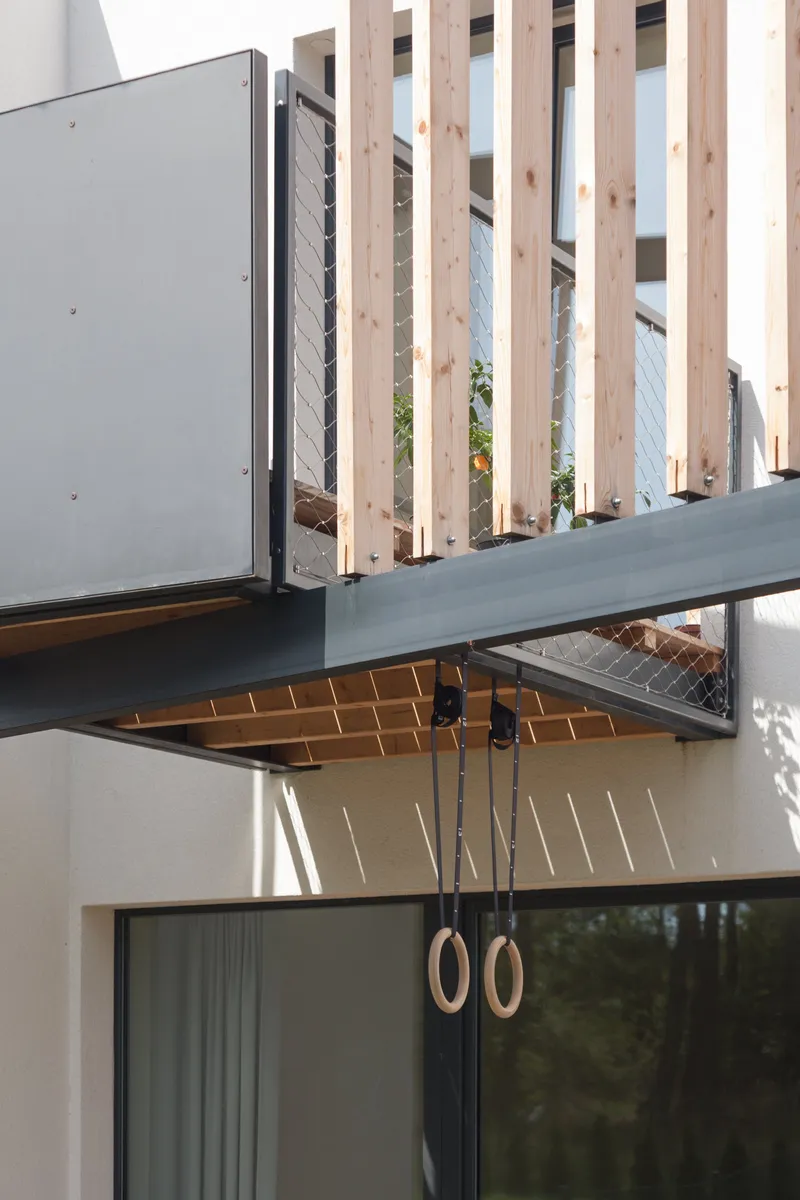
The balcony detail shows the in-between zone the title promises. A steel edge, a row of timber slats, a glazed door in full sun: the outer layer stands just far enough from the plastered volume to create usable depth. Stachova uses this depth for concealed storage, shaded outdoor rooms and semi-private thresholds where an occupant can step outside without stepping into view.
This is the most transferable idea in the scheme. The glazing on the inner cube can stay generous because the outer layer handles exposure, so the house does not need to choose between large openings and a sense of shelter. The slats also act as passive shading, cutting summer solar gain while letting filtered daylight reach the interiors and reducing the need for mechanical cooling. Privacy and environmental performance come from one element, not two.
White Mass, Timber Veil, Pine Backdrop
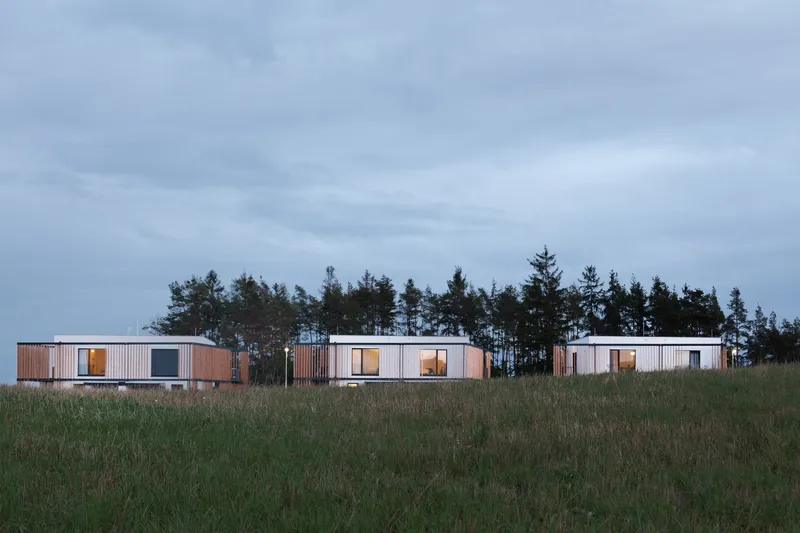
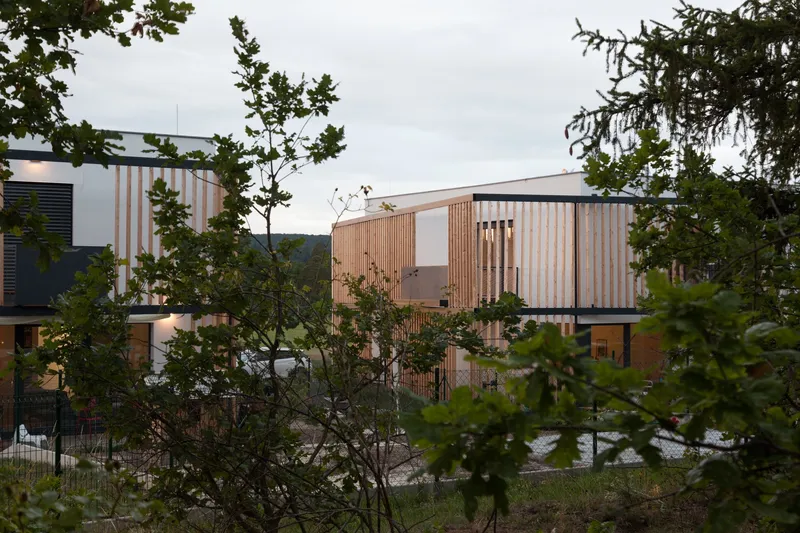
The palette is limited to three materials: white plaster for the primary mass, natural timber for the screen and exposed steel for the frame. In the view of three houses on a grassy rise against the pines, the plastered cubes read as solid and monolithic, while the timber layer softens their silhouettes toward the treeline. The vertical rhythm of the slats echoes the trunks behind, and the houses borrow the forest's grain without imitating its forms.
Glimpsed through leafy branches with a parked car in the foreground, the volumes settle into the vegetation instead of standing apart from it. Inside, the plan is compact and direct. Open-plan living spaces face framed views of the landscape, private rooms sit behind the deeper parts of the screen, and circulation is kept short. The material contrast of solid against permeable maps directly onto that programmatic split between open and private.
Lanterns at the Edge of the Road
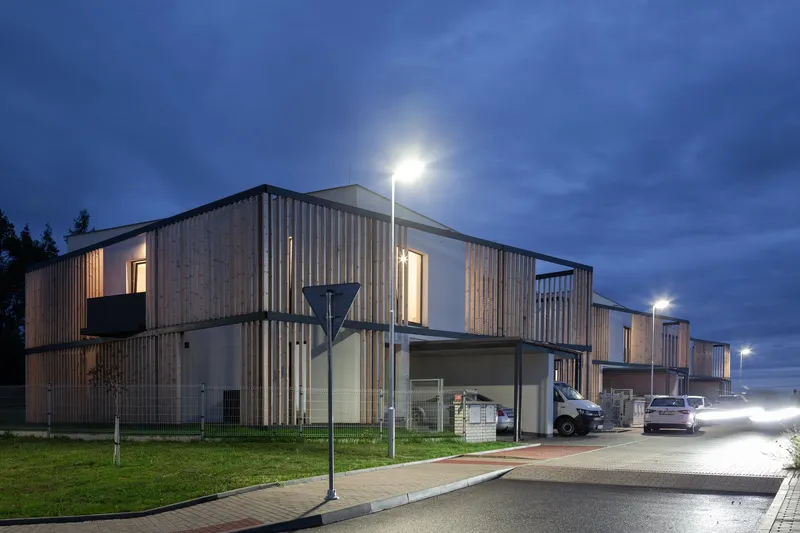
At night the screen works in reverse. With a street lamp overhead, parked vans alongside and light trails streaking past, the slatted corner glows from within, diffusing interior light into a soft haze instead of exposing rooms to the road. This is the setting where privacy is most tested, beside traffic and in plain view of passers-by. The house turns that exposure into atmosphere, and the cluster becomes a series of luminous volumes along the street instead of a row of lit windows.
Why This Project Matters
Cube in Cube takes a problem most suburban developments ignore and solves it at the scale of the envelope rather than the plot. It accepts the semi-detached, two-storey type and its economic constraints, then shows that one well-considered layer can deliver shading, storage, outdoor living and visual privacy together. That is a realistic proposition, not a speculative one, and it is likely what earned the Jury Commendation.
The broader lesson is about how privacy is defined. Instead of treating it as isolation behind solid walls, Stachova treats it as a set of calibrated thresholds that the inhabitant moves through and controls. As peri-urban housing grows denser across Europe, that shift from barrier to filter offers a useful model: houses that remain open to light and landscape while still protecting the people inside them.
View the Full Project
About the Designers
Designer: Jana Stachova
Enter a Design Competition on uni.xyz
uni.xyz runs architecture and design competitions year-round that reward proposals with spatial conviction and real site intelligence.
Project credits: Cube in Cube by Jana Stachova Habitats '20 (uni.xyz).


Popular Articles
Popular articles from the community


ETEH Reworks the Shared Spaces of São Domingos School in Brazil Around Timber, Color and Hanging Plants
At São Domingos School in Brazil, 436 m² of hall, refectory and library are recast with timber joinery, a yellow and blue code and trailing greenery.

FCC Arquitectura Expands a Portuguese Granite House with a Board-Marked Concrete Wing
In Portugal, JV House pairs a cleaned-up whitewashed and granite dwelling with a timber-shuttered concrete extension, courtyards and a garden pool.

graciastudio Turns a Viewless Tijuana Lot Inward Around a Courtyard of Concrete, Timber and Trees
In Tijuana, Jorge Gracia's GA2 House stacks a timber-clad private floor over exposed concrete and replaces a missing view with a planted interior patio.


The Amber Palace Opera: A Geological Fiction Surfaces on Tallinn's Baltic Waterfront
Pierre Brillard reimagines a Baltic legend as a public landscape, opera house, and waterfront promenade rooted in Tallinn's coastal identity.

Similar Reads
You might also enjoy these articles
Healing Façade: A Modular Chapel System That Restores Ethiopia's Sacred Forests
Winner of the Eco-Chapel competition, this circular timber façade collects water from air to rebuild soil and reforest degraded Ethiopian landscapes.
Kaffeebühnen: Where Coffee Shop Architecture Becomes a Civic Stage in Vienna
A linear sequence of timber boxes, transparent shells, and open yards turns the Viennese café tradition into a public performance space.
Eco Chapel: A Modular Forest Pavilion That Grows Like the Landscape It Protects
Hexagonal timber modules weave through existing trees, turning a chapel into a living system for prayer, education, and reforestation.


Urban Forest: A Vertical Ecosystem for 5,000 Workers in Singapore's Changi Business Park
Radially stacked pods and layered green decks turn a 7-acre plot into 47 acres of ecological workspace projected for 2040.

Explore Architecture Competitions
Discover active competitions in this discipline

Challenge to reimagine the Iron Throne

Photograph architecture without architects

Illustrate the lost glory of Angkor Wat - Render Challenge

Competition to design a workstation for architects
Comments (0)
Please login or sign up to add comments
No comments yet. Be the first to comment!