
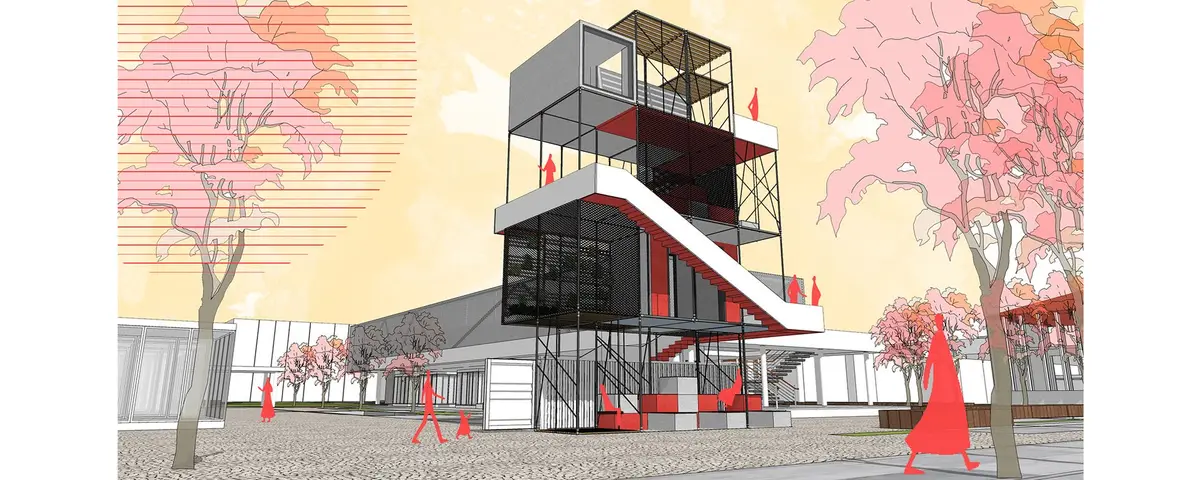
CUBE(ish): Modular Towers That Turn Urban Dead Zones into Social Escape Points
A 3D grid of stacked volumes and diagonal stairs creates flexible in-between spaces for pause, play, and community gathering.


Between home and the office, there is a spatial void most cities refuse to acknowledge. Not a park, not a plaza, not a transit hub, but the leftover gaps where people move through without stopping. CUBE(ish) targets precisely these forgotten slivers of urban fabric, proposing a vertically stacked modular system that gives commuters and residents a reason to pause. The concept is disarmingly simple: take a 3D grid of house-shaped volumes, thread them with diagonal white stairs, and drop them into the neglected interstices of the city.
Designed by Selen Karadogan, Mert Akay, and Ecem Kutlay, CUBE(ish) was a People's Choice Award entry in the Elevate 2019 competition on uni.xyz. The project frames itself as an "urban movement" rather than a single building, envisioning a system of modular towers that can be deployed near parks, public squares, transit hubs, and cultural centers to activate underutilized ground.
A Diagonal Stair Stitching Stacked Rooms Together
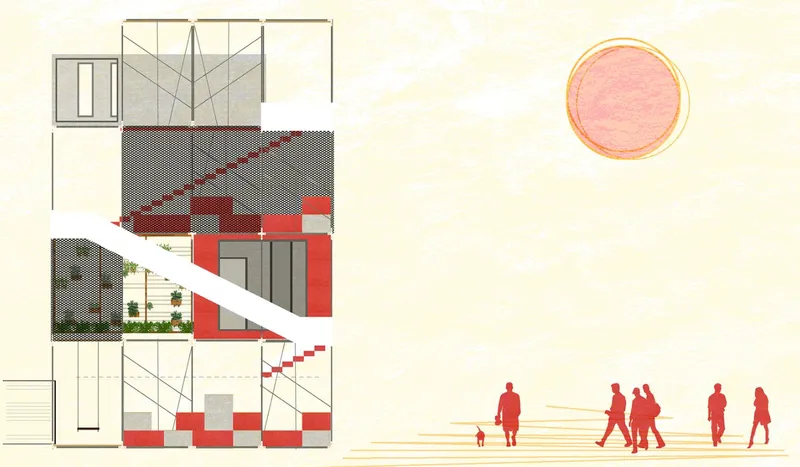
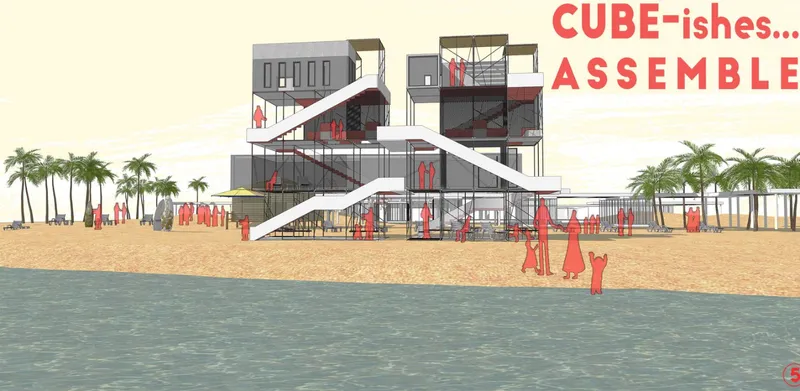
The section drawing reveals the project's organizational logic with clarity. Stacked modular volumes, each roughly the profile of a small gabled house, sit atop one another in slightly offset positions. A continuous diagonal white stair cuts through them, serving as both circulation spine and visual signature. The stair is not tucked inside; it runs along the exterior face, making movement through the structure legible from the street. In the beachfront rendering, this same system appears transplanted to a sandy shoreline flanked by palm trees, demonstrating the adaptability the designers claim. The volumes maintain their identity while the context shifts entirely.
Red Panels and Pink Trees: The Tower in Its Urban Context
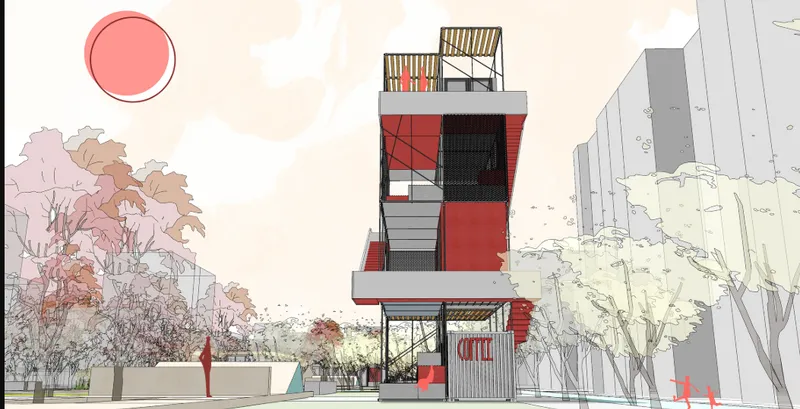
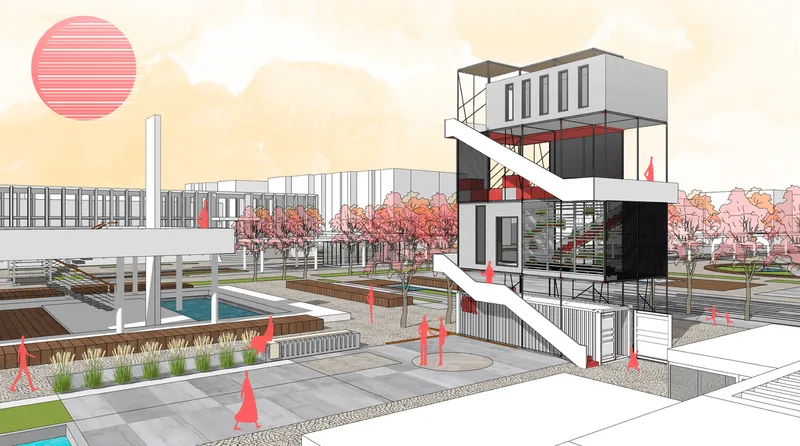
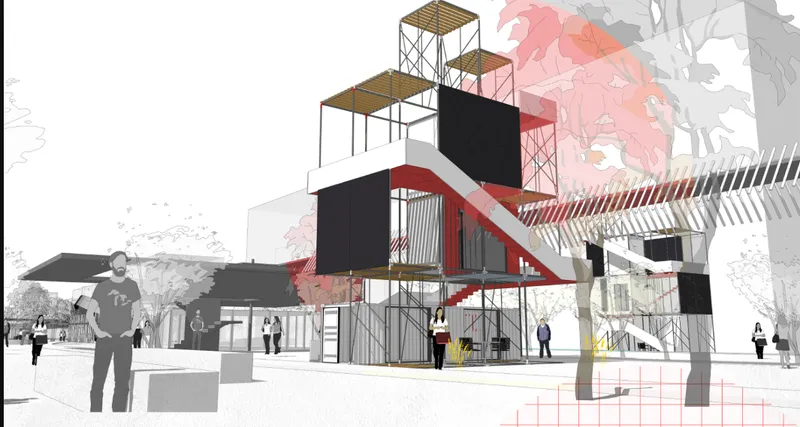
Placed within a streetscape, the CUBE(ish) tower takes on a surprisingly monumental presence. Red and grey panels alternate across the stacked volumes, giving each unit a distinct material register while the white diagonal stair unifies them into one legible object. The pink-toned trees in several renderings are a deliberate atmospheric choice, softening the tower's industrial modularity against a more romantic urban backdrop. At the plaza level, reflecting pools and pedestrian gathering spaces extend the tower's influence beyond its footprint, pulling people toward it rather than past it.
The street-level perspective is the most telling image. Pedestrians cluster naturally at the base, drawn by the open ground plane and the visual pull of the staircase ascending above them. The designers understand that a vertical intervention in a horizontal city only works if it generates activity at grade. Without that magnetic ground floor, the tower becomes a sculpture. With it, the tower becomes a destination.
Three Towers, Curved Pathways, One Urban Block
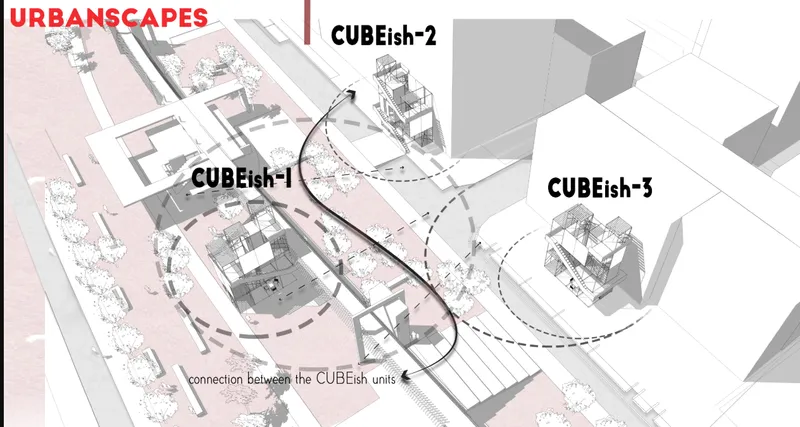
The site plan reveals an ambition that goes beyond a single installation. Three modular tower units sit within a single urban block, connected by curved pathways that flow organically between them. This network approach transforms what could be isolated objects into a system of linked social nodes. The curved paths resist the rigid grid of the surrounding streets, creating a micro-landscape that feels intentionally different from its context. It is a small act of spatial resistance: the city gives you straight lines, CUBE(ish) gives you curves.
Perforated Screens, Planted Terraces, and Programmatic Flexibility
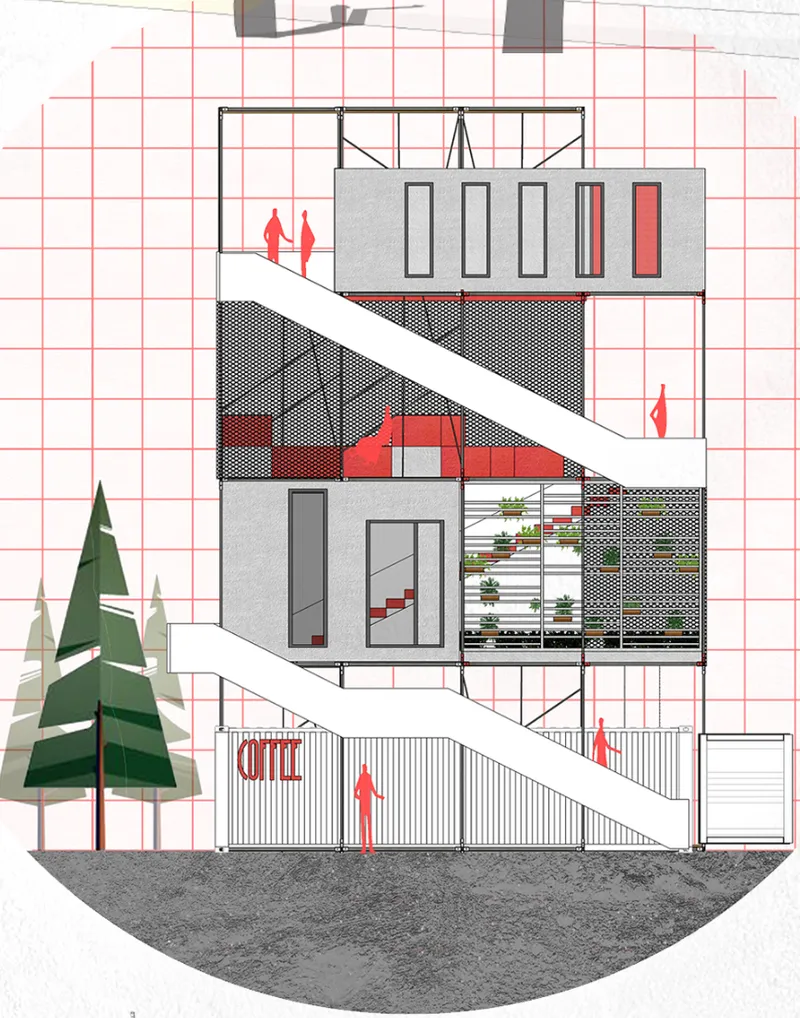
A detailed section reveals layers of environmental responsiveness within each volume: perforated screens filter light and encourage natural airflow, planted terraces introduce green at multiple levels, and the recurring diagonal stairs connect everything in a continuous promenade. These are not sealed boxes. The mesh and perforation strategy allows air to move through the structure, reducing reliance on mechanical ventilation and giving occupants a sensory connection to the outdoors even when several stories up.
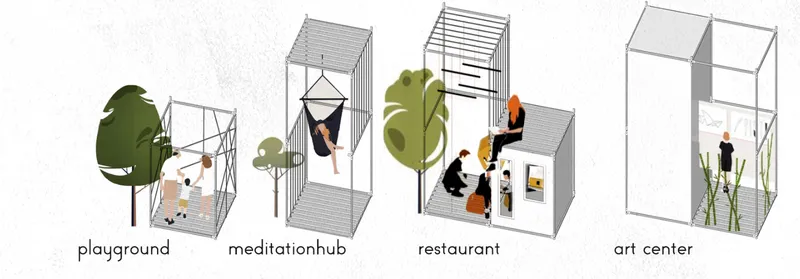
The axonometric drawing of four small house-shaped pavilions is perhaps the most direct expression of the project's programmatic thinking. Labeled as playground, meditation hub, restaurant, and art center, these units show how a single modular geometry can accommodate radically different uses. The gabled silhouette remains constant; only the interior arrangement changes. This is the real proposition of CUBE(ish): a universal spatial container flexible enough to absorb whatever a community needs, from quiet reflection to collective dining.
Mesh, Red Walls, and the Layered Section
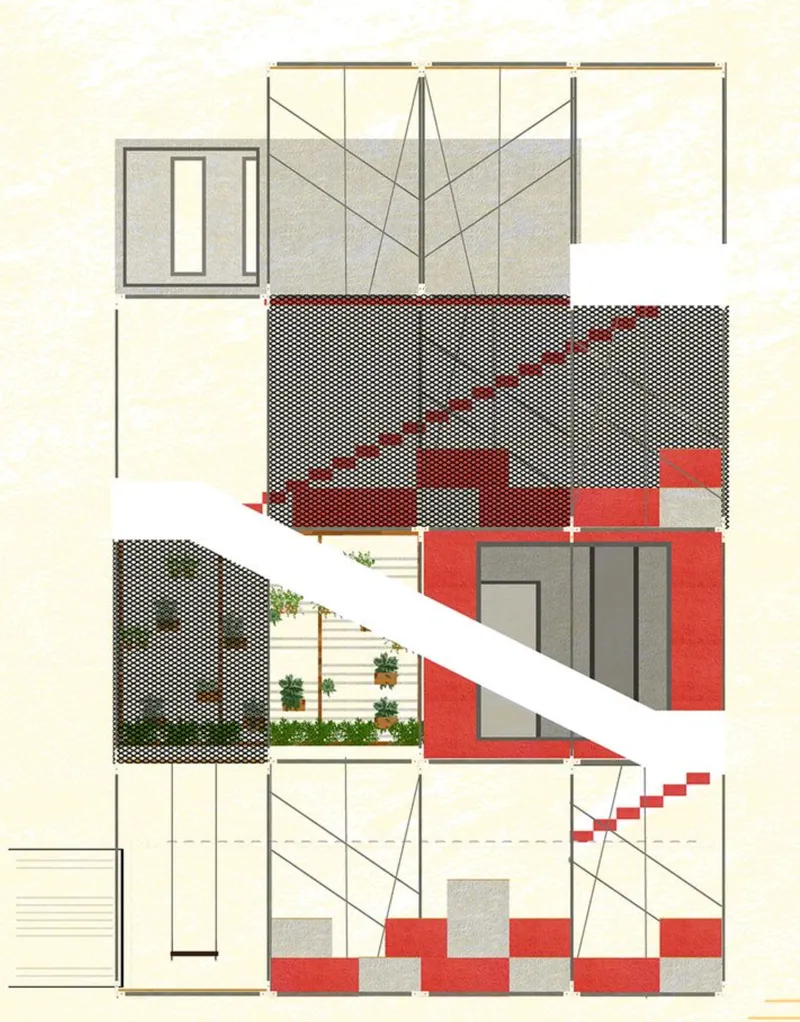
The final section drawing consolidates the project's material palette into one readable composition. Mesh screens, red accent walls, and the white diagonal circulation stairs layer against one another, creating a visual depth that suggests more complexity than a simple stack of boxes. The red walls act as spatial anchors, marking thresholds and programmatic shifts within the vertical sequence. The mesh panels soften boundaries between inside and outside, reinforcing the project's core ambition to blur the line between public infrastructure and intimate escape.
Why This Project Matters
CUBE(ish) takes a familiar observation (that cities are full of leftover space nobody uses) and proposes a response that is both structurally specific and programmatically open. The 3D grid system allows for scalable, repeatable deployment without forcing every installation into the same configuration. Each tower can respond to its site, its community, and its climate while maintaining a coherent architectural language. That balance between system and specificity is harder to achieve than it looks, and the designers handle it with a confident hand.
What makes the project resonate is its insistence that urban life needs relief valves. Not grand civic gestures, but modest, accessible interventions that give people permission to stop moving. A meditation hub stacked above a playground stacked above a restaurant is not a building typology that exists in any zoning code, but it captures something true about how people actually want to spend the minutes between obligations. CUBE(ish) does not try to fix the city. It tries to make the spaces the city forgot worth lingering in.
View the Full Project
About the Designers
Designers: Selen Karadogan, Mert Akay, Ecem Kutlay
Enter a Design Competition on uni.xyz
uni.xyz runs architecture and design competitions year-round that reward proposals with spatial conviction and real site intelligence.
Project credits: CUBE(ish) by Selen Karadogan, Mert Akay, Ecem Kutlay Elevate 2019 (uni.xyz).


Popular Articles
Popular articles from the community


Conexión: Biophilic Design Reimagines High-Rise Living in Hong Kong
Conexión reimagines high-rise living in Hong Kong through biophilic design, green facades, shared spaces, daylight, water and nature within.

Hill & Cross Opera: Sculptural Opera House Architecture Shaped by Tallinn’s Landscape and Identity
Hill & Cross Opera reimagines opera house architecture in Tallinn through its sculptural hill, civic plaza, glass wave and a luminous cross.

Play: Fragments of Their World
Familiar architecture becomes modular playground design, creating safe spaces where displaced children can learn, connect, imagine and play.

Co-Life: Senior Housing Design That Reconnects Older Adults With the City
Co-Life reimagines senior housing design through healing gardens, shared streets, workshops, and a sustainable community across generations.

Similar Reads
You might also enjoy these articles

Day and Night Park: A Time-Based Urban Newsstand in Beijing
A temporary urban newsstand in Beijing blending travel, light, and reading through poetic colors, compact form, and community-focused design.

Modernist Patio Renovation in El Masnou, Barcelona by Oliver Segura Arquitectura + Cebrià Arquitectura
Modernist patio renovation blending tradition and innovation with a movable pool, leveled floors, and Catalan materials in El Masnou.

Alto Residencial Coop: Cooperative Housing Development in Santiago de Compostela by Carbajo Barrios Arquitectos
A linear cooperative housing complex blending white volumes and perforated metal façades, enhancing community living, natural light, privacy, and urban integration.

Vil Genis School by BPA ARCHITECTURE – Massy, France
Vil Genis School in Massy, France, features sustainable design, south-facing classrooms, community integration, accessible spaces, and modern educational architecture.
Explore Urban Space Competitions
Discover active competitions in this discipline

Challenge to design a portable theatre

Challenge to design locus for the upliftment of human rights

Challenge to design a portable music platform

Challenge to design an open learning module for the elderly
Comments (0)
Please login or sign up to add comments
No comments yet. Be the first to comment!