
Cultural and Historical Public Center: Rebuilding Aleppo Through Arches, Markets, and Memory
A multifunctional center near Aleppo's Citadel reinterprets traditional Islamic geometries to house commerce, culture, and collective healing.


Architecture in a post-crisis city carries a weight that no structural engineer can calculate. When a building rises where conflict has erased the familiar, every arch, every courtyard, every material choice becomes an act of collective memory and a wager on the future. The Cultural and Historical Public Center with Market Function takes that wager seriously, proposing a four-level civic building near Aleppo's Citadel that fuses commerce, exhibition, and public gathering within a formal language drawn directly from the city's surviving architectural DNA.
Designed by Vycheslav Baryshev, the project is organized around central courtyards and nested rectangular volumes, with arched colonnades, pixelated stone façades, and stepped public terraces establishing a spatial rhythm that feels both ancient and deliberately contemporary. The programme is broad: retail, cafés, lecture halls, exhibition galleries, and outdoor plazas, all threaded together by a central atrium that pulls light and circulation through the building's full height. It is an ambitious proposition, grounded in the conviction that markets, museums, and meeting places can rebuild communal ties that conflict has severed.
Nested Volumes Around the Courtyard Void
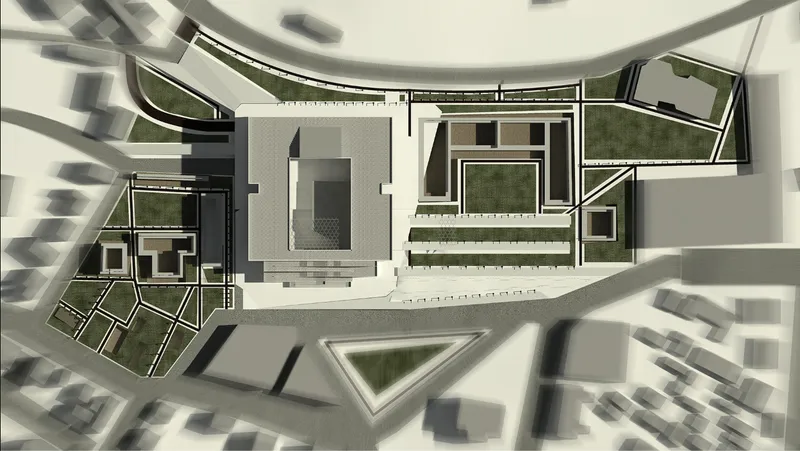
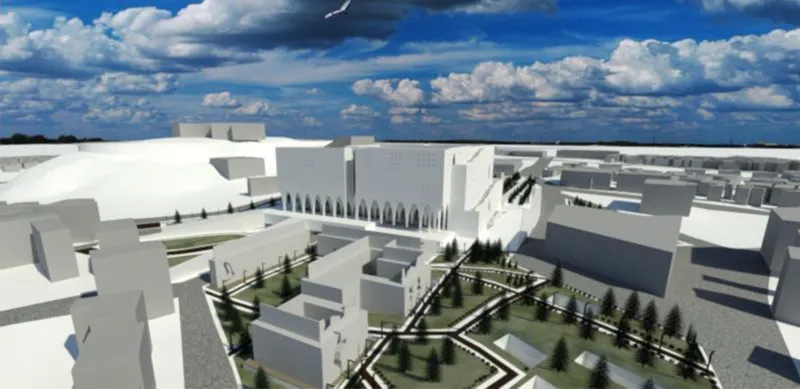
The site plan reveals the project's organizational clarity: nested rectangular masses frame a series of geometric courtyards, with landscaped buffers softening the edges where the building meets the city. The aerial model view confirms this reading in three dimensions, showing white volumes stepped and staggered around green-filled voids under open sky. The massing aligns with the principal axis toward the Citadel, framing views of one of Aleppo's most historically charged landmarks while generating circulation routes designed to reconnect fragmented urban tissue.
What makes this plan strategy compelling is its refusal to treat the courtyard as mere ornament. The voids are working spaces: they organize movement between the four programmatic levels, channel daylight into the central atrium, and offer outdoor terraces where the building's social life spills into open air. Evergreen trees planted within the courtyards anchor the composition to the ground and provide shade, reinforcing the idea that the building is not an object placed on a site but a landscape integrated into one.
Perforated Screens and Arched Colonnades as Memory Carriers
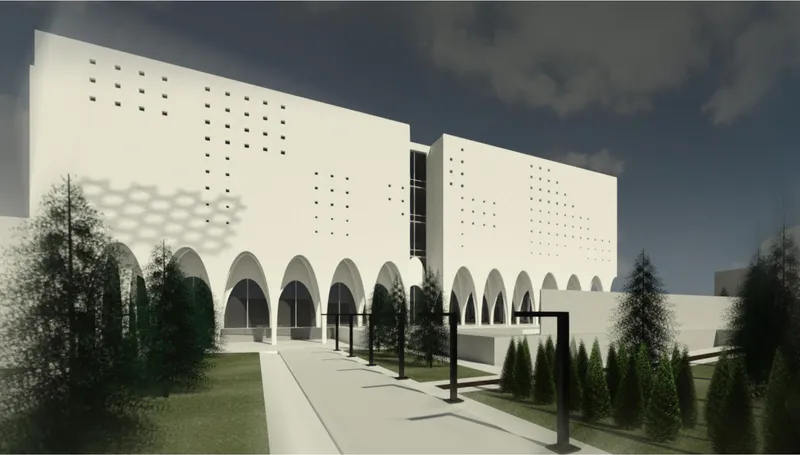
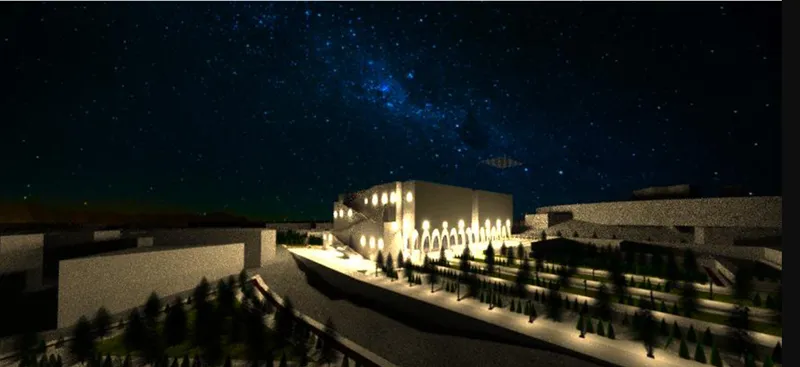
The pedestrian-level view along the façade shows the building's strongest formal gesture: a repeating arched colonnade at ground level, surmounted by a perforated screen wall whose pixelated gradient evokes the texture of aged stone and weathered masonry. Baryshev draws explicitly from local precedents, including the al Khusruwiyah Mosque and traditional dome constructions, reinterpreting arch-and-column logic as both structural system and emotional signal. The arches establish a rhythmic visual field that dissolves the boundary between interior and exterior, inviting pedestrians along a conifer-lined path directly into the building's public realm.
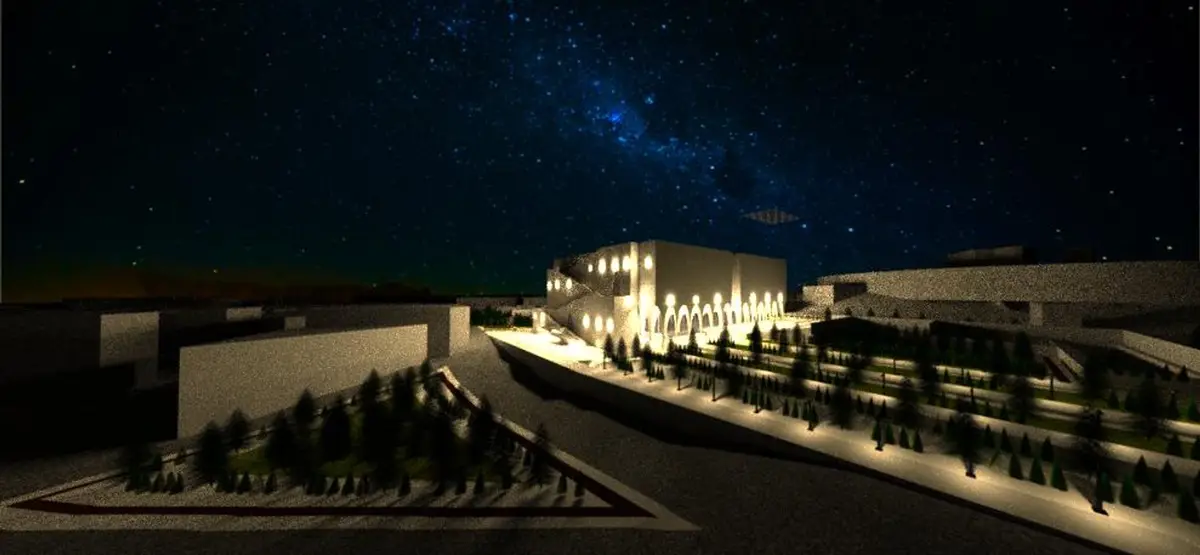
The night rendering underscores how the building transforms after dark. Warm light floods through the arched arcade, illuminating the tiered levels that step up from the landscaped ground plane. The stepped terraces are not decorative; they soften the grade change between street level and the elevated main structure, creating pathways and seating zones that keep the civic environment active across different hours. The effect is a building that glows from within, a lantern set against the night sky, legible as a gathering place even from a distance.
A Patterned Skin That Filters Light and Identity
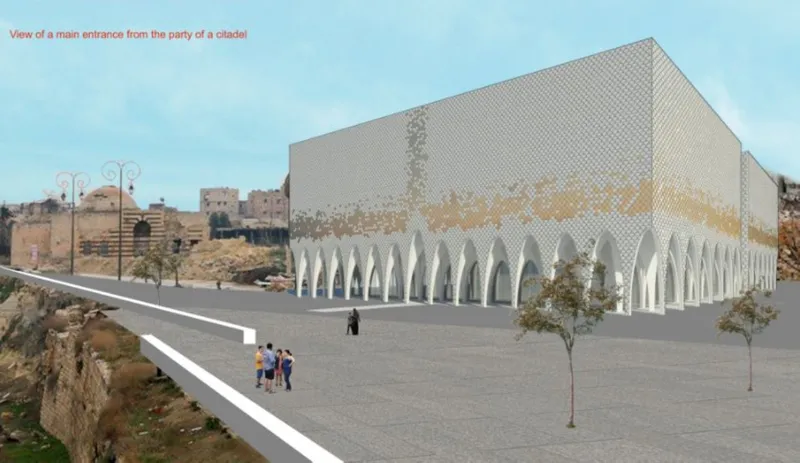
The corner view captures the interplay between the two primary façade systems: the open arched colonnade at the base, hosting retail and the trading island that forms the economic backbone of the ground floor, and the patterned screen above, which wraps the upper levels housing lecture halls, café areas, and exhibition galleries. Pedestrians and young trees in the foreground plaza give the composition its human scale. The screen's geometry draws on classical Islamic patterns but abstracts them into a contemporary register, avoiding pastiche while maintaining cultural legibility. It filters harsh sunlight, modulates privacy, and brands the building as unmistakably of this place.
The Oculus: Where Light, Geometry, and Silence Converge
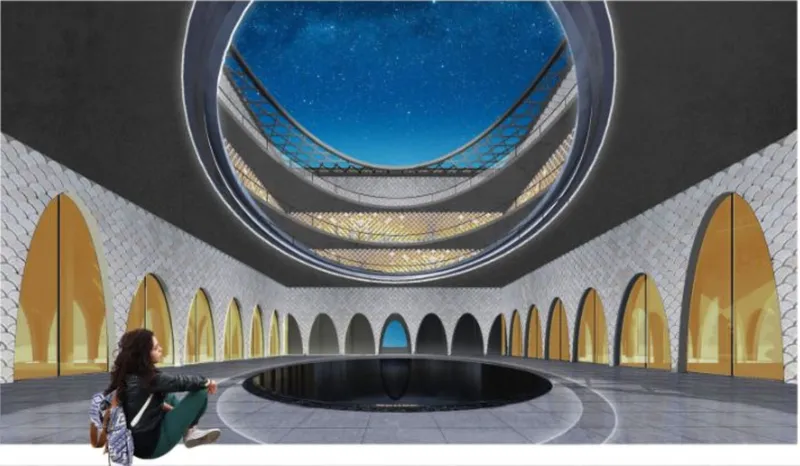
The interior view from the uppermost level is the project's most arresting image. A circular oculus opens to the sky, ringed by golden arches that radiate outward like the ribs of a dome. Two seated figures at the edge of the central void provide scale and, more importantly, suggest the contemplative atmosphere Baryshev intends for this space. This is Level 4, the building's spiritual summit, where exhibition spaces and openings to the courtyard below are sheltered by a dramatic roof canopy that filters light into the central atrium.
The oculus functions as more than a skylight. It is the culmination of the building's sectional logic: the same void that organizes markets and retail at Level 1, social exchange at Level 2, and cultural display at Level 3 arrives here as pure atmosphere, an interplay of light, sky, and geometry that rewards the vertical journey through the building. The golden tone of the arches suggests warmth and craftsmanship, a deliberate contrast to the white volumes seen from outside, signaling that the interior life of the building holds its own distinct register of experience.
Why This Project Matters
Post-conflict reconstruction too often defaults to either nostalgic replication or context-blind modernism. Baryshev's proposal navigates a more difficult path: it absorbs the formal and spatial lessons of Aleppo's traditional architecture, particularly the arch, the courtyard, and the stone screen, and redeploys them within a contemporary programmatic framework that addresses urgent needs for commerce, education, and public assembly. The four-level organization, from the trading island at ground level to the contemplative oculus at the roof, traces a deliberate experiential arc from civic commerce to cultural reflection.
What gives the project its conviction is the refusal to separate function from meaning. Markets are not merely economic infrastructure; they are sites where daily life reconstitutes itself. Exhibition halls are not neutral white boxes; they are framed by courtyard voids that connect viewers to sky and city. The building's alignment with the Citadel axis is not a formalist gesture; it is a spatial argument that architecture can stitch a wounded urban fabric back together. For a city that has lost so much, this kind of purposeful ambition is exactly what the conversation around reconstruction needs.
View the Full Project
About the Designers
Designer: Vycheslav Baryshev
Enter a Design Competition on uni.xyz
uni.xyz runs architecture and design competitions year-round that reward proposals with spatial conviction and real site intelligence.
Project credits: Cultural and Historical Public Center with Market Function by Vycheslav Baryshev.


Popular Articles
Popular articles from the community


Singing Woman: An Opera House That Performs Before the Curtain Rises
Ovidiu Cristian Pavel's conceptual opera house translates Estonia's choral identity into a sculpted waterfront landmark facing the Baltic Sea.


ETEH Reworks the Shared Spaces of São Domingos School in Brazil Around Timber, Color and Hanging Plants
At São Domingos School in Brazil, 436 m² of hall, refectory and library are recast with timber joinery, a yellow and blue code and trailing greenery.

Aquadapt: An Underwater Habitat That Rewrites Its Rooms by the Hour
Curved modules ring the seabed while one shell shifts from breakfast room to cinema, farm and football pitch as residents' needs change.

David Ortega Stacks a Two-Story Mexico City Penthouse Around a Steel Stair and a Pergola-Shaded Roof Terrace
In Colonia Roma, a 300 m² penthouse uses oak joinery, a planted steel stair and a slatted roof pergola to make a new-build apartment feel like a house.

Similar Reads
You might also enjoy these articles
Aquadapt: An Underwater Habitat That Rewrites Its Rooms by the Hour
Curved modules ring the seabed while one shell shifts from breakfast room to cinema, farm and football pitch as residents' needs change.

Play: Fragments of Their World: Remembered Architecture Rebuilt as a Modular Playground for Refugee Camps
Tom Gardner abstracts domes, arches and towers from the homelands of displaced families into a kit of child-scaled play parts for camp settlements.
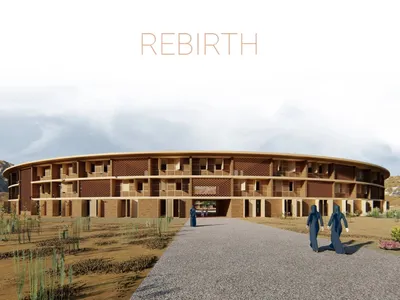
REBIRTH: A Circular Settlement Where Afghan Widows and Their Children Rebuild Life Together
A shortlisted Resile entry turns the circle into a protective ring of timber and brick, gathering homes, classrooms and gardens around a shared landscape.
The Main Dream: A Recycled Plastic Kit That Lets Refugee Children Build Their Own Playground
Thirty-centimetre interlocking cubes that connect on three axes turn play into construction, letting children author the spaces they occupy.

Explore Cultural Architecture Competitions
Discover active competitions in this discipline

Design a brochure to showcase the effects of the technosphere

Challenge to illustrate ‘A tale of Two Cities’

Deconstructivism - Illustration Design Challenge

Bring back Drive In's
Comments (0)
Please login or sign up to add comments
No comments yet. Be the first to comment!