
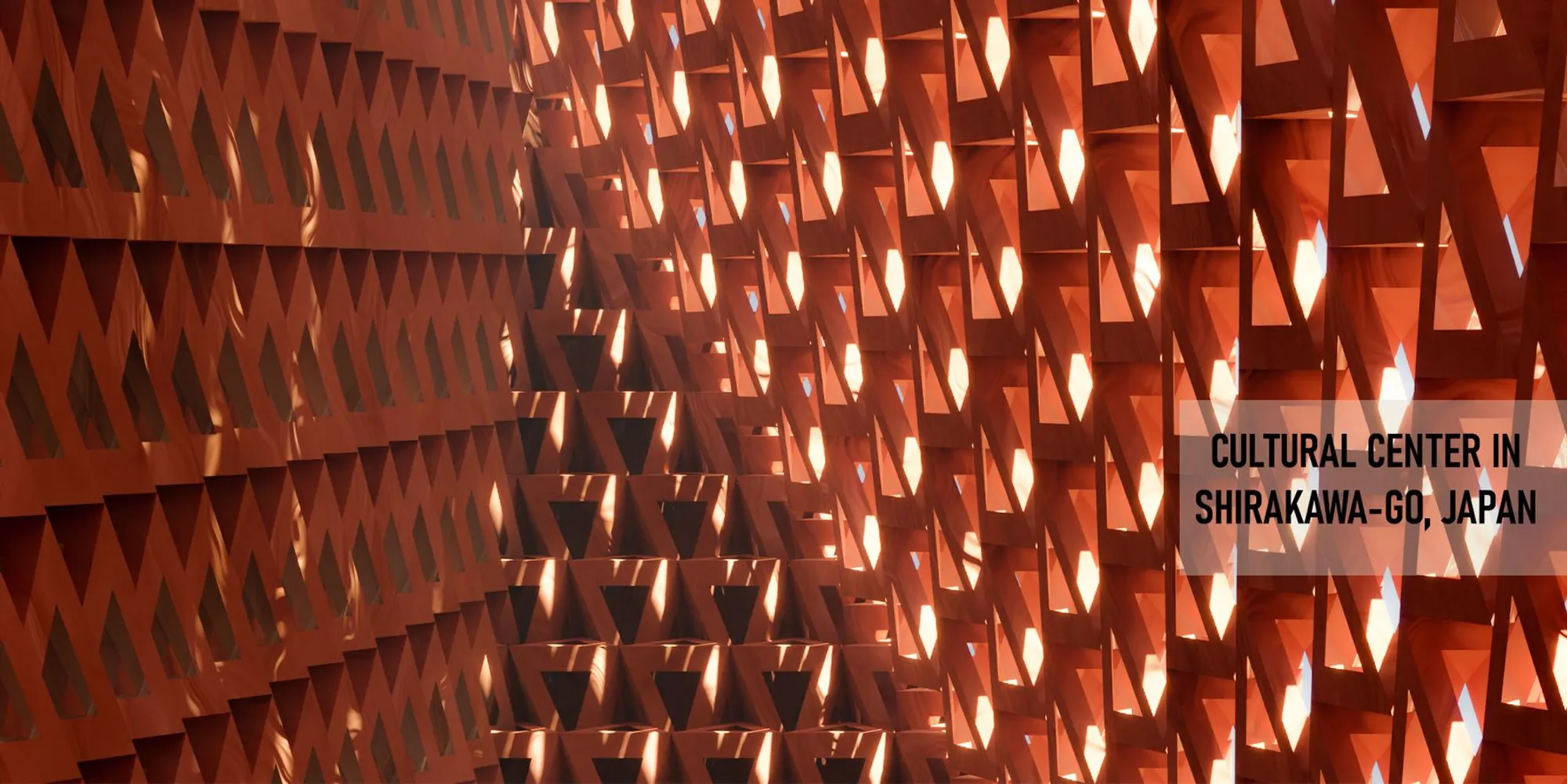
Cultural Center in Shirakawa-go: Modular Craft as Heritage Preservation
A runner-up entry in Cultural Conserve reimagines vernacular Japanese tectonics through 60-degree geometries and community workshops.


What happens when a building's construction method is itself the cultural artifact being preserved? In Shirakawa-go, a UNESCO World Heritage village famous for its steeply pitched Gassho-zukuri farmhouses, this cultural center proposes that architecture can be both a container for heritage and an active vehicle of its transmission. The design treats modular construction not as an industrial convenience but as a craft practice, one rooted in Japanese woodworking joints and regional ceramic production, inviting locals and visitors to literally build the culture they came to witness.
Designed by Ghayad Muhandes, this project earned runner-up honors in the Cultural Conserve competition. Sited at the gateway to the village and flanked by rice paddies, the center comprises five pavilions organized on a grid derived from the surrounding agricultural landscape. Its tectonic logic draws directly from the 60-degree geometries inherent in Gassho architecture, translating vernacular form into a contemporary modular system built from Japanese cypress and regional white ceramics.
Gabled Pavilions Rooted in Rice Fields
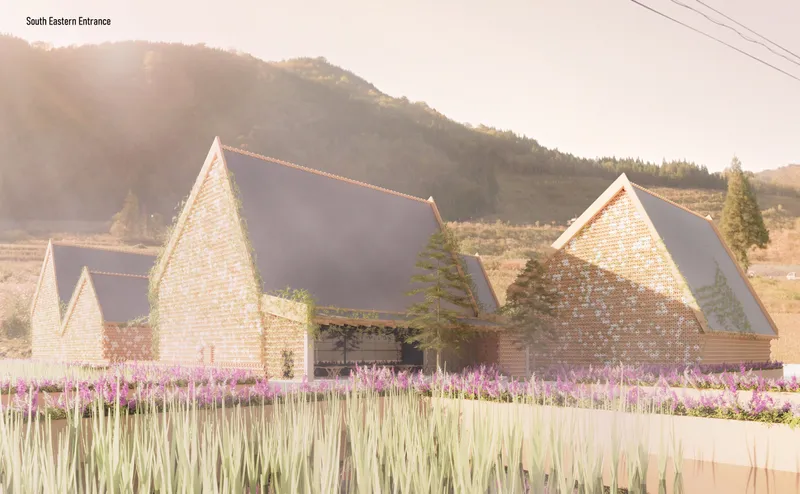
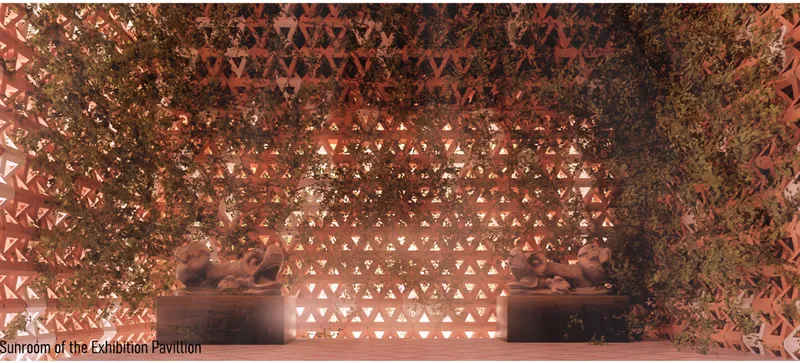
The cluster of gabled volumes reads as a quiet extension of the landscape rather than an imposition on it. Perforated facades, composed of interlocking modular units, filter light and air in a manner that recalls the latticed walls of traditional Japanese architecture while registering as unmistakably contemporary. Viewed across fields of purple wildflowers and wheat, the pavilions maintain a scale and rhythm that defers to the village beyond. At night, the interior reveals itself through the triangular screen walls: warm light spills through thousands of apertures, and planted greenery at the base softens the boundary between building and ground.
Five distinct pavilions house the program: Exhibition, Education, Workshop, Lounge, and Management. The modular system that generates the facades also forms the structure and interior partitions, meaning the building can be reconfigured over time. Variants of the module include basic wood units, ceramic vegetation panels, window frames, and concrete elements, each calibrated to a specific environmental or programmatic condition.
A Tectonic System You Can Hold in Your Hands
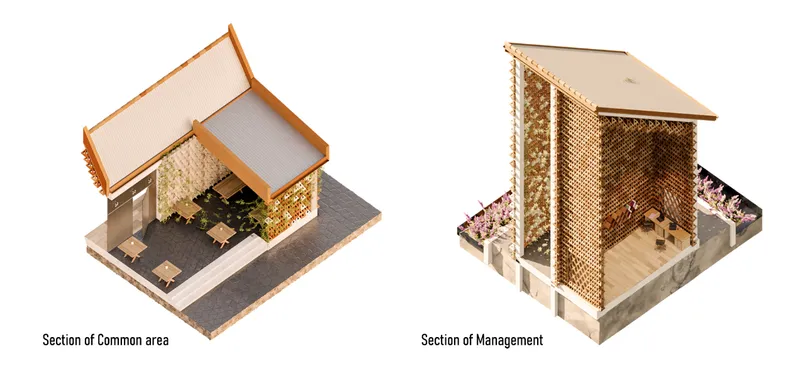
Physical section models expose the spatial logic at work inside the gabled volumes. Latticed walls divide and connect interior rooms while maintaining visual porosity, a quality that keeps the pavilions feeling open despite their modest footprints. The models also demonstrate how the 60-degree geometry governs everything from roof pitch to partition angle, creating a formal coherence that ties the project back to the Gassho-zukuri tradition without resorting to pastiche.
The use of locally sourced Japanese cypress and regional ceramics is more than a material decision; it is the project's central argument. As younger generations migrate to cities, the traditional construction knowledge of Shirakawa-go erodes. Workshop pavilions offer hands-on instruction in techniques like Ari kata sanmai hozo komisen uchi, a traditional Japanese woodworking joint, alongside ceramic production. Elders teach, tourists participate, and the building itself becomes a pedagogical instrument.
Threshold Between Ancient Village and Modern World
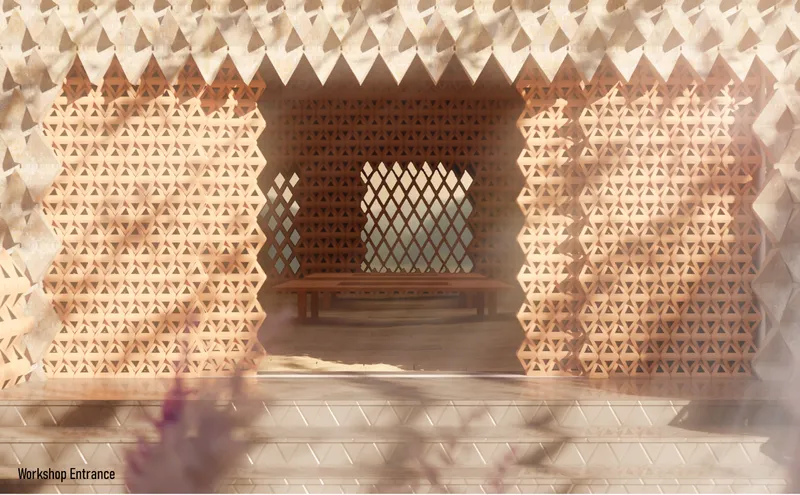
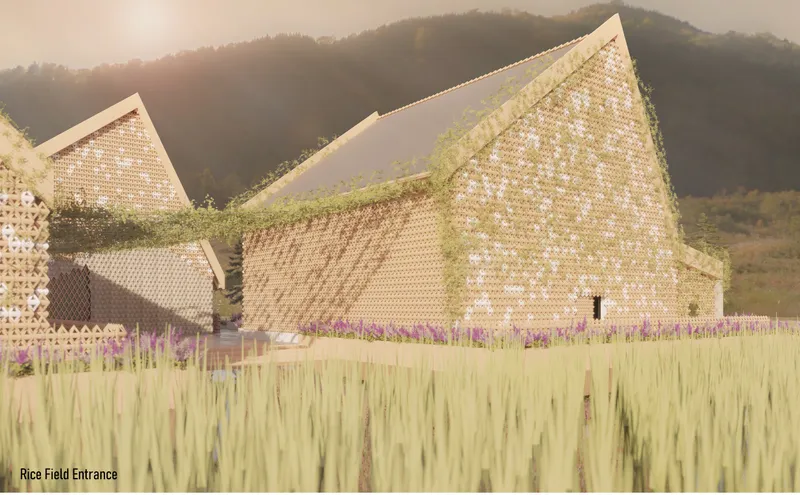
Positioned at the entrance to Shirakawa-go, the center operates as a literal threshold. Visitors pass through triangular perforated clay screens that frame views of the village beyond, dappled sunlight filtering through the modules like light through a forest canopy. A pedestrian bridge connects the center to the historic fabric, while the surrounding rice paddies anchor the building in the agricultural traditions that have shaped this landscape for centuries. The progression from open field to screened entry to village interior choreographs a shift in tempo, slowing visitors before they encounter the heritage site.
Against the mountain backdrop, the perforated gabled facades rise from the rice field with a presence that is assertive yet respectful. The silhouette echoes the steep rooflines of Gassho-zukuri houses, but the open, faceted surfaces communicate a building that belongs to the present. The center does not freeze Shirakawa-go in amber; it proposes that vernacular architecture is most alive when it is still being made, adapted, and taught.
Why This Project Matters
Heritage preservation in architecture too often falls into one of two traps: faithful reconstruction that embalms the past, or contemporary insertion that ignores it. Muhandes sidesteps both by locating the heritage not in form alone but in the act of construction. The modular system functions as what architectural theorist Sibyl Moholy-Nagy called a "generative matrix," a reproductive framework capable of growth and transformation. The building can evolve because the community knows how to build it.
By centering craft workshops, intergenerational knowledge transfer, and locally sourced materials, the project reframes the cultural center typology. It is not a museum of tradition but a workshop for its continuation. In a village threatened by depopulation and the erosion of inherited skills, that distinction carries real weight. The architecture argues, persuasively, that preserving a culture means keeping its tools sharp and its hands busy.
View the Full Project
About the Designers
Designer: Ghayad Muhandes
Enter a Design Competition on uni.xyz
uni.xyz runs architecture and design competitions year-round that reward proposals with spatial conviction and real site intelligence.
Project credits: cultural center in Shirakawa-go, Japan by Ghayad Muhandes Cultural Conserve (uni.xyz).




Popular Articles
Popular articles from the community


Conexión: Biophilic Design Reimagines High-Rise Living in Hong Kong
Conexión reimagines high-rise living in Hong Kong through biophilic design, green facades, shared spaces, daylight, water and nature within.

Co-life: Sustainable Architecture for Age-Friendly Community Living
Co-life reimagines sustainable architecture for seniors through courtyards, rammed earth, shared gardens, and spaces designed for belonging.

Hill & Cross Opera: Sculptural Opera House Architecture Shaped by Tallinn’s Landscape and Identity
Hill & Cross Opera reimagines opera house architecture in Tallinn through its sculptural hill, civic plaza, glass wave and a luminous cross.

Riyadh For All: Intergenerational Urban Design for Active Aging in Rabat
Riyadh For All reimagines urban design in Rabat with intergenerational co-living, adaptive courtyards, and Moroccan cultural exchange today.

Similar Reads
You might also enjoy these articles

Day and Night Park: A Time-Based Urban Newsstand in Beijing
A temporary urban newsstand in Beijing blending travel, light, and reading through poetic colors, compact form, and community-focused design.

Modernist Patio Renovation in El Masnou, Barcelona by Oliver Segura Arquitectura + Cebrià Arquitectura
Modernist patio renovation blending tradition and innovation with a movable pool, leveled floors, and Catalan materials in El Masnou.

Alto Residencial Coop: Cooperative Housing Development in Santiago de Compostela by Carbajo Barrios Arquitectos
A linear cooperative housing complex blending white volumes and perforated metal façades, enhancing community living, natural light, privacy, and urban integration.

Vil Genis School by BPA ARCHITECTURE – Massy, France
Vil Genis School in Massy, France, features sustainable design, south-facing classrooms, community integration, accessible spaces, and modern educational architecture.

Explore Cultural Architecture Competitions
Discover active competitions in this discipline



Challenge to design locus for the upliftment of human rights


Bring back Drive In's


Design challenge to reuse E-waste
Comments (0)
Please login or sign up to add comments
No comments yet. Be the first to comment!