
CUP.Scale Studio Stacks a Tree House Café from Salvaged Timber on a 10-Meter Plot in Thailand
Boobun Pocket Café in Nakhon Sawan compresses four split levels of reclaimed hardwood into 40 square meters of vertical intimacy.


Forty square meters is a storage unit in most cities. In Nakhon Sawan, Thailand, it is a café with four distinct levels, a bakery counter, a courtyard, and enough spatial intrigue to make you forget you are standing on a plot barely ten meters wide. Boobun Pocket Café, designed by CUP.Scale Studio and led by architect Santi Aramwibul, takes a childhood tree house fantasy and filters it through the logic of Thai vernacular building, producing a structure that is vertical, open to the air, and built almost entirely from reclaimed tropical hardwood.
The premise is straightforward but demanding: the owner had a personal collection of salvaged Teng and Mai Daeng hardwood panels, most of them incomplete, torn from demolished wooden buildings around the region. These pieces measured only one to 1.2 meters long, roughly half the standard usable length. The design had to consume every last panel. That constraint, paired with a tight site wedged behind two private properties fronting a busy road, drove every architectural decision, from the red steel I-beam structure to the staggered half-landings that climb through the section like a spiral of wooden platforms.
Lifting the Volume


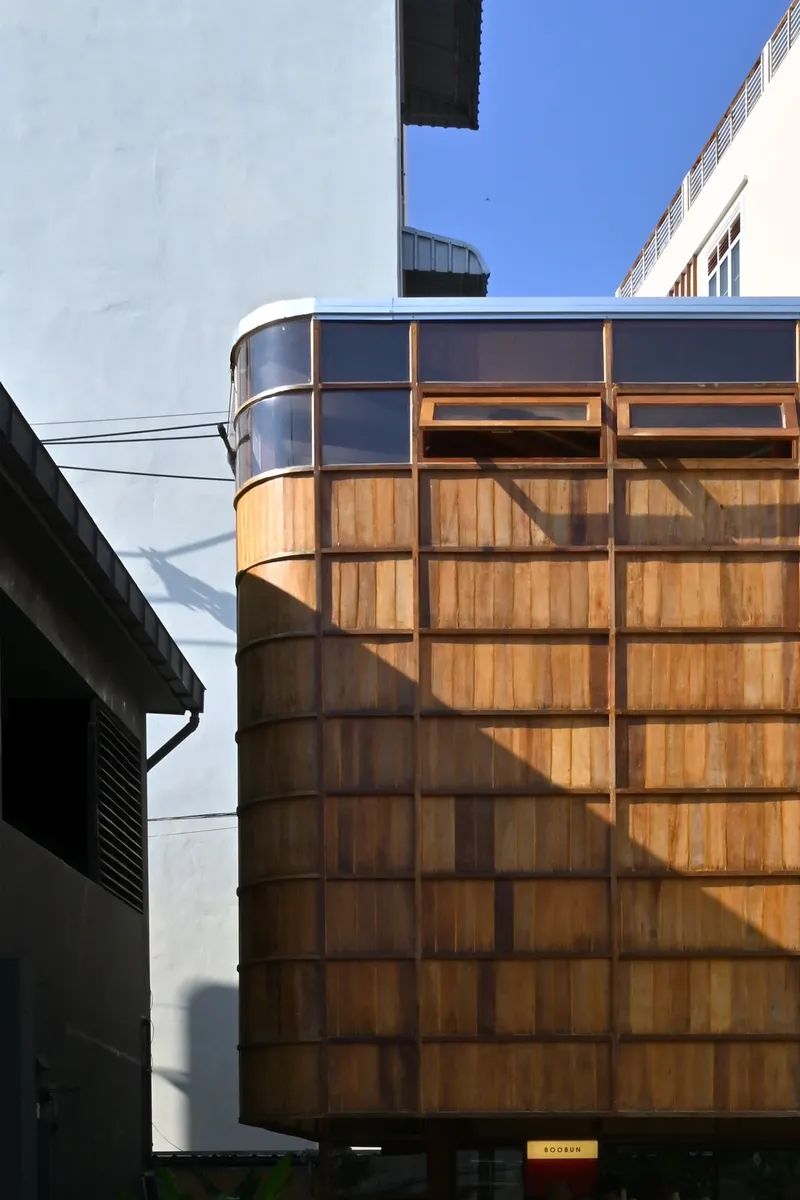
The building hovers. Raised on pilotis above a ground-level courtyard, the main timber volume sits in the air, creating a shaded, open-air zone below where wind passes through freely. This is not a stylistic flourish; it is a direct translation of the Thai stilt house principle, where elevating the living space reduces heat, prevents moisture damage, and discourages termites from reaching the wood. For a café clad almost entirely in reclaimed hardwood, keeping the material off the damp ground is a matter of survival.
The gridded facade, with its gently curved corners, gives the volume a soft, almost barrel-like profile that reads as a single sculptural object dropped between its neighbors. Steel framing in a deliberate red finish holds everything together, visible through gaps in the timber cladding like a skeleton showing through skin.
Salvaged Wood as System
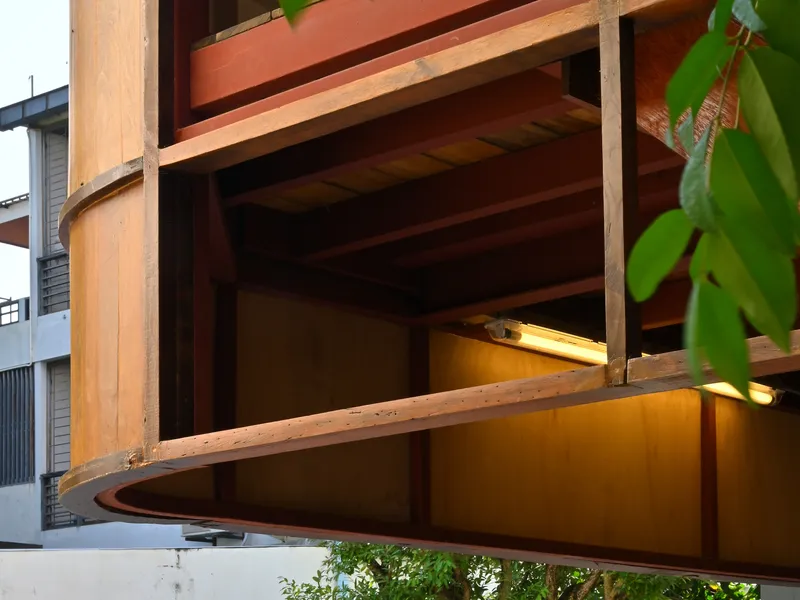


The short, uneven panels of reclaimed hardwood could have been a liability. Instead, Aramwibul turned them into a louver system. Cut down further and arranged as closely spaced slats, the wood wraps the facade and lines the interior walls in a pattern that recalls the decorative louvers found on vernacular Thai residential buildings. The reddish hue of the Teng and Mai Daeng species deepens in afternoon light, lending the structure a warmth that photographs only partially capture.
The cantilevered balcony detail reveals how honestly the material is used. Exposed joists, visible steel connections, and timber boards laid with their grain showing: nothing is concealed. The red steel columns stand proud of the cladding line, framing views while making the structural hierarchy legible at every junction. The material palette is limited to two elements, wood and steel, and the discipline holds.
Four Levels in Forty Square Meters


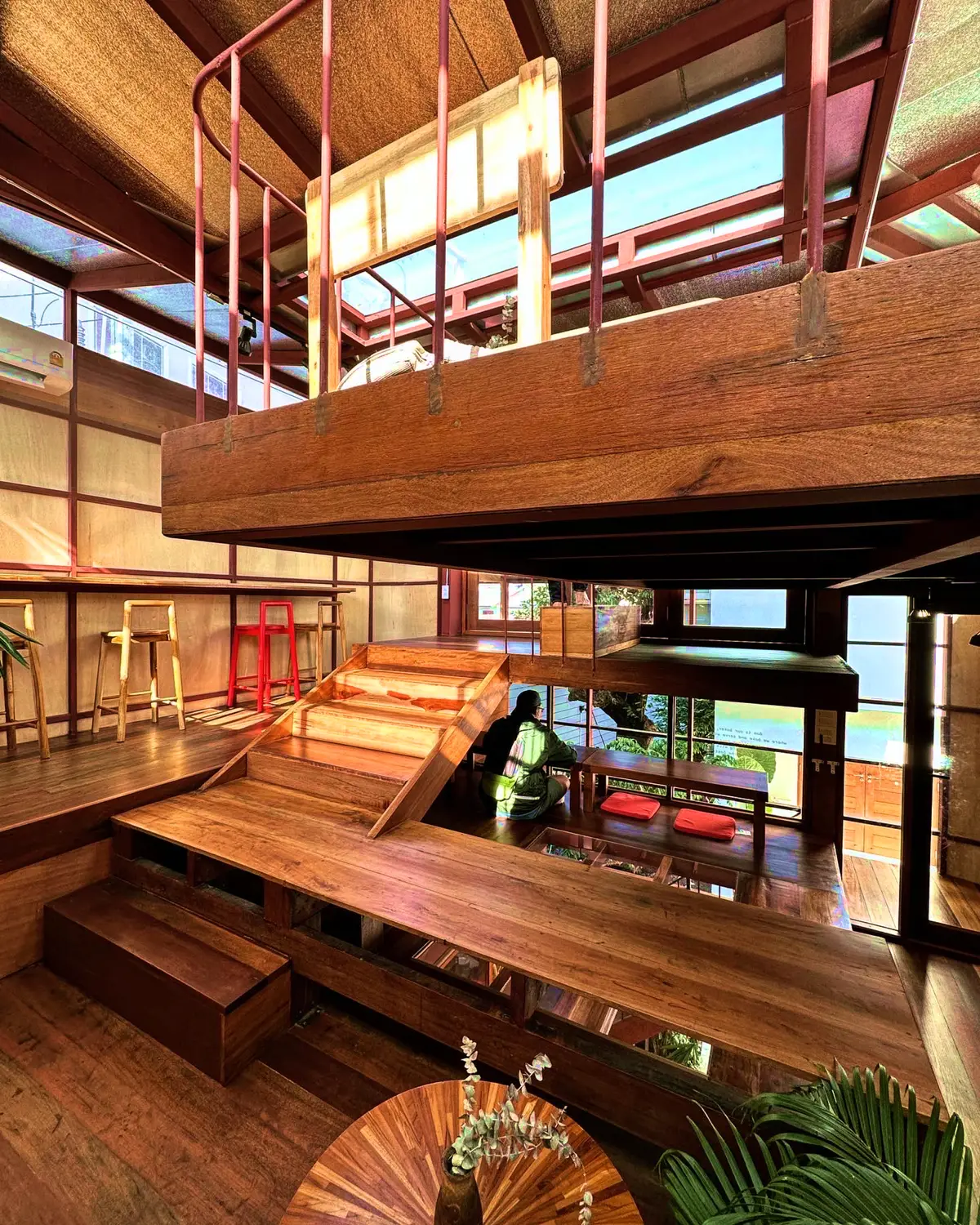
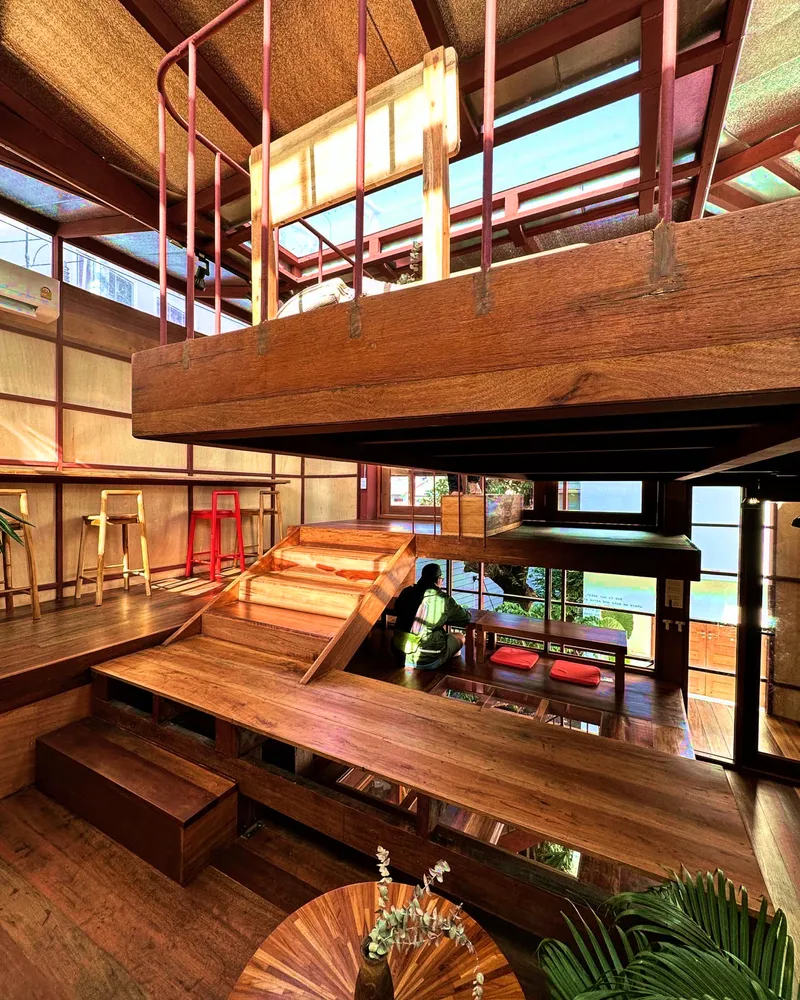
The section is where the project earns its ambition. Four levels, each elevated 60 centimeters above the last, stack upward through the volume in a series of interlocking half-landings. The coffee bar and bakery counter occupy the open ground floor. Above, wooden stairs lead to staggered seating niches that feel more like perches than conventional dining areas. Looking down through the steel-railed floor openings, you can watch baristas work below; looking up, a lightwell pulls daylight deep into the center of the plan.
The 60-centimeter increment is precise enough to create distinct spatial zones without requiring full-height walls between them. You are always aware of the people on the level above or below, always connected to the vertical section. This is the tree house concept made real: occupation happens not on a single plane but across a vertical field, with each platform offering a slightly different relationship to light, view, and enclosure.
Ground Floor: Open to the Street
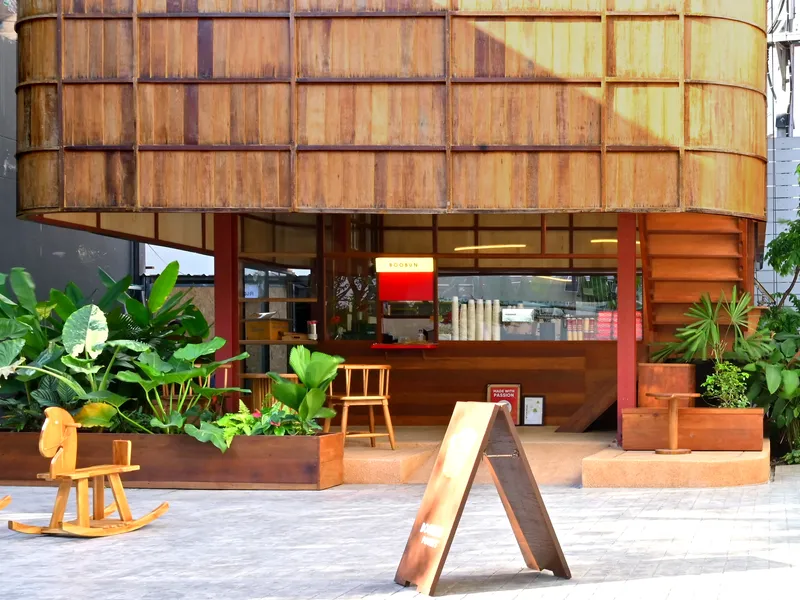

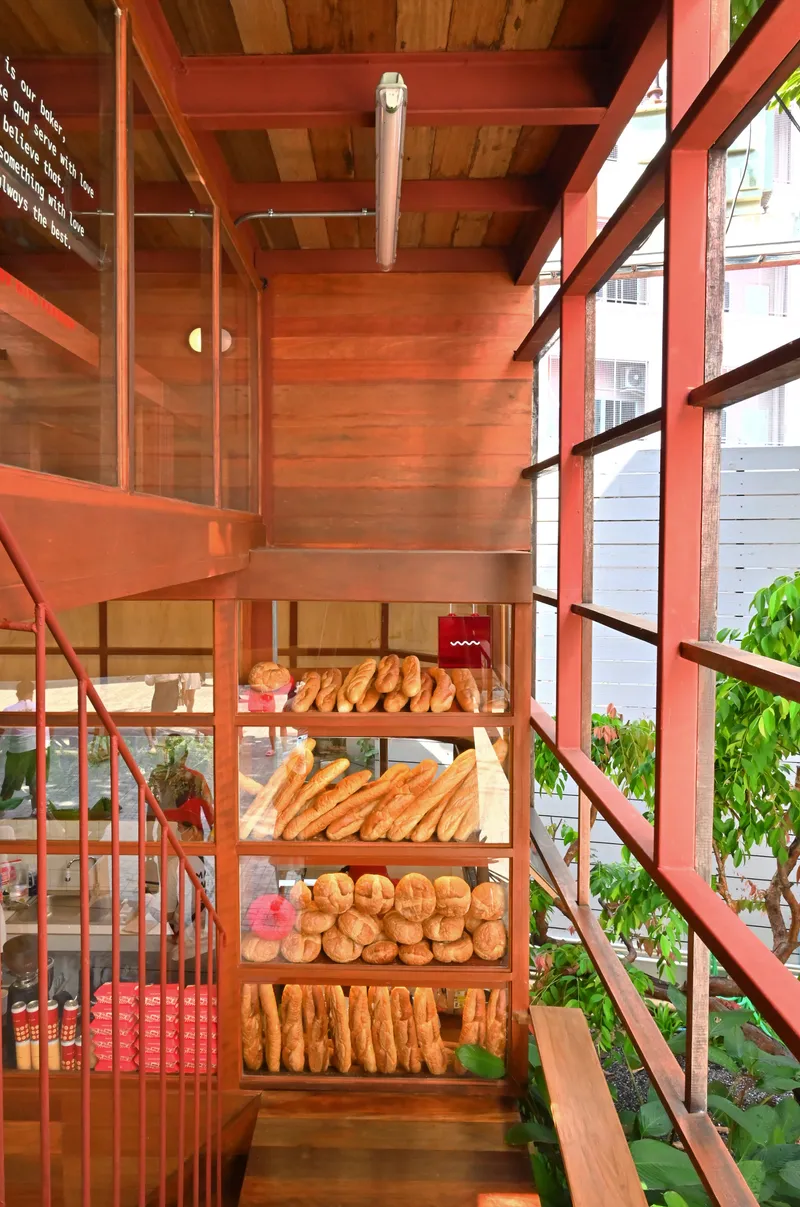
At street level, the café operates as a pavilion. The ground floor is largely open, with the coffee counter and bakery shelves lining the back wall, sheltered by the mass of timber above but free to the air on its courtyard-facing side. Tropical plantings in raised beds and potted containers soften the edges, and a few seats beneath the floating volume catch the breeze that the elevated structure channels through the site. The approach is informal and welcoming, scaled to the foot traffic of Pak Nam Pho rather than to any ambition of Instagram spectacle.
The bakery display, framed in the same red steel as the primary structure, doubles as a visual anchor. Bread stacked on open shelves under an exposed timber ceiling: it is a straightforward image, and it works because the architecture does not compete with it.
Light, Air, and the Stairwell


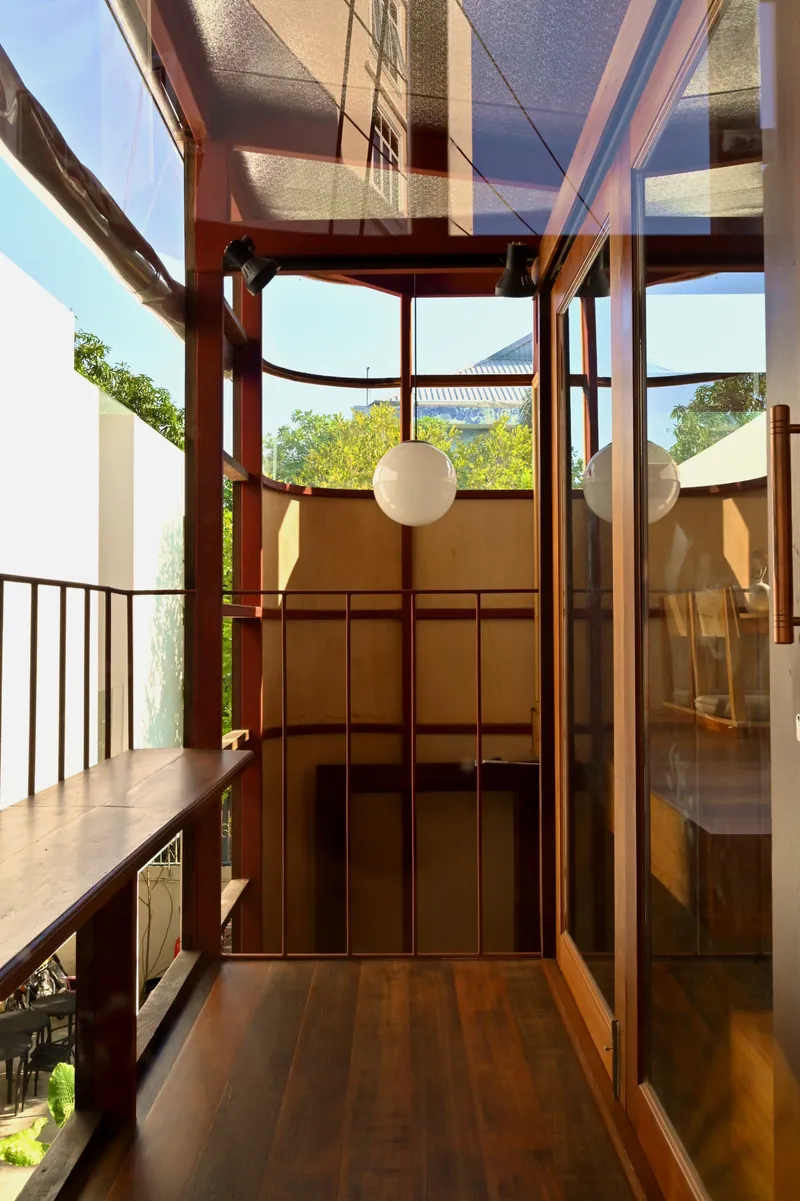
Clerestory windows at the upper levels and translucent screen panels along the stair create a layered system for admitting light without solar gain. The stairwell itself is the spatial engine of the building: curved, timber-lined, and topped with a skylight, it functions simultaneously as circulation, lightwell, and the primary moment of architectural drama. Climbing it in the evening, when warm light filters through the translucent arched panels, must feel like ascending through the belly of a lantern.
The glazed stairwell wall facing the garden opens the vertical core to greenery, collapsing the boundary between the tight interior and the planted courtyard outside. In a building this compact, that visual connection to landscape is not decorative. It is the mechanism by which 40 square meters avoids claustrophobia.
Courtyard and Context

The courtyard beneath and around the raised volume is small but deliberate. Curved timber stairs wrap around planted terraces framed by white columns and tropical foliage, creating an outdoor room that serves as the café's social threshold. You arrive here before you enter the building proper, and the transition from the busy road through the gap between neighboring properties to this shaded, planted space sets the pace for the experience.
From below, looking up through the stacked mezzanines with their red steel frames and woven ceiling panels, the full spatial ambition of the project is visible. The building is legible from every angle: structure, material, and program are all on display, interlocking in a section that rewards the kind of slow looking a coffee stop encourages.
Plans and Drawings


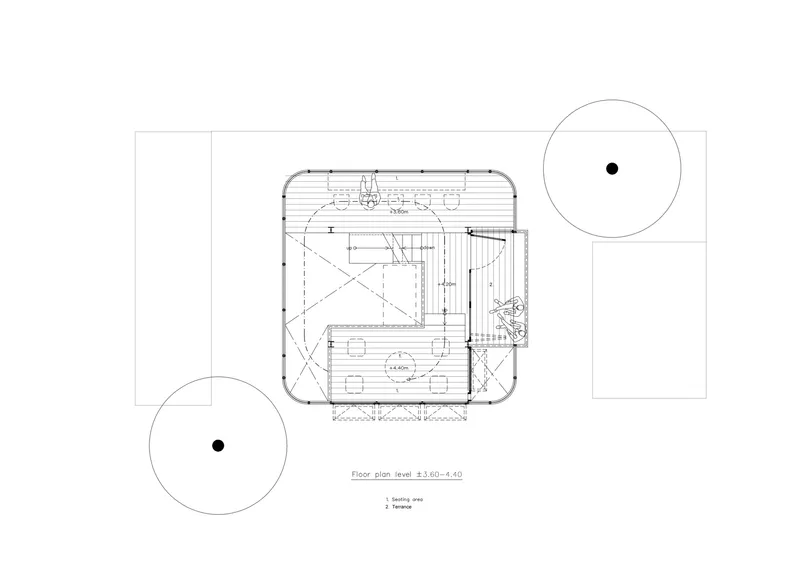

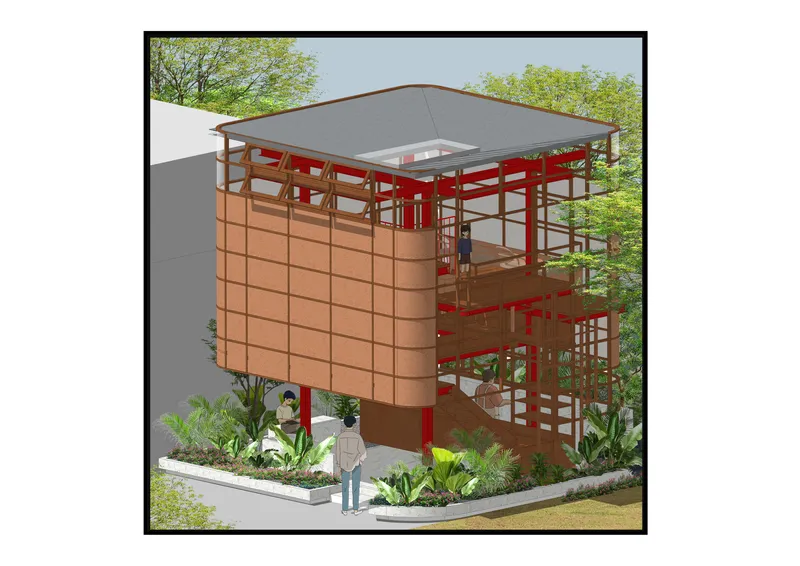
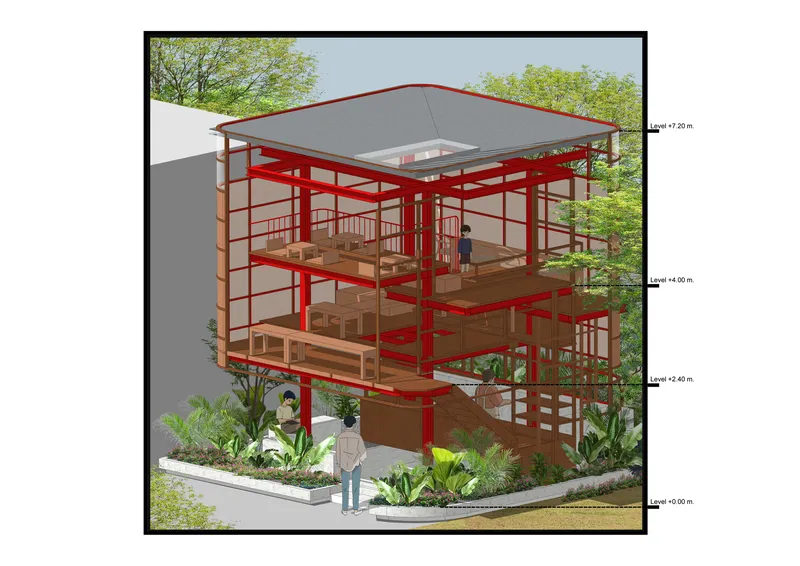
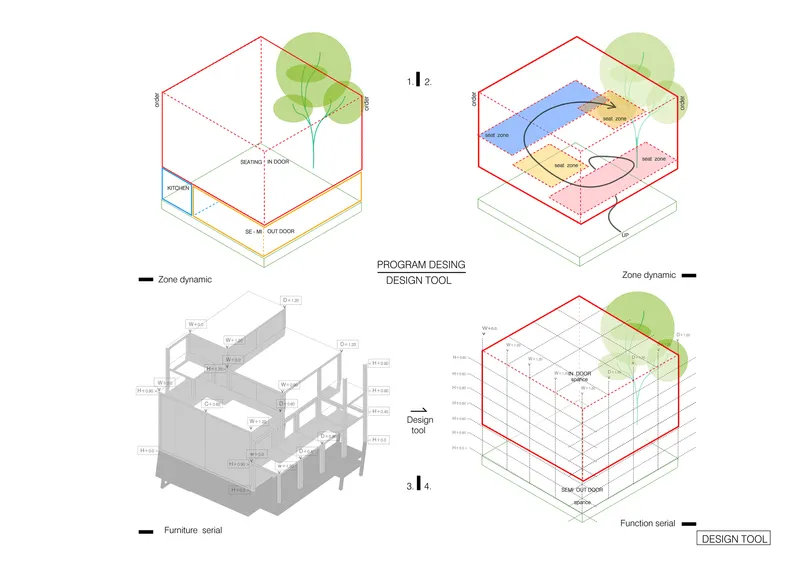
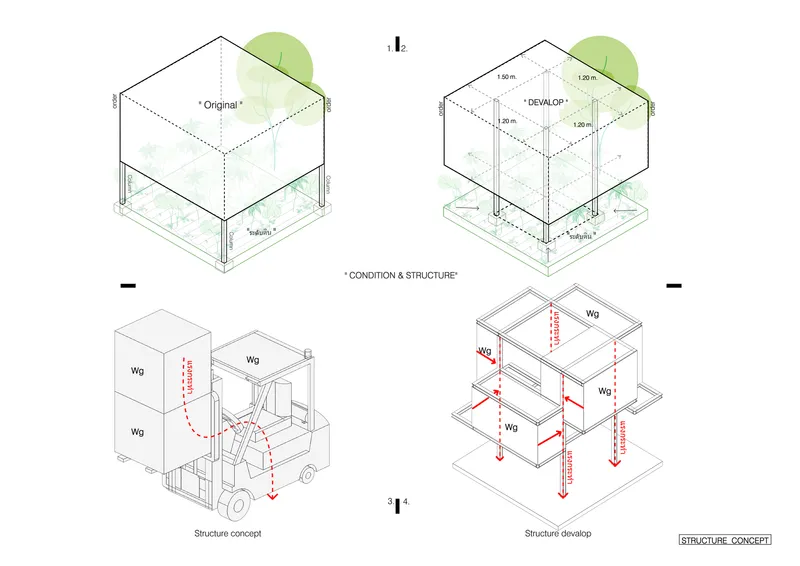
The floor plans confirm what the section promises: the rectangular footprint gives way to two circular seating zones on the upper level, softening the geometry and maximizing usable perimeter within the tight envelope. The elevations reveal the consistency of the gridded facade and the variations in openings at each level. Most revealing are the structural axonometrics, which trace the development from massing to loading conditions to the final red steel frame, making clear that the I-beam grid was designed first and the reclaimed timber was hung from it like a second skin.
The sectional axonometric, with its level annotations and exposed frame, should be studied by anyone working with reclaimed materials at this scale. It shows how a rigorous primary structure can absorb the irregularity of salvaged components without compromising spatial precision. Every 60-centimeter step, every half-landing, every clerestory is accounted for in a diagram that is as legible as the building itself.
Why This Project Matters
Boobun Pocket Café is a proof of concept for working with constraints rather than against them. A tiny plot, a fixed budget of salvaged wood, a hot and humid climate: each limitation generated a design decision that made the building better, not merely adequate. The stilt house logic is not applied as nostalgia but as engineering. The short timber panels are not hidden but celebrated as a louver system. The vertical stacking is not novelty but necessity on a footprint this small. The result is a building that teaches without lecturing, carrying forward specific Thai constructive traditions into a contemporary program.
At a moment when sustainability in architecture often means high-tech material passports and complex certification regimes, Aramwibul offers something simpler and more direct: take wood from buildings that no longer stand, design a structure that can hold it, and let air move through. The café stands as a living record of its own material history, every reddish panel a fragment of a demolished house given a second occupation. That is not a gesture. That is an argument for how small architecture can operate with real consequence.
Boobun Pocket Café by CUP.Scale Studio, lead architect Santi Aramwibul. Nakhon Sawan, Thailand. 40 m². Completed 2022. Photography by Chamaiphorn Lamaiphan & Santi Aramwibul.
About the Studio
Share Your Own Work on uni.xyz
If projects like this are the kind of work you want to make, uni.xyz is a place to publish your own, find collaborators, and enter design competitions.


Popular Articles
Popular articles from the community


Aquadapt: An Underwater Habitat That Rewrites Its Rooms by the Hour
Curved modules ring the seabed while one shell shifts from breakfast room to cinema, farm and football pitch as residents' needs change.

Singing Woman: An Opera House That Performs Before the Curtain Rises
Ovidiu Cristian Pavel's conceptual opera house translates Estonia's choral identity into a sculpted waterfront landmark facing the Baltic Sea.

The Amber Palace Opera: A Geological Fiction Surfaces on Tallinn's Baltic Waterfront
Pierre Brillard reimagines a Baltic legend as a public landscape, opera house, and waterfront promenade rooted in Tallinn's coastal identity.


ETEH Reworks the Shared Spaces of São Domingos School in Brazil Around Timber, Color and Hanging Plants
At São Domingos School in Brazil, 436 m² of hall, refectory and library are recast with timber joinery, a yellow and blue code and trailing greenery.

Similar Reads
You might also enjoy these articles

LAVA Architecten Gives Vocational Education a Sawtooth-Roofed Face on a Mechelen School Campus
In Mechelen, Belgium, a 2,053 m² STEM school on a 6×6 m grid turns workshops and classrooms into rooms that can be rearranged as teaching changes.

KEMA Studio Turns a Derelict Marvila Attic into a 60 m² Lighthouse Apartment Above Lisbon
In Lisbon's Marvila district, a rebuilt roof, four skylights and two plywood volumes turn an unlivable attic into a bright home facing the Tagus.

Pixel Gardens: One Repeated Module Stacked Into a Terraced Social Housing Tower for Famagusta
Salem Bader's shortlisted housing tower builds a vertical neighbourhood from one repeated module, offsetting units to carve terraces, light and air.

Bao Huynh Watercolor Atelier: A Serene Art Retreat in Hội An
Bao Huynh Watercolor Atelier in Hội An blends multifunctional art spaces, sustainable design, local materials, and family-friendly living in a serene environment.

Comments (0)
Please login or sign up to add comments
No comments yet. Be the first to comment!