

Curtain Call: A Robot-Marked Timber Pavilion at Bethel
office office built a timber lattice pavilion with a red mesh canopy at the Woodstock site, using a low-cost marking robot and four days of assembly.


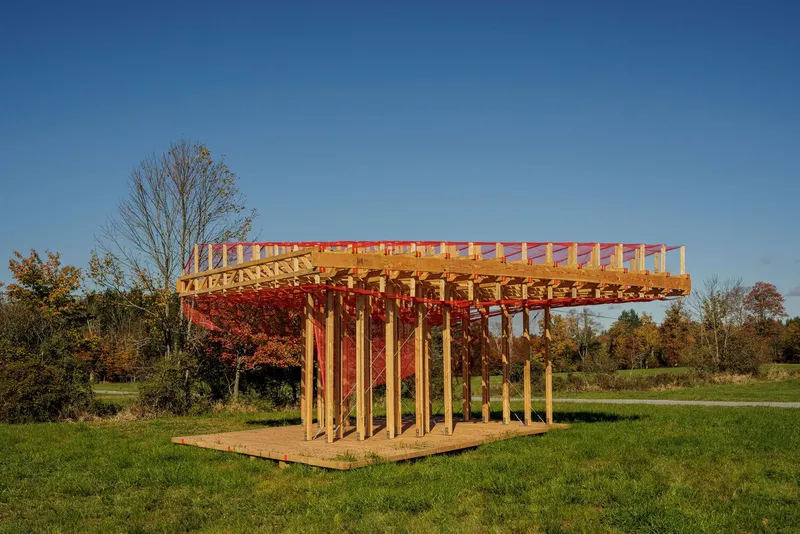
The Bethel Woods Center for the Arts is built on the site of the original 1969 Woodstock festival in upstate New York. Every summer it hosts BuildFest, a design-build competition for small pavilions in the fields around the museum. Curtain Call Pavilion, designed by office office, won the 2024 BuildFest. It is a timber lattice structure with a translucent red construction-mesh canopy, built on a grass meadow and assembled on site in four days using a workflow the team calls Human-Robot Collaborative Construction (HRCC).
The pavilion is a reference to the Woodstock stage's original timber tectonics, reinterpreted with contemporary fabrication tools. The columns, beams, and trusses are dimensional lumber bolted together. The red mesh above is ordinary construction safety fabric, stretched to create a glowing canopy that casts a pink light onto the timber below. The result is a simple, readable structure that doubles as a demonstration of how robots and humans can share a construction process.
The Pavilion on the Meadow
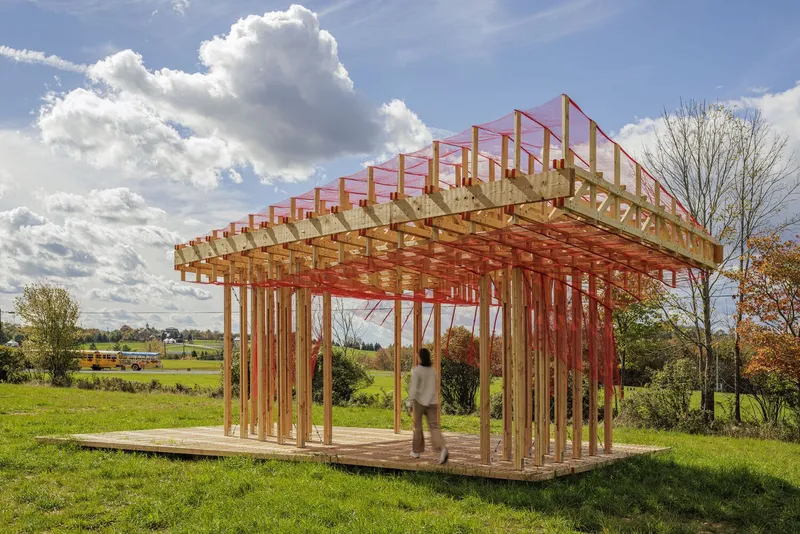
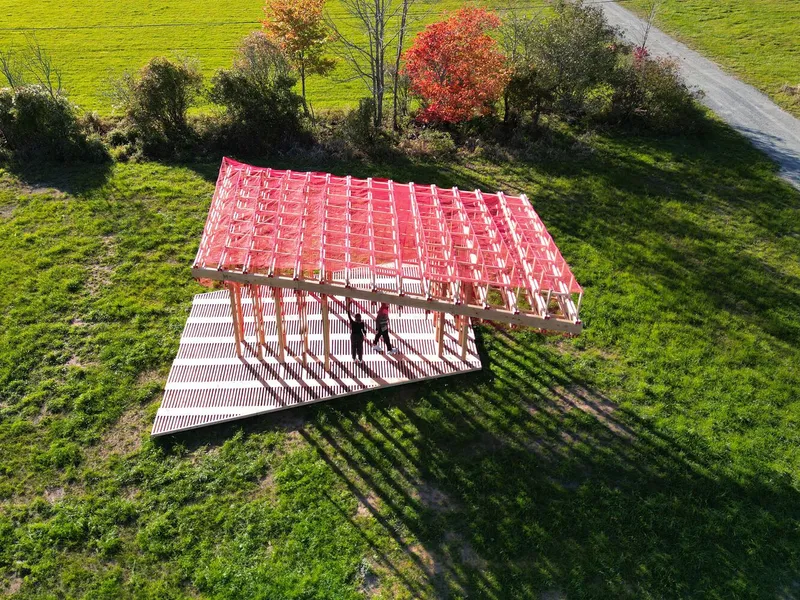
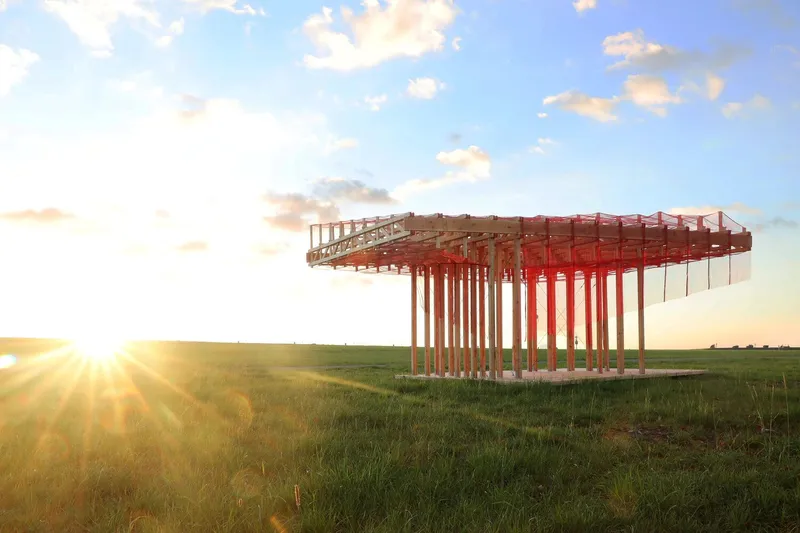
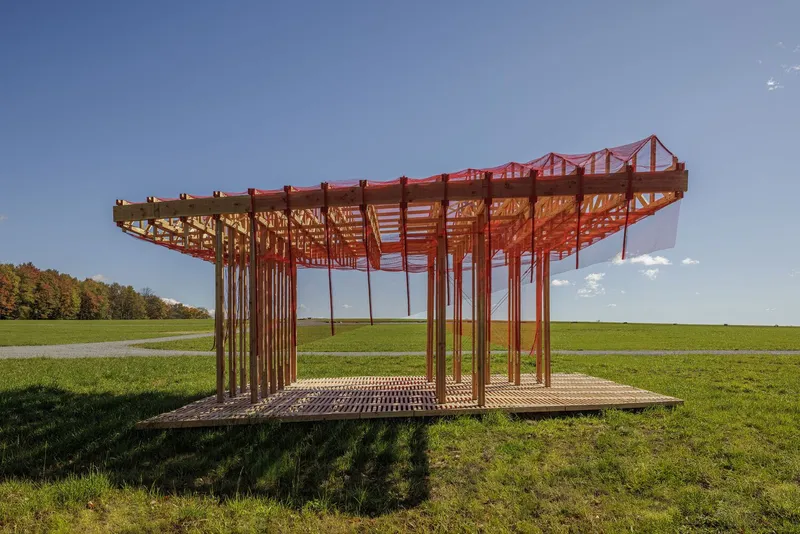
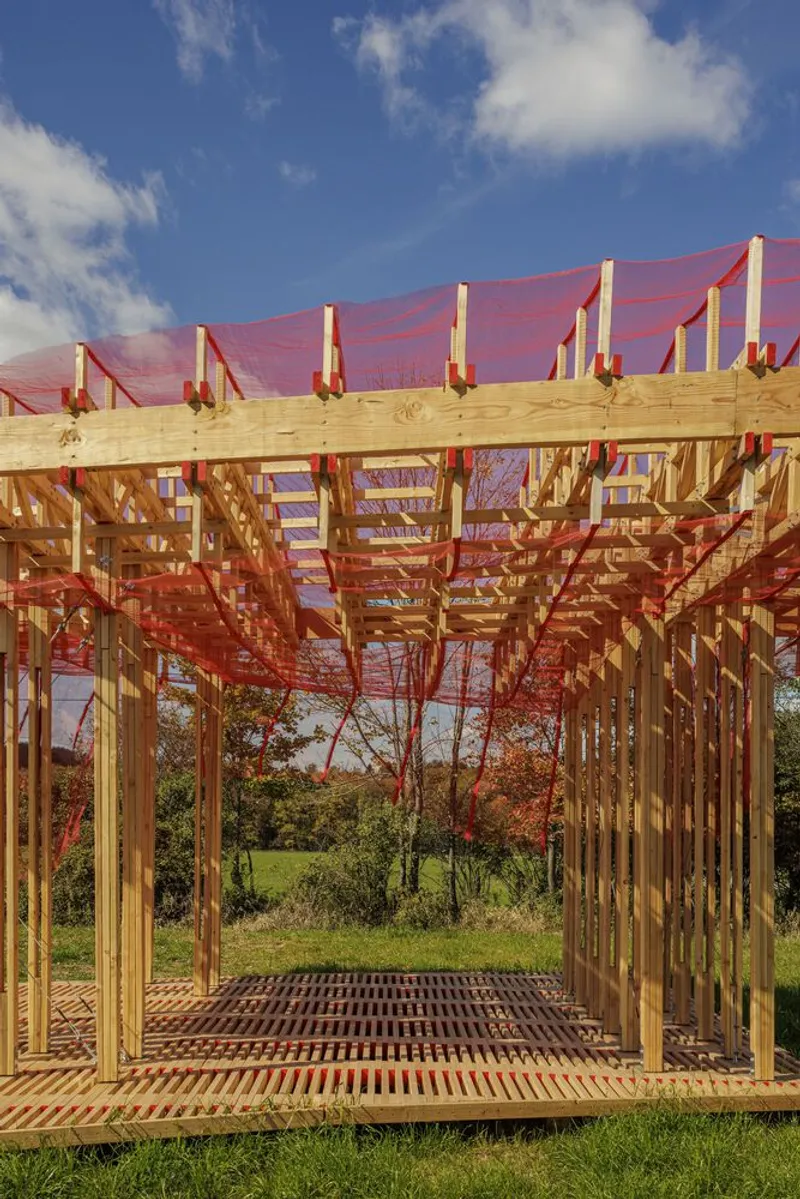
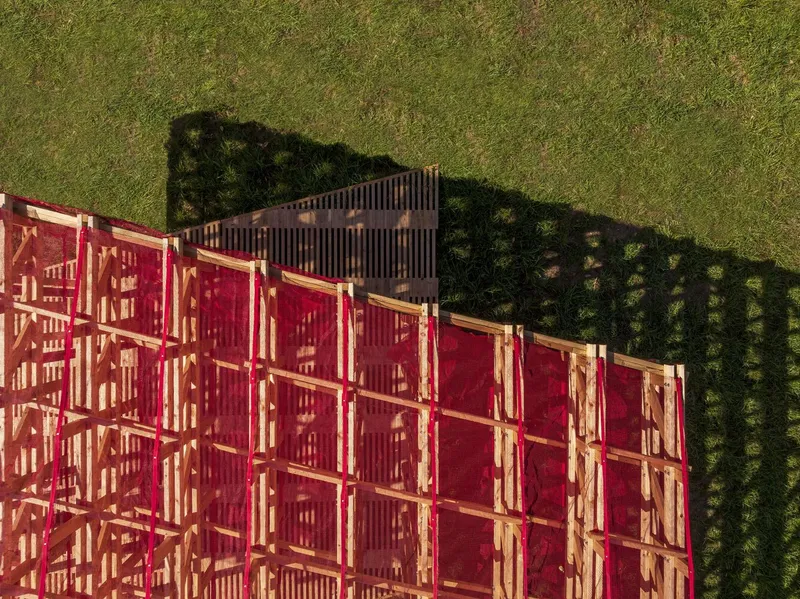
From a distance, the pavilion is a rectangular timber frame on a raised wooden deck, with a red canopy floating above. The columns are painted with horizontal red stripes that match the mesh, tying the structure together visually. On the grass, the shadow of the truss grid runs in stripes alongside the building. A timber stage-like step extends from one end, doubling as informal seating and a performance platform.
The Timber Lattice
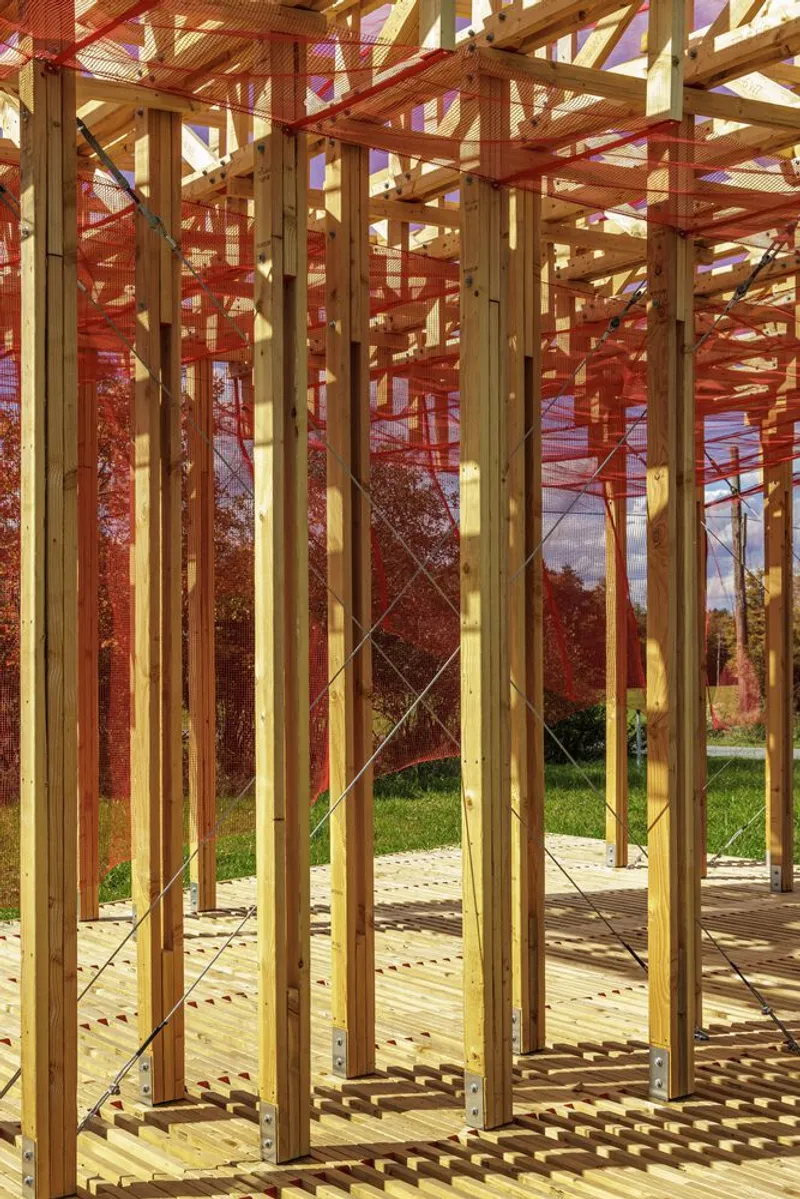
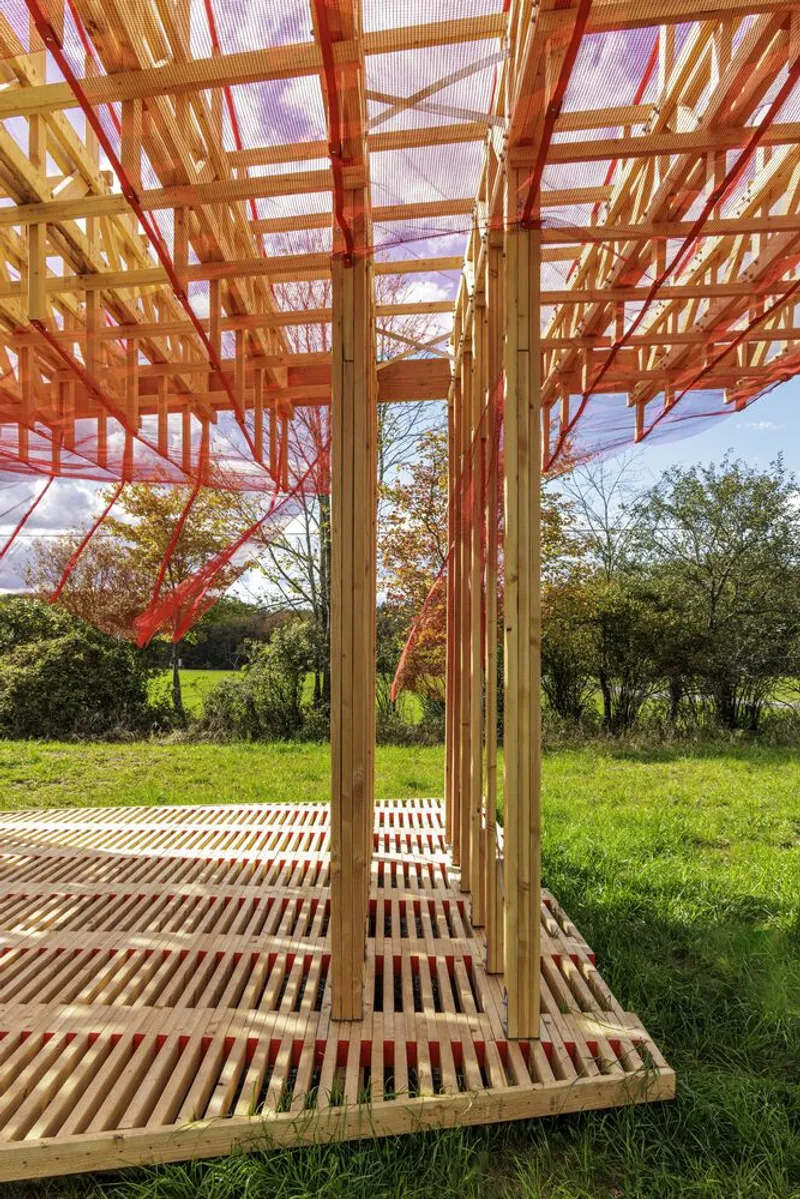
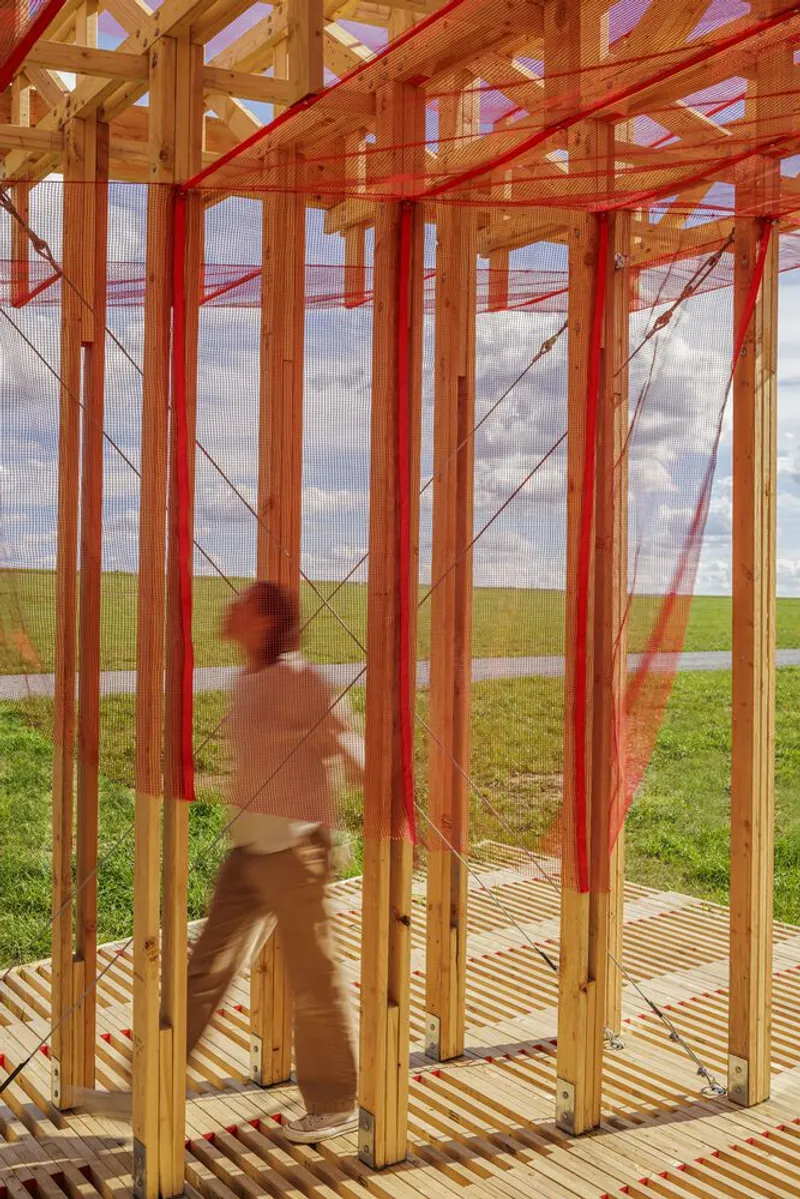
The structure is a dense lattice of dimensional lumber. Vertical posts support a field of trusses that run in two directions, creating a coffered ceiling of crossed timbers. The posts have red painted stripes at regular intervals. Walking through the pavilion, the experience is of moving through a forest of timber columns and under a canopy of rafters. The floor is a slatted timber deck that drains through the boards.
The Red Mesh Canopy

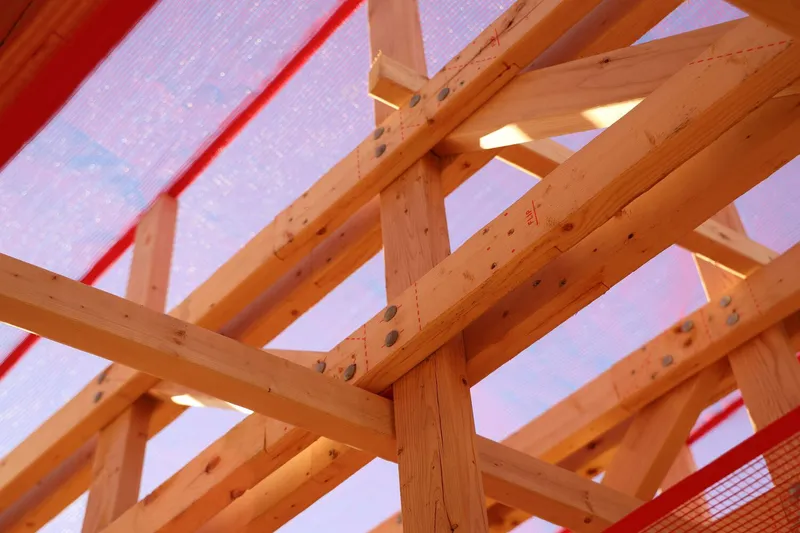
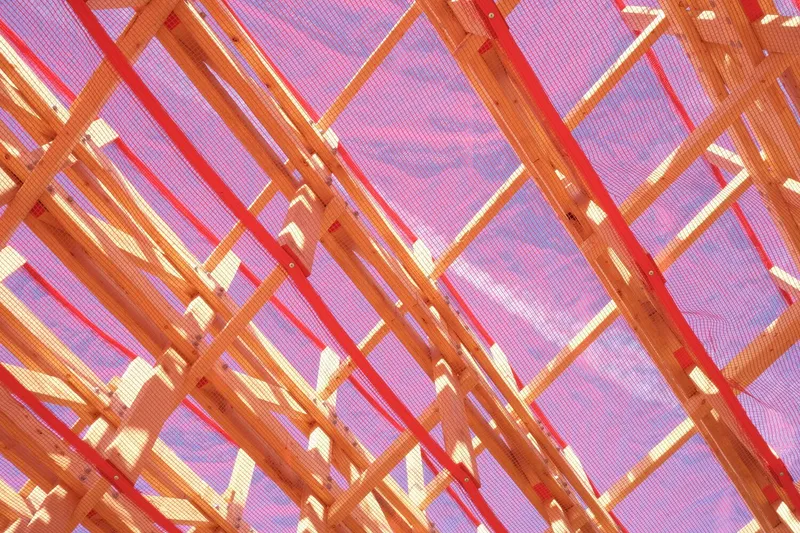
The canopy is construction safety mesh, a cheap and instantly recognisable building-site material, used here as an architectural finish. Stretched between the timber rafters, the mesh glows in the sun and turns the light pink inside the pavilion. The translucency means the canopy reads differently from every angle: solid red from above, filtered pink from below, striped with shadow on the grass.
The Robot and the Humans
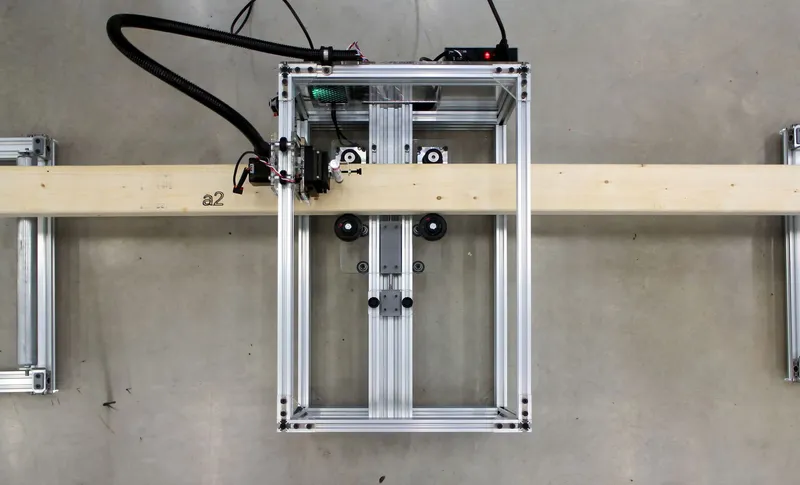
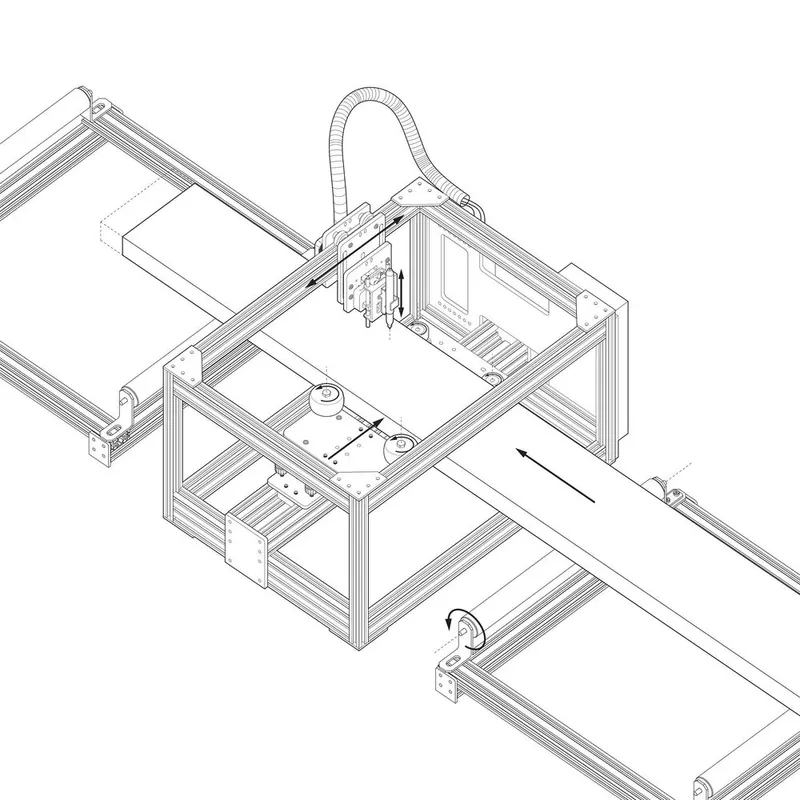
The project's most ambitious claim is in the construction method. The team built a low-cost timber-marking robot: a small aluminium gantry with a marking head that inscribes drilling and connector locations directly onto each timber member. Every piece of lumber passes through the robot before it goes to the workshop. When the human builders assemble the structure, they follow the robot's marks, which tell them exactly where to drill, where to bolt, and which joint connects to which other joint.
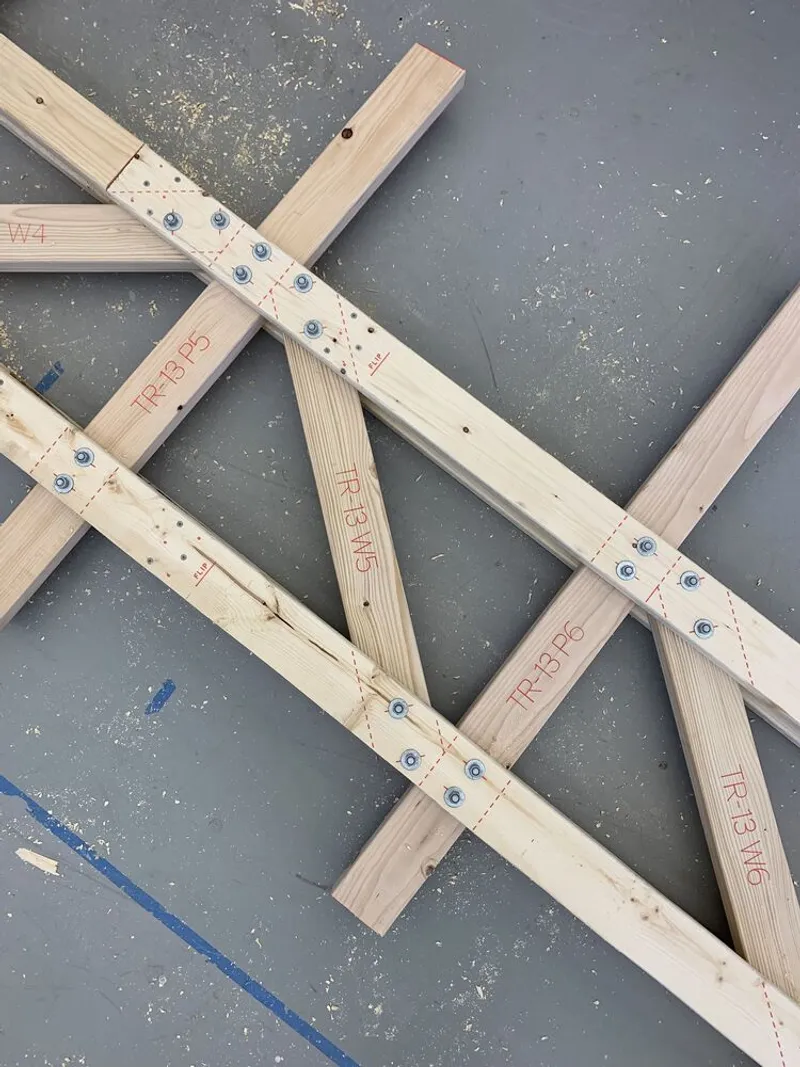

The marks are left visible on the finished pavilion as a construction record. You can walk up to any truss and read the numbers the robot inscribed. The collaboration is transparent: the robot does the geometry, the humans do the assembly, and the building holds both kinds of labour in equal view.
Construction: Four Days on the Meadow
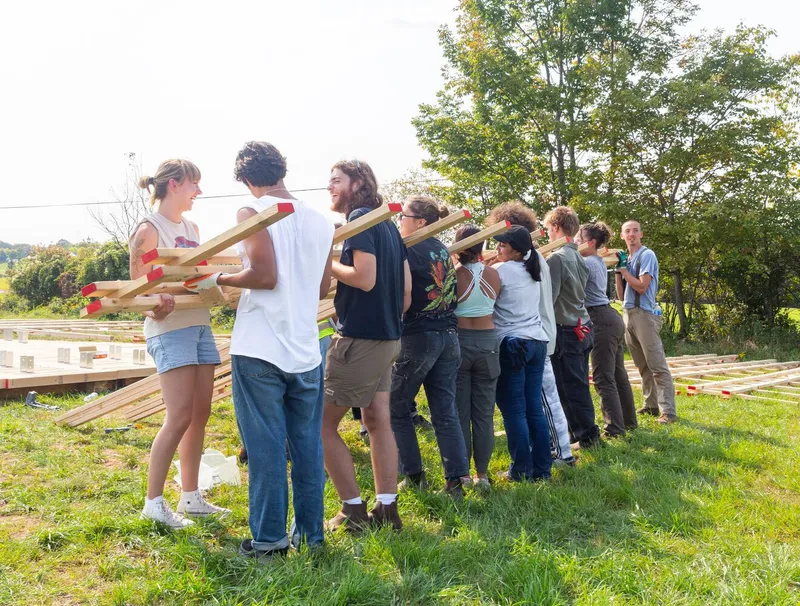

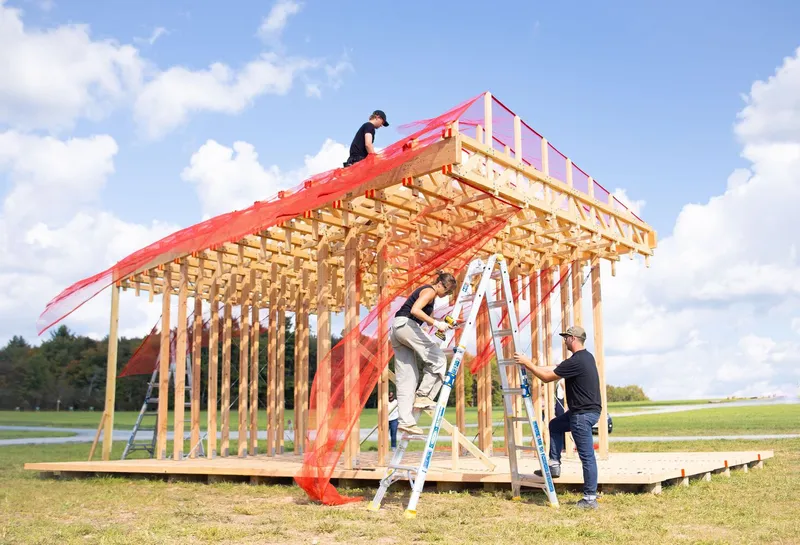
The pavilion was assembled in four days by a small team. The students and builders carried the prefabricated timber members out onto the meadow, followed the robot's markings, and bolted the structure together on site. A few workers on ladders stretched the red mesh over the completed frame to form the canopy. The choreography of the build appears in several photographs: a line of people passing timber members, a worker on a ladder in a hi-vis vest, three builders lifting the mesh over the frame.
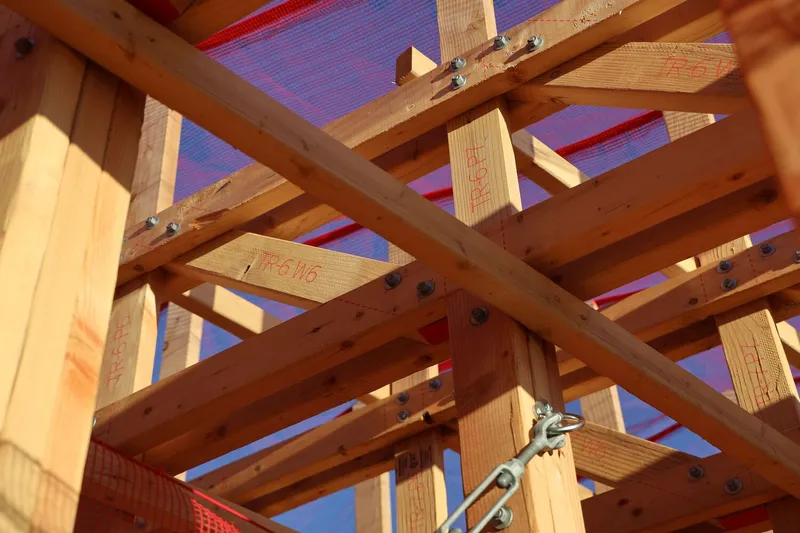
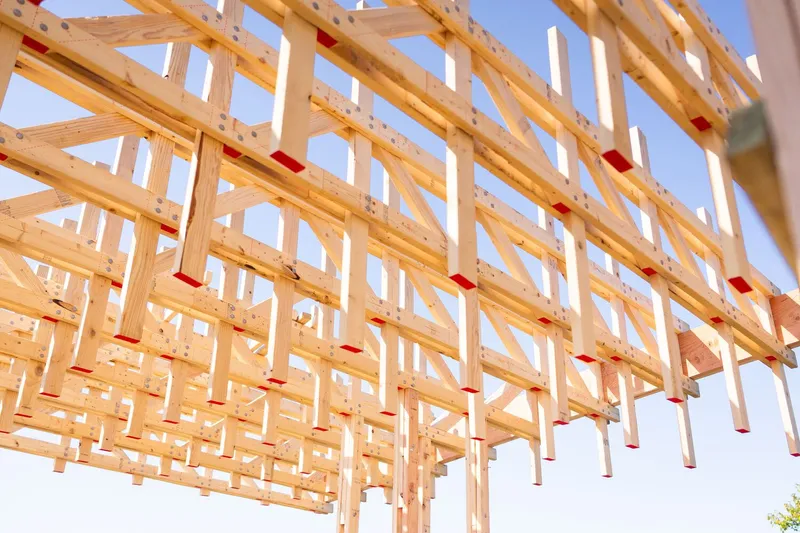
The fabrication is deliberately simple: dimensional lumber, bolts, steel connectors, and a marking robot. No CNC, no robotic arms, no parametric joinery. The complexity is in the layout, not in the machining. This makes the system cheap, reproducible, and scalable to teams of non-specialists.
Drawings
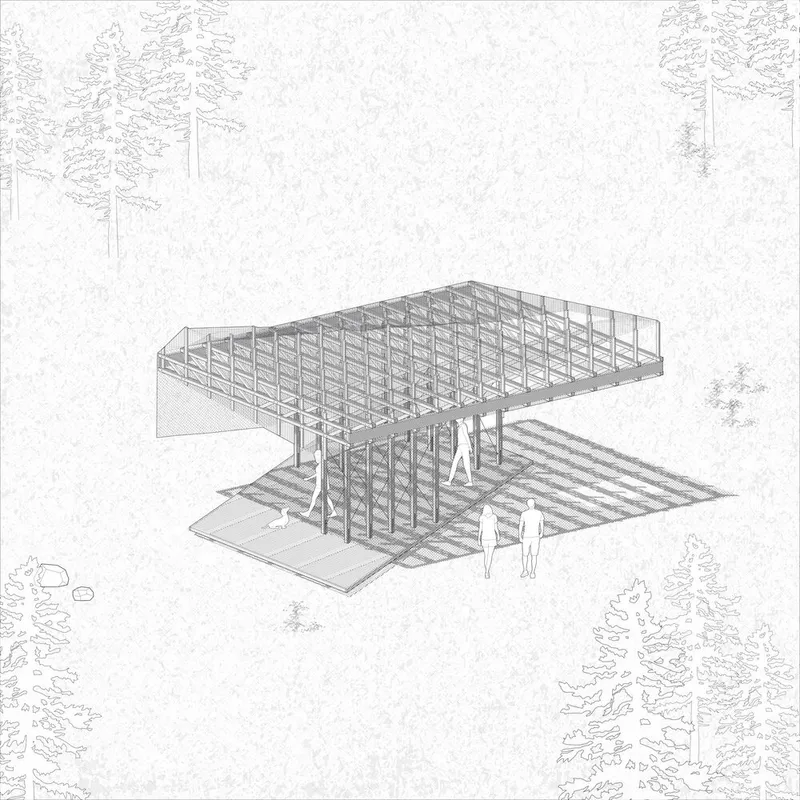
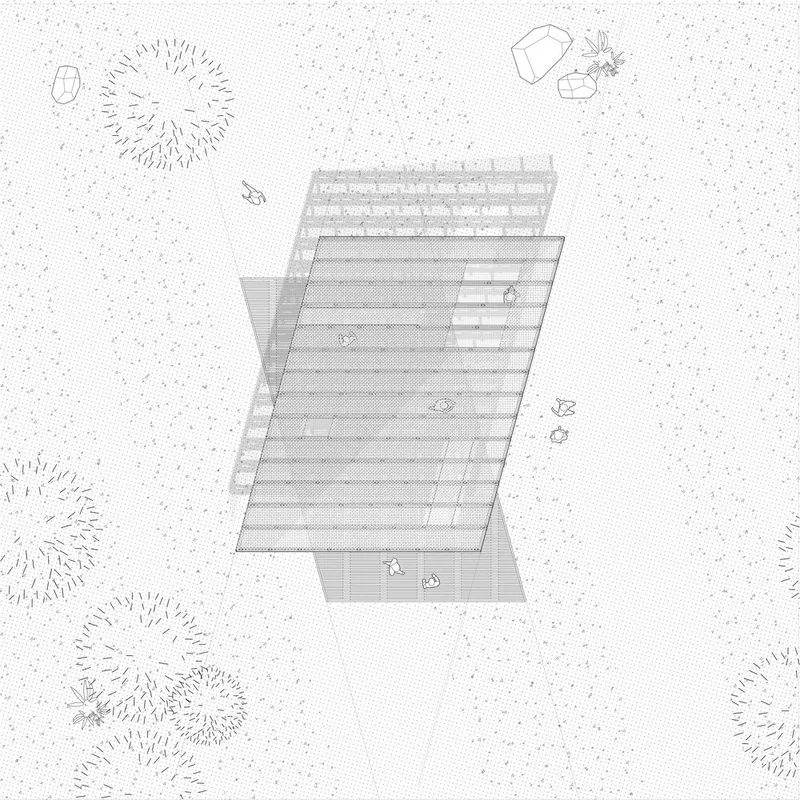
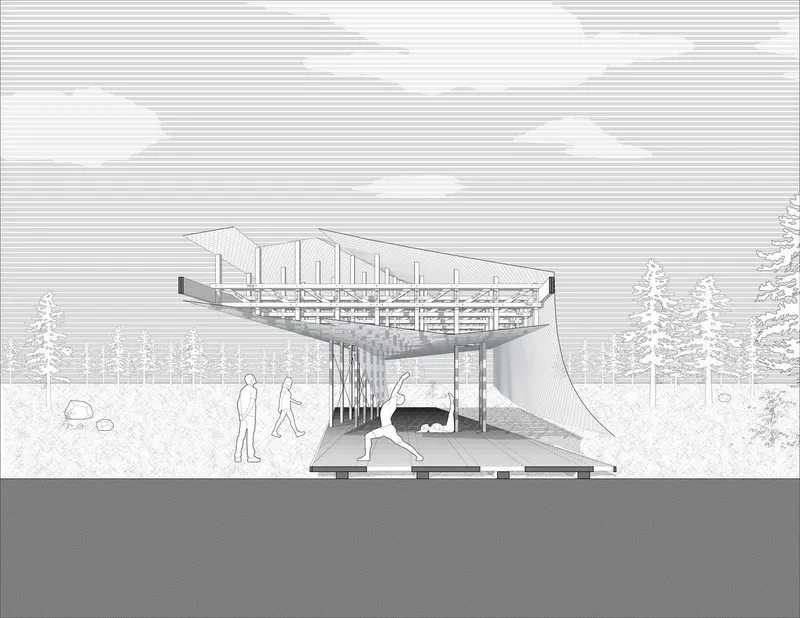
The axonometric, roof plan, and elevation drawings show the pavilion in context: a timber rectangle on a deck in a meadow, with a truss roof and an overhanging red canopy. The elevation includes figures, a piano under the structure, and distant trees, hinting at the pavilion's intended use as a small performance space.
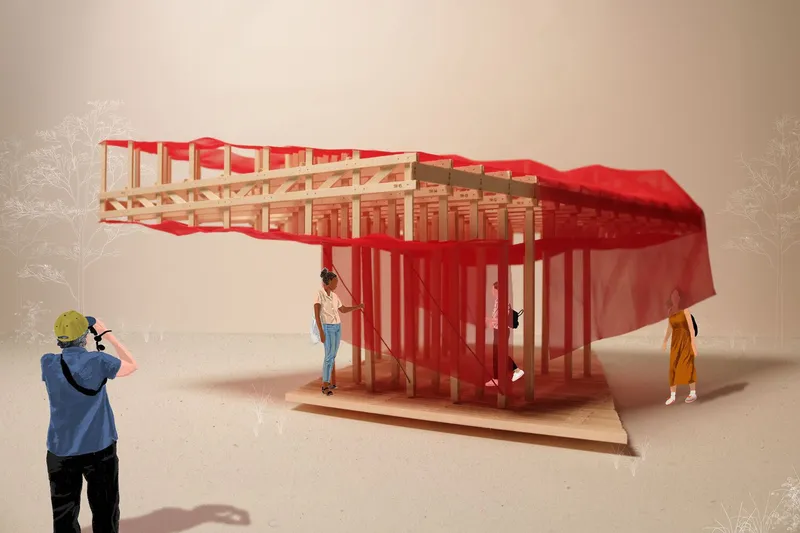
The render shows the completed pavilion from a three-quarter angle, with the red mesh canopy stretched above the timber lattice. A photographer crouches at the left edge. Figures sit under the structure. It is a small building, but the presence it projects is larger than its footprint.
Why This Project Matters
Design-build pavilions are everywhere in the architecture-school ecosystem, and most of them demonstrate either parametric geometry or robotic fabrication. Curtain Call does something different: it uses a simple marking robot as the only automated tool in an otherwise conventional timber build. The collaboration between the robot and the human builders is visible, legible, and humane. The red construction mesh is a clever choice of canopy material: cheap, familiar, and surprisingly beautiful when stretched over a timber frame.
If you are interested in design-build pedagogy, human-robot collaboration, or temporary pavilions, this project is worth studying for how it uses a tiny automation tool to change the logic of a timber build without making the result inaccessible.
About the Studio
Share Your Own Work on uni.xyz
If you are working on pavilions, design-build projects, or digital fabrication, uni.xyz is a place to publish your work and connect with a global design community.
Project credits: Curtain Call Pavilion by office office. Bethel Woods Center for the Arts, Bethel, New York, USA. 2024 BuildFest winner. Photographs: Alon Koppel, Breyden Anderson.


Popular Articles
Popular articles from the community


Opera on the Sea: Driftwood Logic Shapes a Timber Opera House on Estonia's Coast
Trevor Orgill's opera house translates the entangled drift of floating timber into a civic building where wood, water, and music converge.

The Amber Palace Opera: A Geological Fiction Surfaces on Tallinn's Baltic Waterfront
Pierre Brillard reimagines a Baltic legend as a public landscape, opera house, and waterfront promenade rooted in Tallinn's coastal identity.


David Ortega Stacks a Two-Story Mexico City Penthouse Around a Steel Stair and a Pergola-Shaded Roof Terrace
In Colonia Roma, a 300 m² penthouse uses oak joinery, a planted steel stair and a slatted roof pergola to make a new-build apartment feel like a house.

Singing Woman: An Opera House That Performs Before the Curtain Rises
Ovidiu Cristian Pavel's conceptual opera house translates Estonia's choral identity into a sculpted waterfront landmark facing the Baltic Sea.

Similar Reads
You might also enjoy these articles


Hodi-Mandai Geram
Project Function: Preservation and revitalization of the Intangible heritage and socio-spatial identity of the Hodi by Housing, Cultural Memory Center, Sacred Grove, landscape, local tourism economy


Olio Towers: A Mid-Rise for Performers That Fuses Housing, Rehearsal, and Stage
Located blocks from Houston's Theater District, this modular tower stacks living units around a central performance atrium.

Oasis: Modular Green Housing Carved into Dhaka's Urban Fabric
A shortlisted Plugin Housing entry reclaims unauthorized settlements in Dhaka with stepped concrete volumes, green roofs, and ventilation-driven design.

Black Hole: A Floating Megastructure for the Post-Physical Era
Emiliano Mazzarotto envisions a spherical, self-scaling arena where e-sports, digital hotels, and holographic stadiums replace traditional public space.

Explore Human-Building Connect Competitions
Discover active competitions in this discipline

Challenge to reimagine the Iron Throne

Photograph architecture without architects

Illustrate the lost glory of Angkor Wat - Render Challenge

Design challenge to reuse E-waste
Comments (0)
Please login or sign up to add comments
No comments yet. Be the first to comment!