

Curved-Living: Rethinking Communal Habitation Through Orbital Architecture
A rotating space habitat uses centrifugal gravity, 3D-printed recycled debris, and movable pin surfaces to foster communal life beyond Earth.


What if the most ancient model of human settlement could inform how we live in orbit? Curved-Living takes an unexpected cue from Çatalhöyük, a Neolithic settlement in Anatolia known for its cooperative spatial logic, and projects it into a rotating cylindrical habitat where centrifugal force stands in for gravity and 3D-printed plastic debris becomes the primary building material. The result is a provocative fusion: deep communal values encoded into the architecture of a space station.
Designed by Yakup Cesur as a People's Choice Award entry for the Origyn competition on uni.xyz, Curved-Living confronts the toughest constraints of orbital habitation: cosmic radiation, limited oxygen and water, and the physiological toll of microgravity. Rather than treating these as purely engineering problems, the project weaves them into a social and spatial proposition. The habitat is modular, expandable, and organized around shared resources, refusing the isolated pod model in favor of dynamically allocated zones where no space is permanently owned.
Agricultural Corridors as Social Infrastructure
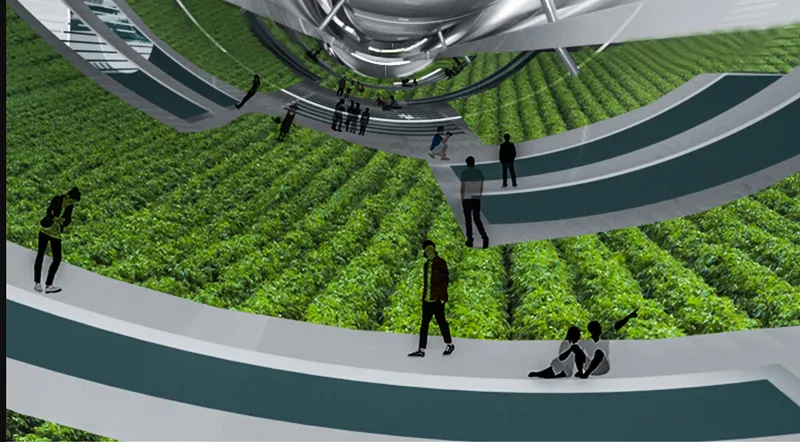
In a habitat where every resource must be produced on-site, agriculture is not a background function; it is the center of communal life. The design integrates planted crop rows alongside spiraling walkways, turning food production into a visible, participatory activity. Visitors move through these green corridors not as tourists but as residents engaged with the cycle of sustenance. The spatial overlap between growing zones and circulation paths means that agriculture is never siloed away from daily social interaction.
This is a deliberate architectural choice. By making food visible, shared, and accessible, Curved-Living reinforces the communal framework that structures the entire habitat. The precedent of Çatalhöyük, where cooperative food management sustained a dense settlement for millennia, is directly legible here, translated into orbital terms.
A Surface That Refuses to Stay Still
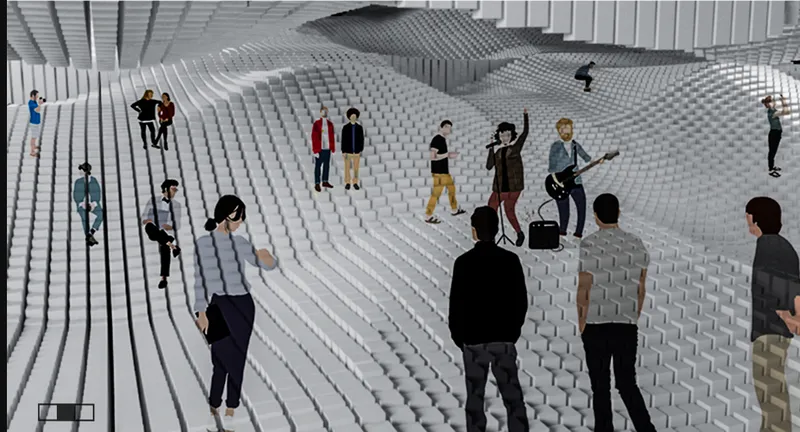
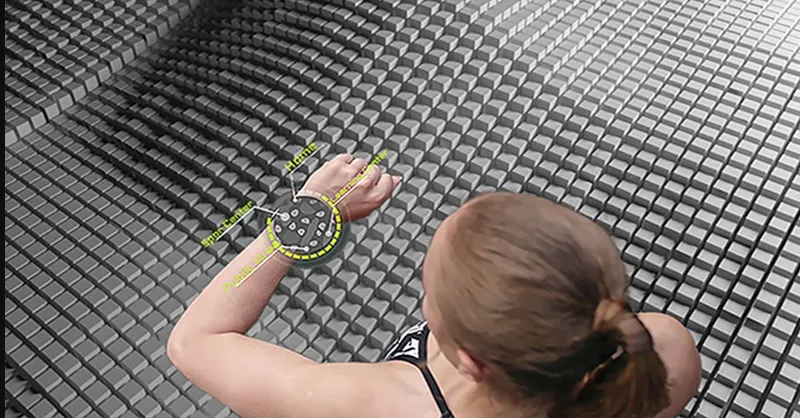
The most technically inventive element of Curved-Living is its movable pin system: mechanical actuators embedded beneath a white tiled surface that can shift and reshape terrain in real time. A flat gathering plaza can ripple into seating, private enclosures, or sloped terrain within moments. The renderings show visitors standing and gathering on an undulating white surface whose topography is entirely mutable. One image captures a person measuring the surface with a tape measure, underscoring the precision required to make this kinetic landscape function at a human scale.
This is where Curved-Living makes its strongest conceptual argument. Space in orbit is finite and expensive. If walls and floors can transform, then a single room can serve as bedroom, laboratory, public square, and theater, not through compromise but through genuine spatial reconfiguration. The dynamic surface eliminates the need for permanent ownership of space, enabling the intelligent allocation system that tracks usage patterns and assigns zones accordingly.
Modular Terrain as Public Ground
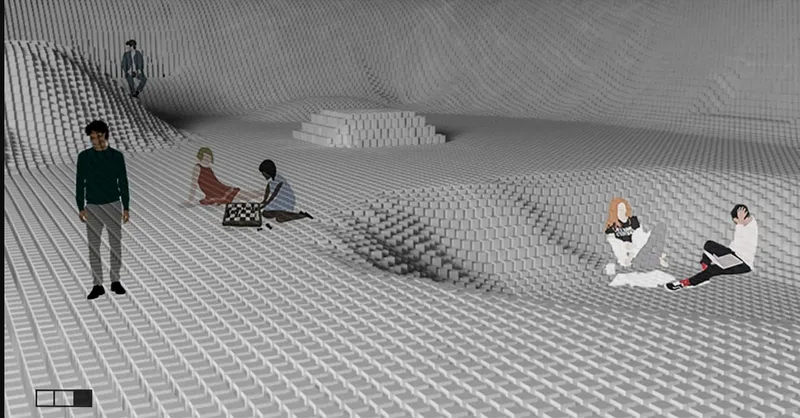
Seen at a wider scale, the modular tile surface becomes a new kind of public ground. Seated and standing figures populate the undulations, occupying the landscape in varied postures: some reclining on gentle slopes, others clustered on raised platforms. The whiteness of the tiles reads as neutral infrastructure, a blank canvas for social life rather than a prescribed program. There are no benches, no designated seating areas, no fixed furniture. The ground itself provides everything.
This approach dissolves the traditional hierarchy between architecture and furniture, between building and landscape. In an orbital context where every kilogram of mass matters, eliminating discrete objects in favor of a single responsive surface is both an aesthetic and logistical triumph. The habitat becomes lighter, more adaptable, and more egalitarian in its spatial offerings.
Closed-Loop Systems and the Rotating Shell
The structural logic of Curved-Living operates at multiple scales. The outer cylinder rotates to generate centrifugal force, simulating gravity for healthier long-term habitation. Inner layers optimize usable volume while providing insulation and radiation shielding. Divided buffer layers reduce vibrational interference and prevent cross-contamination between programmatic zones. Hyperloop-style magnetic tubes connect residential modules, agricultural facilities, scientific research centers, and public gathering spaces, ensuring seamless mobility across the habitat.
The material strategy is equally considered. Plastic waste collected from space debris is repurposed into 3D-printable feedstock, creating a closed-loop construction system that reduces dependence on Earth-sourced materials. Life support relies on NASA's MOXIE device for oxygen generation from carbon dioxide and the Sabatier System for water production via hydrogen and CO₂ reactions. These are not speculative technologies; they are existing systems scaled up and integrated into a coherent architectural whole.
Why This Project Matters
Most space habitat proposals lean hard into engineering and leave the social question as an afterthought. Curved-Living reverses that priority. By grounding its spatial logic in the communal principles of one of humanity's oldest known settlements, the project argues that how we share space is as critical as how we pressurize it. The movable pin surface, the agricultural corridors woven into circulation, the refusal of permanent ownership: these are not gimmicks but coherent expressions of a social thesis about life beyond Earth.
For a competition entry by a young designer, Curved-Living demonstrates unusual ambition in holding together technical systems, spatial innovation, and social theory within a single proposal. It does not pretend that orbital habitation is simply a matter of better engineering. It insists that the real design challenge is building a community, and that architecture is the medium through which that community takes shape.
View the Full Project
About the Designers
Designer: Yakup Cesur
Enter a Design Competition on uni.xyz
uni.xyz runs architecture and design competitions year-round that reward proposals with spatial conviction and real site intelligence.
Project credits: Curved-Living by Yakup Cesur Origyn (uni.xyz).


Popular Articles
Popular articles from the community


Manzana Morphosis: Stretching Barcelona's Grid into a Living Landscape for 2050
A radical reworking of the Eixample manzana turns density into a tool for generous public space, vertical ecology, and environmental performance.

Tsunami Convergenics: Turning Catastrophic Ocean Forces into Underwater Housing Infrastructure
A speculative underwater settlement off the coast of Onagawa, Japan, treats tsunamis and typhoons as energy sources rather than threats.

Temporary Home for Dogs: A Reversed Zoo Rethinks Animal Shelter Architecture
In Bucharest, a sinuous corridor and freed landscape flip the logic of containment, designing a shelter that works to make itself unnecessary.
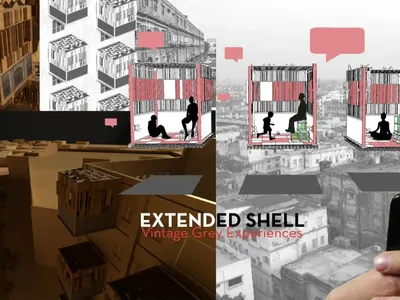
Extended Shell: Retrofitting Kolkata's Balconies as Living Urban Thresholds
A modular retrofit system recovers the social and environmental intelligence of Kolkata's historic verandas for contemporary Park Street residents.

Similar Reads
You might also enjoy these articles

Shakur's House: Exposed Brick as an Interior Organiser in a 168 m² Mashhad Residence
Brick moves indoors in this Mashhad residence, where masonry walls, glass partitions and teal planes sequence a compact home without closing it off.

Day and Night Park: A Time-Based Urban Newsstand in Beijing
A temporary urban newsstand in Beijing blending travel, light, and reading through poetic colors, compact form, and community-focused design.

Modernist Patio Renovation in El Masnou, Barcelona by Oliver Segura Arquitectura + Cebrià Arquitectura
Modernist patio renovation blending tradition and innovation with a movable pool, leveled floors, and Catalan materials in El Masnou.

Alto Residencial Coop: Cooperative Housing Development in Santiago de Compostela by Carbajo Barrios Arquitectos
A linear cooperative housing complex blending white volumes and perforated metal façades, enhancing community living, natural light, privacy, and urban integration.

Comments (0)
Please login or sign up to add comments
No comments yet. Be the first to comment!