

CycleHaus: An Ocean-Current Recycling Station Free from Political Borders
Positioned at the heart of the world's largest ocean current, CycleHaus uses natural forces to collect, process, and redistribute waste globally.


What if a building could sit at the center of the world's largest ocean current and let the planet's own momentum do the work? CycleHaus proposes exactly that: a recycling infrastructure stationed in open water, designed to collect debris carried by ocean currents, process it on-site, and redistribute usable material globally, all without consuming additional energy. The premise is radical not because it involves new technology but because it repositions architecture as an active agent in environmental restoration rather than a passive consumer of resources.
Designed by Tijana Zisic, CycleHaus was shortlisted in Bauhaus Neue, a competition that challenges designers to reinterpret the legacy of the Bauhaus for contemporary conditions. Zisic's response sidesteps nostalgia entirely. Instead of revisiting form or pedagogy, she takes Bauhaus principles of social utility and industrial logic and drops them into the Pacific Ocean. The result is a speculative structure that is politically, economically, and socially autonomous: a floating ecosystem free from national jurisdiction, capable of expanding and adapting as environmental and social demands shift.
Collage as Manifesto: Framing Waste as Spatial Material
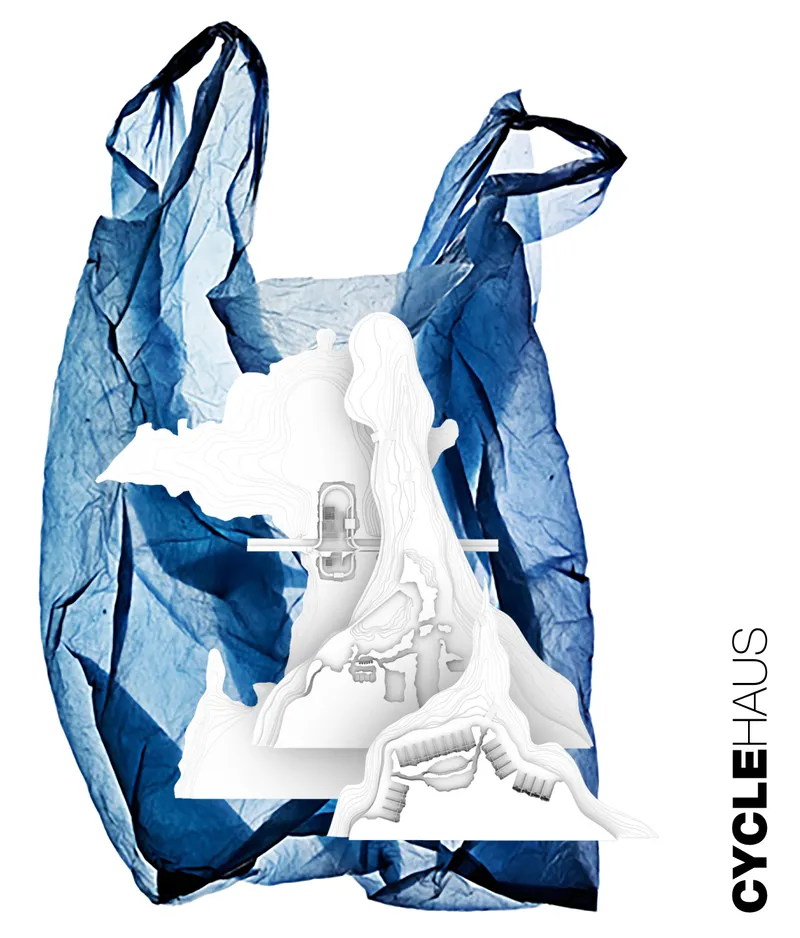
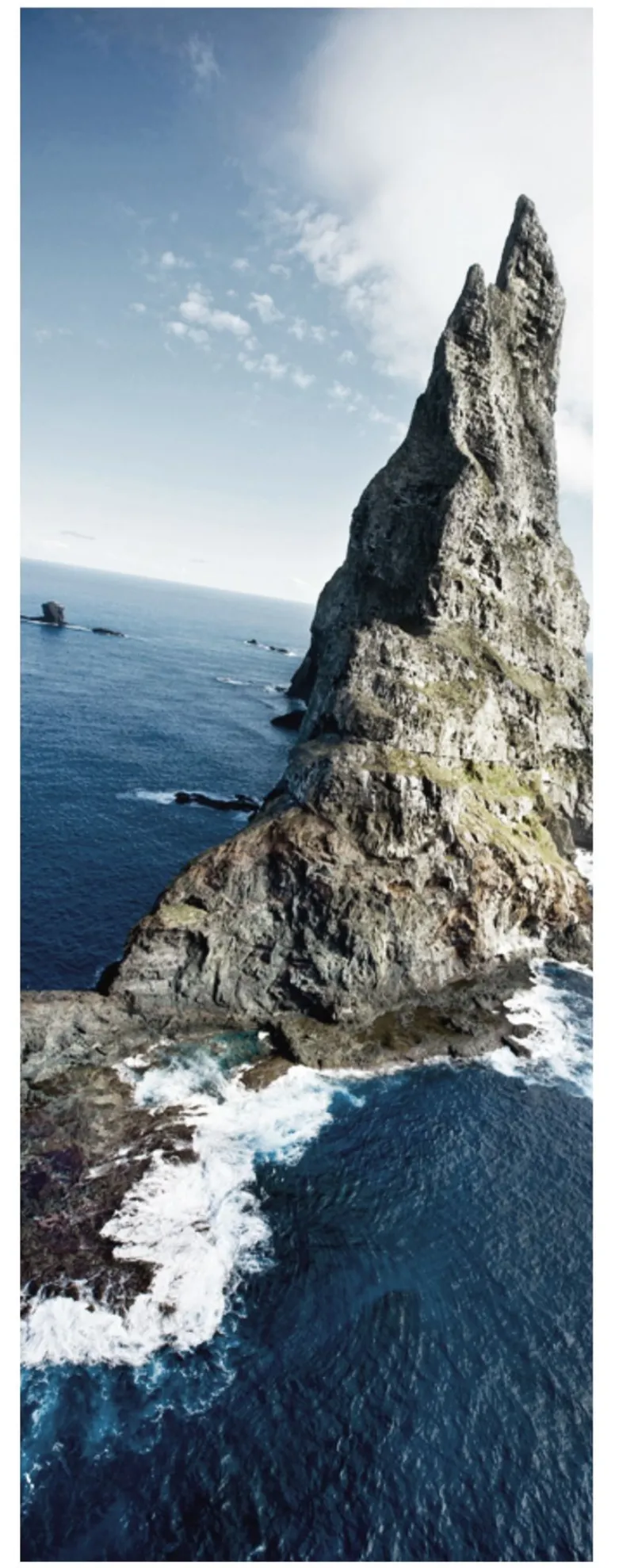
The opening collage sets the conceptual tone immediately. White figure cutouts occupy interior spaces framed by a blue plastic bag, a blunt visual equation between human habitation and the waste that defines our era. It is not a rendering; it is a provocation. The adjacent image of a jagged sea stack rising from blue ocean waters grounds the project in its physical reality. These rock formations, sculpted by the same currents CycleHaus intends to harness, serve as geological precedents for structures shaped entirely by natural force. Zisic positions her architecture in dialogue with these formations, suggesting that built form in the open ocean must be as responsive and erosion-aware as the stone around it.
Inhabiting the Threshold Between Rock and Sea

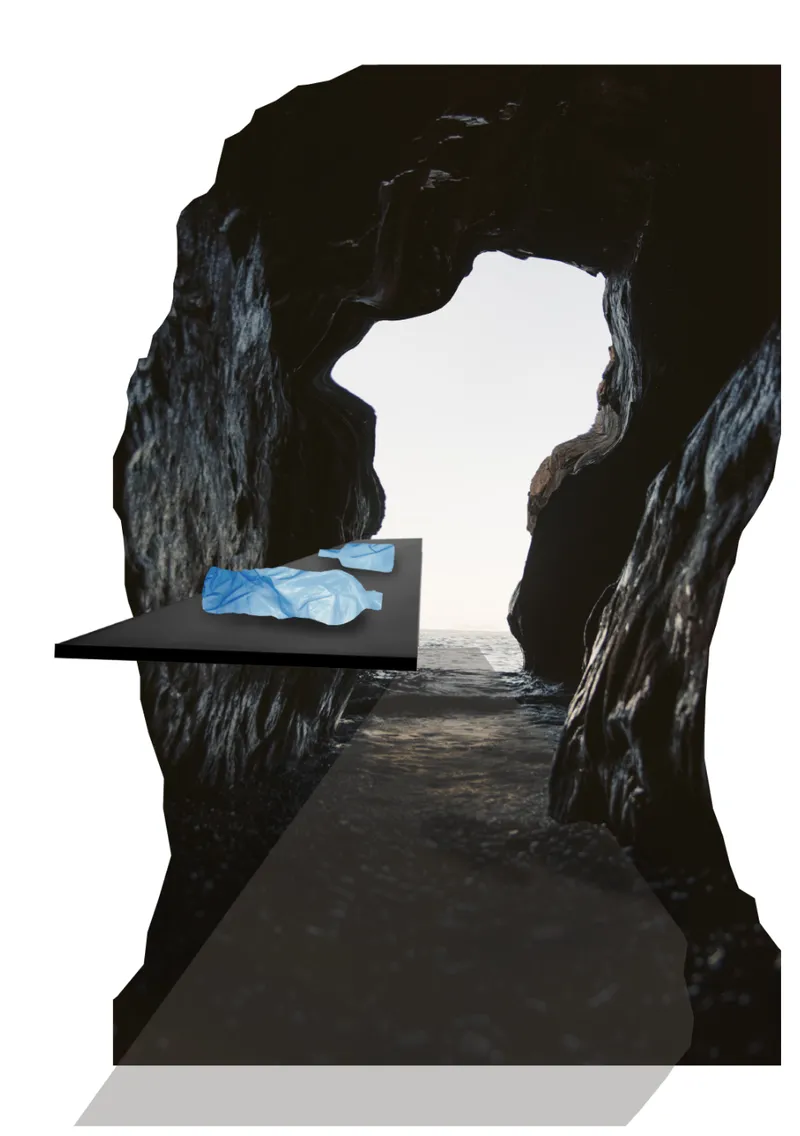
The project's spatial language draws heavily from coastal cave interiors. Visitors standing inside a weathered rock opening demonstrate scale and atmosphere simultaneously: these are not polished galleries but raw, geological enclosures where daylight enters laterally and surfaces remain unfinished. The cave passage containing a black platform draped in blue fabric reads as a stage set within the earth itself. The fabric's color and texture deliberately echo ocean plastics, folding the project's recycling mission into its spatial experience. Architecture here is not layered on top of nature but inserted into its cavities.
Programme as Provocation: Leisure Inside the Machine
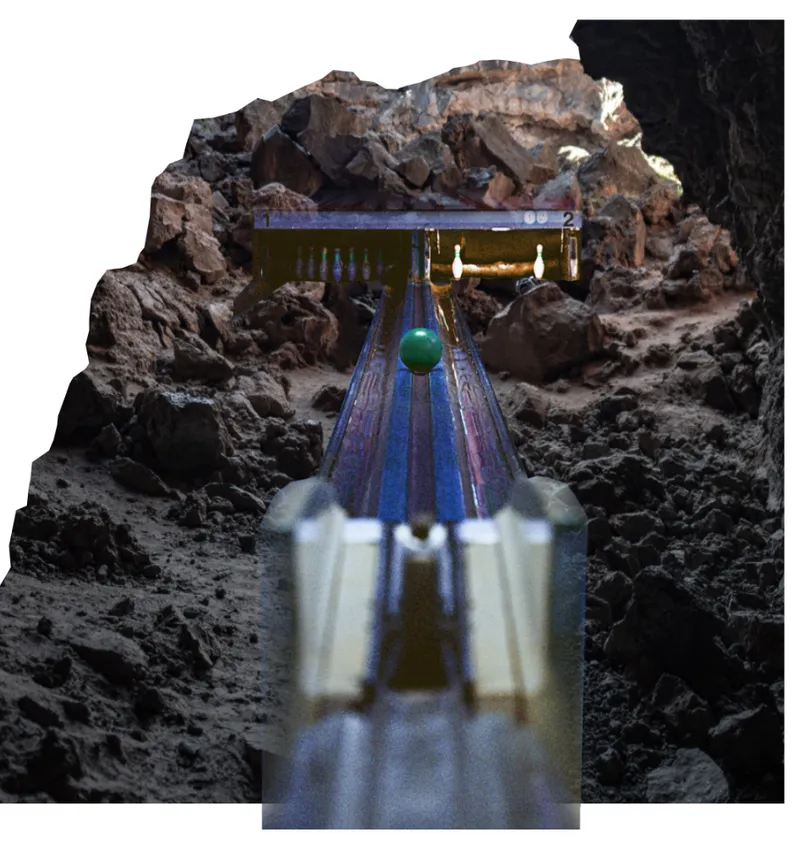
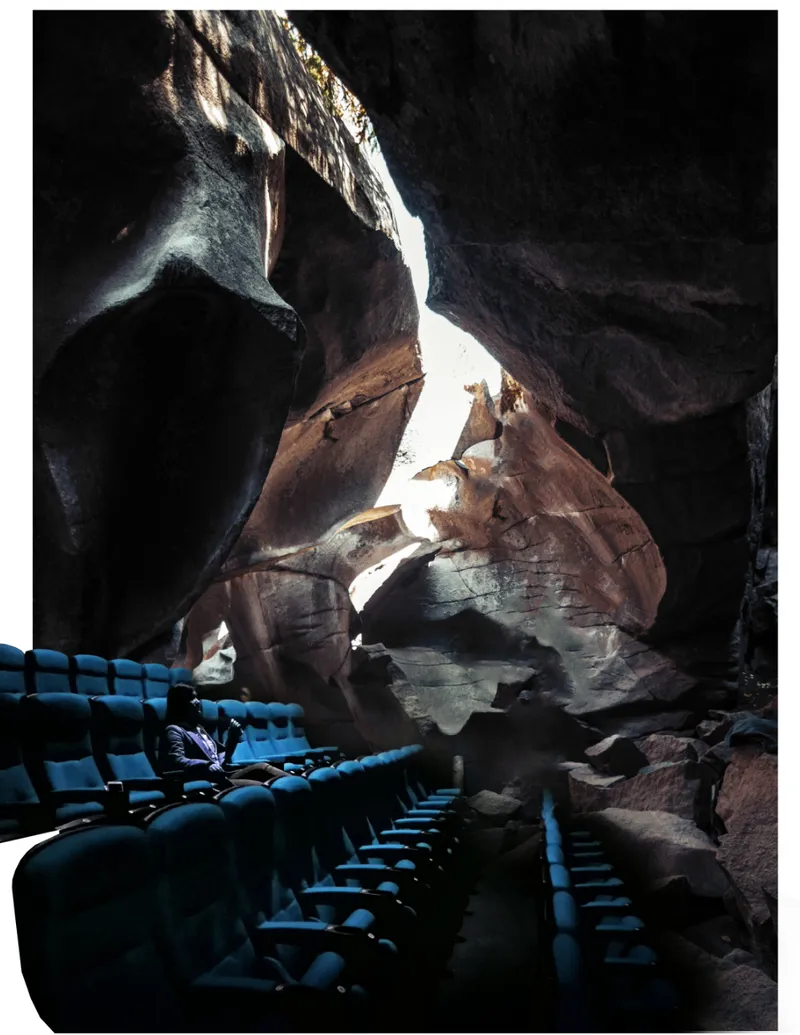
Two of the most striking images in the series place recreational programs inside cave chambers. A bowling lane extends through a rocky interior, its green ball rolling across a surface that terminates against rough stone walls. Nearby, rows of blue theater seating fill a natural cave chamber lit by filtered daylight. These juxtapositions are deliberately absurd, and that is the point. Zisic suggests that an autonomous oceanic structure must sustain a community, not just a process. Recycling infrastructure alone does not create habitation; social and cultural programs do. By embedding leisure within geological space, the project argues that even the most utilitarian architecture must account for the full spectrum of human activity.
Shelter at the Edge: Domesticity on Open Water
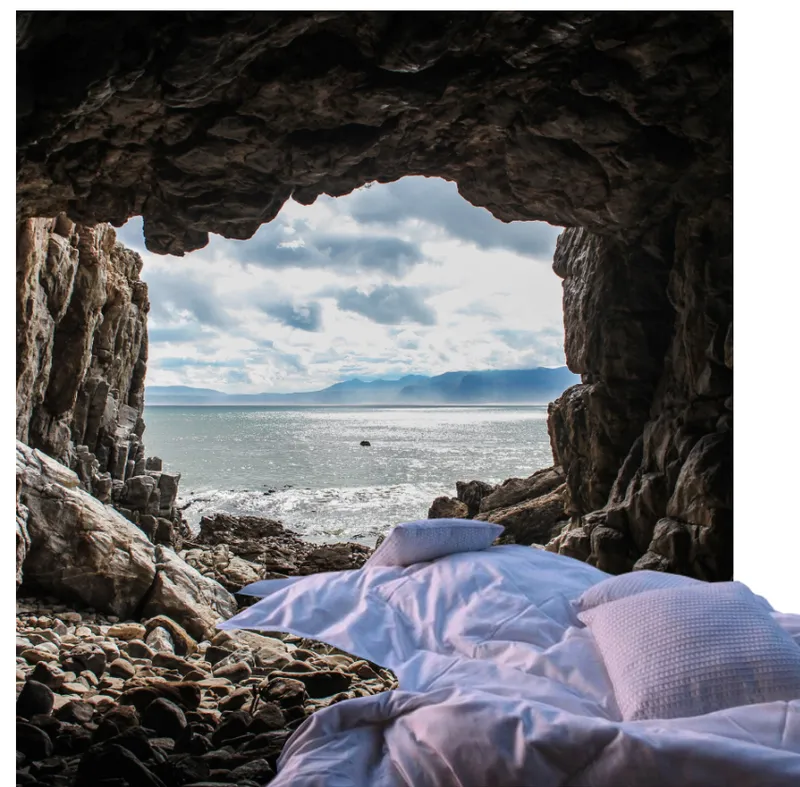
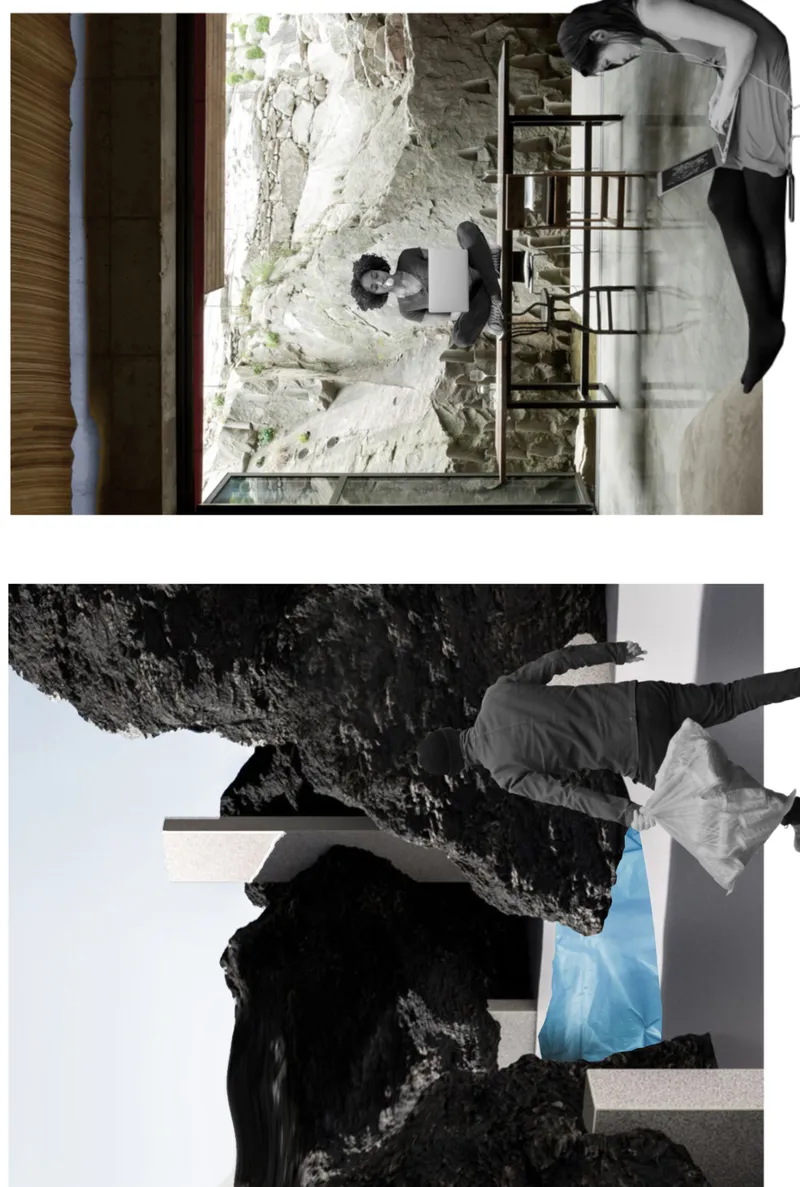
The most intimate image in the series frames a view from inside a coastal cave, where white bedding rests on pebbles and the ocean stretches toward distant mountains. It is a deeply domestic moment set in a deeply inhospitable environment. The tension between comfort and exposure defines CycleHaus's relationship to its site: the structure must provide refuge while remaining permeable to the forces it depends on. The final image, a top-down view of a metal staircase descending through a natural rock opening with people visible below, reveals the project's circulatory logic. Movement through CycleHaus is vertical and geological, threading through openings carved by water rather than corridors drawn on plan.
Passive design strategies, natural ventilation, and self-sustaining energy systems underpin the project's technical ambition. By harnessing the kinetic energy of ocean currents to power waste collection and processing, CycleHaus eliminates the need for external energy input. The structure is designed to be expandable, an adaptive system that grows in response to the volume of debris it encounters. This modularity ensures that the architecture remains relevant as ocean conditions change, functioning less like a fixed building and more like an organism.
Why This Project Matters
CycleHaus matters because it refuses to accept the boundaries that typically constrain architectural proposals. It has no client, no nation, no fixed footprint. By situating itself in international waters and drawing energy from planetary systems rather than grids, Zisic's project challenges the profession to think about architecture as infrastructure for ecological repair. The Bauhaus Neue competition asked for contemporary relevance, and this entry responds by arguing that the most relevant architecture today may not sit on land at all.
The speculative register of the project is also its strength. Zisic does not pretend that CycleHaus can be built tomorrow. Instead, she constructs a rigorous spatial argument, using collage, found environments, and programmatic provocation, to demonstrate what architecture could become if it aligned its ambitions with the scale of the environmental crisis. As a shortlisted entry, the project earned recognition for precisely this willingness to think beyond convention. It is a reminder that the most useful architectural proposals are sometimes the ones that redesign the question before attempting an answer.
View the Full Project
About the Designers
Designer: Tijana Zisic
Enter a Design Competition on uni.xyz
uni.xyz runs architecture and design competitions year-round that reward proposals with spatial conviction and real site intelligence.
Project credits: CycleHaus by Tijana Zisic Bauhaus Neue (uni.xyz).


Popular Articles
Popular articles from the community


David Ortega Stacks a Two-Story Mexico City Penthouse Around a Steel Stair and a Pergola-Shaded Roof Terrace
In Colonia Roma, a 300 m² penthouse uses oak joinery, a planted steel stair and a slatted roof pergola to make a new-build apartment feel like a house.

ETEH Reworks the Shared Spaces of São Domingos School in Brazil Around Timber, Color and Hanging Plants
At São Domingos School in Brazil, 436 m² of hall, refectory and library are recast with timber joinery, a yellow and blue code and trailing greenery.


Singing Woman: An Opera House That Performs Before the Curtain Rises
Ovidiu Cristian Pavel's conceptual opera house translates Estonia's choral identity into a sculpted waterfront landmark facing the Baltic Sea.

Cube Design Draws an Ecological Corridor Between Two Shenzhen Hills with the Nankai Building
Beside Shenzhen's container docks, the Nankai Building pairs stacked balconies with a climbing green screen to connect two hillsides across its height.

Similar Reads
You might also enjoy these articles

Vereda Arquitetos Renovates a 40-Square-Meter Apartment Inside Niemeyer's Copan Building
A compact unit in São Paulo's most iconic residential tower gets a material overhaul that pairs exposed concrete with bold blue Formica.

Shakur's House: Exposed Brick as an Interior Organiser in a 168 m² Mashhad Residence
Brick moves indoors in this Mashhad residence, where masonry walls, glass partitions and teal planes sequence a compact home without closing it off.

Day and Night Park: A Time-Based Urban Newsstand in Beijing
A temporary urban newsstand in Beijing blending travel, light, and reading through poetic colors, compact form, and community-focused design.

Modernist Patio Renovation in El Masnou, Barcelona by Oliver Segura Arquitectura + Cebrià Arquitectura
Modernist patio renovation blending tradition and innovation with a movable pool, leveled floors, and Catalan materials in El Masnou.

Explore Eco Building Competitions
Discover active competitions in this discipline

Challenge to design public laboratory

Challenge to reimagine the Iron Throne

Photograph architecture without architects

Illustrate the lost glory of Angkor Wat - Render Challenge
Comments (0)
Please login or sign up to add comments
No comments yet. Be the first to comment!