
Dark Brewed: Cafe Architecture Designed for Dialogue, Heritage, and Public Exchange
Dark Brewed revives Viennese coffee house culture with vaulted cafe architecture for open dialogue, urban views, and shared ideas every day.

Project: Dark Brewed
Designers: Mauricio Salazar Castro, José Alfredo Hinojosa De la Torre, Hannia GW
A Coffee House Where Small Talk Becomes Big Talk
Dark Brewed is a coffee house proposal shaped around a simple but powerful idea: a public space where anyone can talk, share, develop, and display ideas. Designed by Mauricio Salazar Castro, José Alfredo Hinojosa De la Torre, and Hannia GW, the project reimagines the coffee house as more than a place for drinking coffee. It becomes a civic interior, a social platform, and a contemporary interpretation of the historic Viennese coffee house.
The project’s core line, “A coffee house where a small talk becomes a big talk,” defines its architectural ambition. Dark Brewed treats conversation as the main program. Instead of designing only for consumption, the proposal organizes space for debate, exchange, pause, and collective presence. Its cafe architecture is not limited to tables, counters, and circulation. It builds an atmosphere where people can arrive with different backgrounds, sit together, observe the city, and contribute to a shared social environment.
Located in Vienna, the proposal draws from the city’s coffee house tradition while translating it into a new architectural language. The result is a coffee house that feels rooted in cultural memory, yet open to contemporary urban life.
Cafe Architecture as a Public Space for Ideas
The strongest architectural gesture in Dark Brewed is its commitment to openness. The concept frames the coffee house as a place where ideas are not private or isolated, but exchanged in public. The design positions the cafe as a democratic setting, where people of different ages, professions, identities, and points of view can participate.
This approach gives the project a civic dimension. The coffee house becomes a soft public institution, one that does not require formal membership or fixed behavior. A visitor may enter for coffee, but the architecture invites them to stay, observe, listen, speak, and connect. In this sense, Dark Brewed uses cafe architecture to support social inclusion.
The project proposes a welcoming space for anyone. Its interiors and exterior thresholds are designed to lower the distance between the street, the park, and the indoor cafe environment. The coffee house is not treated as a closed commercial box. It becomes a public room within the city, a place where informal conversations can develop into meaningful exchanges.
Reviving the Spirit of Viennese Coffee House Culture
Vienna’s coffee house culture has historically been associated with discussion, literature, politics, philosophy, and everyday social life. Dark Brewed interprets this heritage through spatial form, materiality, and programmatic organization.
Rather than copying the 19th-century coffee house directly, the design extracts its essential values. These include communication, comfort, intellectual openness, and a protected environment for ideas. The project asks how a contemporary coffee house can continue this legacy while responding to today’s urban conditions.
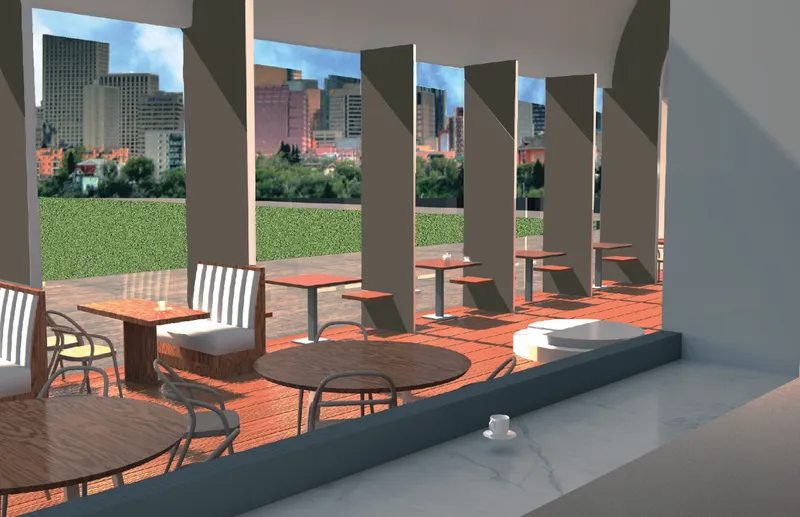
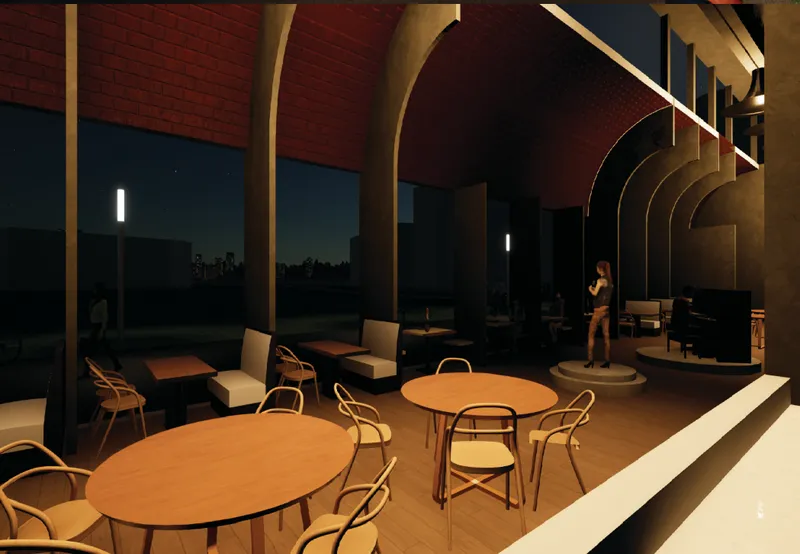
The answer is found in a design that combines enclosure and exposure. The cafe provides a secure, intimate setting for conversation, but it also opens visually toward the surrounding park and city. This duality allows the building to feel both protected and connected. It offers a refuge from routine while still belonging to the public realm.
Dark Brewed translates the heritage of Viennese coffee houses into a contemporary social architecture. It honors the past not through ornament alone, but through the act of making space for dialogue.
Form, Arches, and Vaults as Architectural Memory
One of the defining features of Dark Brewed is its use of arches and vaults. The designers identify these elements as characteristic forms associated with historic coffee houses and reinterpret them as the main spatial language of the project.
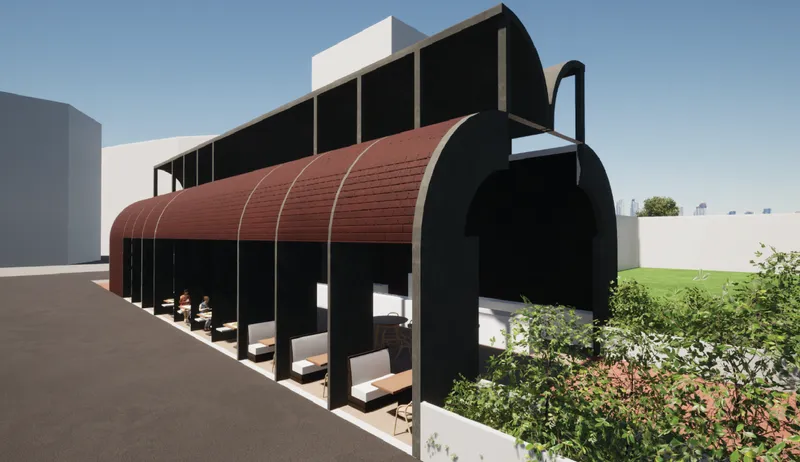
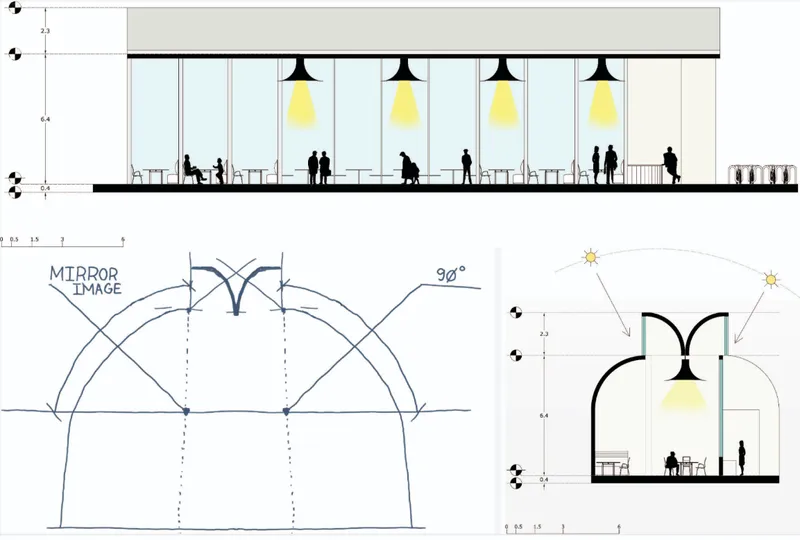
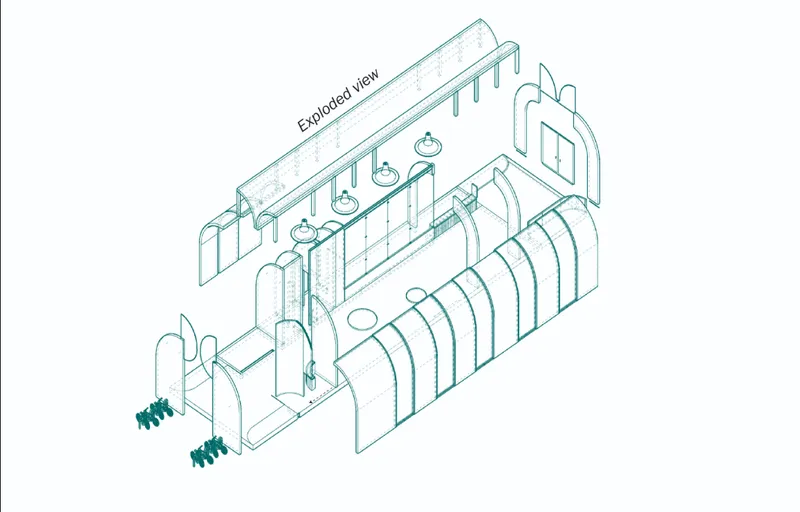
The initial design development began with a simple box-like volume. Through experimentation, the mass evolved into a vaulted form that integrates arches, half circles, and quarter-circle geometries. These forms create rhythm, symmetry, and proportion across the building. They also give the coffee house a strong architectural identity.
The main volume is interpreted as a large vault with internal arches. This produces a sequence of spatial bays that frame seating, guide movement, and create a sense of continuity. The arches are not decorative additions. They become structural, atmospheric, and symbolic elements within the cafe architecture.
The repeated curved forms soften the linear plan and bring a human scale to the interior. They also create moments of focus, allowing each seating zone to feel connected to the whole while retaining a degree of intimacy.
A Building Organized Around Conversation
The plan of Dark Brewed separates service functions and social spaces with clarity. Services are placed along one side, allowing the main interior to remain open, flexible, and socially active. This organization creates a linear movement from entrance to end, guiding visitors through a sequence of seating areas, counters, views, and gathering zones.
The cafe is designed as a place where movement and stillness coexist. Visitors can pass through, order coffee, find a seat, or move toward more open gathering areas. The layout supports different types of interaction, from private conversations to larger discussions.
The interior works as the heart of the building. It is conceived almost as an entity within itself, a central social chamber where the architectural form enhances acoustics, atmosphere, and presence. The vaults and arches help shape this interior identity, turning the coffee house into a stage for everyday conversation.
This theatrical quality is important to the project. The coffee house is not presented as a static interior, but as a living public scene. Each table, window, arch, and threshold contributes to the performance of social life.
Indoor and Outdoor Spaces Working Together
Dark Brewed expands the idea of the coffee house beyond its interior. The outdoor area is designed as an extension of the social environment, transforming the act of sitting outside into an urban experience. It allows discussion to move from enclosed space to open air.
This indoor-outdoor relationship is central to the project’s public character. The cafe does not hide from its surroundings. Instead, it frames the park, acknowledges the street, and creates visual exchange between people inside and outside.
The facade is conceived as an open window toward the park behind the site. This window-like idea allows pedestrians and nearby buildings to maintain a free visual relationship with the landscape. The coffee house becomes a frame through which the city can see greenery, and through which visitors can reconnect with the urban environment.
This strategy also supports the emotional purpose of the design. Entering the coffee house is imagined as a pause from routine. The project creates a moment where work, movement, and daily pressure can slow down. Inside, it becomes the visitor’s time and space.
Light, Ventilation, and Environmental Response
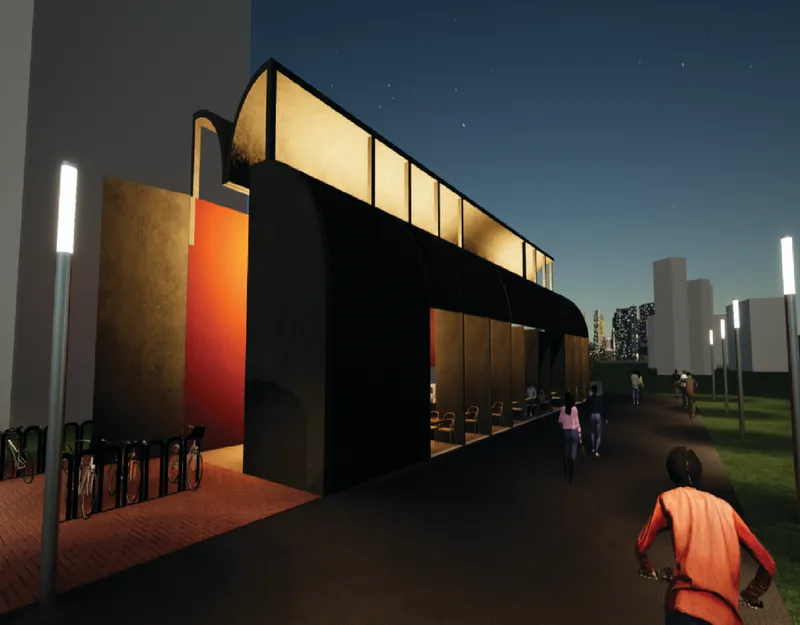
The design responds to Vienna’s climate and seasonal conditions by considering natural illumination, cross ventilation, and the use of framed views. The curved forms and side openings are not only visual gestures. They also assist with daylight and air movement.
The half-circle and quarter-circle elements integrated into the building help create a more symmetrical composition while supporting natural lighting. Ribs along the side frame each window, producing a repeated architectural rhythm and strengthening the relationship between inside and outside.
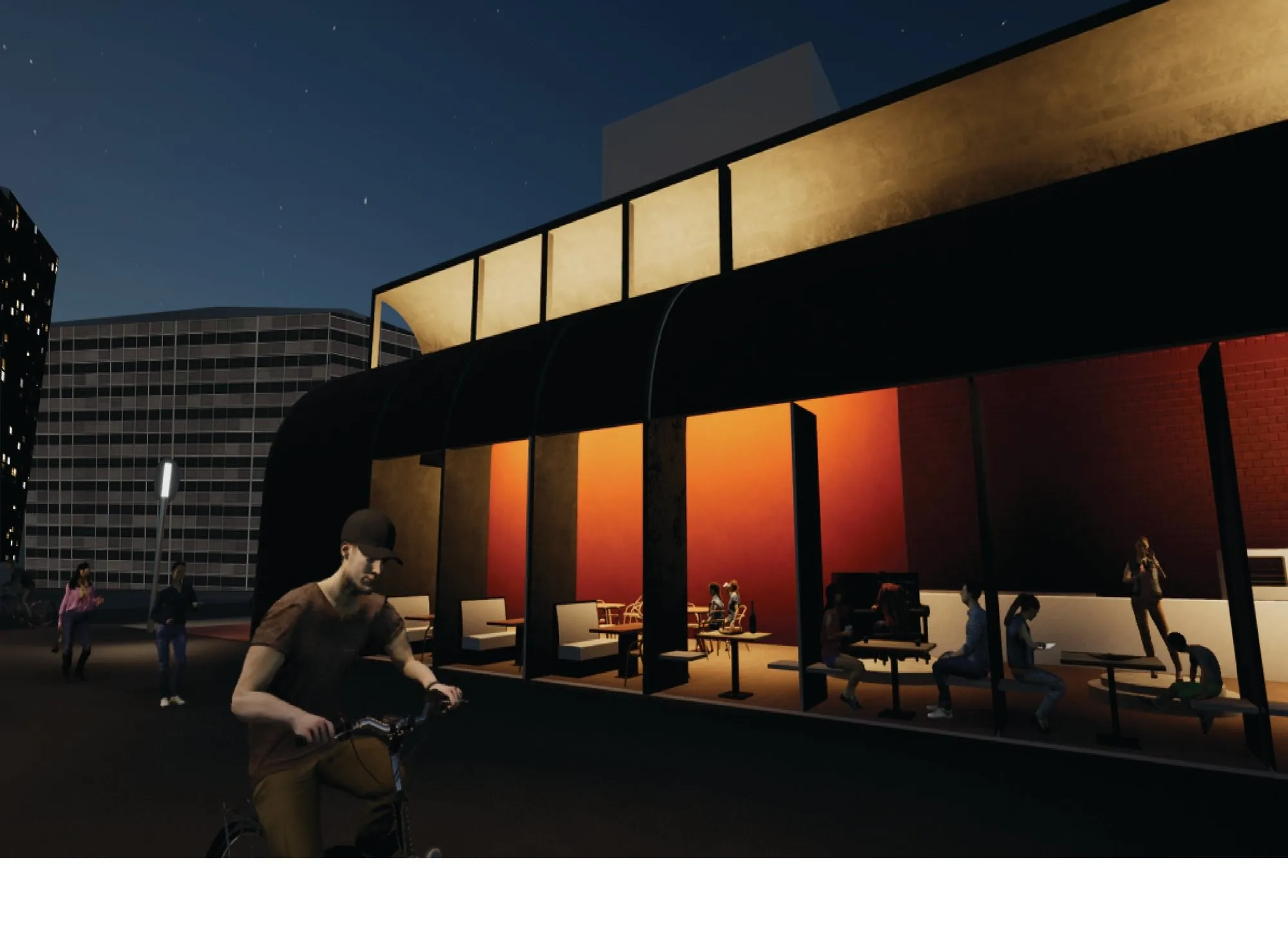
Artificial lighting is also carefully considered. The proposal includes lights that illuminate the interiors directly and indirectly, bouncing light against the ceiling and shaping a warm internal atmosphere. This is particularly important for a coffee house, where mood and comfort are central to the user experience.
Dark Brewed uses light as both a functional and emotional material. During the day, the building opens toward the park and receives natural light. At night, the illuminated vaults create a darker, intimate environment that gives the project its name and identity.
Material Palette and Atmosphere
The material palette reinforces the connection between historical memory and contemporary cafe architecture. Brick is used to bring an earthy texture to the facade and walls, creating a sense of warmth, permanence, and urban familiarity.
Reflective flooring pays homage to the tiles and pure stone surfaces associated with Vienna’s architectural interiors. This material choice helps create depth and luminosity while connecting the project to the historic language of the city.
Furniture is selected to recall the era of traditional coffee houses. Chairs, tables, and seating arrangements are designed to resonate with the same material and cultural atmosphere. The goal is not to create nostalgia as a visual theme, but to revive the spatial feeling of the coffee house as a refined and social interior.
Together, brick, reflective surfaces, curved forms, and classic furniture create an environment that feels grounded, warm, and public. The architecture supports intimacy without losing openness.
The Facade as an Urban Invitation
The facade of Dark Brewed operates as more than a boundary. It is designed as an invitation. Its curved openings, vaulted silhouette, and framed views create an approach that feels both monumental and welcoming.
The designers imagine the first face of the building as a transformation point. When visitors enter for the first time, they should feel that routine has stopped and that they have stepped into a shared environment. This transition is central to the project’s emotional structure.
The building’s face opens toward the park and the street, allowing the cafe to become a social place rather than a closed commercial unit. Its facade allows the idea of conversation to become visible. People sitting, talking, listening, and gathering become part of the urban image.
In this way, the facade helps define the cafe as a public space for society’s ideas. It does not simply display the brand or function of the coffee house. It communicates the project’s larger purpose.
Symmetry, Rhythm, and Proportion
The drawings emphasize three architectural principles: symmetry, rhythm, and proportion. These principles organize the project at multiple scales, from the overall vault form to the repeated arches, seating bays, and facade elements.
Symmetry gives the building a sense of balance and clarity. Rhythm creates continuity through repetition, making the long linear interior feel structured and legible. Proportion ensures that the curved forms remain comfortable and human-scaled rather than overwhelming.
These classical design principles are used in a contemporary way. They do not create a rigid or formal interior. Instead, they help produce a calm framework for flexible social activity. The result is a coffee house that feels ordered but not restrictive.
The disciplined geometry also strengthens the identity of Dark Brewed. Its arches and vaults make the building recognizable, while its proportional system supports a functional and welcoming plan.
A Contemporary Interpretation of Social Architecture
Dark Brewed is ultimately a project about social architecture. It shows how cafe architecture can contribute to the public life of a city by creating spaces where people can speak, listen, and exchange ideas.
The coffee house is treated as a mediator between individual experience and collective culture. It gives people a place to be alone together, to hold small conversations, and to develop larger social discussions. This is the meaning behind the project’s phrase: small talk becomes big talk.
By combining Viennese coffee house heritage, vaulted spatial language, open views, indoor-outdoor connections, and a carefully organized plan, Dark Brewed creates a strong architectural proposal for contemporary urban life.
It is not only a coffee house. It is a public interior, an urban frame, and a cultural vessel for conversation.
Dark Brewed by Mauricio Salazar Castro, José Alfredo Hinojosa De la Torre, and Hannia GW redefines the coffee house as a civic and architectural space. Through arches, vaults, framed park views, warm materials, and a layout centered on dialogue, the project transforms cafe architecture into a platform for public exchange.
The proposal recognizes that coffee houses have always been more than places of service. They are places where ideas move, relationships form, and society speaks to itself. Dark Brewed brings that tradition forward, offering a space where anyone can enter, pause, talk, and belong.


Popular Articles
Popular articles from the community

Simplex Architecture Steps a Seoul Mid-Rise Tower to Negotiate Between Low-Rise Commerce and High-Rise Housing
In Seocho-dong, a gridded stone tower of terraces and sunken courtyards mediates between two radically different urban scales.
How Henri Picq's 1889 Paris Pavilion Traveled 11,000 Kilometers to Become Santiago's Artequín Museum
A prefabricated iron and glass pavilion built for the Paris Universal Exposition found a second life as a children's art museum in Chile.
FAMM Arquitectura Organizes Ten Villas Around Courtyards and Jungle in Nosara, Costa Rica
El Molino pairs two elongated volumes with deep overhangs and timber louvers to build a compact coastal community five minutes from the beach.

A Reinforced Cocoon: Vernacular Architecture for Security, Healing and Community in Qandahar
A Reinforced Cocoon reimagines Afghan vernacular architecture as secure community space for widowed women, families, healing and resilience.
Similar Reads
You might also enjoy these articles
Eco Chapel: A Green Architecture Pavilion Designed in Symbiosis with the Forest
Eco Chapel uses green architecture to weave prayer, learning and reuse into a forest pavilion shaped by modular hexagonal canopies for life.
Kaffeebühnen: Coffee Shop Architecture Designed as a Civic Stage Between Vienna’s City and Park
Kaffeebühnen turns coffee shop architecture into a civic stage, linking Vienna’s park edge, urban life, warm timber yards, and coffee craft.
Healing Façade: Sustainable Architecture for Reforestation, Community, and Sacred Ecology in Ethiopia
Healing Façade reimagines sustainable architecture as a living wall that restores soil, catches water and renews Ethiopia's forest churches.


Urban Forest: A Vertical Ecosystem for 5,000 Workers in Singapore's Changi Business Park
Radially stacked pods and layered green decks turn a 7-acre plot into 47 acres of ecological workspace projected for 2040.
Explore Architecture Competitions
Discover active competitions in this discipline




The International Standard for Design Portfolios

The Global Benchmark for Architecture Dissertation Awards

The Global Benchmark for Graduation Excellence


Challenge to reimagine the Iron Throne
Comments (0)
Please login or sign up to add comments
No comments yet. Be the first to comment!