
fjcstudio Wraps a Sydney Public School in Casuarina Screens and Indigenous Memory
Darlington Public School replaces a 1975 campus with passive design, Aboriginal storytelling, and curving perforated facades in inner Sydney.


Public schools rarely get architecture this deliberate. Darlington Public School, designed by fjcstudio and completed in 2023, replaces a 1975 building on Gadigal Country in Sydney's inner-city fringe, near the University of Sydney and the dense terrace-house fabric of Darlington and Newtown. The original campus, designed under Government Architect Ted Farmer as a Demonstration Public School, had served its purpose for nearly five decades. What fjcstudio delivered in its place is a campus that treats sustainability, cultural continuity, and pedagogical flexibility not as competing agendas but as a single design problem.
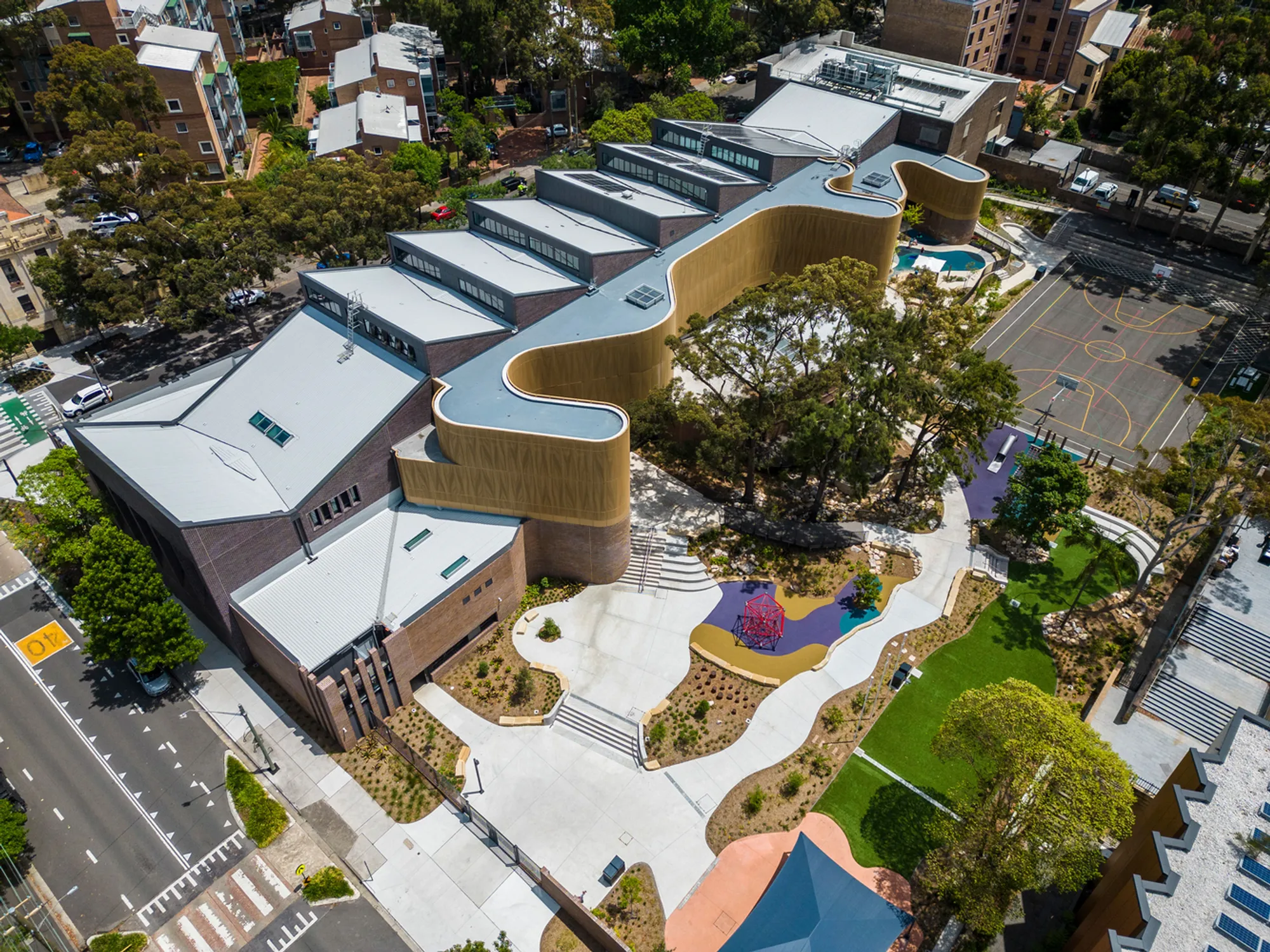
The most striking move is the curvilinear perforated metal screen that wraps around the buildings, patterned after local casuarina trees. It does real work: controlling solar gain, filtering dappled light into circulation spaces, and defining fluid outdoor gathering zones for play and learning. But the screen is also a signal that this is not a standard institutional box. Behind and beneath it, linear brick structures house adaptable learning hubs, a multipurpose hall, a library, and community facilities. Over 70% of teaching spaces rely on natural ventilation. Sawtooth roofs angle north to capture indirect daylight through clerestory glazing. The whole campus was built in two construction stages so that classes could continue without costly relocations. It is practical architecture made generous.
The Urban Edge: Brick, Trees, and the Street
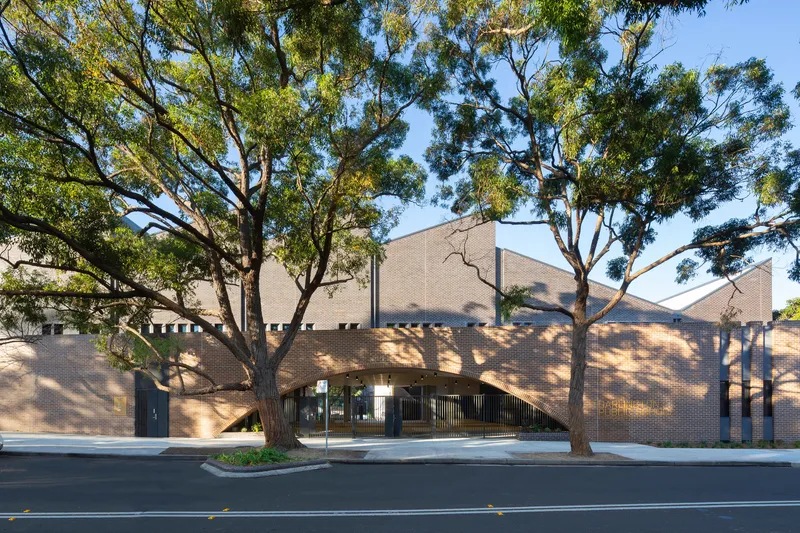
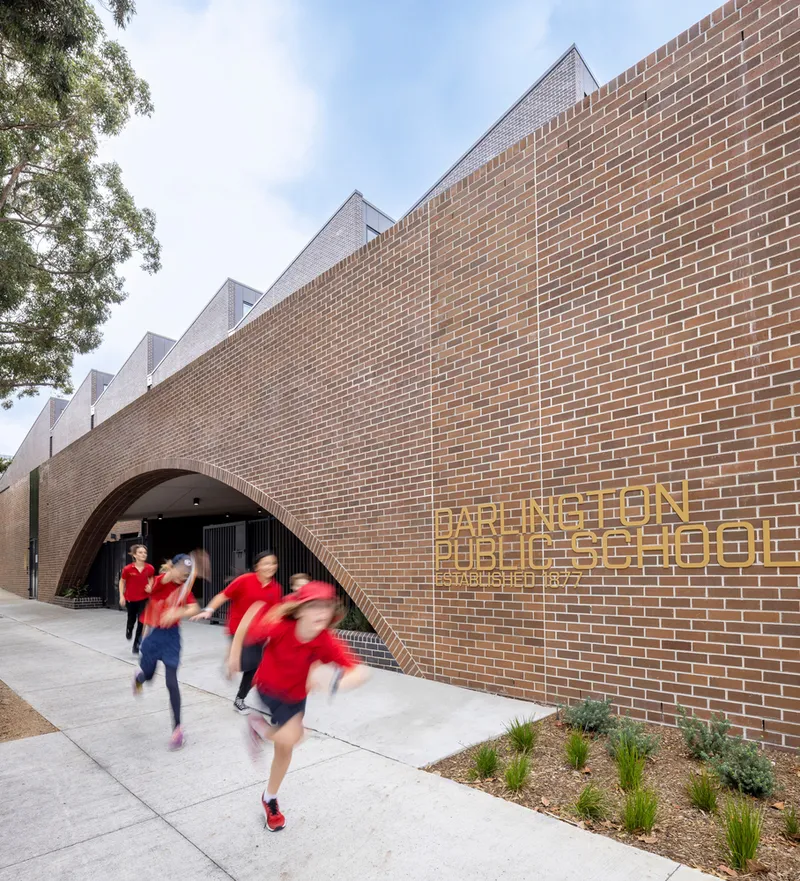
The school sits among Victorian terrace houses, early twentieth-century warehouses, and university buildings. fjcstudio responded by working in brick, a material that reads as both industrial and domestic across this part of Sydney. The brick facade is set back from the street boundary to allow endemic plantings to reintroduce greenery while still holding the urban edge. On Golden Grove Street, a brick arch frames a covered entry undercroft, giving the school a civic front that is welcoming without being monumental.
Mature eucalyptus trees survive along the perimeter and cast dappled shadows across the brickwork. The effect is of a building that has been there longer than it has, embedded in its context rather than dropped onto it. Students in red uniforms stream through the arched entry with the informality of a neighborhood lane, not an institutional gate.
Screens That Filter Light and Tell a Story
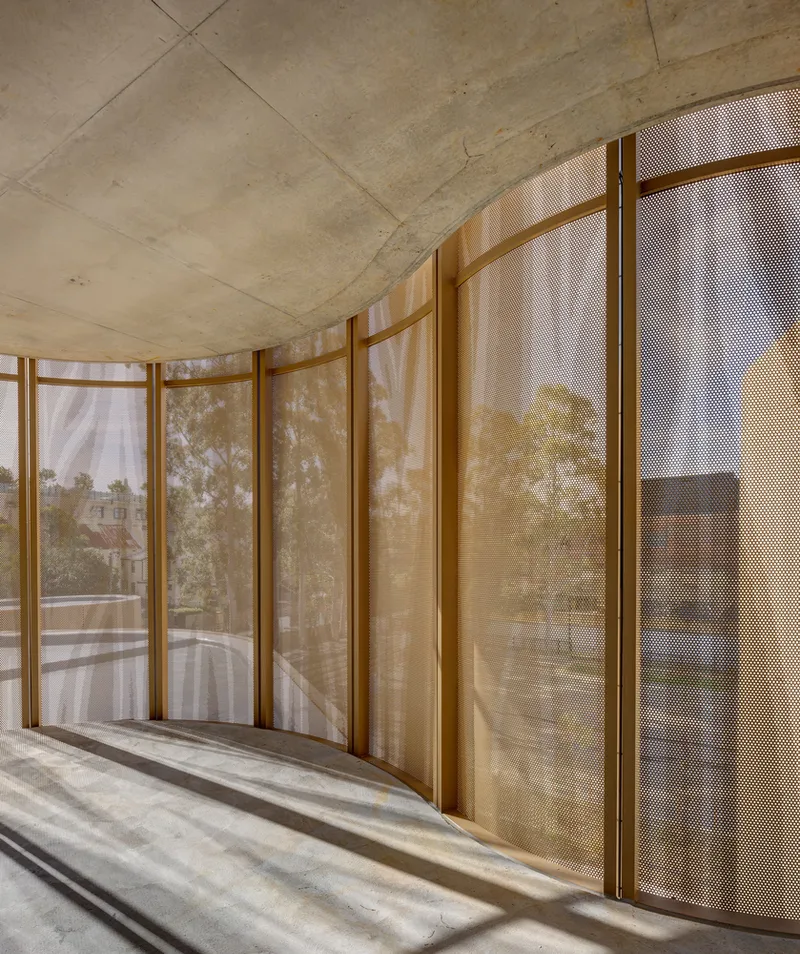
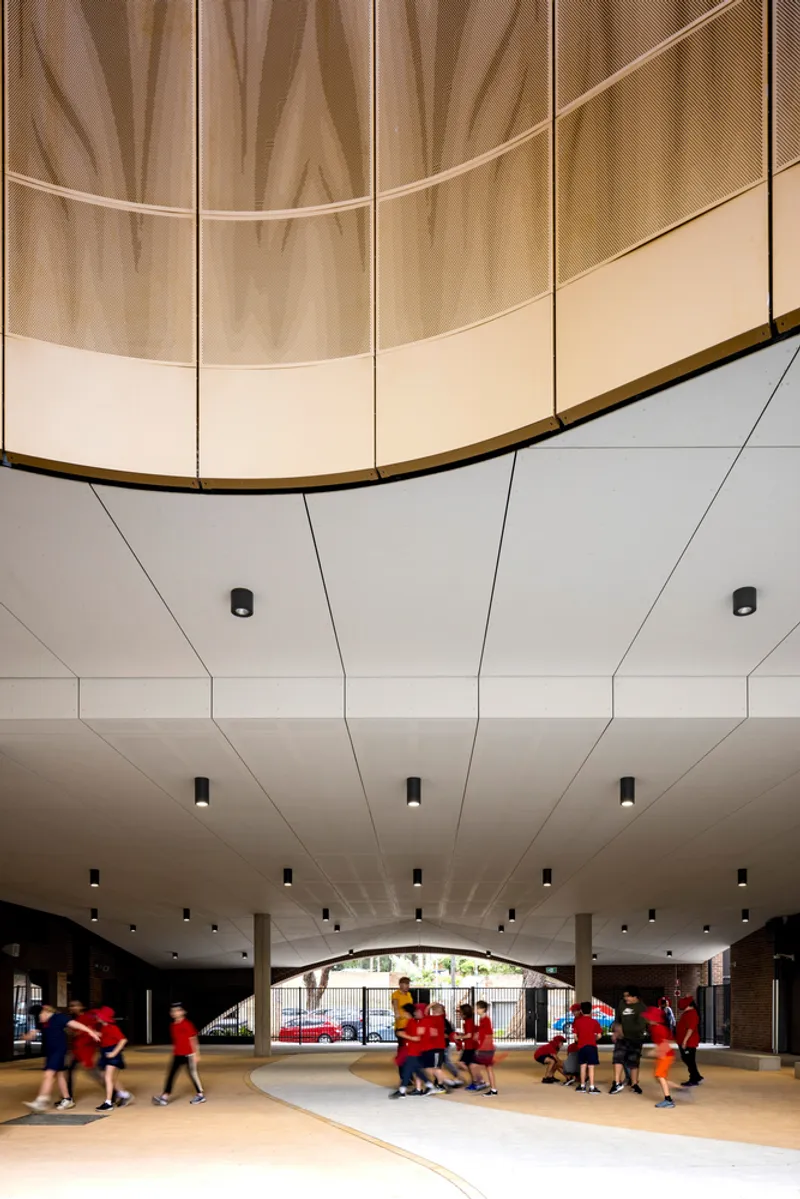
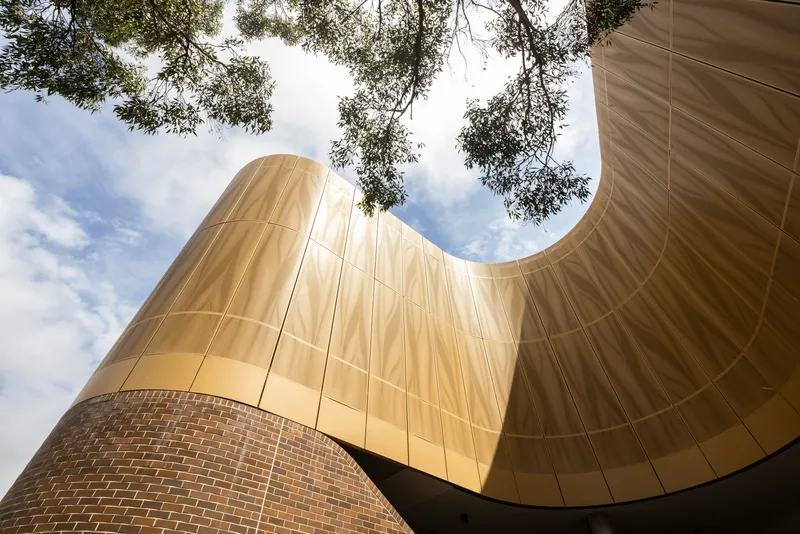
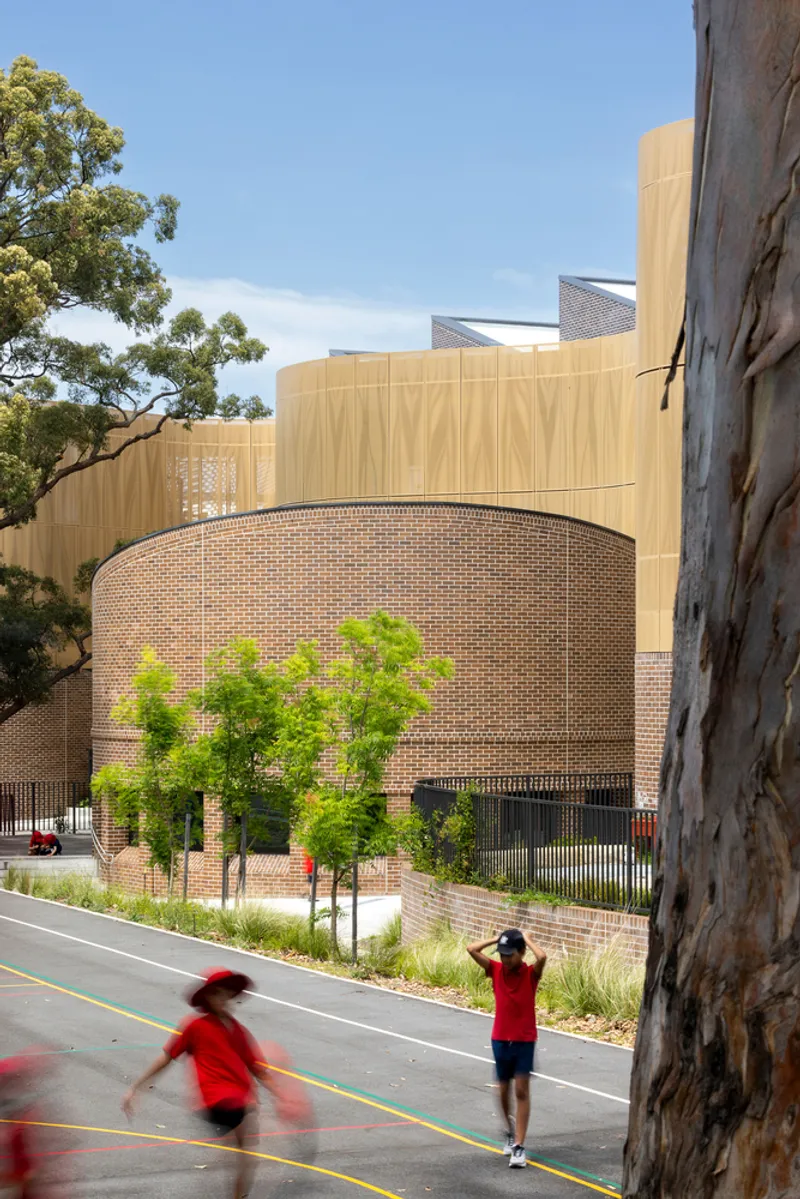
The perforated aluminium screens are the campus's most legible element. Patterned with abstracted casuarina tree forms, they wrap the upper timber-clad volumes in a continuous veil that shifts from opaque to translucent depending on the angle of view and the sun's position. From inside, the screens throw complex shadow patterns onto concrete floors, creating interiors that change character through the day without mechanical intervention.
There is a deliberate sequence at work. The entry's rigid, geometric brick facade gives way to soft, undulating curves as you move deeper into the campus. The rigid becomes organic. The timber-clad upper volumes curve and swell above the brick base, and the screens mediate between inside and out. It is one of those rare projects where the decorative and the performative are genuinely the same thing: the screens look like they do because of what they need to do with solar exposure.
The Courtyard as Campus Heart
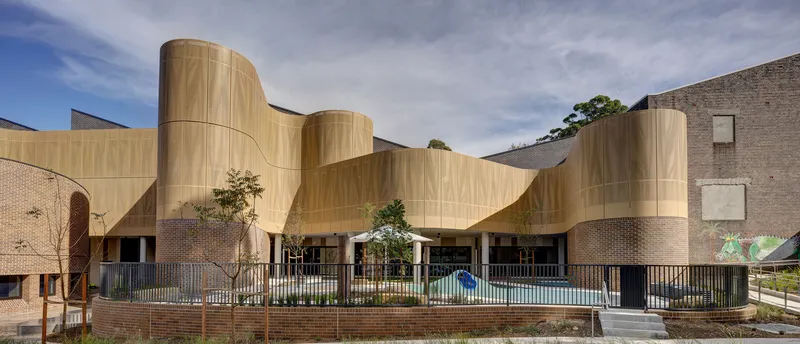

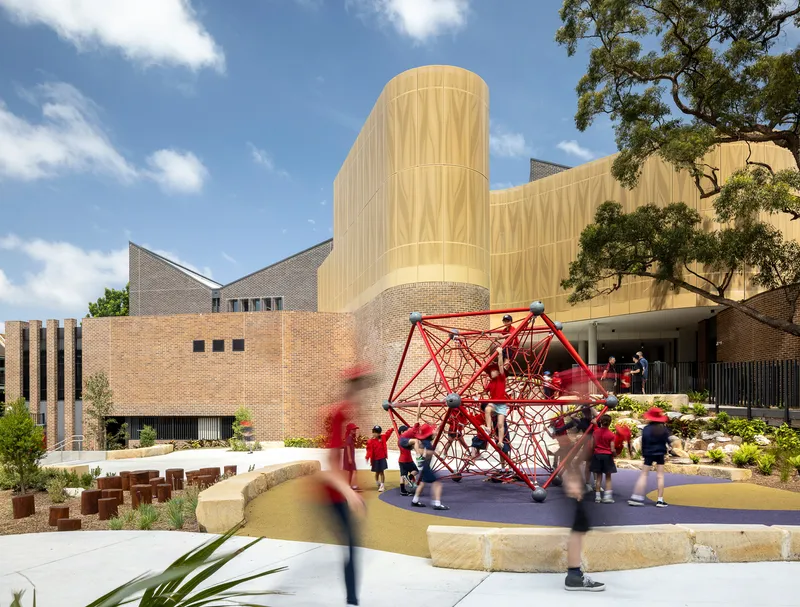
Between the building volumes, a large protected courtyard gathers the campus together. Play equipment, climbing structures, a basketball court, rest areas, decks, and shortcuts all occupy this shared ground. The courtyard is adjacent to the school hall and benefits from the shade of mature trees retained on site. Cylindrical tower forms punctuate the roofline above, giving the courtyard a sense of enclosure without making it feel boxed in.
The design of these outdoor spaces is not incidental. Garden play areas and terraces double as outdoor learning environments, echoing what the architects describe as traditional Indigenous learning spaces where knowledge is exchanged in the open air. A Covered Outdoor Learning Area (COLA) sits alongside the community hall and library, making these facilities usable for after-hours community events as well as daily instruction.
Learning Hubs: Active, Quiet, Collaborative, Withdrawn

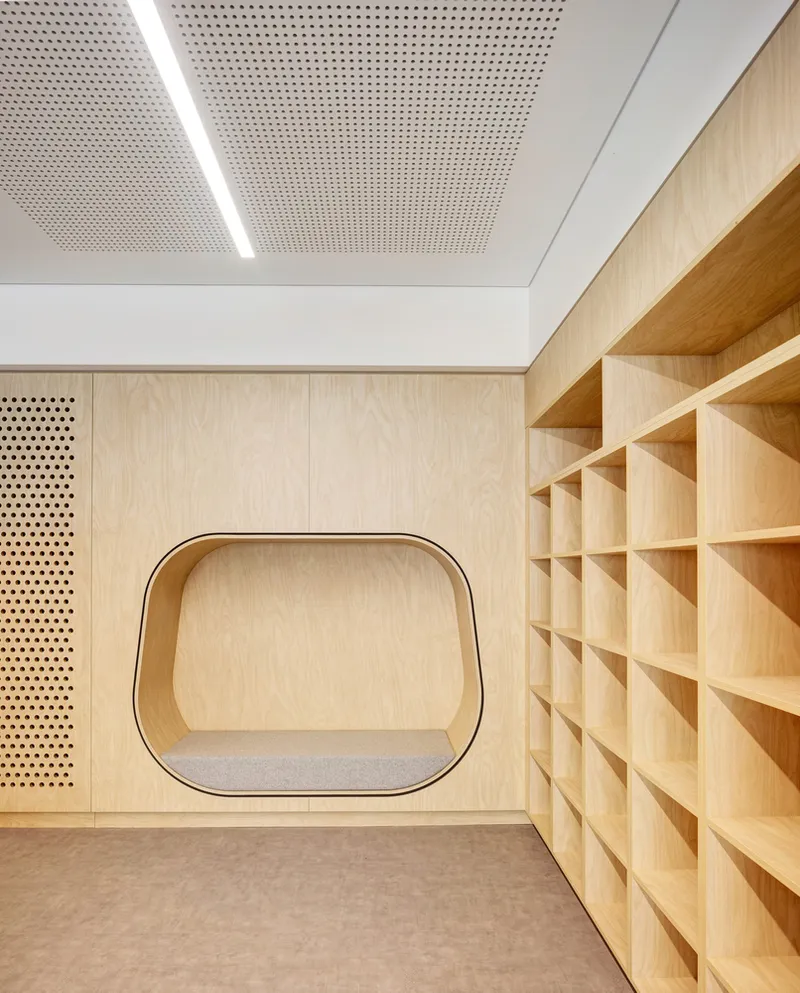

Developed with educational consultants New Learning Environments, the interior learning hubs are designed to support four modes of engagement: active learning, quiet focused work, collaborative or instructional learning, and withdrawal. Rather than defaulting to the open-plan classroom that has become a lazy shorthand for progressive pedagogy, fjcstudio created distinct spatial characters within each hub. Light timber cabinetry, high clerestory windows, and pale plywood shelving with rounded nooks give each area its own atmosphere.
Perforated white acoustic ceilings span the rooms, and timber ceiling fans supplement natural ventilation. Yellow built-in storage niches and island benches organize the plan without rigidity. These are rooms that can be rearranged without renovation, which is the real test of whether a school is designed for children or for photographs.
Library, Hall, and the Threshold Between Indoor and Outdoor
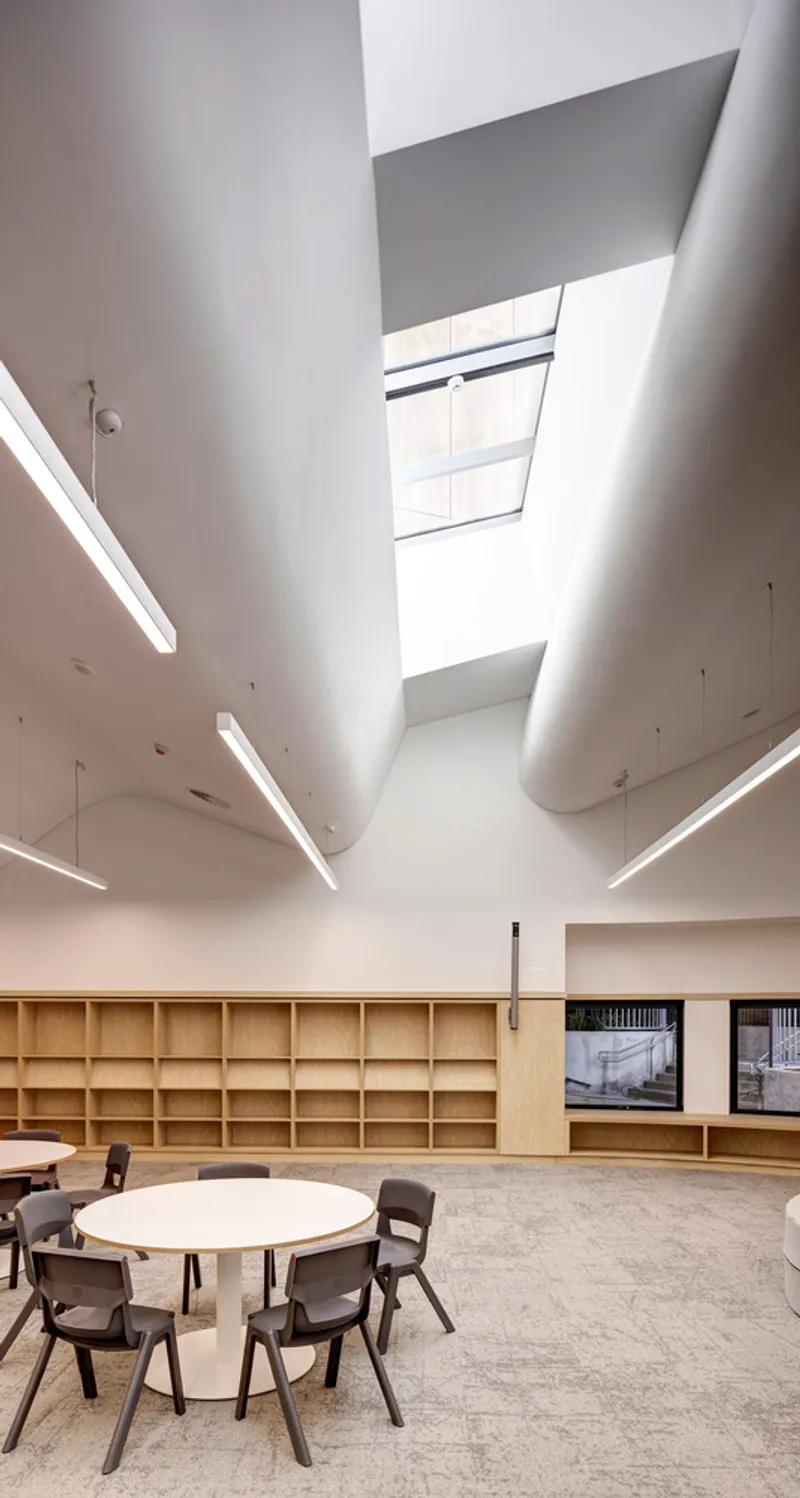
The library functions as the school's hearth: an educational gathering point that links the built form to the outdoor garden. It is a double-height space with skylights, built-in shelving, and suspended linear lighting. The proportions are generous for a primary school, signaling that reading and research are given the same spatial dignity as sport and assembly.
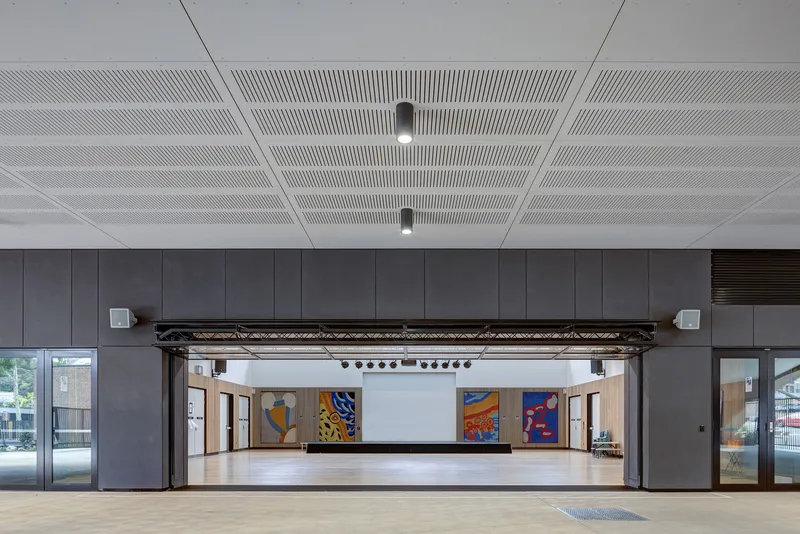
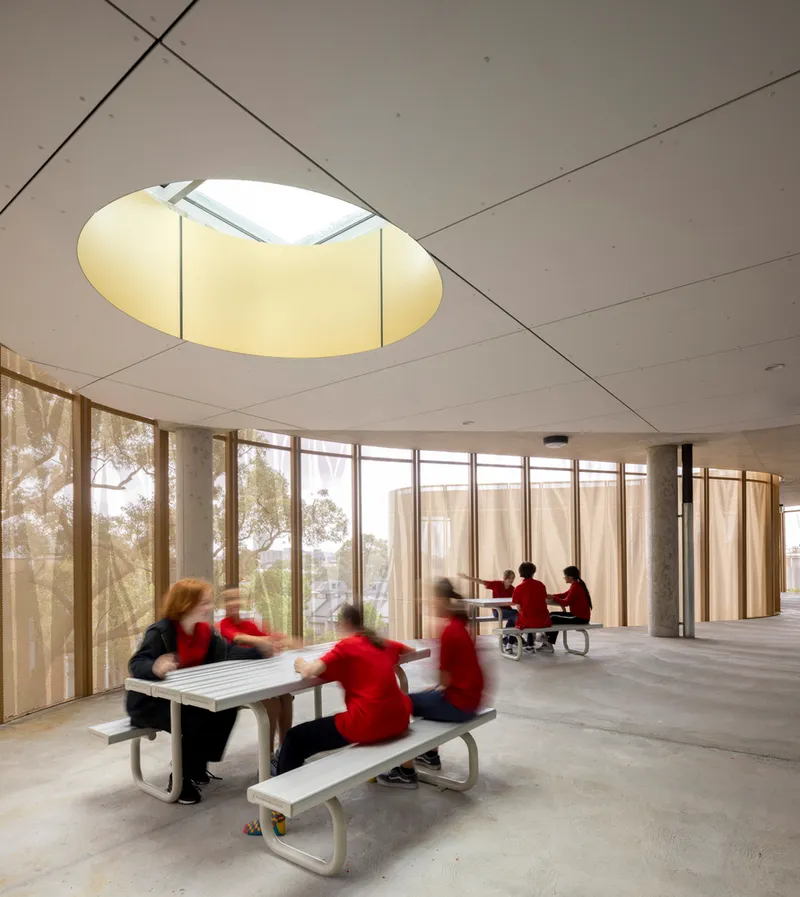
The multipurpose hall is fitted with a raised stage, grey panelled acoustic walls, and track lighting, capable of hosting performances, assemblies, and community events. Elsewhere, a common space with a circular skylight acts as a social crossroads. Students cluster at bench tables beneath the oculus, and the quality of light overhead turns a corridor intersection into a destination.
Indigenous Memory Embedded in the Fabric
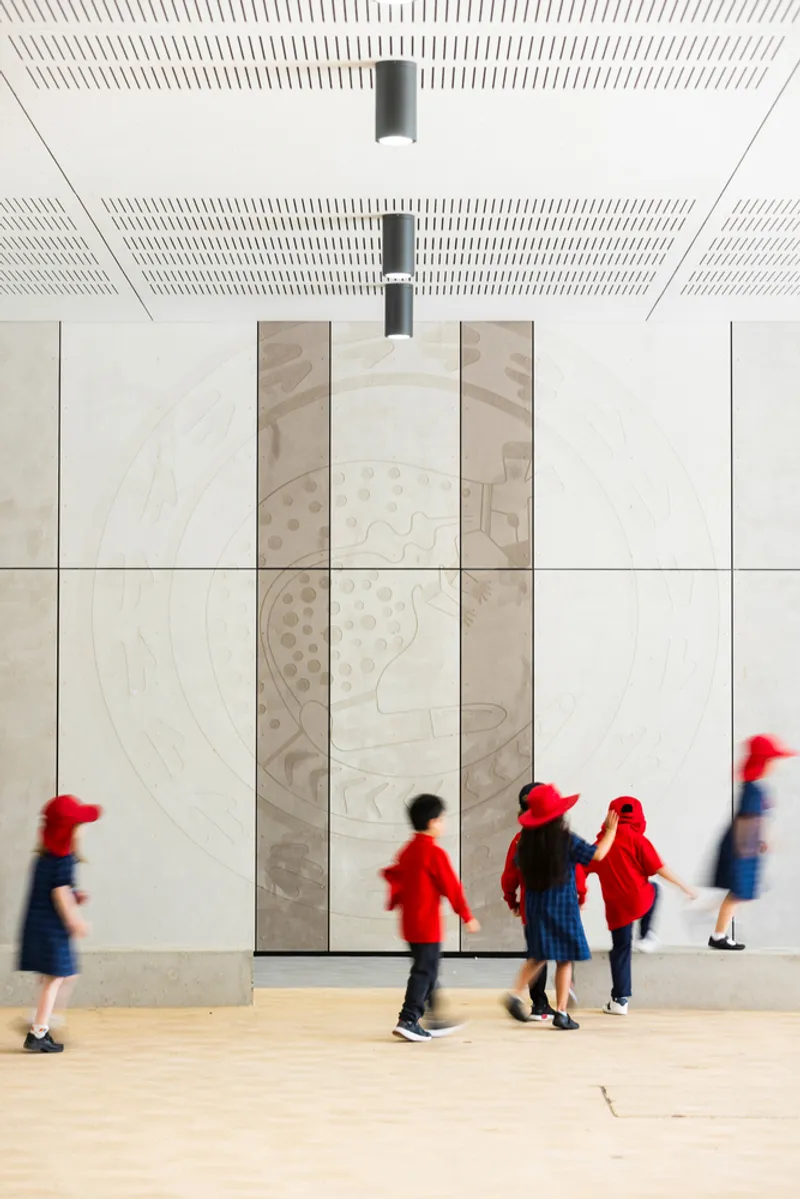
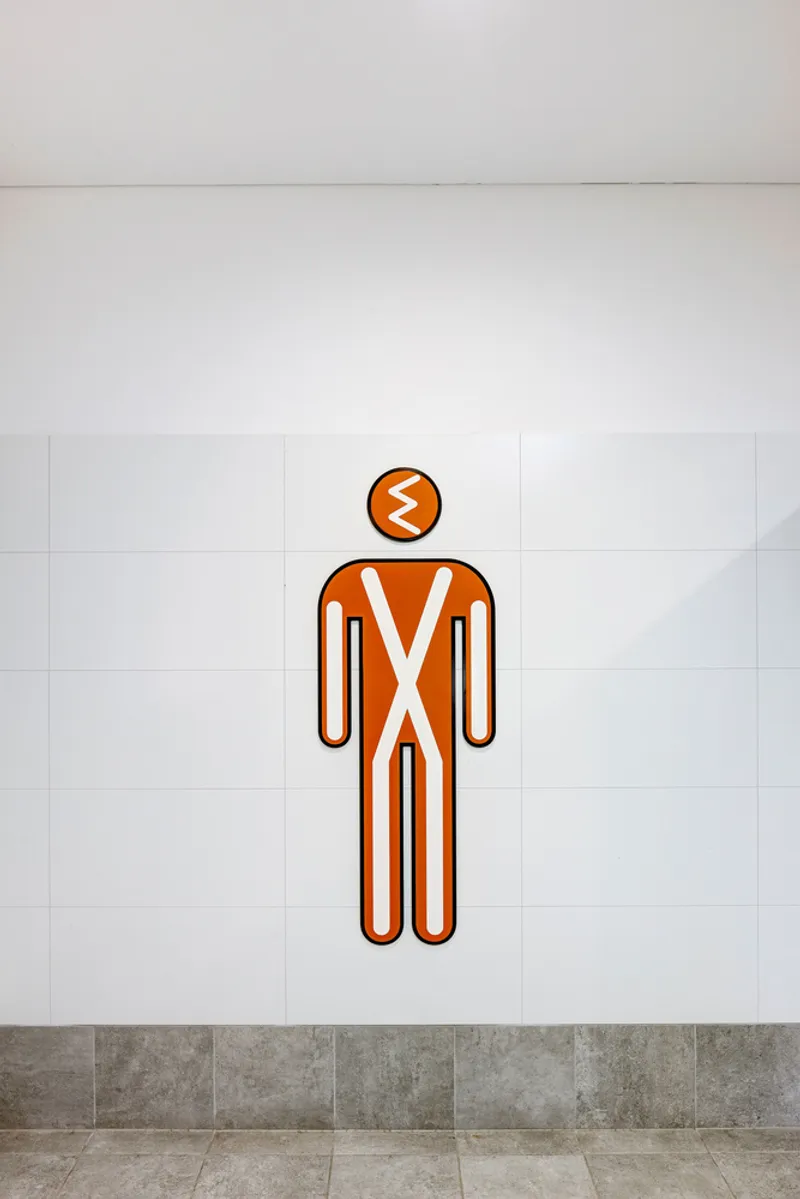
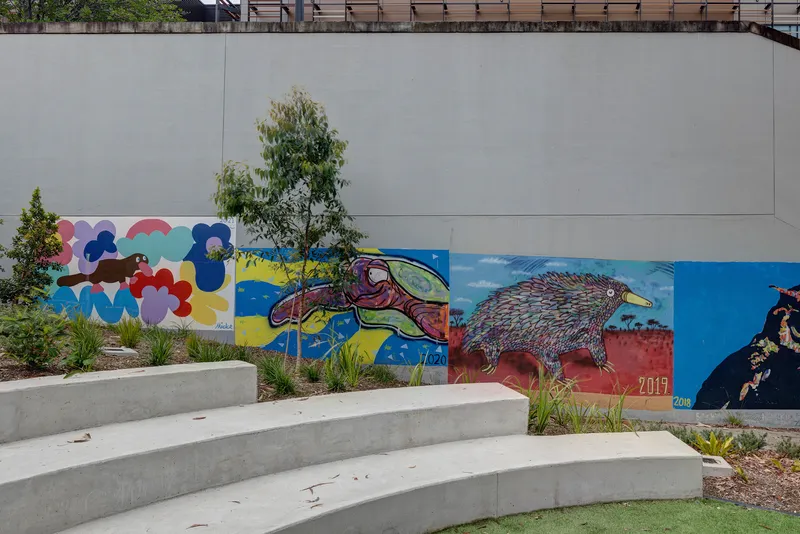
The integration of First Nations culture goes beyond token gestures. When the 1975 building was demolished, murals on its walls were photographed and reproduced in the new campus's cladding. Works by Aboriginal artists Blak Douglas and Neil Thorne, including carved plywood wall panels with Indigenous motifs and totems, are woven into the architecture as cultural markers rather than afterthoughts. QR codes placed throughout the campus allow students and visitors to access the stories behind each artwork, creating an ongoing curatorial framework that can evolve over time.
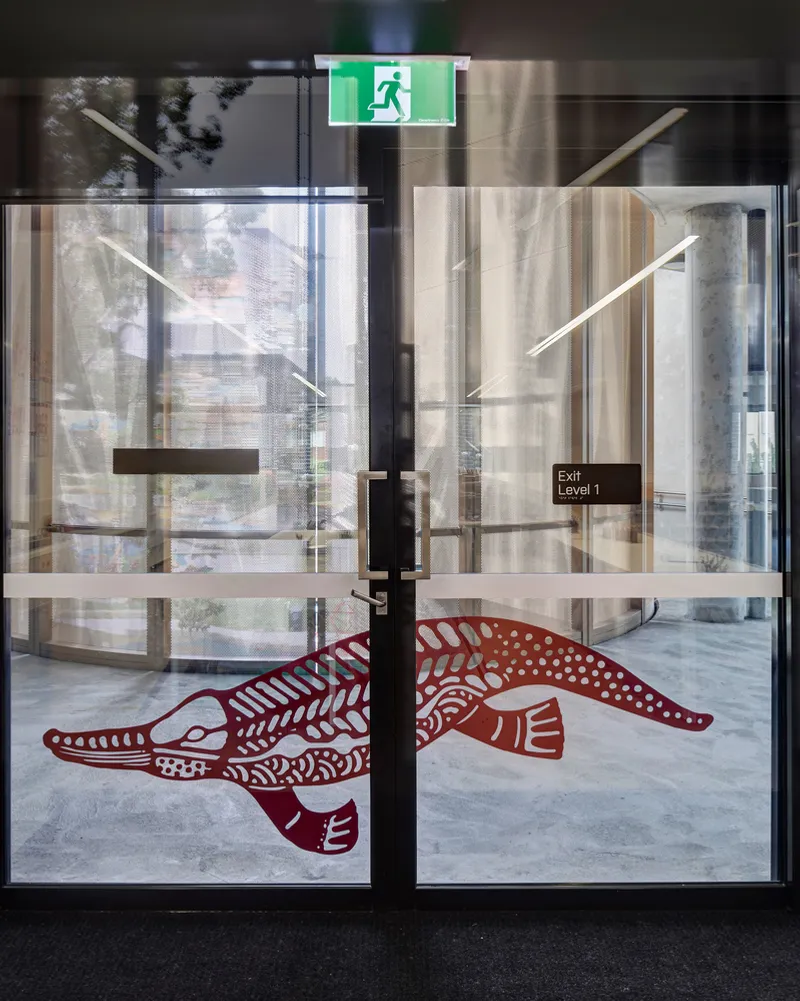
Engraved metal floor strips, glass door decals featuring native animals, and a mural wall with Indigenous figures on outdoor seating steps all reinforce a layered narrative. The school is located on Gadigal Country, the traditional land of the Gadigal people of the Eora Nation, and the design takes that fact seriously: not as a plaque at the entrance but as a spatial and material commitment running through the entire campus.
Circulation and Entry Sequences
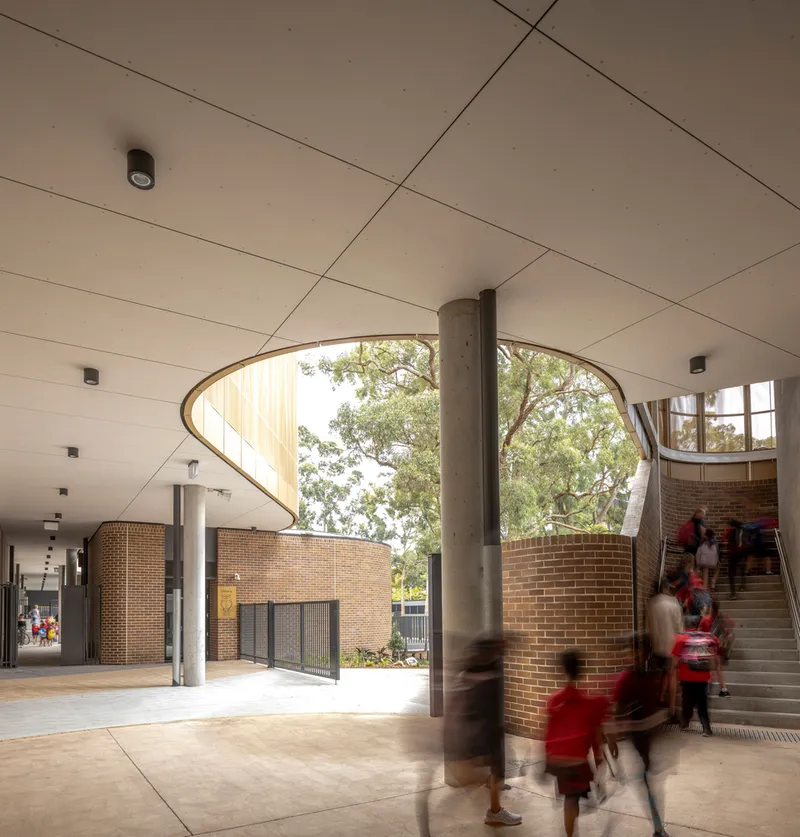
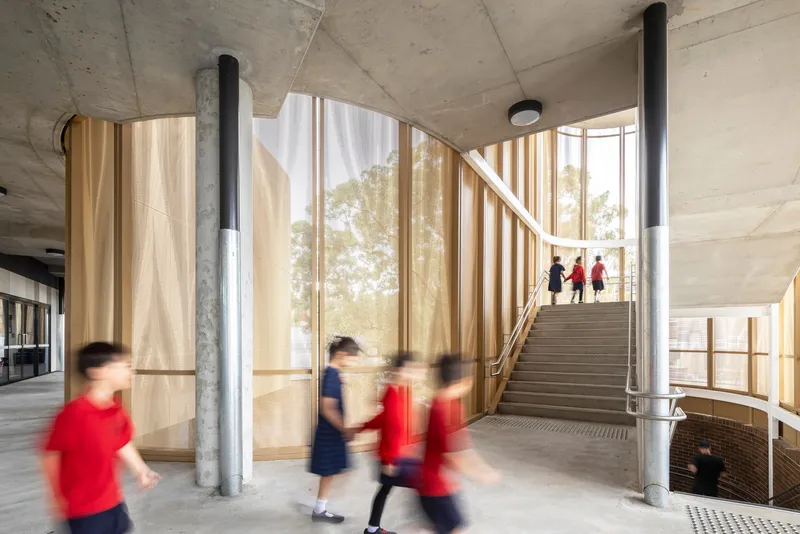

Movement through the school is considered with care. The covered entry hall, with its panelled ceiling, concrete columns, and staircase, channels students through a compression point before releasing them into the courtyard and learning hubs beyond. Curved timber-clad walls line concrete staircases, softening what could be utilitarian transitions. Engraved metal threshold strips mark the junctions between concrete and polished floor surfaces, turning material changes into moments of notice.
Pathways and shortcuts connect building volumes through the landscape, making the campus feel like a small village rather than a single building. The curvilinear screen defines these outdoor circulation routes as much as the buildings themselves, creating fluid movement between indoor and outdoor zones.
Plans and Drawings


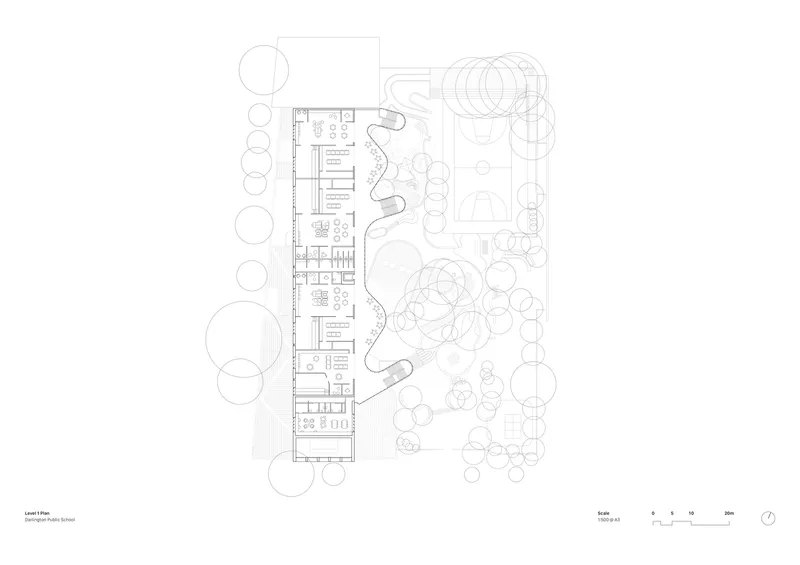
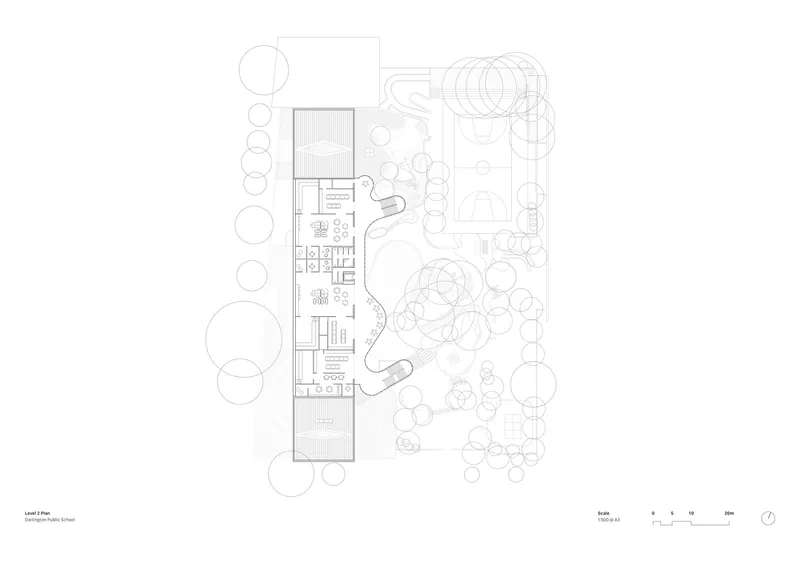


The site plan reveals how three separate building volumes are arranged around the central courtyard, connected by curved landscaped pathways and the continuous perforated screen. The ground floor plan shows the library, hall, and learning hubs organized along linear spines, while upper-level plans feature a curved circulation spine linking rooms to gardens. The elevations are the clearest record of the sawtooth roof strategy: profiles step down from the taller hall volume to lower classroom blocks, with clerestory glazing bands running between each pitch to capture north light.
What the drawings make plain is that the curves are not decorative. The screen walls trace paths that children actually walk, creating covered outdoor zones that expand and contract in width. The landscape is not leftover space between buildings; it is the connective tissue that holds the campus together.
Why This Project Matters

Darlington Public School matters because it demonstrates that a government-funded primary school can be simultaneously rigorous in its passive design, deeply respectful of Indigenous culture, and genuinely flexible in its pedagogy, without any of those ambitions diluting the others. Over 70% natural ventilation in teaching spaces, high thermal mass brick construction, and rainwater harvesting are not aspirational targets here; they are delivered outcomes. The two-stage construction strategy kept students on site throughout, proving that complex builds can be managed without displacing the community they serve.
Too many school projects treat cultural engagement as a mural commission and sustainability as a solar panel on the roof. fjcstudio has woven both into the spatial logic of the campus itself: in the screens that filter light and reference casuarina trees, in the outdoor terraces that echo Indigenous learning traditions, in the QR-coded artworks that turn walls into living archives. It is a model not because it asks to be copied, but because it shows what becomes possible when architects, educators, and community are given the latitude to design a school from first principles.
Darlington Public School, designed by fjcstudio, Darlington (inner Sydney), Australia, completed 2023. Photography by Anthony Fretwell and Brett Boardman.
About the Studio
Share Your Own Work on uni.xyz
If projects like this are the kind of work you want to make, uni.xyz is a place to publish your own, find collaborators, and enter design competitions.




Popular Articles
Popular articles from the community


The Earth Pod: 3D Printed Homes for Resilient Refugee Communities
The Earth Pod reimagines refugee housing through 3D printed homes made from clay, combining resilience, self-sufficiency, and rapid shelter.
AL-JANNAH: Sustainable Architecture and Permaculture for Afghan Widows
AL-JANNAH uses sustainable architecture and permaculture to create resilient oasis of housing, learning, work and renewal for Afghan widows.

Co-life: Sustainable Architecture for Age-Friendly Community Living
Co-life reimagines sustainable architecture for seniors through courtyards, rammed earth, shared gardens, and spaces designed for belonging.

The Ocean Hive: Sustainable Architecture for a Self-Sufficient Civilization at Sea
The Ocean Hive imagines sustainable architecture at sea, where modular habitats, algae, wave power and ocean waste sustain a growing colony.

Similar Reads
You might also enjoy these articles


Hodi-Mandai Geram
Project Function: Preservation and revitalization of the Intangible heritage and socio-spatial identity of the Hodi by Housing, Cultural Memory Center, Sacred Grove, landscape, local tourism economy


Olio Towers: A Mid-Rise for Performers That Fuses Housing, Rehearsal, and Stage
Located blocks from Houston's Theater District, this modular tower stacks living units around a central performance atrium.

Oasis: Modular Green Housing Carved into Dhaka's Urban Fabric
A shortlisted Plugin Housing entry reclaims unauthorized settlements in Dhaka with stepped concrete volumes, green roofs, and ventilation-driven design.

Black Hole: A Floating Megastructure for the Post-Physical Era
Emiliano Mazzarotto envisions a spherical, self-scaling arena where e-sports, digital hotels, and holographic stadiums replace traditional public space.


Explore Architecture Competitions
Discover active competitions in this discipline



Challenge to reimagine the Iron Throne


Photograph architecture without architects


Illustrate the lost glory of Angkor Wat - Render Challenge


Design challenge to reuse E-waste
Comments (0)
Please login or sign up to add comments
No comments yet. Be the first to comment!