

Data Liberalism: Translucent Domes for a Society Organised by Information
Ding Ruoyu reads Homo Deus as a design brief, proposing translucent domes where data shapes space but leaves room for human unpredictability.


In an era increasingly defined by algorithms, data exchange, and digital ecosystems, architecture is undergoing a fundamental transformation. The emergence of data-driven architecture signals a shift from static built environments to adaptive, responsive spatial systems. The project Data Liberalism, conceptualized by Ding Ruoyu, draws inspiration from the philosophical framework outlined in Homo Deus: A Brief History of Tomorrow, proposing a future where data becomes the central organizing force of society and, consequently, architecture.
This futuristic public architecture concept investigates how built environments might evolve when data is treated as a primary resource, shaping spatial organization, human interaction, and environmental integration.
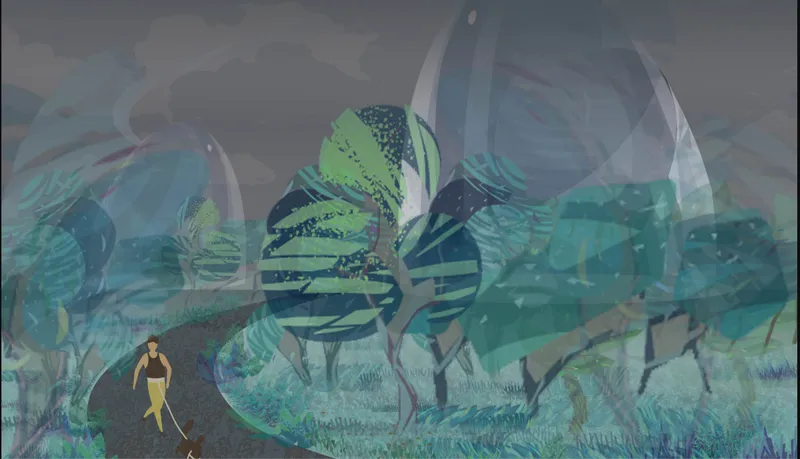
Concept: From Humanism to Data Liberalism
Historically, societal structures have evolved from religious frameworks to human-centered liberalism. Today, the rise of data-centric ideologies introduces a new paradigm often described as data liberalism, where information flow becomes more valuable than individual agency.
The project translates this ideological shift into architecture through a layered conceptual framework:
- Past: Religion-driven spatial hierarchies and symbolic structures
- Present: Human-centric urbanism focused on accessibility and experience
- Future: Data-centric environments governed by transparency, connectivity, and continuous feedback loops
Rather than eliminating human values, the concept proposes a hybrid model where data enhances decision-making while preserving human agency.
Logical Framework and Spatial Intelligence
The logical diagrams in the project reveal a networked system where architecture behaves like an intelligent organism. Nodes represent key societal elements such as privacy, transparency, efficiency, and unpredictability.
This network establishes a tension between two conditions:
- WOE (World of Emptiness): A scenario where excessive data control leads to loss of human spontaneity
- WEAL (World of Abundance): A condition where data sharing improves efficiency, accessibility, and collective benefit
The architecture operates within this spectrum, aiming to balance computational precision with human unpredictability. Spaces are designed to accommodate both calculated processes and moments of randomness, ensuring that creativity and emotional experience are not eliminated.
Architectural Form and Spatial System
The formal expression of the project emerges from abstracting data structures into spatial geometries. The design evolves through a series of transformations:
- Simplified geometric forms representing data units
- Networked clusters mimicking neural systems
- Aggregated spatial volumes forming enclosed ecosystems
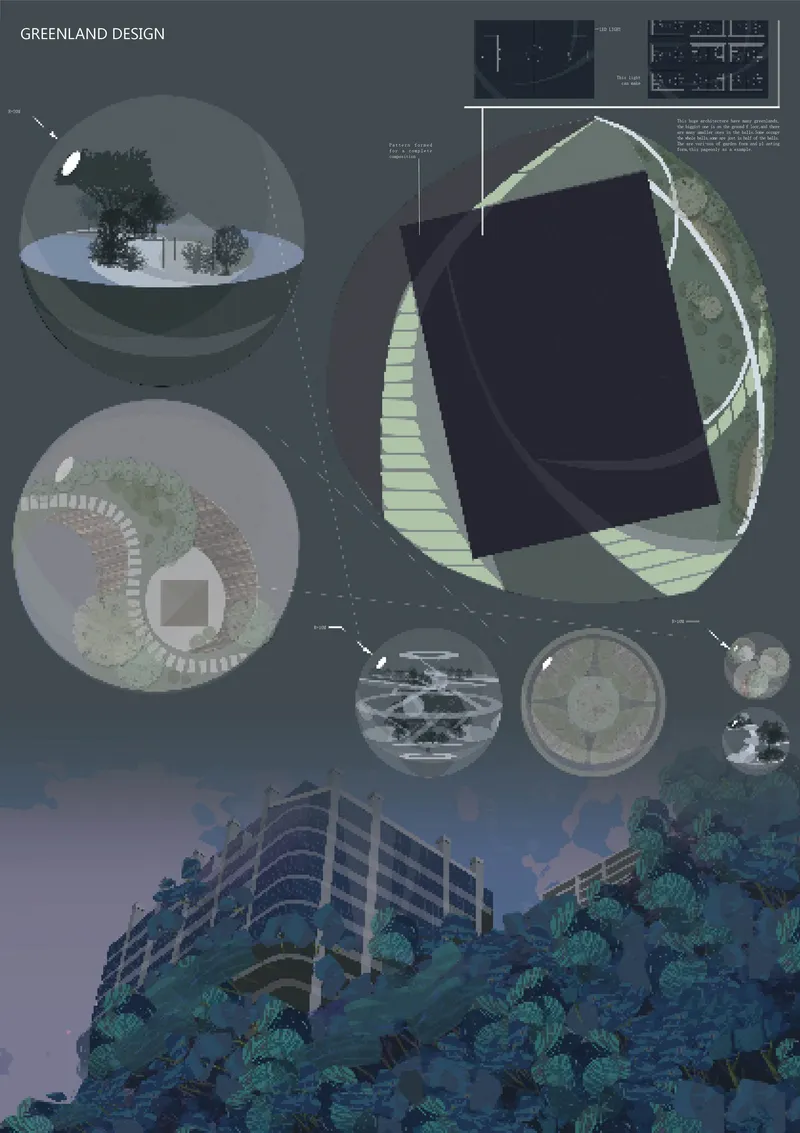
The result is a series of dome-like, translucent structures embedded within a natural landscape. These enclosures function as self-contained environments where data continuously informs spatial conditions.
Key architectural features include:
- Adaptive envelopes: Transparent shells that respond to environmental and data inputs
- Central data cores: Internal hubs that process and redistribute information
- Modular spatial clusters: Flexible units that reorganize based on usage patterns


Programmatic Strategy
The project proposes a hybrid public architecture integrating multiple functions within a data-responsive system:
- Library: A knowledge hub where information is dynamically curated and personalized
- Supercomputer core: The central processing unit managing data flows
- Transportation node: Seamless mobility systems guided by real-time data
- Public interaction spaces: Areas encouraging social exchange and collective experience
These programs are not fixed but evolve based on user behavior and data analytics, creating a continuously adapting environment.
Landscape Integration and Ecological Interface
A defining aspect of the proposal is its integration with the natural environment. The architecture does not dominate the landscape but coexists with it through controlled ecological systems.
The domes act as microclimates, preserving vegetation and biodiversity while allowing human occupation. This approach reflects a future where architecture becomes a mediator between technology and ecology rather than a disruptive force.
The Greenland design strategy further reinforces this relationship by embedding greenery within and around the structures, creating layered environmental systems that respond to both climatic and data-driven parameters.
Structural Logic and Technical Resolution
The general layout plan reveals a highly organized yet fluid spatial system. Circular geometries dominate, reflecting efficiency in distribution and connectivity.
Key technical aspects include:
- Radial planning for optimized circulation
- Layered structural shells for insulation and adaptability
- Integrated data infrastructure embedded within architectural elements
Elevation studies demonstrate how the structure accommodates both vertical and horizontal movement, supporting diverse programmatic requirements while maintaining spatial coherence.
Human Experience in a Data-Centric Environment
Despite its technological foundation, the project emphasizes human experience. The architecture is designed to remain intuitive, immersive, and emotionally engaging.
Users interact with spaces that subtly adapt to their needs without becoming intrusive. The balance between visibility and privacy is carefully calibrated, ensuring that data enhances rather than controls human life.
Moments of unpredictability are intentionally preserved, allowing users to experience discovery, surprise, and creativity within an otherwise optimized system.
Data Liberalism by Ding Ruoyu presents a compelling vision of futuristic architecture shaped by the principles of data flow and computational intelligence. By integrating technology, ecology, and human-centered design, the project challenges conventional notions of public architecture.
Rather than offering a deterministic future, it proposes a nuanced model where data and humanity coexist in a dynamic equilibrium. This approach positions architecture not just as a physical construct but as an evolving interface between people, technology, and the environment.
As cities continue to evolve in response to digital transformation, concepts like data-driven architecture will play a critical role in shaping the built environment of tomorrow.



Popular Articles
Popular articles from the community


ETEH Reworks the Shared Spaces of São Domingos School in Brazil Around Timber, Color and Hanging Plants
At São Domingos School in Brazil, 436 m² of hall, refectory and library are recast with timber joinery, a yellow and blue code and trailing greenery.

Cube Design Draws an Ecological Corridor Between Two Shenzhen Hills with the Nankai Building
Beside Shenzhen's container docks, the Nankai Building pairs stacked balconies with a climbing green screen to connect two hillsides across its height.


Manzana Morphosis: Stretching Barcelona's Grid into a Living Landscape for 2050
A radical reworking of the Eixample manzana turns density into a tool for generous public space, vertical ecology, and environmental performance.

Aquadapt: An Underwater Habitat That Rewrites Its Rooms by the Hour
Curved modules ring the seabed while one shell shifts from breakfast room to cinema, farm and football pitch as residents' needs change.

Similar Reads
You might also enjoy these articles
Healing Façade: A Modular Chapel System That Restores Ethiopia's Sacred Forests
Winner of the Eco-Chapel competition, this circular timber façade collects water from air to rebuild soil and reforest degraded Ethiopian landscapes.
Kaffeebühnen: Where Coffee Shop Architecture Becomes a Civic Stage in Vienna
A linear sequence of timber boxes, transparent shells, and open yards turns the Viennese café tradition into a public performance space.
Eco Chapel: A Modular Forest Pavilion That Grows Like the Landscape It Protects
Hexagonal timber modules weave through existing trees, turning a chapel into a living system for prayer, education, and reforestation.


Urban Forest: A Vertical Ecosystem for 5,000 Workers in Singapore's Changi Business Park
Radially stacked pods and layered green decks turn a 7-acre plot into 47 acres of ecological workspace projected for 2040.

Comments (0)
Please login or sign up to add comments
No comments yet. Be the first to comment!