
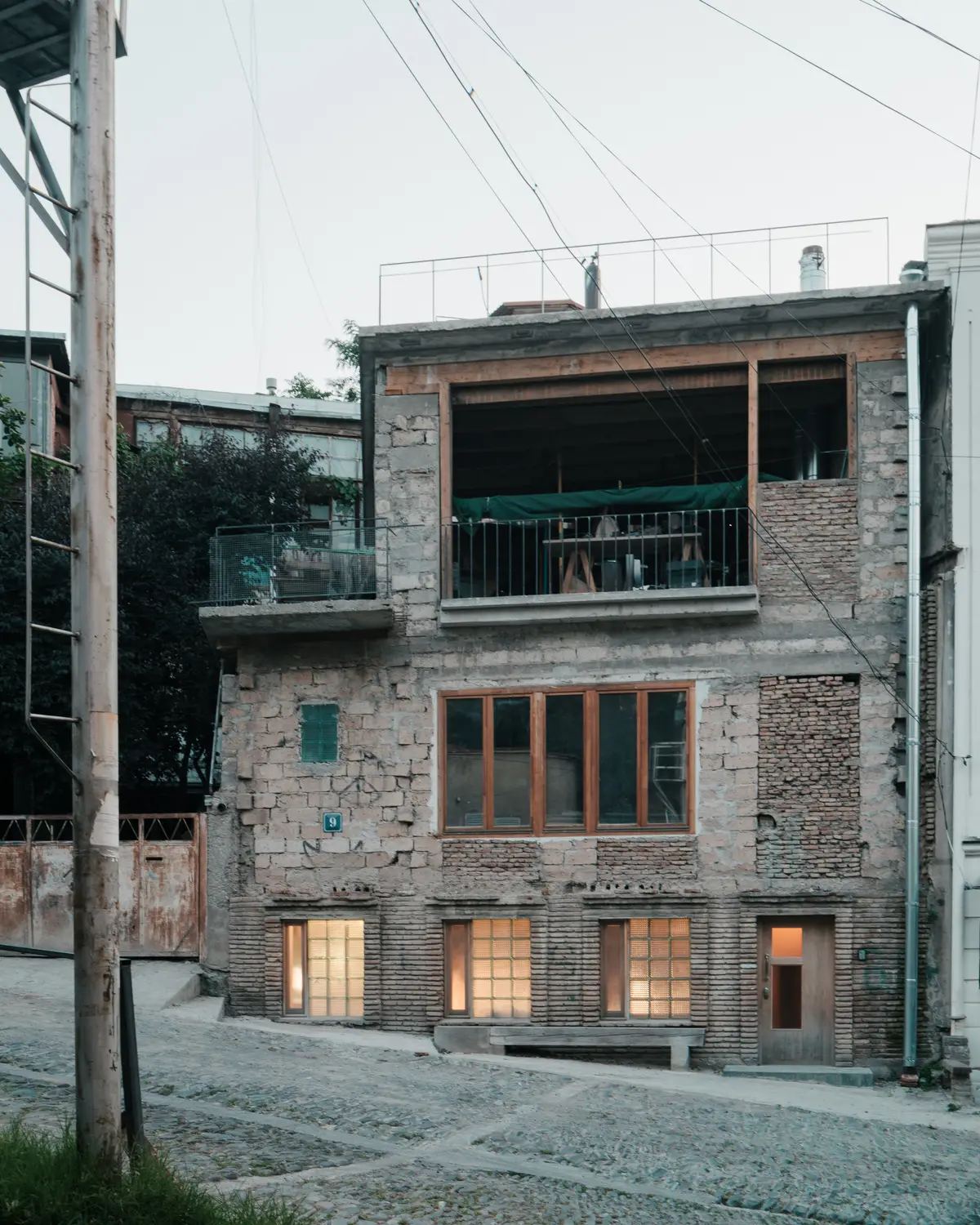
David and Alexander Brodsky Reassemble a Tbilisi Ruin into the Unfinished House
A family home in Tbilisi's historic district rebuilt from its own ruins using Soviet-era glass bricks, local stone, and collective labor.


Call it urban mining, call it radical salvage, call it what you want: the Unfinished House in Tbilisi is a building that refuses to pretend it started from scratch. Designed by David Brodsky and Alexander Brodsky, this 309 m² family home occupies a site in the city's historic district where a structure has stood since the 1920s. Rather than demolishing what remained and starting over, the Brodskys gathered the debris of the previous building and its neighborhood, then reassembled those fragments into something that reads less like a finished object and more like a process caught mid-stride.
What makes the project genuinely interesting is that incompleteness is not a flaw here but an organizing principle. The house draws on the tradition of Tbilisi's baniani houses, flat-roofed dwellings that expand incrementally as families grow and resources allow. Students, friends, and local craftspeople all contributed to the design's evolution, making the building a record of collective authorship rather than a singular vision imposed on a site. The result is a three-story residence that wears its history on every surface: handmade cement blocks sit next to Soviet-era glass bricks, corrugated metal meets exposed stonework, and local timber frames openings that feel more like discoveries than compositions.
A Facade Built from Strata
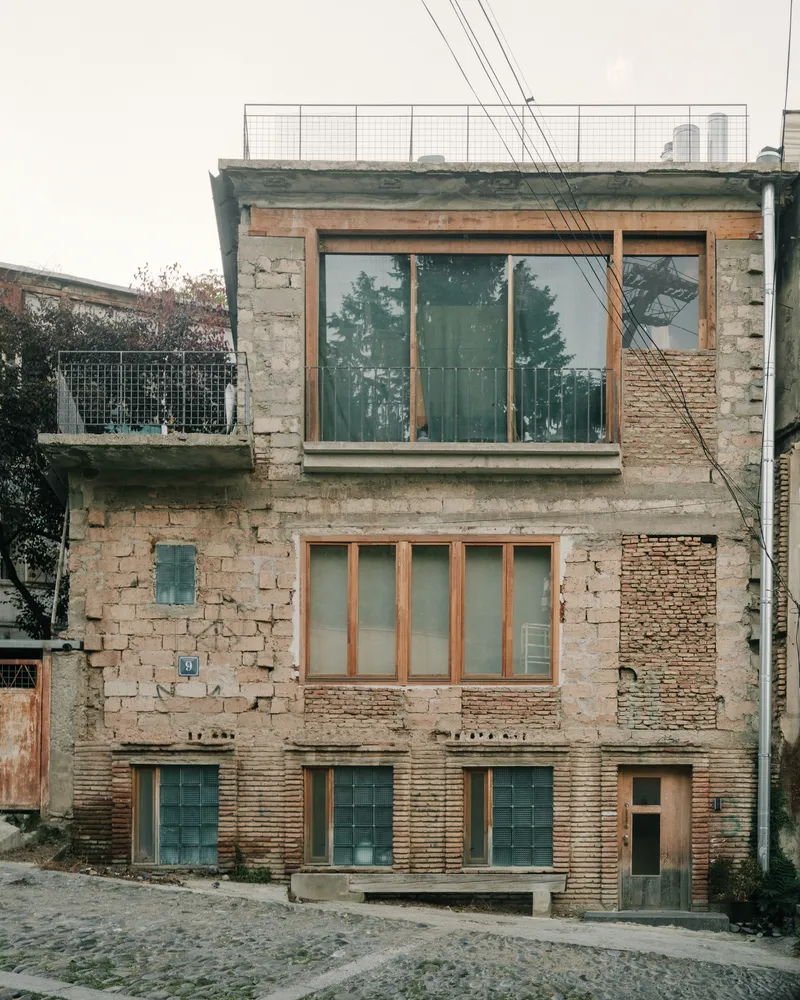
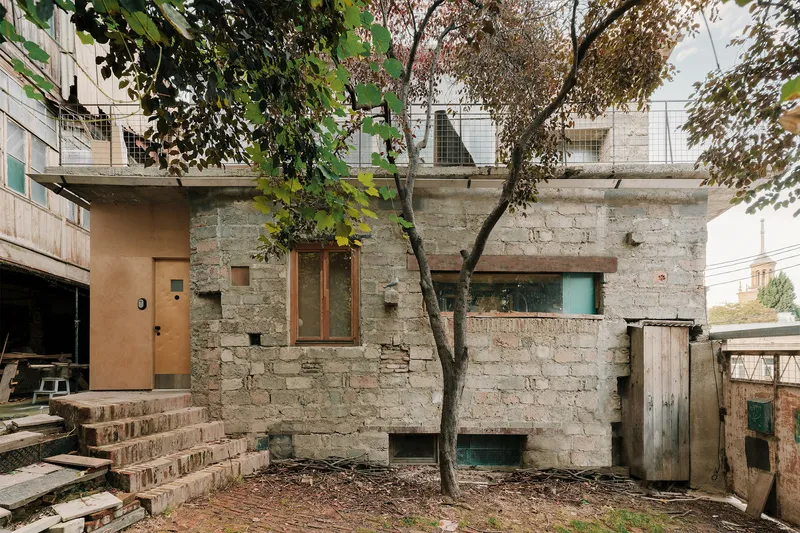
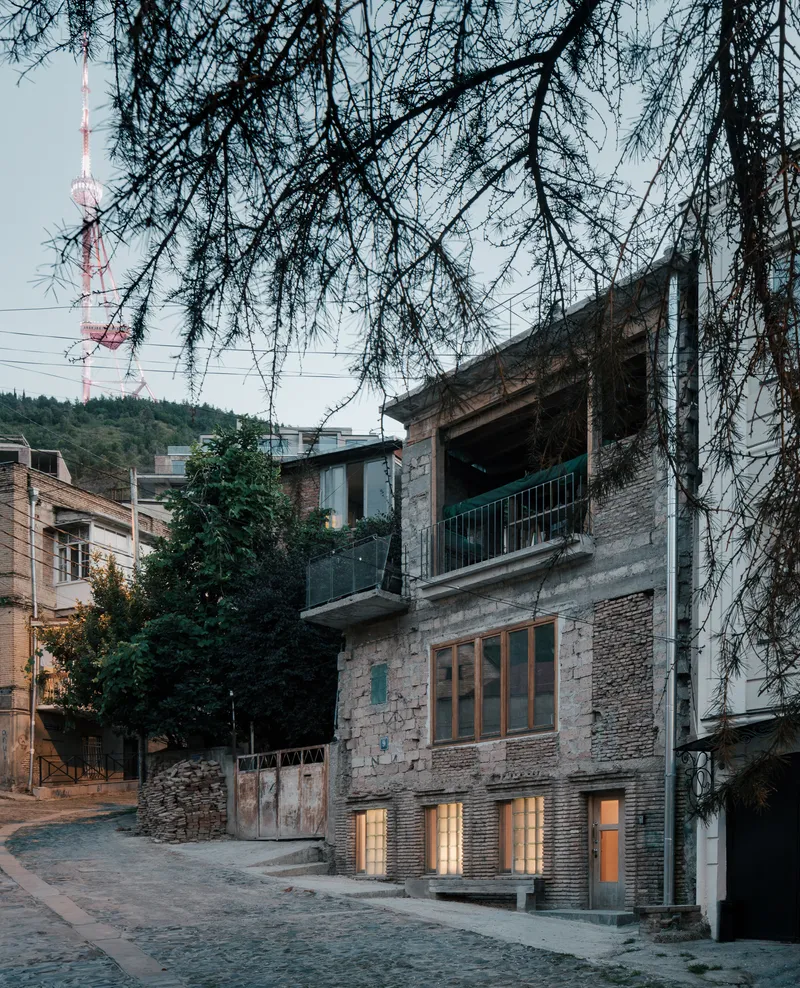
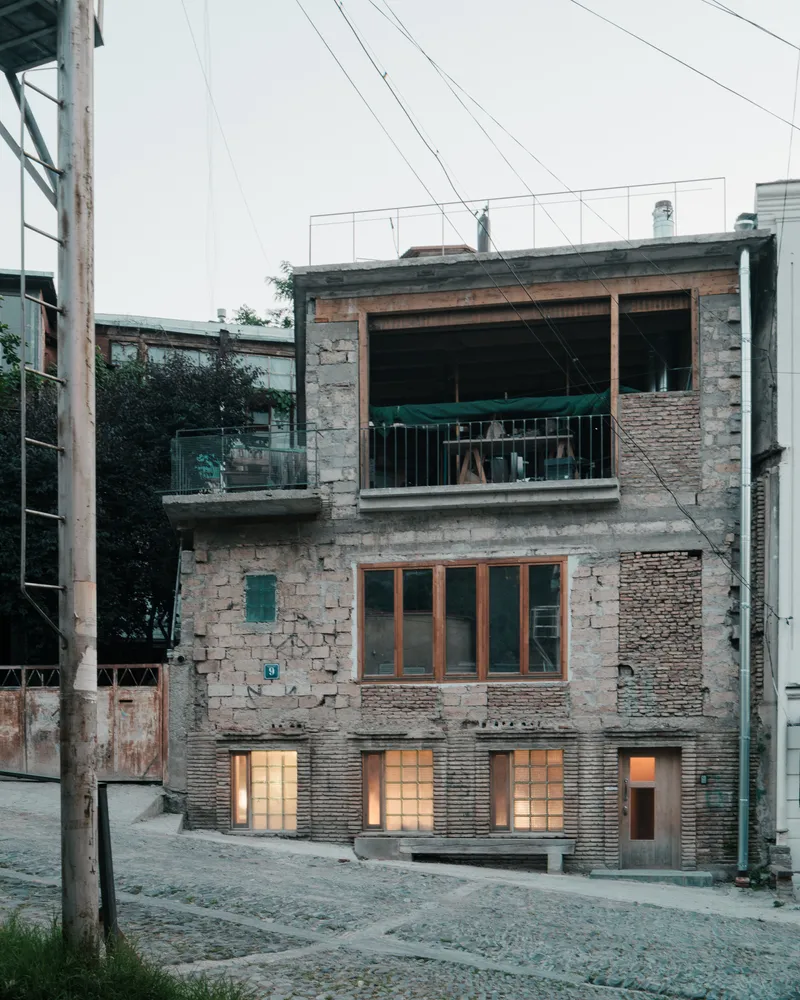
The street-facing elevations are a geological section in miniature. Stacked stone, exposed brick, concrete block, and timber fenestration pile up across three stories without any effort to reconcile them into a single material language. The facade at dusk, with its illuminated ground floor openings, makes the logic clear: the base is heavy and mineral, the upper floors lighter and more provisional. This is not a collage for its own sake. Each material corresponds to a construction campaign, a found resource, or a structural need.
A young tree in the courtyard and grapevines overhead at the entry give the building an organic frame. The house does not announce itself as architecture so much as it settles into its block like a neighbor who has always been there, albeit one who keeps renovating.
Glass Brick as Connective Tissue
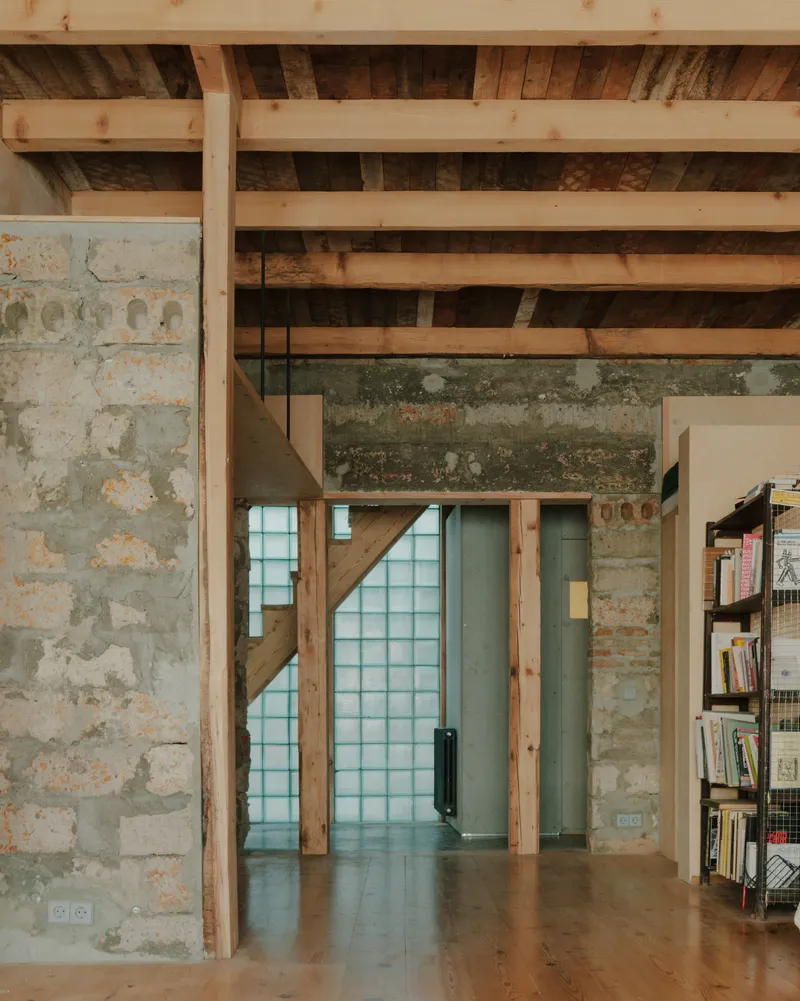
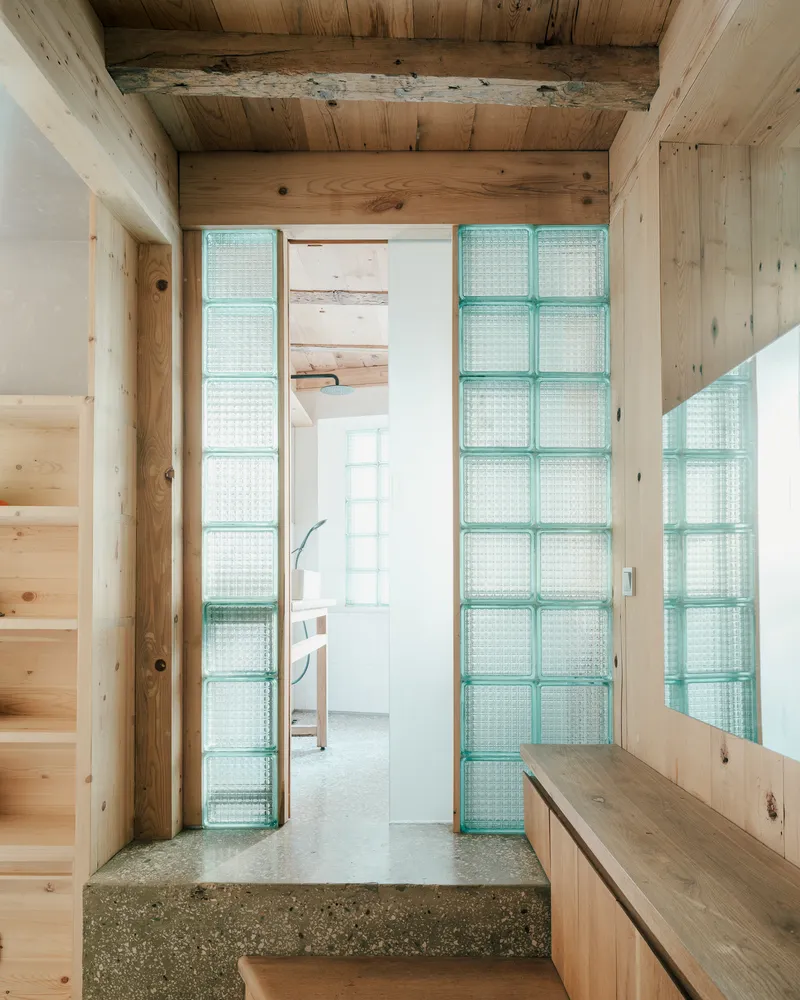
Soviet-era glass bricks appear throughout the house, serving as both structure and light filter. In the entryway, a wall of glass blocks creates a luminous threshold between the street and the interior, diffusing daylight while maintaining the solidity of a load-bearing partition. Corridors framed by these translucent walls glow in a way that softens the rough masonry around them.
The choice is significant. Glass bricks are a material with deep associations in post-Soviet space: utilitarian, mass-produced, once ubiquitous, now largely abandoned. By reintegrating them into a domestic setting, the Brodskys give them a second life without irony, using them for exactly what they do best. The blocks admit light, provide thermal mass, and carry load. No conceptual gymnastics required.
Interior Rooms Carved from Salvage
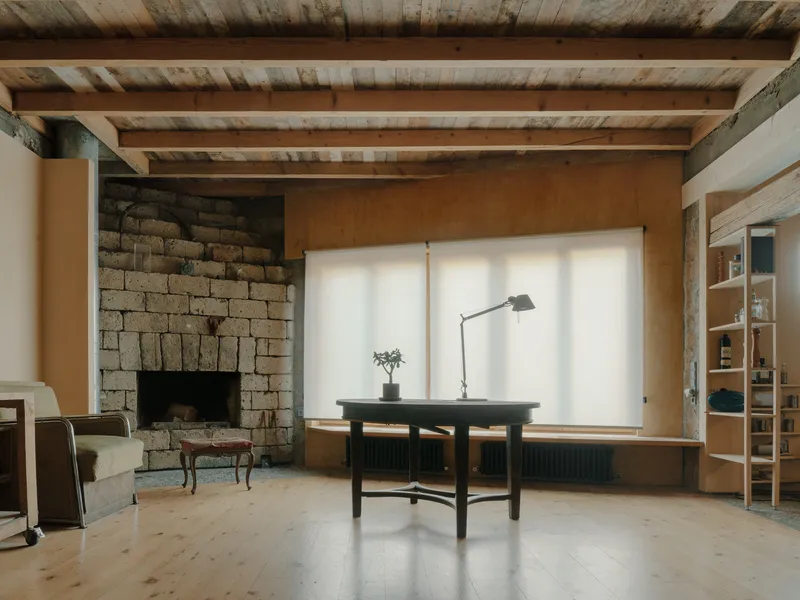
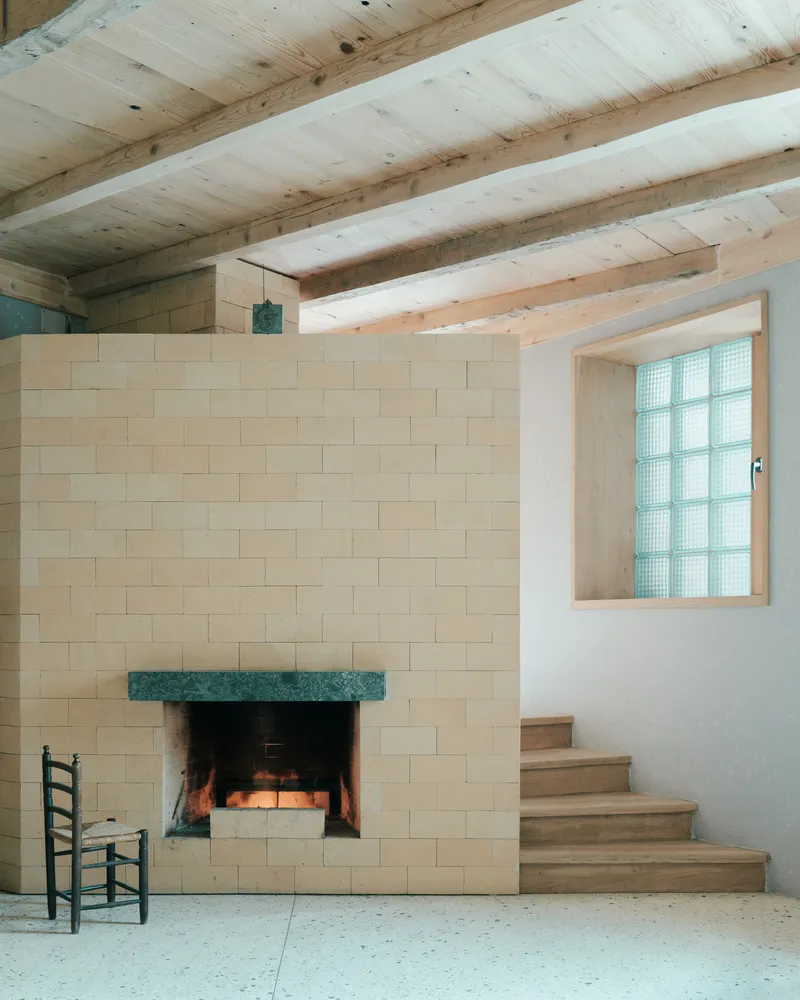
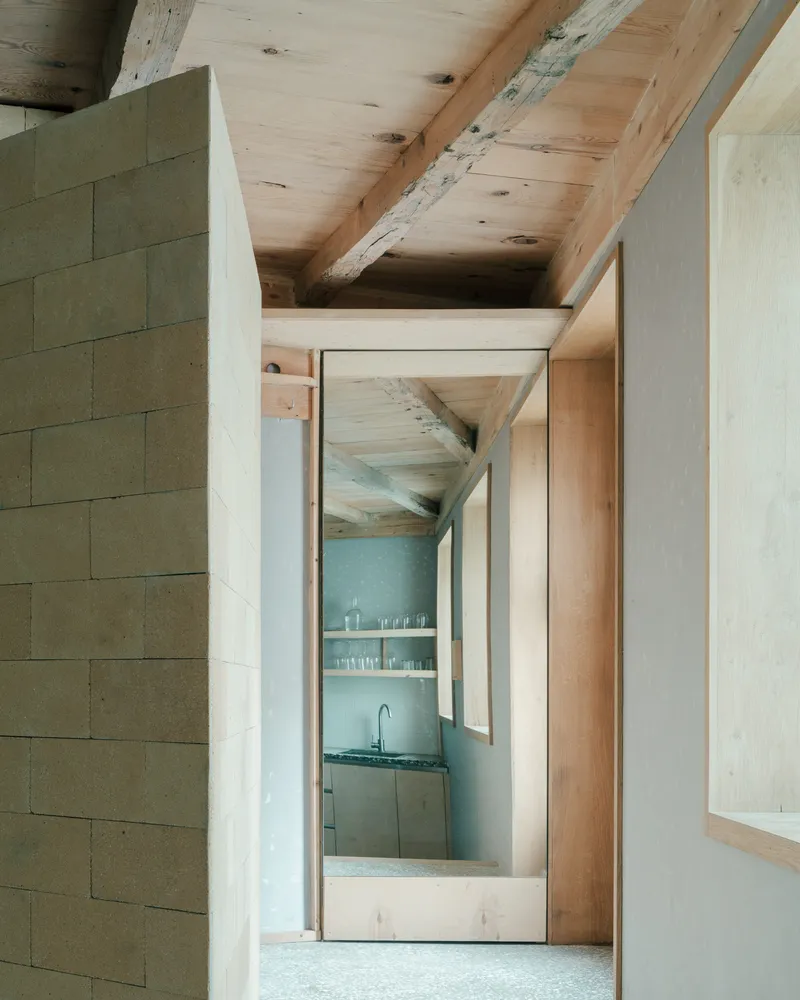
Inside, the house reads as a sequence of intimate rooms rather than an open plan. An exposed timber beam ceiling runs above a stone fireplace with a green marble mantel, the kind of detail that suggests someone found the piece and built the room around it. Walls of aged plaster and exposed masonry give every passage a depth that new construction simply cannot fake. The Brodskys seem to understand that a room gains character not from applied finishes but from the honesty of its assembly.
Doorframes are framed with timber diagonals, a structural bracing gesture that doubles as ornament. Views through the house are carefully composed: a doorway opens to a corridor, which opens to a kitchen, which opens to the city. Each threshold layers depth, and the varied wall textures keep the eye engaged without overwhelming it.
A Kitchen That Earns Its Place
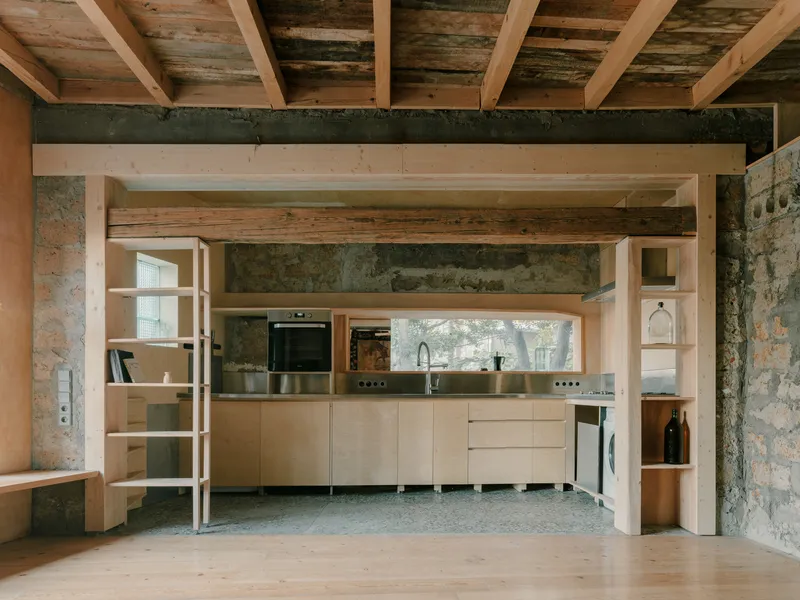
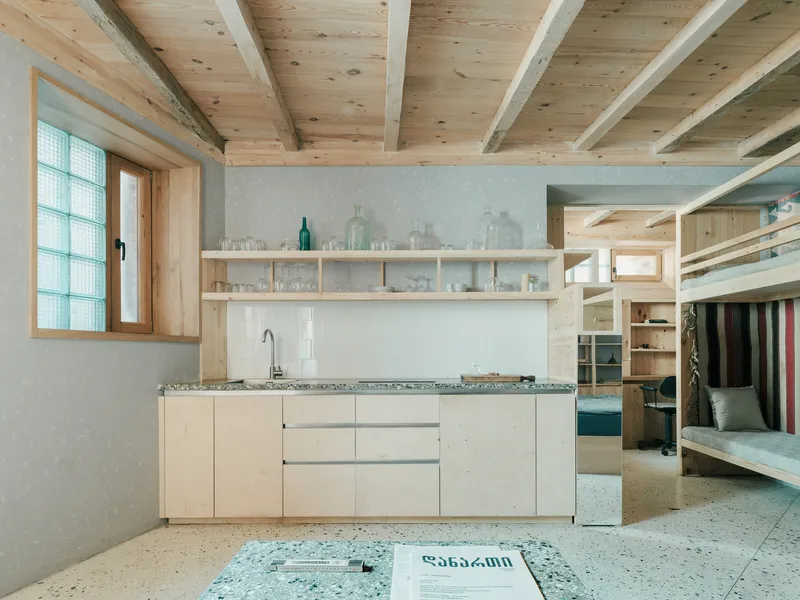
The kitchen occupies an alcove within the masonry shell, fitted out in pale plywood cabinetry that contrasts with the rawness of the surrounding walls. On the upper floor, the terrazzo floor and exposed beam ceiling give the cooking and dining space a warmth that feels lived-in from day one. There is no attempt to segregate the kitchen as a service zone; it sits at the heart of the house's social life, visible from multiple angles through the open layout of the upper level.
The plywood joinery is clean but not precious. It reads as handmade, consistent with the project's ad hoc construction ethos. The Brodskys and their collaborators, including Zurab Zaridze, Otar Galdava, Zurab Mikaberidze, and Maria Kremer, clearly understood that the kitchen needed to be functional and robust, not a showcase for expensive fittings.
The Rooftop Terrace and the Baniani Tradition
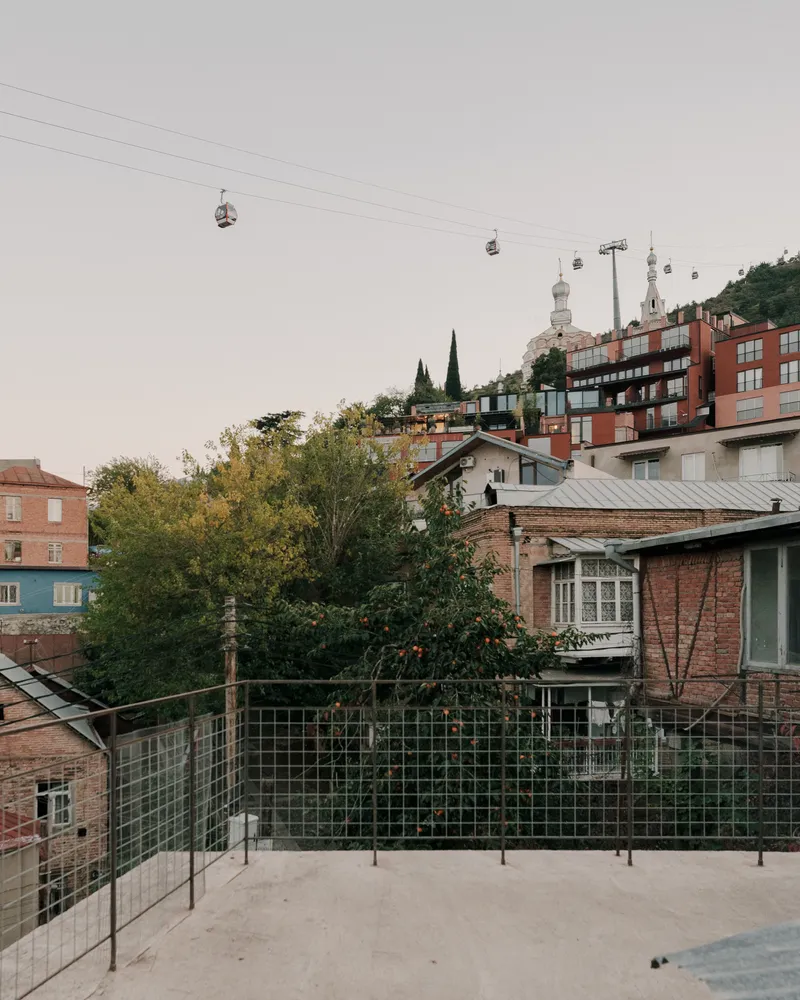
At the top of the house, a rooftop terrace formed by a concrete monolith opens to views of the hillside neighborhood and the city's cable car lines. The terrace is a direct reference to the baniani house typology, where flat roofs serve as communal gathering spaces, drying areas, and social rooms open to the sky. By capping the building with this generous outdoor platform, the Brodskys signal that the house is not yet done, that its next chapter might be an additional room, or simply decades of dinners under the stars.
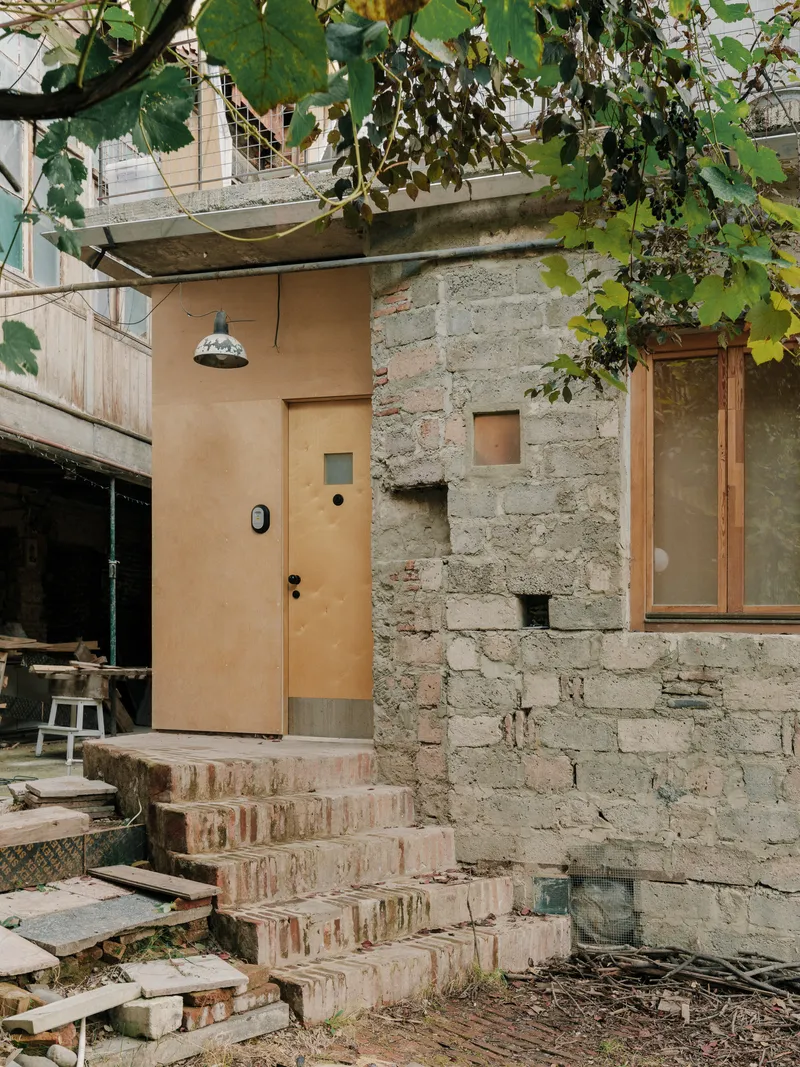
The entry sequence at ground level works the same logic from the other end. Reclaimed brick steps, a plywood door, and grapevines overhead create a threshold that belongs to the neighborhood as much as to the family. The house breathes in both directions: up toward the sky and out toward the street.
Plans and Drawings
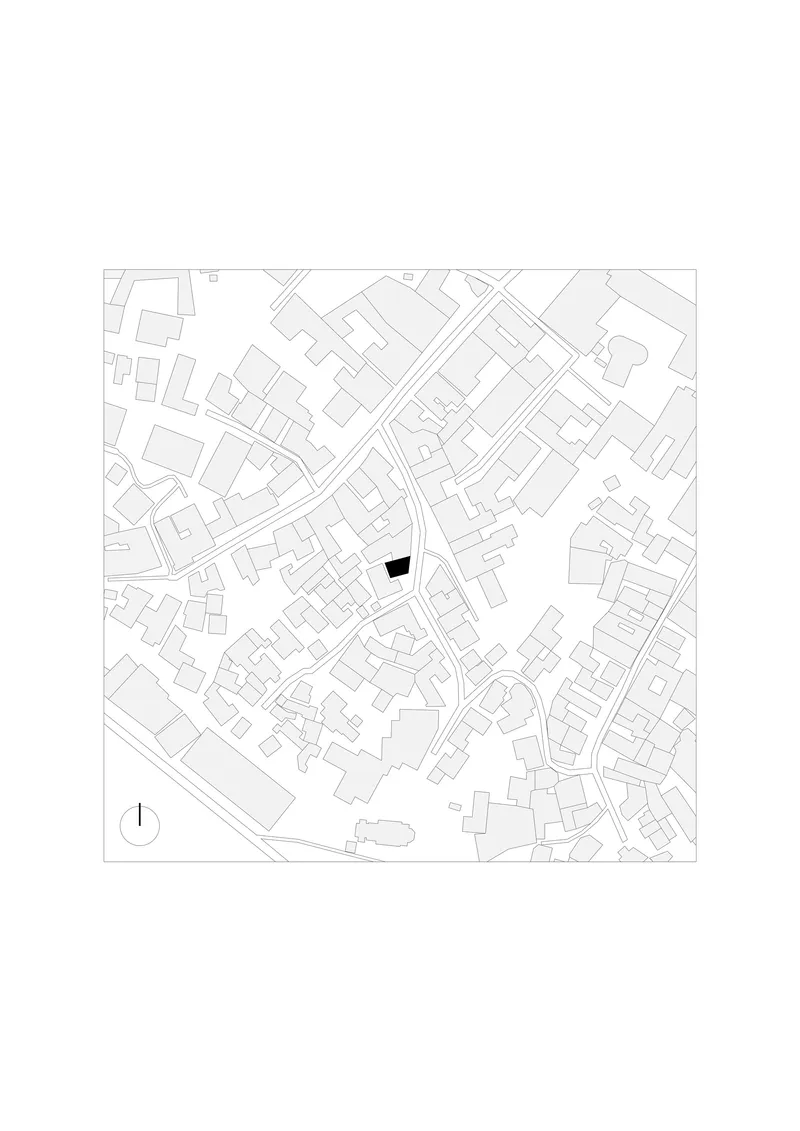
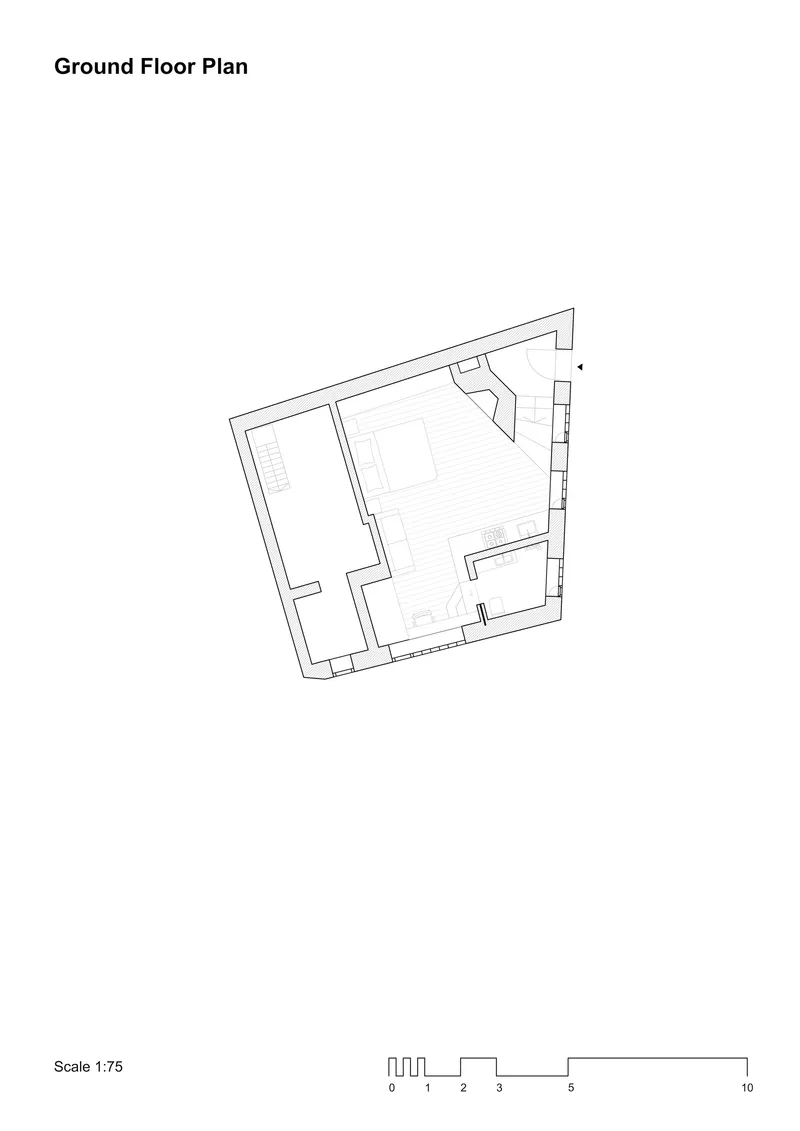
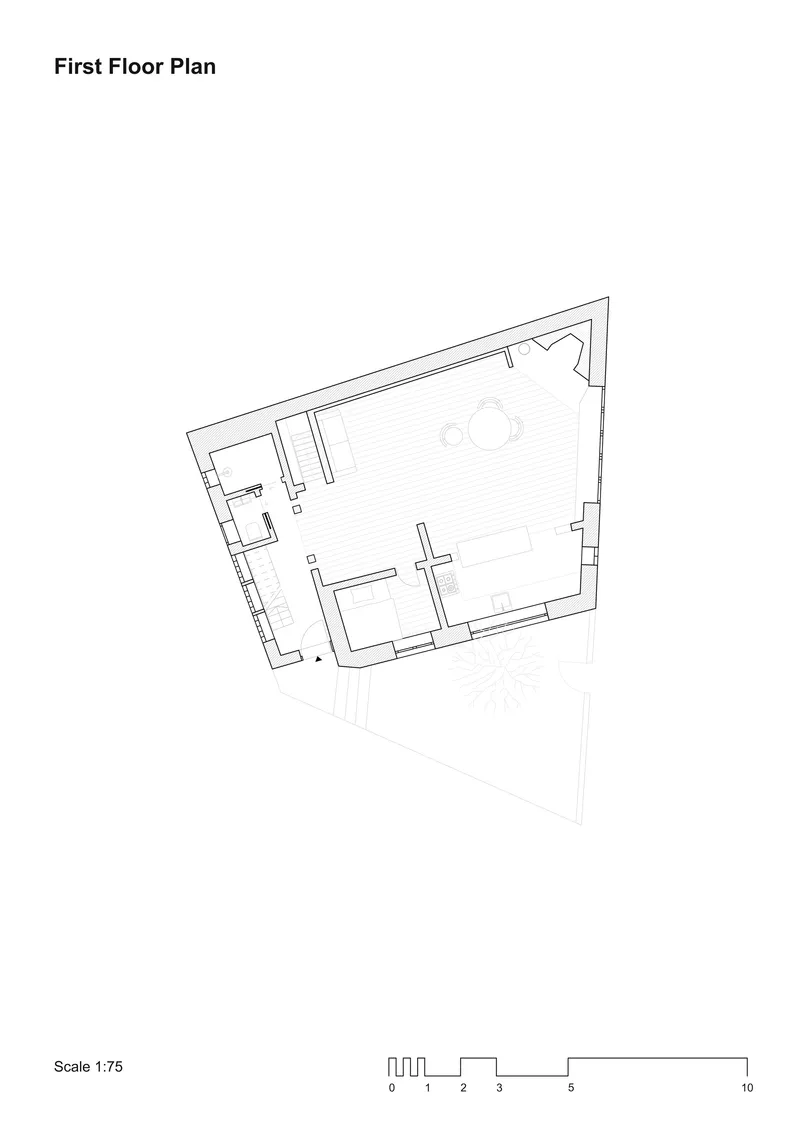
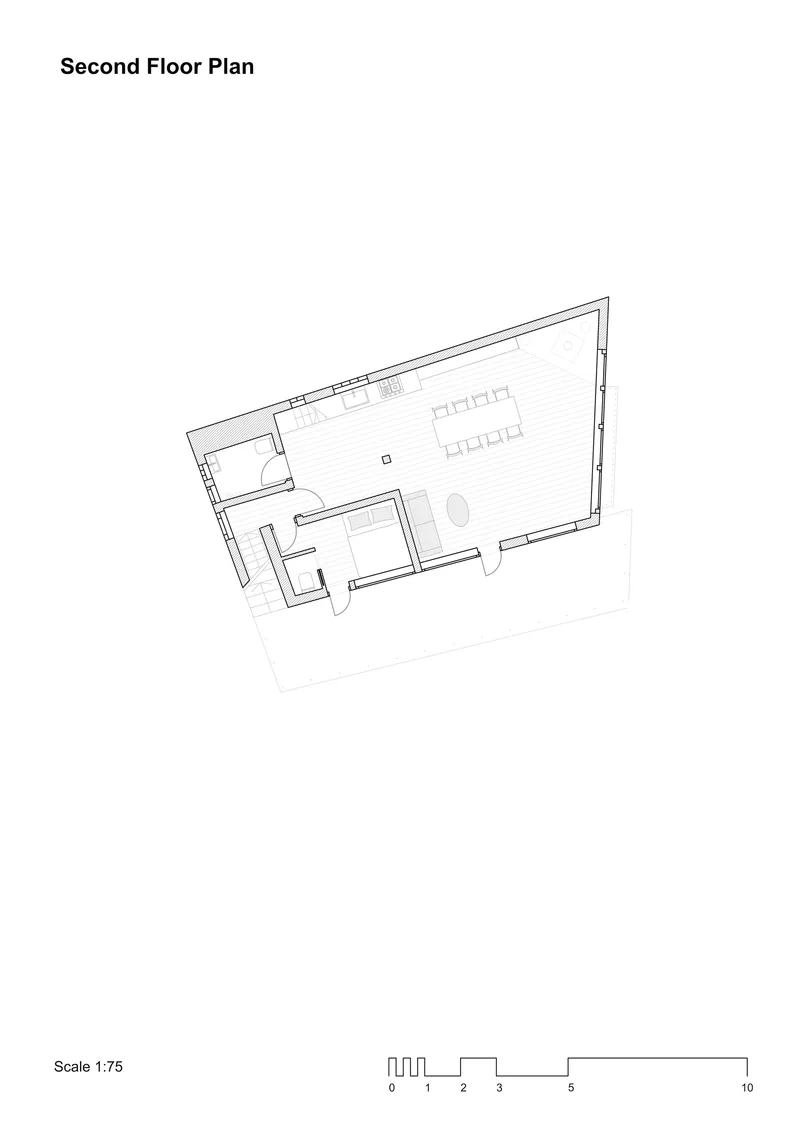
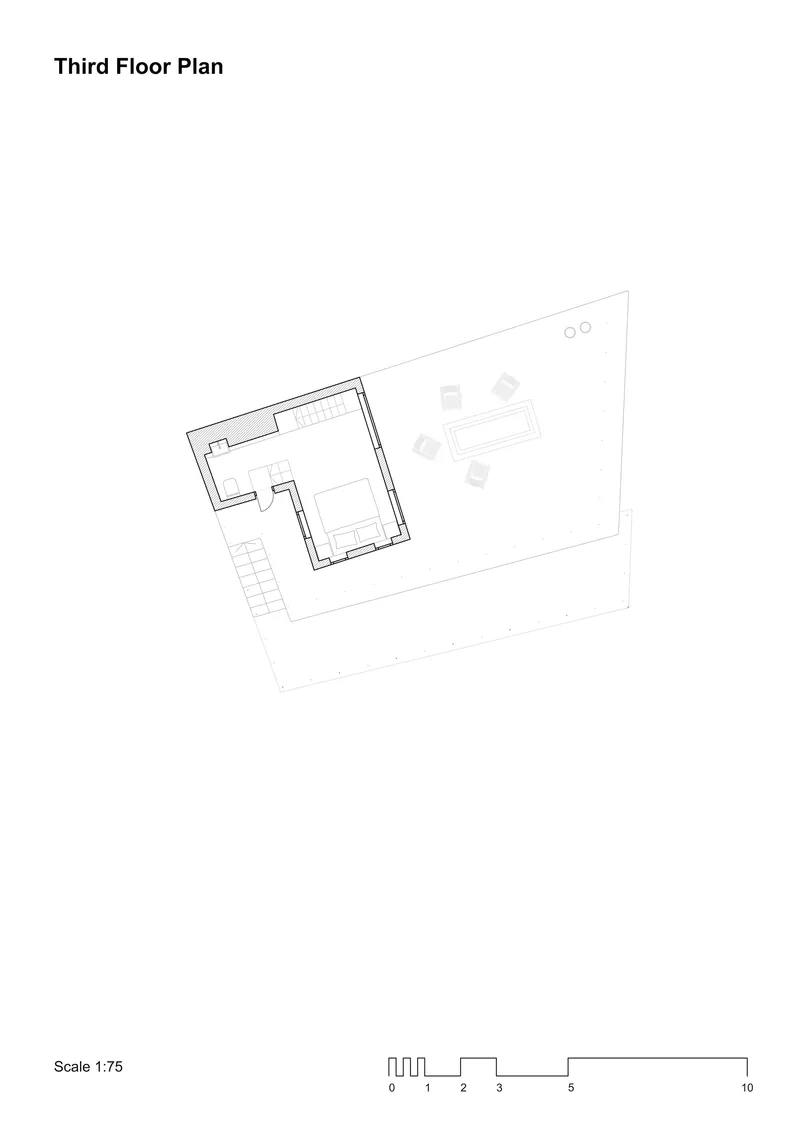
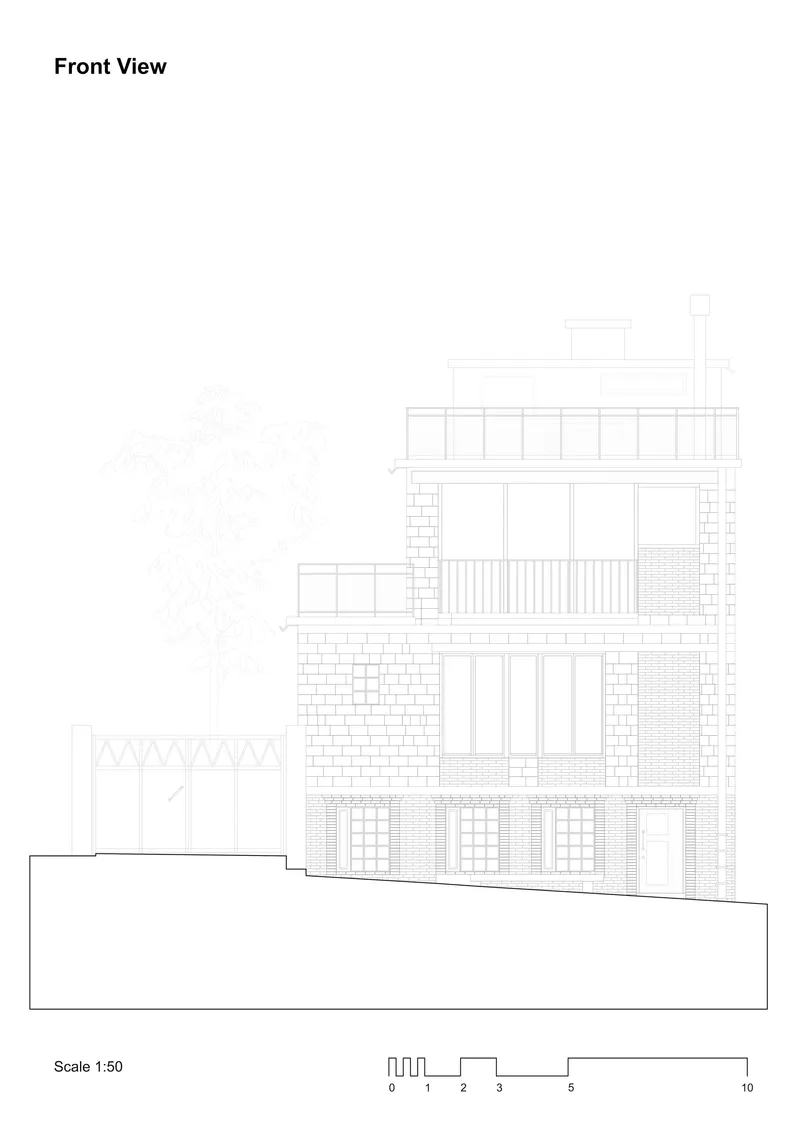
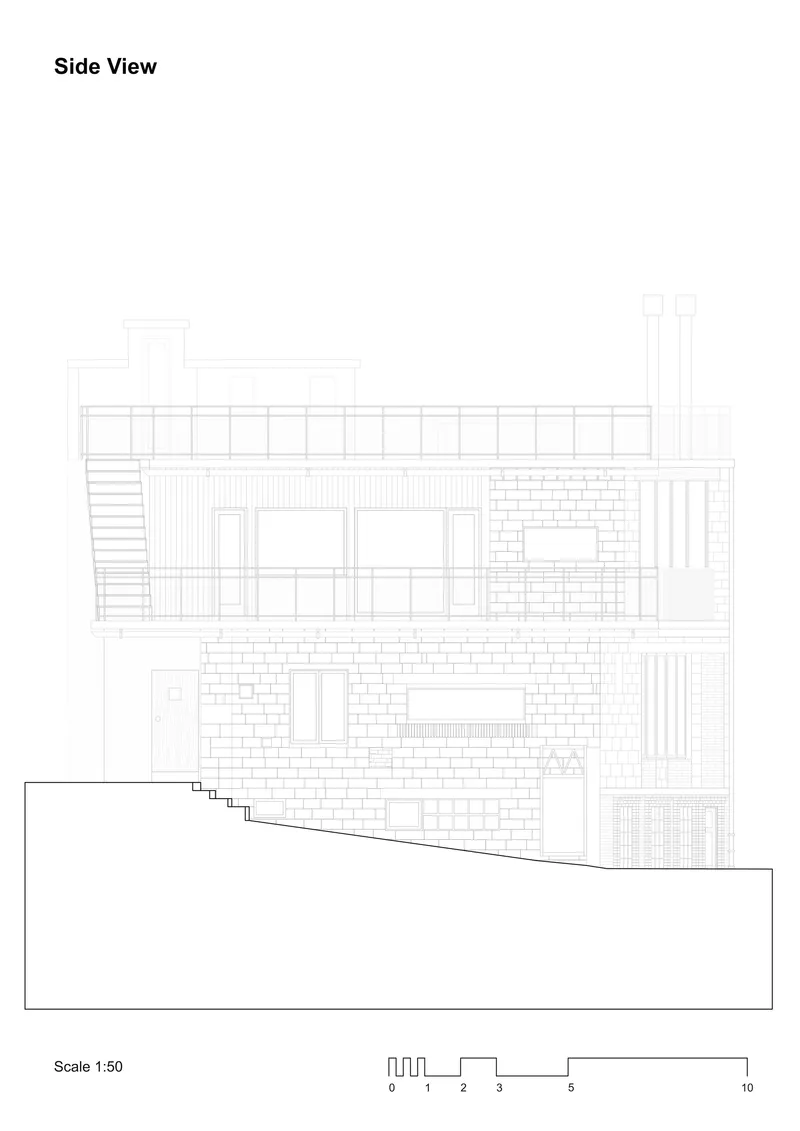
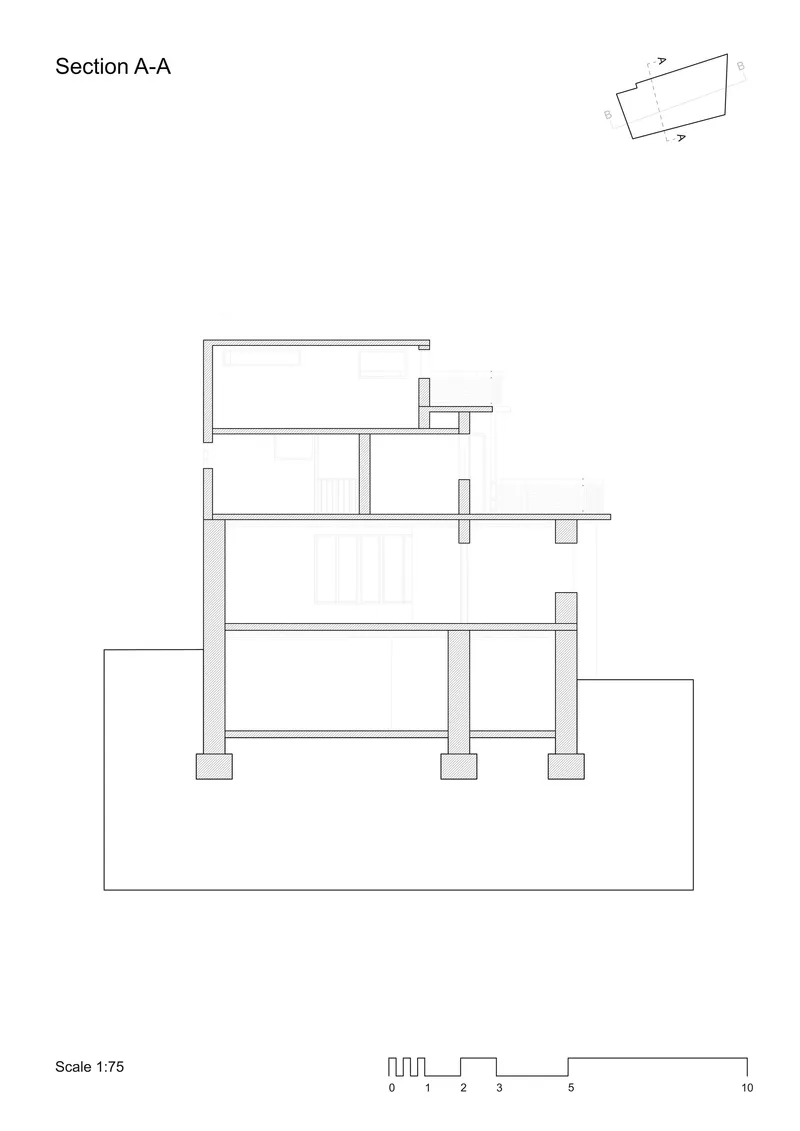
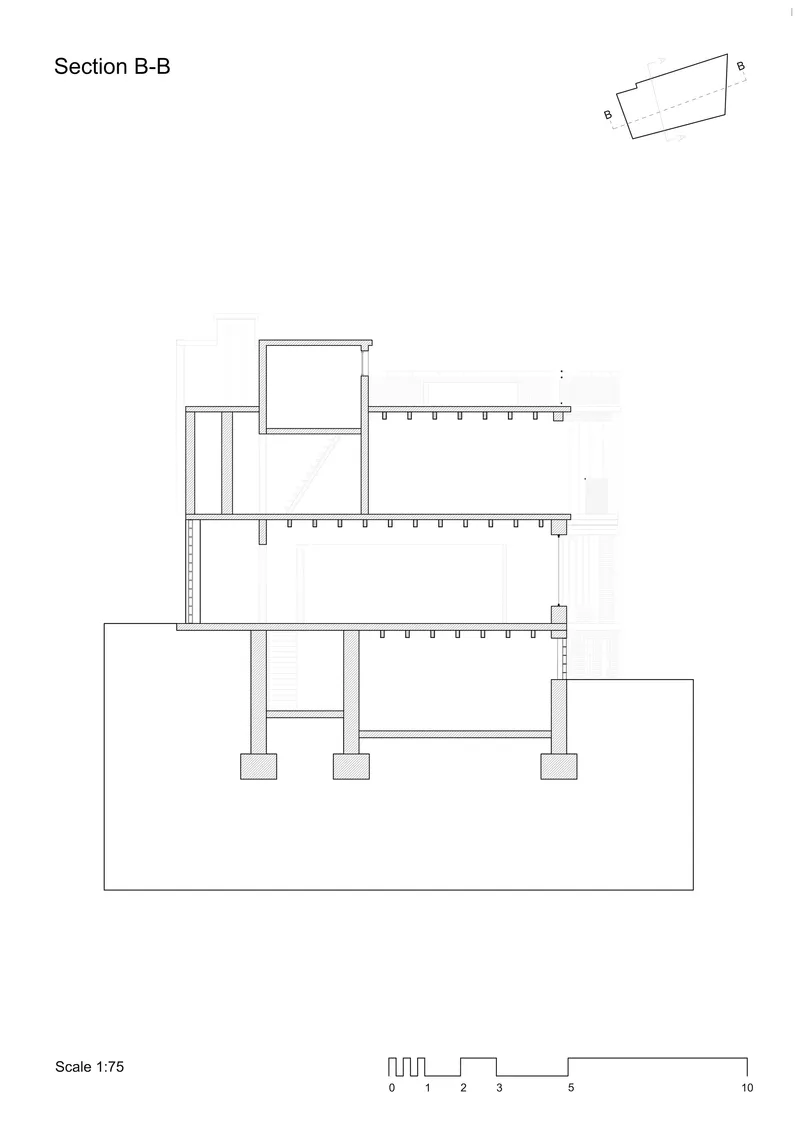
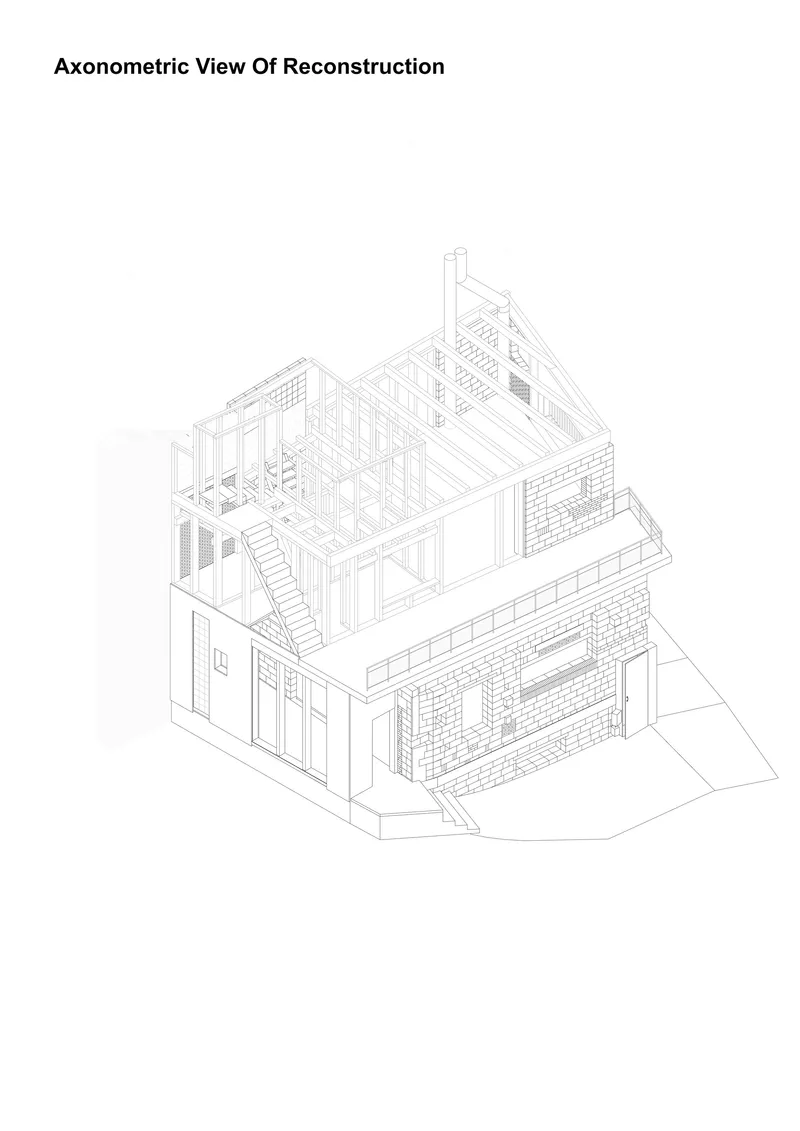
The plans reveal the constraints the Brodskys were working within. The site is an irregular trapezoid of just 109 m², squeezed into Tbilisi's dense historic fabric. The ground floor accommodates two enclosed rooms that can function as a flexible cultural space, while the upper levels progressively open up: the first floor is organized around a service edge, the second floor holds the kitchen and dining area in an open arrangement, and the third floor houses a bedroom suite that steps out onto the roof terrace.
The sections are especially revealing. Floor plates are offset from one another, supported by columns that reach down to raised foundations. The axonometric drawing exposes the timber framing system, the staircase threading vertically through the plan, and the masonry walls that do double duty as structure and enclosure. Nothing is concealed. The drawing set makes the same argument as the building itself: every piece is legible, every decision is on display.
Why This Project Matters
The Unfinished House offers a pointed alternative to the way most residential projects handle existing fabric. Where others raze and replace, the Brodskys excavate and recompose. The building is the third iteration of a structure that has occupied this site for a century, and its materials carry that history forward. Handmade cement blocks, Soviet glass bricks, local stone, salvaged timber: each element brings its own biography into the composition. The result is not nostalgia. It is an argument that architecture does not need to start from zero to be original.
More broadly, the project challenges the cult of completion that dominates contemporary practice. By embracing the baniani tradition of incremental growth, and by distributing authorship across a network of collaborators, the Brodskys propose a model of building that is open-ended, resource-conscious, and deeply embedded in its place. In a moment when sustainability is often reduced to energy ratings and material certifications, the Unfinished House reminds us that the most sustainable building might be the one that was already there, waiting to be read carefully and put back together with intelligence and care.
Unfinished House by David Brodsky and Alexander Brodsky. Tbilisi, Georgia. 309 m². Completed 2025. Photography by Grigory Sokolinsky.
About the Studio
David Brodsky
Official website of David Brodsky, one of the studios behind this project.
instagram.comAlexander Brodsky
Share Your Own Work on uni.xyz
If projects like this are the kind of work you want to make, uni.xyz is a place to publish your own, find collaborators, and enter design competitions.


Popular Articles
Popular articles from the community


Juan García Correa, John González and Claudia Rueda Sink a Circular Amphitheater into a Manizales Engineering Building
On the La Nubia campus in Manizales, Colombia, the S1 Building folds labs and offices into a hillside of ramped lawns that double as a campus route.

Cube Design Draws an Ecological Corridor Between Two Shenzhen Hills with the Nankai Building
Beside Shenzhen's container docks, the Nankai Building pairs stacked balconies with a climbing green screen to connect two hillsides across its height.

David Macias Steps a Doorless Stone and Plaster House Down a Tropical Colombian Hillside
In the humid hills of Colombia, Threshold House replaces the front door with an open void and terraces its 850 m² down the slope instead of fighting it.

Architekt Andreas Gruber Scatters 23 Dark Timber Chalets Across a South Tyrolean Forest Edge
In Molini di Tures, Amonti Chalets breaks a resort into a hamlet of gabled timber houses, with parking, storage and services pushed into the slope.

Similar Reads
You might also enjoy these articles


LAVA Architecten Gives Vocational Education a Sawtooth-Roofed Face on a Mechelen School Campus
In Mechelen, Belgium, a 2,053 m² STEM school on a 6×6 m grid turns workshops and classrooms into rooms that can be rearranged as teaching changes.

KEMA Studio Turns a Derelict Marvila Attic into a 60 m² Lighthouse Apartment Above Lisbon
In Lisbon's Marvila district, a rebuilt roof, four skylights and two plywood volumes turn an unlivable attic into a bright home facing the Tagus.

Pixel Gardens: One Repeated Module Stacked Into a Terraced Social Housing Tower for Famagusta
Salem Bader's shortlisted housing tower builds a vertical neighbourhood from one repeated module, offsetting units to carve terraces, light and air.

Bao Huynh Watercolor Atelier: A Serene Art Retreat in Hội An
Bao Huynh Watercolor Atelier in Hội An blends multifunctional art spaces, sustainable design, local materials, and family-friendly living in a serene environment.

Explore Recycled Ruin Competitions
Discover active competitions in this discipline

Challenge to design mud housing for contemporary communities

Design challenge to equip cities with modern furniture
Comments (0)
Please login or sign up to add comments
No comments yet. Be the first to comment!