

DEJA-VU: Modular Urban Furniture That Reactivates Chengdu's Forgotten In-Between Spaces
A shortlisted entry proposes adaptive, panel-based furniture modules organized around life, play, and light to revive gray zones in Chengdu.


Between the narrow alleys of old Chengdu and the glass facades of its modern expansion lies a category of space that belongs to neither world. These gray zones, once saturated with communal life, tea drinking, and street-level socializing, have been squeezed into irrelevance by decades of rapid development. DEJA-VU refuses to accept that outcome. Instead of proposing new buildings or grand plazas, the project intervenes at the scale of furniture: modular, reconfigurable, and deliberately intimate.
Designed by Sun Qiyang, Gong Xi, and Minghan Li, DEJA-VU was shortlisted in the Urbanscape: Symbiosis competition. The project maps Chengdu's urban transformation from 1933 to the present, using that historical layering as justification for a design philosophy rooted in spatial memory rather than erasure. Its core proposition is straightforward: adaptive urban furniture, assembled through overlapping panels, can transform neglected semi-public zones into active social infrastructure.
Six Sites, One System: Mapping Activity Across Gray Zones
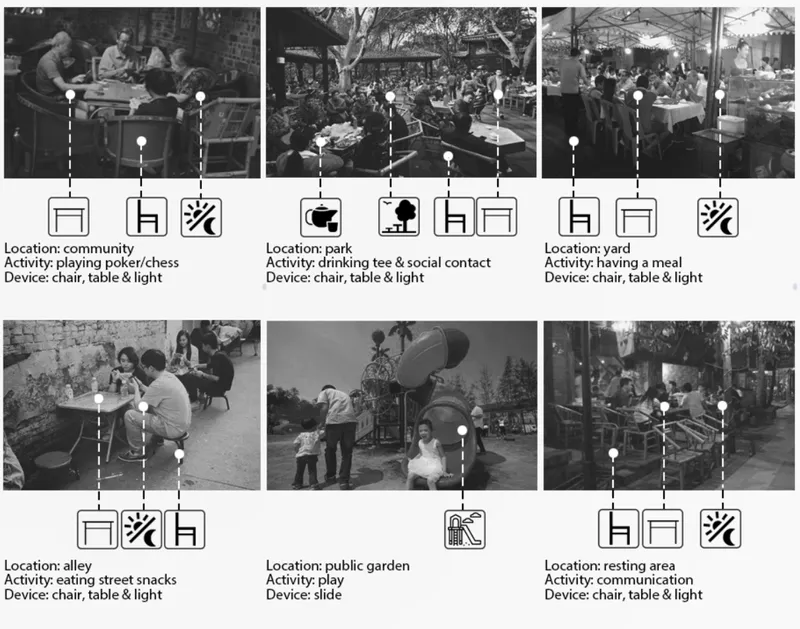
The opening diagram lays out the project's territorial ambition. Six outdoor locations across Chengdu are identified, each documented with photographs of people already improvising with portable furniture and lighting to claim residual spaces for socializing, eating, and resting. The diagram functions as both site analysis and provocation: if residents are already doing this with ad hoc objects, what happens when you give them a purpose-built system? DEJA-VU treats existing behavior as design intelligence, reading the informal occupations of gray spaces as a brief rather than a problem.
Timber Clusters on Carpet Patches: The Life Module at Work
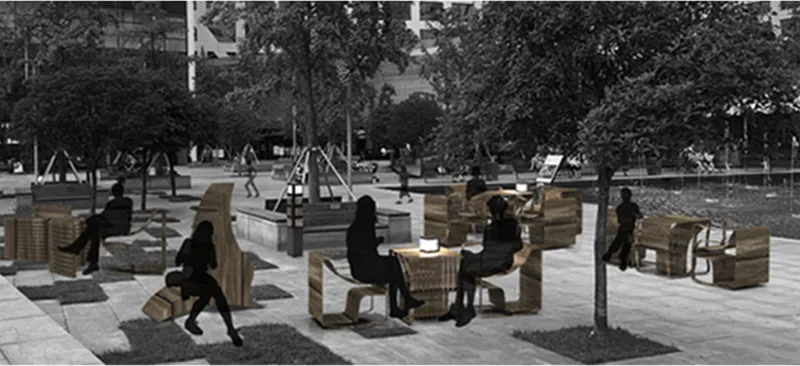
In the plaza rendering, modular timber furniture clusters sit on individual carpet patches beneath mature trees. The effect is deliberate: each cluster reads as a semi-private room within a public field. The furniture units, which can be reconfigured into chairs, recliners, tables, or informal play structures through the strategic overlapping of panels, offer residents genuine choice about how they occupy the space. The carpet patches reinforce territorial softness without hard boundaries, a subtle spatial move that encourages lingering without exclusion.
This is the "Life" pillar of DEJA-VU's three-part framework, which also includes "Play" and "Light." Life supports flexible seating and resting, and in this image it is doing exactly that. The furniture scale keeps the intervention approachable. There is no monumental gesture here, only the quiet assertion that sitting comfortably under a tree is a civic act worth designing for.
Illuminated Alleys: Light as Safety and Invitation
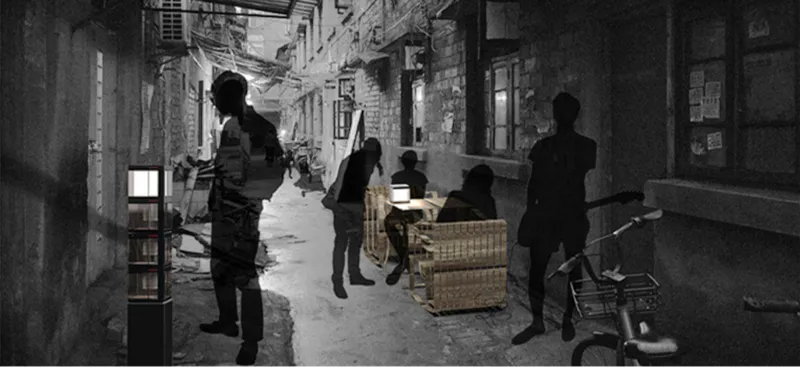
The narrowest, most characteristically Chengdu scene in the project shows a residential alley at dusk, where illuminated portable furniture units draw neighbors out of their doorways. Bicycles lean against walls, laundry hangs overhead, and the light from USB-powered modules casts a warm glow that extends the usability of the alley well past sunset. The "Light" pillar is at its most potent in this context, where darkness would otherwise cede the space to disuse or anxiety. Shared lighting transforms the alley from a transitional corridor into a destination.
What makes this rendering compelling is the specificity of the social scene it depicts. People are gathered, not passing through. The furniture units are small enough to be repositioned by a single person, allowing the alley's configuration to shift from evening conversation to morning bicycle storage without formal intervention. The design invites the kind of communal rituals, tea sharing, card playing, casual conversation, that Chengdu's alleys historically hosted.
Waterfront and Courtyard: Scaling the System to Public Stages
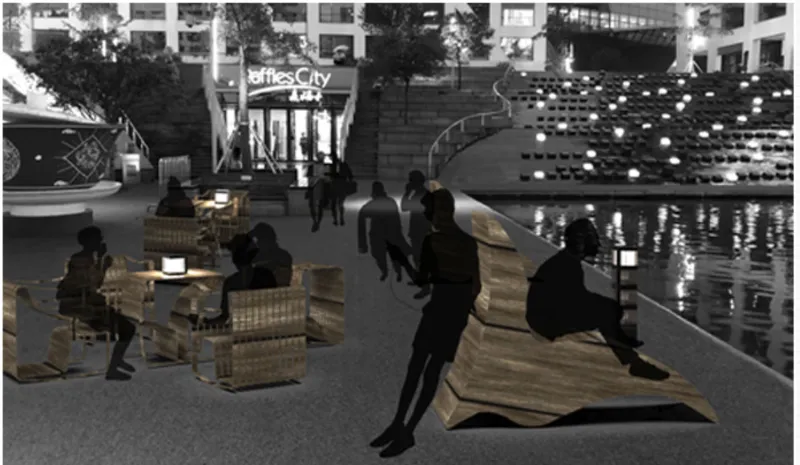
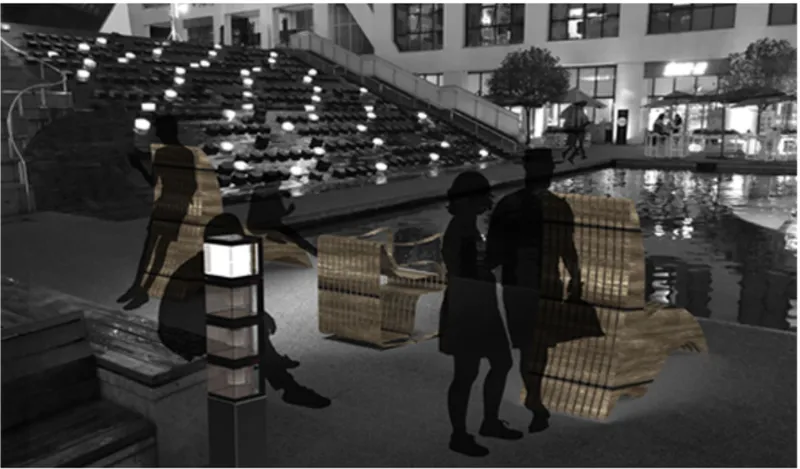
Two evening scenes test DEJA-VU's adaptability at a larger scale. The waterfront plaza pairs illuminated furniture with a reflecting pool and stepped seating wall, creating a layered social landscape where the modular units supplement rather than replace existing hardscape. Meanwhile, a courtyard rendering shows people actively moving woven furniture near a pool, with an illuminated stepped amphitheater as a backdrop. In both cases, the "Play" module surfaces: the furniture becomes something to rearrange, to gather around, to configure for an impromptu audience.
The nighttime settings are not incidental. By demonstrating the system's performance after dark, the designers make a case that gray spaces are often most neglected precisely when they could be most socially valuable. The integrated USB-powered lighting ensures the furniture remains a draw rather than an obstacle once daylight fades. The reflecting pool and amphitheater compositions show that DEJA-VU can hold its own alongside more permanent architectural elements without competing with them.
Why This Project Matters
DEJA-VU is not trying to save Chengdu's heritage through preservation. It is trying to keep the social behaviors that heritage once supported alive in spaces where those behaviors are under threat. The distinction matters. The project does not fetishize the old city or resist the new one; it operates in the seam between them, using furniture-scale interventions to make that seam habitable. The three-pillar framework of Life, Play, and Light gives the system enough programmatic range to address multiple conditions without losing coherence.
What stands out is the project's trust in residents. The modular panels are not pre-set into optimized arrangements by a designer. They are offered as a kit of parts, reconfigurable by the people who actually use these spaces daily. That handoff, from designer to citizen, is where DEJA-VU locates its most meaningful contribution. Architecture, at this scale, becomes a facilitator of spatial memory rather than an author of new spatial narratives. For Chengdu's gray zones, that may be exactly what is needed.
View the Full Project
About the Designers
Designers: Sun Qiyang, Gong Xi, Minghan Li
Enter a Design Competition on uni.xyz
uni.xyz runs architecture and design competitions year-round that reward proposals with spatial conviction and real site intelligence.
Project credits: Deja-vu by Sun Qiyang, Gong Xi, Minghan Li Urbanscape: Symbiosis (uni.xyz).


Popular Articles
Popular articles from the community


The Ocean Hive: Sustainable Architecture for a Self-Sufficient Civilization at Sea
The Ocean Hive imagines sustainable architecture at sea, where modular habitats, algae, wave power and ocean waste sustain a growing colony.

Co-Life: Senior Housing Design That Reconnects Older Adults With the City
Co-Life reimagines senior housing design through healing gardens, shared streets, workshops, and a sustainable community across generations.

The Earth Pod: 3D Printed Homes for Resilient Refugee Communities
The Earth Pod reimagines refugee housing through 3D printed homes made from clay, combining resilience, self-sufficiency, and rapid shelter.

Hill & Cross Opera: Sculptural Opera House Architecture Shaped by Tallinn’s Landscape and Identity
Hill & Cross Opera reimagines opera house architecture in Tallinn through its sculptural hill, civic plaza, glass wave and a luminous cross.


Similar Reads
You might also enjoy these articles

Day and Night Park: A Time-Based Urban Newsstand in Beijing
A temporary urban newsstand in Beijing blending travel, light, and reading through poetic colors, compact form, and community-focused design.

Modernist Patio Renovation in El Masnou, Barcelona by Oliver Segura Arquitectura + Cebrià Arquitectura
Modernist patio renovation blending tradition and innovation with a movable pool, leveled floors, and Catalan materials in El Masnou.

Alto Residencial Coop: Cooperative Housing Development in Santiago de Compostela by Carbajo Barrios Arquitectos
A linear cooperative housing complex blending white volumes and perforated metal façades, enhancing community living, natural light, privacy, and urban integration.
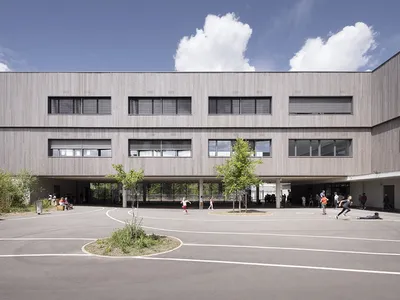
Vil Genis School by BPA ARCHITECTURE – Massy, France
Vil Genis School in Massy, France, features sustainable design, south-facing classrooms, community integration, accessible spaces, and modern educational architecture.





Comments (0)
Please login or sign up to add comments
No comments yet. Be the first to comment!