

Denmark Unveils Plans for Revolutionary Neuroscience Center: Merging Psychiatry and Neuroscience in a Groundbreaking Facility
Cutting-edge research and collaborative innovation at the forefront of Denmark's groundbreaking approach to mental health and brain disorders


BIG, the architecture firm founded by Bjarke Ingels, has unveiled its designs for the New Center for Neuroscience and Psychiatry, set to be the first of its kind in the world. The facility, located at Aarhus University Hospital in Denmark, will bring together psychiatry and neuroscience in one building to promote ground-breaking science and treatments of physical and mental brain diseases, spinal cord and nervous systems. The design of the building replicates the gyrification of the human brain to utilize the limited site area most efficiently while creating synergies between the different disciplines within the hospital.
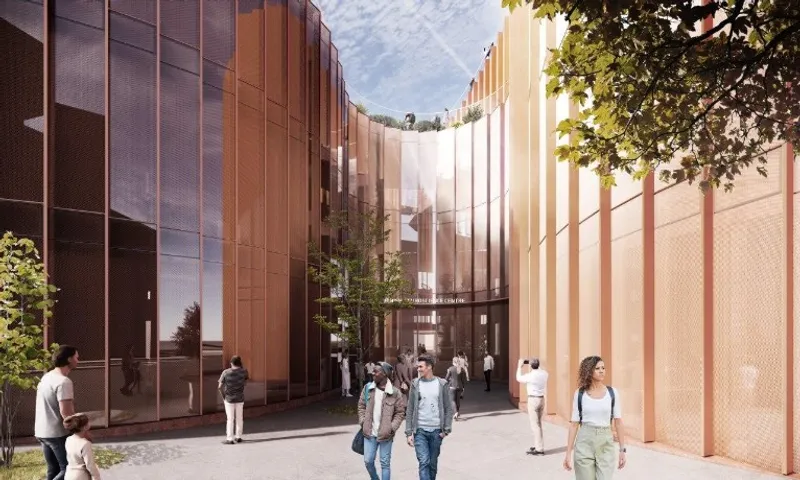 Image by BIG-Bjarke Ingels Group.
The Danish Neuroscience Center (DNC), established in 2009, has become a world-class research and treatment facility for understanding and treating the brain. A new building for DNC is set to open in 2026 and will connect directly with the existing campus of Aarhus University Hospital to intensify the hospital’s unique approach that combines healthcare, education, and scientific research to collaborate and inspire each other.
BIG’s proposal for the six-story neuroscience centre combines the efficiency of a double-loaded corridor building with the generosity and openness of a classic atrium typology. By folding the floor plan around an atrium, similar to the characteristic folds in the cerebral cortex, the design not only allows each floor to reach the necessary square footage within a limited area, it also creates a number of connections and smaller clusters with intimate workspaces, courtyards and views between each floor within the hospital.
The building’s natural materials, including wood and brick, will bring positive health benefits and a comforting atmosphere to the patients and guests, while the red concrete of the exterior will blend well with the existing brick buildings and bring warmth to the spaces, contrasting the usual clinical and sanitized white environment of hospitals. Furthermore, each department from neurology to nuclear medicine, headache clinic and psychiatry have its own distinct space and program functions. To avoid separation and fragmentation between the disciplines, BIG proposes to organize them by the functions they have in common, encouraging crossbreeding between the different research groups that can help fuel inspiration, innovation, and creativity, and future-proof the spaces for growth, reduction or replacement.
 Image by BIG-Bjarke Ingels Group.
Patients and guests will access the building through a generous reception area, into the large open atrium at the centre of the building which contains an experience centre – an interactive public exhibition and presentation area where the visitors can learn about the hospital’s latest research and findings. The visitors can head directly to one of the clinics upstairs or enjoy the café and a public green courtyard at ground level.
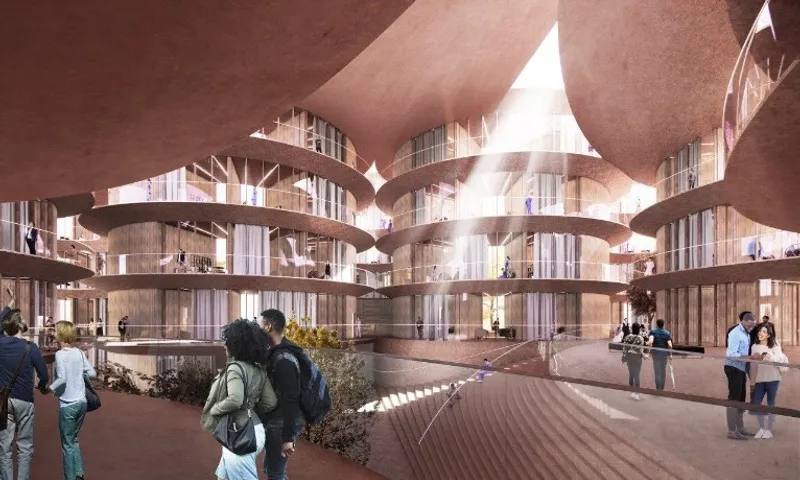 Image by BIG-Bjarke Ingels Group.
All office areas in the building are planned to be naturally ventilated, and every floor has access to an outdoor terrace. A stretched metal window mesh prevents all workspaces from being affected by glare or direct sunlight, filtering the light to provide each office, laboratory, or examination room with pleasant natural illumination. The project aims for a DGBN Gold sustainability certification for hospitals in Denmark.
 Image by BIG-Bjarke Ingels Group.
The New Center for Neuroscience and Psychiatry in Aarhus seeks to bridge the research and treatment of physical and psychological brain conditions and destigmatize psychological disorders. Historically, hospitals have divided knowledge and expertise into different specialities and departments. DNC seeks to gather all current and future knowledge under one roof to create synergies between different expertise areas and a more holistic approach to understanding and curing brain disorders.
 Image by BIG-Bjarke Ingels Group.
In conclusion, the New Center for Neuroscience and Psychiatry in Aarhus is a ground-breaking project that will combine groundbreaking science and treatments of physical and mental brain diseases, spinal cord, and nervous systems. The design of the building replicates the gyrification of the human brain to utilize the limited site area most efficiently while creating synergies between the different disciplines within the hospital. The building’s natural materials will bring positive health benefits and a comforting atmosphere to the patients and guests, while the design will encourage crossbreeding between different research groups that can help.
Cover image: Image by BIG-Bjarke Ingels Group.
Press Release.

Popular Articles
Popular articles from the community


David Macias Steps a Doorless Stone and Plaster House Down a Tropical Colombian Hillside
In the humid hills of Colombia, Threshold House replaces the front door with an open void and terraces its 850 m² down the slope instead of fighting it.

Juan García Correa, John González and Claudia Rueda Sink a Circular Amphitheater into a Manizales Engineering Building
On the La Nubia campus in Manizales, Colombia, the S1 Building folds labs and offices into a hillside of ramped lawns that double as a campus route.

LT2A and OPEN Architectes Thread a Brick and Glass High School Through a Wooded Belgian Campus
In Braine-l'Alleud, a 3,000 m² wing for Collège Cardinal Mercier pairs pale brick with a glazed colonnade, deferring to a small chapel and a dense wood.

Cube Design Draws an Ecological Corridor Between Two Shenzhen Hills with the Nankai Building
Beside Shenzhen's container docks, the Nankai Building pairs stacked balconies with a climbing green screen to connect two hillsides across its height.

Similar Reads
You might also enjoy these articles


Rede Arquitetos Turns Circulation into Civic Space at the Educar II SESC School in Fortaleza
In Fortaleza, Brazil, Educar II SESC-CE trades a signature form for mesh screens, yellow thresholds and courtyard walkways built for equatorial heat.
116 Rokeby Building, Collingwood
Sustainable Collingwood office building featuring double-skin façade, natural ventilation, rooftop amenities, and carbon-neutral design focused on wellbeing and longevity.
Contemporary Apartment Renovation in Spain: RV House by BIAN Opens Up to the Sea
A minimalist 1930s apartment in Santander is transformed into a flexible, sea-facing home through contemporary Spanish renovation.
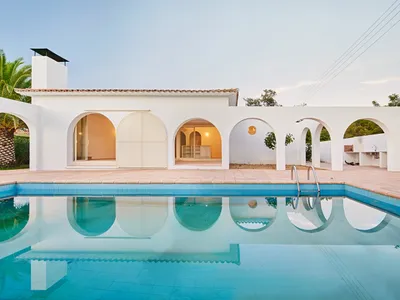
3 Marías House: A Contemporary Mediterranean Courtyard Retreat by Bajet Giramé + Burckhardt
Mediterranean courtyard home blending traditional architecture with modern design, terracotta flooring, flexible interiors, sustainable climate strategies, and garden integration.

Explore Architecture Competitions
Discover active competitions in this discipline


Challenge to reimagine the Iron Throne

Photograph architecture without architects

Illustrate the lost glory of Angkor Wat - Render Challenge

Design challenge to reuse E-waste
Comments (0)
Please login or sign up to add comments
No comments yet. Be the first to comment!