

Design Journal
A winery design in Cape Town.
A modern winery design requires the art of balancing the conflict between nature and man-made, ancient and contemporary, production and hospitality.Especially for a building in the middle of a vast vine area, the merge of the above factors are key to create a unique context where the influence of the winery start to take effect.
Considering the relatively smaller area of our site compared to its surrounding vineyard landscape, respecting existing context makes it much easier for the winery to blur its boundary with nature, therefore, rather than inflict major landscape changes to our site, we layout the plan with mostly vineyard areas. To make it more blended in, we distance our winery from the main vehicular road to create more space for the vines.The building, on the other hand, with an impressive dimension, sits on higher ground of the site, imposing a sense of monument and exploration.Viewed From the main road, The winery, half sprouting from the highland,while the other half buried on a higher level, acts like an outcrop that protrudes above a vast vineyard, manifesting its rooted relationship with the environment. Constructed with pure concrete on the outside, its topographical characteristic suggests further internal exploration for the visitor.
Subsequently,The idea "hidden cave" comes to mind, indicating quite an experience in the upcoming journey. Within the "caves", wine sales and production, museum and education, shows and public gatherings etc, complex programs are brought together under one single roof which, is also an accessible terrace from the higher ground of the site.
From the main road, we propose two main ways for people to tour along the building, one from beneath and one from above.
From above, visitors could drop off at the main entry and ramp up to a sky bridge that connects them to the winery. Passing over the vineyard, they are welcomed by a giant archway that leads to a semi-sunken and valley-like courtyard.Clad mainly in red bricks, this courtyard plays an important part in organizing the whole winery. On one hand, It splits the building into two parts on the ground floor, respectively sales and reception area on the north, museum and administration area on the south.Moreover, it provides access to the underground wine production line with two iconic structures, the structures are connected with a linear water channel. Together, the composition reminds visitors of an ancient wine press within a mountain valley. The courtyard, therefore, is regarded as a metaphor, a symbol that marks the beginning to discover the origin of wine. Last but not the least, the courtyard also establishes connectivity to the terraced roof, through a spiral ramp, visitors could enjoy 360-degree of the surrounding landscape while ascending to the top.
From beneath, Driving past the tunnel under the vineyard, visitors could arrive at the underground level where they park their car and enter the wine-display lobby. Terraces of barrels and bottles welcome their guests in a ceremonial way. The lobby marks the beginning of their exploration, one could follow the spiral ramp within a funnel space to reach the courtyard on the ground, or he could simply bifurcate in the middle to a mezzanine and visit the wine production rooms, which, finally leads them back to either the reception or the museum.
The underground floor houses the main production line of wine making. Dome units with similar shapes and sizes are arrayed side by side to provide rooms for different stages that include wine press, fermentation, aging as well as wine bottling. Floor height is also utilized to accommodate mezzanine path for sightseeing and maintenance of the production facilities.What’s more, In some of the dome units, wine tasting space overlooking the production rooms are designed to hang over the fermentation tanks, offering visitors with pleasurable drinking experiences.
Following the mezzanine path, visitors could end up going back to the reception or the museum at the end of their journey.They could either continue their wine tasting journey back at the reception, or tour around the museum to see the latest wine exhibitions. The reception hall includes sales area for wine as well as lounge bars for visitors.While the museum is designed to be a flexible space for any temporary exhibition. there are two different heights along its circulation. An amphitheater is placed next to the museum. It Serves as an extension of the museum space, and designed to hold product activities, wine education, as well as cultural events.
Generally, Our winery should be a place where nature, culture and industry meet and mingle, it's a complex that integrates.Our design aim to arouse a sense of origin meanwhile offer a contemporary place where demands of industry and modern life can be met.
.

Popular Articles
Popular articles from the community


Cloaked Colonization: A Mobile Underwater Habitat That Moves Like a Fish
Micah Abaya's shortlisted EHC Pacific entry reimagines ocean settlement as a dispersed network of self-sustaining architectural organisms.
Tsunami Convergenics: Turning Catastrophic Ocean Forces into Underwater Housing Infrastructure
A speculative underwater settlement off the coast of Onagawa, Japan, treats tsunamis and typhoons as energy sources rather than threats.

Manzana Morphosis: Stretching Barcelona's Grid into a Living Landscape for 2050
A radical reworking of the Eixample manzana turns density into a tool for generous public space, vertical ecology, and environmental performance.

Opera on the Sea: Driftwood Logic Shapes a Timber Opera House on Estonia's Coast
Trevor Orgill's opera house translates the entangled drift of floating timber into a civic building where wood, water, and music converge.

Similar Reads
You might also enjoy these articles

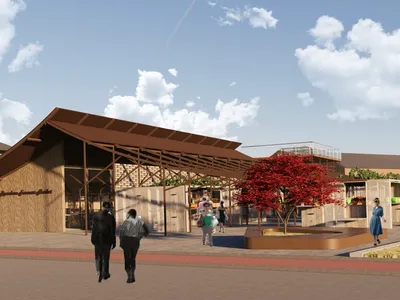
The Rhythm of Seasons
A Farmers' Market Connecting Nature and the City

More Than a Building-Designing a Living System
More Than a Building-Designing a Living System
Base Beyond
DESERT COMPOUND ARID: TOURISM OF ABSENCE AND ABUNDANCE

Explore Wineyard Competitions
Discover active competitions in this discipline


Challenge to reimagine the Iron Throne

Photograph architecture without architects

Illustrate the lost glory of Angkor Wat - Render Challenge

Design challenge to reuse E-waste
Comments (0)
Please login or sign up to add comments
No comments yet. Be the first to comment!