

Amphi-Bays
Design Narrative

DESIGN PRINCIPLES
Habitation property, inspired by human inventions.
Humans, through generations have been refining the art of travelling, of which life on the road has evolved to an extent that habitat on the move is no more a choice. We also looked upon house boats, ships and private jets that accommodate liveable spaces in their respective modes of transportation's.
Amphibian properties, inspired by nature, life appreciated better in land and water.
Model that offers habitat on both land and water for humans. The body of a crustacean that moves both in water and land has 3 main segments, the head, abdomen, and a set of legs. Series of joined appendages helped us come up with a design to enable mobility in land and water.
Aerodynamic shape, for better mobility and protection.
The aerodynamic design helps to withstand high wind pressures during natural calamities. The linear design helps in the mobility of the structure through the traffic and maneuver around narrow spaces.
Sustainable energy sources, for a cleaner environment.
Energy required for the habitat will be self-made through natural resources like solar and wind energy. This will not only help to be self-efficient to meet the basic needs but also helps to keep the environment clean.
DESIGN CONCEPT
The base properties of a 17*6 feet truck were used and further modified to provide features to support the concept, as explained below. The road dimensions and guidelines for heavy vehicle design were also considered.
The truck of the size, designed to carry heavy weights, forms the base and holds the whole structure. Properties of crustaceans from sensors to rear swimming legs inspired to design a sustainable model in both land and water. The head of crustaceans has all sensors and controls the rest of their body, which in our model is the driver’s cabin. The abdomen, mostly a protected, shelled cephalothorax, forms almost 80% of the crustacean’s body. This part, in our model is considered for the habitual space in the vehicle. The wheels and the rear propeller help the vehicle move in land and water, like the set of legs of a crustacean, mostly found in 2 different groups, the front walking legs and the rear swimming legs.
The propeller is placed at 2 feet height from the back tyre, which activates when touched in water, giving the back tyre the chance to maneuver through the water until it rises to a certain level.
The wing flaps of the model is inspired by another mesmerising creation of nature, beetles. The incredible structural and mechanical properties of their wings, with rotation angle and locking system, inspired us to design the flaps, helping the model float on water. This can also act as a connecting bridge among the cluster.
SPATIAL PLANNING
Living space is designed in multi levels with a bed on the mezzanine level, having ladder access from the ground floor. Ground floor consists of a bath area, a toilet, TV cum dining space and a pantry, providing all basic amenities for a small family. The sofa can be converted into a bed space of size 120*160.
Wireless vehicle charging pods in the form of "circle of life" has been provided to function on land and water. These are strategically placed to encourage clustered living.
DESIGN CONCLUSION
The studies and researches carried out to come up with the design, helped us understand how humans can take inspiration from nature. Our proposed model can be easily implemented with current resources and setting, rather than considering this as an utopian futuristic design.

Popular Articles
Popular articles from the community

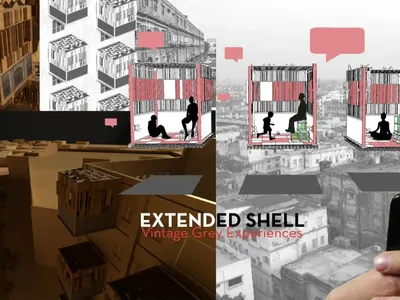
Extended Shell: Retrofitting Kolkata's Balconies as Living Urban Thresholds
A modular retrofit system recovers the social and environmental intelligence of Kolkata's historic verandas for contemporary Park Street residents.

Singing Woman: Contemporary Architecture Inspired by Estonia’s Voice and the Sea
Singing Woman turns Estonia’s song culture into flowing opera house architecture, blending public life, landscape, sea, and national memory.
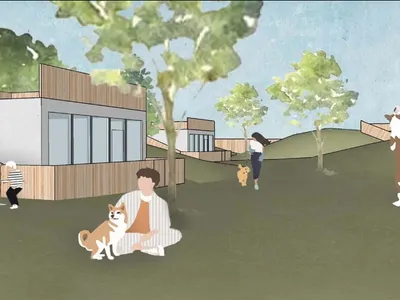
Temporary Home for Dogs: A Reversed Zoo Rethinks Animal Shelter Architecture
In Bucharest, a sinuous corridor and freed landscape flip the logic of containment, designing a shelter that works to make itself unnecessary.
Cloaked Colonization: A Mobile Underwater Habitat That Moves Like a Fish
Micah Abaya's shortlisted EHC Pacific entry reimagines ocean settlement as a dispersed network of self-sustaining architectural organisms.

Similar Reads
You might also enjoy these articles
The Rhythm of Seasons
A Farmers' Market Connecting Nature and the City

More Than a Building-Designing a Living System
More Than a Building-Designing a Living System
Base Beyond
DESERT COMPOUND ARID: TOURISM OF ABSENCE AND ABUNDANCE


Comments (0)
Please login or sign up to add comments
No comments yet. Be the first to comment!