

Designing for ‘The End’- A Hospice Center
Oasis Childrens Hospice
THE BEGINNING
We began the project with a blank canvas and an open mind. We focused on answering the many heavy questions, but 3 main ones shaped our course.
• Why does one choose a hospice and not their home?
• How is a children’s hospice different from adult hospice?
• What role does architecture take in helping one cope for the end of their life?
Unlike any other project we had done this project stood out because its purpose was so raw.
THE MIDDLE
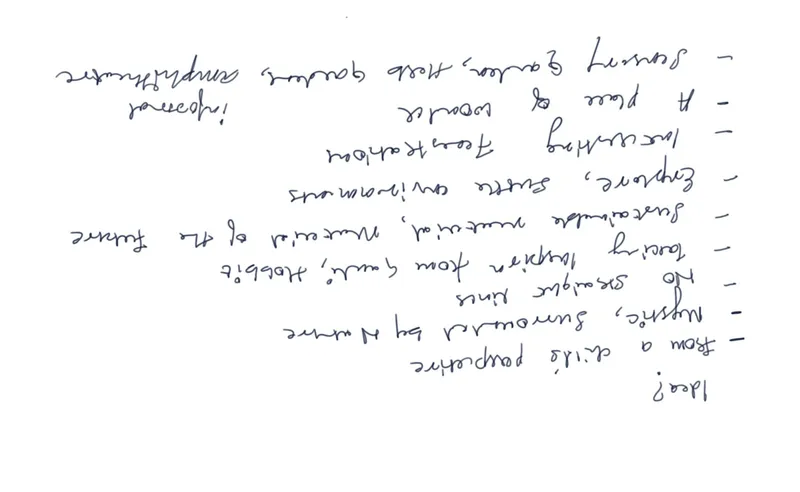
Form finding
Hospice Vs home
People resort to hospice care once the choose to take no more curative measures. To get away from painful, tiring hospital treatments. But they still need constant and undivided care.
A place that gives them comfort.
In terms of design, it should be able to facilitate comfort. But that doesn’t mean it should resonate with a hospital.
Children Vs Adults
Comfort is the common element in a hospice.
From personal experiences we understand as one age, they spend more time contemplating the past.
But for kids, their life is fresh and new, and mostly spend time painting their future. But what does that leave for children diagnosed as terminally ill. When their future has been snatched away. What then gives them joy. The fear of travelling to a place unknown forever, leaving familiarity behind.
This gave us the vision of a world within the hospice that is ever so intriguing and something straight out of a dream.
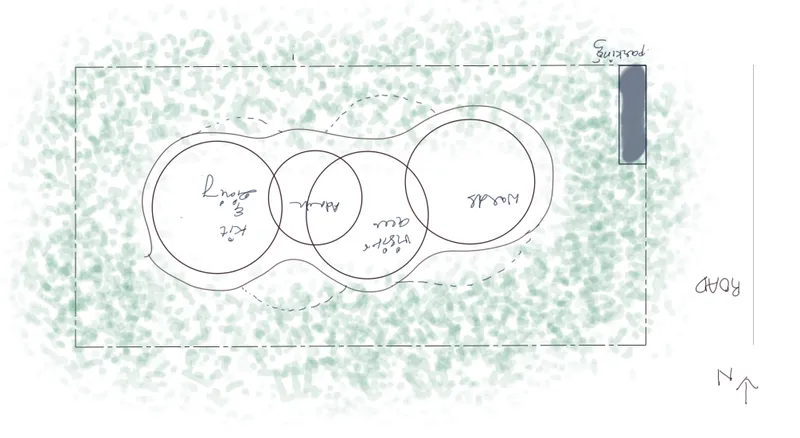
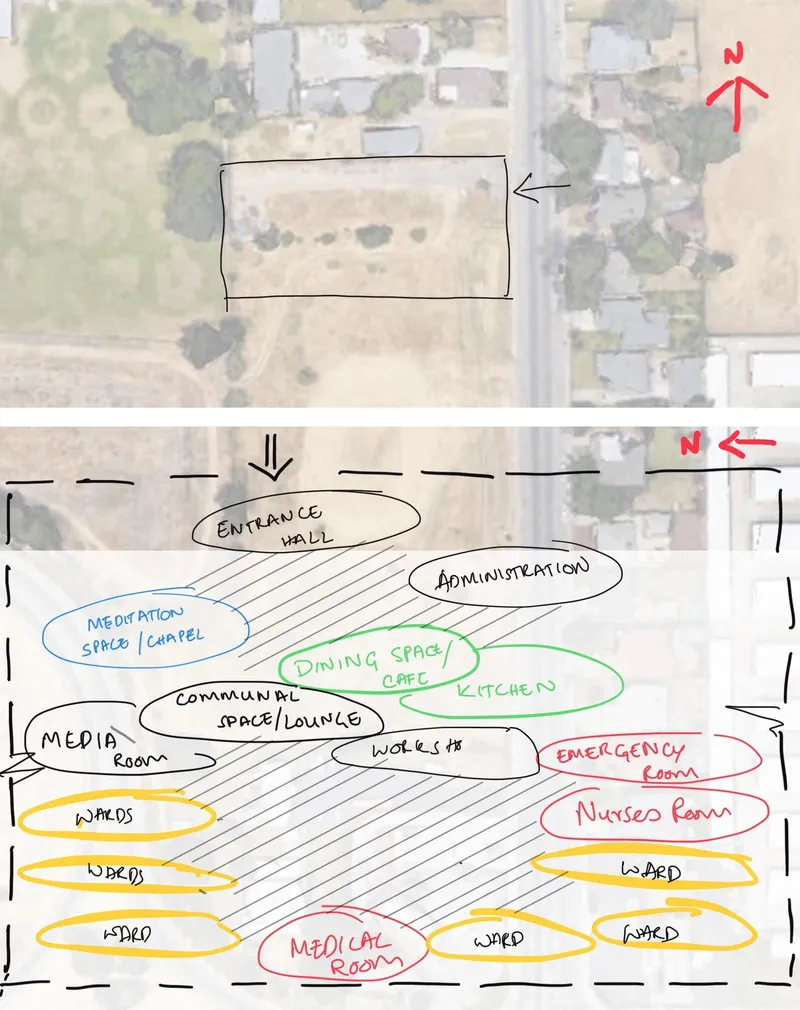
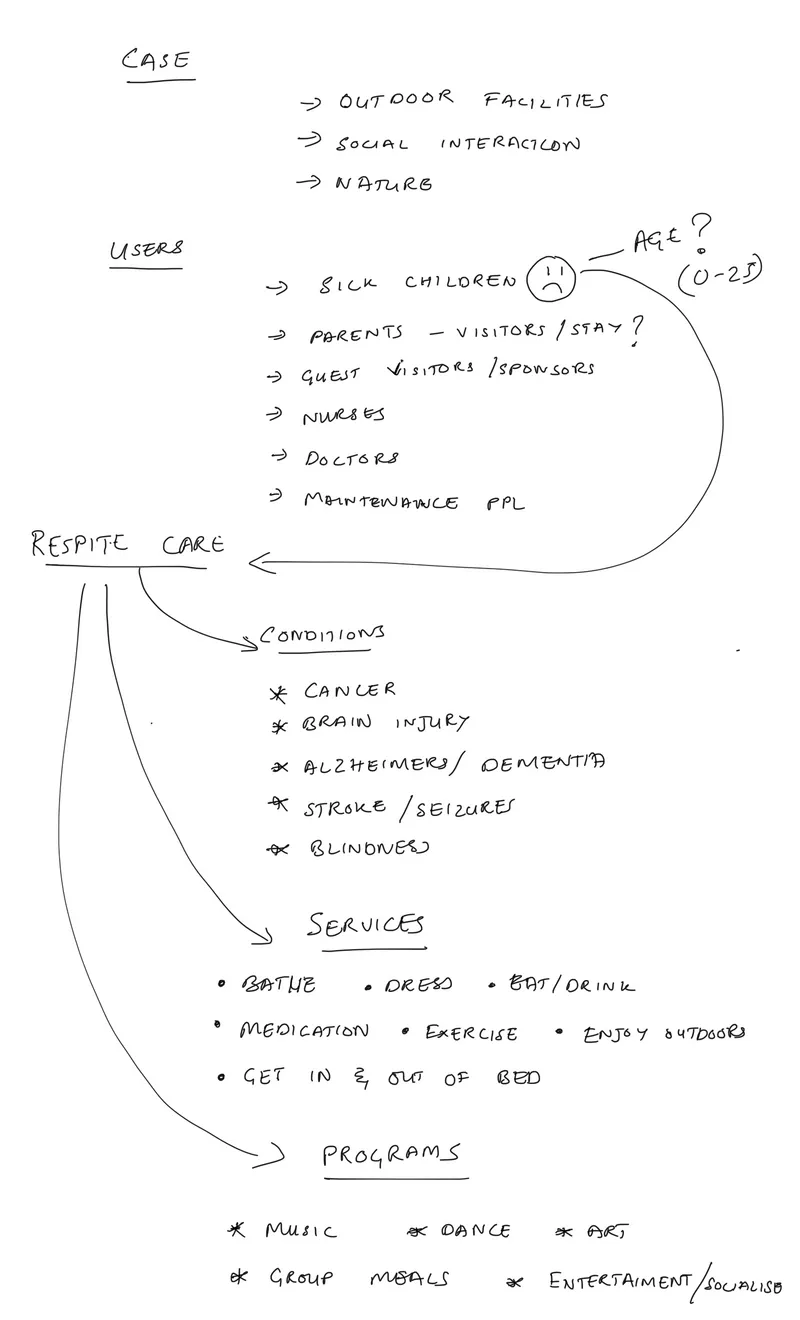
Zoning the site for providing a spread-out plan vs a vertical plane gave us a better understanding of how to link the wards, where to provide the staff accommodation. We realize that it is also home for people who work there. Which is why ample space for movement and break out zones are provided within to give moments of peace in a constantly ‘giving’ work atmosphere. The visitor’s accommodation is kept in the garden separate from the wards. The family needs time to calm and collect themselves and would give their children time to get used to the separation and familiarize with the center. Face their demons on their own.
Materiality
As we started generating various iterations of landscaping, and form finding journey, we were also constantly on the search to understand the materiality.
Our university was research on ways to solidify and use paper as a viable building material for organic forms instead of concrete. Right around that time we came across many heartbreaking wildfire news in California. It struck that the trees were symbolic of these little children. All trees grow to perform a function and fulfill their role but when in a wildfire, they burn away to their end. So much like the children who would use the hospice. Their ashes become one with the earth.
The full circle of life is subjective and selective. We wanted to use natures truth as part of the materiality of the hospice. It gives the trees new purpose. Magnus Larsson’s experimentation with soil and bacteria to form a solid refuge in the desert, was intriguing.(magnus larsson sculpts the saharan desert with bacteria, 2014)
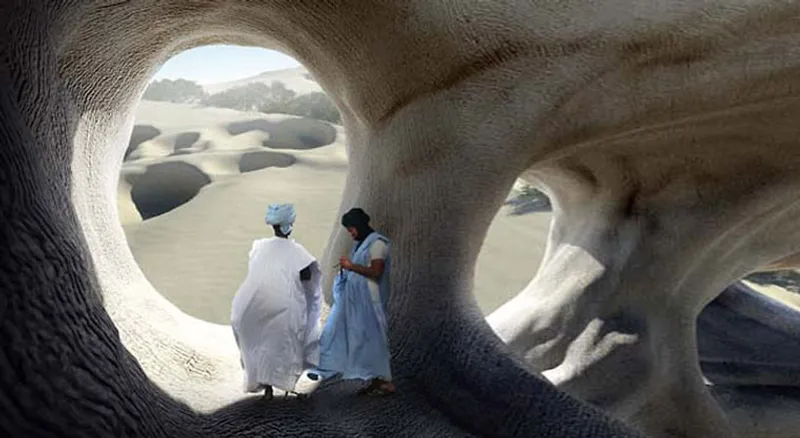
We concluded on using a mixture of earth (along with ashes from burns) mixed with activated bacteria to form a sludgy building material that can be precast to fit the mold. Just like ferrocement construction. The form work is sandwiched by mesh network and a steel framework.
This would give the form its structural integrity, material ingenuity and nature inclusivity.
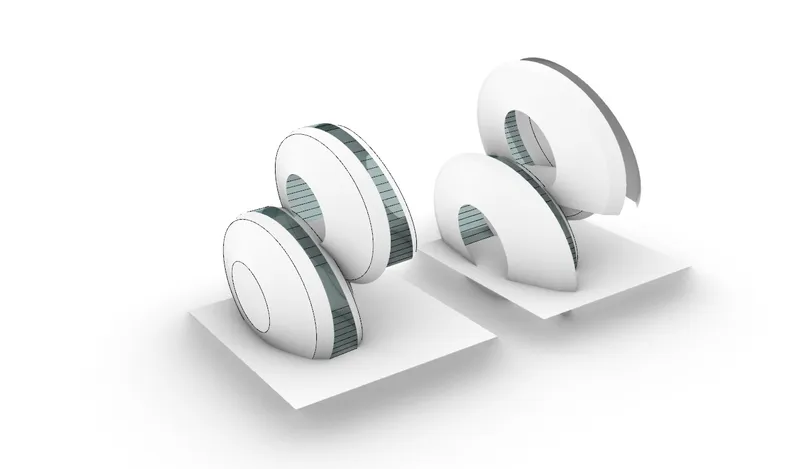
The first iteration involved providing separate units for the wards. So that every child felt included. But that would also mean loneliness. We decided to form shared units for wards. But from the first iteration we intended on creating a focal point for the building, the amphitheater space. It is where everyone unites and is a multifunctional zone easily accessed on a wheelchair or bed on wheels.

Landscaping
Using natural elements like water was key in the landscape aspect of the project. Which lead to the design of the lily Pond with its sculpture. Wildflowers, Orange poppy, Bougainvillea and African tulip trees populate the garden. We also wanted the dining space to extend out to the fresh air and serenity of the garden.
THE END
A refuge amidst the storm. A pause from the terrors of life. Oasis is that sanctuary in the desert where the soul is replenished. This proposal aims at celebrating life while acknowledging the inevitable.
An Ode to The Circle of Life
From days to seasons, happiness to the blues, nature revolves around this conceptual circle. Trees bloom and breathe life and sometimes burn to their seemingly untimely, unfair demise. Their ashes become one with the earth. The earth forms the oasis. Just like the souls of the children are rejuvenated at this center.
The focus of this proposal is to take this concept and resonate it with the values, function, materiality, and the form of the project. The project unravels ways in which the form can be looped along with its function.
The most magnificent thing in a child is their mind. They dare to imagine without bounds. It is what sparks hope and curiosity in them. Oasis tries to glorify and challenge this quality in them with a form that is ever so intriguing and fantastical. Unlike adults the terminally ill children have less to do with nostalgia but more to do with dreams unfulfilled. An ode to the celebration of Life no matter how little it may be.
Reference
designboom | architecture & design magazine. 2014. magnus larsson sculpts the saharan desert with bacteria. [online] Available at: <https://www.designboom.com/architecture/magnus-larsson-sculpts-the-saharan-desert-with-bacteria/> [Accessed 10 August 2021].

Popular Articles
Popular articles from the community


Tsunami Convergenics: Turning Catastrophic Ocean Forces into Underwater Housing Infrastructure
A speculative underwater settlement off the coast of Onagawa, Japan, treats tsunamis and typhoons as energy sources rather than threats.

Extended Shell: Retrofitting Kolkata's Balconies as Living Urban Thresholds
A modular retrofit system recovers the social and environmental intelligence of Kolkata's historic verandas for contemporary Park Street residents.

Faces of the Soviet Avant-Garde: Turning Moscow's Street Names into an Open-Air Museum
A network of sculptural installations across a Moscow residential district transforms forgotten architect names into spatial encounters with cultural memor

The Amber Palace Opera: A Geological Fiction Surfaces on Tallinn's Baltic Waterfront
Pierre Brillard reimagines a Baltic legend as a public landscape, opera house, and waterfront promenade rooted in Tallinn's coastal identity.

Similar Reads
You might also enjoy these articles
The Rhythm of Seasons
A Farmers' Market Connecting Nature and the City

More Than a Building-Designing a Living System
More Than a Building-Designing a Living System
Base Beyond
DESERT COMPOUND ARID: TOURISM OF ABSENCE AND ABUNDANCE


Comments (0)
Please login or sign up to add comments
No comments yet. Be the first to comment!