
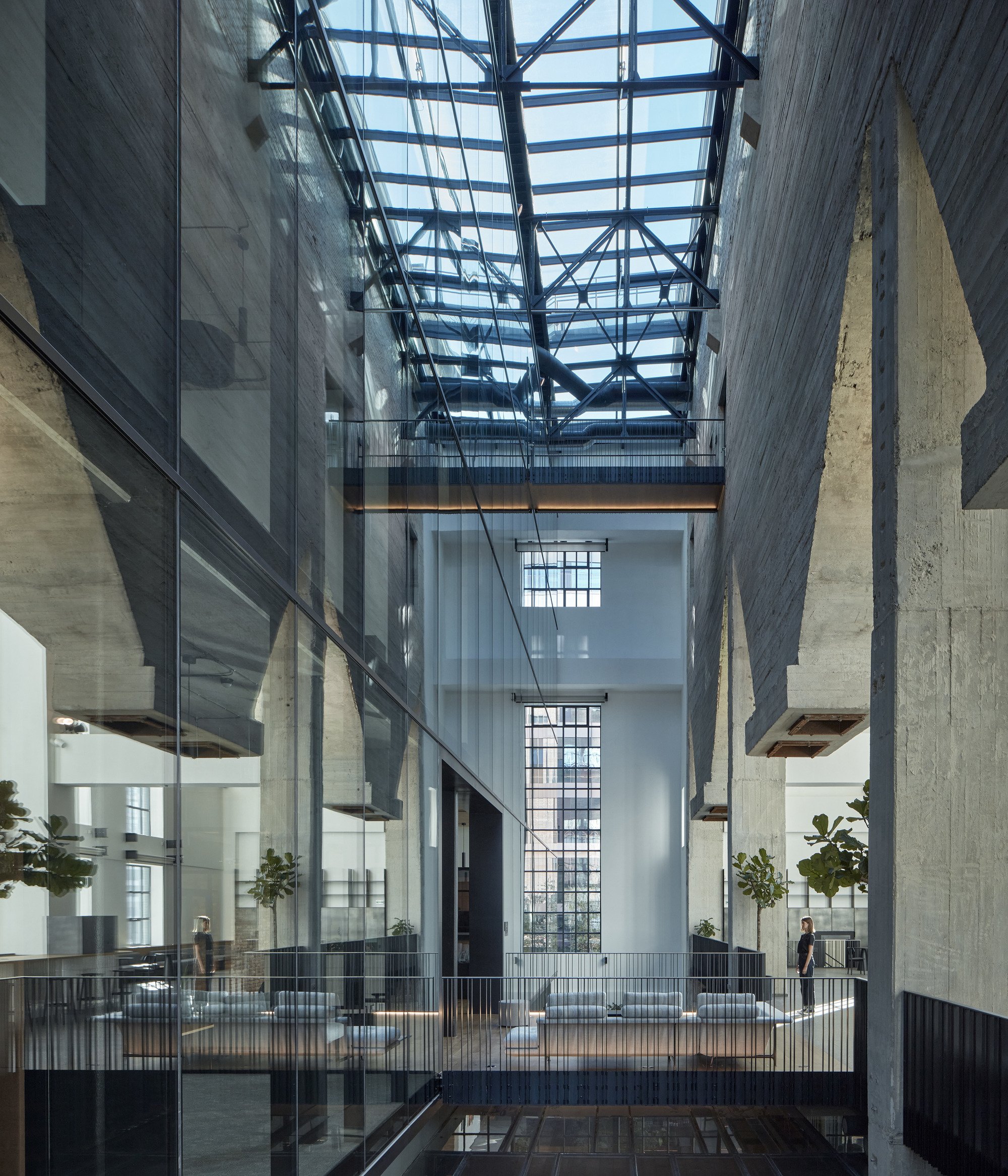
df creative group Nests a Five-Story Office Building Inside a WWII-Era Heating Plant in Bratislava
A bombed, abandoned refinery relic becomes a co-working hub, gallery, and restaurant through a meticulous building-within-a-building strategy.

The Jurkovič Heating Plant is the last surviving fragment of Bratislava's Apollo Refinery, an industrial complex partially destroyed by Allied bombing in 1944 and later abandoned entirely. Designed in the 1940s by Dušan Jurkovič, widely regarded as the founder of modern Slovak architecture, the building fuses Art Nouveau flourishes with functionalist rigor. After decades of neglect and the demolition of every other refinery structure around it, the heating plant was declared a national cultural monument in 2008. It now sits at the center of Sky Park, a residential masterplan by Zaha Hadid Architects, where its rough brick mass reads as a deliberate counterpoint to the sleek towers rising on all sides.
What makes the conversion by df creative group, led by Martin Pasko, genuinely interesting is the structural logic. Rather than gutting the interior and draping new finishes over old bones, the team inserted an entirely independent structure inside the original shell. New floors, walls, and bridges do not touch the historic facades; they maintain a visible gap, so the relationship between old and new is always legible. The result is 6,300 square meters of co-working space, a restaurant, a café, a contemporary art gallery, and a multifunctional hall, all organized around a full-height atrium carved through the former turbine hall. The guiding principle, as the architects frame it, is "truthfulness": every new material declares itself as new, and every salvaged element is left honest.
A Brick Shell Reborn
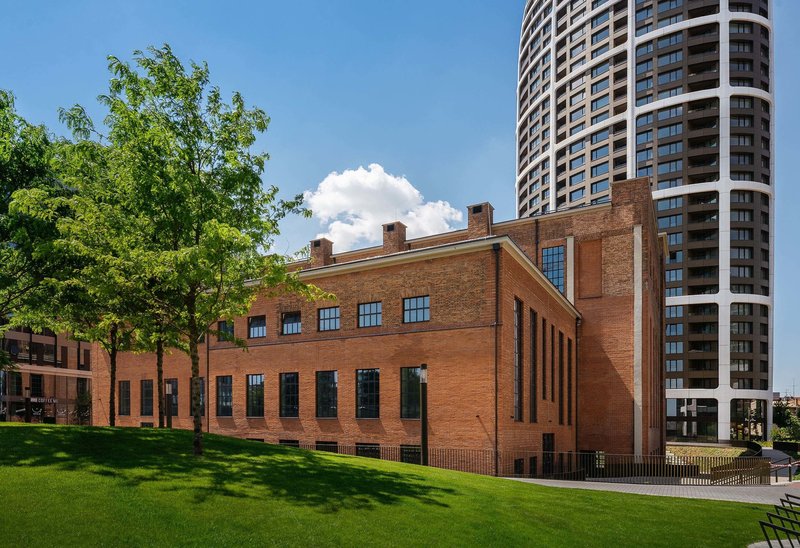
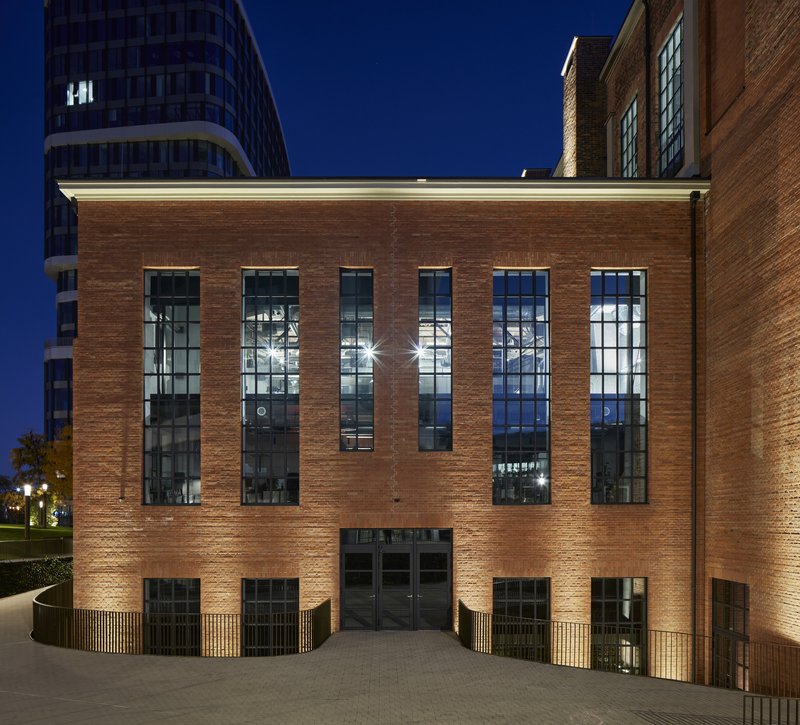
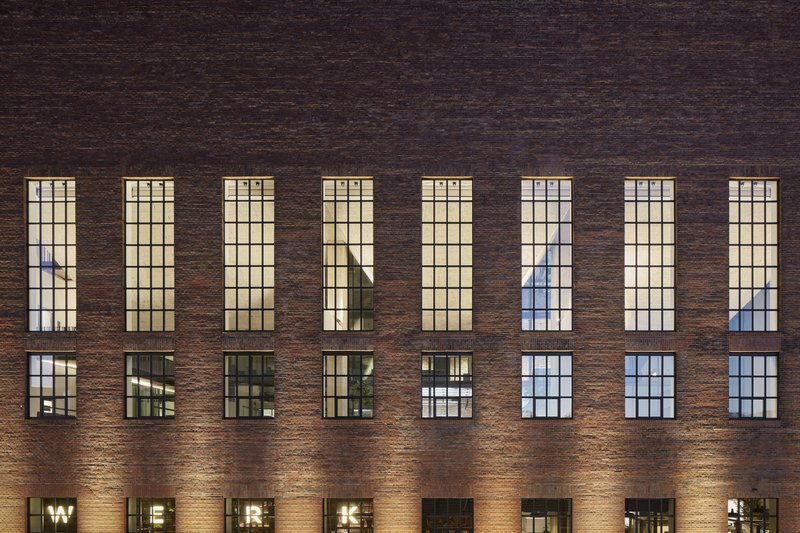
The exterior tells a story of restraint. The red brick facades, with their tall gridded industrial windows, have been cleaned and repaired rather than reimagined. Eleven original windows were salvaged and reinstalled; the rest are triple-glazed replacements that follow the original divisions precisely. At night the building glows from within, the grid pattern amplified by interior lighting that turns each window bay into a lantern. The curved brick section, one of the building's most distinctive moves, picks up uplighting that traces the mortar courses and reveals the subtle variations in brick-laying technique across different construction phases.
Over 31,000 bricks were recovered from the original facade during construction. Many of those were reused in the reconstructed interior, a painstaking salvage effort that keeps the material palette coherent even where the walls are entirely new. From the street, the heating plant looks almost unchanged. That is the point.
The Atrium as Inner Square
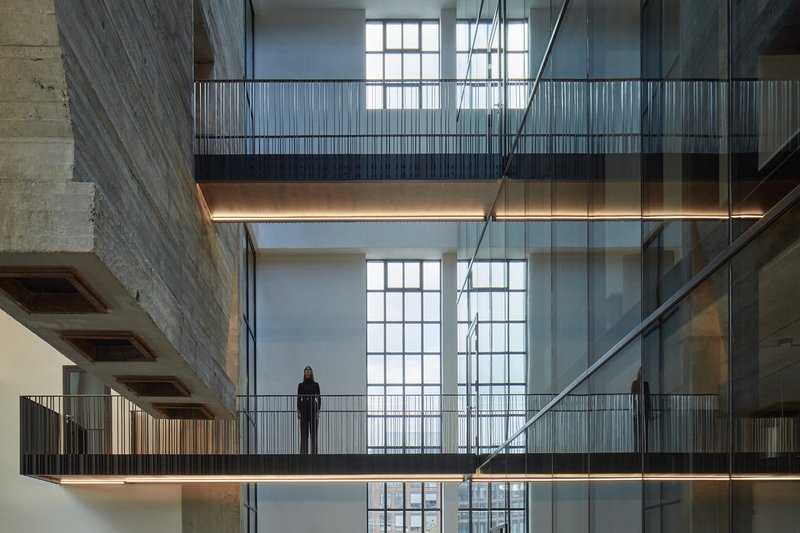
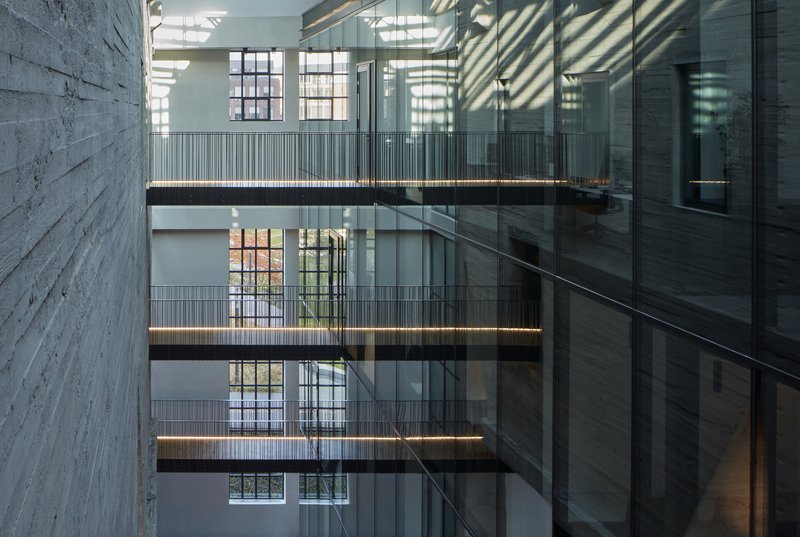
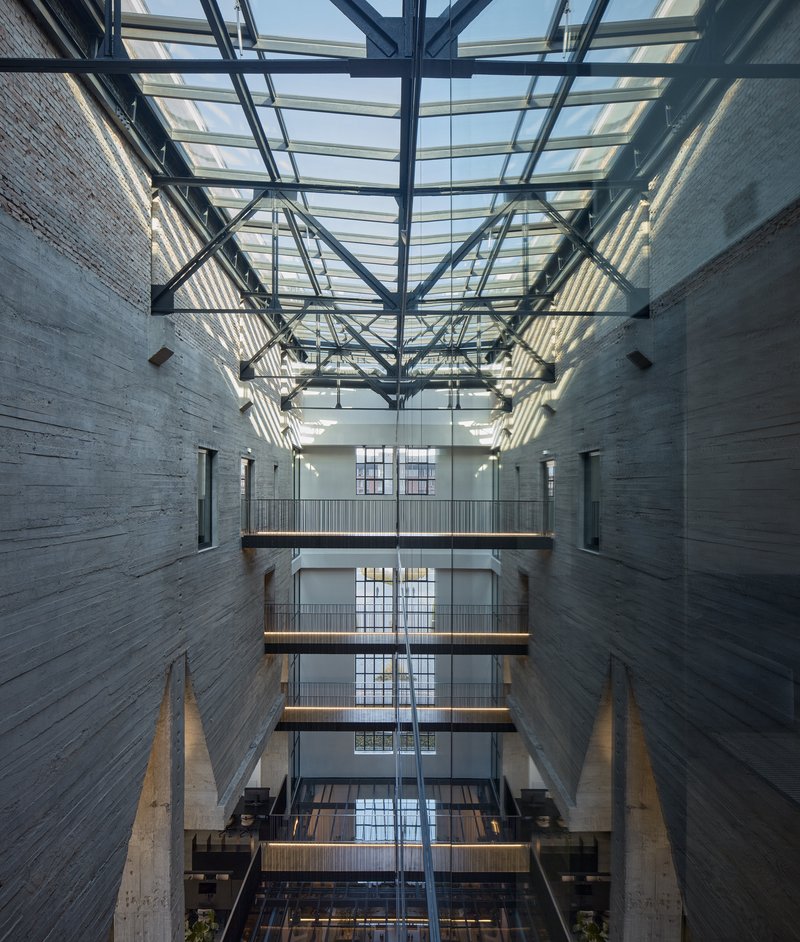
The full-height atrium, rising through all five floors to a steel truss skylight, is the spatial engine of the project. df creative group describes it as an interior "living square," and the analogy holds. Black steel bridges cross the void at multiple levels, connecting the two sides of the office building. Glass railings and corrugated metal soffits create layered shadow patterns that shift with the sun's position throughout the day. The experience from the ground floor, where the WERK restaurant and lobby café operate, is one of constant visual activity: figures crossing overhead, daylight slicing through the skylight, the original crane structure preserved and visible high above.
The decision to push all public programming to the ground floor while stacking office space above it means the atrium functions as a threshold between two worlds. You walk in off the lawn, past the café, through the gallery space, and only then encounter the vertical circulation that leads to the workplace. The ground floor is genuinely open to the public, not just in name.
Building Within a Building
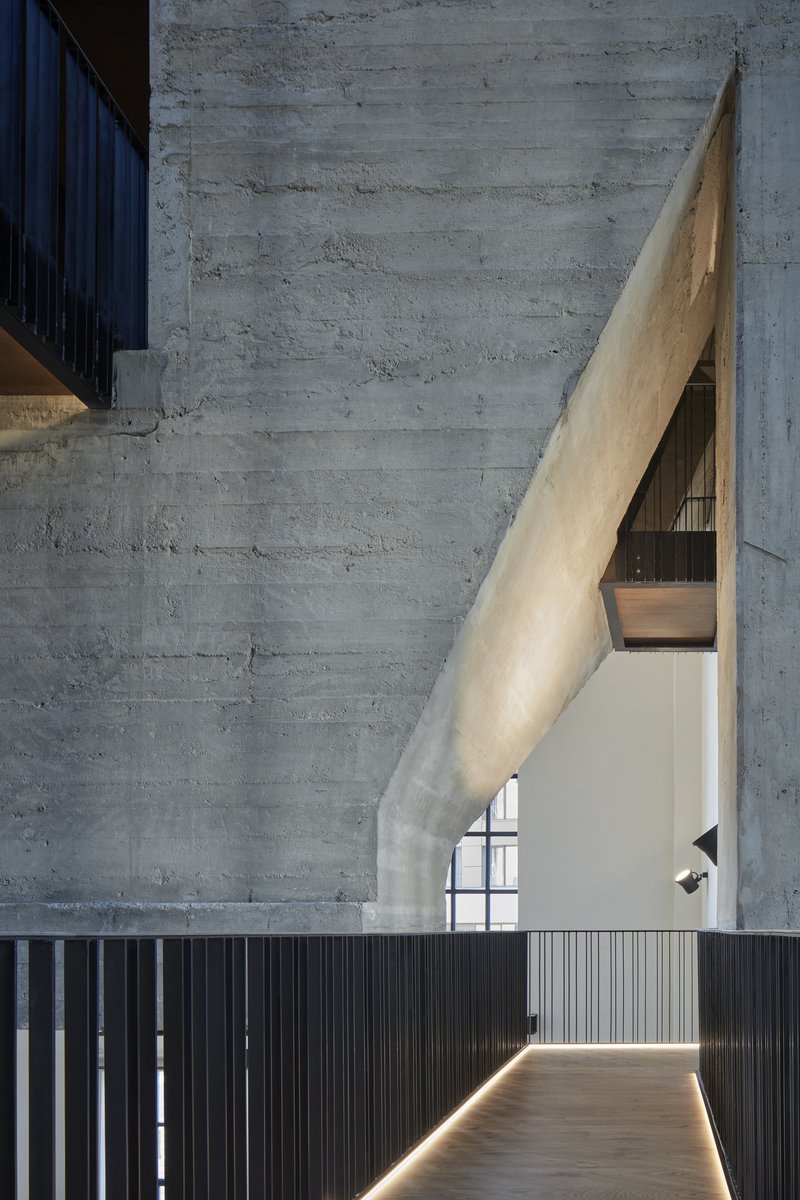
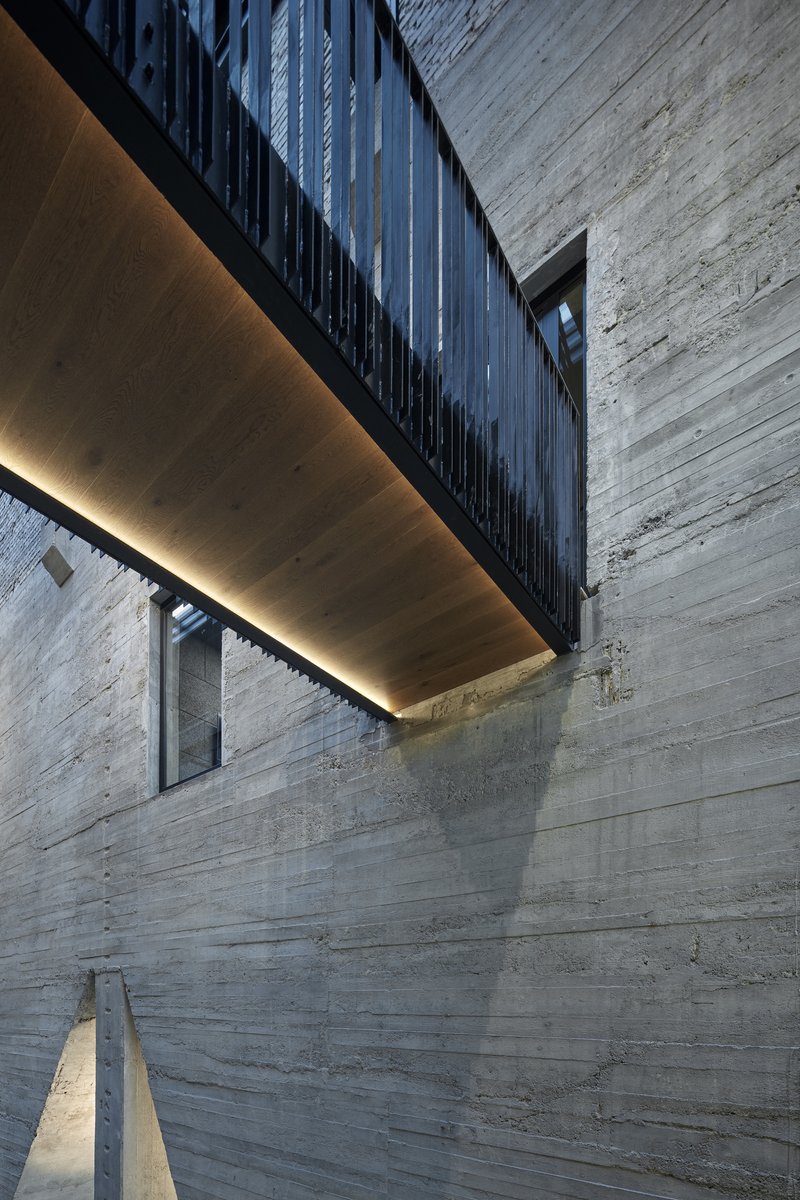
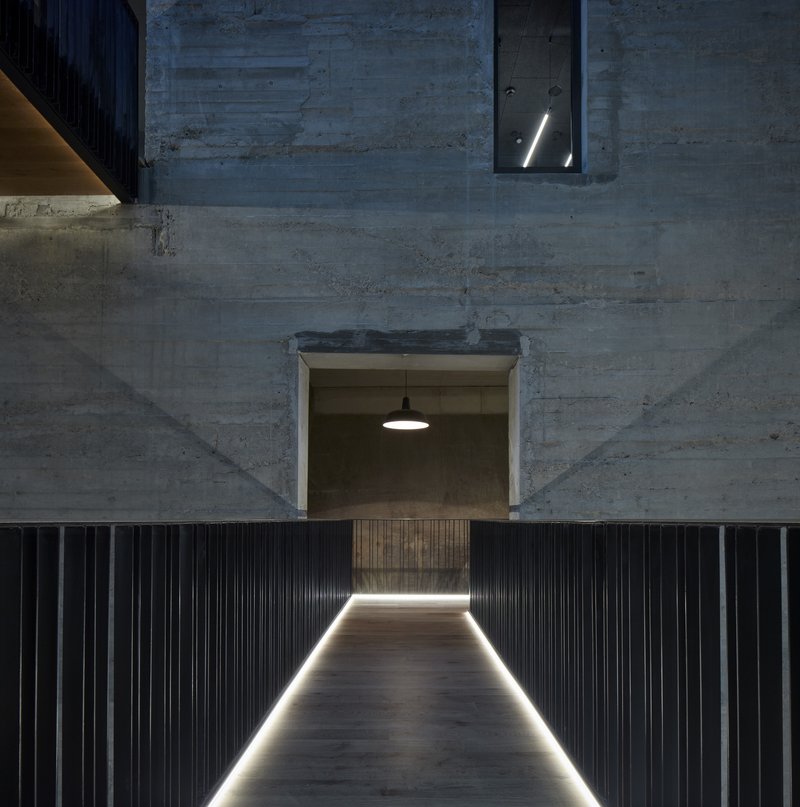
The gap between old and new is the conceptual heart of the project. Board-formed concrete walls sit visibly offset from the original brick, with the space between them sometimes just a few centimeters wide. The new internal structure strengthens the historic envelope without bonding to it, and the detailing is deliberately minimal: raw concrete, black steel, Heraklith cladding. Corrugated metal panels at the base of certain walls catch recessed floor lighting, reinforcing the sense that the new volumes are floating objects dropped into a much older container.
Construction was carried out through an opening in the roof, a necessity given the protected status of the facades. The entire new structure had to be assembled from above, piece by piece, without disturbing the exterior. It is the kind of logistical constraint that, when embraced rather than fought, produces better architecture.
Coal Hoppers Become Meeting Rooms
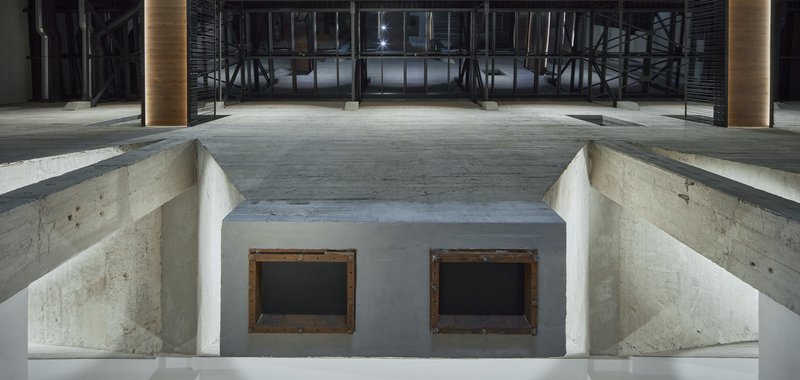
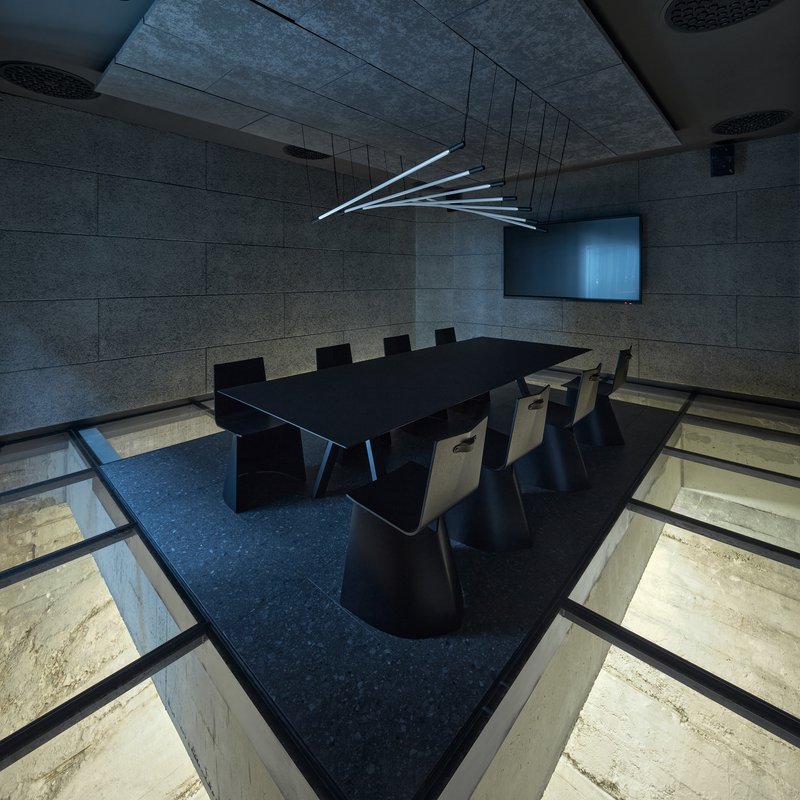
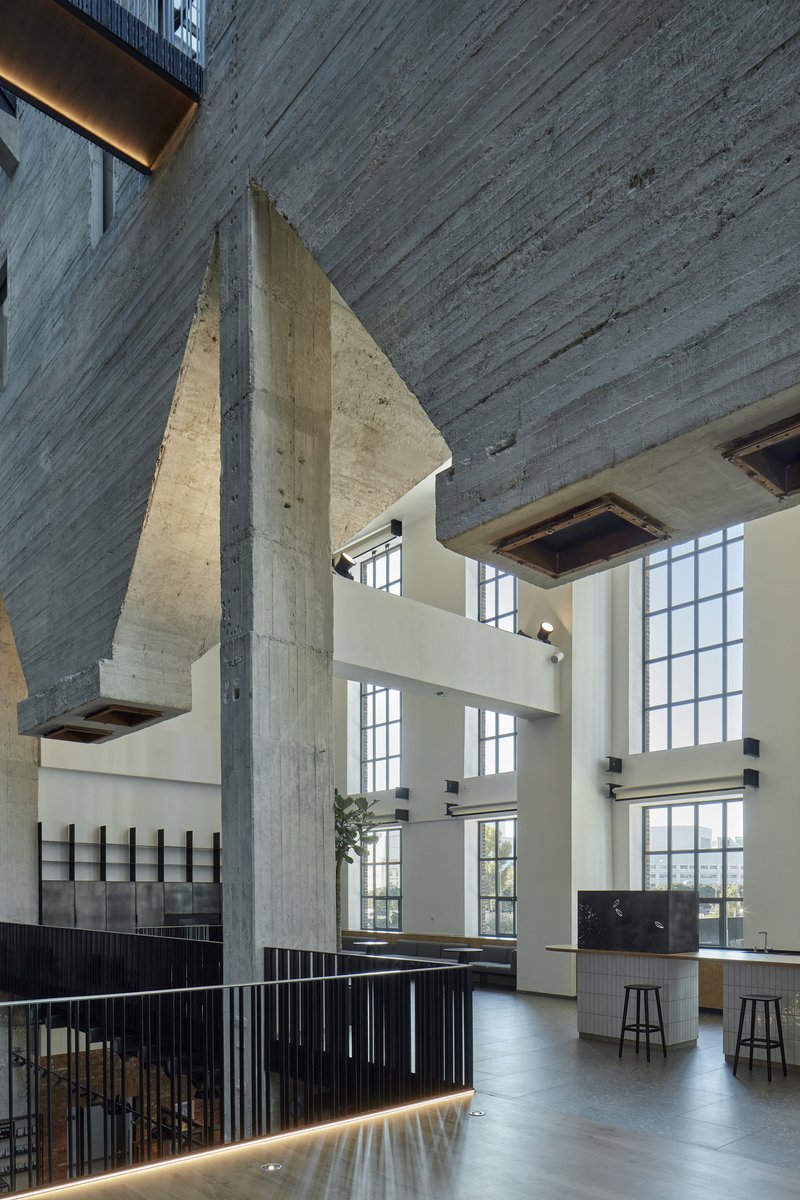
Three reinforced concrete coal hoppers, nationally protected elements that could not be demolished, presented the most inventive design challenge. Rather than treating them as obstacles, the architects converted them into glass-floored meeting rooms. You sit in a conference room with an LED fixture overhead and look straight down through the floor into the level below. The hoppers' original funnel geometry, sunken concrete volumes with angular walls, is preserved and legible. Timber-framed openings punctuate the mass, providing access while keeping the industrial character intact.
Nearby, an angled concrete column supports an elevated slab above a communal kitchen, the structural expressiveness left deliberately visible. These moments, where the program occupies the residual geometries of industrial infrastructure, are where the project is at its most convincing.
The Co-Working Interiors
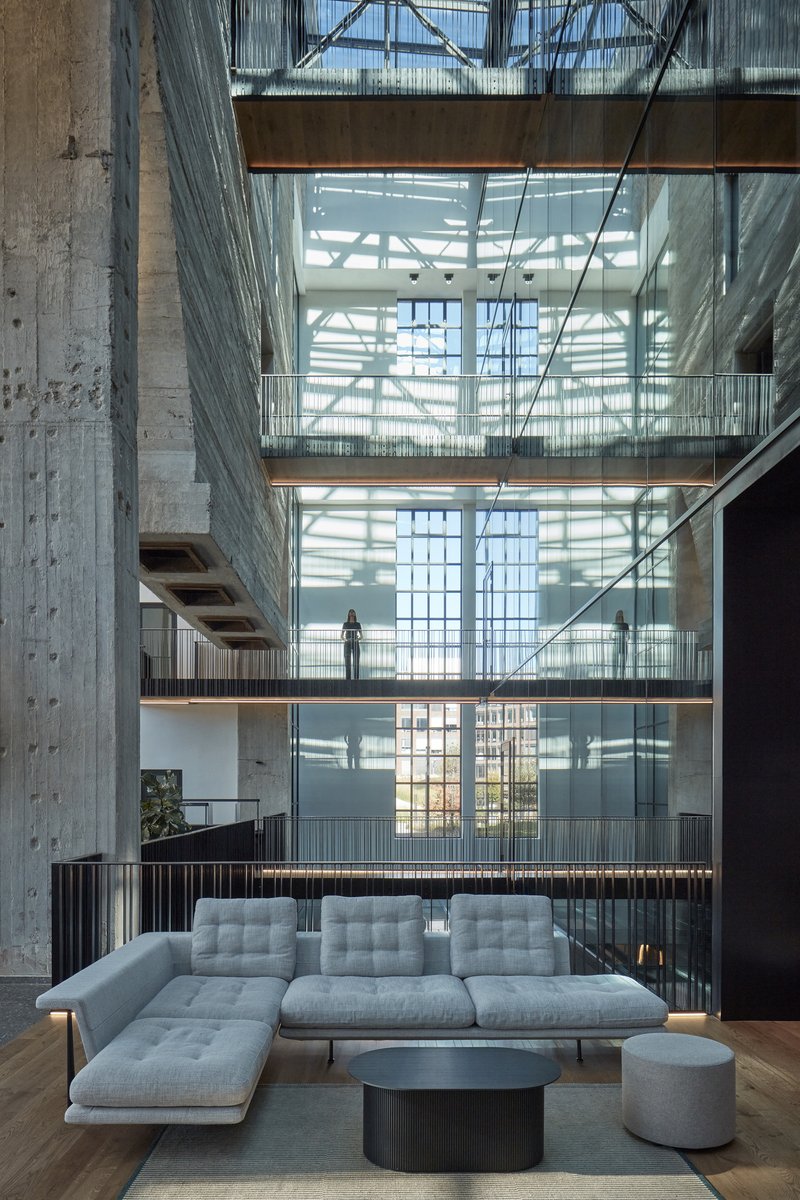
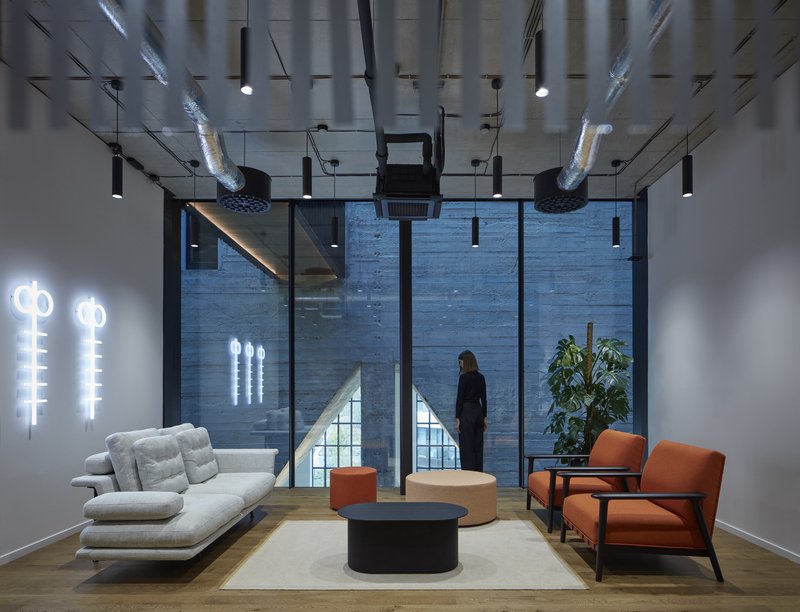
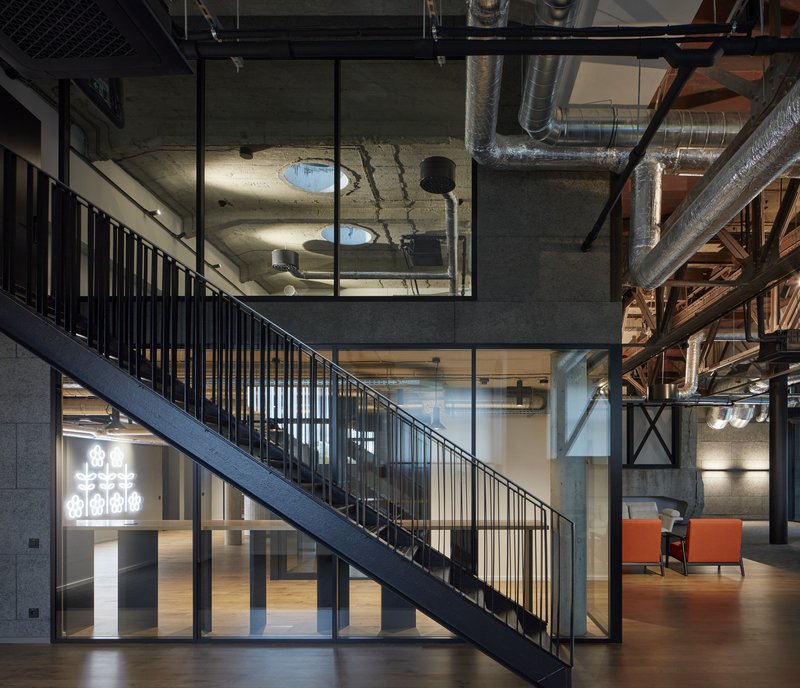
The BASE co-working center occupies the upper floors with a deliberately restrained material palette. White walls, orange and neutral upholstery, and black steel staircases create a contemporary office environment that reads as a clean insert against the brick and concrete backdrop. The lounge areas along the atrium edge are generous, with sectional sofas positioned to face the full-height void and the walkways above. It is a workplace that constantly reminds you where you are.
Glass-enclosed meeting rooms slot beneath exposed structural ceilings, and vertical balusters on the staircase echo the grid of the original windows outside. The interiors are minimalist without being sterile, largely because the building's history provides all the texture anyone needs.
Roof Structure and Upper Terrace
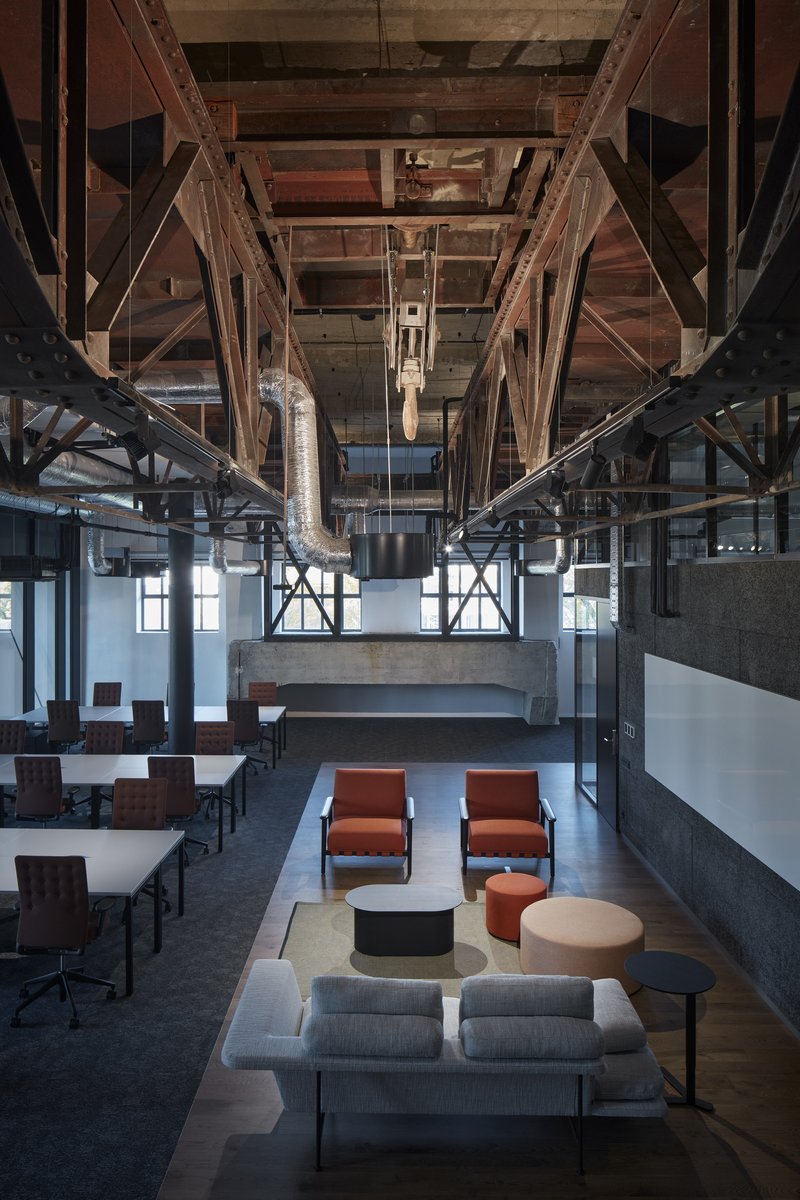
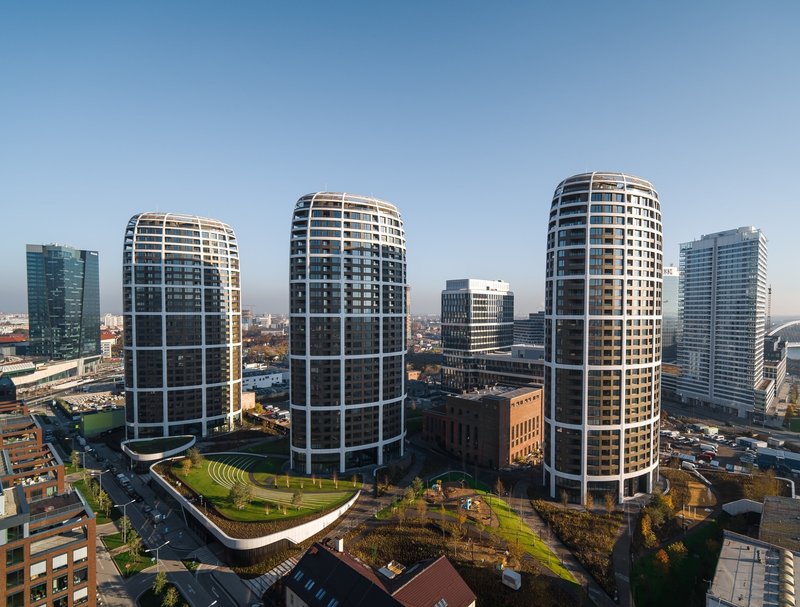
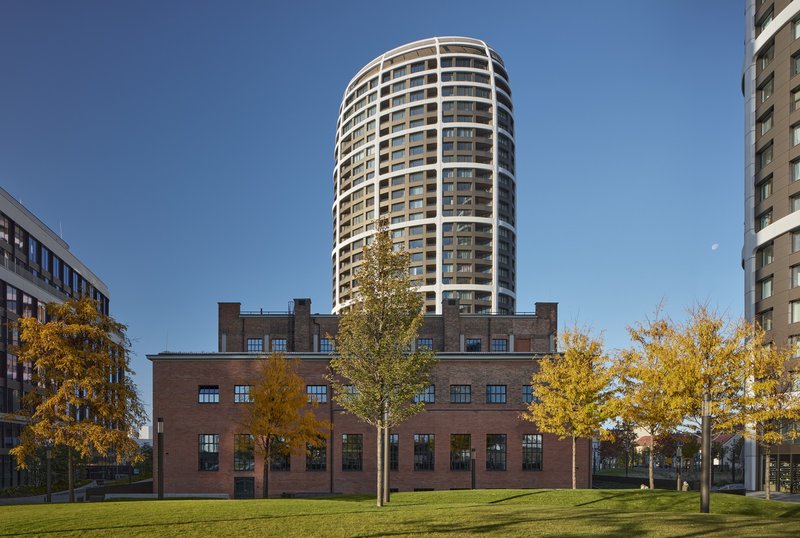
The preserved timber trusses and steel bracing at the roof level are among the most visually striking elements of the project. Exposed and restored, they frame the uppermost seating areas with a kind of raw grandeur that no new structure could replicate. An upper terrace opens outward, providing views of the Sky Park towers and the broader Bratislava cityscape. The cylindrical towers of the original plant, now cleaned and banded with horizontal detailing, rise above the roofline and anchor the building's silhouette against its glass-clad neighbors.
Circulation and Thresholds
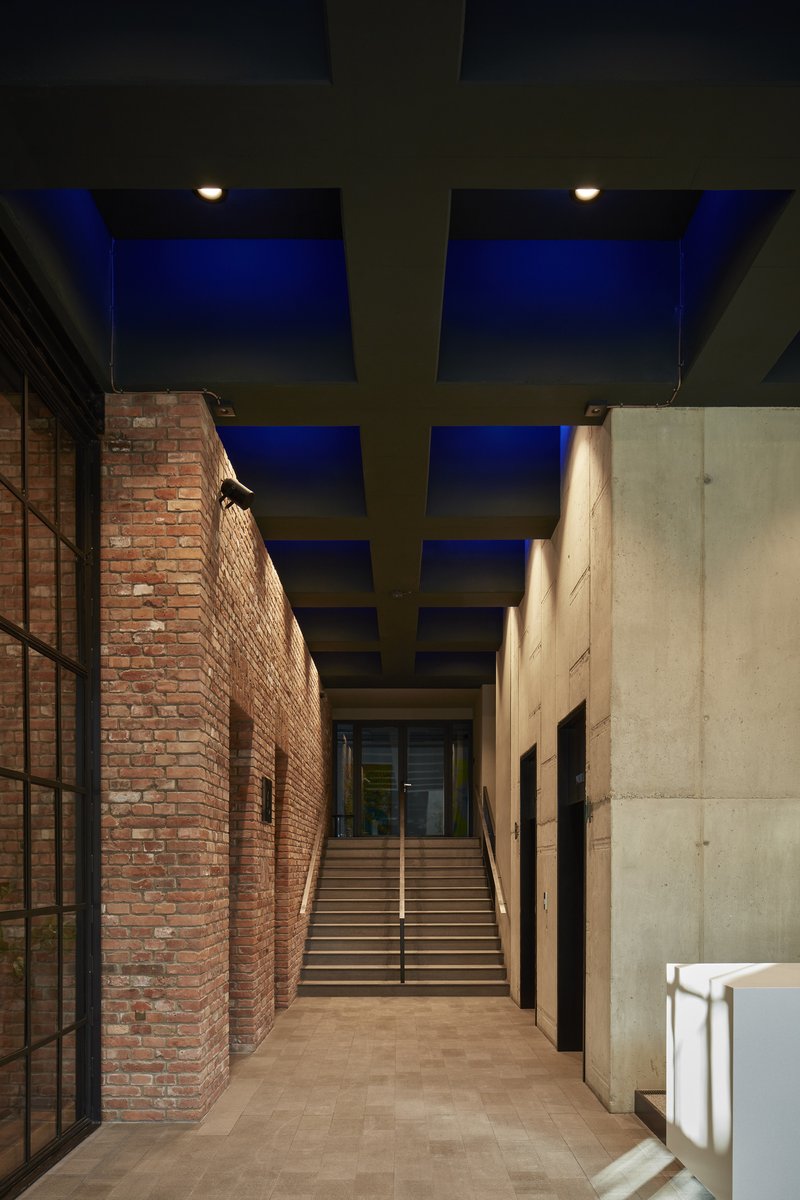
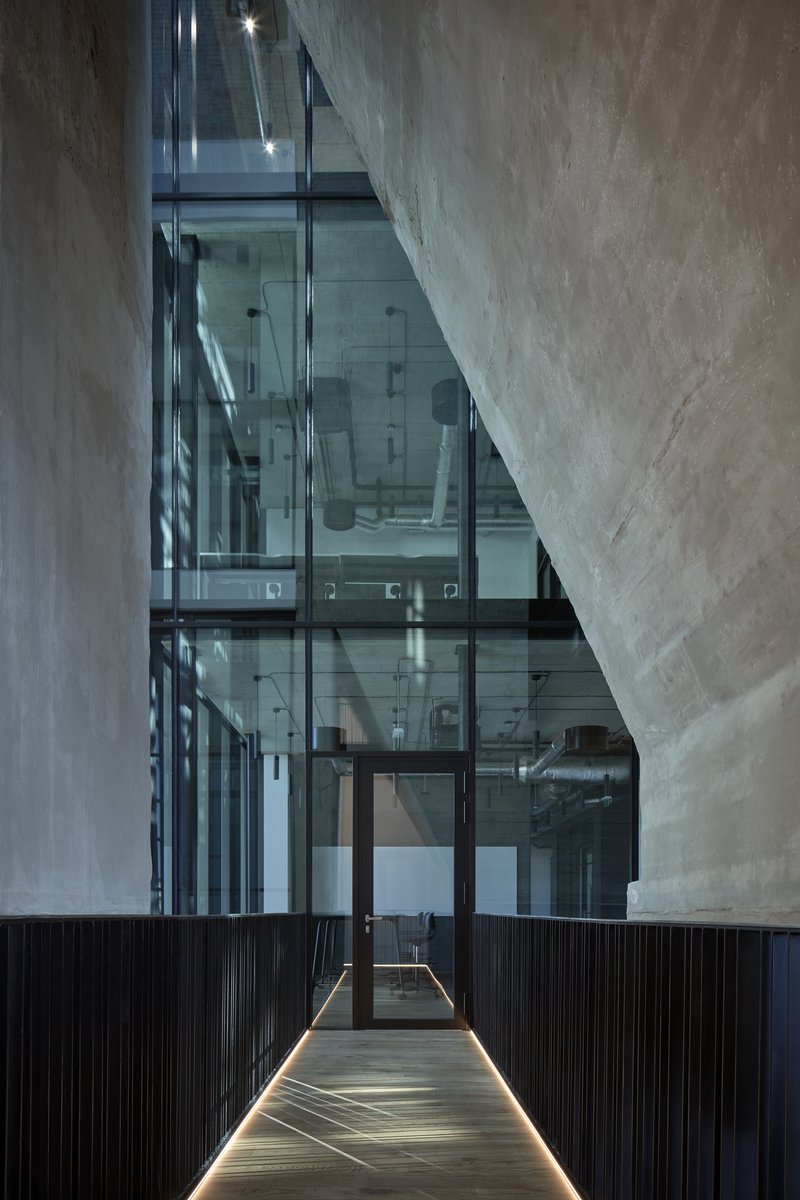
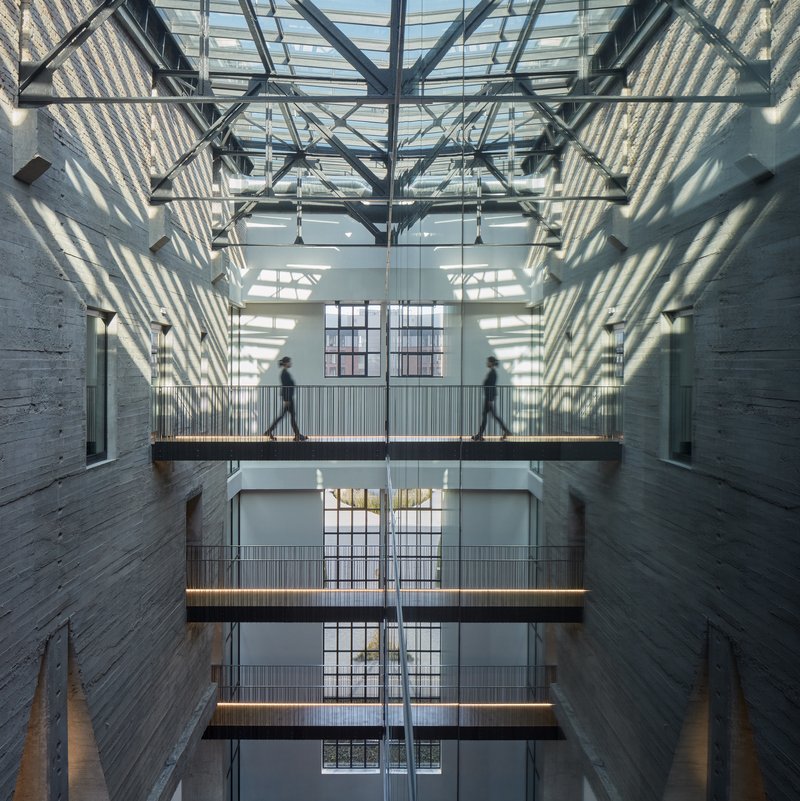
The covered passageway between brick and concrete walls at the building's entrance sets up the tonal contrast immediately: warm, textured masonry on one side, smooth poured concrete on the other, with a staircase visible at the far end drawing you inward. Inside, the glass elevator shaft and black metal corridor walls create a darker, more compressed experience that makes the atrium feel even more expansive when you arrive. The stacked walkways, viewed from below through the skylight, produce geometric shadow play that changes by the hour.
Plans and Drawings
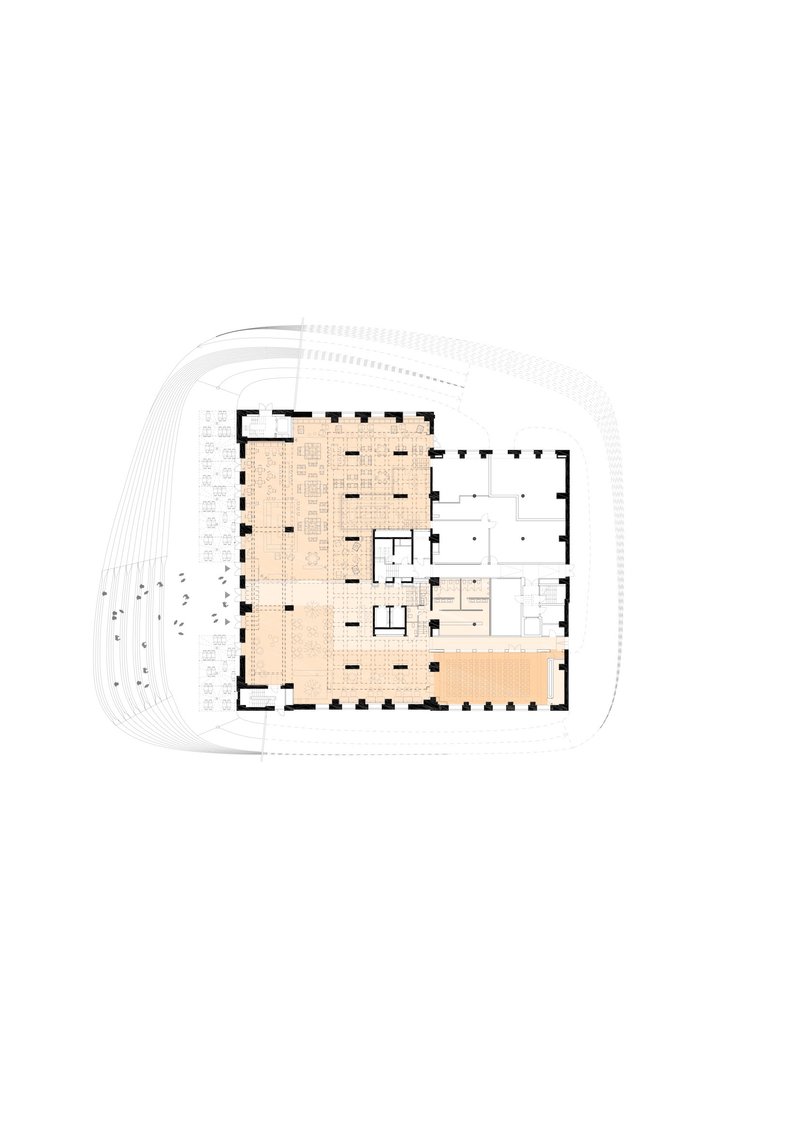
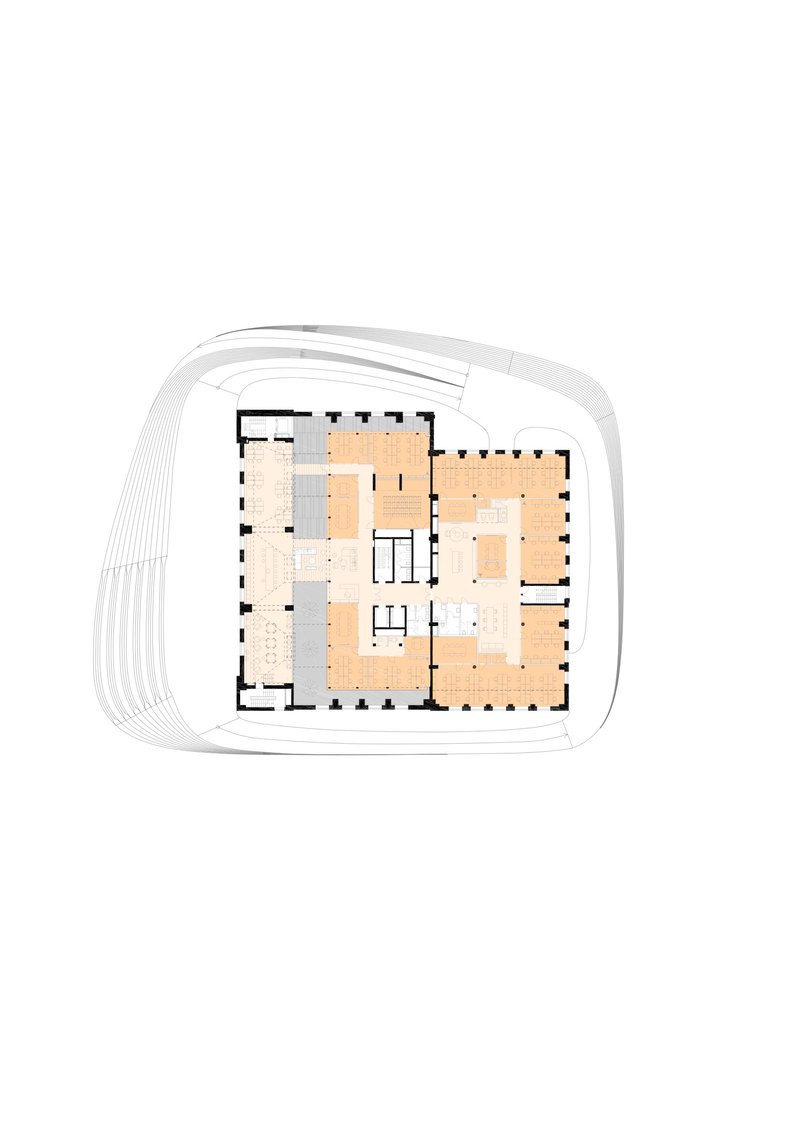
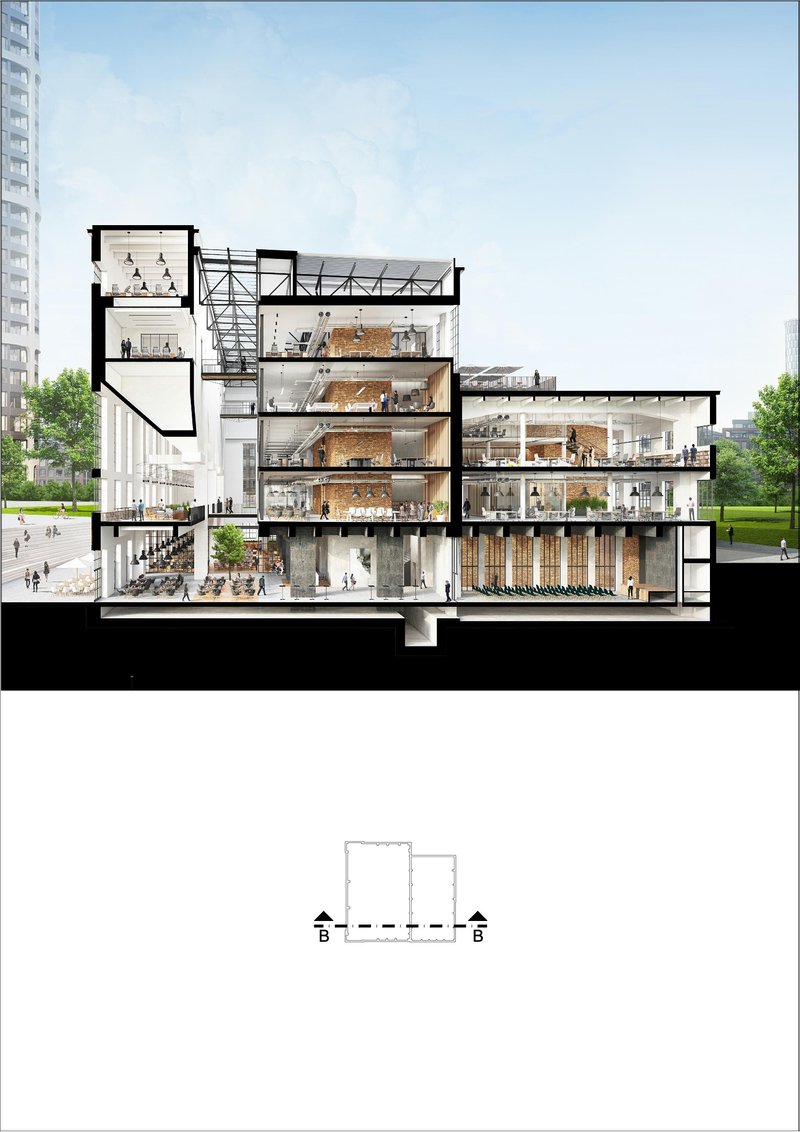
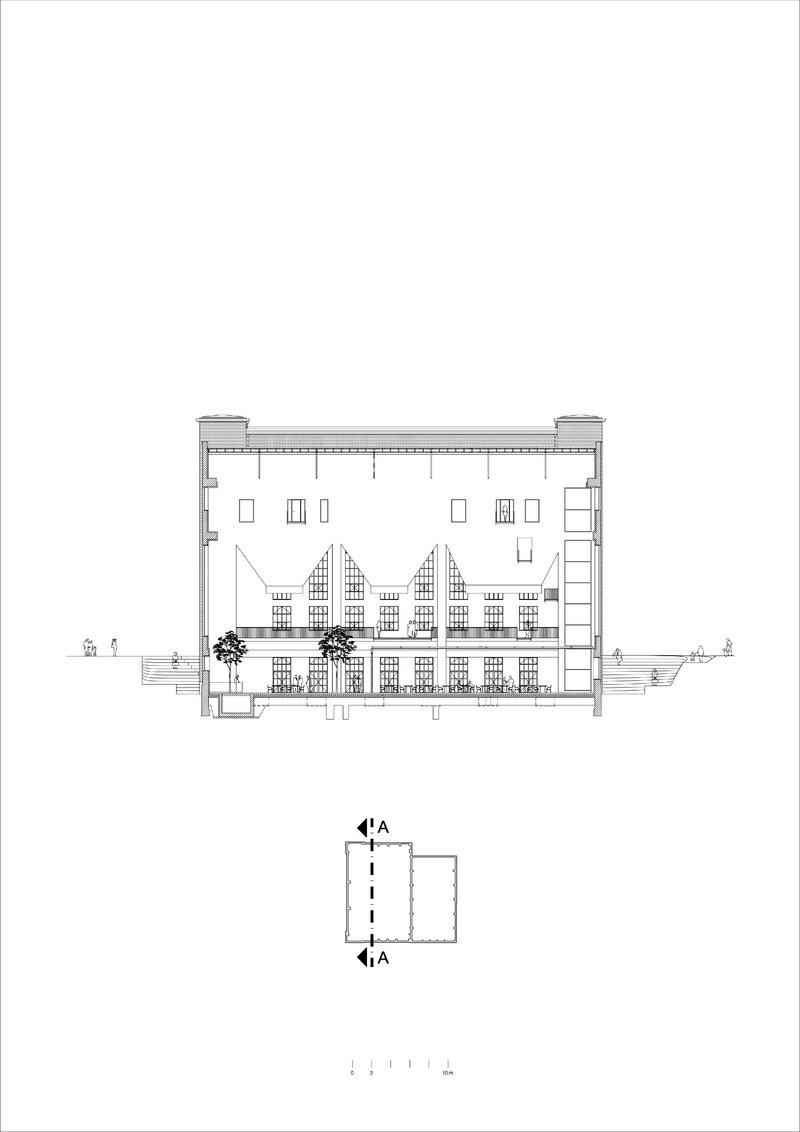
The floor plans reveal the open column grid of the new internal structure, with enclosed rooms pushed to the edges and the central void left clear. The irregular curved perimeter of the upper floors traces the original brick shell precisely, and the circulation cores are concentrated to preserve maximum open area. The sections are the most telling drawings: they show the full height of the atrium, the timber roof structure restored above new floors, and, in the longitudinal cut, the historic facade retained as an outer layer with the new building sitting independently within it. Trees at ground level indicate the landscape strategy that ties the plant into the Sky Park public realm.
Why This Project Matters
Adaptive reuse has become architecture's default virtue signal, but the Jurkovič Heating Plant conversion earns its credentials through structural discipline rather than surface aesthetics. The building-within-a-building strategy is not merely conceptual; it solves the real problem of adding 6,300 square meters of usable floor area to a protected monument without compromising its integrity. Every joint between old and new is a legible seam. The coal hoppers turned into glass-floored meeting rooms, the crane left in place as a spatial landmark, the 31,000 salvaged bricks reintegrated into interior walls: these are not decorative gestures. They are evidence of a team that understood the building well enough to let it dictate the design.
The project also matters for what it says about Bratislava's relationship with its industrial past. The Apollo Refinery is gone. Every building except this one was demolished to make way for the Sky Park development. That the heating plant survived at all is partly luck, partly bureaucratic protection, and partly the stubbornness of Jurkovič's original construction. That it now functions as a co-working hub, gallery, and restaurant at the center of a Zaha Hadid masterplan is a more provocative proposition: the oldest, roughest building on the block has become the one that gives the entire neighborhood its identity.
Conversion of Jurkovič Heating Plant National Cultural Monument by df creative group, led by Martin Pasko. Located in Bratislava, Slovakia. Land area: 1,800 m²; built area: 6,300 m². Completed in 2021. Photography by Boys Play Nice.
About the Studio
Share Your Own Work on uni.xyz
If projects like this are the kind of work you want to make, uni.xyz is a place to publish your own, find collaborators, and enter design competitions.



Popular Articles
Popular articles from the community

a2o architecten Builds a Concrete and Brick Wunderkammer in the Belgian Countryside
House Be in Flanders treats dwelling as a Romantic act, threading rooms along a central axis that opens gradually toward a restored landscape.
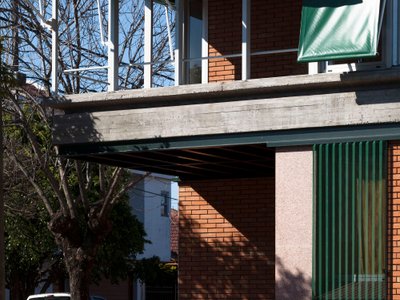
Francisco Cadau Converts a 1970s Corner House in Campana into Four Compact Dwellings
A light steel-and-timber upper volume lands on a brick base, turning a single Argentine home into a tectonic study in railroad vernacular.
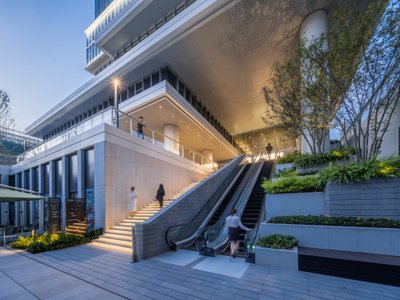
Superimpose Architecture Splits a Hangzhou Transit Hub into Valley and Cloud
A 72,000-square-meter mixed-use TOD complex near Alibaba's campus pairs human-scaled green terraces with serene tower volumes.
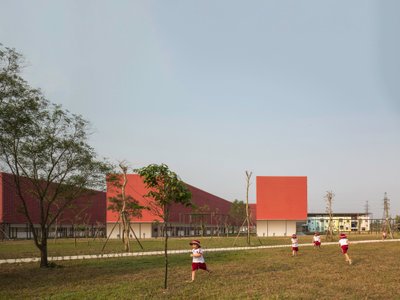
BHA Studio Wraps a 2,000-Student Campus in Terracotta Screens and Double-Layered Roofs in Central Vietnam
iSchool Quang Tri in Đông Hà uses perforated brick lattices and rainwater harvesting to keep 17,000 square meters cool and green.
Similar Reads
You might also enjoy these articles

127af Flips a Tiny Bagnolet Rowhouse Upside Down with a Handcrafted Roof Extension
A 55-square-meter terraced house on the edge of Paris gains a luminous upper living floor through lightweight timber and steel.
1.61 Design Workshop Wraps a 600-Square-Meter Café in Vietnam in Sculptural Burgundy Drama
Reden Café & Bistro pairs a helical staircase, mosaic floors, and deep red interiors to rethink Vietnamese hospitality space.

The Unbound Brain: A School Shaped by Cognitive Architecture
Cylindrical learning pods radiate like neurons from a central cortex, turning the floor plan into a spatial model of human thought.
Revival Vernacular Architecture: Rammed Earth Settlements for the Sahara
A modular desert community in Mauritania that fuses passive cooling techniques with earthen construction and local craftsmanship.
Explore Office Building Competitions
Discover active competitions in this discipline




The Global Benchmark for Architecture Dissertation Awards


The Global Benchmark for Graduation Excellence

Bring back Drive In's
Comments (0)
Please login or sign up to add comments
No comments yet. Be the first to comment!