

dolmus Architekten Wraps a Willisau Apartment Block in Curved Tiles and Galvanised Steel
A four-storey residential building in central Switzerland replaces a single-family house with a robust, sun-facing volume rooted in its plot.


Replacing a single-family house on a sloped site in Willisau, dolmus Architekten's Apartment Block Grundmühle is the kind of densification project Swiss towns increasingly need but rarely get right. The four-storey volume follows the northeastern edge of its plot, tucking into the existing topography while stretching its living spaces toward the southwest to capture daylight and views of distant hills. It is a building that earns its presence not through scale but through material specificity: curved, vertically segmented facade tiles, exposed concrete balconies, and galvanised metal elements that give the whole composition a quietly industrial bearing.
What makes this project worth studying is the way it resolves two competing pressures. The first is programmatic: fitting two to three apartments per floor around a single central staircase without producing corridor-heavy plans. The second is contextual: inserting a multi-storey block into a neighbourhood of pitched-roof houses without it reading as an imposition. dolmus Architekten manage both by keeping the plan compact and the facade articulate, using verticality in the tile pattern to elongate the building's proportions and soften its massing against the treeline.
A Facade Built from Rhythm


The street-facing elevation tells you most of what you need to know about the architects' intentions. Continuous vertical bands of windows alternate with curved, segmented tiles that catch light differently across the day, creating a surface that reads as textile more than wall. The stacked white balconies, cantilevered in exposed concrete, punctuate this rhythm with horizontal depth, giving the facade a layered quality that rewards a second look.
Galvanised metal railings and trim reinforce a material logic centred on durability and ageing. Nothing here is precious. The palette is concrete, brick, tile, and zinc: materials that weather predictably and gain character over time. For a residential building in a small Swiss town, this is a smart bet. Maintenance costs stay low, and the building grows more at home in its context as the years pass.
Living Rooms Turned Toward the Light

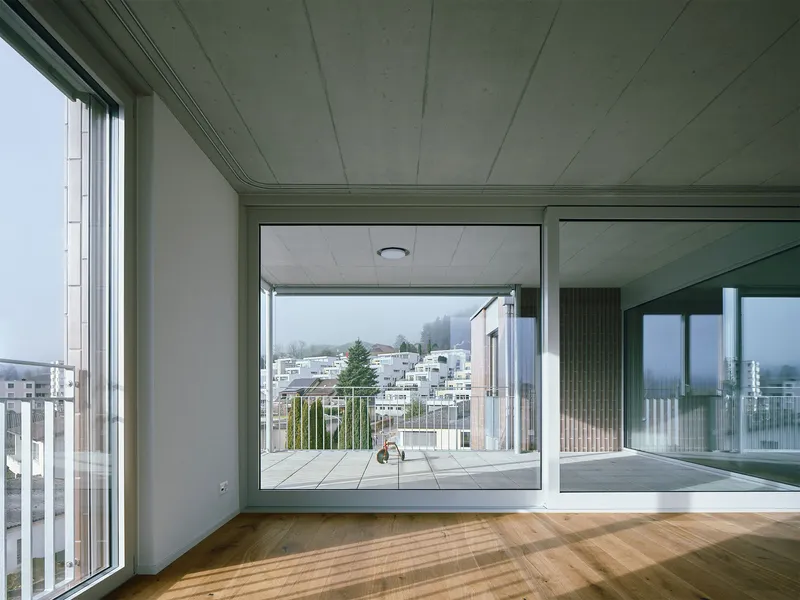

The interior strategy is straightforward and effective. Bedrooms line the entrance zone near the central core, absorbing the less desirable orientations and acoustic exposure from the corridor. Living and dining areas, paired with open kitchens, occupy the southwest-facing ends of each unit, where floor-to-ceiling glazing frames generous views and floods rooms with afternoon light. Oak flooring warms the palette inside, a deliberate contrast to the concrete and tile of the exterior and circulation spaces.
The relationship between interior and balcony is handled well. Sliding glass doors open onto tiled terraces deep enough to furnish, while concrete soffits above provide weather protection without darkening the rooms behind. On misty days, the balconies frame the landscape like viewfinders, cropping the rolling hills and neighbouring rooftops into something almost cinematic.
Balconies as Inhabitable Edges
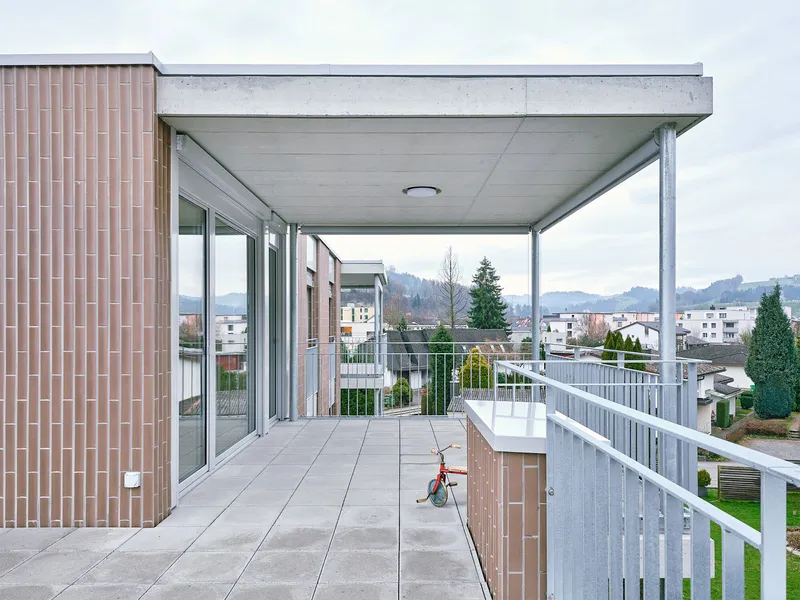

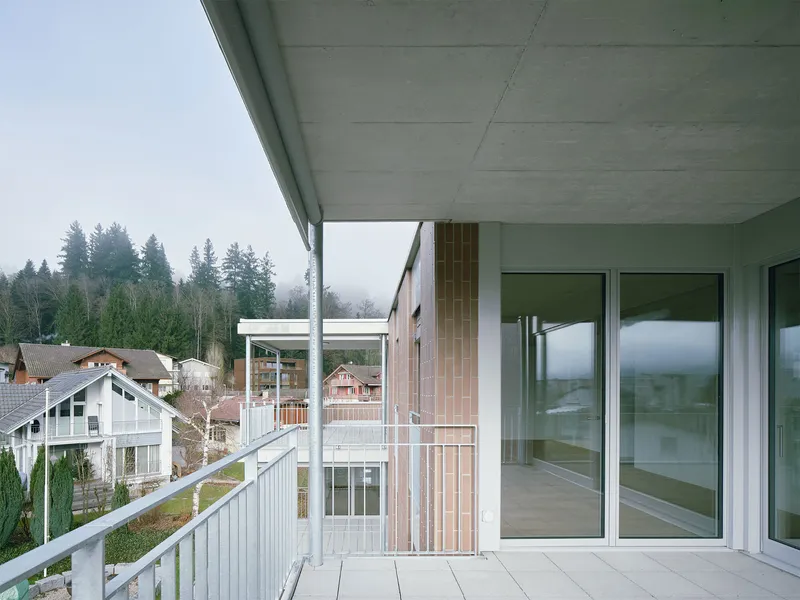
The balconies here are not decorative appendages. They are carved into the building's volume, recessed beneath thick concrete slabs, and detailed with vertical timber screens and metal railings that offer privacy without blocking airflow. Each one reads as a distinct outdoor room, calibrated to its orientation. Some face the residential street with timber screening for intimacy; others open toward the forested hillside with more transparent railings.
This differentiation matters. A balcony overlooking a parking area and one overlooking a valley demand different degrees of enclosure, and dolmus Architekten treat each condition on its own terms. The result is a set of outdoor spaces that residents will actually use, not just photograph from the inside.
Circulation with Character


The central staircase is raw concrete with a brass handrail and wire mesh safety guards, a combination that gives the shared circulation a civic quality rarely achieved in small apartment buildings. A recessed skylight at the top of the stair shaft sends warm light down through the core, turning what could be a utilitarian fire escape into the building's spatial spine.
Corridors on each floor use the same light timber flooring found in the apartments, blurring the threshold between public and private. The mustard-coloured apartment doors introduce the only strong colour in the palette, acting as wayfinding markers. It is a restrained set of moves, but they add up to circulation spaces that feel generous and intentional rather than residual.
Plans and Drawings

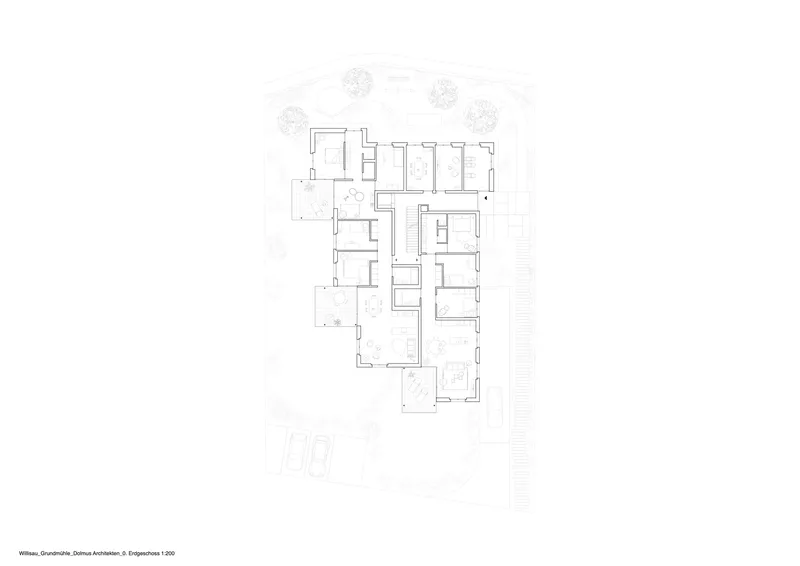
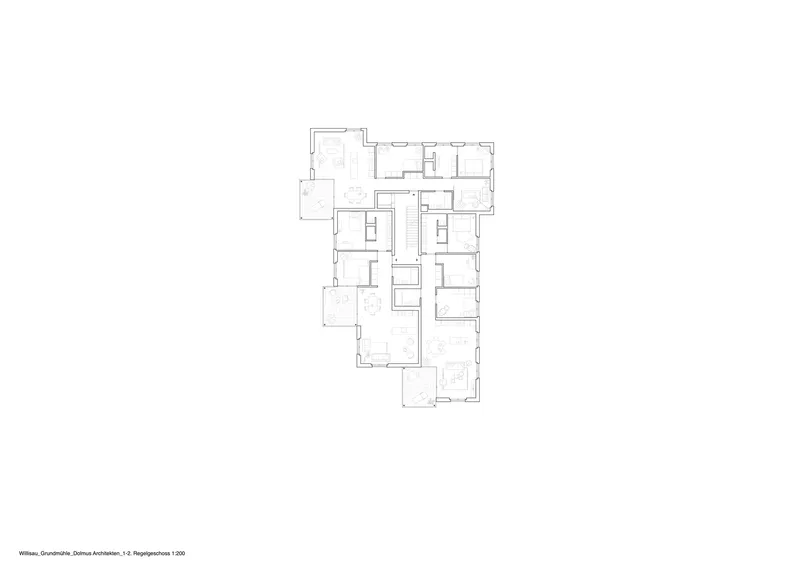

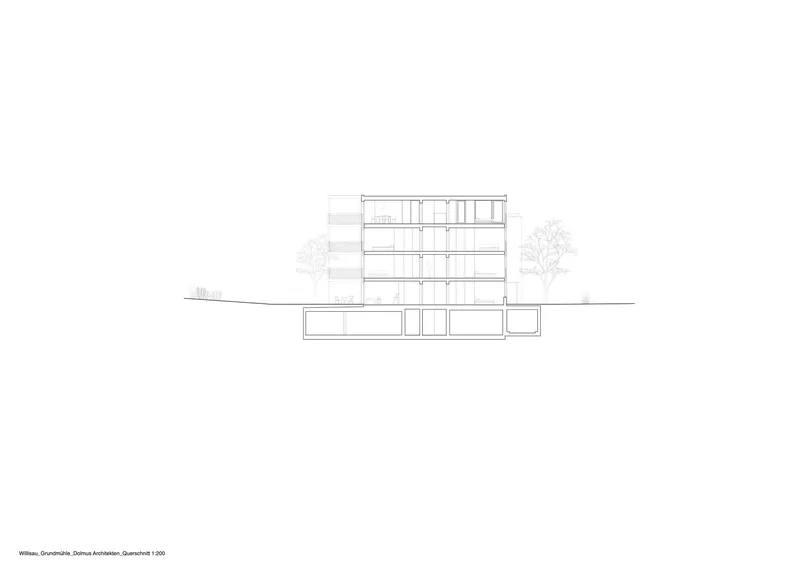
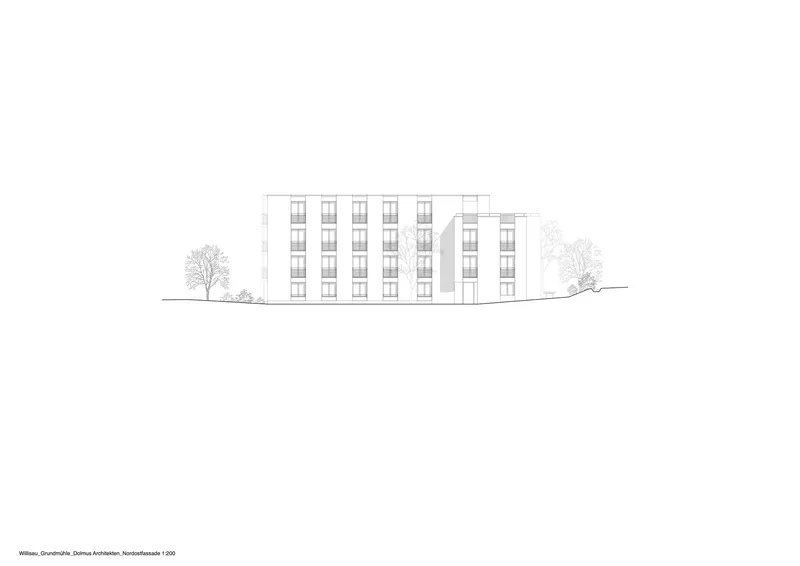
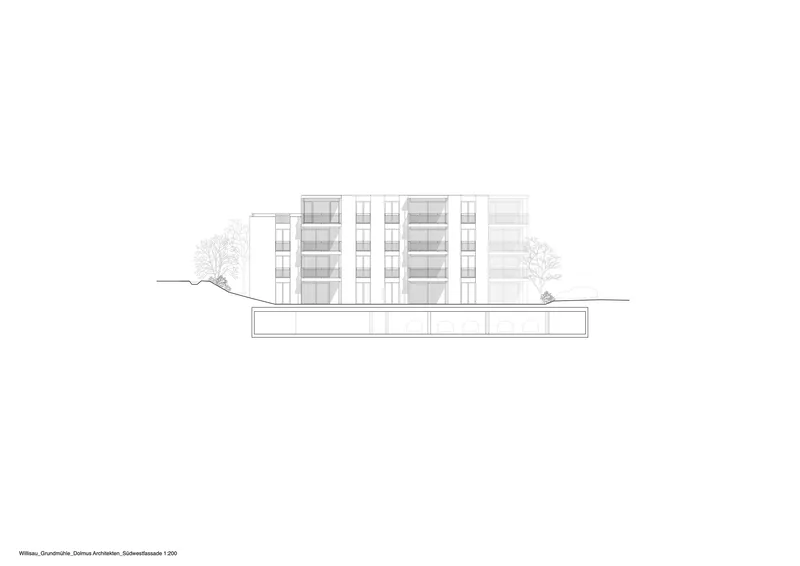
The site plan reveals how closely the building's footprint follows the plot boundary on the northeast side, maximising garden space on the opposite face. Floor plans show a compact central staircase distributing two to three units per level, with bedrooms clustered near the core and living spaces pushed to the building's southwest perimeter. The section confirms the four-storey volume with basement levels cut into the slope, and the elevations document the tile pattern and balcony rhythm in detail.
What the drawings make especially clear is the economy of the plan. There is almost no wasted corridor space. The staircase does double duty as light well and social threshold, and each apartment wraps its program efficiently around the core. For a building of this size, the ratio of usable to circulatory area is notably high.
Why This Project Matters
Apartment Block Grundmühle is a case study in how to densify a low-rise neighbourhood without alienating it. The four-storey volume is substantial, but its articulated facade, recessed balconies, and landscape integration prevent it from dominating its context. dolmus Architekten have not tried to disguise the building as something smaller than it is. Instead, they have invested in surface, material, and detail to make its scale feel earned.
The project also demonstrates that durable, unflashy material choices and clear spatial logic can produce residential architecture with genuine presence. There is no formal gymnastics here, no parametric geometry, no sculptural staircase meant for social media. What there is: a well-made building that faces the sun, shelters its residents, and will still look good in thirty years. In an era of housing shortages and disposable construction, that is a quietly radical proposition.
Apartment Block Grundmühle by dolmus Architekten, Willisau, Switzerland. Completed 2026. Photography by Egemen Karakaya.
About the Studio
Share Your Own Work on uni.xyz
If projects like this are the kind of work you want to make, uni.xyz is a place to publish your own, find collaborators, and enter design competitions.


Popular Articles
Popular articles from the community


Opera by the Sea Estonia: Three Shells Dissolving Architecture into Tallinn's Coastline
A winning opera house proposal replaces monumental form with interconnected shells that blur the boundary between building, park and Baltic Sea.

Cloaked Colonization: A Mobile Underwater Habitat That Moves Like a Fish
Micah Abaya's shortlisted EHC Pacific entry reimagines ocean settlement as a dispersed network of self-sustaining architectural organisms.

Extended Shell: Retrofitting Kolkata's Balconies as Living Urban Thresholds
A modular retrofit system recovers the social and environmental intelligence of Kolkata's historic verandas for contemporary Park Street residents.

Temporary Home for Dogs: A Reversed Zoo Rethinks Animal Shelter Architecture
In Bucharest, a sinuous corridor and freed landscape flip the logic of containment, designing a shelter that works to make itself unnecessary.

Similar Reads
You might also enjoy these articles

Pixel Gardens: One Repeated Module Stacked Into a Terraced Social Housing Tower for Famagusta
Salem Bader's shortlisted housing tower builds a vertical neighbourhood from one repeated module, offsetting units to carve terraces, light and air.

Bao Huynh Watercolor Atelier: A Serene Art Retreat in Hội An
Bao Huynh Watercolor Atelier in Hội An blends multifunctional art spaces, sustainable design, local materials, and family-friendly living in a serene environment.

Atelier Macri Concept Store Interior Design by CASE-REAL
Atelier Macri store features a "ko" counter, walnut wood details, cork displays, blending retail, gallery, and seamless customer experiences.

Manuel Vargas Izquierdo Stadium and High-Performance Sports Center: Architectural Excellence in Jalpa de Méndez
The Manuel Vargas Izquierdo Stadium blends sustainable design, inclusive sports facilities, and cultural-inspired architecture, revitalizing Jalpa de Méndez’s public spaces.

Explore Apartment Competitions
Discover active competitions in this discipline

Challenge to reimagine the Iron Throne

Photograph architecture without architects

Illustrate the lost glory of Angkor Wat - Render Challenge

Design challenge to reuse E-waste
Comments (0)
Please login or sign up to add comments
No comments yet. Be the first to comment!