
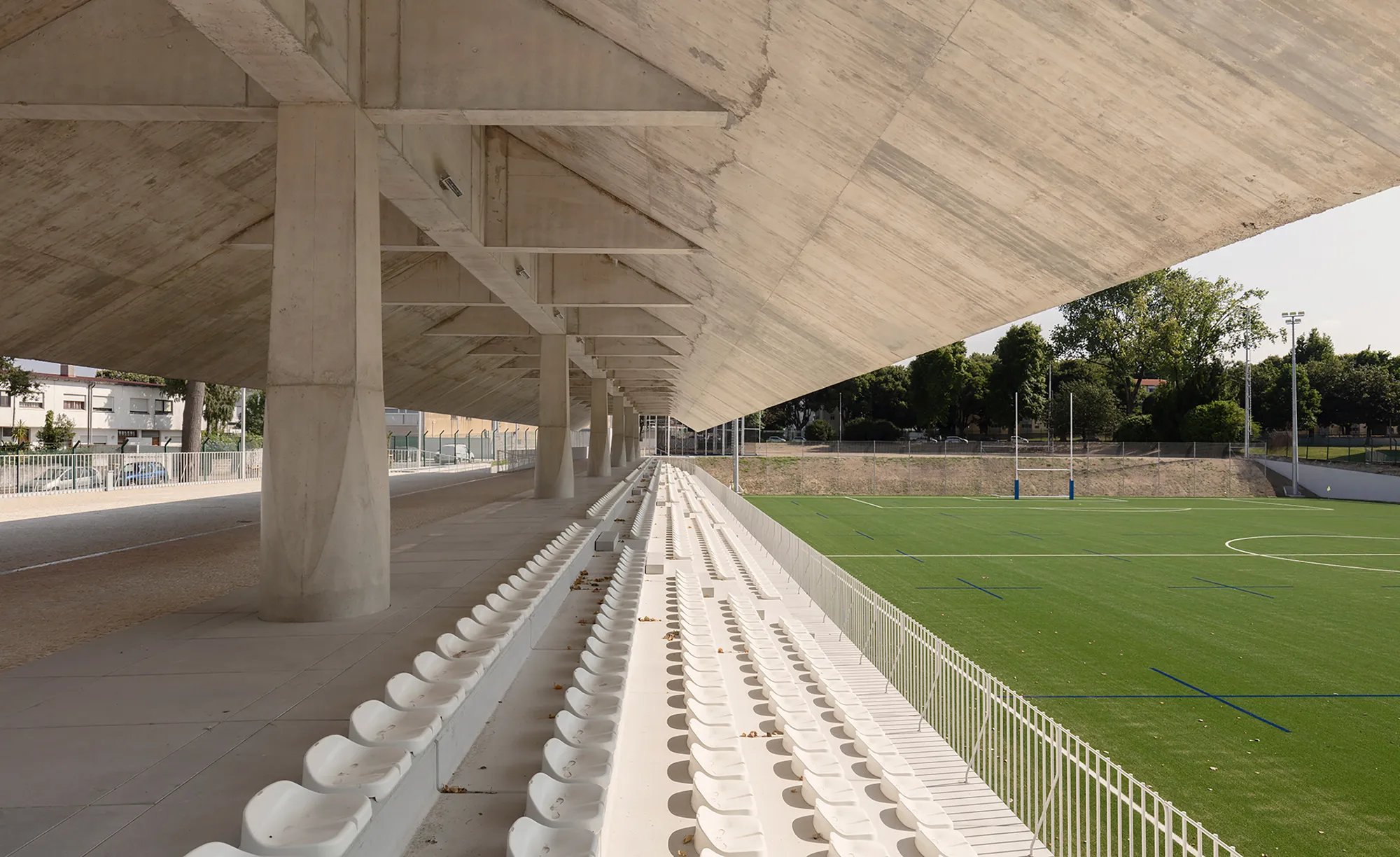
Domitianus Arquitectura Embeds a Concrete Grandstand into Porto's Ramalde Sports Park
A board-formed concrete pavilion merges with the landscape to serve rugby and football pitches in northern Porto, Portugal.


Sports infrastructure rarely gets the architectural attention it deserves. Most municipal projects in this category settle for prefabricated sheds and bolt-on bleachers, treating the program as a logistical problem rather than an opportunity to shape civic space. At Porto's Ramalde Sports Park, Domitianus Arquitectura takes the opposite approach, treating a grandstand and support building as a single topographic gesture: a long, low concrete volume that slots into a bermed podium so cleanly that it reads less as a building and more as an extension of the ground itself.
Completed in 2025, the 2,898 square meter intervention occupies the northern half of the park, serving newly constructed rugby and football pitches. The project's defining move is its section: a cantilevered roof shelters tiered seating above while a full program of changing rooms, clinical spaces, and service areas tucks beneath at pitch level. What makes the building genuinely interesting is how seriously it takes the material and sectional logic of a type that usually gets none.
The Cantilever as Civic Canopy

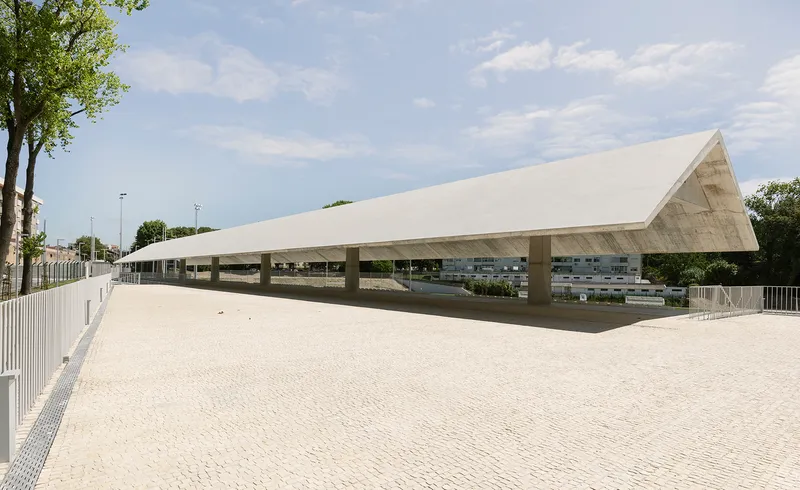

The most striking element from the pitch is the cantilevered concrete roof, which extends well beyond the last row of seats to cast the entire grandstand in shade. Board-formed and left exposed, the soffit carries the imprint of its timber shuttering like a geological record. From below, the cantilever's underside becomes a kind of ceiling for the adjacent paved plaza, framing views of mature trees and the park perimeter. It is a move borrowed from mid-century Brazilian precedent, but deployed here without nostalgia.
The structural logic is straightforward: a series of central columns carry the roof load, allowing both the pitch-side and park-side edges to float free. White molded seats and simple metal railings keep the palette restrained. The effect is one of quiet authority, a building that does not shout but commands the space around it.
Embedding the Building in the Terrain


Rather than sitting on the landscape, the pavilion is set into it. The entrance approach reveals a bermed podium with retaining walls of the same board-marked concrete, so the transition from topography to architecture is gradual and deliberate. Tiered seating steps emerge from this artificial landform, their risers doubling as the structural section that houses the rooms below.
From the residential neighborhood to the east, the building barely registers above the treeline. This is not modesty for its own sake but a pragmatic reading of the site: the park is flanked by apartment blocks, and a tall structure here would have been combative rather than generous. By sinking the program, Domitianus preserves sightlines and keeps the park's open character intact.
Arrival and Threshold
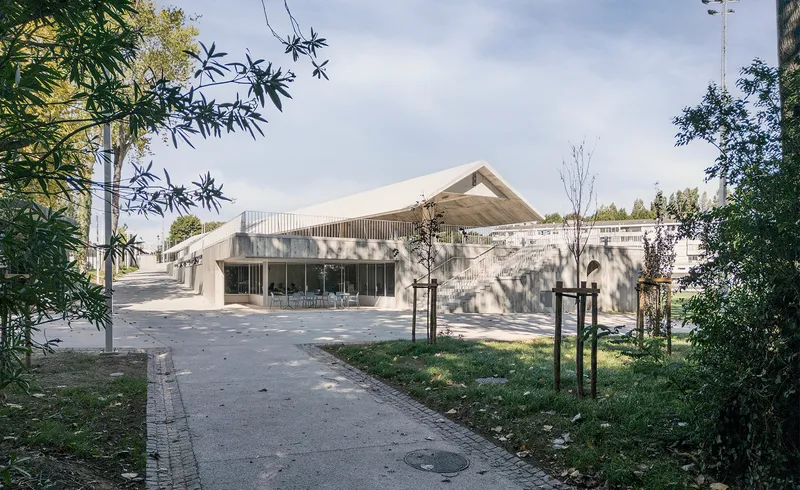
The entrance sequence is handled with care. A pathway lined with bamboo and young trees channels visitors toward a glass-fronted gabled volume that signals the building's presence without overwhelming it. The gabled form is a deliberate departure from the dominant horizontal language, marking the threshold between park and program.
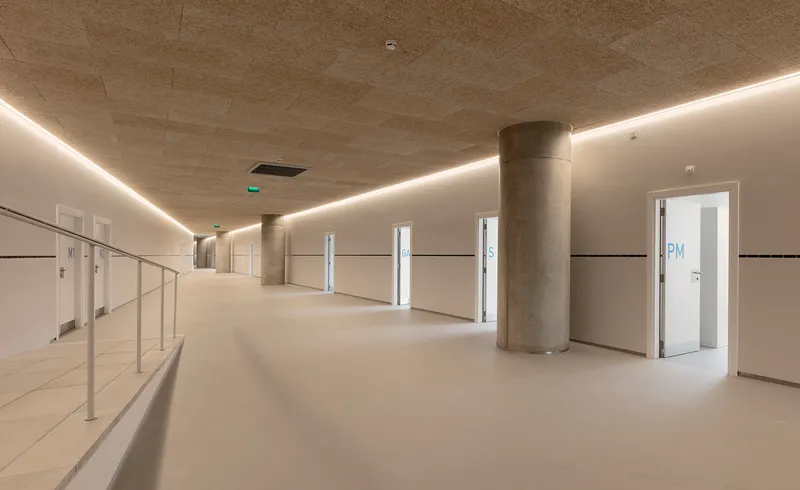
Inside, a concourse runs the length of the building beneath the board-marked concrete ceiling. Continuous perimeter cove lighting traces the ceiling edge, creating an even wash that softens the otherwise raw interior. Circular columns march down the central axis, reinforcing the sense of a covered street rather than a corridor.
Interior Program: Clinical Precision Below the Stands


Beneath the grandstand, the support spaces are finished with a controlled palette of white subway tile, exposed concrete soffits, and linear lighting strips. A clinical room with tiled walls and a window desk area offers treatment space for athletes. Showers are minimal and well lit. The material language is consistent: concrete above, tile below, light at the seam between them.
A waiting area with blue chairs and a veined marble reception counter introduces a warmer note. The marble is an unexpected luxury in a municipal sports building, and it works precisely because it is used sparingly, one surface rather than an entire room. These interiors are proof that civic programs do not require civic budgets to feel dignified.
Corridors and Materiality

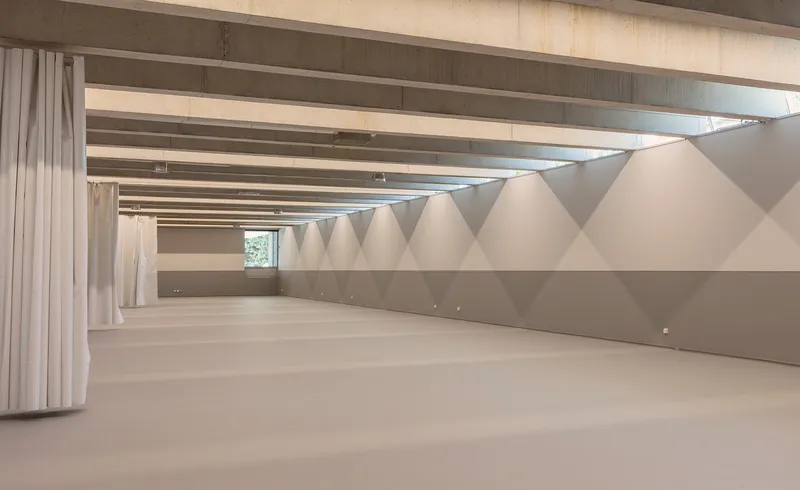
Two corridor conditions reveal the range within a tight material vocabulary. One is defined by board-formed concrete service cores and continuous cove lighting that hugs the ceiling edge. The other features faceted white wall panels beneath exposed timber beams, a moment where the structure's formwork logic is literally turned inside out and left on display. Both corridors are long and narrow, but the variation in surface treatment keeps them from feeling monotonous.
Urban Scale and Context

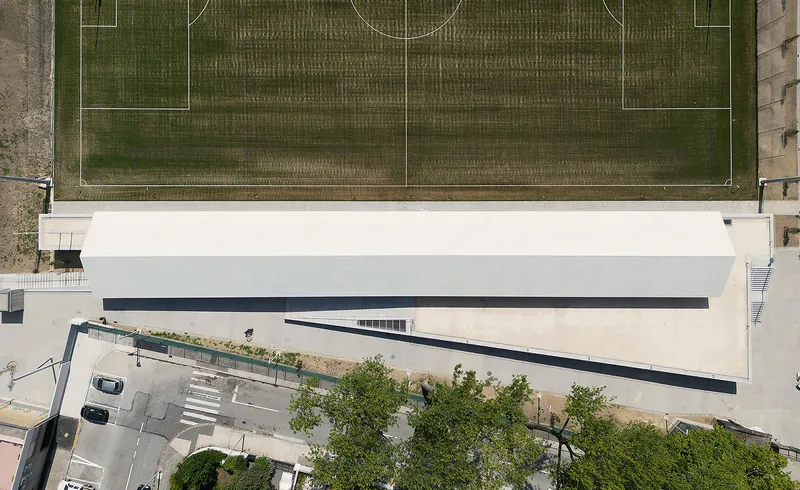
Seen from above, the building's strategy becomes fully legible. A single rectangular roof plane stretches parallel to the striped pitch, its length calibrated to the field's long dimension. The surrounding residential fabric, mostly mid-rise apartment blocks, frames the park on three sides. The pavilion mediates between the open green space and the dense urban grain, acting as a long edge that gives the park a clear boundary without walling it off.
The aerial views also confirm just how thin the building is. This is not a complex with multiple wings or courtyards; it is a single bar, one room deep, that does everything through section rather than plan. That economy is the project's strength.
Process: Study Models


The physical models reveal a design process rooted in topographic thinking. Wire trees stand in for the landscape context, and the building volume is tested against tiered platform conditions and curved landform bases. Even at this scale, the relationship between building and ground is the primary concern. Layered cardboard contour models show the team working through grading strategies before committing to the final section.

The cardboard study models, built up from contour-cut layers, are the most telling artifact. They make explicit what the finished building implies: that the design started with the ground, not the roof. Architecture that treats landscape as its first material, rather than its last problem, tends to age well.
Plans and Drawings
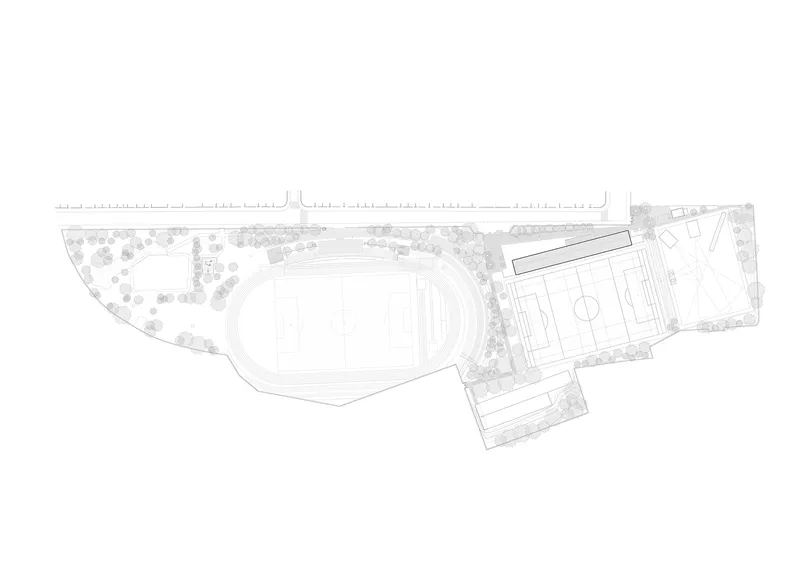
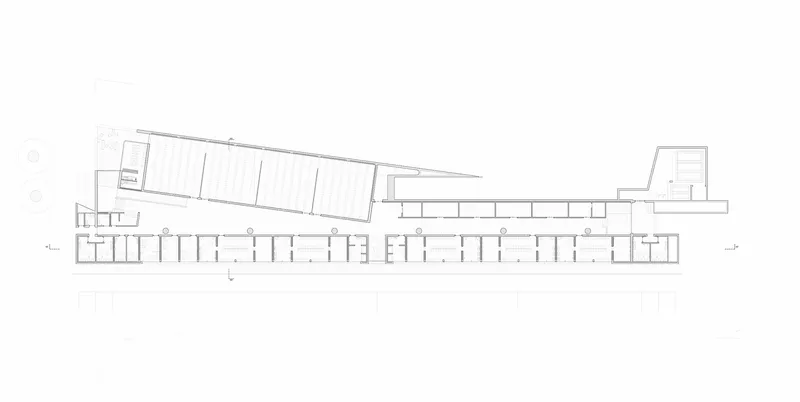

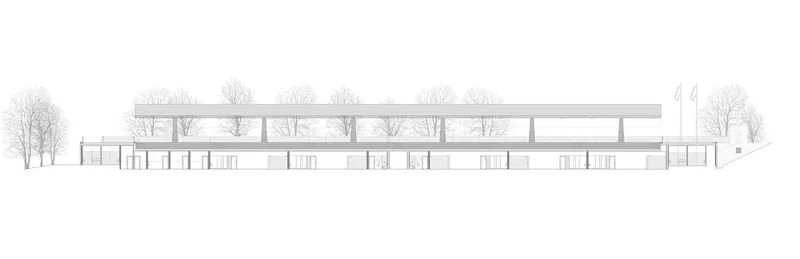
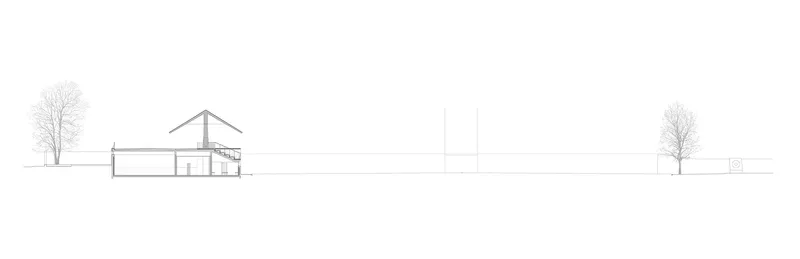
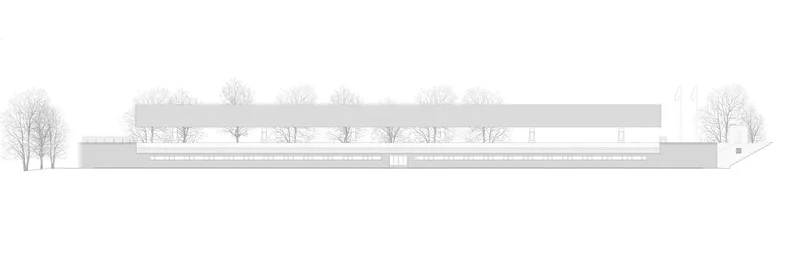
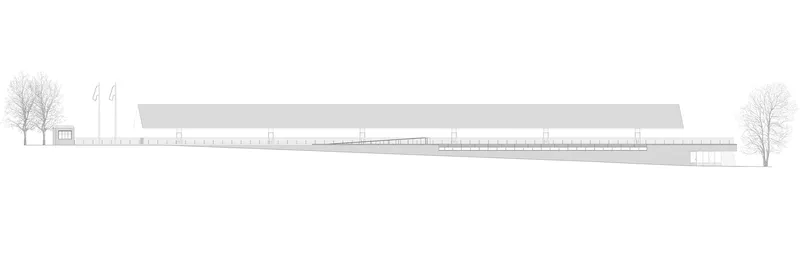
The site plan confirms the oval athletic field and the building's position as a lateral boundary. The floor plan shows a linear arrangement of rooms with angled volumes kicking out at each end, breaking the strict bar geometry just enough to manage circulation and entry. The roof plan is deliberately minimal: a clean rectangle with service elements pushed to the edges.
Sections and elevations are where the project argues its case most convincingly. A pitched roof with clerestory windows brings daylight into the concourse level, while the elevations read as stacked horizontal bands, concrete wall, window strip, canopy, never more than two stories above grade. Winter trees drawn into the elevations acknowledge the seasonal reality of the park, grounding the building in its temporal context as much as its spatial one.
Why This Project Matters
Ramalde Sports Park matters because it demonstrates that municipal sports infrastructure can be architecturally rigorous without being extravagant. The building's budget is clearly modest, yet the board-formed concrete, careful sectional strategy, and landscape integration give it a presence that most facilities in this category never achieve. Domitianus Arquitectura has produced a building that respects its neighbors, serves its athletes, and rewards close attention.
More broadly, the project is a case study in the power of section over plan. Almost every interesting decision here, the bermed entry, the cantilevered canopy, the program tucked beneath the stands, is a sectional move. In a discipline that still tends to privilege plan organization, this is a useful reminder that the cut through the ground can be the most consequential drawing on the table.
Ramalde Sports Park by Domitianus Arquitectura. Porto, Portugal. 2,898 m². Completed 2025. Photography by Inês d'Orey.
About the Studio
Share Your Own Work on uni.xyz
If projects like this are the kind of work you want to make, uni.xyz is a place to publish your own, find collaborators, and enter design competitions.


Popular Articles
Popular articles from the community


Riyadh For All: Intergenerational Urban Design for Active Aging in Rabat
Riyadh For All reimagines urban design in Rabat with intergenerational co-living, adaptive courtyards, and Moroccan cultural exchange today.

The Ocean Hive: Sustainable Architecture for a Self-Sufficient Civilization at Sea
The Ocean Hive imagines sustainable architecture at sea, where modular habitats, algae, wave power and ocean waste sustain a growing colony.

The Earth Pod: 3D Printed Homes for Resilient Refugee Communities
The Earth Pod reimagines refugee housing through 3D printed homes made from clay, combining resilience, self-sufficiency, and rapid shelter.

Co-Life: Senior Housing Design That Reconnects Older Adults With the City
Co-Life reimagines senior housing design through healing gardens, shared streets, workshops, and a sustainable community across generations.

Similar Reads
You might also enjoy these articles

Bao Huynh Watercolor Atelier: A Serene Art Retreat in Hội An
Bao Huynh Watercolor Atelier in Hội An blends multifunctional art spaces, sustainable design, local materials, and family-friendly living in a serene environment.

Atelier Macri Concept Store Interior Design by CASE-REAL
Atelier Macri store features a "ko" counter, walnut wood details, cork displays, blending retail, gallery, and seamless customer experiences.

Manuel Vargas Izquierdo Stadium and High-Performance Sports Center: Architectural Excellence in Jalpa de Méndez
The Manuel Vargas Izquierdo Stadium blends sustainable design, inclusive sports facilities, and cultural-inspired architecture, revitalizing Jalpa de Méndez’s public spaces.

KAKR Buluh Awar Hall: Revitalizing Community and Ecology Through Bamboo Architecture
Community built bamboo hall revitalizes Buluh Awar village, empowering youth, restoring ecology, celebrating vernacular craftsmanship through sustainable architecture and culture.


Comments (0)
Please login or sign up to add comments
No comments yet. Be the first to comment!