
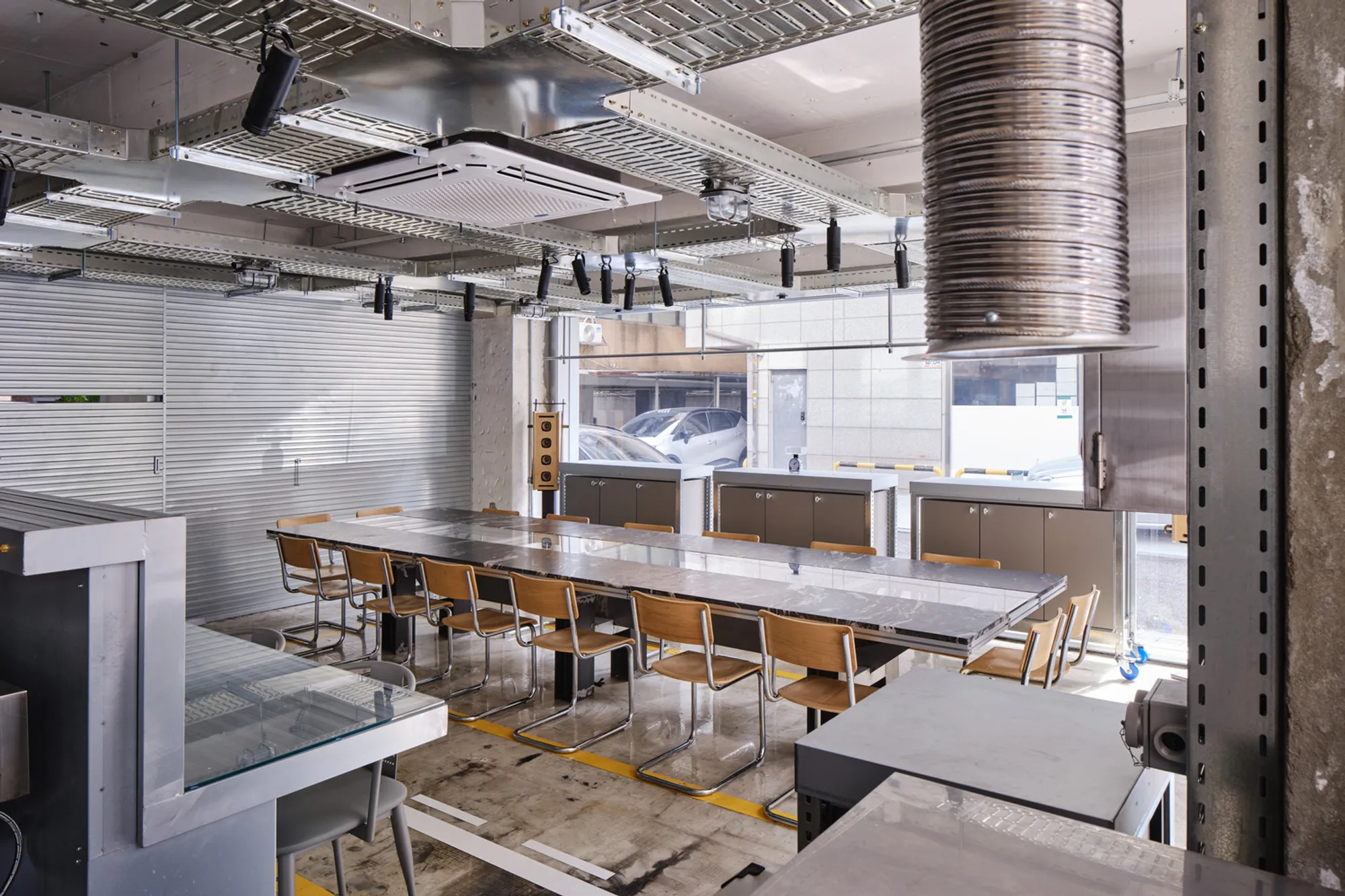
Indiesalon Turns a Seoul Dining Bar into a Precision Factory Where Ingredients Replace Components
In Gangnam-gu, corrugated steel, H-beam tables, and ground concrete walls collapse the distance between a machine shop and a kitchen.


There is an old analogy between cooking and engineering: both demand exactness, both depend on the proper assembly of small parts, and both fall apart when a single component is off. Most restaurants that invoke industrial aesthetics treat the reference as skin deep, bolting a few Edison bulbs to a reclaimed beam and calling it a day. Indiesalon, led by architect Seokjoon Jang, takes the conceit seriously at Dosan Precision Restaurant in Seoul's Gangnam-gu, building a 99-square-meter dining bar that operates like a factory floor rearranged for hospitality.
The core proposition is that a precision workshop and a fine-dining kitchen share an organizational logic. Both arrange small, specialized components into a coherent whole. Both reward meticulous calibration. Indiesalon materializes this parallel through corrugated steel dividers, an H-beam communal table, a grid-shaped ceiling raceway, and wall surfaces that were deliberately ground down rather than plastered over. The result is a space that does not merely look industrial; it thinks in industrial terms, using factory signals, toggle switches, and measuring-scale handles as genuine interface elements.
The Factory Floor as Dining Room
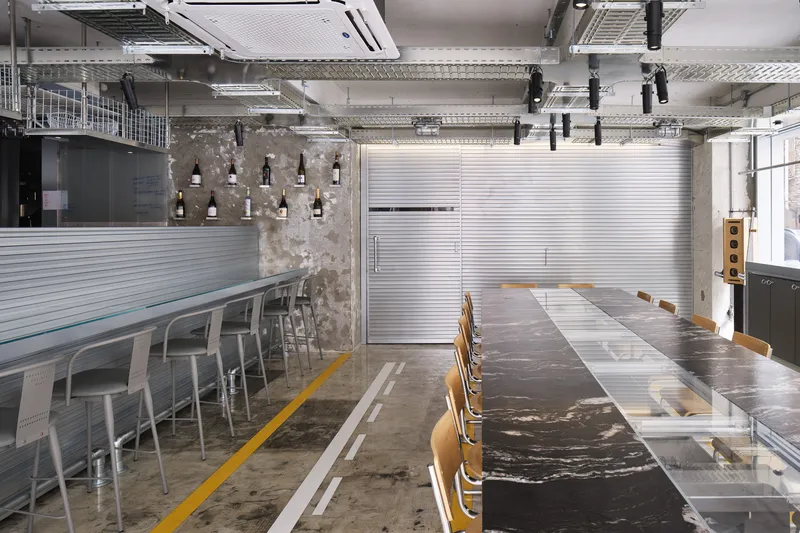
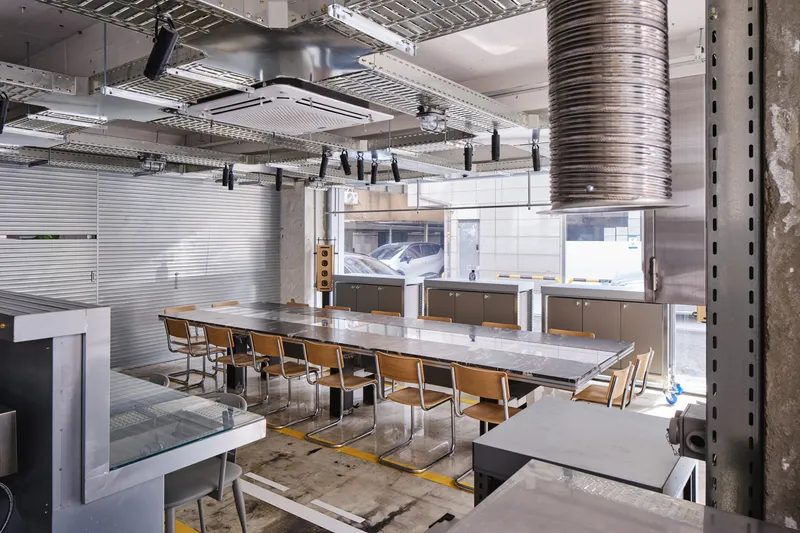
Walk in and the first thing you register is the communal table: thick metal plates welded to H-beams, sitting under a suspended grid raceway that channels services the way a cable tray would in a workshop. Corrugated steel sheets mark the boundary of the kitchen, functioning as both space dividers and operable shutters. When these shutters close, the restaurant physically mimics a factory winding down for the night. When they open, the kitchen becomes a transparent production line.
Exposed concrete columns punctuate the plan without apology, and horizontal metal louvers filter sightlines between zones. The spatial logic is legible: you can trace exactly where structure ends and partition begins, because Indiesalon treats every joint as a visible seam rather than a hidden connection.
Surfaces That Refuse to Hide Their History
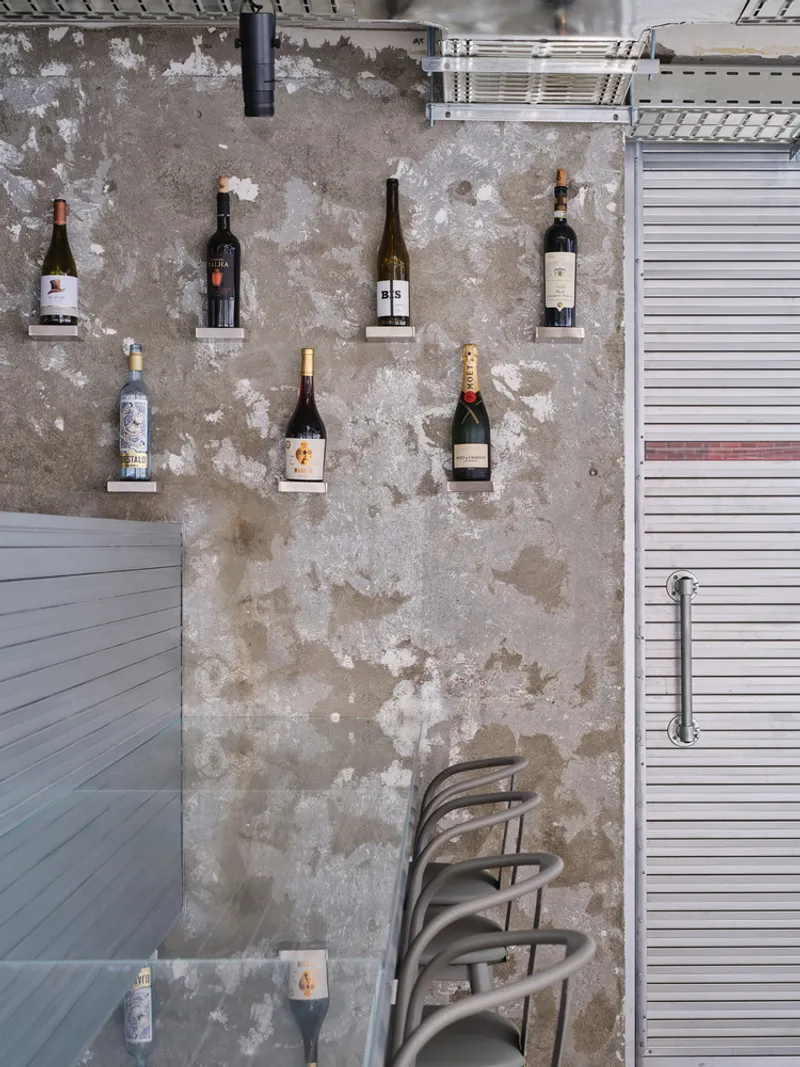
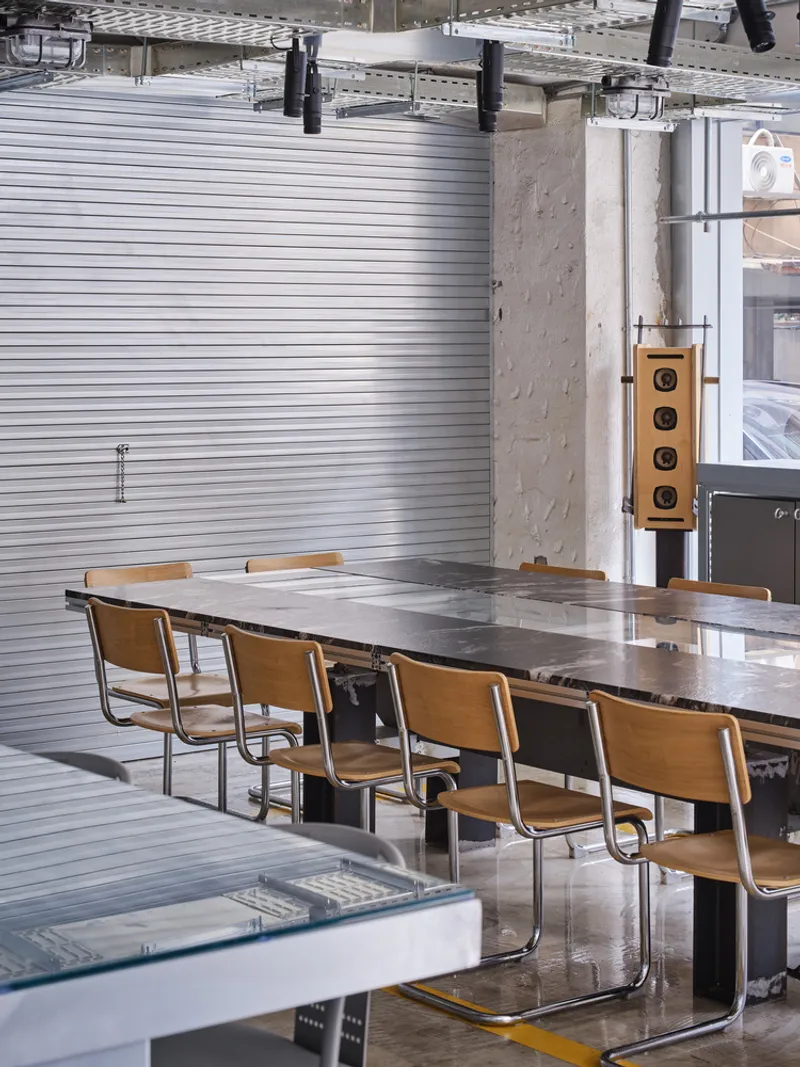
The weathered concrete walls were not refinished. They were ground, a subtractive process that strips material to expose aggregate and imperfection. The effect is a texture that reads as authentically worn rather than artificially distressed. Against this backdrop, wine bottles on minimal mounted shelves and stacked chairs create a still life that feels more stockroom than sommelier's cellar.
Underfoot, the same preservationist instinct applies. When the original flooring was removed, old tiles were discovered beneath it. Rather than ripping these out too, the team sealed them with transparent epoxy, locking their patina in place. It is a small decision, but it telegraphs a larger commitment: nothing here is decorative for its own sake. The marbled stone countertop along one column wall, paired with cantilevered wooden chairs, demonstrates that refinement and rawness can share a material palette without contradiction.
Red Light, Steel Threshold
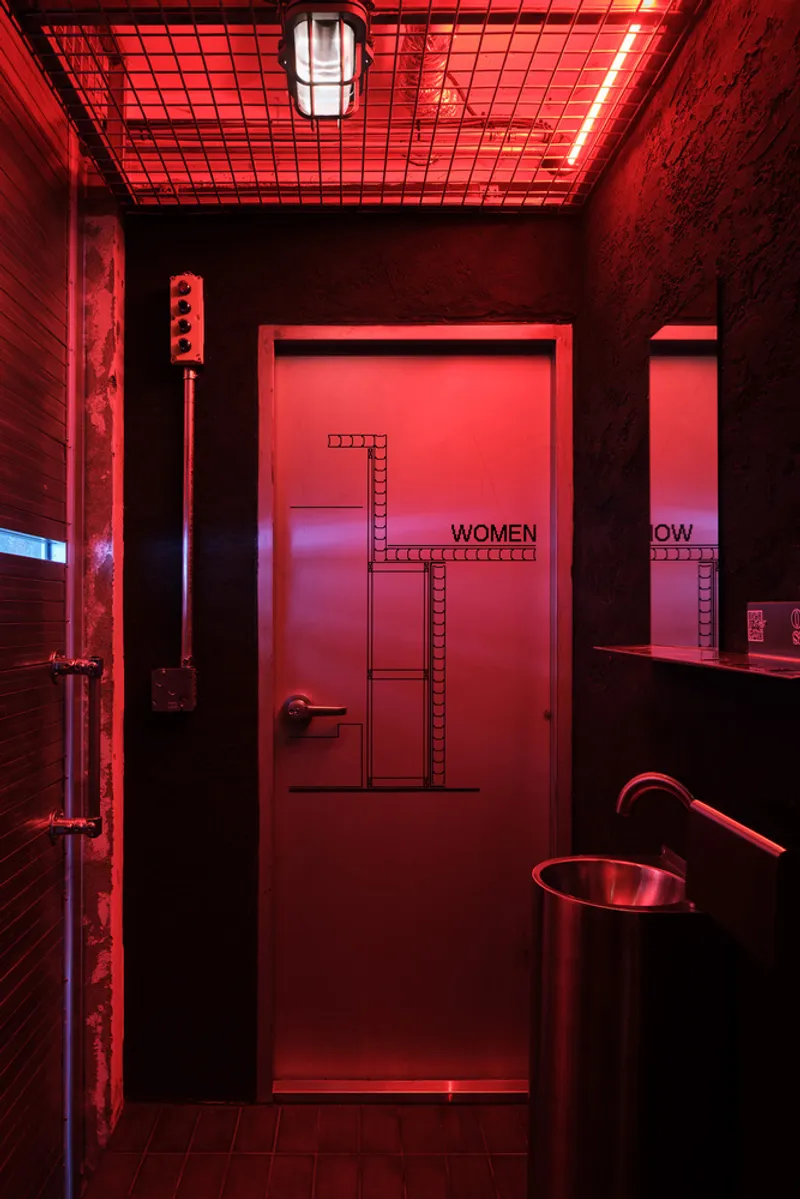
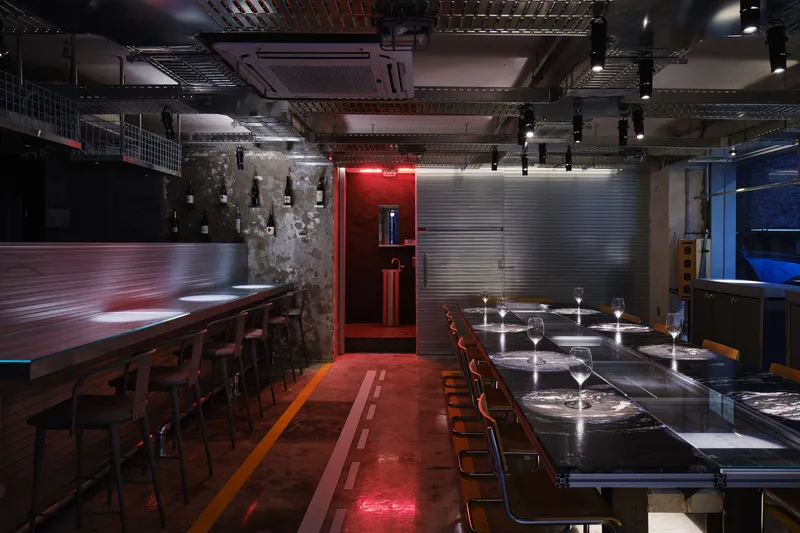
The restroom alcove deserves its own mention because it does something unexpected. A red LED strip beneath a gridded ceiling panel bathes the threshold in a saturated glow that reads as warning signal and nightclub entrance simultaneously. At night, this crimson pocket leaks color into the main dining hall, giving the otherwise monochrome space a warm pulse visible from the communal table.
It is a deliberate disruption, the one moment where Indiesalon drops the factory metaphor and introduces something more theatrical. The move works precisely because the rest of the palette is so restrained. Steel, concrete, and corrugated metal earn their neutrality, so when red appears, it registers as an event rather than a decoration.
The Workshop Within
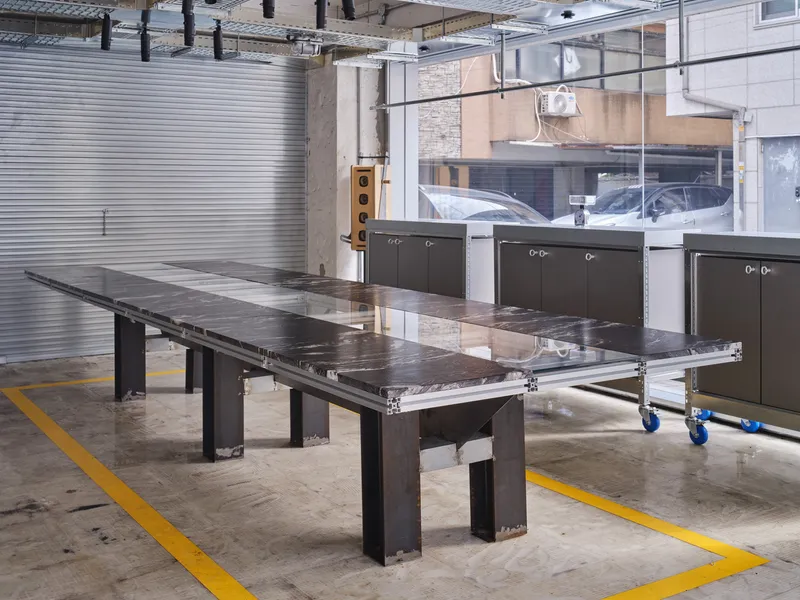
One zone strips the dining pretense away entirely. Steel work tables, dark metal cabinets, and corrugated cladding converge to create what could pass for an actual machine shop. This is where the kitchen's back-of-house infrastructure lives, and Indiesalon made no effort to soften it. The cabinets sit on polyurethane casters so they can be rolled and reconfigured, a detail borrowed directly from tool storage systems in manufacturing.
Toggle switches and control buttons, modeled on factory control panels, serve as the interface for lighting and utilities. Even the cabinet handles are shaped like precision measuring scales. These are not Easter eggs for design-literate visitors; they are functional components that also happen to reinforce the conceptual frame. The line between prop and tool dissolves, which is exactly the point.
Why This Project Matters
Themed interiors age poorly when the theme is only cosmetic. What distinguishes Dosan Precision is that its industrial reference goes deeper than surface: the corrugated shutters actually open and close like a factory gate, the H-beam table actually carries structural logic, and the ground walls actually expose the building's previous life. The concept is not applied to the space; it is extracted from the space's own material reality.
Indiesalon's broader argument, that the discipline required to assemble a precision machine is the same discipline required to compose a dish, gives the project an intellectual backbone that most hospitality interiors lack. In a Seoul dining scene saturated with polished minimalism and Instagram-ready pastels, Dosan Precision pushes back with grit, weight, and specificity. It trusts that diners can appreciate a space that does not flatter them, and in doing so, it redefines what a 99-square-meter restaurant in Gangnam can be.
Dosan Precision Restaurant by Indiesalon, Gangnam-gu, Seoul, South Korea. 99 square meters. Photography by Donggyu Kim.
About the Studio
Share Your Own Work on uni.xyz
If projects like this are the kind of work you want to make, uni.xyz is a place to publish your own, find collaborators, and enter design competitions.




Popular Articles
Popular articles from the community


Co-Life: Senior Housing Design That Reconnects Older Adults With the City
Co-Life reimagines senior housing design through healing gardens, shared streets, workshops, and a sustainable community across generations.

The Musturak Paradise: Senior Living Architecture for a Connected Future in Temara, Morocco
The Musturak Paradise reimagines senior living architecture in Temara via private homes, social spaces, culture, community, and shared care.

Riyadh For All: Intergenerational Urban Design for Active Aging in Rabat
Riyadh For All reimagines urban design in Rabat with intergenerational co-living, adaptive courtyards, and Moroccan cultural exchange today.

The Earth Pod: 3D Printed Homes for Resilient Refugee Communities
The Earth Pod reimagines refugee housing through 3D printed homes made from clay, combining resilience, self-sufficiency, and rapid shelter.


Similar Reads
You might also enjoy these articles


Hodi-Mandai Geram
Project Function: Preservation and revitalization of the Intangible heritage and socio-spatial identity of the Hodi by Housing, Cultural Memory Center, Sacred Grove, landscape, local tourism economy


Olio Towers: A Mid-Rise for Performers That Fuses Housing, Rehearsal, and Stage
Located blocks from Houston's Theater District, this modular tower stacks living units around a central performance atrium.

Oasis: Modular Green Housing Carved into Dhaka's Urban Fabric
A shortlisted Plugin Housing entry reclaims unauthorized settlements in Dhaka with stepped concrete volumes, green roofs, and ventilation-driven design.

Black Hole: A Floating Megastructure for the Post-Physical Era
Emiliano Mazzarotto envisions a spherical, self-scaling arena where e-sports, digital hotels, and holographic stadiums replace traditional public space.


Explore Interior Design Competitions
Discover active competitions in this discipline


Challenge to design luxury tourism on rails


Challenge to reimagine the Iron Throne


Photograph architecture without architects


VR headsets Storefront design competition
Comments (0)
Please login or sign up to add comments
No comments yet. Be the first to comment!