

Douglass Tower: A Vertical Garden Memorial That Breathes with Its City
Cade Chidester's tower transforms a traffic roundabout into a living monument to Frederick Douglass, layering ecology, brick, and public space.


What if a memorial could photosynthesize? The Douglass Tower proposes exactly that: a cylindrical, tiered structure wrapped in native vegetation that sits at a dense urban intersection, filtering CO₂, reducing heat island effects, and collecting rainwater while honoring the legacy of Frederick Douglass. It is not a statue on a plinth but a regenerative organism, one that exchanges air, light, and meaning with the city around it.
Designed by Cade Chidester as a People's Choice Award entry for the Greenward competition, the project inserts itself into the center of a traffic roundabout flanked by high-rise buildings. The site is infrastructural, noisy, dominated by vehicular movement. Chidester sees this not as a limitation but as an opportunity: the tower becomes a vertical counterpoint, a column of greenery and public program rising from the asphalt.
A Circular Footprint on a Traffic Island
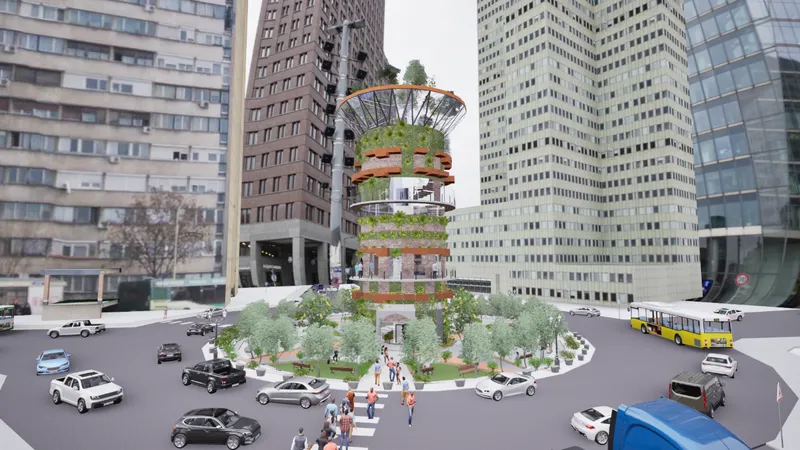
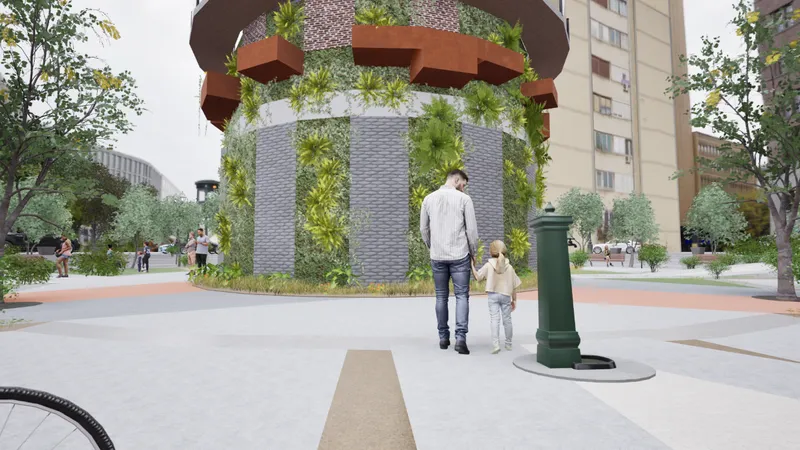
The tower's circular plan is deliberate. Chidester uses the geometry to symbolize unity and continuity, but it also responds pragmatically to the roundabout site, where every approach angle matters equally. From any lane of traffic, the building presents the same profile: stacked planted terraces ascending in a spiral that narrows as it rises. The base widens to meet the ground with textured concrete walls and vertical planted columns, establishing a material rhythm of brick, vegetation, and metal that carries through the entire structure.
At street level, the scale shifts from monumental to human. People walk alongside the tower's base, dwarfed by the greenery above but drawn in by the texture of the walls and the presence of plants at arm's reach. The transition from the surrounding vehicular infrastructure to the pedestrian realm of the tower happens quickly, a compressed threshold between city and garden.
Archways, Perforated Brick, and the Public Ground

The ground-level entry is framed by an archway with a perforated brick canopy, a detail that does significant work. The brick perforations filter daylight into the passage below while nodding to the material heritage of urban construction. Vertical gardens flank the opening, making the threshold between outside and inside feel less like a doorway and more like an immersion. You walk through vegetation to reach the public plaza at the building's core.
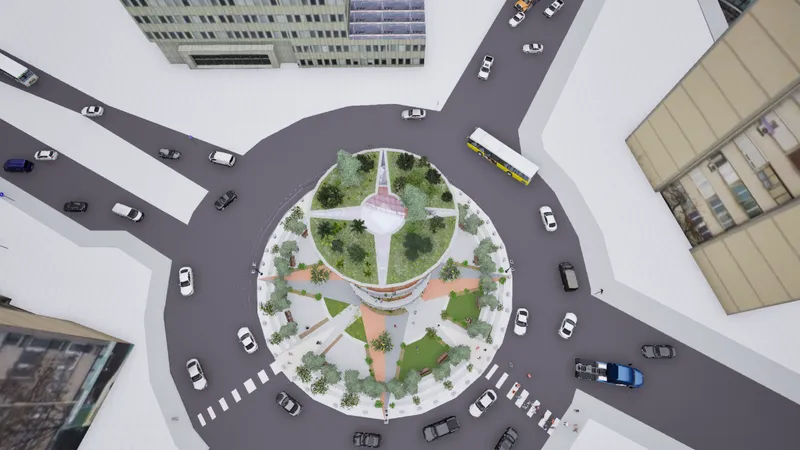
Seen from above, the circular landscaped plaza reveals radial pathways that organize movement from the surrounding streets inward. Educational installations narrating Douglass's life populate this ground plane, turning the base of the tower into a gathering space for reflection and engagement. The aerial view makes clear how the project carves a civic clearing out of a traffic island, a quiet center surrounded by the constant motion of buses and cars.
Tiered Terraces as an Urban Lung
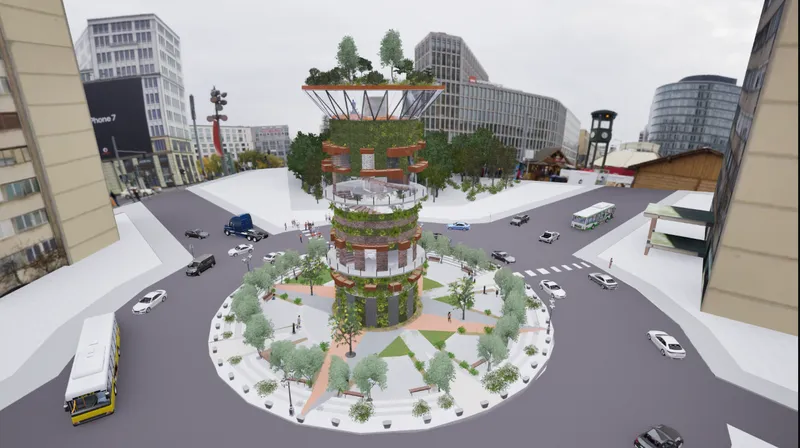
Pulled back to a wider angle, the tower's role as infrastructure becomes legible. The tiered planted structure rises from the roundabout like a stack of garden trays, each level carrying enough vegetation to function as a bio-filter. Chidester describes the vertical greenery as an "urban lung," and the image makes the case: surrounded by asphalt and exhaust, the tower is the one element in the frame that is actively producing oxygen. Terracotta elements embedded in the façade provide thermal balance, working with natural ventilation and rainwater collection to make the structure largely self-sufficient.
Each ascending level also operates as a spatial metaphor for Douglass's journey toward freedom and knowledge. The progression from dense, grounded base to open, sky-facing terrace traces a narrative of growth and transformation. It is a memorial strategy that avoids the static: instead of representing Douglass with a likeness, the building embodies his trajectory.
Terra-Cotta Walls and a Spiral Core

The interior atrium is where the tower's material ambitions come together most convincingly. Terra-cotta tiled walls wrap a spiral staircase, their warm tones set against cascading greenery that spills down from the upper levels. Above, a glazed curved skylight floods the space with diffused light. The combination is specific: brick for strength, vegetation for adaptation, glass for connection to the sky. These are not decorative choices but structural and symbolic ones, reinforcing the project's argument that sustainability and cultural depth are not competing agendas.
The spiral staircase also serves a programmatic purpose, linking the educational ground-level plaza to the uppermost canopy, which functions as an open green terrace for exhibitions, performances, and civic discussions. The ascent is continuous, and the architecture ensures that movement through the building is also movement through Douglass's story.
A Canopy at Dusk
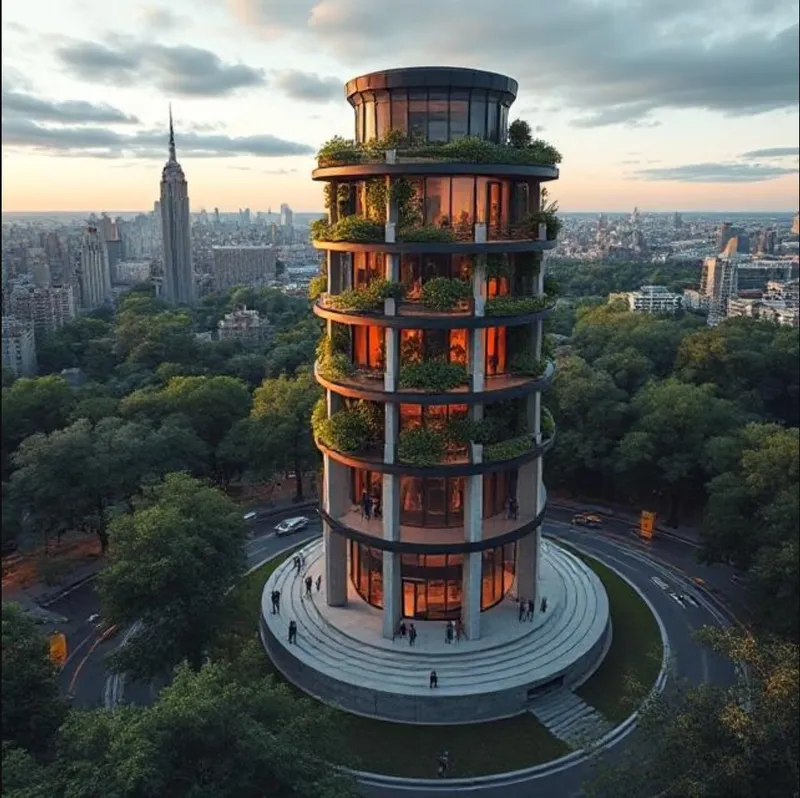
Seen from above at dusk, the cylindrical tower reads as a lantern: planted terraces at each level catch the last light while the surrounding park falls into shadow. The image crystallizes the project's dual identity. By day, the tower is an ecological machine, filtering air and harvesting rain. By evening, it is a beacon, its green terraces glowing against the skyline. Chidester's ambition is to make the memorial visible not just spatially but temporally, a presence that shifts and breathes across the hours.
Why This Project Matters
Douglass Tower challenges a deeply embedded assumption: that memorials are finished objects, fixed in stone and meaning. By wrapping a monument in living systems, Chidester proposes a memorial typology that grows, absorbs, filters, and changes with its city. The integration of green infrastructure, public education, and cultural storytelling into a single vertical structure suggests what 21st-century commemoration might look like when it takes ecology seriously.
The project also reframes a hostile site. Traffic roundabouts are rarely considered civic spaces, yet the Douglass Tower makes one into the center of a regenerative public landscape. That spatial ambition, turning leftover infrastructure into a living landmark, is perhaps the most Douglass-like quality of the entire design: a refusal to accept the conditions as given, and an insistence that something better can grow in their place.
View the Full Project
About the Designers
Designer: Cade Chidester
Enter a Design Competition on uni.xyz
uni.xyz runs architecture and design competitions year-round that reward proposals with spatial conviction and real site intelligence.
Project credits: Douglass Tower by Cade Chidester Greenward (uni.xyz).



Popular Articles
Popular articles from the community


Riyadh For All: Intergenerational Urban Design for Active Aging in Rabat
Riyadh For All reimagines urban design in Rabat with intergenerational co-living, adaptive courtyards, and Moroccan cultural exchange today.
EW PARK: Sustainable Architecture Reimagines the Future of Urban Parking
EW PARK reimagines city parking as a modular wooden tower combining automation, solar energy, electric mobility, and adaptable urban design.

Hill & Cross Opera: Sculptural Opera House Architecture Shaped by Tallinn’s Landscape and Identity
Hill & Cross Opera reimagines opera house architecture in Tallinn through its sculptural hill, civic plaza, glass wave and a luminous cross.

Co-life: Sustainable Architecture for Age-Friendly Community Living
Co-life reimagines sustainable architecture for seniors through courtyards, rammed earth, shared gardens, and spaces designed for belonging.


Similar Reads
You might also enjoy these articles

The Musturak Paradise: Senior Living Architecture for a Connected Future in Temara, Morocco
The Musturak Paradise reimagines senior living architecture in Temara via private homes, social spaces, culture, community, and shared care.

The Leaf Center: Cultural Center Architecture for Social Integration in Amsterdam
Cultural center architecture becomes a bridge at The Leaf Center, connecting international students with Amsterdam through art and exchange.

Conexión: Biophilic Design Reimagines High-Rise Living in Hong Kong
Conexión reimagines high-rise living in Hong Kong through biophilic design, green facades, shared spaces, daylight, water and nature within.

Wander to Wonder: Modular Playground Design for Children in Kutupalong Refugee Camp
Wander to Wonder uses modular playground design to create flexible, imaginative play spaces for children in Kutupalong refugee camp.

Explore Educational Building Competitions
Discover active competitions in this discipline


Challenge to visualize a collision of the future and past

Challenge to visualize future spaces of waste

Challenge to visualize slums of 2080

Challenge to illustrate the change you wish in architecture
Comments (0)
Please login or sign up to add comments
No comments yet. Be the first to comment!