
Drawer Balcony House: A Contemporary Japanese Home Defined by a Protruding Sky Garden
Protruding balcony creates elevated garden space, connecting skip-floor interiors with light, airflow, and refined material detailing in compact Tokyo home.


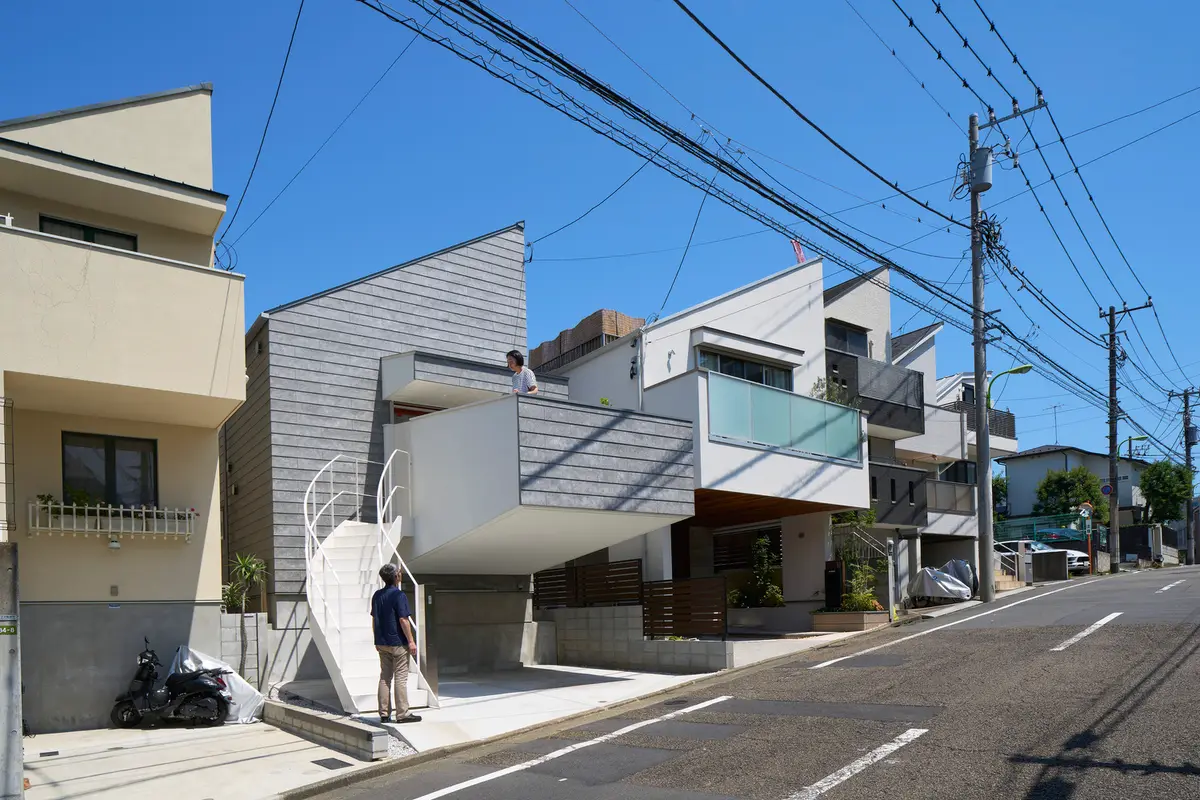
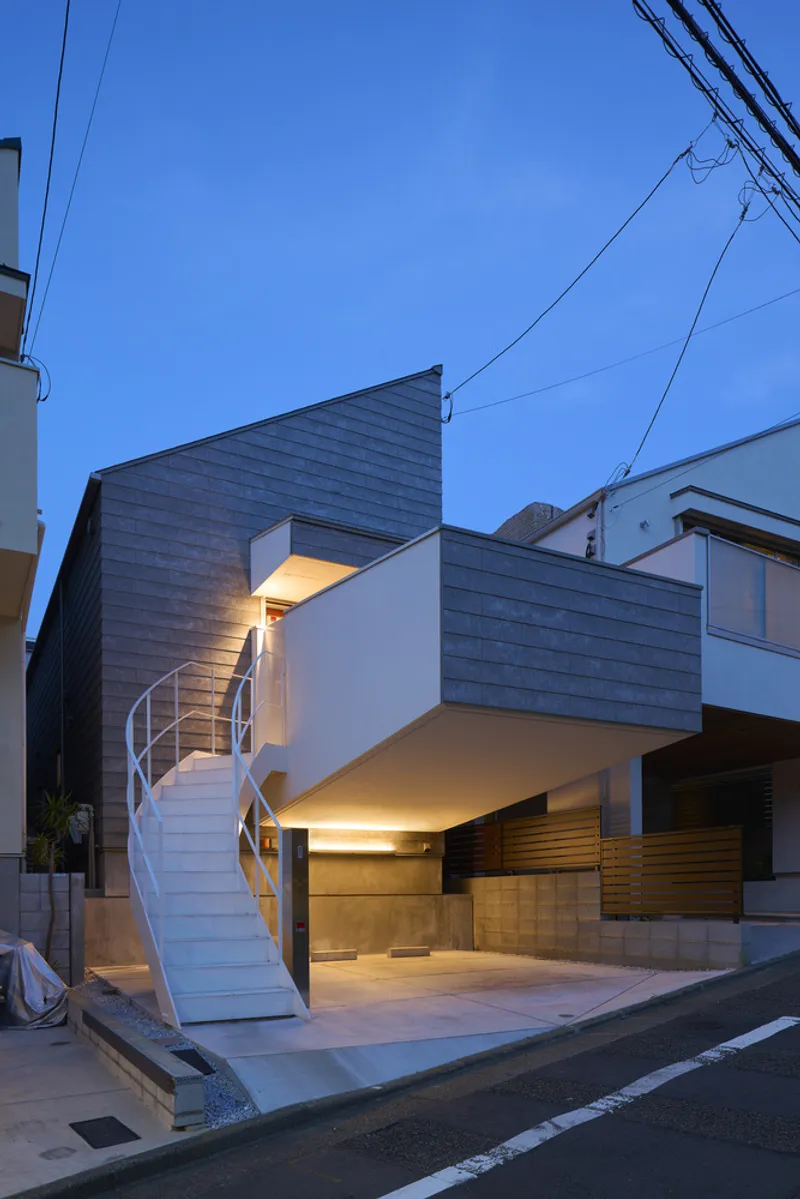
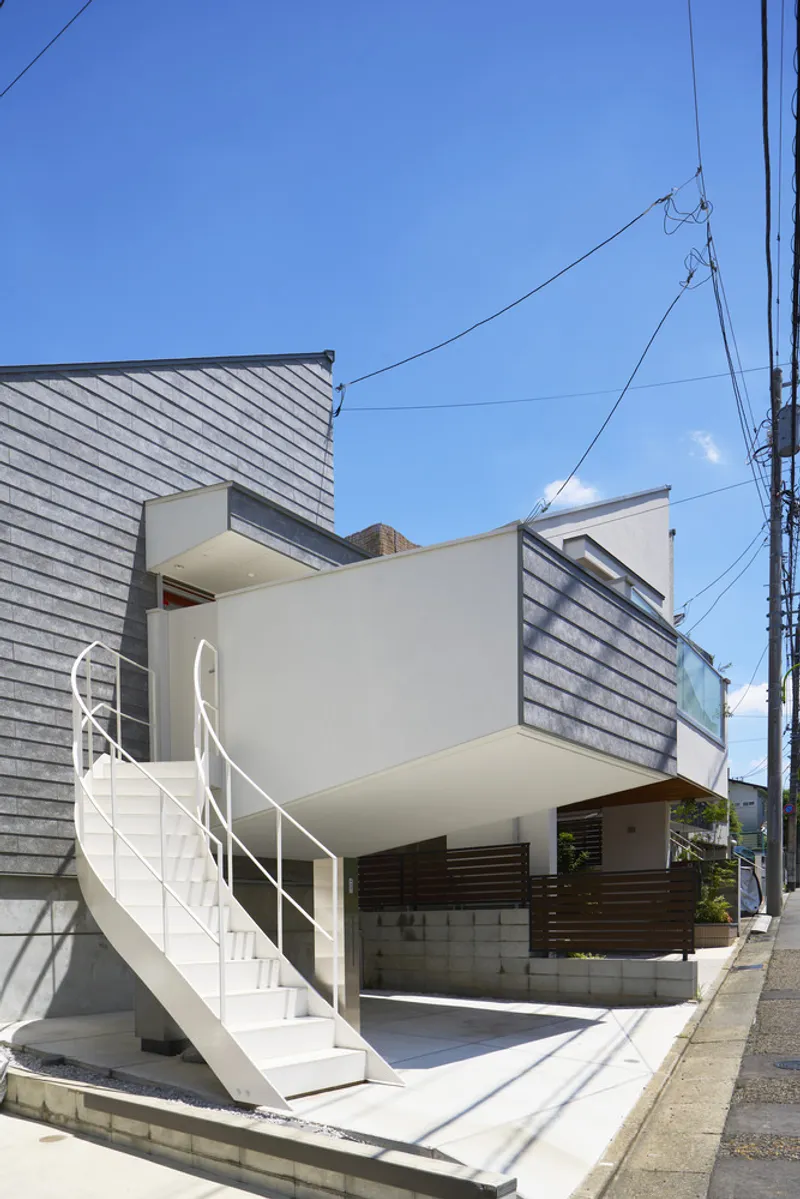
Located in a compact residential neighborhood of Setagaya City, Tokyo, Drawer Balcony House by Naf Architect & Design redefines small-lot urban living through a bold architectural gesture: a balcony that “draws out” toward the street, creating a semi-private garden suspended in the air.
Built on a tight 99 sqm site with a 6-meter frontage, this 106 sqm single-family home transforms regulatory constraints into architectural opportunity. Through a carefully articulated protruding balcony, skip-floor planning, and layered materiality, the project introduces openness, light, and spatial depth into a dense urban fabric.
A Balcony That Becomes an Elevated Garden
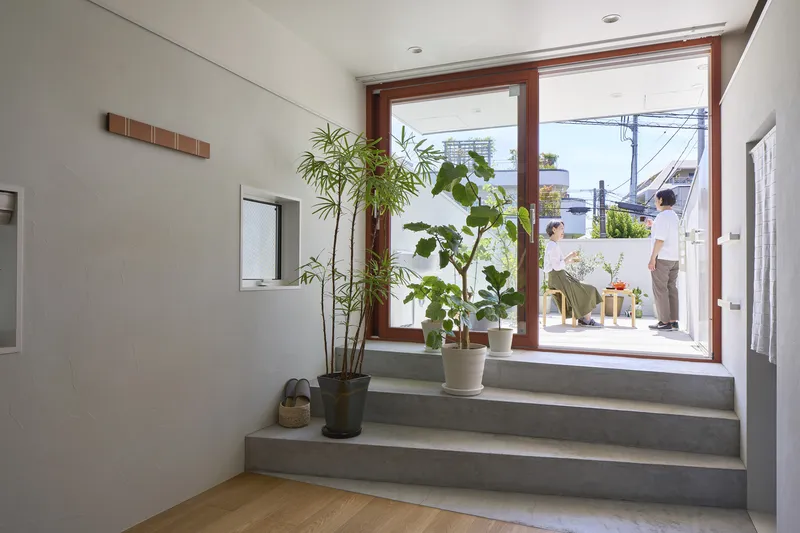
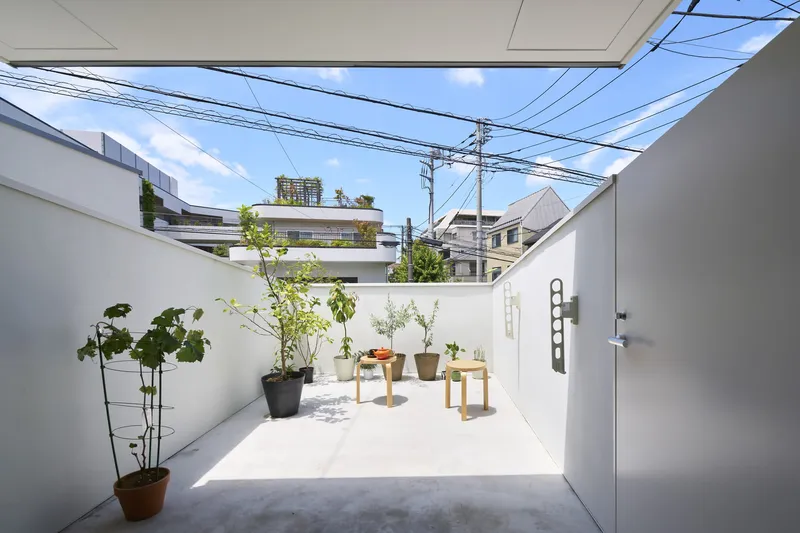
The defining feature of this modern Japanese house is its 12 sqm (6.5 tatami mat) balcony extending toward the front road. Designed with privacy and security in mind, the balcony functions as:
- An outdoor dining space
- A plant-filled sky garden
- A relaxing evening retreat
- A reading corner in the sun
This elevated terrace also doubles as an entrance porch, accessed via an external staircase. Beneath it, the owner’s car fits neatly, maximizing spatial efficiency, a critical strategy in compact Tokyo residential architecture.
Unlike conventional balconies, this one shapes the architectural identity of the house. Its side walls gradually lower toward the front, reaching 1.1 meters in height. This subtle move enhances openness while preserving privacy, allowing views of the nursing home’s greenery across the street and the expansive sky beyond.
Skip-Floor Living: Vertical Continuity in Compact Space
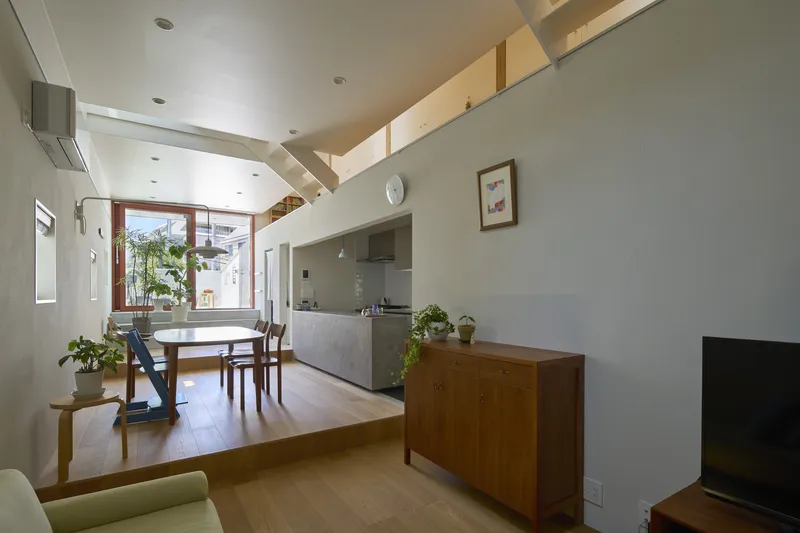
Inside, the spatial experience unfolds gradually. From the entrance porch, the interior gently steps down through:
- First-floor hall
- Dining area
- Living room
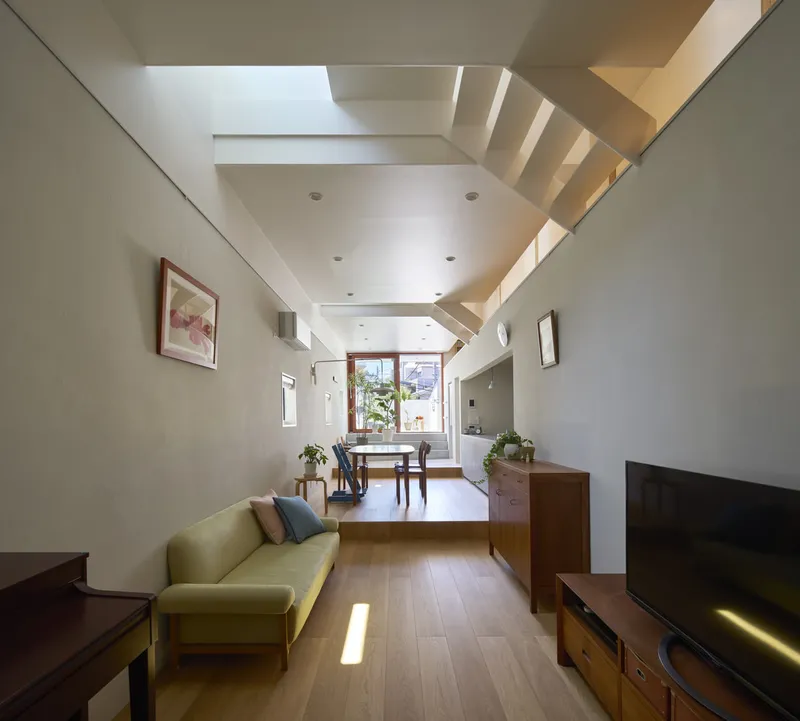
The entire first floor spans 31 tatami mats (57 sqm), culminating in a living room with a generous 3.1-meter ceiling height. This gradual descent enhances spatial depth and creates a dynamic interior sequence uncommon in small urban homes.
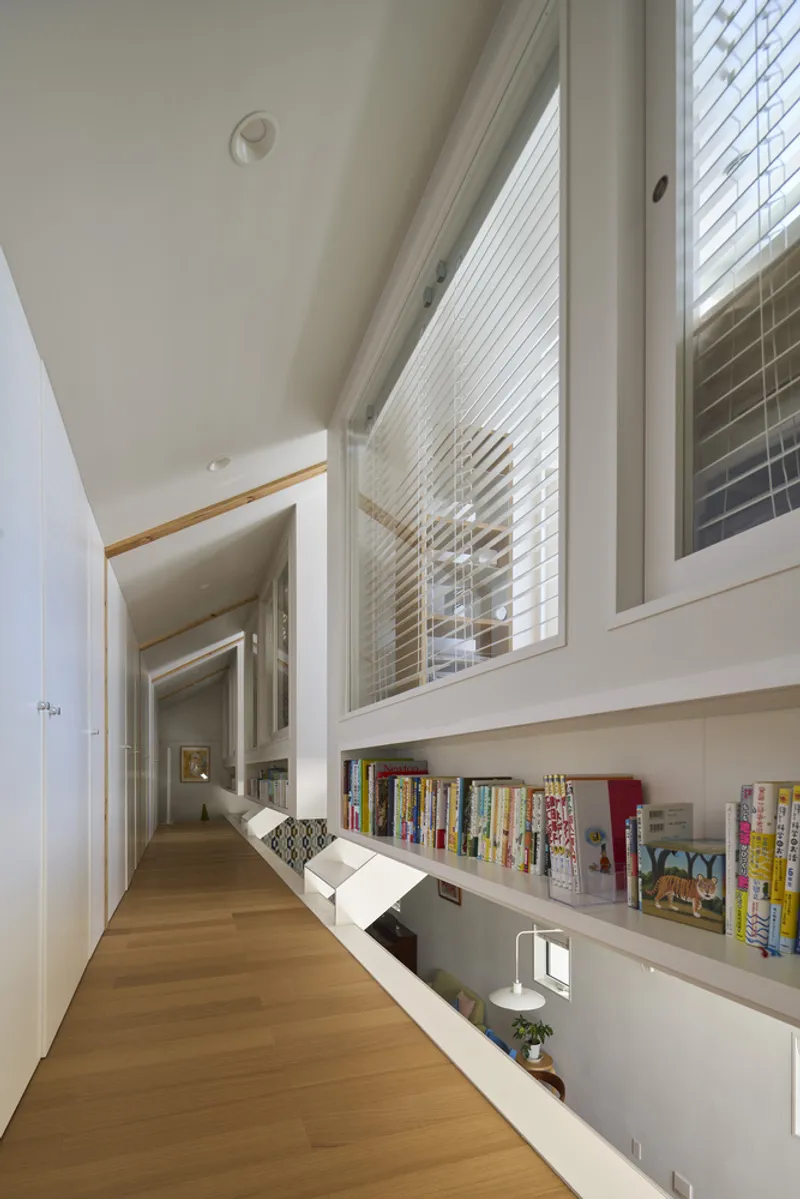
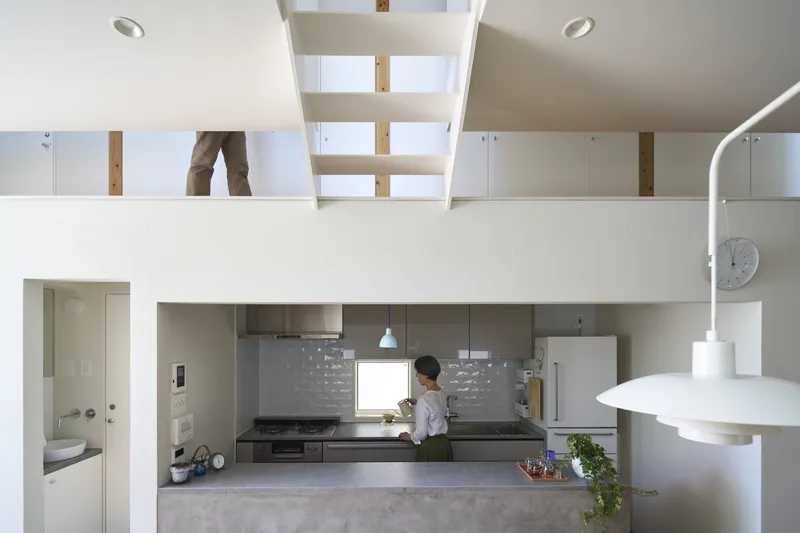
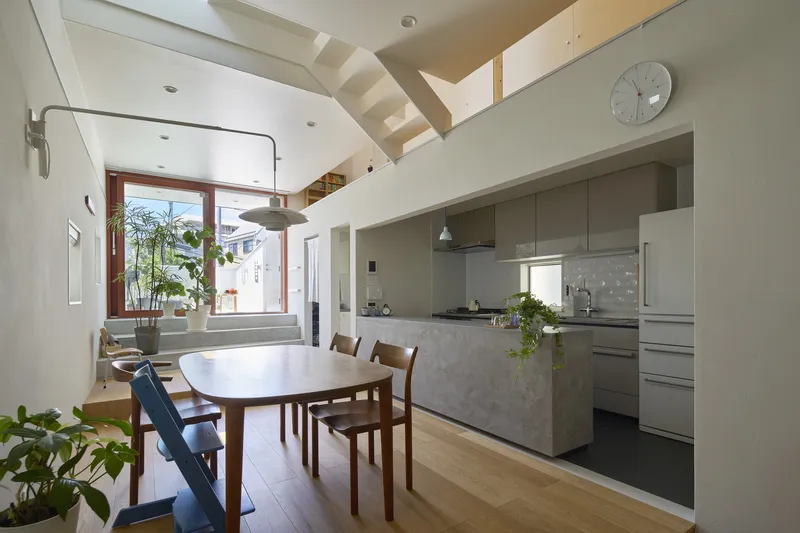
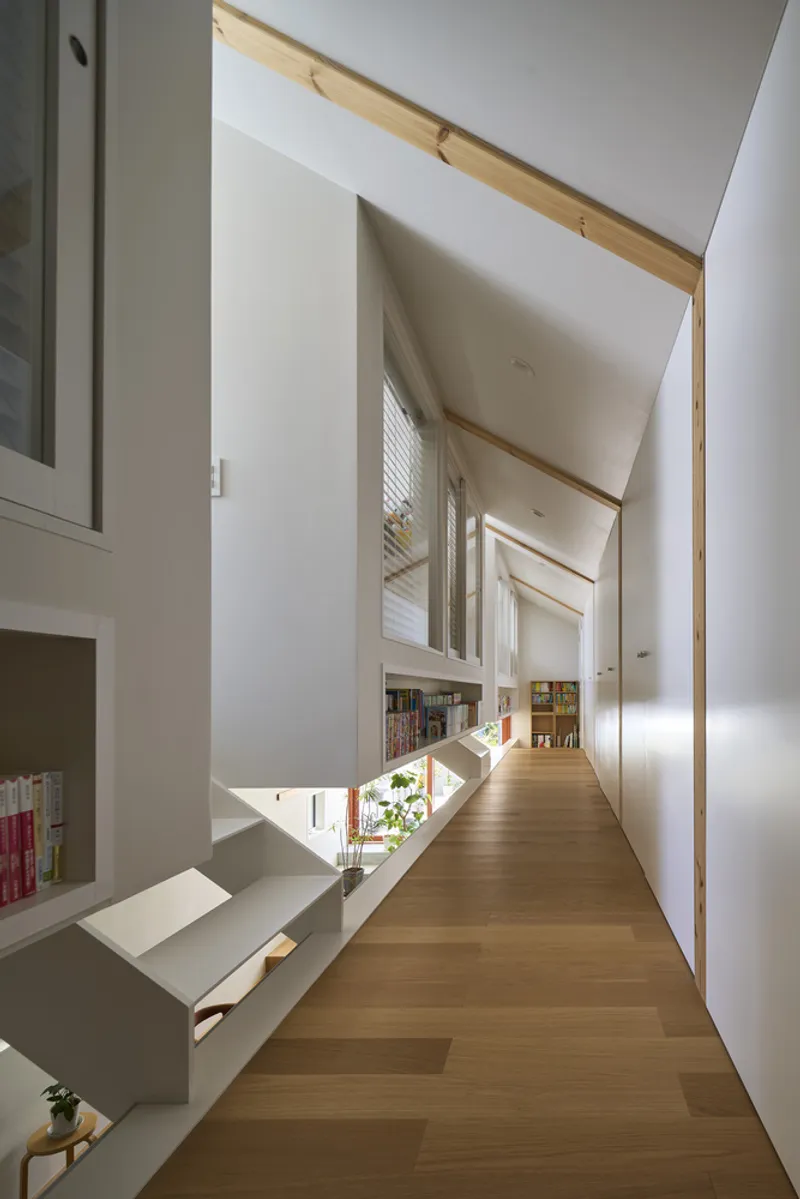
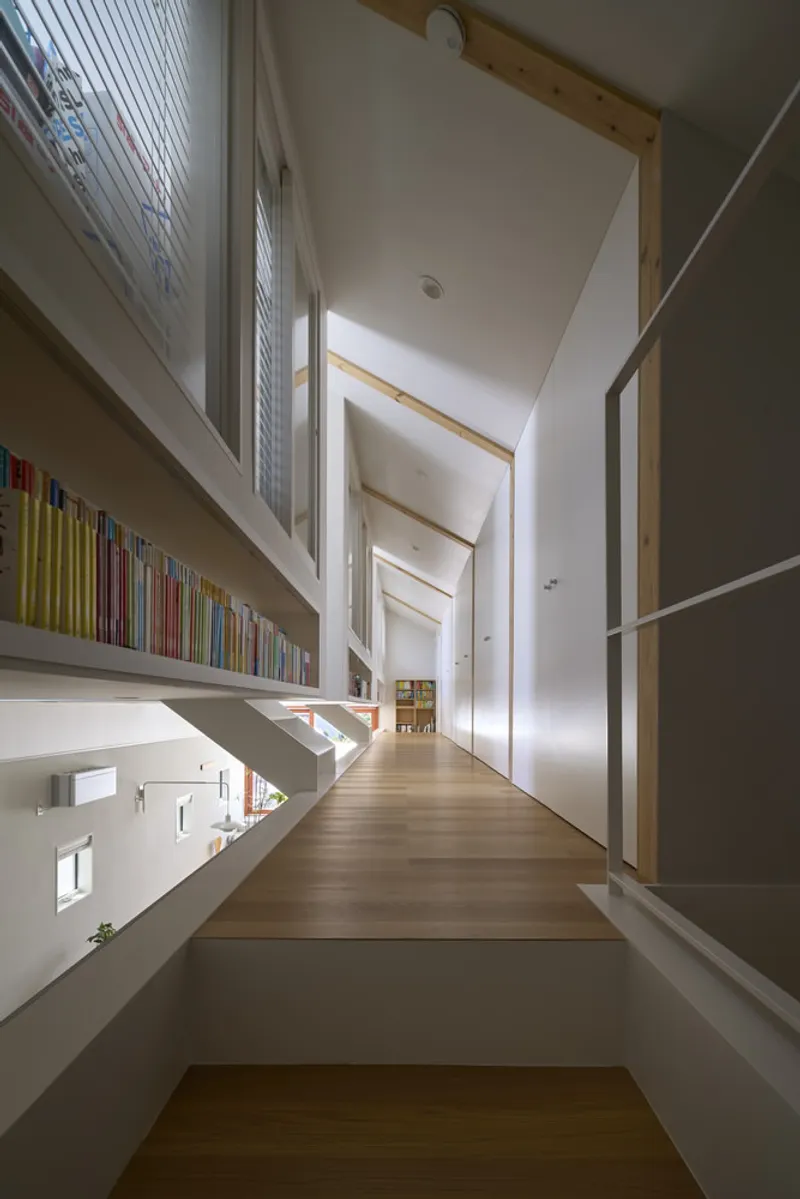
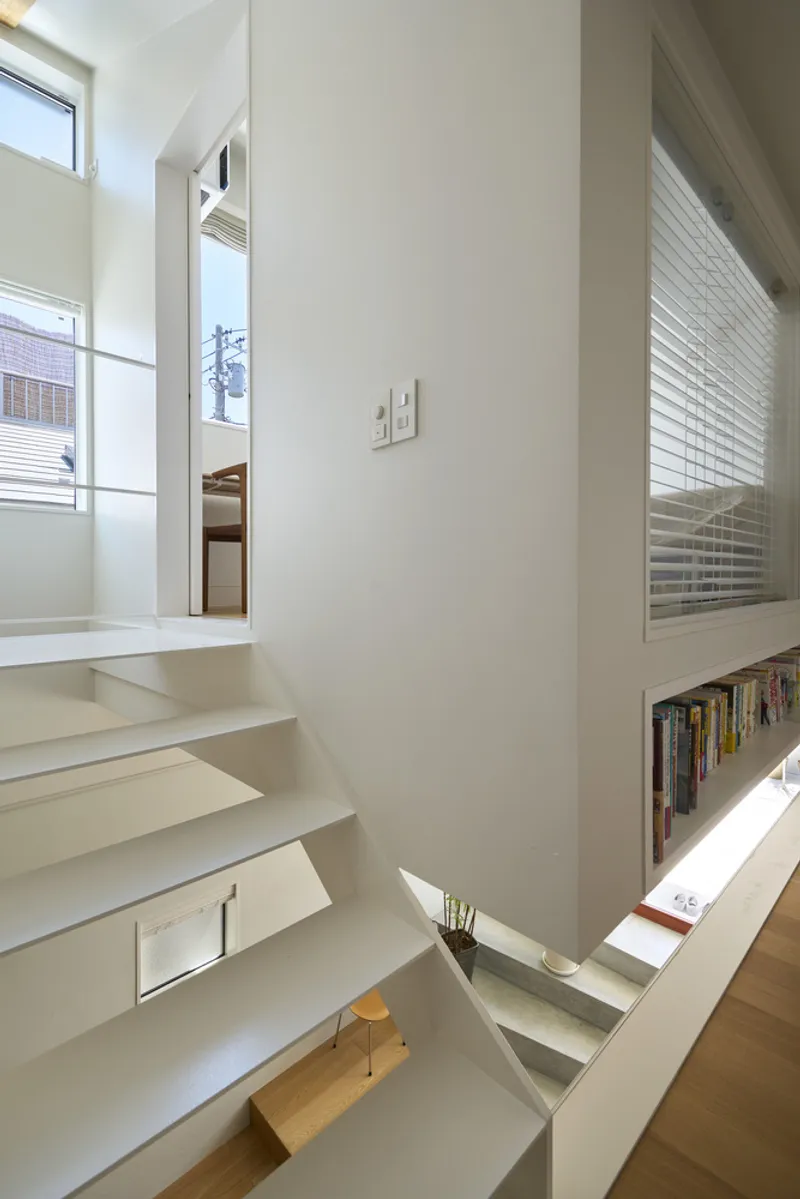
The first and second floors are connected by an open staircase integrated with bookshelves and storage. This diagonal spatial cut visually connects levels while subtly defining zones.
The house employs a skip-floor configuration, enabling:
- Visual connection among family members
- Spatial layering without excessive partitions
- Flexibility in privacy
Interior glass windows in second-floor private rooms can be opened or closed, allowing residents to adjust ventilation, sound, and comfort levels, a thoughtful strategy in contemporary Japanese residential design.
Light, Air, and Structural Innovation
Despite being flanked by neighboring houses, the home achieves impressive daylight performance. The second floor receives abundant sunlight via the adjacent roofscape, and soft light filters down into the first-floor living space through an atrium.
Natural ventilation enhances environmental comfort. When windows are opened, air flows vertically from the first floor to the second floor, supporting passive cooling strategies, a sustainable design approach suitable for Tokyo’s climate.
To enhance spatial openness, visible pillars supporting the second floor were eliminated. Instead, structural support is achieved through steel-framed stairs, reducing visual clutter and reinforcing architectural clarity.
Material Depth and Craft Precision
Material selection plays a key role in creating both unity and depth. The interior palette carefully combines:
- Tile
- Wood
- Cement
- Paint
- Linoleum
While the overall impression remains simple and cohesive, closer inspection reveals a nuanced interplay of textures and finishes. The homeowners were deeply involved in material decisions, ensuring each surface contributes to both aesthetic and tactile richness.
Externally, textured cement-based cladding wraps the house. The “drawn-out” balcony walls are finished in a contrasting material to emphasize the architectural gesture.
Particular attention was given to detailing at material transitions. Rather than using factory-made corner parts, craftsmen fabricated custom metal sheet components on-site to achieve sharp, precise edges, a testament to Japanese craftsmanship and architectural refinement.
Urban Context and Architectural Identity
The surrounding neighborhood consists of similarly scaled detached houses shaped by strict building regulations. Instead of competing with context, Drawer Balcony House blends into its environment through massing while distinguishing itself through the definition of its balcony.
The protruding volume subtly animates the streetscape without overwhelming it. Over time, plants added to the balcony have enhanced its garden-like presence, reinforcing the connection between domestic life and the urban landscape.
- Compact urban site optimization (99 sqm lot)
- Protruding balcony as architectural identity
- Skip-floor configuration enhancing spatial flow
- Passive lighting and ventilation strategies
- Custom-crafted façade detailing
- Material layering for spatial depth
- Integrated parking under balcony
Drawer Balcony House demonstrates how thoughtful architectural intervention can transform regulatory constraints into expressive opportunity. By redefining the balcony as an inhabitable sky garden and spatial connector, Naf Architect & Design creates a home that balances privacy, openness, structural innovation, and material refinement.
The result is a compact yet dynamic modern Japanese house that feels expansive, connected, and deeply rooted in its urban context.
All photographs are works of
Toshiyuki Yano


Popular Articles
Popular articles from the community


U.GA Architects Wraps an Oval Rooftop Pool in Curved Board-Formed Concrete on Busan's Jeollidan-gil
In Busan's Jeonpo-dong, a 454 m² mixed-use block stacks a neighborhood facility, guest rooms and an oval rooftop pool inside spiraling concrete walls.

GROUP A Strips a 1969 Rotterdam Harbor Headquarters to Its Frame and Wraps It in Timber Louvers
In Rotterdam's M4H harbor district, Ferro Offices reuses a 1969 frame, adds one timber storey and reaches BREEAM-NL Outstanding.

David Ortega Stacks a Two-Story Mexico City Penthouse Around a Steel Stair and a Pergola-Shaded Roof Terrace
In Colonia Roma, a 300 m² penthouse uses oak joinery, a planted steel stair and a slatted roof pergola to make a new-build apartment feel like a house.

Cube Design Draws an Ecological Corridor Between Two Shenzhen Hills with the Nankai Building
Beside Shenzhen's container docks, the Nankai Building pairs stacked balconies with a climbing green screen to connect two hillsides across its height.

Similar Reads
You might also enjoy these articles

Gil Mello Arquitetura Tilts a Single Roof Toward the Waterfalls on a Plateau Above Aiuruoca, Brazil
In Aiuruoca, Minas Gerais, a 200 m² house of local labor and reclaimed poles pairs a low valley veranda with a tall mountain one.
U.GA Architects Wraps an Oval Rooftop Pool in Curved Board-Formed Concrete on Busan's Jeollidan-gil
In Busan's Jeonpo-dong, a 454 m² mixed-use block stacks a neighborhood facility, guest rooms and an oval rooftop pool inside spiraling concrete walls.

Felipe Hess Arquitetos Turns a Blind Stone Wall to the Street and Opens a Brazilian House onto a Courtyard and Canal
A canal-front house in Brazil hides behind painted stone and planting, then opens to an olive-tree courtyard, a reed-ceilinged porch and a curving pool.

David Macias Steps a Doorless Stone and Plaster House Down a Tropical Colombian Hillside
In the humid hills of Colombia, Threshold House replaces the front door with an open void and terraces its 850 m² down the slope instead of fighting it.

Explore Architecture Competitions
Discover active competitions in this discipline

Challenge to reimagine the Iron Throne

Photograph architecture without architects

Illustrate the lost glory of Angkor Wat - Render Challenge

Design challenge to reuse E-waste
Comments (0)
Please login or sign up to add comments
No comments yet. Be the first to comment!