

Dry Water: Sand Replaces Sea in Istanbul's Drought-Resilient Park
A waterfront landscape near the Bosphorus uses sand as metaphor and material to confront Istanbul's accelerating water crisis.


What happens when you strip water from a city defined by it? Istanbul, a metropolis built across two continents and shaped by centuries of fountains, aqueducts, and the Bosphorus itself, now watches its reservoirs dip below 30% capacity. Dry Water takes that crisis and turns it into a public park where sand fills the spaces water once occupied, transforming a waterfront site near the Bosphorus Strait into a landscape of deliberate absence. Visitors don't read about drought on plaques. They walk through it.
Designed by Shenyu Sun, Dry Water is a shortlisted entry in the Ripple competition. The project occupies a site at the edge of the Sarayburnu waterfront, within visual reach of Hagia Sophia and Topkapi Palace. That proximity to cultural landmarks is strategic: it forces a confrontation between Istanbul's monumental past and its uncertain environmental future. Decreasing rainfall, rising temperatures, and excessive surface runoff form the backdrop against which the park stages its spatial narrative.
A Sand Valley Where Fountains Used to Flow
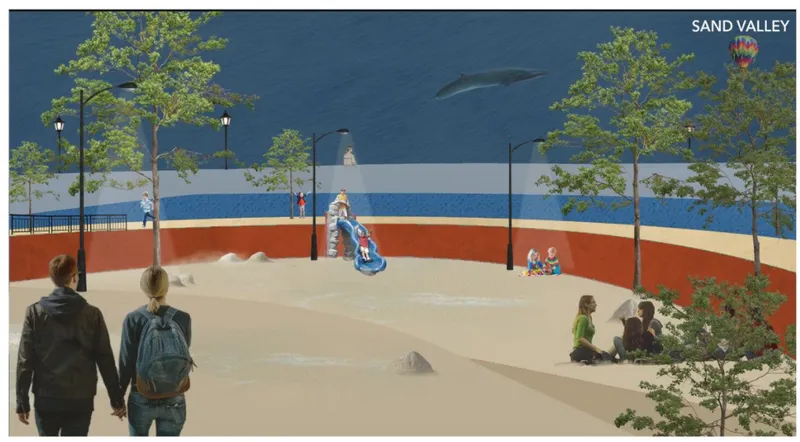
The opening scene of the park grounds the entire concept. A sandy plaza stretches out beneath tree canopies and street lamps, where families gather near a red curved wall that reads as both sculptural gesture and threshold. Children play on sandscapes where fountains might once have been. The material is the message: sand replaces water as the dominant ground surface, immediately communicating scarcity without a single word of explanation. The red wall operates as a spatial hinge, guiding movement while marking the boundary between the city's everyday rhythm and the park's more confrontational interior.
Terraced Amphitheater and the Illusion of Sea
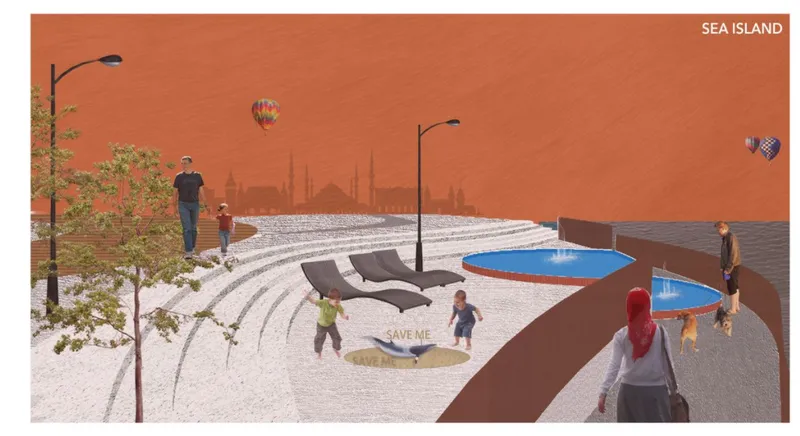
The park's six experiential nodes include spaces like the Sea Island, a surreal coastal illusion embedded in sand, and the Steam Plaza, which uses fog to symbolize evaporation and loss. Here, a terraced amphitheater steps down toward circular blue pools set under an orange, heat-saturated sky. Hot air balloons drift above, lending the scene a dreamlike quality that underscores the project's approach: environmental storytelling through sensory immersion rather than didactic instruction. The water in those pools is almost too vivid against the surrounding aridity, a deliberate contrast that makes the visitor acutely aware of what the rest of the landscape lacks.
The visitor path is designed as a sequential revelation. It begins in water-rich zones mimicking aquatic settings and ends in barren, desolate environments that reflect the outcome of climate neglect. The amphitheater sits somewhere in this gradient, offering a gathering space that doubles as a moment of reckoning: water is present, but it feels precarious, staged, almost too precious to last.
The Dripping Wall: Architecture Activated by Rain
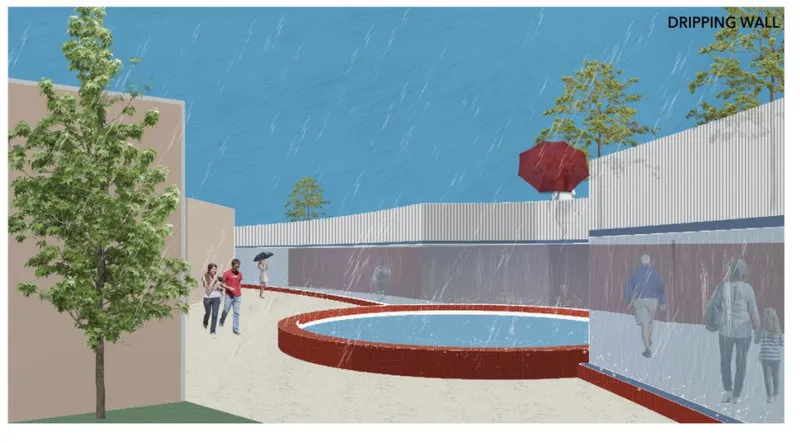
Among the most compelling design moves is the Dripping Wall, an installation that only becomes active in wet seasons. A curved pool with red brick edging sits beside a corrugated metal wall, and rain transforms the wall into a temporary waterfall. The elegance of this detail lies in its contingency: the architecture performs only when the climate allows it to, turning weather itself into a design collaborator. In dry months, the wall stands mute, its silence communicating drought more powerfully than any graphic panel could. The corrugated metal amplifies the sound of rainfall, making scarce precipitation feel like an event rather than a background condition.
Tulip Garden: Cultural Memory Rooted in Bloom
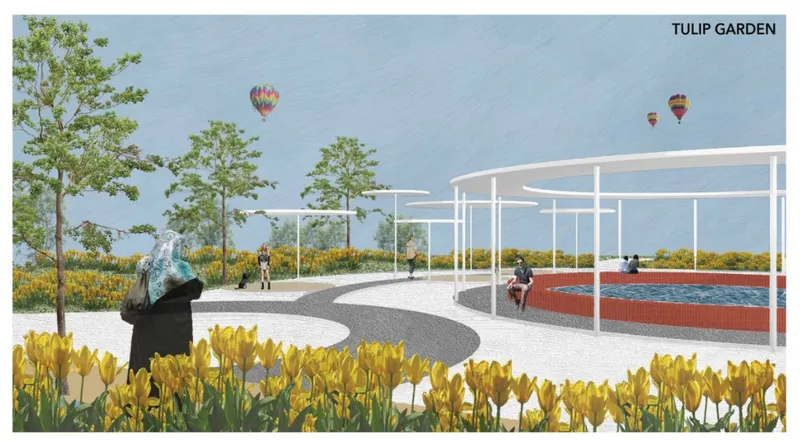
Not everything in Dry Water speaks the language of loss. The Tulip Garden celebrates Istanbul's deep floral heritage with pathways lined in yellow tulips beneath a white pergola structure. Hot air balloons float overhead, connecting this zone visually to the amphitheater scene and maintaining the project's slightly surreal register. The seasonal bloom is a reminder that water, when present, generates abundance. By placing this garden within a narrative sequence that also includes sand valleys and fog plazas, the design frames beauty as something conditional, dependent on the resources we choose to protect.
The pergola itself is restrained in form, providing shade without competing with the planting below. Its repetitive white frames create a rhythm that draws visitors forward along the path, functioning as an architectural metronome that paces the transition from this moment of color back toward the drier zones of the park.
Why This Project Matters
Dry Water succeeds because it refuses to separate aesthetics from advocacy. The park does not lecture; it immerses. Sand, fog, corrugated metal, seasonal rain, and tulip blooms become instruments of environmental communication, each calibrated to trigger a specific spatial and emotional response. In a discipline that too often treats sustainability as a technical footnote, this project places ecological crisis at the center of the design concept and builds every material decision around it.
For a city historically defined by its waterworks, Dry Water proposes a painful but necessary reframing of identity. Istanbul's relationship to water is no longer one of abundance; it is one of negotiation, loss, and adaptation. Shenyu Sun's contribution to the Ripple competition demonstrates that landscape architecture can function as both public space and public argument, turning the ground beneath our feet into evidence of a crisis that demands attention.
View the Full Project
About the Designers
Designer: Shenyu Sun
Enter a Design Competition on uni.xyz
uni.xyz runs architecture and design competitions year-round that reward proposals with spatial conviction and real site intelligence.
Project credits: Dry Water by Shenyu Sun Ripple (uni.xyz).


Popular Articles
Popular articles from the community


Opera on the Sea: Driftwood Logic Shapes a Timber Opera House on Estonia's Coast
Trevor Orgill's opera house translates the entangled drift of floating timber into a civic building where wood, water, and music converge.

Opera by the Sea Estonia: Three Shells Dissolving Architecture into Tallinn's Coastline
A winning opera house proposal replaces monumental form with interconnected shells that blur the boundary between building, park and Baltic Sea.

Manzana Morphosis: Stretching Barcelona's Grid into a Living Landscape for 2050
A radical reworking of the Eixample manzana turns density into a tool for generous public space, vertical ecology, and environmental performance.

Extended Shell: Retrofitting Kolkata's Balconies as Living Urban Thresholds
A modular retrofit system recovers the social and environmental intelligence of Kolkata's historic verandas for contemporary Park Street residents.

Similar Reads
You might also enjoy these articles

The Amber Palace Opera: A Geological Fiction Surfaces on Tallinn's Baltic Waterfront
Pierre Brillard reimagines a Baltic legend as a public landscape, opera house, and waterfront promenade rooted in Tallinn's coastal identity.
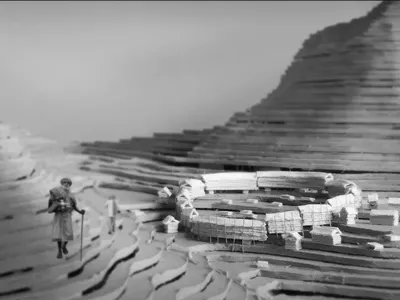
Dynamic Modules Shelter: A Telescopic Ring for Mountain Pilgrimage
A circular modular framework of steel, bamboo, and fabric grows vertically with demand, wrapping communal ground in adaptable shelter.

Singing Woman: Contemporary Architecture Inspired by Estonia’s Voice and the Sea
Singing Woman turns Estonia’s song culture into flowing opera house architecture, blending public life, landscape, sea, and national memory.
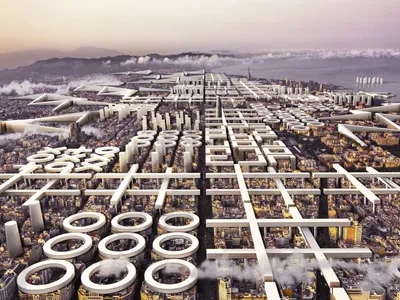
HYPERBLOCK: Flexible Urban Design for Barcelona’s Future City
HYPERBLOCK reimagines Barcelona as flexible urban design, layering density, daylight, public space and adaptable housing above Cerdà’s grid.

Comments (0)
Please login or sign up to add comments
No comments yet. Be the first to comment!