
DUHA Architects Builds a Reversible Red Pavilion on Hue's Protected Perfume River Corridor
A modular steel-framed hospitality retreat in central Vietnam designed to be assembled, disassembled, and leave no lasting trace on the landscape.

The most interesting thing about the Scarlet Pavilion is not that it exists on the banks of the Perfume River in Hue, but that it was designed, from first principles, to un-exist. DUHA Architects, led by principal architect Ha Xuan Du, conceived this 2,637-square-foot hospitality project as a fully reversible structure: a prefabricated steel frame assembled on site without deep foundations, capable of being taken apart and the ground returned to its original state. In a protected riverside corridor subject to strict landscape preservation regulations, that constraint became the project's generative idea.
What prevents the building from reading as a timid exercise in compliance is its color. The red corrugated metal roof and red steel frame are an unmistakable reference to Hue's traditional chromatic identity, the vermilion of its imperial citadel and temple gates, reinterpreted in raw industrial materials. The pavilion simultaneously defers to its context and announces itself within it. Built as a second home and boutique retreat for a young couple, it negotiates between permanence and impermanence, between architectural ambition and ecological restraint, with unusual confidence.
Red Among Green
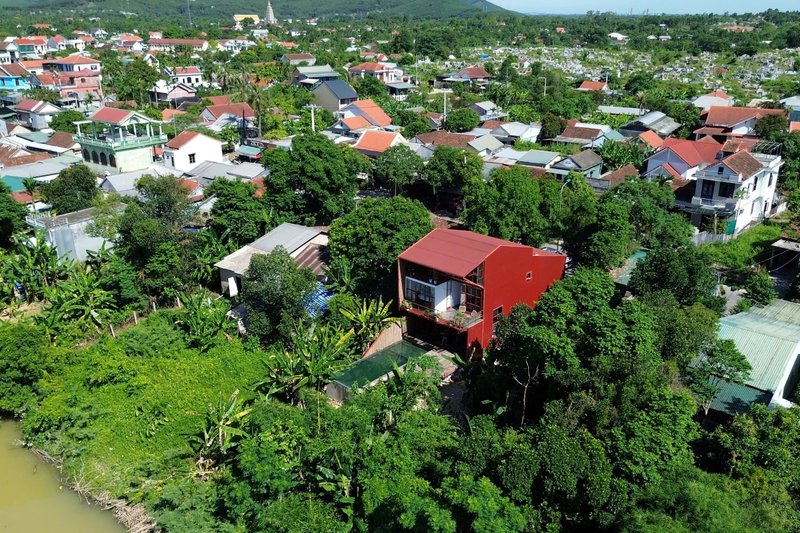
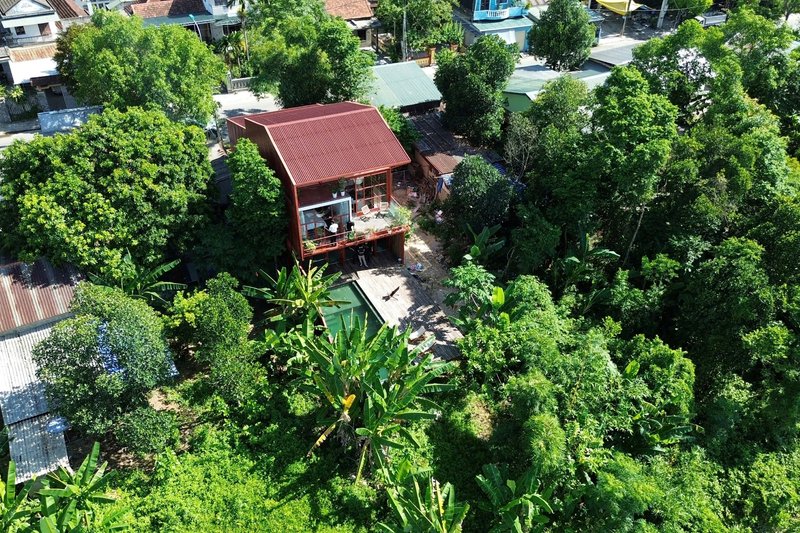
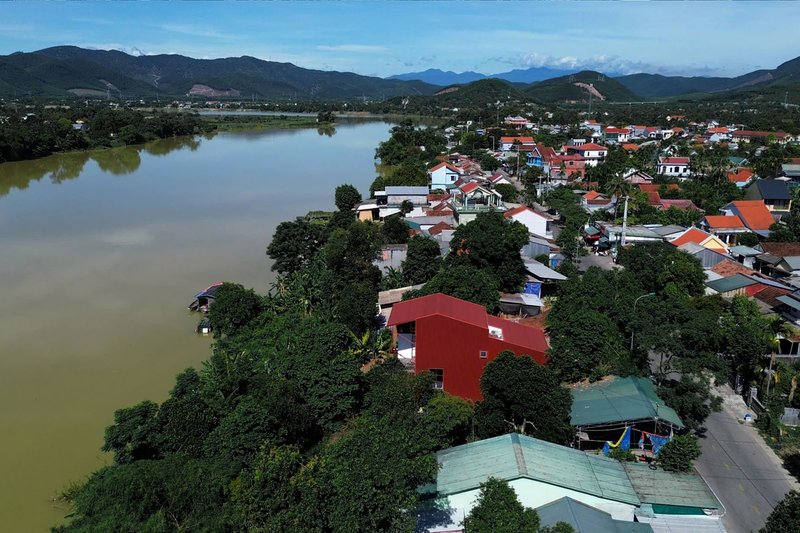
From above, the Scarlet Pavilion reads as a single crimson slab lodged in the canopy. The drone views reveal just how dense the vegetation along this stretch of the Perfume River is, and how decisively the architects chose to work within it rather than against it. The building sits among banana palms, mature trees, and neighboring houses without clearing a wide perimeter. Its footprint is modest; its color does the work of presence.
The decision to use corrugated metal for the roof is both pragmatic and symbolic. Corrugated sheets are the vernacular roofing material across Vietnam, visible on every street in Hue. Painted red and folded into the truss geometry of DUHA's steel frame, the material is elevated from background utility to foreground identity. Viewed against the distant Truong Son mountains and the muddy water of the river, the roof becomes a geographic marker as much as an architectural one.
The Street Face and the River Face
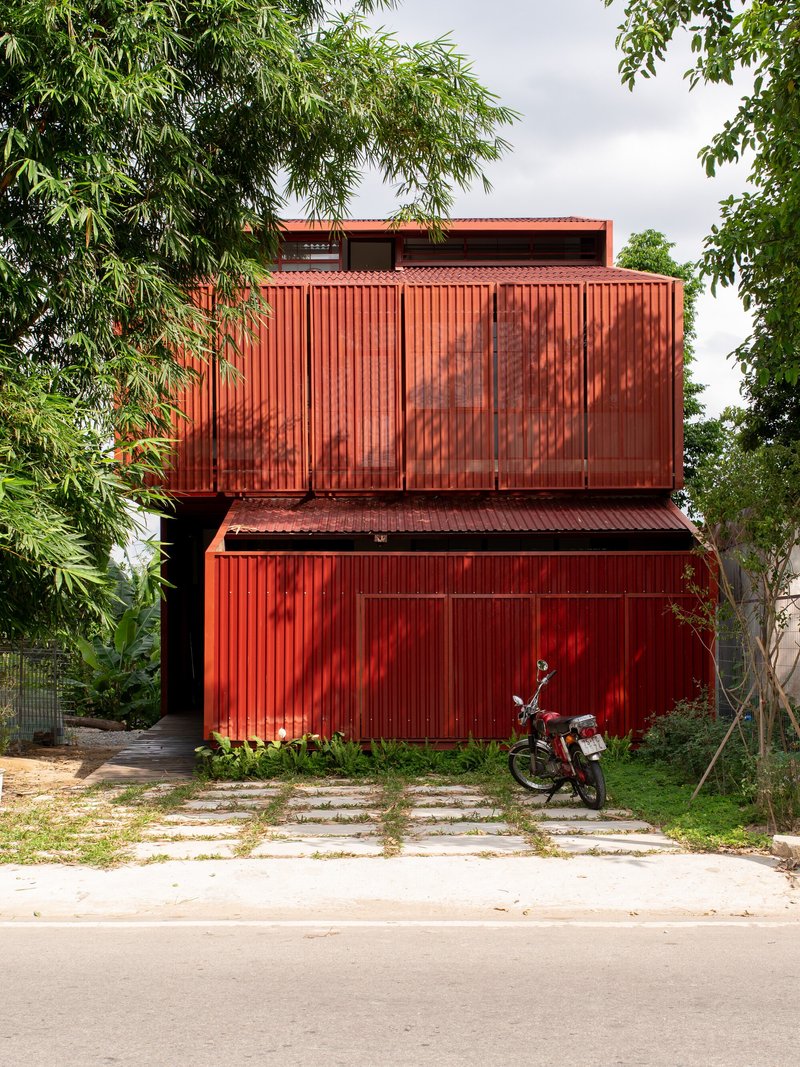
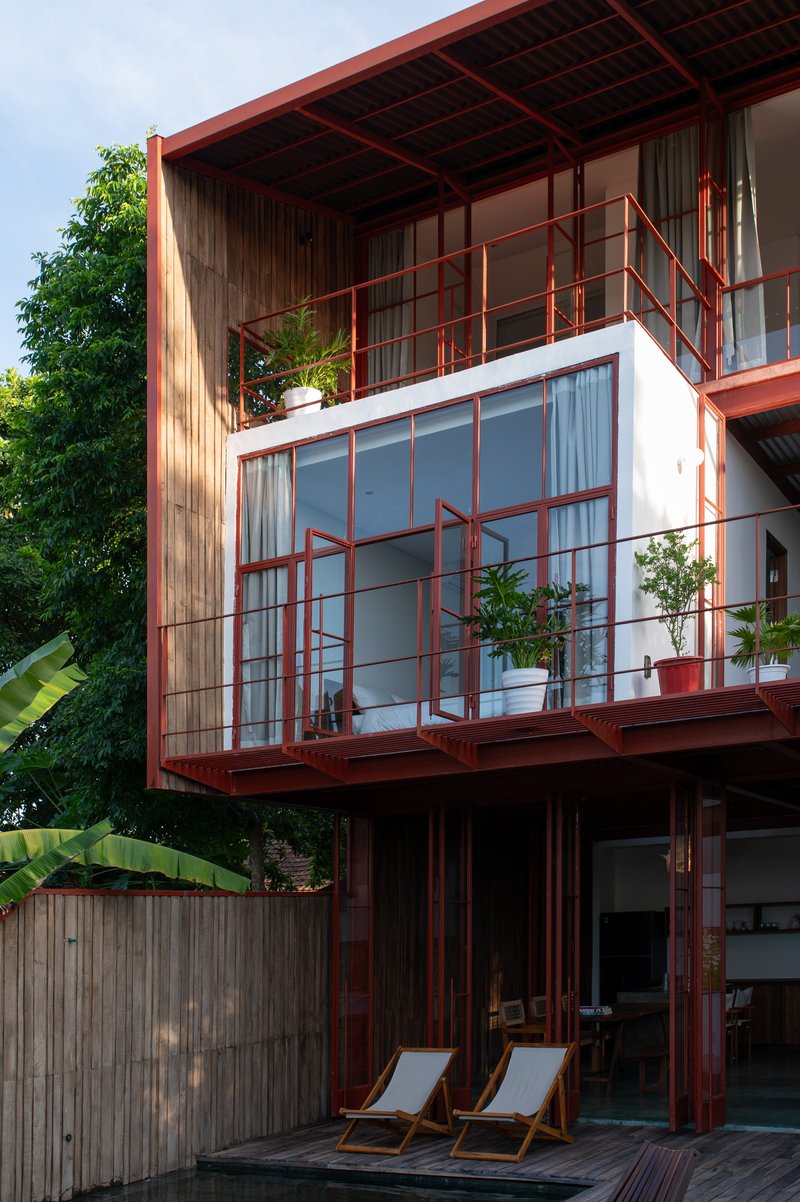
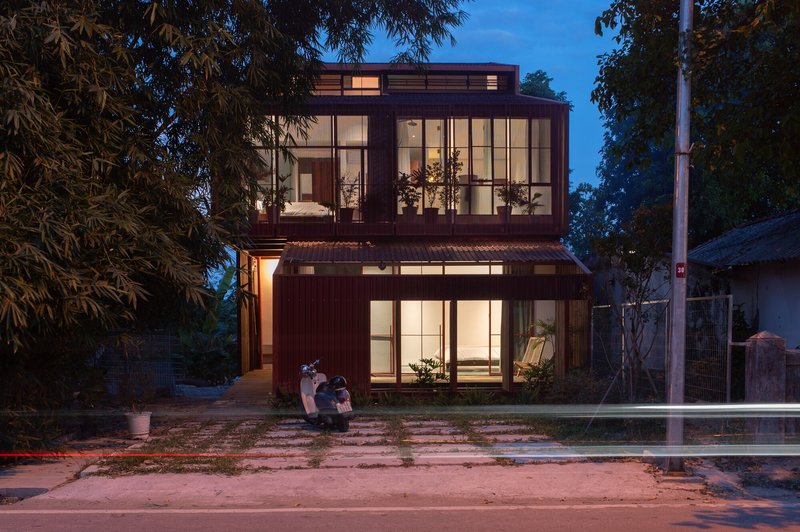
The pavilion operates as two different buildings depending on which direction you approach from. The street facade is relatively guarded: stacked red corrugated volumes, vertical timber cladding, a stepping-stone path past a parked motorcycle. It belongs to its neighborhood. The proportions are domestic. The material palette is familiar. At night, the glazed sections glow warmly through the metal shell, but the posture remains restrained.
Turn the building around and it opens completely. The river-facing elevation dissolves into full-height glazing, timber decks, cantilevered balconies, and lounge terraces. The stacked balconies with red metal railings and tropical foliage frame views toward the water and distant mountains. The dusk photographs make this duality especially legible: the lit interior volumes project outward through the glass, while the steel frame holds the composition together like a scaffolding for looking.
Interior Volume and the Red Staircase
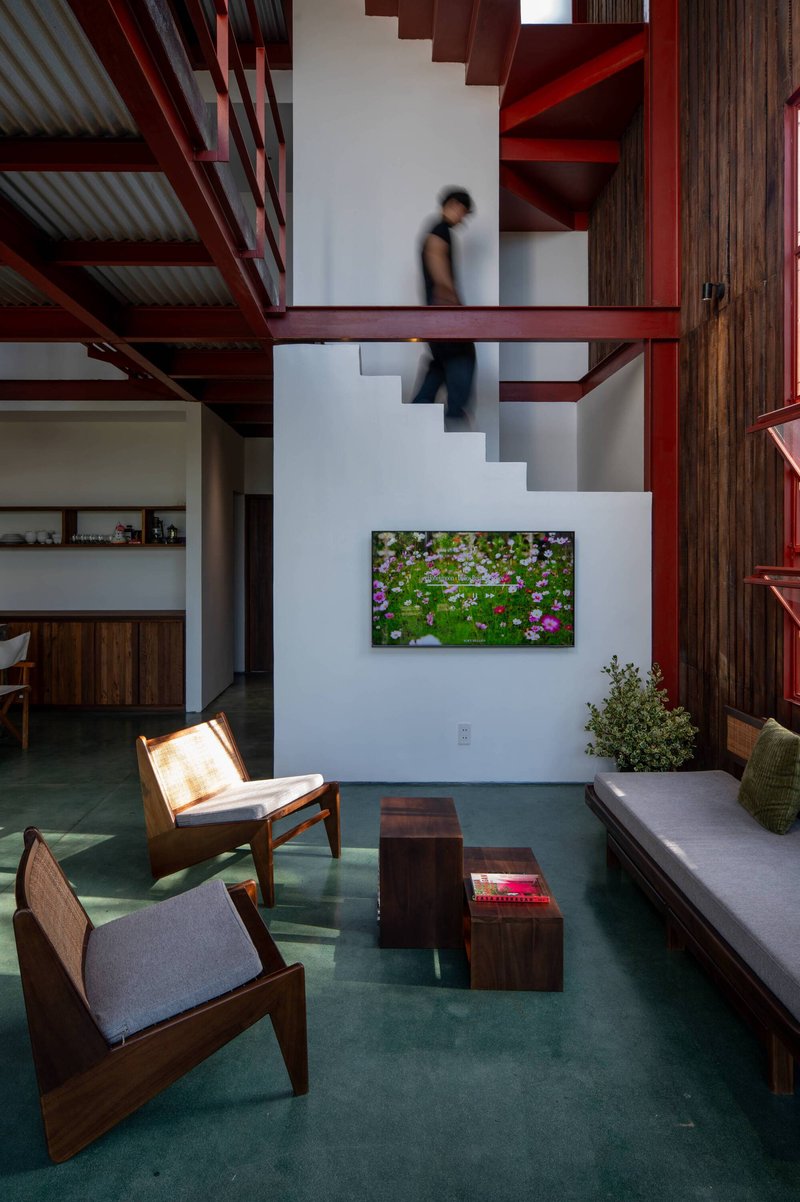
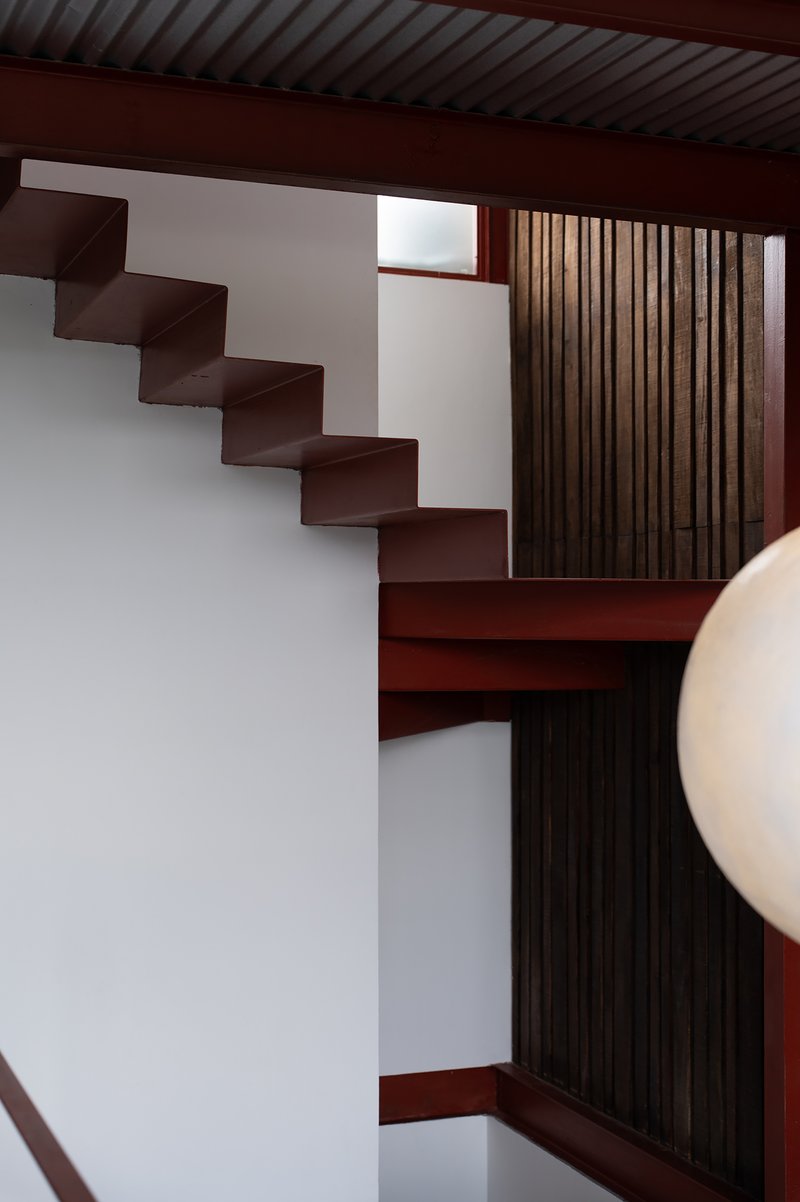
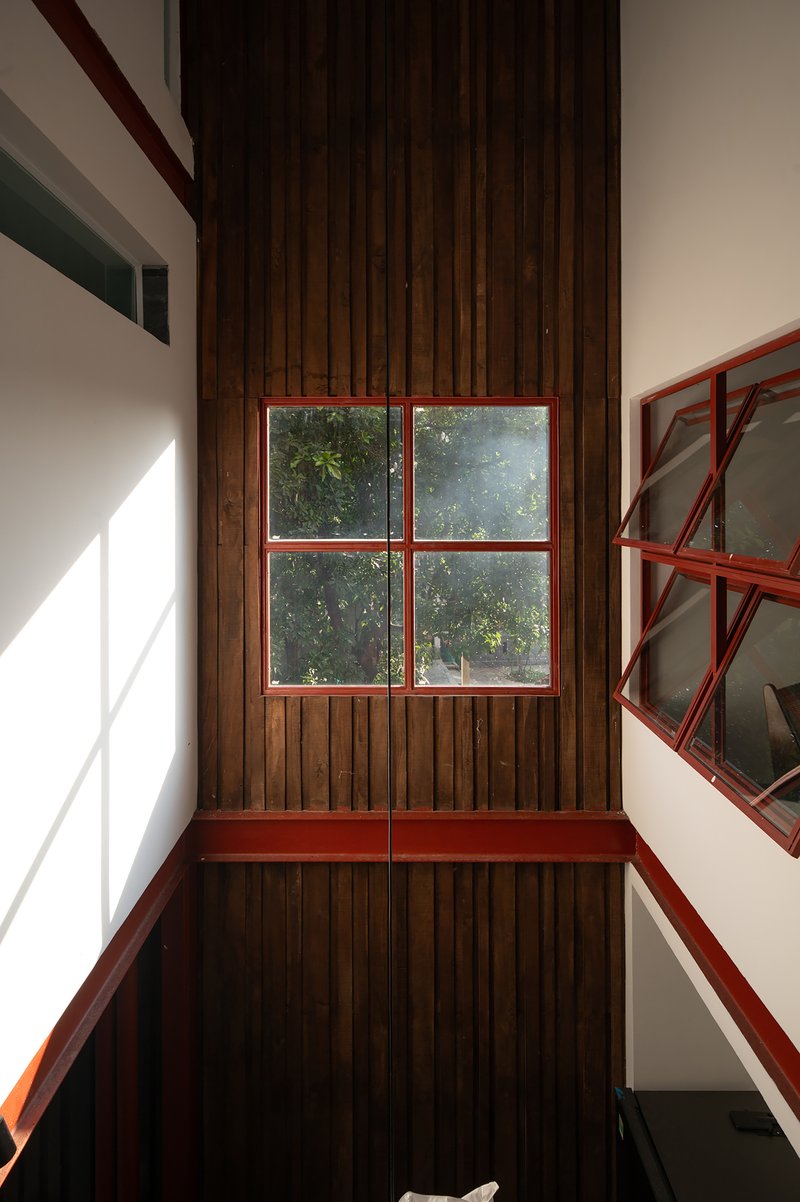
The central staircase is the spatial engine of the interior. Rising through a double-height void lined with vertical timber slats and topped by the corrugated ceiling, it connects three levels while bringing light deep into the plan. The red steel of the stair structure matches the window frames and exterior railings, creating a continuous material language from outside to inside. DUHA treats the stair not as a service element tucked into a corner but as a vertical room, visible from nearly every position in the house.
The strong sunlight that penetrates the timber cladding around the stairwell produces a striped pattern across the concrete landings, a controlled version of the dappled shadows cast by the surrounding trees onto the exterior decks. It is a thoughtful detail: the building absorbs the language of its landscape and replays it indoors.
Ground Floor Living on Green Concrete
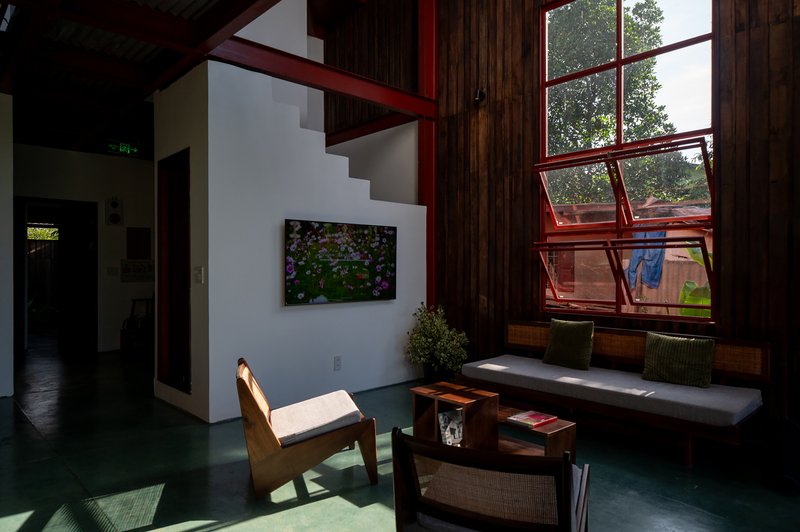
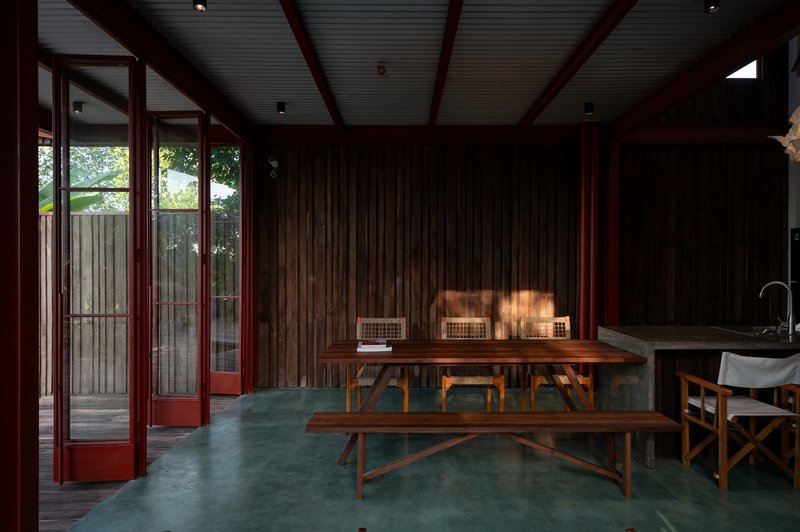
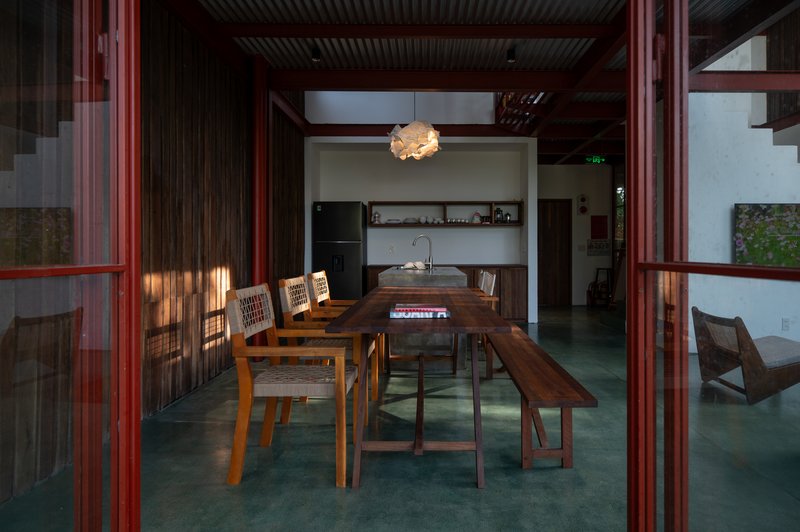
The ground level is organized around a double-height living room with a green polished concrete floor, a material choice that reads as both earthy and deliberate. Against the red steel window frames, the green floor creates a complementary color tension that runs through the entire project. Afternoon light enters through the tall windows and lays geometric shadows across the surface, making the room feel like a covered outdoor space.
The dining area continues this material logic: a timber table and benches on the same green concrete, under the exposed corrugated ceiling. The kitchen alcove, visible through red-framed glass doors, features a concrete countertop and timber cabinetry beneath a sculptural pendant light. Every element is raw, expressed honestly, and held together by the steel frame's consistent geometry. There is no applied finish or decorative layer. The architecture is the decoration.
Thresholds Between Inside and Out
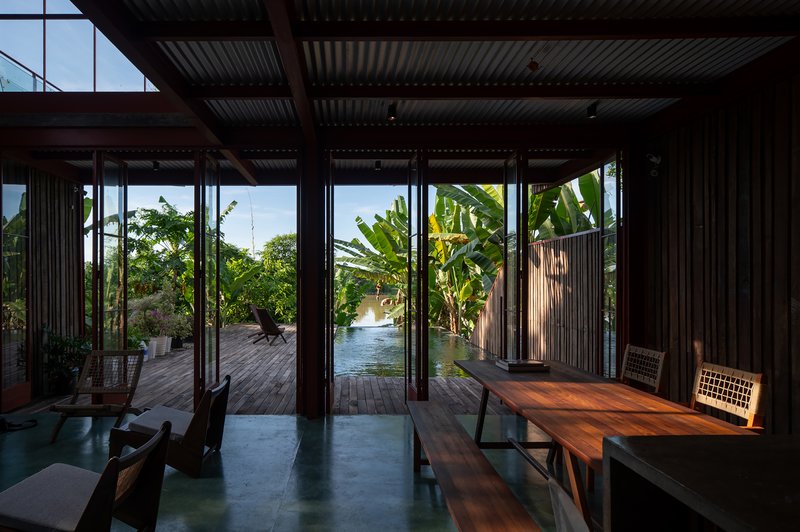
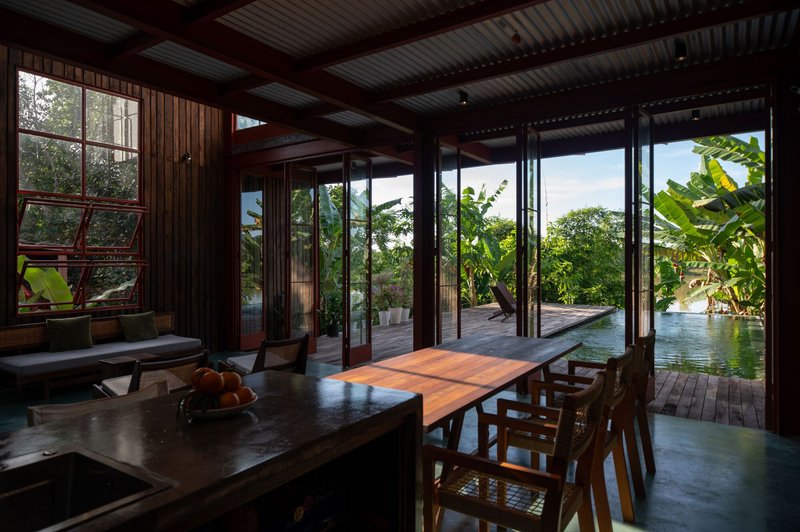
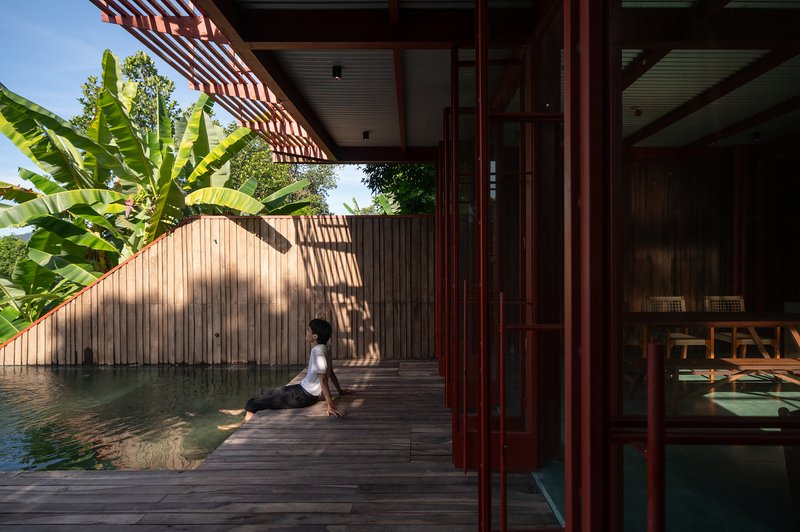
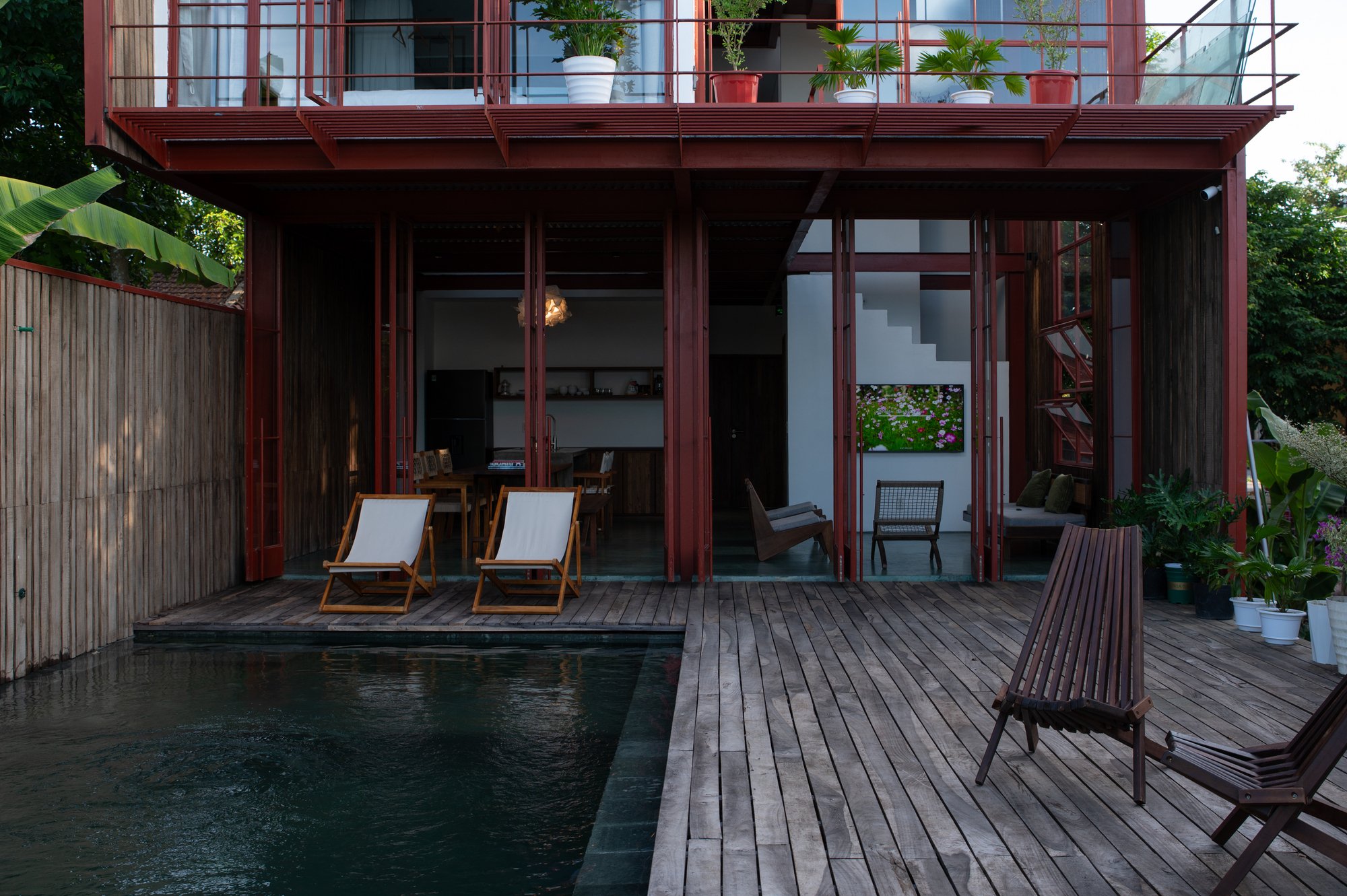
The most compelling moments in the pavilion occur at its edges, where the interior dissolves into landscape. Folding glass walls open the living space directly onto a terrace pool ringed by banana trees. Timber decks extend alongside reflecting pools where figures sit in morning light. The boundary between room and garden is deliberately ambiguous, managed through material transitions (concrete to timber to water) rather than through walls.
The dusk views through open glass doors toward the pond and palms show how the interior was designed to frame exterior conditions rather than compete with them. DUHA's approach to thresholds here is generous: screens filter rather than block, decks extend rather than terminate, and the red steel frame acts as a consistent datum that stitches together indoor and outdoor volumes into a single spatial sequence.
Bedrooms Above the Canopy
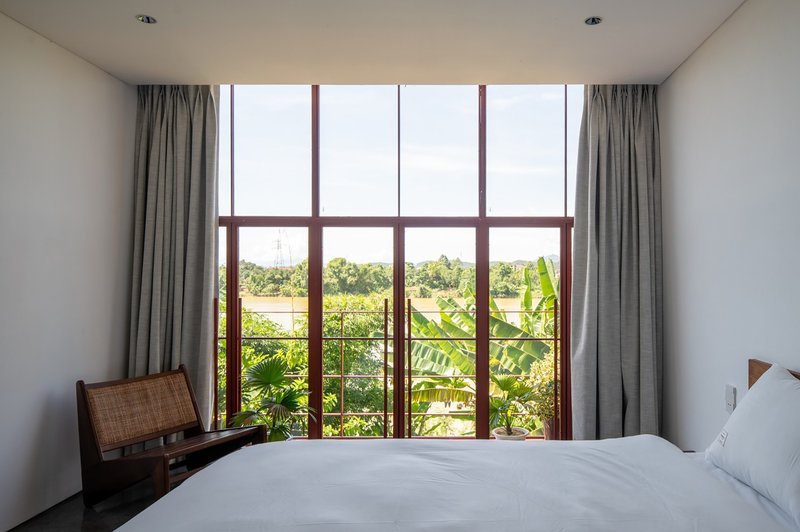
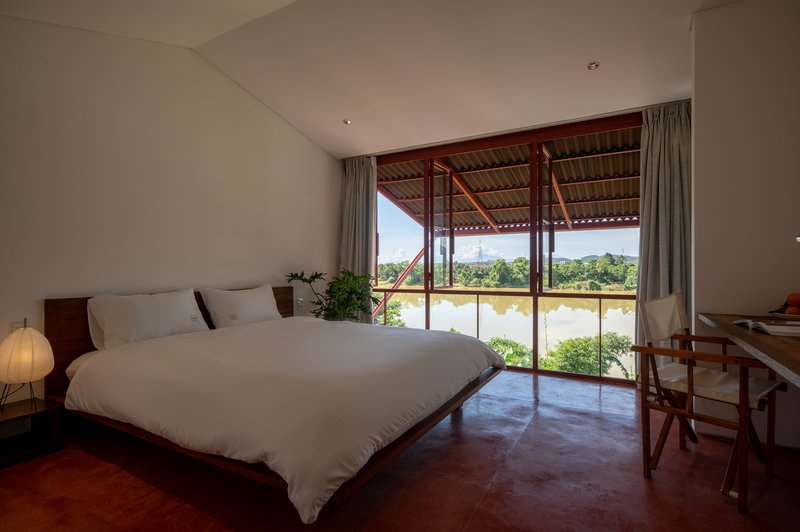
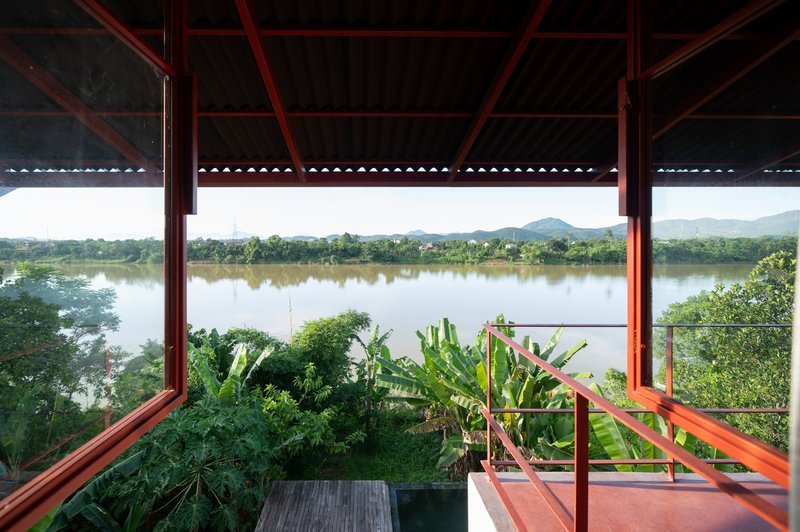
The upper floors contain bedrooms that lean into the river view with floor-to-ceiling glazing. The rooms are spare: exposed steel trusses overhead, concrete and timber underfoot, and the landscape filling the frame. One bedroom looks through banana palms to the water beyond. Another opens through glazed doors directly to the river and distant mountains. A covered terrace with a red steel trellis and glass railing creates a semi-outdoor room at the highest point of the building.
These are not luxury suites in the conventional sense. They are elevated platforms for observation, calibrated to the specific conditions of this site. The choice to expose the roof trusses in the bedrooms maintains the honest, unfinished quality of the entire project. You are never allowed to forget that this is a structure, an assembly of parts, something that was put together and could be taken apart.
The Deck, the Pool, and the River Beyond
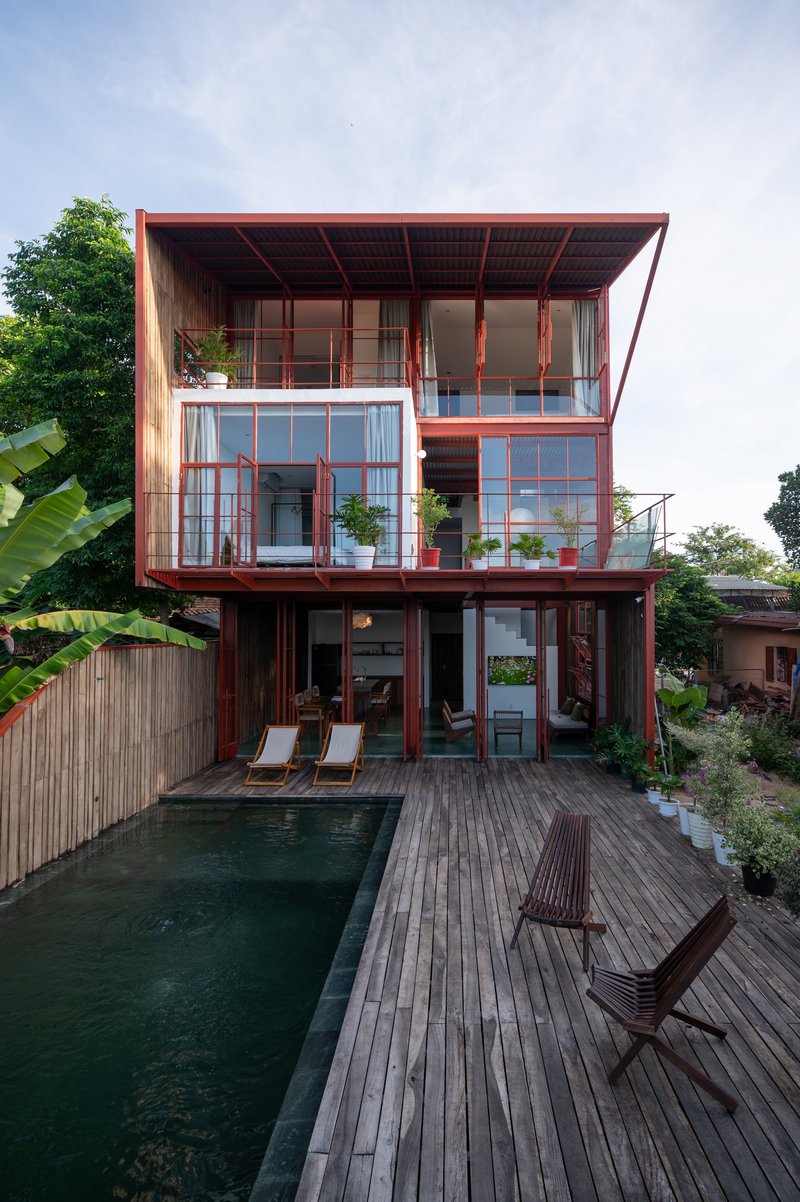
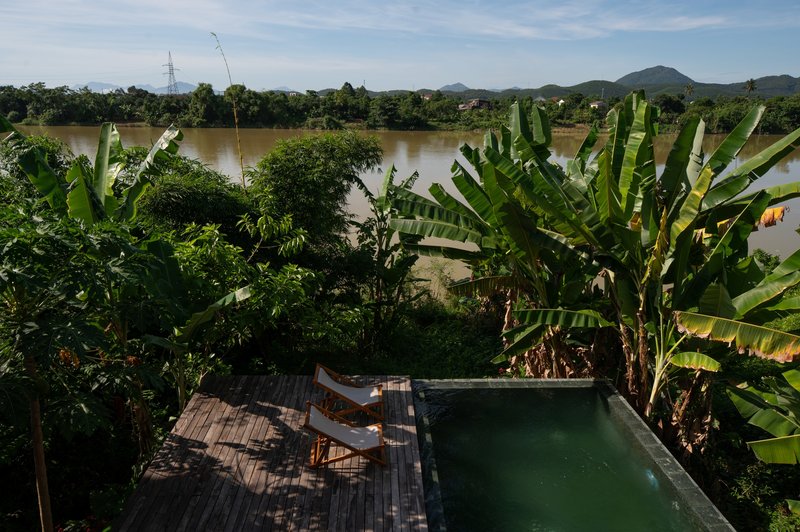
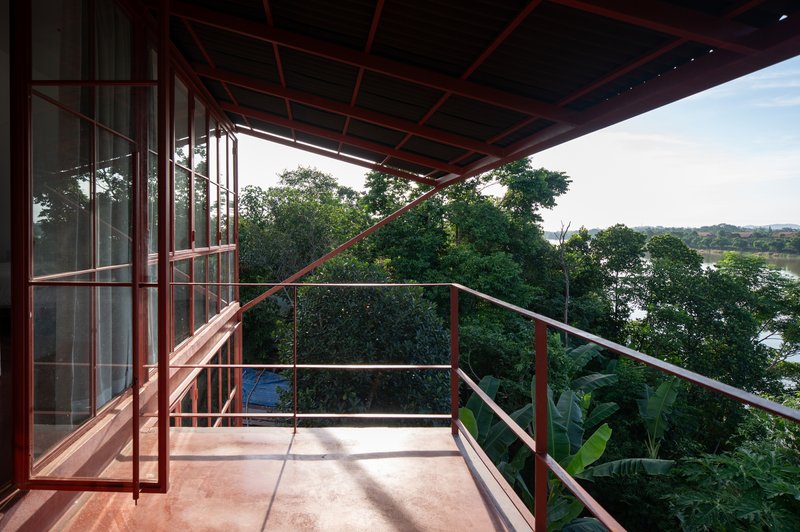
The rear timber deck with its swimming pool is the project's social heart. Oriented toward the Perfume River, it stages a layered sequence of water: the pool in the foreground, the river in the middle distance, the mountains at the horizon. Lounge chairs face the view. At dusk, the red steel frame glows against the darkening sky and the lit interior becomes a warm backdrop.
It would be easy to dismiss this as boutique resort scenography, but the detail tells a different story. The deck is elevated above the existing ground plane, floating on the same modular steel frame that supports the rest of the building. No deep foundations were poured. The pool sits within the deck structure. If the project were ever removed, the riverbank below would be largely as it was before. That is a meaningful claim, and the structural logic of the building supports it.
Plans and Drawings
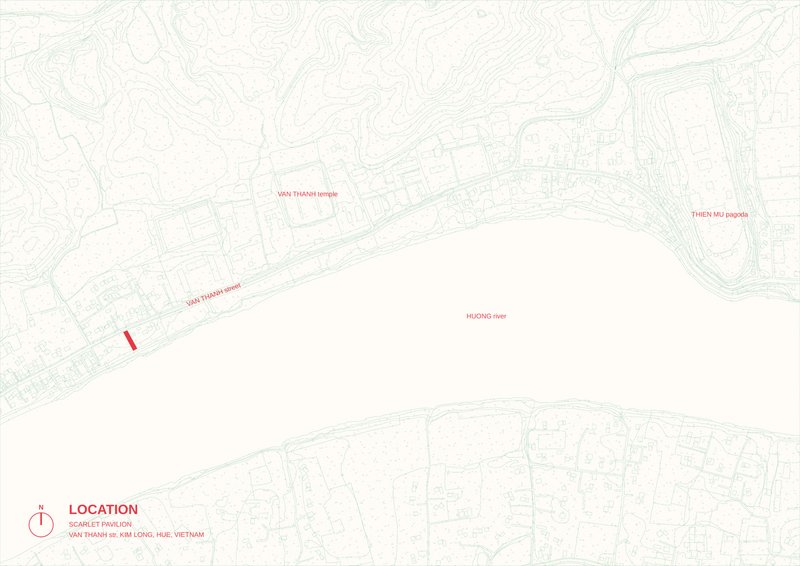
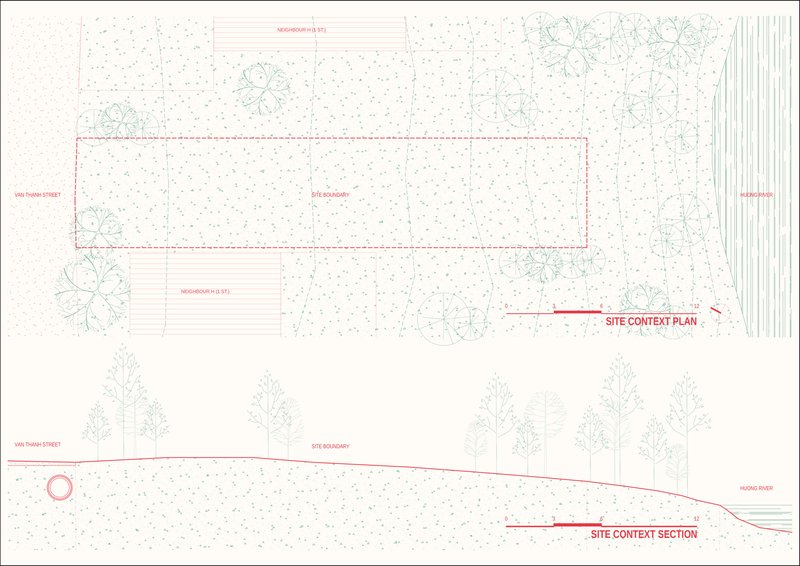
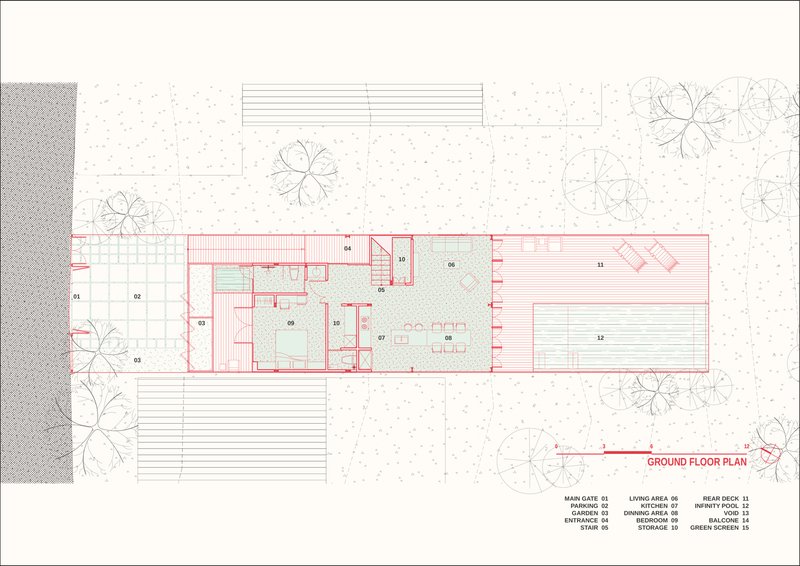
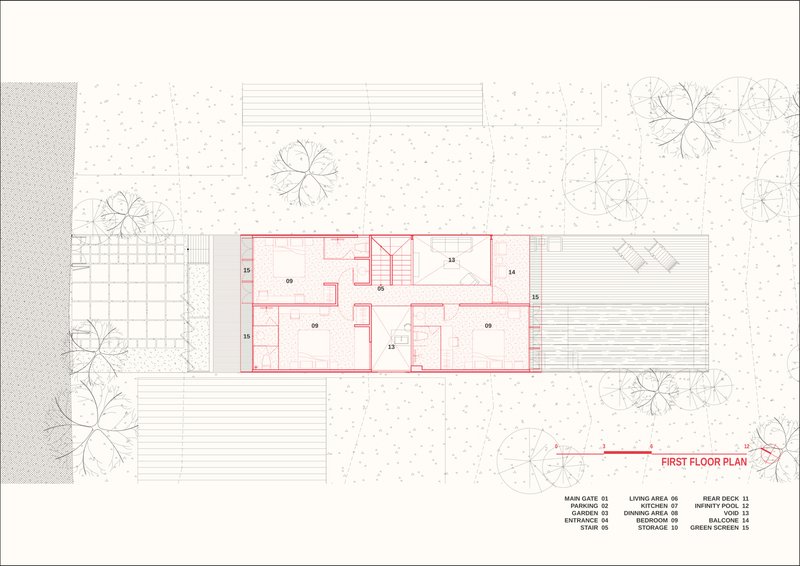
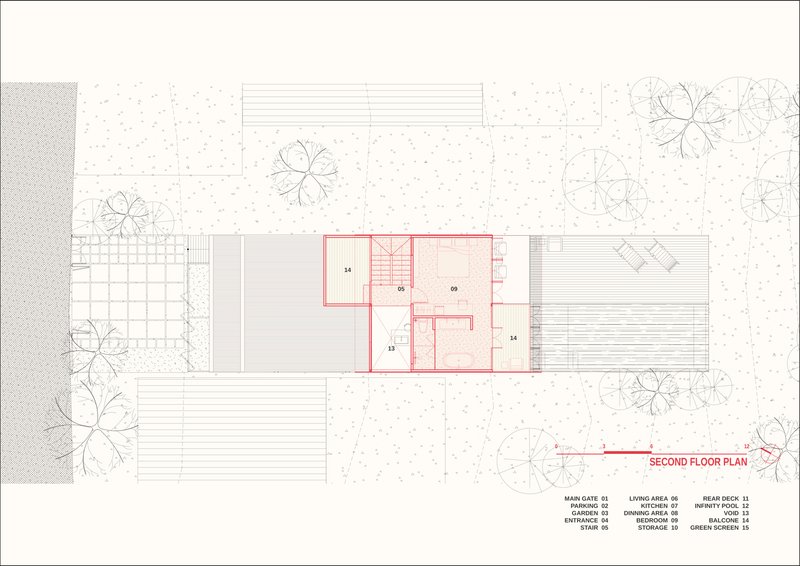
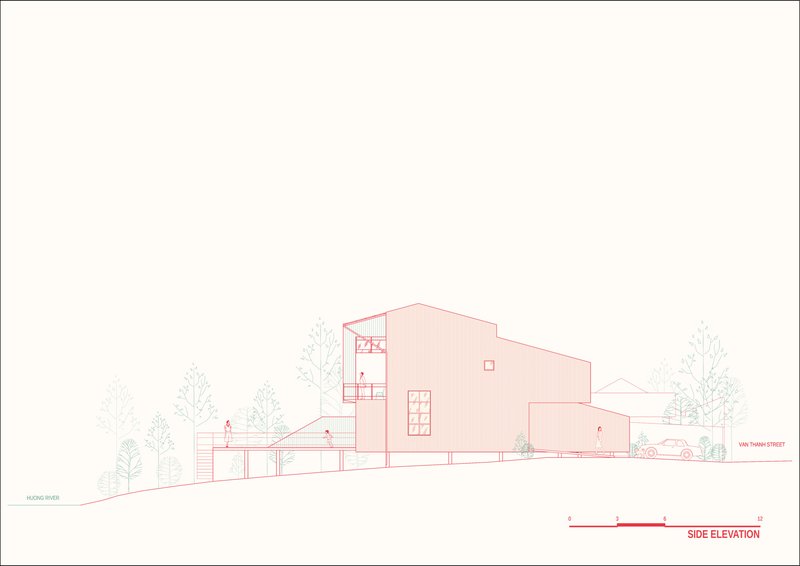
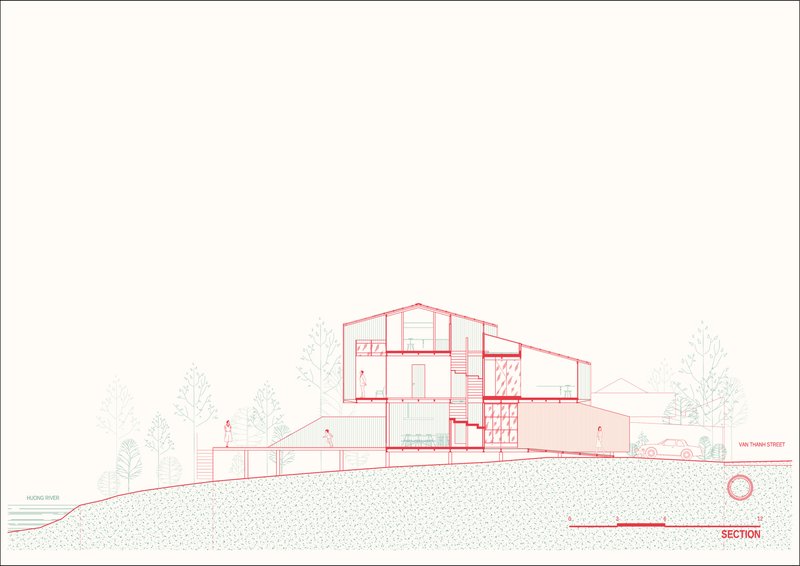
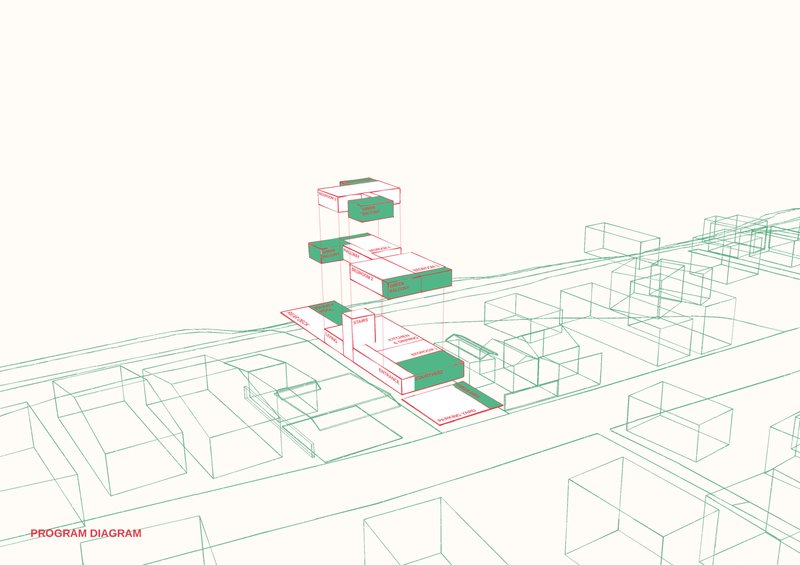
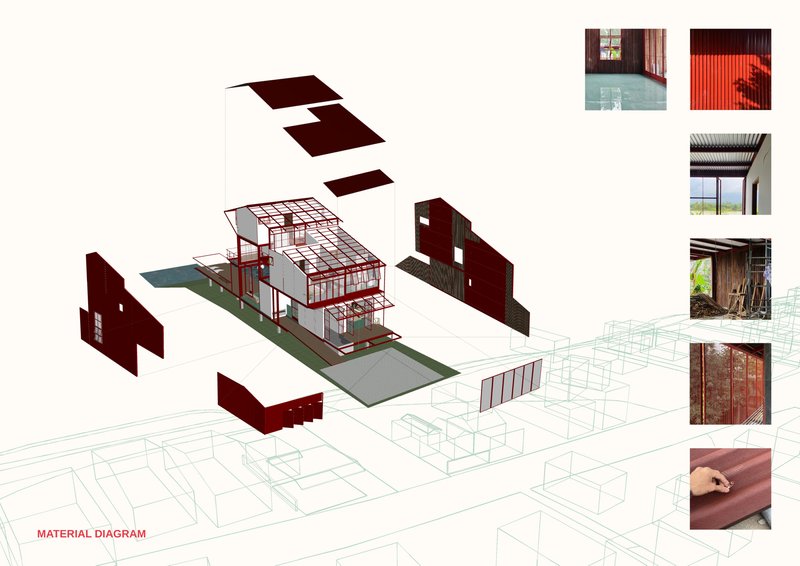
The plan drawings reveal a compact organization: a central courtyard on the ground floor surrounded by living spaces and exterior decks, with bedrooms stacked above around the stairwell. The section drawing is particularly instructive, showing how the building steps down a sloping site to meet the river while maintaining a consistent structural module. The exploded axonometric diagram breaks the project into its constituent layers, roof planes, wall panels, and frame, illustrating the reversible assembly logic that defines the design. Each component is a discrete piece that bolts to the frame and can be unbolted. The site plan and context section confirm the narrow footprint between street and river, making visible the regulatory and topographic constraints that shaped the project.
Why This Project Matters
Reversible architecture is often discussed in academic contexts and rarely built with this level of spatial ambition. Most projects that claim to leave no trace compensate by looking apologetic, as though the architecture has to disappear aesthetically in order to disappear physically. DUHA Architects refuse that trade-off. The Scarlet Pavilion is vivid, present, and unapologetically red. It holds its ground precisely because it was designed to give that ground back.
The project also demonstrates that strict environmental regulations need not produce timid design. The protected status of the Perfume River corridor forced DUHA into a prefabricated, modular, foundation-free structural system that turned out to be the most interesting thing about the building. Constraint generated invention. For a 2,637-square-foot hospitality project in central Vietnam, that is a quietly radical achievement, and a model for how architects can build in sensitive landscapes without pretending they were never there.
Scarlet Pavilion by DUHA Architects (Principal Architect: Ha Xuan Du). Located in Hue, Vietnam. 2,637 sq ft. Completed in 2025.
About the Studio
Share Your Own Work on uni.xyz
If projects like this are the kind of work you want to make, uni.xyz is a place to publish your own, find collaborators, and enter design competitions.



Popular Articles
Popular articles from the community

20 Most Popular Furniture Design Projects of 2025
Modular street systems, parametric benches, and insect hotels: the furniture design projects that captivated architects on uni.xyz in 2025.
20 Most Popular Office Building Projects of 2025
From biophilic workspaces in India to net-positive energy offices in New Delhi, 20 office building projects that defined architecture in 2025.

Prokop Hartl Turns a 1930s Prague Corner Apartment into a Lesson in Structural Honesty
A 115 m² renovation on the Vltava River celebrates exposed concrete, restored parquet, and a mirrored column as its centerpiece.
OUJ Rewires a 72-Square-Meter Taipei Apartment for Multigenerational Living After the Pandemic
Inside a 40-year-old public housing block, plywood volumes and translucent screens turn three cramped bedrooms into a flexible family home.

Similar Reads
You might also enjoy these articles

127af Flips a Tiny Bagnolet Rowhouse Upside Down with a Handcrafted Roof Extension
A 55-square-meter terraced house on the edge of Paris gains a luminous upper living floor through lightweight timber and steel.
1.61 Design Workshop Wraps a 600-Square-Meter Café in Vietnam in Sculptural Burgundy Drama
Reden Café & Bistro pairs a helical staircase, mosaic floors, and deep red interiors to rethink Vietnamese hospitality space.
The Unbound Brain: A School Shaped by Cognitive Architecture
Cylindrical learning pods radiate like neurons from a central cortex, turning the floor plan into a spatial model of human thought.
Revival Vernacular Architecture: Rammed Earth Settlements for the Sahara
A modular desert community in Mauritania that fuses passive cooling techniques with earthen construction and local craftsmanship.


Explore Religious Building Competitions
Discover active competitions in this discipline




The Global Benchmark for Architecture Dissertation Awards


Design Challenge - Contemporary interpretation of a religious complex


Challenge to design mud housing for contemporary communities
Comments (0)
Please login or sign up to add comments
No comments yet. Be the first to comment!