
D'WELL Carves a 10,000 Sq Ft Inward-Looking Sanctuary from Sculpted Volumes in Surat
A private residence in Surat, India turns away from the street to organize domestic life around curving concrete walls and filtered light.


Surat is a city of density, noise, and relentless sunlight. Building a private residence there means accepting that the street will impose itself unless you design against it. D'WELL took that premise literally with the Sculpted Sanctuary House, a 10,000 square foot home that turns its back on the city and organizes every room around a sequence of curved concrete walls, double-height voids, and carefully rationed daylight. The result is a house that feels geological: hollowed out rather than built up.
What makes the project worth studying is not any single material gesture but the consistency with which D'WELL pursues interiority. From the ground floor garage to the third floor poker room, each level is shaped by the same vocabulary of circular openings, spiral stairs, and split-face stone surfaces. Light enters through skylights and narrow vertical slots, never through broad picture windows. The house has no interest in panoramic views. Its luxury is spatial, not scenic.
Double-Height Voids as the Organizing Principle
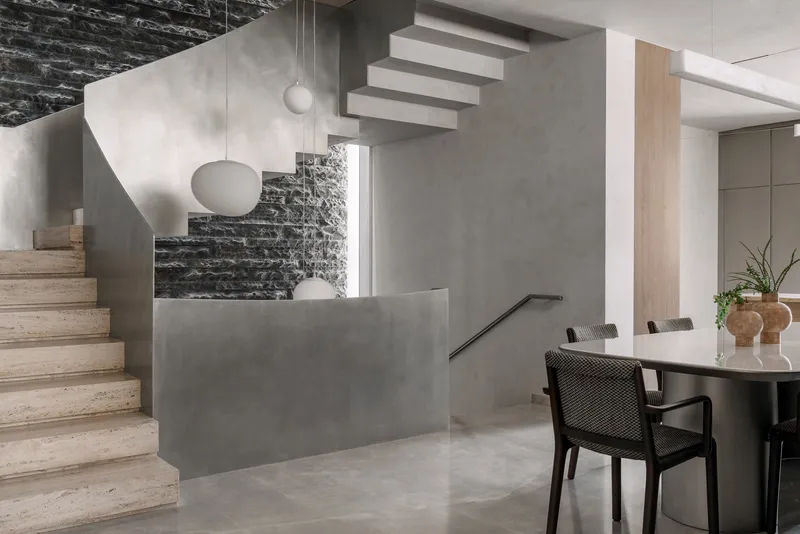
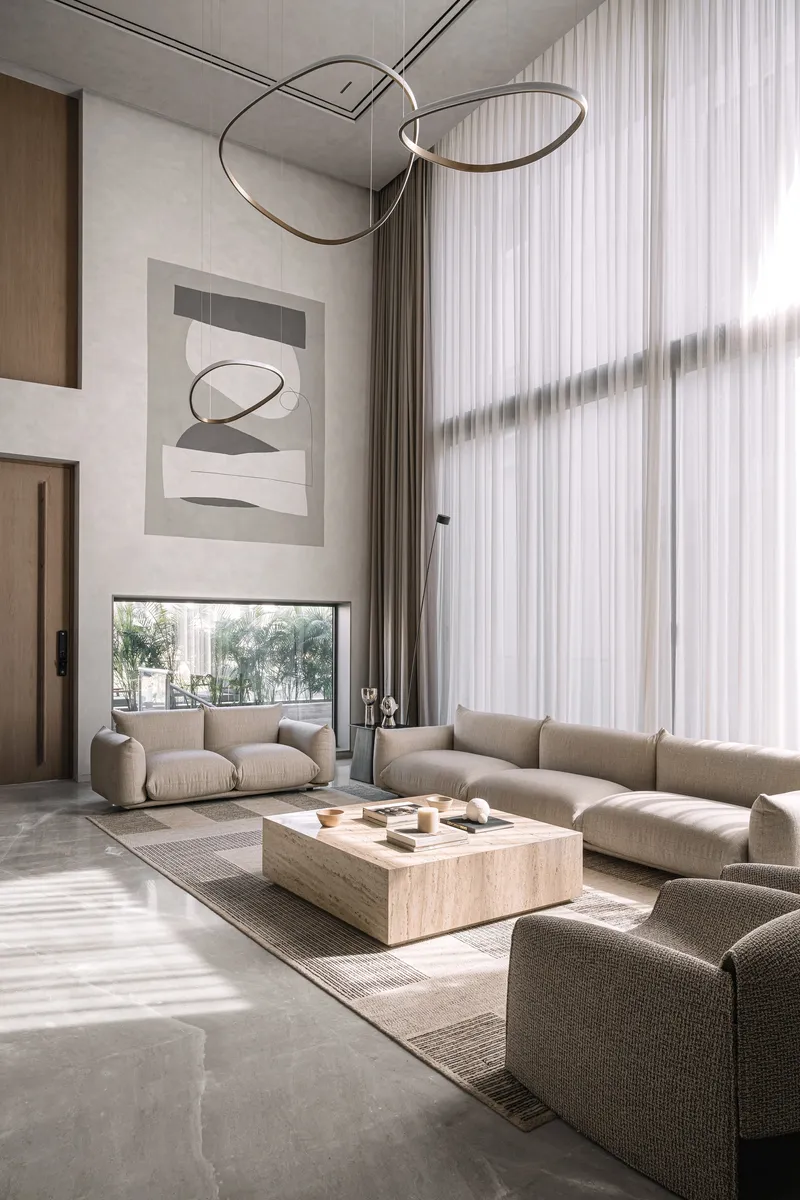
The living room is the gravitational center of the house, and D'WELL gives it room to breathe with a full double-height volume. A floating timber staircase climbs one wall while a black stone feature wall anchors the opposite side, creating an asymmetry that keeps the space from feeling like a hotel lobby. Floor-to-ceiling sheer curtains diffuse the afternoon sun into a warm, directionless glow that softens every hard surface.
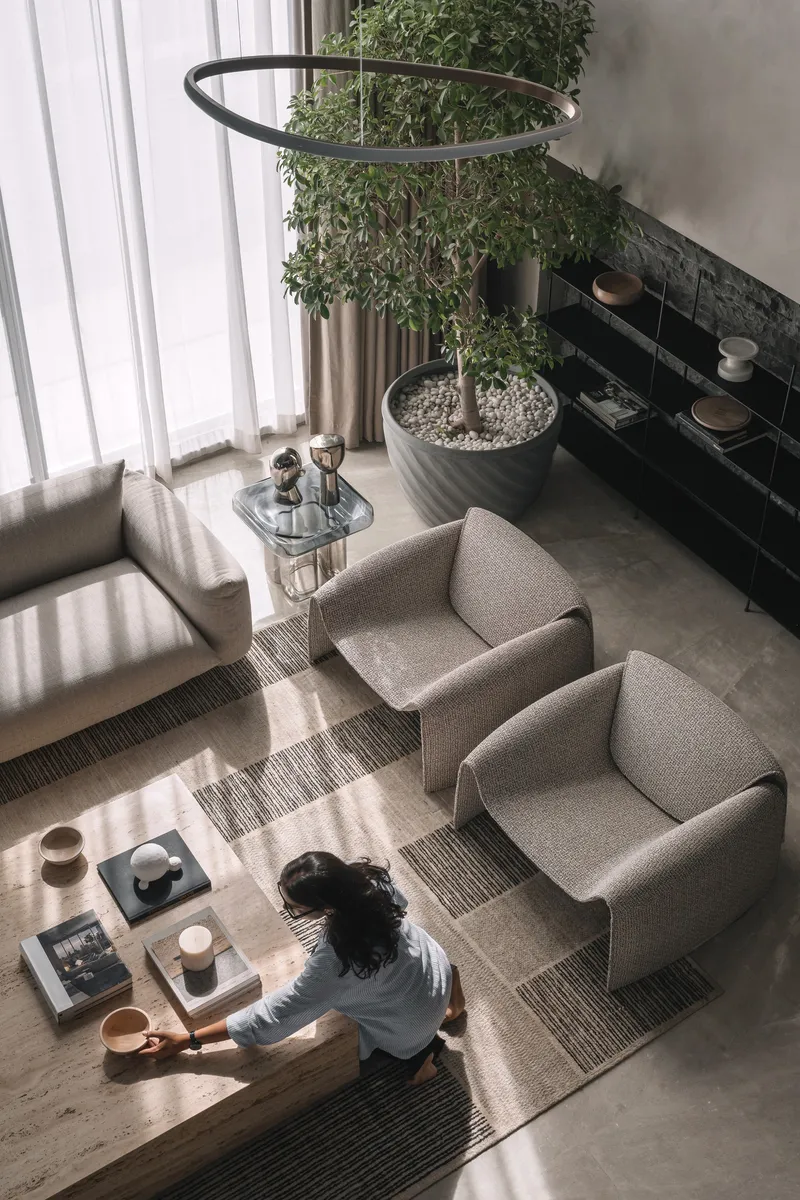
Seen from the mezzanine above, the living room reveals its proportional logic: a circular ring light echoes the potted tree below, and the interplay of vertical stone and horizontal timber millwork becomes legible as a deliberate composition rather than decoration. The void is not just tall for the sake of drama. It connects four of the five levels visually, giving the house a legibility that its inward plan might otherwise deny.
Spiral Stairs as Sculptural Events
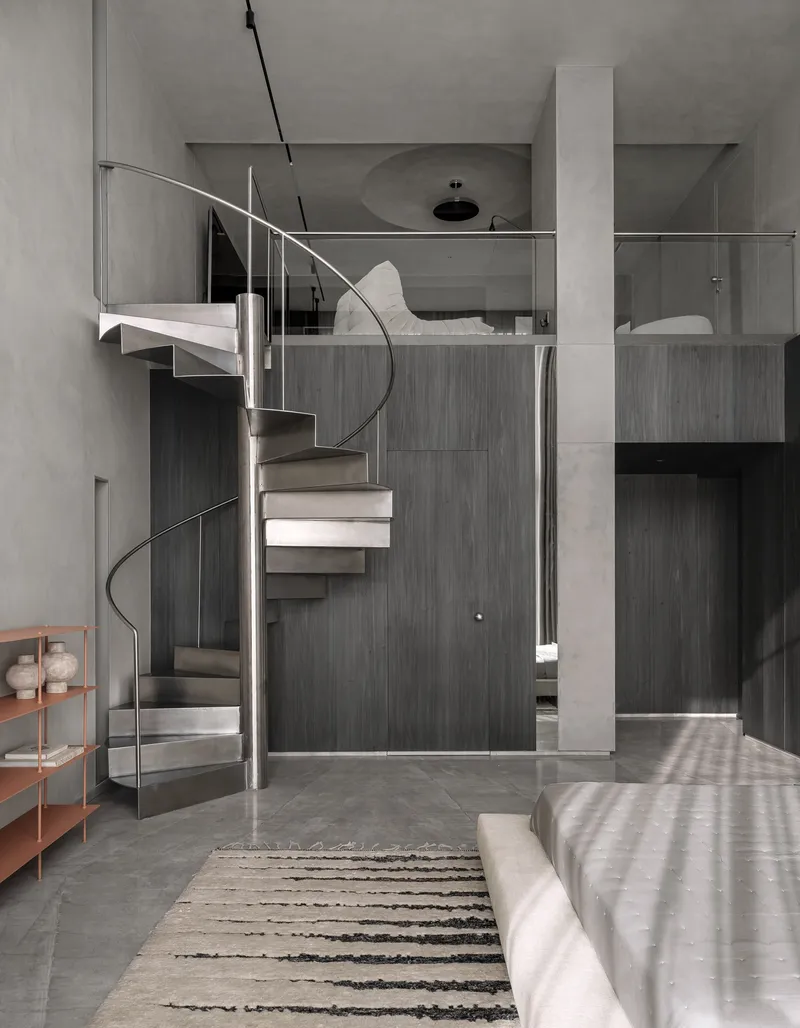
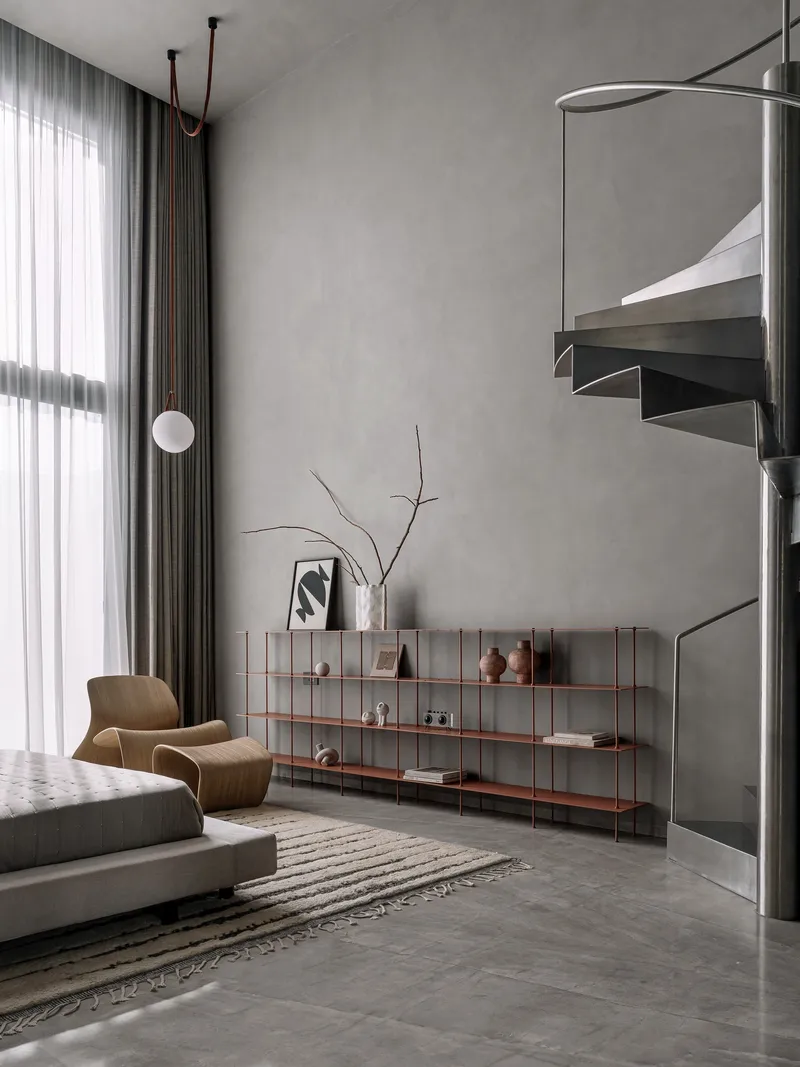
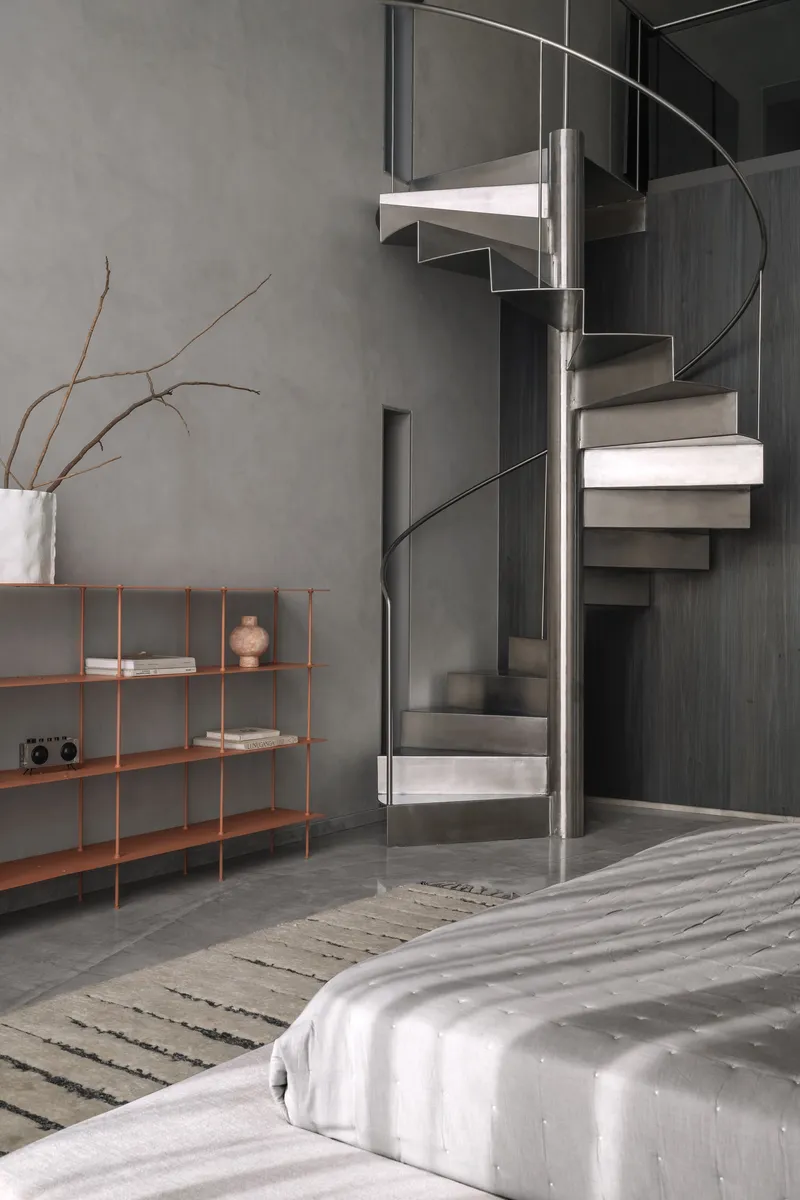
There are at least two spiral staircases in the house, and D'WELL treats each one as a stand-alone sculpture. The steel spiral connecting the lower bedroom to the mezzanine floats its treads on a slender central column beneath a wash of diffused skylight. Shot from above, the geometry is pure: a helix of dark metal against pale concrete, with no balustrade clutter to break the line.
The close-up of the circular tread pattern against the dark paneled wall reveals the level of craft involved. The metalwork is precise, with each tread cantilevered just far enough to cast a thin shadow on the one below. These stairs are not transitional spaces. They are rooms in their own right, programmed to slow you down and make you look up.
Curved Concrete and Split-Face Stone
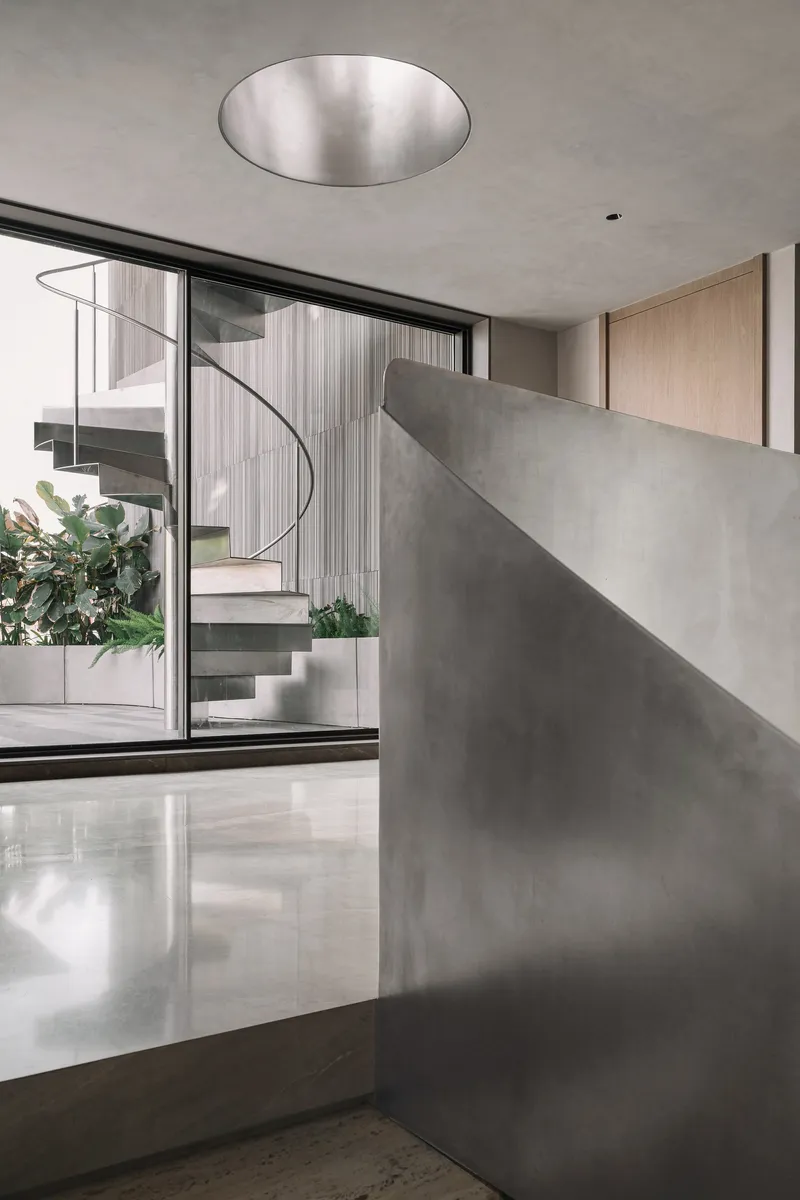
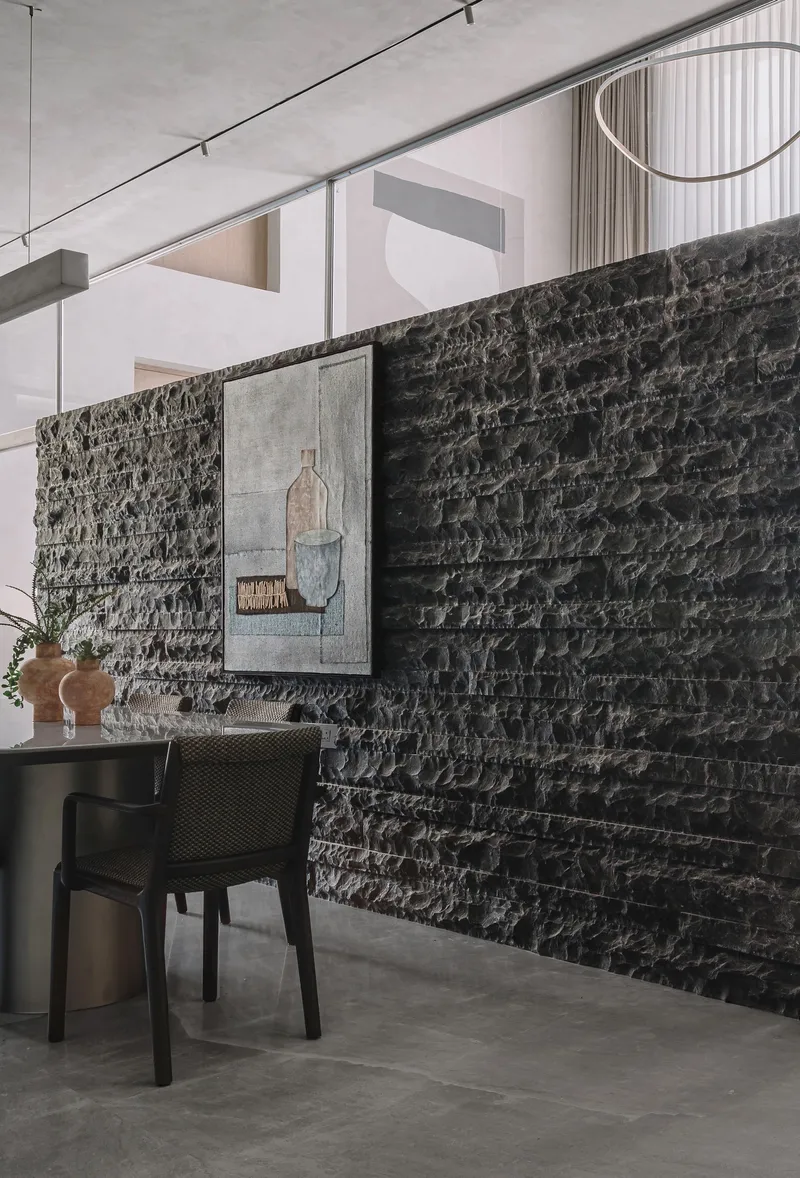
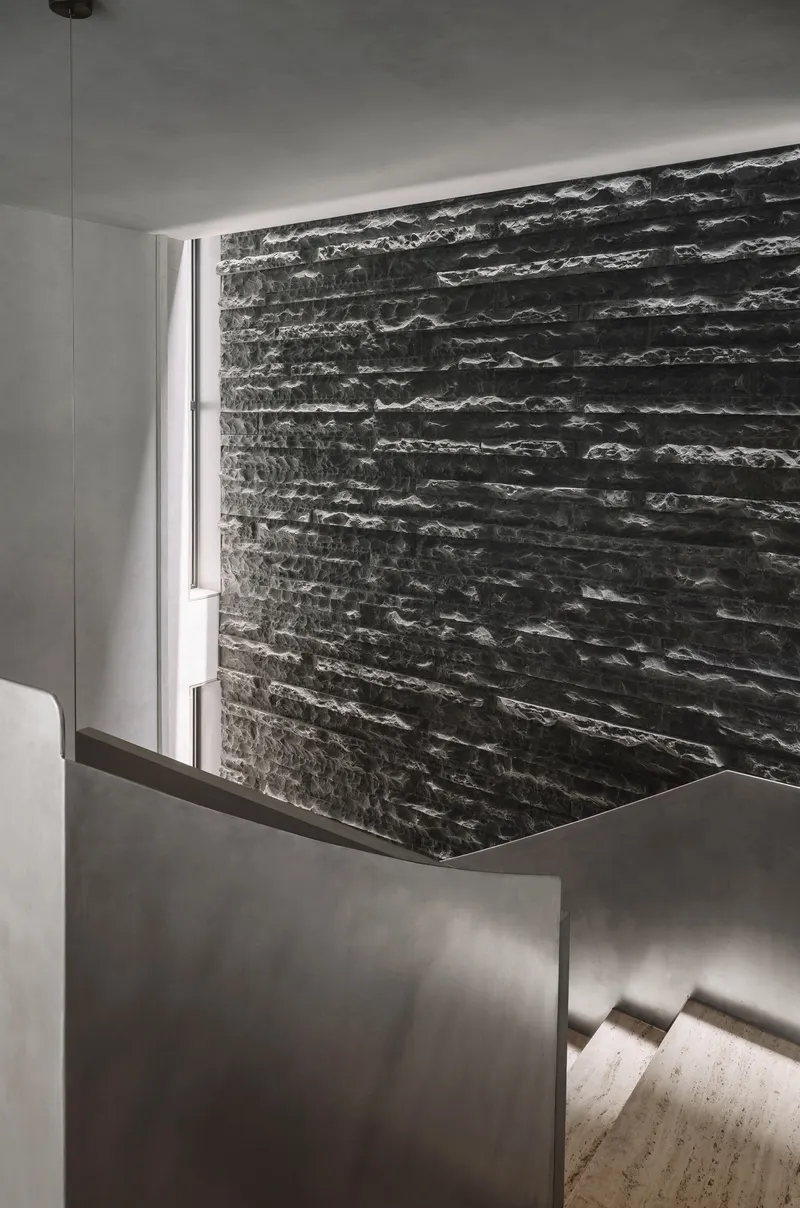
The material palette is restrained to the point of austerity: polished concrete, split-face stone, dark timber, and the occasional flash of travertine. The curved polished concrete wall beside the glazed courtyard opening is the most resolved moment in the house. It bends light across its surface in a way that makes the wall feel soft, almost textile, while simultaneously framing a view through to the spiral stair and planted courtyard beyond.
In the stairwell, an exposed stone wall gets backlit by a narrow vertical window that turns the rough texture into a bas-relief. The dining room repeats the trick with a dark split-face stone wall, framed artwork, and soft sidelight. D'WELL understands that stone does not need to be monumental. It just needs light at the right angle.
The Circular Skylight and Domestic Rituals
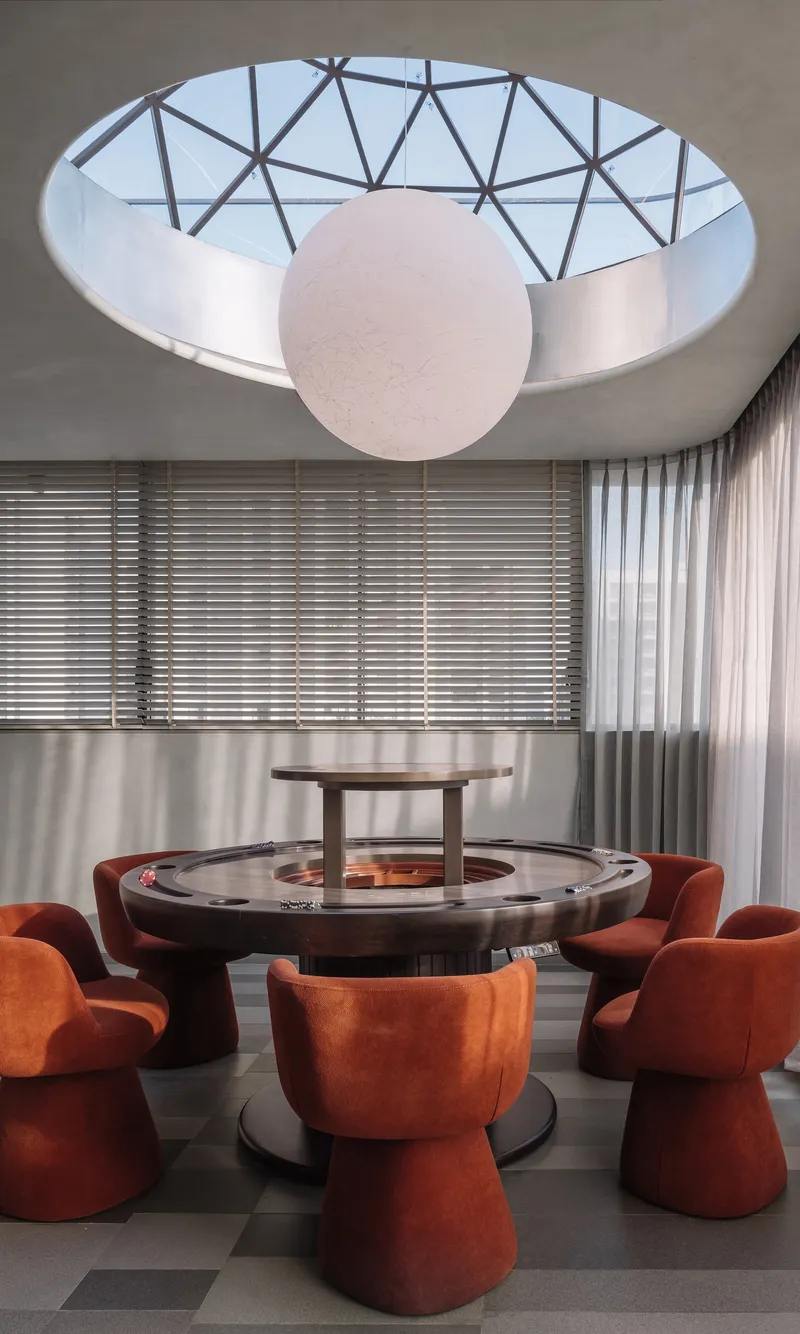
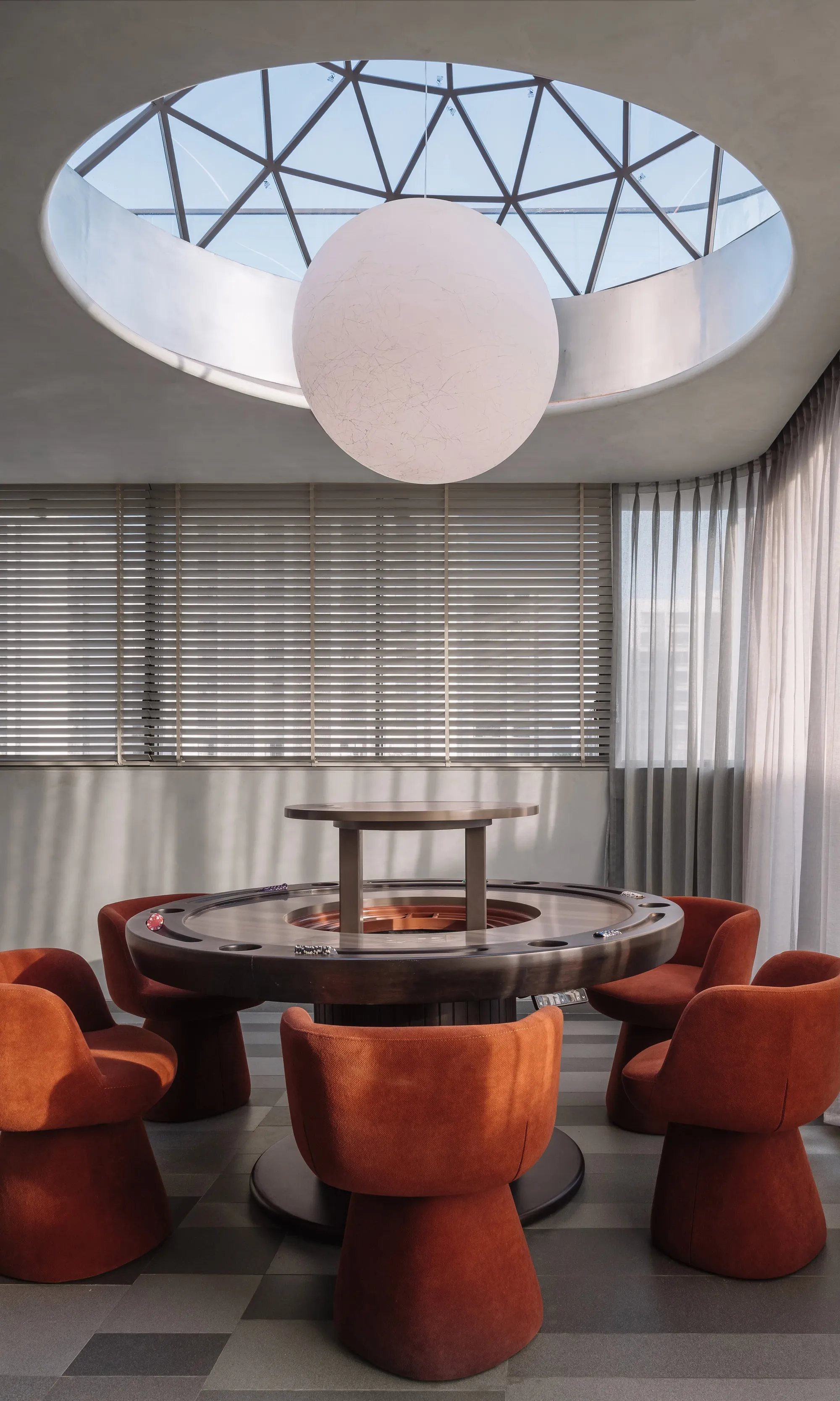
The dining room's circular skylight is the single most photographable element in the house, and deservedly so. A triangulated steel frame holds a ring of glass above a round table surrounded by terracotta upholstered stools. The geometry is unambiguous: everything is circular, from the light fitting to the table to the skylight itself. It is a controlled piece of theater that makes an ordinary meal feel like an occasion.
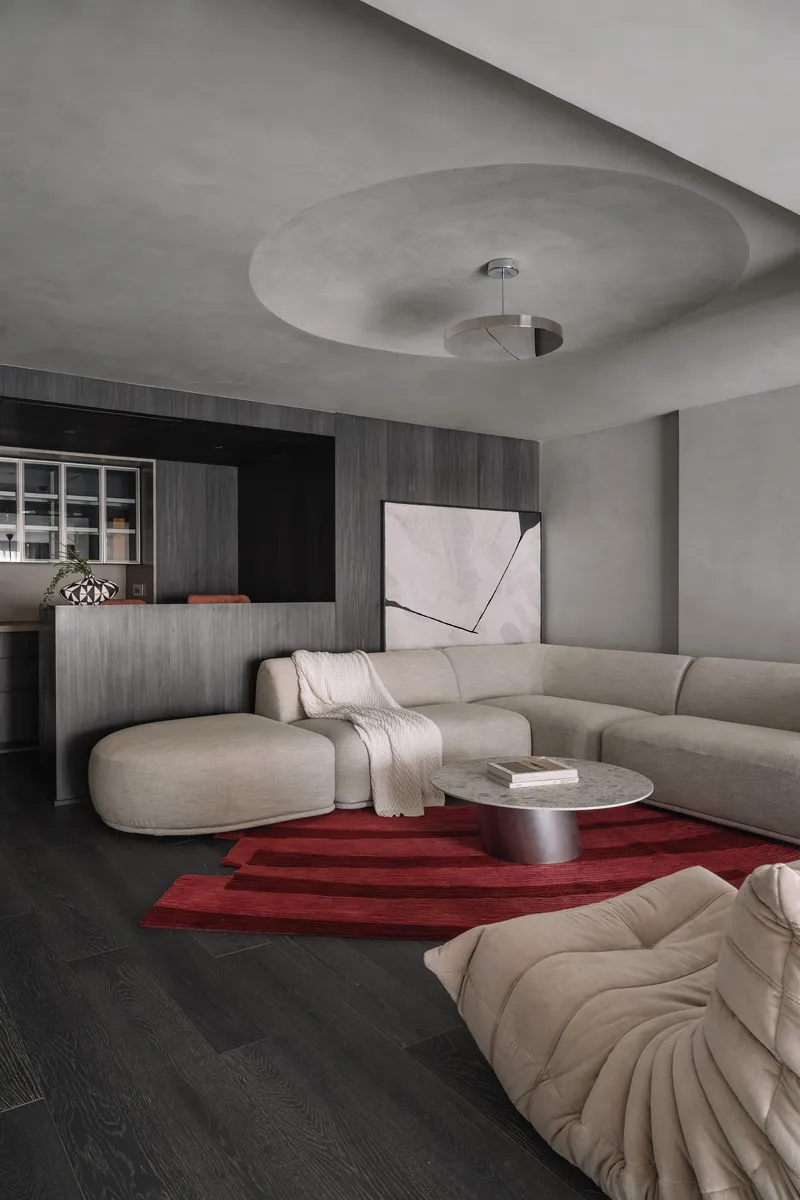
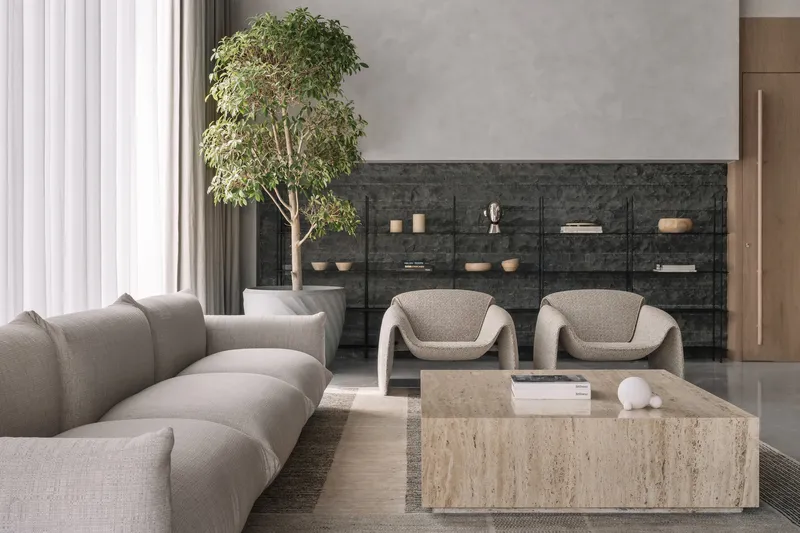
Elsewhere, the living area pairs a circular ceiling recess with dark timber millwork and a red geometric rug, establishing a pattern of round forms set against rectilinear containers. The charcoal stone shelving wall in the adjacent sitting zone grounds the composition, giving the eye a resting point between all the curves. D'WELL deploys the circle motif often enough to give the house a signature without tipping into repetition.
Kitchen and Bathroom Detailing
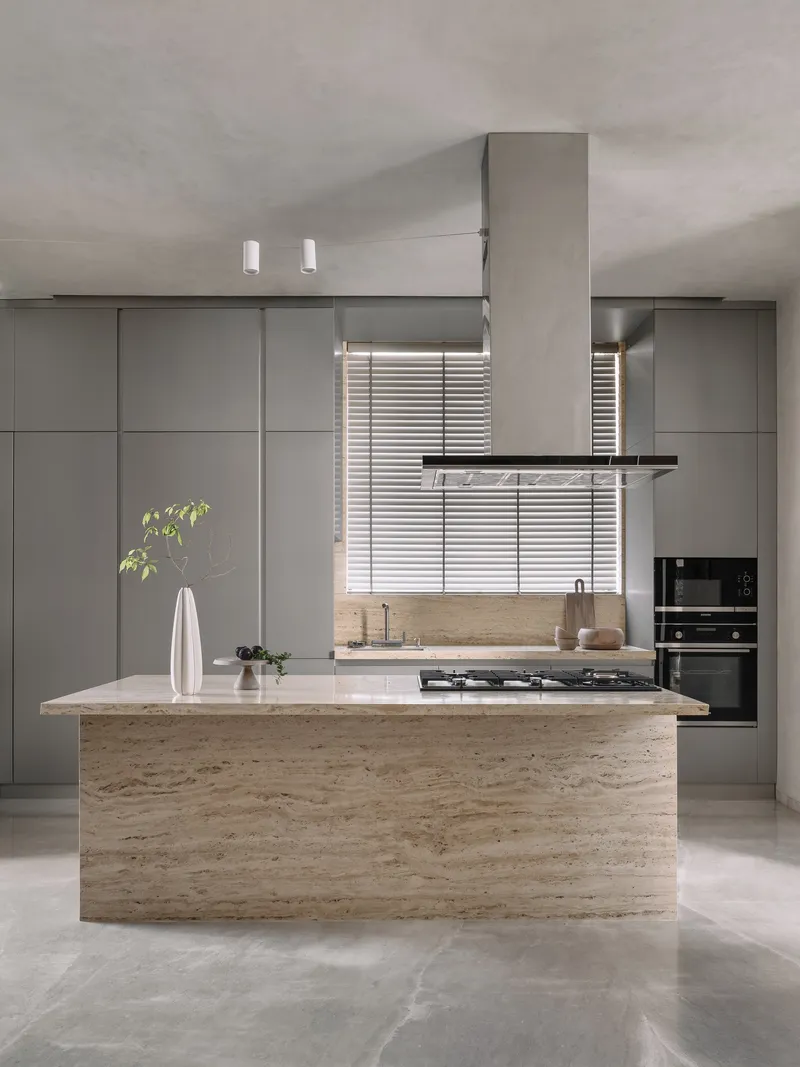
The kitchen island, clad in travertine with grey cabinetry behind it, is the warmest room in the house. Timber blinds filter window light into horizontal bands, and the stone's natural veining introduces a softness that the living room's black stone deliberately avoids. It is a conscious shift in register: public rooms are monumental, private rooms are tactile.
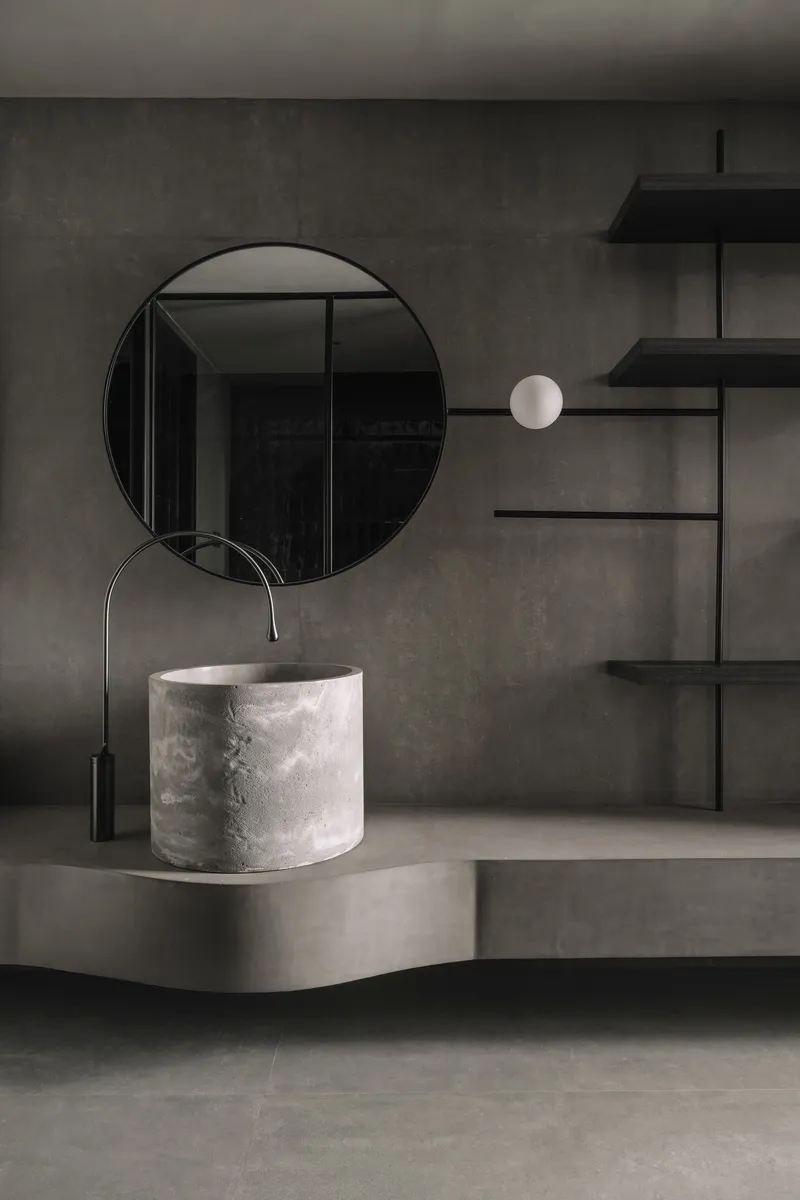
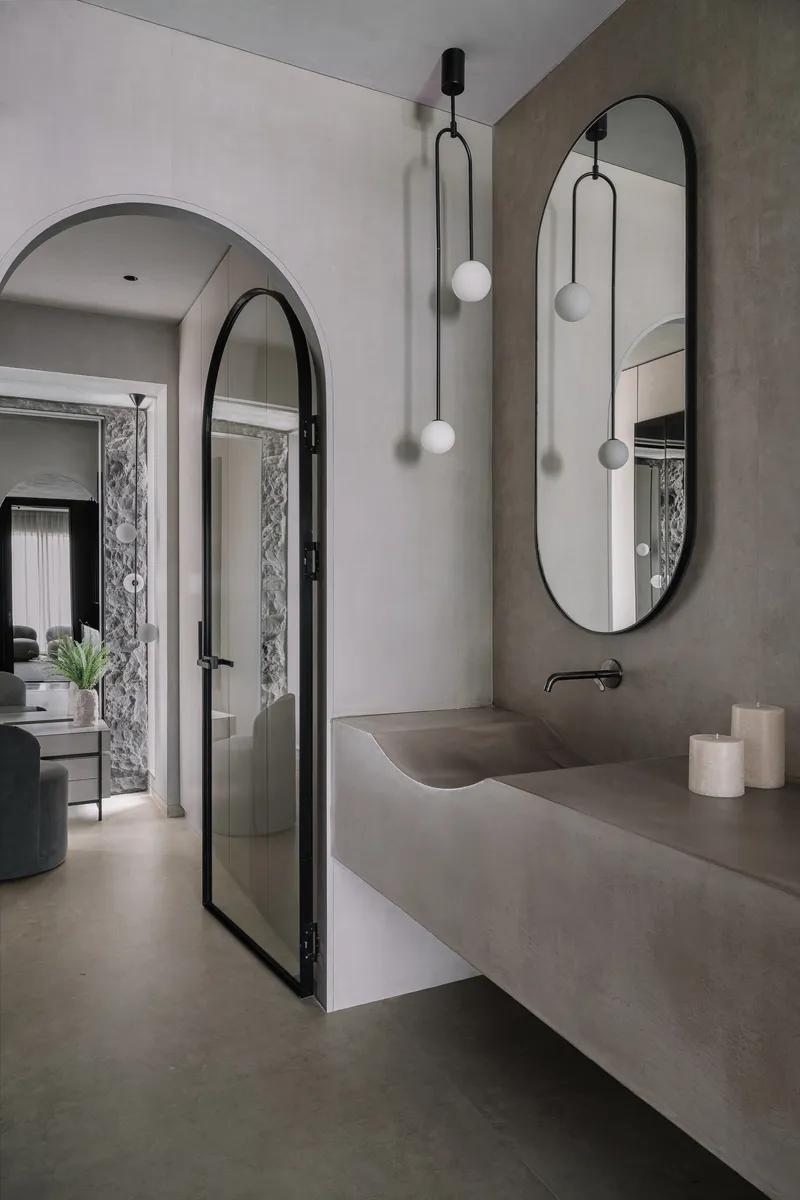
The bathrooms continue this logic. A cylindrical white stone basin against a raw concrete wall strips the vanity down to its essential form. In the master bathroom, an arched doorway frames the integrated grey stone sink and pendant lights with a quiet formality that recalls chapel architecture. These are not spa bathrooms. They are contemplative ones.
Private Rooms and the Outdoor Terrace
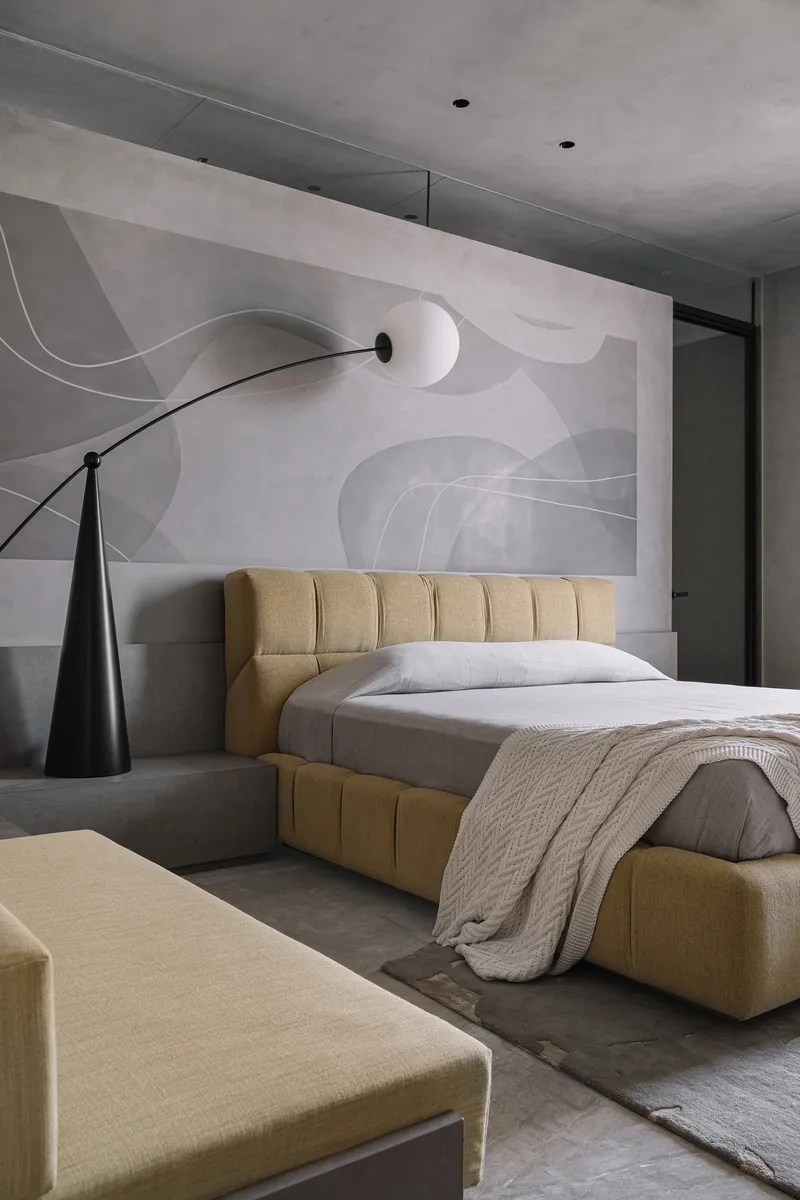
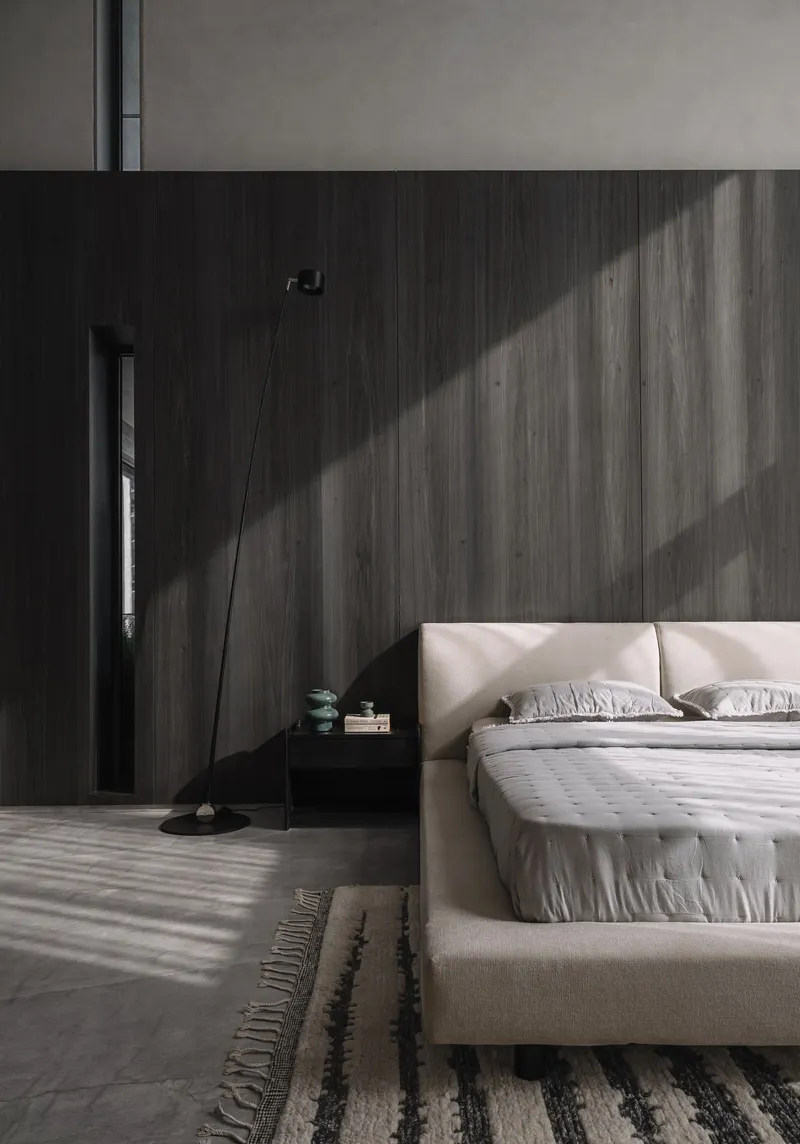
The bedrooms reveal a looser, more playful side of the project. A tufted yellow bed frame sits against a wall mural of flowing abstract forms in soft grey, introducing color and figuration that the rest of the house deliberately suppresses. In an adjacent room, striped shadows from unseen blinds rake across a dark wood wall, turning the surface into a kinetic composition that changes by the hour.
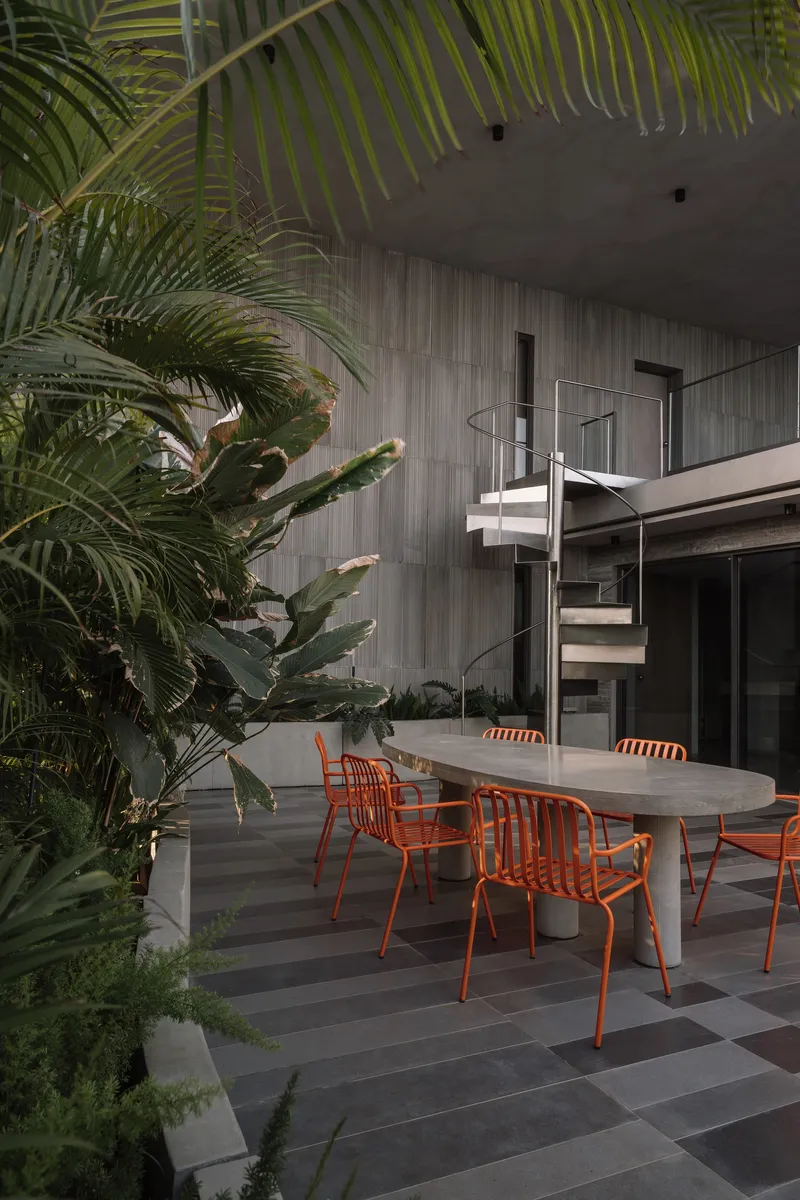
The outdoor dining terrace is the only space where the house fully opens to the sky. Concrete table, orange metal chairs, tropical palms, and the blue hour of dusk create a scene that feels almost Mediterranean. It is a release valve after the disciplined interiority of the lower floors, and it works precisely because D'WELL earns it by withholding the outdoors everywhere else.
Plans and Drawings
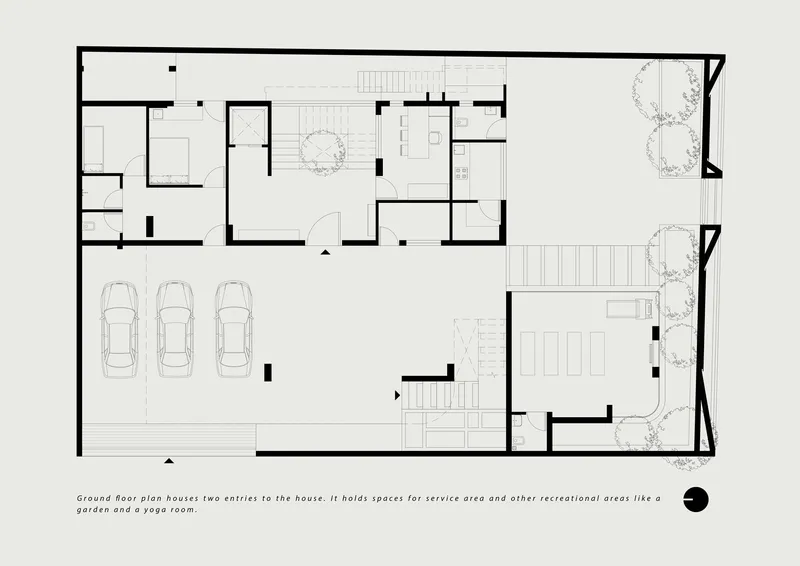
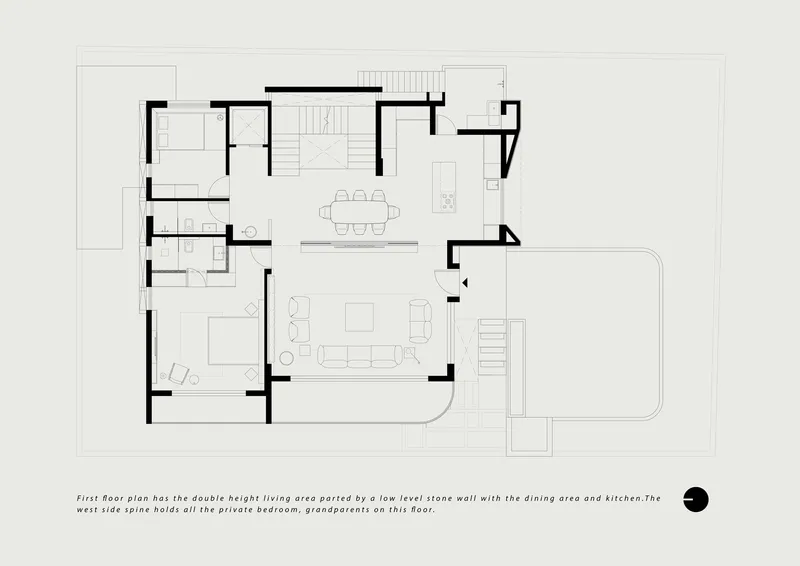
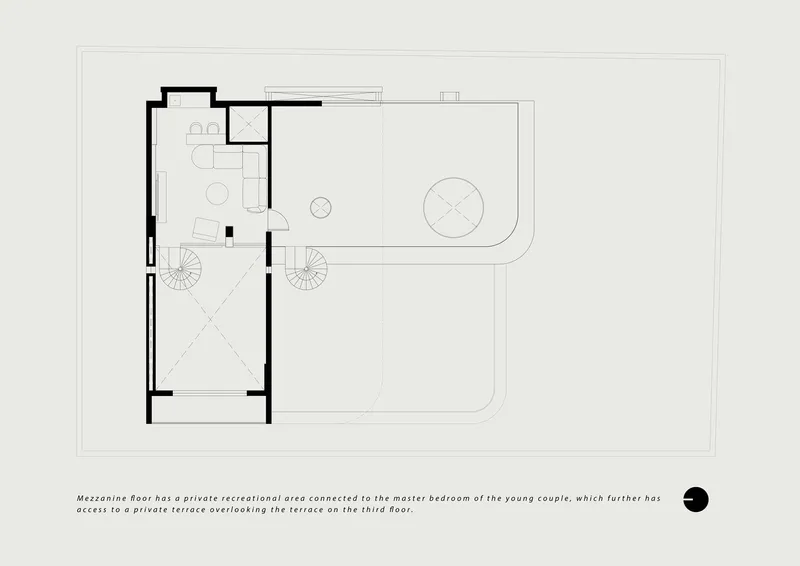
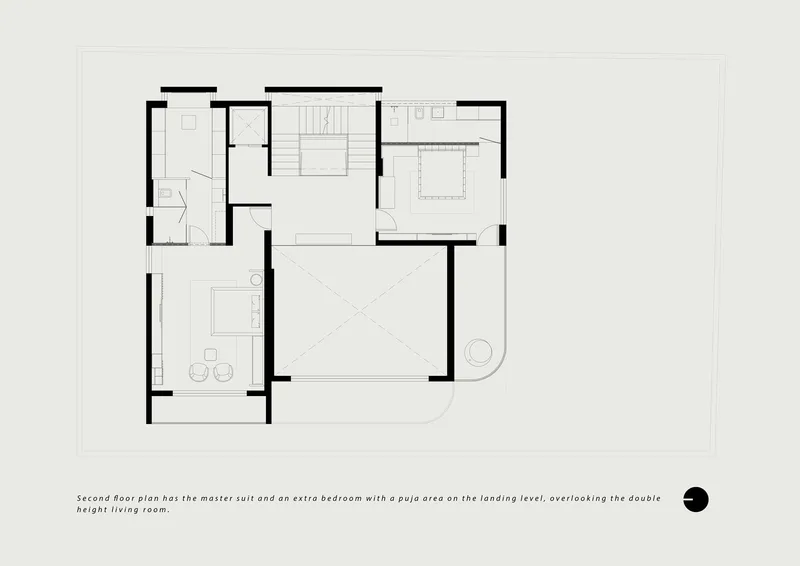
The ground floor plan confirms the inward strategy: a three-car garage and service zone buffer the street, while a garden with trees occupies the rear. The first floor divides the double-height living area from the dining and kitchen zones with a low stone wall rather than a full partition, preserving visual continuity while creating acoustic separation. The mezzanine places a bedroom suite with terrace access overlooking the exterior courtyard, and the second floor devotes its most generous space to a master suite with a puja area that looks down into the double-height living void.
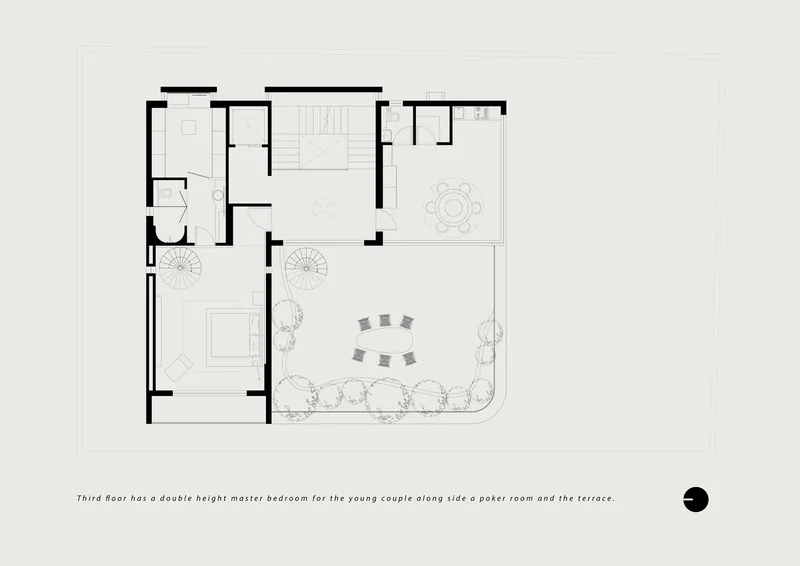
At the third floor, the section reveals its final surprise: a double-height master bedroom paired with a poker room and a planted perimeter terrace. The stacking of double-height volumes at both the bottom and top of the house gives the section a symmetry that the plan deliberately avoids. It is a smart structural decision that creates drama at both the communal and the private ends of the domestic program.
Why This Project Matters
The Sculpted Sanctuary House is not a radical experiment. It does not propose new typologies or challenge the conventions of the Indian urban bungalow. What it does, with notable discipline, is take a familiar program and execute it through a consistent formal language. Every room, every stair, every skylight reinforces the same thesis: that domestic life in a dense city is best served by turning inward, controlling light, and treating circulation as inhabitable space rather than leftover corridor.
D'WELL's achievement here is tonal. The house never shouts. The curves are not Zaha-scale; the stone is not Brutalist in ambition. Everything operates at the register of a well-told story: consistent pacing, deliberate reveals, and a climactic terrace at the top that opens the sky only after you have spent four floors earning it. For a residential practice working at 10,000 square feet, that kind of narrative control is worth paying attention to.
Sculpted Sanctuary House by D'WELL, Surat, India. 10,000 sq ft. Completed 2025. Photography by Ishita Sitwala.
About the Studio
Share Your Own Work on uni.xyz
If projects like this are the kind of work you want to make, uni.xyz is a place to publish your own, find collaborators, and enter design competitions.




Popular Articles
Popular articles from the community


The Ocean Hive: Sustainable Architecture for a Self-Sufficient Civilization at Sea
The Ocean Hive imagines sustainable architecture at sea, where modular habitats, algae, wave power and ocean waste sustain a growing colony.

The Musturak Paradise: Senior Living Architecture for a Connected Future in Temara, Morocco
The Musturak Paradise reimagines senior living architecture in Temara via private homes, social spaces, culture, community, and shared care.

Lunar Spiral: Space Architecture Shaped by the Mathematics of the Universe
Lunar Spiral reimagines space architecture through Fibonacci geometry, lunar regolith, levitating habitats, and self-sustaining Moon living.

The Earth Pod: 3D Printed Homes for Resilient Refugee Communities
The Earth Pod reimagines refugee housing through 3D printed homes made from clay, combining resilience, self-sufficiency, and rapid shelter.


Similar Reads
You might also enjoy these articles

Bao Huynh Watercolor Atelier: A Serene Art Retreat in Hội An
Bao Huynh Watercolor Atelier in Hội An blends multifunctional art spaces, sustainable design, local materials, and family-friendly living in a serene environment.

Atelier Macri Concept Store Interior Design by CASE-REAL
Atelier Macri store features a "ko" counter, walnut wood details, cork displays, blending retail, gallery, and seamless customer experiences.

Manuel Vargas Izquierdo Stadium and High-Performance Sports Center: Architectural Excellence in Jalpa de Méndez
The Manuel Vargas Izquierdo Stadium blends sustainable design, inclusive sports facilities, and cultural-inspired architecture, revitalizing Jalpa de Méndez’s public spaces.

KAKR Buluh Awar Hall: Revitalizing Community and Ecology Through Bamboo Architecture
Community built bamboo hall revitalizes Buluh Awar village, empowering youth, restoring ecology, celebrating vernacular craftsmanship through sustainable architecture and culture.




Comments (0)
Please login or sign up to add comments
No comments yet. Be the first to comment!