
E-Containership: Cargo Ships Become Floating E-Sports Arenas in a Modular Future
A speculative 2050 proposal turns standard shipping containers into plug-and-play VR competition pods deployed across a global maritime network.


What if the next great stadium had no fixed address, no foundation, and no single location? The E-Containership proposes exactly that: a fleet of cargo vessels retrofitted with modular container units, each housing individual VR player stations, forming a distributed digital colosseum that operates simultaneously across the world's oceans. It is architecture unmoored in the most literal sense, leveraging the existing logic of global shipping infrastructure to host 800-player e-sports competitions without a single permanent structure on land.
Designed by Léa Parmiani and Léo Calmes, this shortlisted entry in The Digital Colosseum 2020 competition sets its narrative in 2050, a period of intense global connectivity and digital interdependence. Rather than designing a building, the duo designed a system: a network of ships, a kit of spatial parts, and a protocol for assembling them. The result challenges the fixity of traditional architectural typologies and asks whether the future of large-scale cultural events belongs on water, not land.
A Global Network Floating on Shipping Lanes
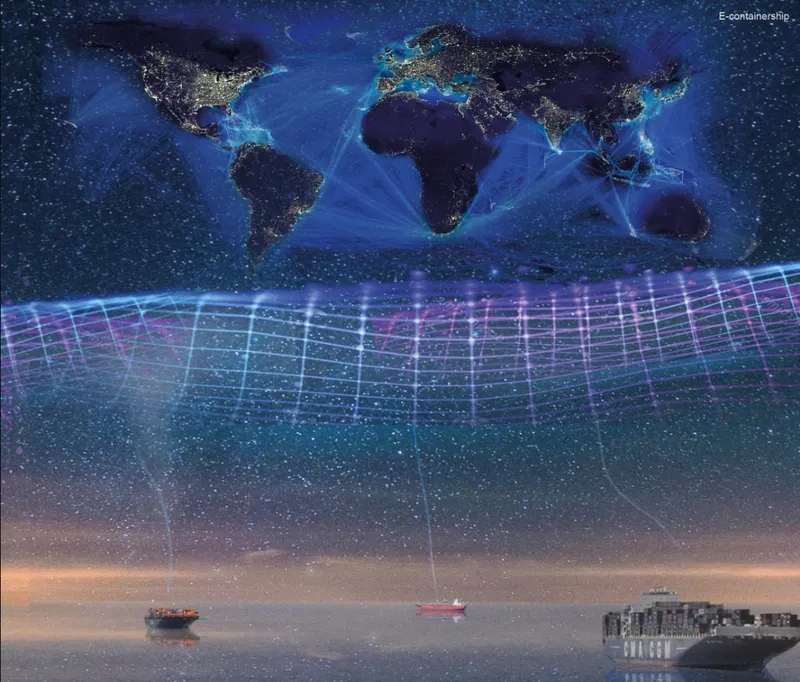
The opening diagram maps the E-Containership's operational logic: a web of shipping routes linking container vessels stationed at sea, each one a node in a planetary competition network. The image communicates the project's central ambition clearly. Geography becomes irrelevant to participation. Players physically positioned around the world compete in a unified virtual stadium, their individual containers synchronized through data transmission infrastructure carried within the ships themselves. The architecture facilitates a distributed yet unified digital experience, and this network view makes that idea immediately legible.
By grafting e-sports infrastructure onto existing maritime logistics, Parmiani and Calmes sidestep the enormous material and political costs of building permanent arenas. The ships already exist. The containers already conform to universal dimensional standards. The design intervention is organizational and programmatic rather than structural, which gives the speculation its plausibility.
Inside the Container: Isolation as Immersion
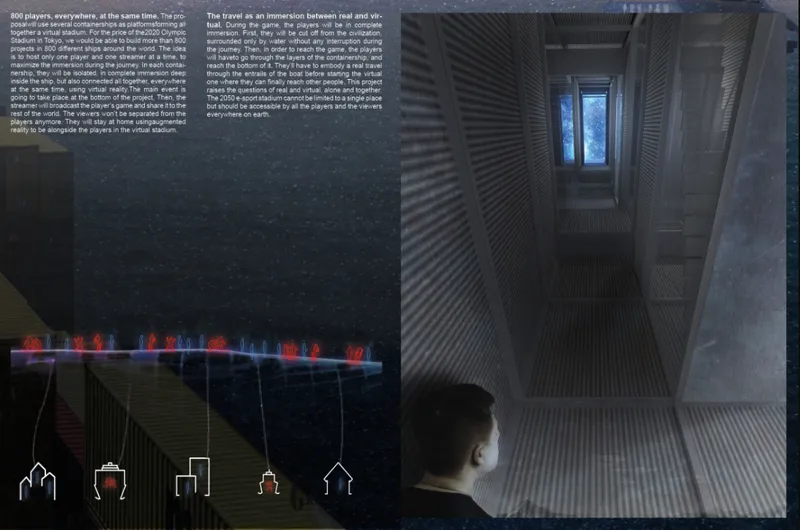
Step inside a player's station and the scale shifts dramatically. The narrow corridor, clad in ribbed metal walls, terminates in a distant blue-lit opening, producing an atmosphere that is equal parts submarine and spacecraft. This is the individual player's room, one of three architectural component types in the modular system (alongside the streaming container and the server and ventilation infrastructure). Isolation here is deliberate. Each player occupies their own container, immersed in a collective VR arena that replicates the spatial choreography of a live stadium. The tight, controlled physical environment amplifies the expansiveness of the virtual one.
The rendering is effective because it resists the temptation to show the VR experience itself. Instead, it shows the real space: raw, industrial, compressed. That honesty about the physical condition makes the speculative leap into virtual collectivity more convincing. The audience, too, can experience the event through synchronized broadcasts, blurring the line between physical presence and virtual participation.
Plug-and-Play Assembly on the Quayside
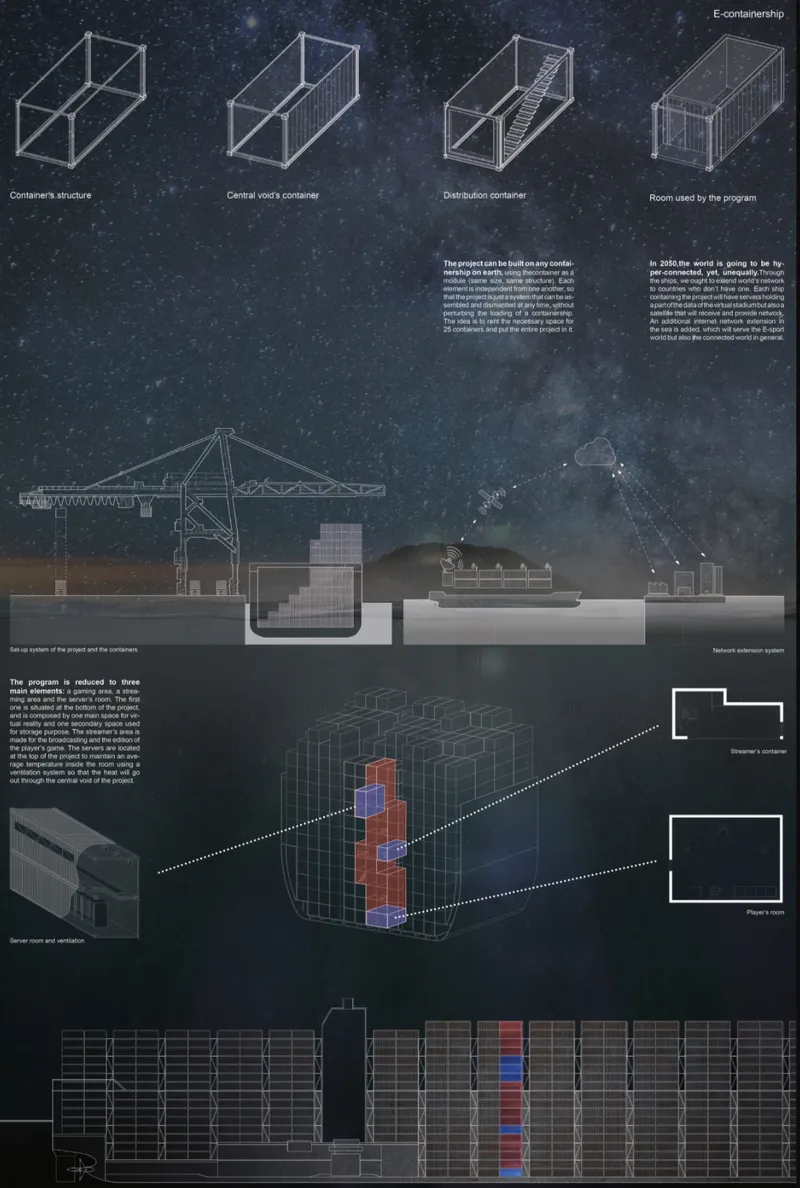
The technical diagram lays out the container assembly sequence with precision. Cranes load preconfigured units onto vessels in an order that integrates directly into the ship's existing loading logic, requiring minimal alteration of the hull structure. The three component types stack vertically: player rooms, streaming containers, and server and ventilation units. Central voids are maintained between stacks to ensure proper heat ventilation, a critical detail given the thermal output of hundreds of computing stations packed into steel boxes at sea.
The plug-and-play approach is the project's strongest operational argument. Scalability and mobility are built into the system's DNA. A competition can expand by adding ships, reconfigure by swapping container types, or relocate by sailing to a different port. Specialized containers handle data transmission, creating what the designers describe as a seamless interface between physical space and virtual activity. The diagram's matter-of-fact graphic language, closer to a logistics manual than an architectural presentation, reinforces the sense that this system could actually be deployed.
The Hull as Facade: Architecture Visible at Night
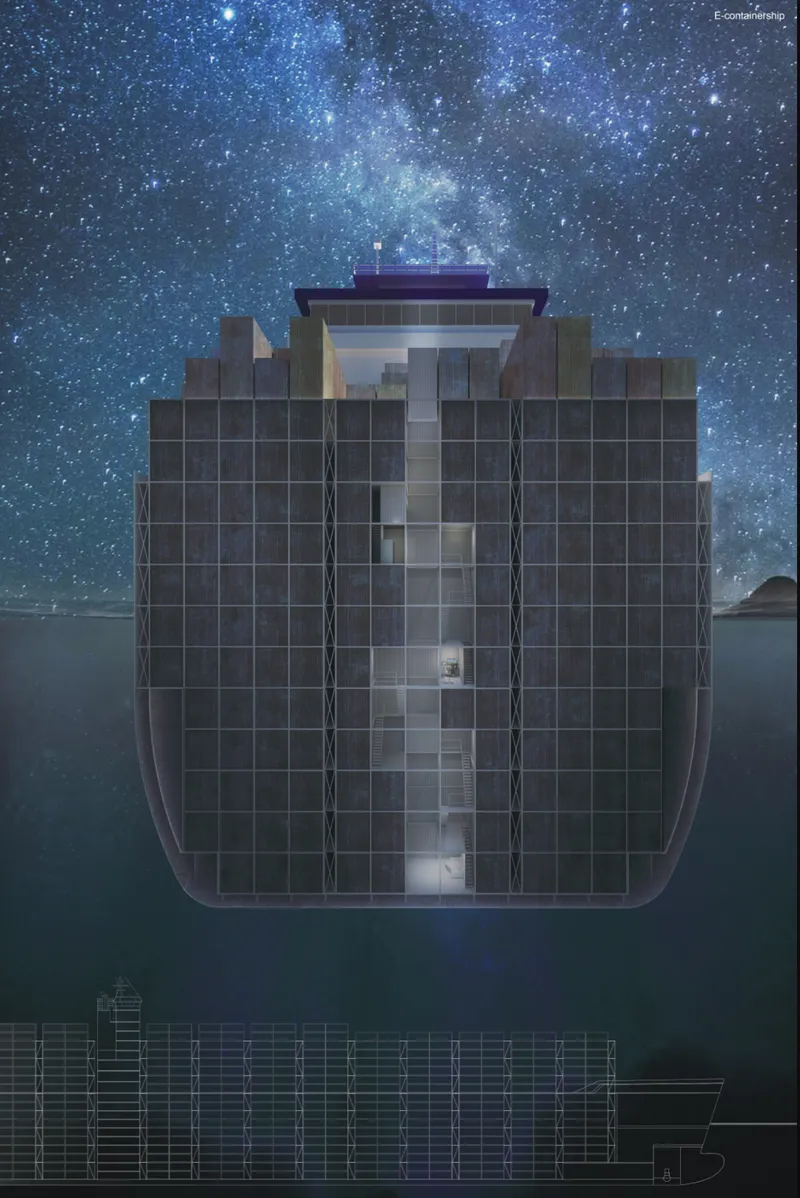
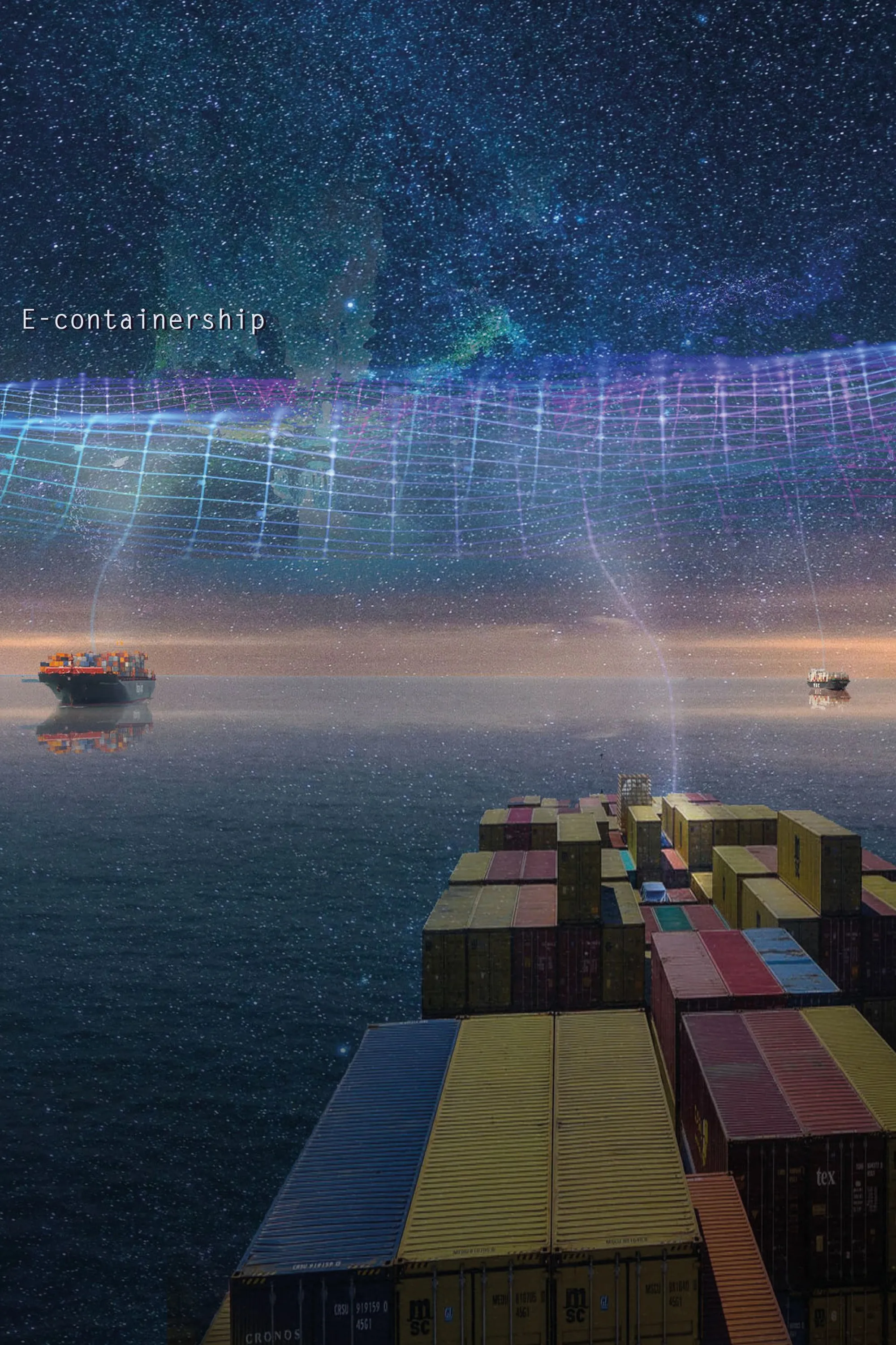
The frontal elevation of the containership at night is the project's most striking image. The modular grid of containers reads as a luminous facade set within the dark mass of the ship's hull, each cell glowing with the activity inside. Against a starry sky, the vessel looks less like a cargo ship and more like a floating city block, a stack of inhabited rooms adrift on open water. It is a powerful visual summary of the entire thesis: architecture that is mobile, modular, and integrated with digital ecosystems.
The image also raises a question the designers leave open. Who sees this? If the audience is virtual and the players are sealed in their pods, the ship's exterior presence becomes almost accidental, a byproduct rather than a performance. That tension between the invisibility of digital space and the undeniable physicality of a 200-meter steel vessel is part of what makes the project compelling.
Why This Project Matters
The E-Containership works because it refuses to treat e-sports architecture as a decorated shed with better screens. Parmiani and Calmes start from a systems question: what existing infrastructure can host distributed digital events at global scale? Their answer, the international shipping fleet, is both audacious and surprisingly logical. The modular container is architecture's most universal building block, and the cargo ship is its most mobile foundation. Combining the two produces a typology that can adapt and expand beyond conventional buildings to serve emergent cultural formats.
More broadly, the project challenges designers to think beyond land, permanence, and traditional construction. It proposes a future where architecture moves with the rhythms of data, connectivity, and global audiences. That is a provocation worth sitting with, especially as the cultural events that draw the largest crowds increasingly exist in virtual space. The E-Containership suggests that the architecture supporting those events might as well keep moving too.
View the Full Project
About the Designers
Designers: Léa Parmiani, Léo Calmes
Enter a Design Competition on uni.xyz
uni.xyz runs architecture and design competitions year-round that reward proposals with spatial conviction and real site intelligence.
Project credits: E-Containership by Léa Parmiani, Léo Calmes The Digital Colosseum 2020 (uni.xyz).




Popular Articles
Popular articles from the community


The Earth Pod: 3D Printed Homes for Resilient Refugee Communities
The Earth Pod reimagines refugee housing through 3D printed homes made from clay, combining resilience, self-sufficiency, and rapid shelter.

Co-Life: Senior Housing Design That Reconnects Older Adults With the City
Co-Life reimagines senior housing design through healing gardens, shared streets, workshops, and a sustainable community across generations.

The Musturak Paradise: Senior Living Architecture for a Connected Future in Temara, Morocco
The Musturak Paradise reimagines senior living architecture in Temara via private homes, social spaces, culture, community, and shared care.

Lunar Spiral: Space Architecture Shaped by the Mathematics of the Universe
Lunar Spiral reimagines space architecture through Fibonacci geometry, lunar regolith, levitating habitats, and self-sustaining Moon living.


Similar Reads
You might also enjoy these articles

Day and Night Park: A Time-Based Urban Newsstand in Beijing
A temporary urban newsstand in Beijing blending travel, light, and reading through poetic colors, compact form, and community-focused design.

Modernist Patio Renovation in El Masnou, Barcelona by Oliver Segura Arquitectura + Cebrià Arquitectura
Modernist patio renovation blending tradition and innovation with a movable pool, leveled floors, and Catalan materials in El Masnou.
Alto Residencial Coop: Cooperative Housing Development in Santiago de Compostela by Carbajo Barrios Arquitectos
A linear cooperative housing complex blending white volumes and perforated metal façades, enhancing community living, natural light, privacy, and urban integration.
Vil Genis School by BPA ARCHITECTURE – Massy, France
Vil Genis School in Massy, France, features sustainable design, south-facing classrooms, community integration, accessible spaces, and modern educational architecture.


Explore Shipping Containers Competitions
Discover active competitions in this discipline



Challenge to design a barrier free sports center


Challenge to design an outdoor ice-rink and park
Comments (0)
Please login or sign up to add comments
No comments yet. Be the first to comment!