
EA Architects Wraps a Penang Hawker Center in Perforated Brick to Honor Fort Cornwallis
A low-slung pavilion of patterned brickwork and green roofs replaces a food court that once sat atop George Town's colonial moat.


Street food and heritage rarely get equal billing. In George Town, Penang, a beloved hawker center once perched directly on top of the Western Moat of Fort Cornwallis, one of the oldest colonial fortifications in Southeast Asia. The arrangement was practical but irreverent: cooking oil and foot traffic grinding into stonework that predates Malaysian independence by centuries. EA Architects, led by Liou Hung Woei and Lui Sy Ying, was tasked with squaring this circle. Their answer, Astaka Kota Selera, shifts the food court slightly westward, liberates the moat, and wraps 26 hawker stalls around a central courtyard in a pavilion made almost entirely of red brick.
What makes the project genuinely interesting is how it refuses to treat heritage as a museum exercise. The red brick is not decorative nostalgia; it is a direct material echo of Fort Cornwallis's own walls, reinterpreted through perforated screens that do real work: managing ventilation, filtering light, and giving the building a texture that reads as both old and unmistakably new. Completed in 2025 as part of the North Seafront Improvement Programme and built for RM4 million, this is public architecture operating under tight fiscal and cultural constraints, and it succeeds on both fronts.
A Brick Pavilion in a Colonial Landscape
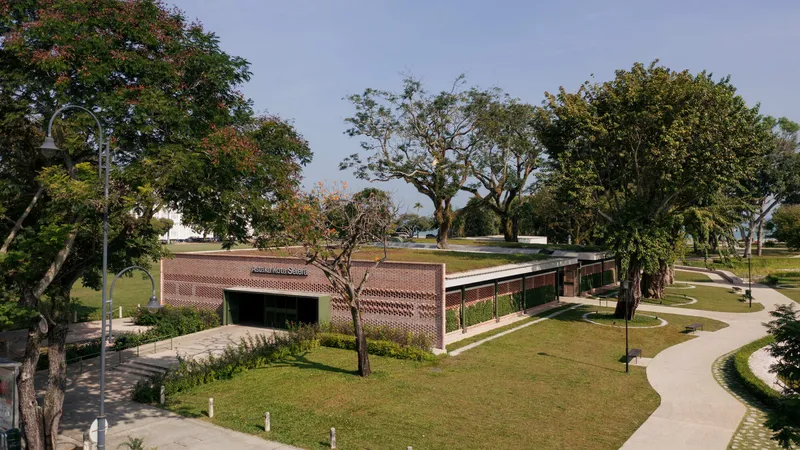
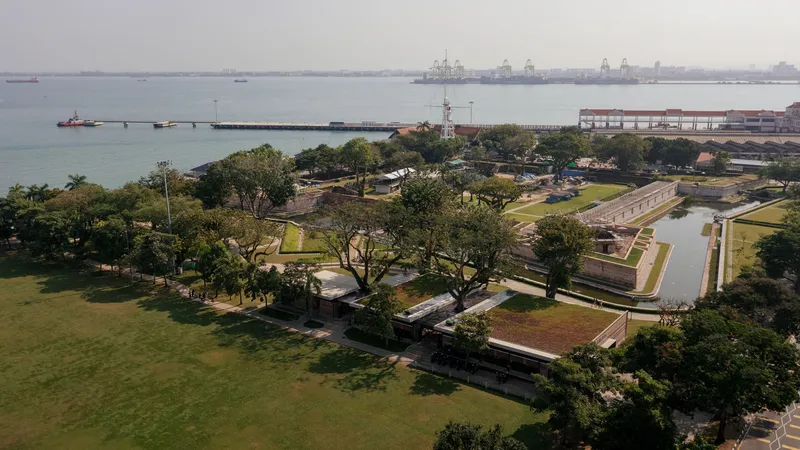
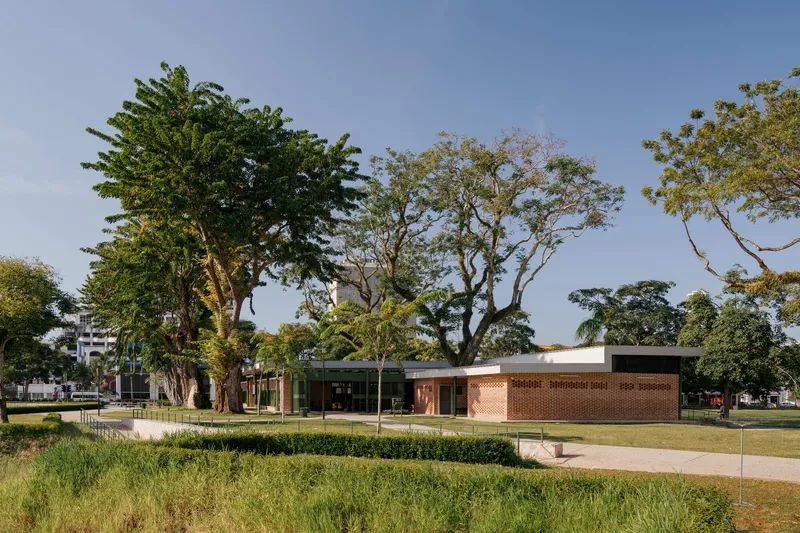
From above, the building reads as a long, low mass tucked beneath the canopy of mature park trees, its planted roof blurring the boundary between architecture and landscape. The aerial view reveals the waterfront context in full: harbor cranes, the Strait of Malacca, and the manicured lawns of the Esplanade stretching around the pavilion on all sides. EA Architects kept the roofline deliberately horizontal, ensuring the structure never competes with the tree line or with Fort Cornwallis itself. The result is a building that defers to its neighbors while holding its ground as a civic destination.
The decision to shift the food court westward was not purely architectural. It was an act of restoration, freeing the historic moat from decades of encroachment. The new position allows the building to sit within the park rather than on top of history, a distinction that sounds semantic but carries real weight in a UNESCO World Heritage buffer zone.
Perforated Brick as Working Facade
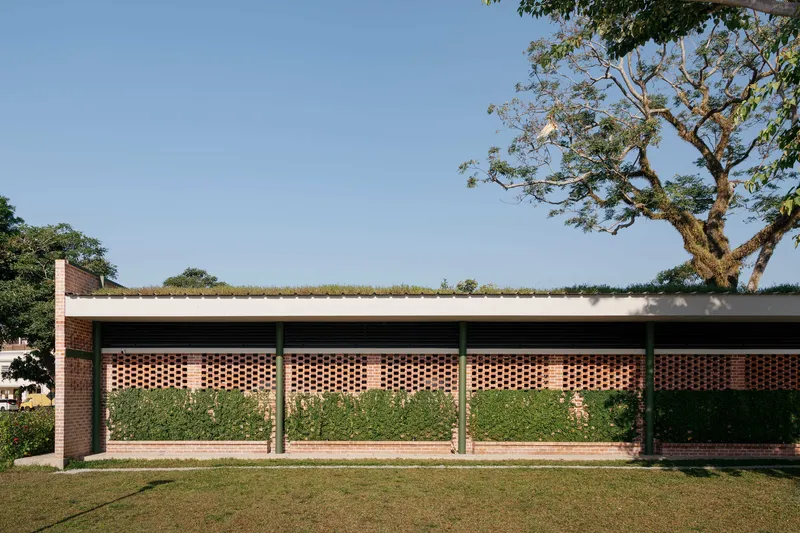
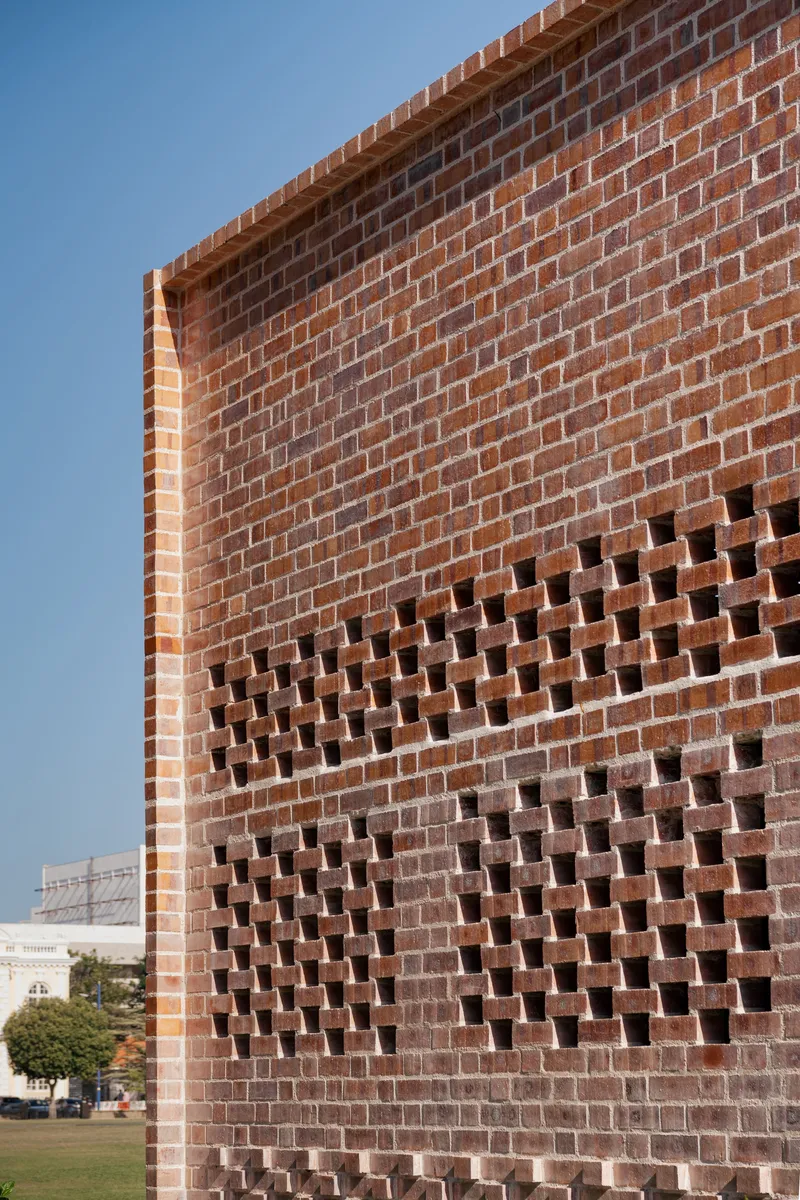
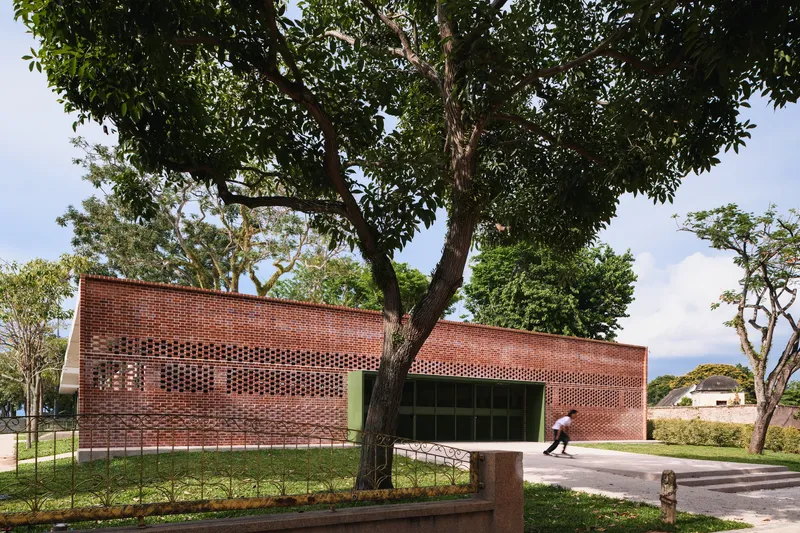
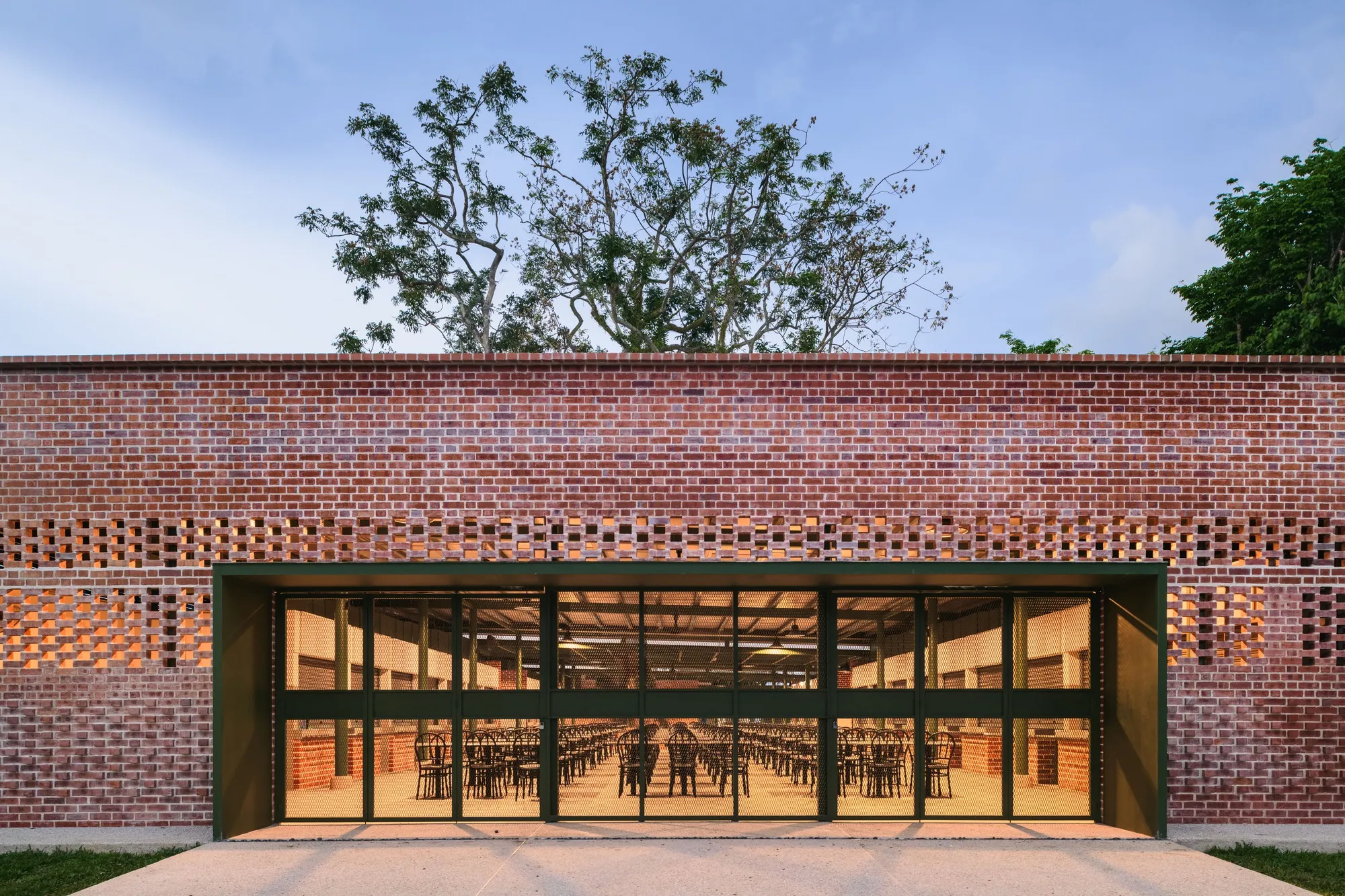
The perforated brick screens are the building's signature move, and they earn it. Individual brick units protrude at varying depths to create a ventilation pattern that is visually rhythmic and thermally effective. In Penang's equatorial climate, where humidity rarely drops below 70 percent and the air temperature hovers near 32°C year-round, any passive strategy that encourages cross-ventilation is not a luxury but a necessity. The screens work in concert with the seaside location, channeling the onshore breeze through the dining hall.
Critically, the brick is not applied as cladding over a frame that does the real structural work. The patterning is integral to the wall construction: corbelled courses, recessed joints, and protruding units all emerge from a single material logic. Up close, the corner detail reveals the precision required. Each unit is placed to maintain a continuous bond even as the wall transitions from solid to perforated, which takes careful coordination between mason and architect.
Entrance Sequence and Threshold
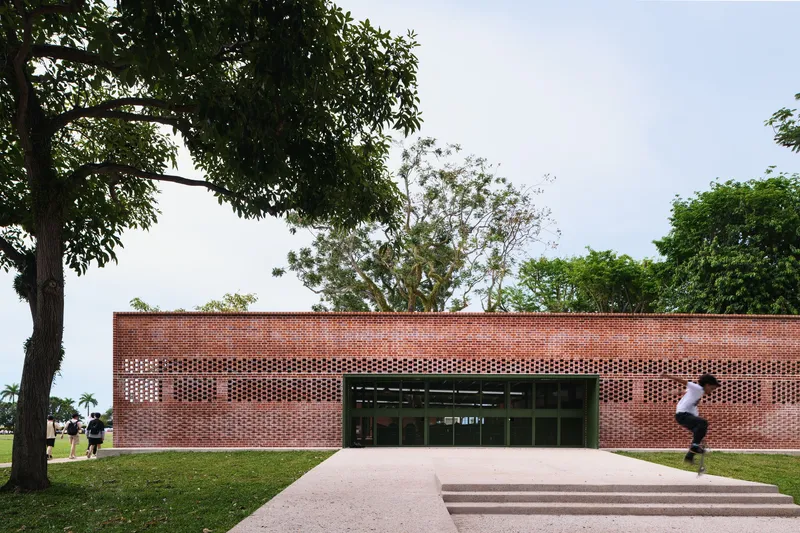
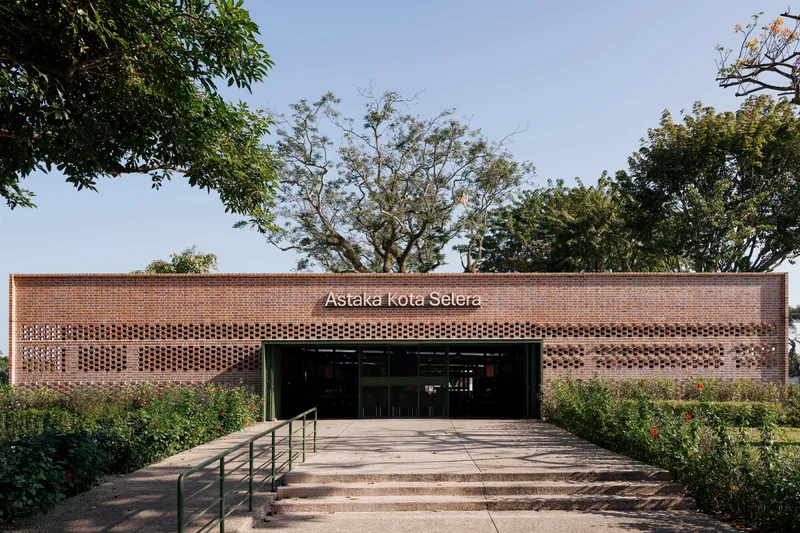
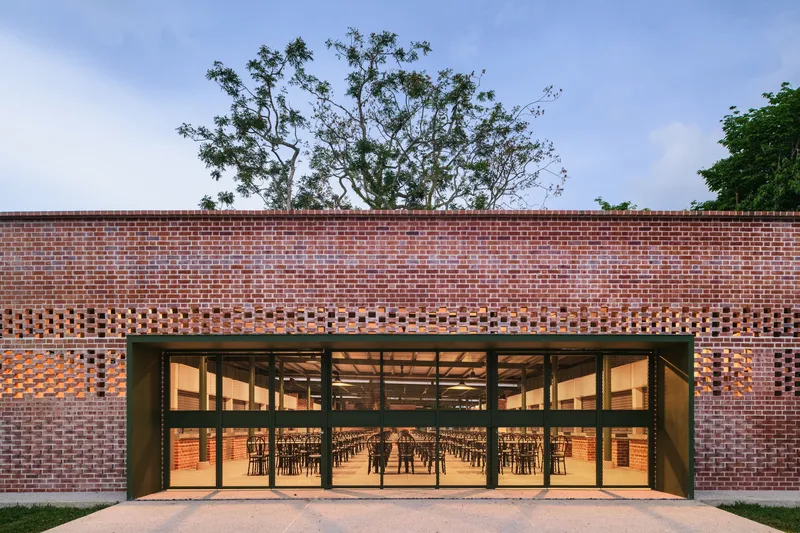
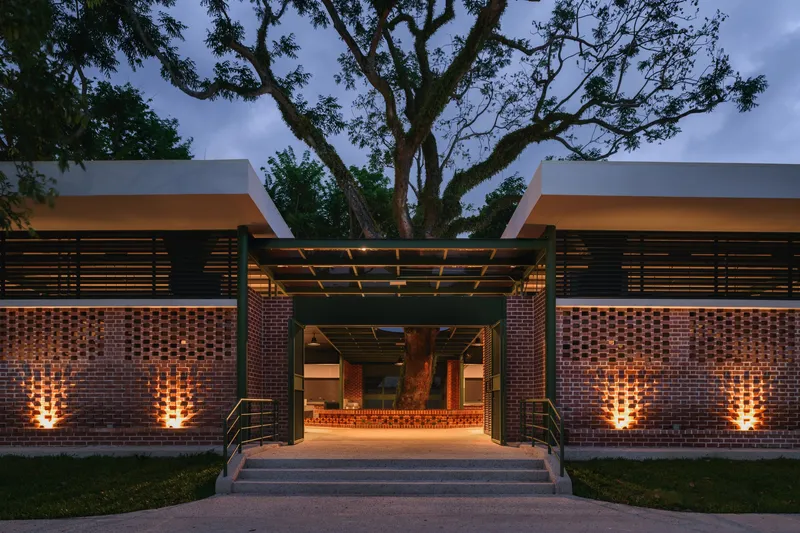
The front elevation is composed with almost graphic clarity: a solid brick base, a band of perforated screen, and a thin planted roof floating above. Fully glazed entrance doors sit below the patterned brickwork, creating a layered threshold that transitions from bright tropical daylight to the sheltered interior. At dusk, the relationship inverts. Light spills outward through the glass and upward through the brick perforations, turning the facade into a lantern that announces the building's public function without signage or spectacle.
Wide entry steps with proper ramp access ensure the building is legible and welcoming to all visitors, a detail worth noting given that accessibility in Southeast Asian hawker centers is often an afterthought. The covered portico with its timber and steel pergola provides a transitional zone between park and pavilion, shading visitors before they step inside.
The Central Court and Its Preserved Tree
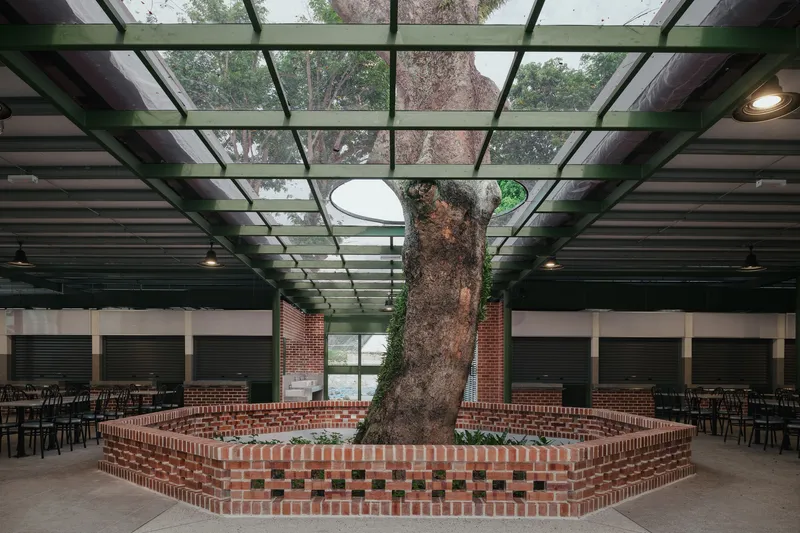
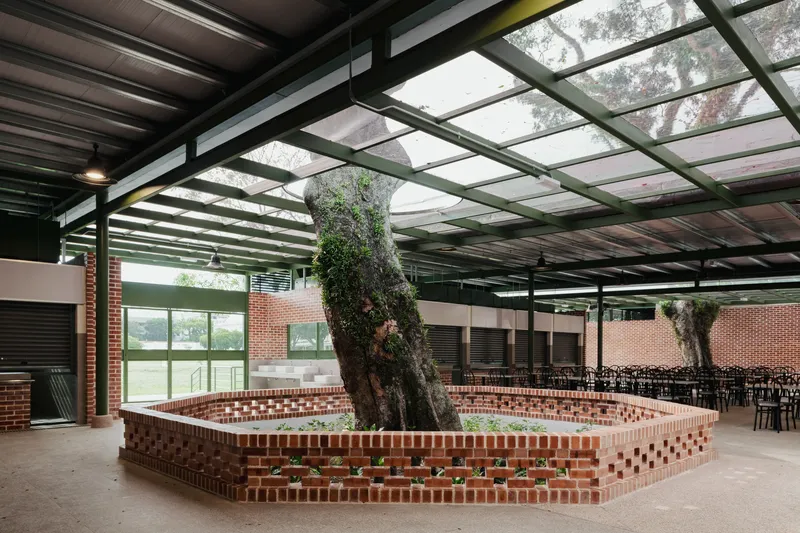
The most dramatic spatial moment is the central courtyard, where a mature tree rises through a hexagonal brick planter and pierces the glass and steel skylight above. The 26 hawker stalls line the perimeter, facing inward, so every diner has a sightline to this green anchor. It is a clever organizational device: the tree provides orientation, a sense of permanence, and, practically, a chimney effect that draws hot air upward and out through the skylight.
The hexagonal planter is constructed from the same red brick as the exterior walls, reinforcing the material continuity of the project. Its geometry breaks the rectilinear grid of the floor plan just enough to register as a deliberate act of care rather than an expedient accommodation. Preserving a tree of this size inside a commercial building costs time and money during construction; doing it signals that the architects understood what actually matters in this landscape.
Dining Hall and Structure
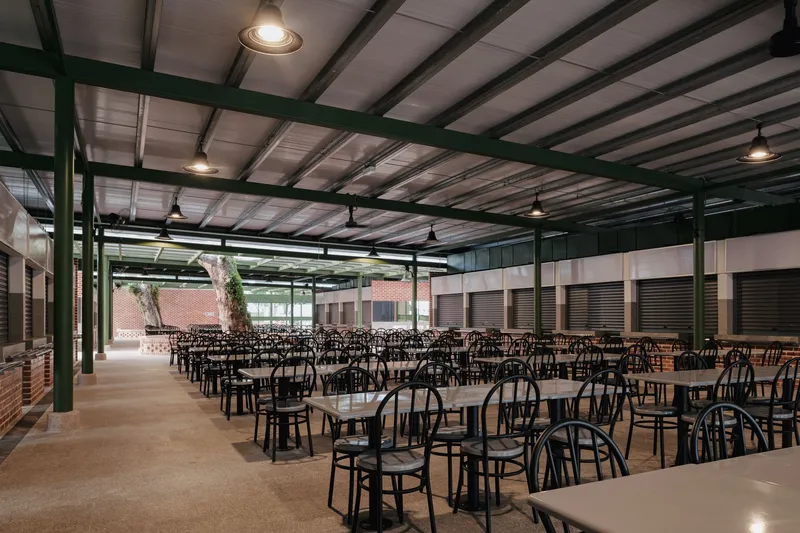
Inside the dining hall, exposed green steel beams span the width of the space, supporting pendant lighting and ceiling fans. The palette is restrained: brick, steel, glass, timber. There is no applied finish trying to conjure a theme. The furniture is functional and robust, arranged in long communal rows that encourage the shoulder-to-shoulder eating culture hawker centers have always fostered. Clear visibility across stalls and seating areas means you can scan the entire food offering from any seat, which is exactly how a hawker center should work.
The covered entry portico, visible at twilight, frames the illuminated interior through timber battens and steel structure, collapsing the distinction between inside and outside. Given that hawker centers across Malaysia are often open-air or semi-enclosed, the decision to fully enclose the space while maintaining this visual porosity is a thoughtful calibration of comfort and character.
Material Details
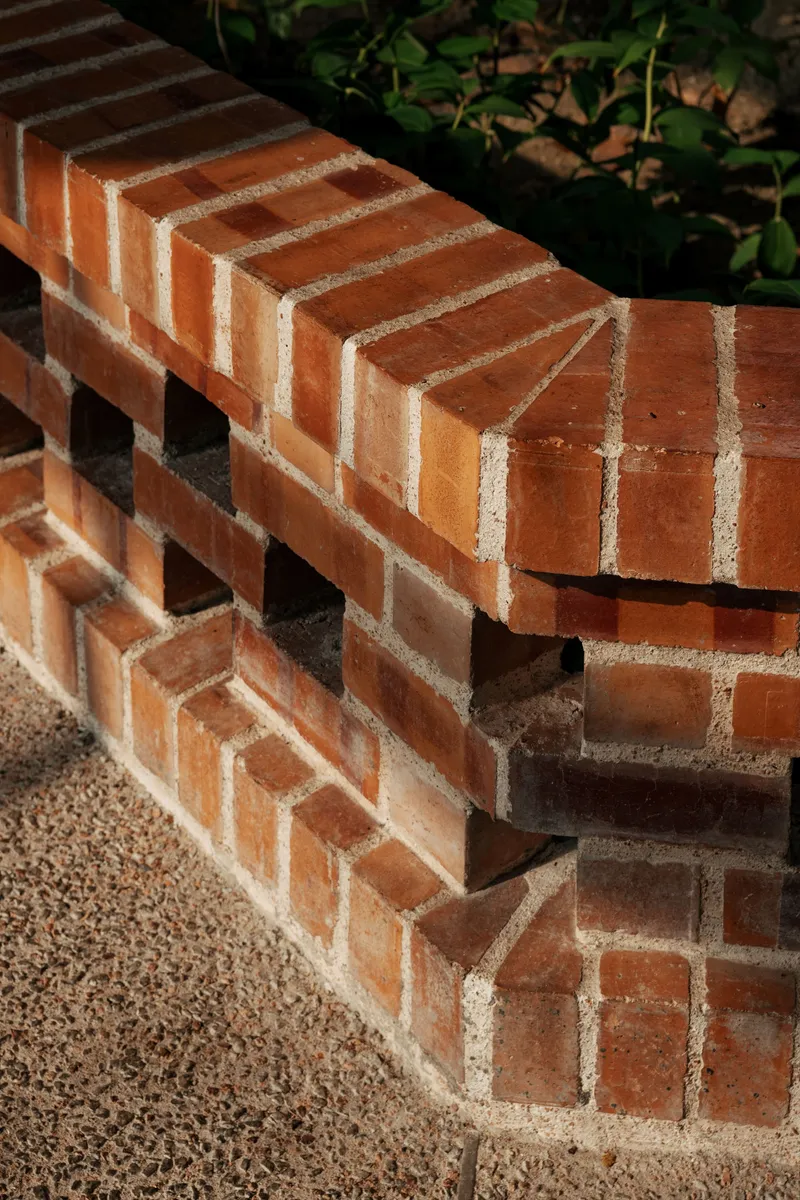
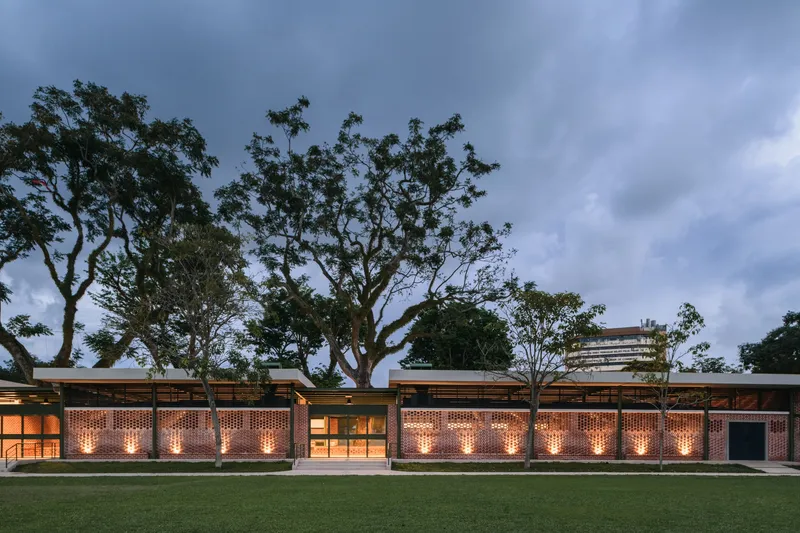
A brick bench at the building's base demonstrates how the perforated patterning language extends into furniture-scale elements. Corbelled courses create a seating surface while maintaining the ventilation motif, and the gravel base provides drainage at the wall footing. At night, uplighting washes the perforated facade from below, revealing shadow patterns that are entirely absent during the day. The building effectively has two faces: a warm, material presence in sunlight and a delicately graphic one after dark.
Plans and Drawings
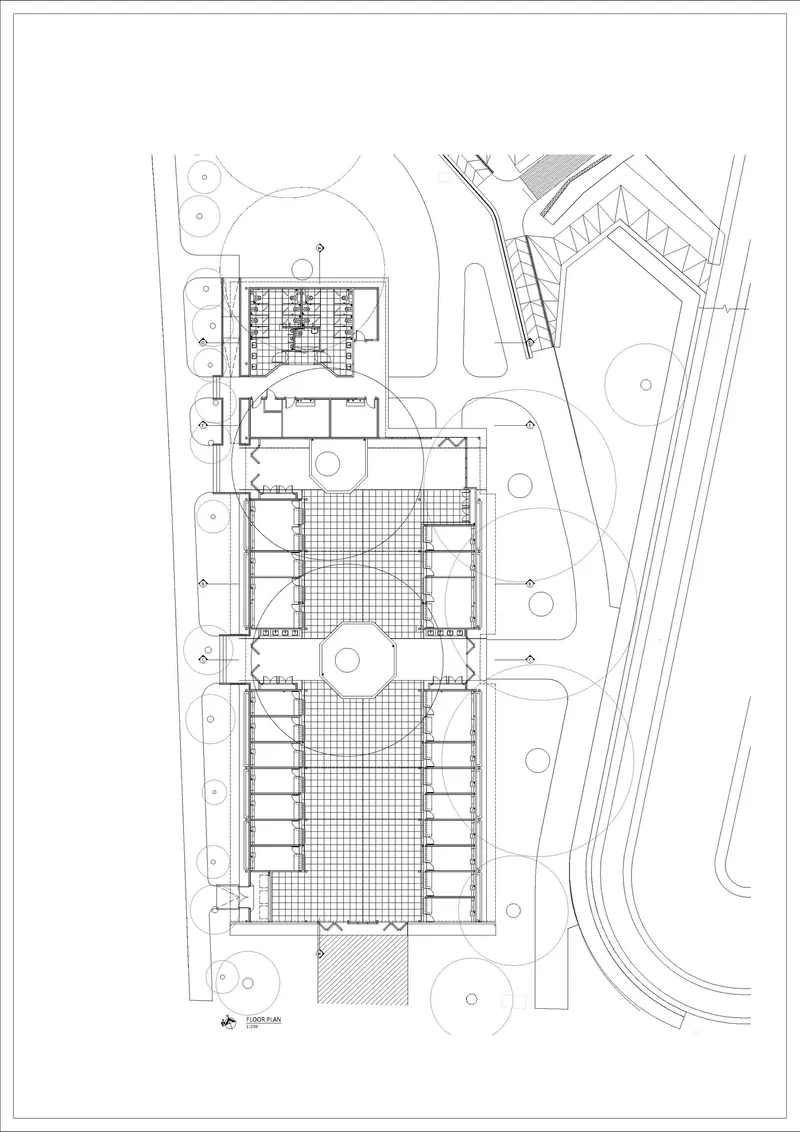
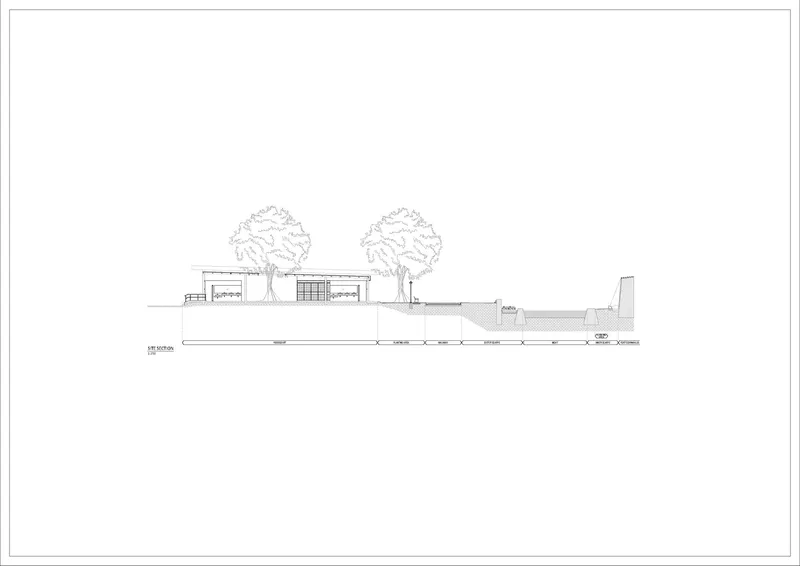
The site plan confirms the organizational strategy: three rectangular volumes arranged around a central courtyard, with the preserved tree at the heart of the composition. Surrounding pathways and trees are carefully mapped, showing the building's integration into the park landscape rather than its imposition upon it. The elevation drawing reinforces the horizontality of the project. Two trees flanking the facade are drawn at the same scale as the building, making explicit what the photographs suggest: that the architecture is calibrated to the landscape, not the other way around.
Why This Project Matters
Hawker centers are the social infrastructure of Malaysian cities. They are where communities eat, argue, celebrate, and simply exist. Designing one next to a colonial fort in a UNESCO heritage zone could easily result in either a timid pastiche or an arrogant insertion. EA Architects avoided both traps by building with the same material as the fort, using it in a way the fort never did, and organizing the entire plan around a living tree. The building earns its place not through deference but through intelligence.
At RM4 million, Astaka Kota Selera is also a lesson in doing more with less. The perforated brick screens are structurally honest, climatically responsive, and visually striking without requiring expensive mechanical systems or imported materials. For a region where public architecture budgets are perpetually constrained, this project offers a replicable argument: that careful brick detailing, passive ventilation, and respect for existing trees can produce civic architecture of genuine quality. George Town's waterfront has a new landmark, and it is not a tower or a museum. It is a place to eat char kway teow and watch the ships come in.
Astaka Kota Selera by EA Architects (Liou Hung Woei, Lui Sy Ying). George Town, Pulau Pinang, Malaysia. Completed 2025. Photography by TWJPTO.
About the Studio
Share Your Own Work on uni.xyz
If projects like this are the kind of work you want to make, uni.xyz is a place to publish your own, find collaborators, and enter design competitions.




Popular Articles
Popular articles from the community


Lunar Spiral: Space Architecture Shaped by the Mathematics of the Universe
Lunar Spiral reimagines space architecture through Fibonacci geometry, lunar regolith, levitating habitats, and self-sustaining Moon living.

Hill & Cross Opera: Sculptural Opera House Architecture Shaped by Tallinn’s Landscape and Identity
Hill & Cross Opera reimagines opera house architecture in Tallinn through its sculptural hill, civic plaza, glass wave and a luminous cross.

Conexión: Biophilic Design Reimagines High-Rise Living in Hong Kong
Conexión reimagines high-rise living in Hong Kong through biophilic design, green facades, shared spaces, daylight, water and nature within.

Co-Life: Senior Housing Design That Reconnects Older Adults With the City
Co-Life reimagines senior housing design through healing gardens, shared streets, workshops, and a sustainable community across generations.


Similar Reads
You might also enjoy these articles

Bao Huynh Watercolor Atelier: A Serene Art Retreat in Hội An
Bao Huynh Watercolor Atelier in Hội An blends multifunctional art spaces, sustainable design, local materials, and family-friendly living in a serene environment.

Atelier Macri Concept Store Interior Design by CASE-REAL
Atelier Macri store features a "ko" counter, walnut wood details, cork displays, blending retail, gallery, and seamless customer experiences.

Manuel Vargas Izquierdo Stadium and High-Performance Sports Center: Architectural Excellence in Jalpa de Méndez
The Manuel Vargas Izquierdo Stadium blends sustainable design, inclusive sports facilities, and cultural-inspired architecture, revitalizing Jalpa de Méndez’s public spaces.

KAKR Buluh Awar Hall: Revitalizing Community and Ecology Through Bamboo Architecture
Community built bamboo hall revitalizes Buluh Awar village, empowering youth, restoring ecology, celebrating vernacular craftsmanship through sustainable architecture and culture.


Explore Cultural Architecture Competitions
Discover active competitions in this discipline



Challenge to design a portable theatre


Challenge to design a portable music platform


Challenge to design an open learning module for the elderly


Bring back Drive In's
Comments (0)
Please login or sign up to add comments
No comments yet. Be the first to comment!