
Eagle Eye Tower
A west-coast inspired mass timber skyscraper

The Problem
Resource Extraction
A new Paris is built every single day worldwide. With the world's continuing expansion and old buildings reaching the end of their days, this is inevitable. However, resource extraction is the largest culprit when it comes to rising CO2 emissions. Not only is it responsible for half of the world's carbon emissions, but that number is growing at a rapid 3.2 percent rate (not to mention transporting these materials). Despite the global population growing two-fold since 1970, resource extraction has tripled (sand and gravel have quintupled) according to the Global Resources Outlook. Food packaging, farming, electronics, automobiles are all results of these, but none are greater than the construction industry, providing 78% of the global emissions due to resource extraction. With this in mind we are also depleting our finite resources. While right now it may seem like iron and concrete are infinite, they are not, and eventually the world will run dry of those resources. Meanwhile we have materials, most importantly trees, that are essentially infinite (given we replenish the supply). While sustainable alternative materials such as hempcrete are on the rise, we should be utilising the material we have been using for humans' entire existence; wood, for building. Provided enough sustainably sourced insulation and properly constructed walls, timber can be almost, if not just as effective at preventing thermal bridging, weather, and sound from entering the space as concrete. The contribution of carbon emissions to the atmosphere adds to the rising health risks of poor air quality. Poor air quality will and has led to heart disease, asthma, strokes, lung cancer, and other respiratory issues amongst the global population. Not only this but EPA analysis showed that in 2010 alone, better air quality due to the Clean Air Act resulted in 13 million fewer lost workdays, thus preventing excess (American) healthcare costs. It is affecting everyone, low, or high income. Over the past century, air quality has steadily improved thanks to sanctions made by governments. Recently however, this return to nature has flattened out showing that designers and our governments need to be doing a better job at keeping that train moving. With the removal of these finite materials also comes biodiversity loss in which it accounts for an unsurprising 80% of the global total. Roads, residential, and commercial spaces take up areas previously owned by nature, while the materials used are taken from areas that are slow to replenish in biodiversity, if at all. All of this to say we need to be more mindful of which environments we are destroying, and what kind of materials we are obtaining. Currently 39% of the worldwide annual carbon emissions are a direct cause of the built environment.
Height restrictions
The tallest existing mass timber skyscraper stands 87 metres and 25 stories tall, that being the Ascent MKE Building, located in Milwaukee, Wisconsin, followed closely behind by Norway’s Mjösa’s 18-story residential tower. Eagle Eye Tower would eclipse the Ascent building by 43 metres (to the highest ceiling), thus making it the tallest mass timber skyscraper in the world. This is not at all an unrealistic expectation for the near future, as mass timber skyscrapers have been overtaking each other rapidly as it becomes a more and more popular medium for constructing high-rises.
Context
Mayan, Japanese, Chinese, African, and even now recently; Norwegian architecture, all have developed their own unique, distinguishing styles; so why has Canada yet to develop an architectural language? The first reason is the simple fact that western Canada is so newly ‘formed’, only joining in 1871 (with Canada forming in 1867). Another is the multiculturalism, with some claiming Canada to be the most multicultural country in the world. This culmination of cultures in the short term, while objectively positive for wellbeing and the economy, does not form an architectural identity nation/province wide. However, there has been a “west coast style” being implemented slowly across British Columbia and the Yukon, utilising wood, timber (British Columbia has the largest reserved forest cover in the country, and 64% of the province is forested), greenery, and first nations inspiration in a contemporary package. This style will definitely become the status quo as time moves on which is excellent as it reflects the land and its people, no matter where they are from.
With the city of Kelowna’s continual rise in population comes the expansion of the downtown area. New sky rises are going up each and every year, most notably UBCO’s proposed residential tower along with plans to further develop their campus in the downtown area. This expansion of the campus will undoubtedly call for more housing, specifically affordable ones for students and faculty.
The Solution
Emissions
We always talk about the future, but let's talk about the now. Mass timber creates less waste, is quicker/cheaper to erect, and leaves a lighter carbon footprint. On-site mass timber is much more predictable than concrete and you can work through cold days without having to worry about compromising the state of the material, unlike with concrete. The global market for cross-laminated timber is projected to rise 14.5% every year for the near future. The global market was 1.5 billion Canadian dollars and is expected to rise to over 3.35 billion dollars by 2027 according to MarketsandMarkets research data. With this expansion of the industry it is key that forest management is at the top of the priority list, otherwise this so-called ‘infinite’ resource will turn into yet another an endangered species.
The building itself, and the foliage attached act as a carbon sink; cleaning the air around it, making a healthy working and living environment for everyone. There have been countless studies on people receiving higher sleep scores when residing in a ‘green residence’ On a global level this will aid in our fight against global warming. The planting of trees and greenery in general (as well as mass timber) allows for the sequestering of CO2 and production of oxygen into the air, so if we can even partially replace the environment we take over for our buildings with this wildlife, we are doing an adequate job.
Structure
There are two popular systems for mass timber buildings. The first is the “Post and Beam System”. The main advantage to this system is that you can achieve a larger space between columns while the main drawback to this system is that you need to accommodate extra headheight for the beams,
The second system commonly employed is the “Post and Plate System”. This system does not use beams, instead relying on the structural integrity of the flooring as well as structural CLT columns fitted to the floors. The advantage to this system is the fact that you don't need to accommodate extra head-height and get more ‘bang-for-your-buck’ in terms of floors. The common drawback to this system is that you need a tighter spacing between columns if not utilising structural walls in addition.
The main catalyst to constructing this building to be as tall as it proposes to be, is to employ both of these strategies together. Specifically in the lower portions, with the commercial spaces, parking garages, and lobbies, and grid amongst the hallways, they contain structural beams along with the walls and columns for extra support. Moving up to the residential sections, the system moves to a wall, column system without structural beams underneath the flooring to maximise the ceiling height and floors. The structural columns and walls are all vertically aligned to each other in each floor as structures with load paths that do not align in mass timber buildings will require transfer beams and transfer slabs. This is not ideal as it adds an unnecessary parameter and adds to the cost. Thus, alignment was high on the priority list when designing from a plan point of view. As opposed to in-situ concrete and other building materials that need to be constructed on site, the components, specifically the load bearing walls in Eagle Eye Tower are to be prefabricated off site and lifted into place once on site. Routes in the wall panels are designed specifically for the mechanical, electrical, and plumbing systems. This cuts down on the time spent on-site, saving money, something unavailable to steel/concrete buildings. Given the proper local resources, every CLT beam and panel can be configured with the 3D/BIM model to CNC machines, to digitally create the major components. Galvanised bolts and connectors will allow seamless transition from the CLT components to the steel ones.
Cost
With great responsibility, generally comes great cost, however not when it comes to mass timber. Unsurprisingly, mass timber structures are five times lighter and have a lighter carbon footprint than steel/concrete. Furthermore, they can be erected on site three times faster than its counterparts. Because of the weight difference between the mass timber building and a concrete/steel alternative, it requires a much smaller foundation (as well as no rebar), further cutting emissions and costs. These numbers are certain to rise as when the use of timber in large buildings becomes more mainstream, it will surpass the already perfected and tested iron/concrete pairing. Currently the two options are equal in terms of cost, but yet again, that is sure to change in the near future.
Fire Safety
In speaking with investors, city planners, and city officials, one of the most common concerns in mass timber buildings is fire safety. For good reason, this is a concern for any tall building, especially one that is primarily created using a historically very flammable building material. The last thing as a city you want, is to have a newly developed high-rise collapse onto your city streets. This concern was almost immediately dealt with in the mass timber industry and now performs exceptionally well in fires. This is due to its self-insulating properties and its ability to char the outer layers, thus protecting the inner, more important thermal mass. Essentially, in case of a large fire, the building will almost shed an outer skin of wood, keeping all of its original structural properties.
Site
The absolute number one rule for sustainable architecture is utilising pre-existing buildings. Renovating an abandoned brutalist concrete building, which when constructed, was the automobile equivalent of a hummer, is much more environmentally friendly than tearing it down to build an entirely new building. Not only would you acquire the environmental and financial repercussions of tearing the existing structure down and transporting those materials to the dump, but you would also need to source a whole new palette of materials to build new. That is why instead of demolishing the pre-existing single floor parking garage on the northern site, it is instead expanded upon, providing a cheaper and more environmentally friendly alternative, especially considering the city of Kelowna’s rapid expansion. “The greenest building is the one that already exists.”
Kelowna is located in the heart of the Okanagan, historically home to the Syilx Okanagan indigenous territory. Broadly speaking, this land is a part of the west coast of North America in which there is a rich history of art in its people. This will be expanded upon further into the project proposal.
Design
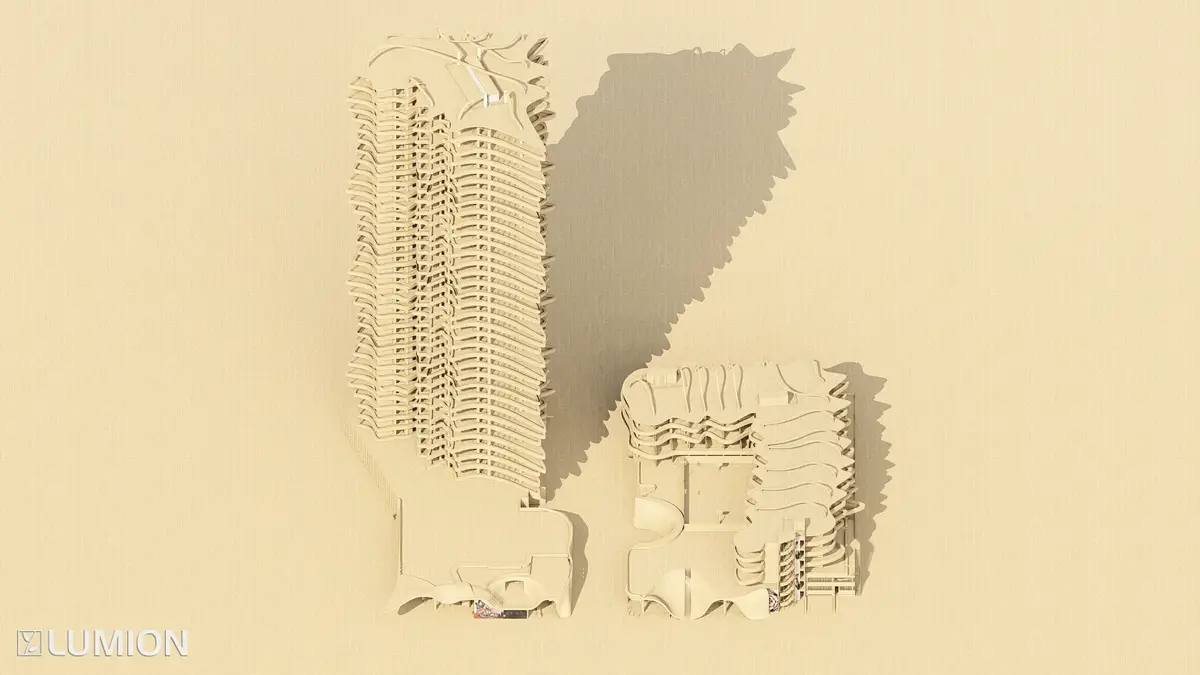
Each deck is extruded under a third degree spline to keep the tower/housing units visually engaging while also shading adjacent decks. The native foliage adds interest to the skyline and cleans the air during the summer while further shading and preventing solar radiation from entering the units during the warm Kelowna summers. During the winters these plants will shed their leaves to allow light further into the units to warm the space during the cool winters. The rooftops collect rainwater to distribute to the units and deck foliage as grey water. The roof is easily accessible via the elevator and stairwells to make any maintenance changes. The coating, waterproof membrane, and vapour barrier layer are specified extra thick to prevent any unwanted moisture from infiltrating into the CLT. Strips of segmented wood wrap down into the column to add to the flowing consistency throughout the project.
The tower units are spacious, comfortable, and private, with extraordinary views of Kelowna. There are 68 single units, 170 double units, and 102 triple units. The affordable housing section contains 168 single units, and 4 double units, all focusing on space saving, yet comfortable living. Each unit is fitted with a Murphy bed/table system that keeps the space open during the day time, and comfortable during the night.
Art
Indigenous culture in Canada is heavily connected to land on which we stand. The goal is always to leave the world as you found it, and to respect the earth on which we were given. The construction/extraction industries’ byproduct in biodiversity loss and pollutants will most likely be here to stay, but that doesn’t mean we shouldn't root (no pun intended) for its improvement. Along with the project's goal of a net-zero carbon footprint, it will also have its own identity inspired by the world around it. Specified exterior and interior walls are to be designed and painted by a local indigenous artist to keep the economy localised, and give a true sense of authenticity to the site's location. The chosen murals for Eagle Eye Tower are a Wolf, a school of Okanagan salmon, and eagle feathers.
Wolf: The wolf represents loyalty, strong family ties, good communication, education, understanding, and intelligence. The goal of Eagle Eye Tower is to be educated on the state of the world and respond to it accordingly. To merge the street with the building instead of designing them as two separate entities, as often the divide between the street and the architecture is drastic and unwelcoming. Loyalty to the land on which the architecture stands by using local wood, and covering as much left over space as possible with native foliage. We must understand our resources are finite and use them sparingly so the next generations can enjoy the world as we do.
Salmon: The school of salmon symbolises abundance, fertility, prosperity and renewal. As a society we must balance societies objective to prosper, and taking care of the earth we were given. While it may seem like we have an abundance of materials now, it will not be that way forever, thus we must replenish our ‘infinite’ resources and use the finite ones sparingly.
Eagle Feathers: Eagle feathers symbolises respect, honour, strength, courage, wisdom, and a step forward in an ongoing story. Respecting the land we are given by restoring all we can when constructing is key to preventing biodiversity loss, unhealthy air, and a dull living environment. Architects and other professionals in the construction industry need to remain resilient in proposing green buildings to clients and cities, and keep it as the standard. We must pass this knowledge on and let younger generations expand on it. If we have the courage to do so, we can rest comfortable knowing that future generations can enjoy the earth and its gifts as much as we have.
The flowing nature of the facade, blending into the street, was inspired by the waves of the Okanagan Lake and the construction of canoes that were historically used to cross it.


Popular Articles
Popular articles from the community


Juan García Correa, John González and Claudia Rueda Sink a Circular Amphitheater into a Manizales Engineering Building
On the La Nubia campus in Manizales, Colombia, the S1 Building folds labs and offices into a hillside of ramped lawns that double as a campus route.

David Ortega Stacks a Two-Story Mexico City Penthouse Around a Steel Stair and a Pergola-Shaded Roof Terrace
In Colonia Roma, a 300 m² penthouse uses oak joinery, a planted steel stair and a slatted roof pergola to make a new-build apartment feel like a house.

Architekt Andreas Gruber Scatters 23 Dark Timber Chalets Across a South Tyrolean Forest Edge
In Molini di Tures, Amonti Chalets breaks a resort into a hamlet of gabled timber houses, with parking, storage and services pushed into the slope.

GROUP A Strips a 1969 Rotterdam Harbor Headquarters to Its Frame and Wraps It in Timber Louvers
In Rotterdam's M4H harbor district, Ferro Offices reuses a 1969 frame, adds one timber storey and reaches BREEAM-NL Outstanding.

Similar Reads
You might also enjoy these articles


Vereda Arquitetos Renovates a 40-Square-Meter Apartment Inside Niemeyer's Copan Building
A compact unit in São Paulo's most iconic residential tower gets a material overhaul that pairs exposed concrete with bold blue Formica.

Shakur's House: Exposed Brick as an Interior Organiser in a 168 m² Mashhad Residence
Brick moves indoors in this Mashhad residence, where masonry walls, glass partitions and teal planes sequence a compact home without closing it off.

Day and Night Park: A Time-Based Urban Newsstand in Beijing
A temporary urban newsstand in Beijing blending travel, light, and reading through poetic colors, compact form, and community-focused design.

Modernist Patio Renovation in El Masnou, Barcelona by Oliver Segura Arquitectura + Cebrià Arquitectura
Modernist patio renovation blending tradition and innovation with a movable pool, leveled floors, and Catalan materials in El Masnou.

Explore Skyscraper Competitions
Discover active competitions in this discipline


Challenge to reimagine the Iron Throne

Photograph architecture without architects

Illustrate the lost glory of Angkor Wat - Render Challenge

Design challenge to reuse E-waste
Comments (0)
Please login or sign up to add comments
No comments yet. Be the first to comment!