
23 Degrees Design Shift Builds a Brewery Around an Orchard in Hyderabad's Tech District
Zero40 Brewery weaves through ten mango trees and a neem on a 1.2-acre site, proving that hospitality architecture can leave the land better than it found


In the heart of Hyderabad's financial and software district, where glass curtain walls and parking structures dominate the streetscape, a brewery has taken root among ten mango trees and a solitary neem. Zero40 Brewery, designed by 23 Degrees Design Shift, occupies a 1.2-acre rectangular plot that once functioned as an orchard. Rather than clear the site and start fresh, the studio made a straightforward commitment: not a single tree would be pruned or removed. The architecture would adapt to the trees, not the other way around.
What makes this project worth attention is not merely the preservation gesture. Plenty of projects claim to "respect nature" while bulldozing everything outside the drip line. Here, the trees literally penetrate the building. Floors open around trunks. Roofs taper to accommodate canopies. The entire 2,176 square meter program, from a 40-seat bar counter to a first-floor brewing operation, is organized through polygonal courtyards that emerged directly from the irregular placement of existing vegetation. The result is a brewery that feels less designed than grown, a series of pavilions and terraces negotiating with a landscape that was there first.
Trees as Structural Logic


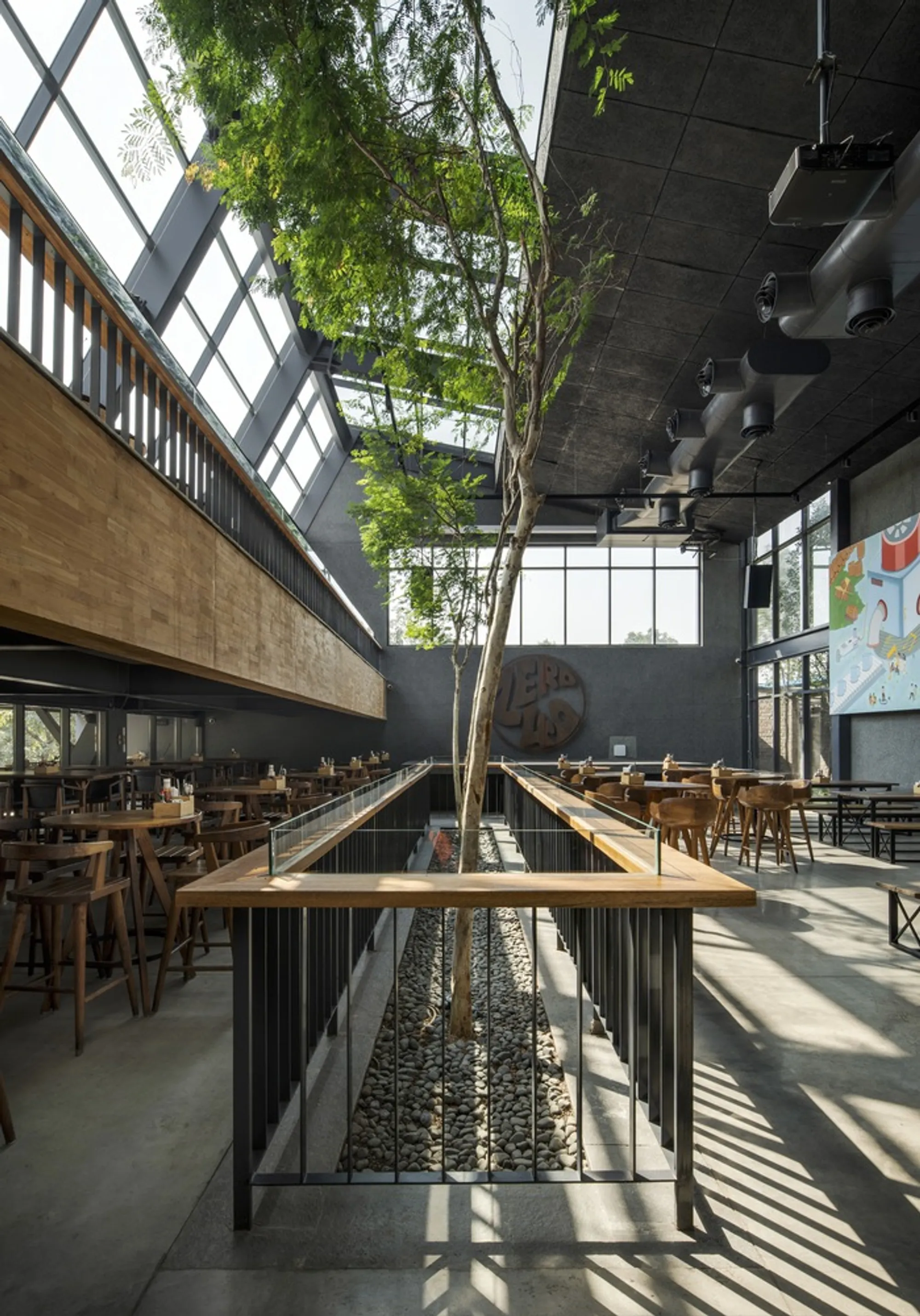
The most striking spatial move at Zero40 is the way trees physically occupy the interior. In the main dining hall, a tree rises through a timber-edged opening in the floor, its canopy brushing a glazed ceiling that floods the double-height space with light. Suspended timber walkways bridge the upper levels, turning vertical circulation into a kind of treehouse experience. These are not decorative plantings dropped into atriums. They are existing specimens that the architects surveyed, mapped, and then wrapped architecture around.
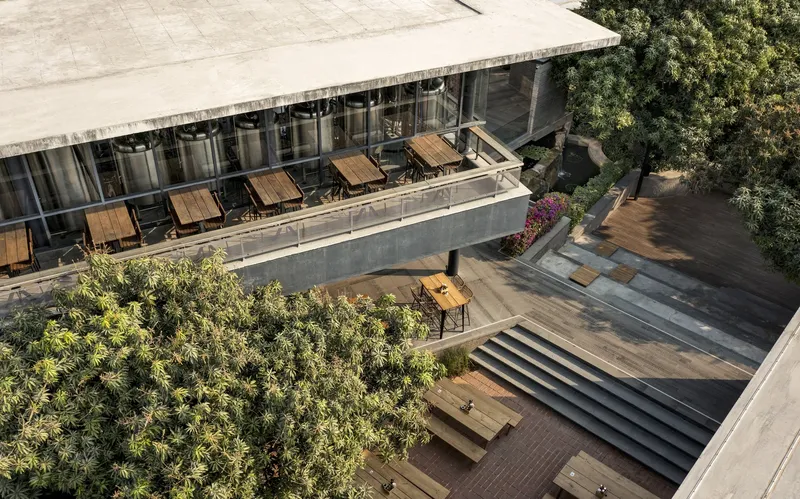
The aerial view reveals how the terraced sections step down to follow the site's natural gradient. Concrete platforms, timber decking, and planted beds slot between building volumes, creating a layered section that reads more like landscape architecture than conventional hospitality design. The tapered structural forms reduce mass near the canopies, allowing branches to spread without interference.
A Material Palette Rooted in the Region
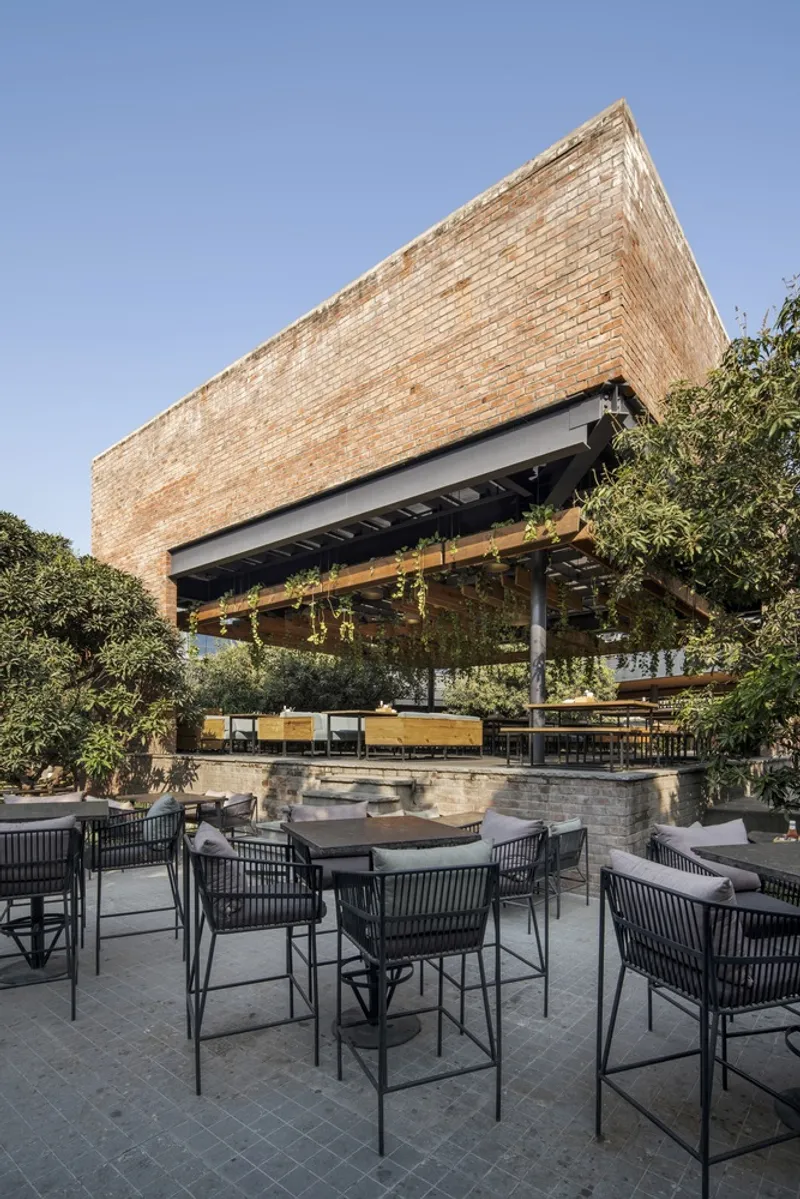

The material choices are blunt and tactile. Red mud bricks and grey fly ash bricks form the exposed masonry walls, lending a rough warmth that connects the project to Hyderabad's material traditions without resorting to pastiche. Bush-hammered basalt surfaces add contrast, their tooled texture catching raking light across courtyard floors. Tandur cobble, a regional stone, appears as aggregate-bound flooring in the outdoor zones, providing a durable surface that reads as landscape rather than pavement.
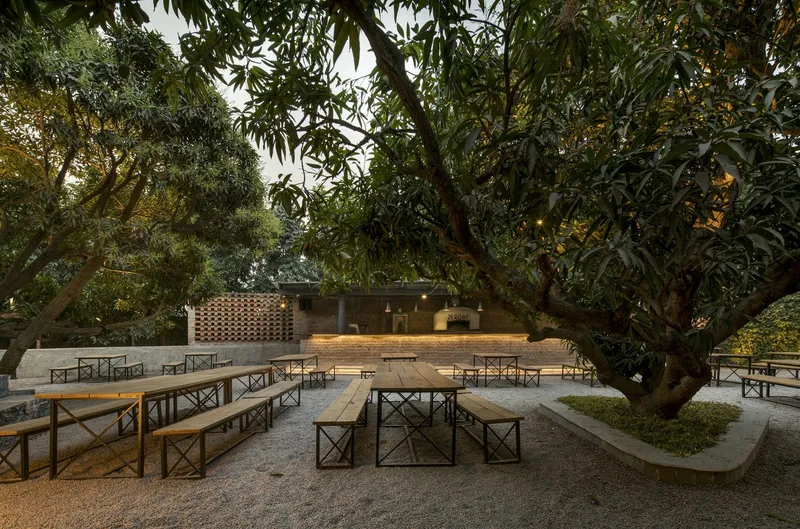
Corten steel and exposed structural steel frame the pergolas and cantilevered volumes. Over time, the weathering patina on the Corten will deepen, pulling the building's palette closer to the bark and soil tones of the orchard. This is a material strategy with a long game: the brewery will look more settled in five years than it does today. The perforated brick walls visible beyond the outdoor dining areas serve double duty, filtering light while providing privacy and service separation.
Five Zones, Five Atmospheres

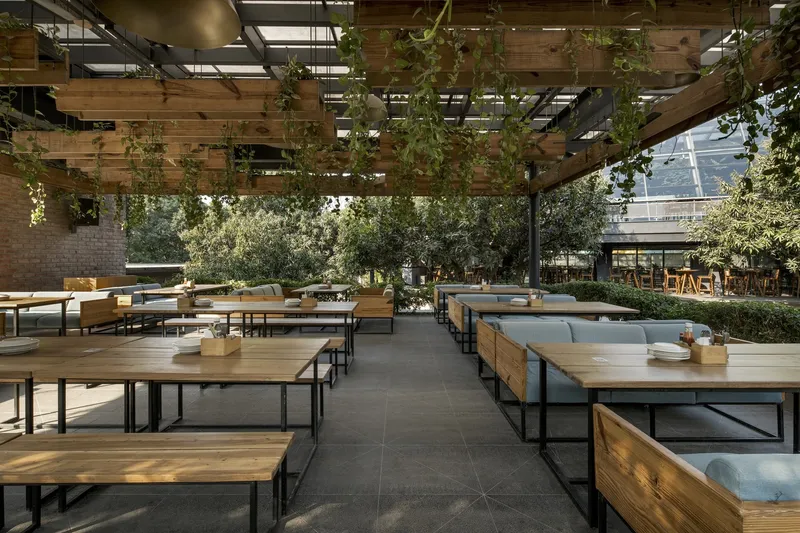
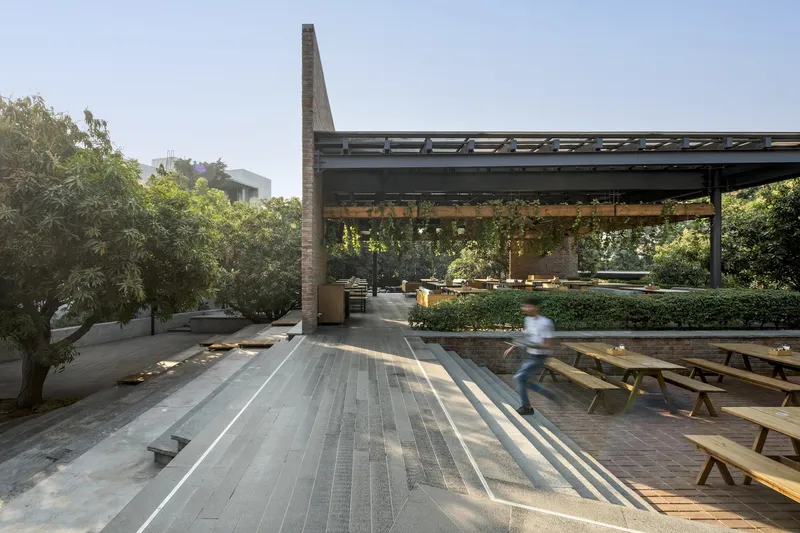
Zero40 organizes its outdoor program into five distinct landscape zones, each calibrated to a different social register. Timber pergolas draped in hanging plants create intimate canopy-like spaces for small groups. Elsewhere, slatted wood structures filter afternoon light into dappled patterns across cushioned banquettes. A covered terrace with a steel frame offers something more open, its picnic tables arranged under mature trees where shadows shift through the day.
The variety matters because it makes the brewery function as more than a drinking destination. 23 Degrees Design Shift conceived Zero40 as a communal space for its neighborhood: a place where the seating typology, from gravel beer garden to sunken amphitheater, accommodates morning coffee, afternoon work meetings, evening performances, and late-night drinking in equal measure. One third of the seating is barrier-free and accessible to people with limited mobility, a commitment that goes well beyond code compliance.
The Sunken Amphitheater and Water Threshold


Two moments anchor the sequence of arrival. The entrance pavilion features a small bridge over flowing water, a threshold device that shifts your psychological register from the road noise of the tech district to the quiet of the orchard. It is a simple move, but an effective one. Water features recur through the site, appearing as concrete channels in courtyards and reflective pools beside brick pavilions.
A sunken amphitheater serves as the project's social heart. By day, it operates as casual outdoor seating. In the evenings, it transforms into a performance space. Dropping the floor level creates intimacy without walls, and the surrounding tree canopy acts as a natural acoustic softener. The courtyard at dusk, captured here with timber picnic tables on brick paving surrounded by planted beds, demonstrates how the landscape zones maintain their character as the light changes.
Light, Glass, and the Polycarbonate Ceiling
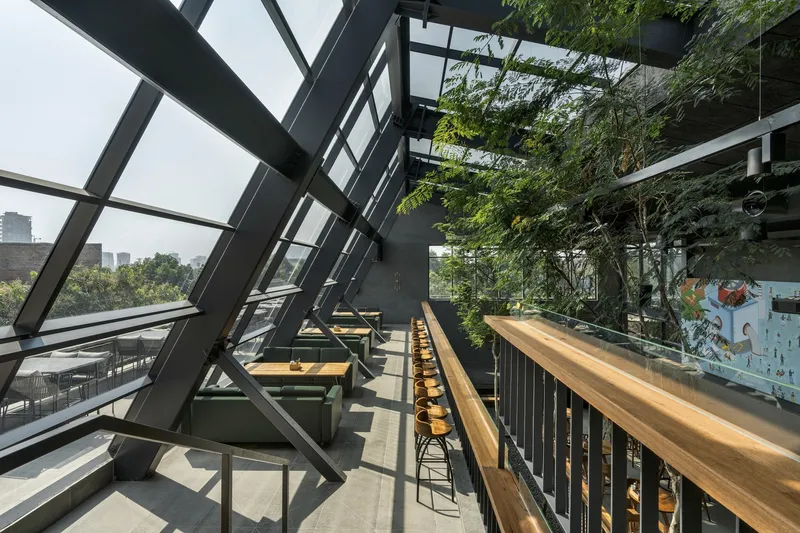
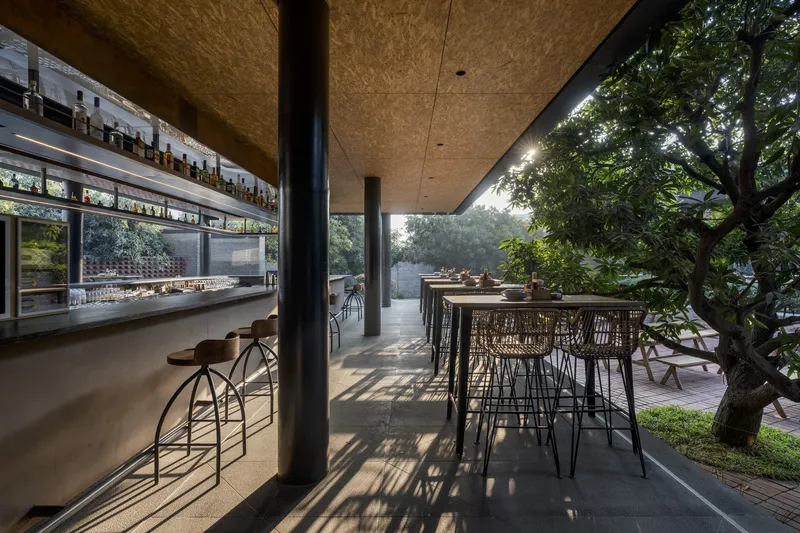
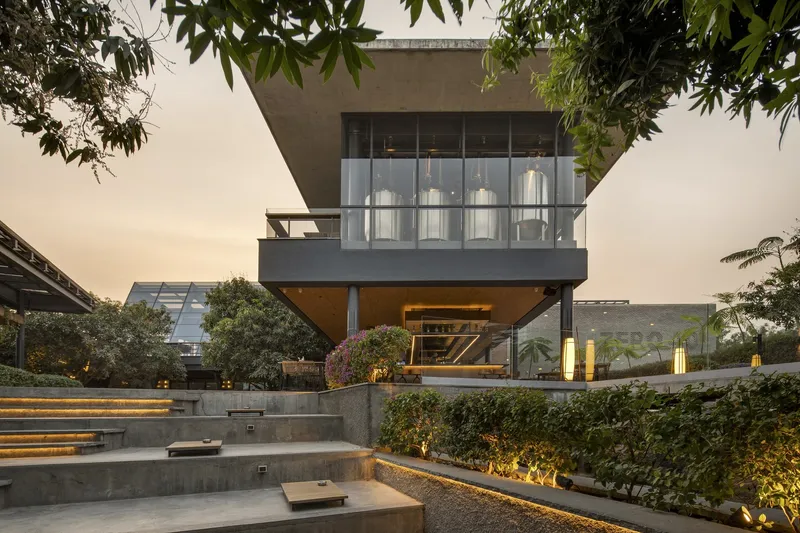
The upper level terrace reveals the lightweight polycarbonate roofing strategy most clearly. Diagonal steel frames support glass panels and planted greenery, creating a hybrid condition that is neither fully interior nor fully exterior. Natural light penetrates through tiled glazing panels, casting geometric shadow patterns across the floors below. The effect is atmospheric without being precious: this is a brewery, not a gallery, and the light serves the mood of social gathering.
At dusk, the cantilevered concrete volumes with their full-height glazing glow against the garden terraces. The elevation of the kitchen above road level, a pragmatic response to flood risk on this sloping site, also produces a sectional drama. The brewing zones sit on the first floor, visible through glass from the courtyards below, turning the production process into spectacle. Exposed services and steel structure in these upper zones reinforce the industrial character that a brewery demands.
The Aerial Reading
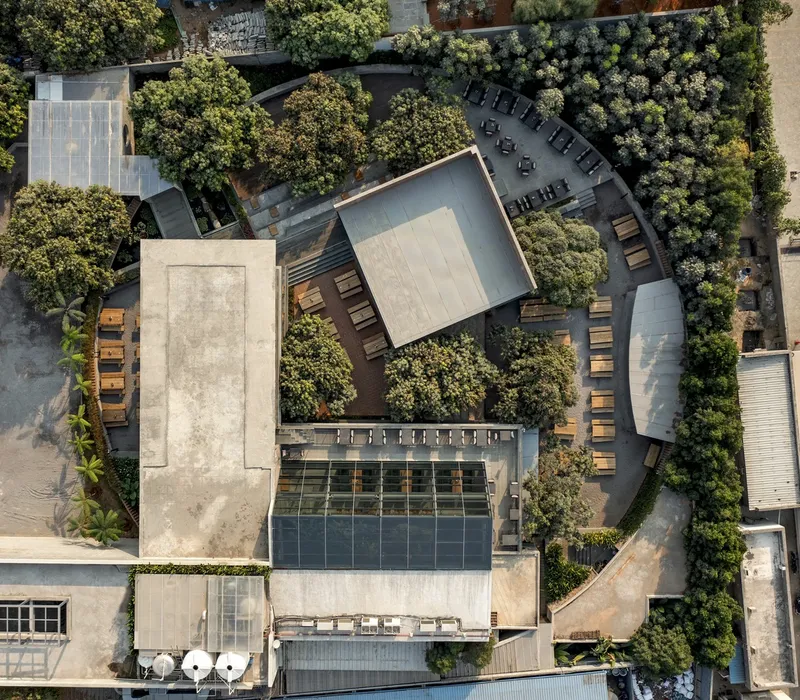
From above, Zero40 reads as a series of concrete roof planes and timber decks threaded through a tree canopy. The building footprint is fragmented, broken into smaller pavilion-like volumes that minimize the sense of mass. Rows of outdoor seating fill the gaps between structures, and the mature trees dominate the composition. It is telling that from this vantage point, the greenery occupies more area than the architecture. That ratio was not accidental.
Plans and Drawings
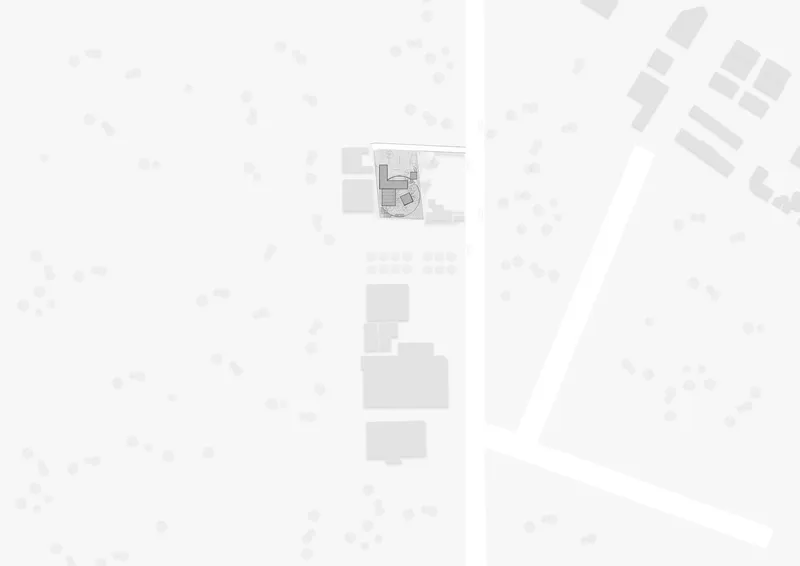

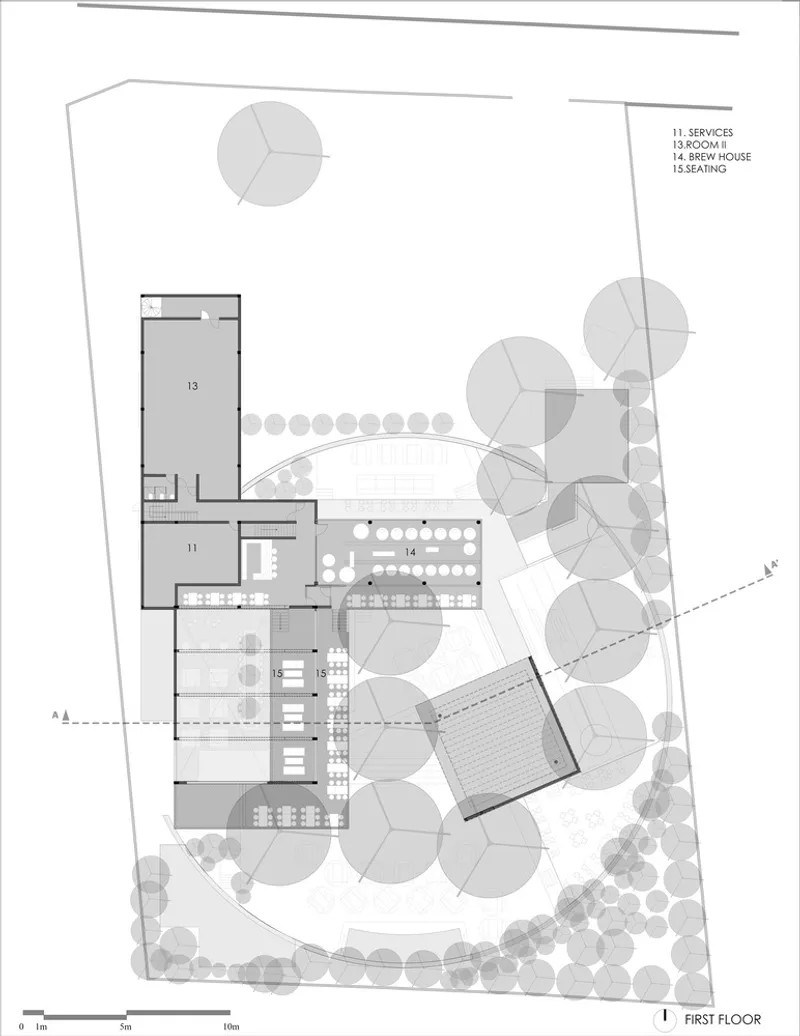
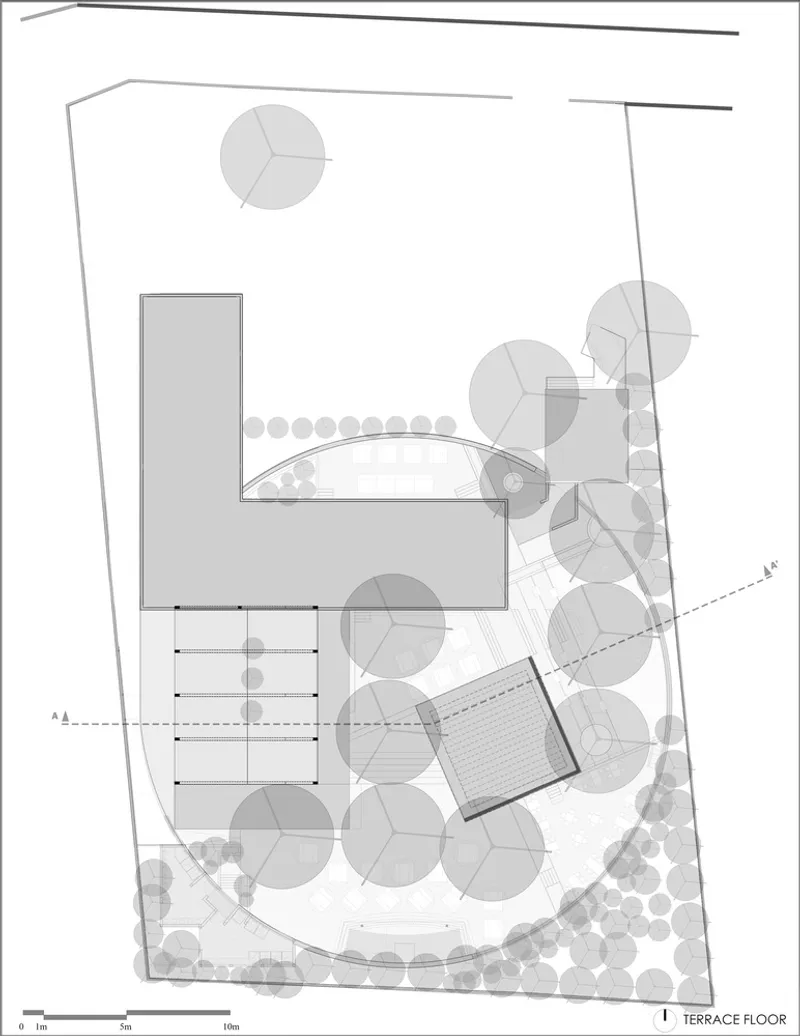


The site plan reveals how tightly the building footprints negotiate with the surrounding urban fabric. The ground floor plan shows the programmatic logic most clearly: dining areas, courtyard seating, and curved outdoor zones all defer to the mapped positions of existing trees. At the first floor, rectangular volumes arrange themselves around a curved landscaped courtyard, with tree canopies drawn as the dominant graphic element. The terrace level introduces a pool and additional outdoor spaces.
The section drawing is the most revealing. Cutting through service rooms, courtyard seating, and pavilion spaces, it shows how the architecture steps with the site's gradient. Trees rendered in elevation stand taller than every built element, a proportional relationship that captures the project's hierarchy: vegetation first, structure second. The elevation drawing confirms the horizontal emphasis, with vertical louvers and planted courtyard elements maintaining the layered reading between tree canopies.
Why This Project Matters
Zero40 Brewery matters because it treats ecological preservation not as a constraint to overcome but as a generative force. The irregular tree placement produced the polygonal courtyards. The sloping topography created the sunken amphitheater. The existing canopy coverage made the lightweight polycarbonate roofing logical. Every distinctive spatial quality of the project traces back to a decision to work with what was already on the site. In a city growing as fast as Hyderabad, where entire neighborhoods of software campuses appear on cleared land, this approach offers a credible alternative.
It also reframes what a brewery can be in an Indian urban context. By designing for accessibility, by programming five distinct outdoor zones rather than a single terrace, and by positioning the project as a neighborhood commons rather than a nightlife destination, 23 Degrees Design Shift has produced a piece of social infrastructure that happens to serve beer. The trees that made this project complicated are also what make it memorable. Ten mangoes and a neem did more for the architecture than any design concept could.
Zero40 Brewery by 23 Degrees Design Shift, located in the financial and software district of Hyderabad, India. Total built area: 2,176 square meters on a 1.2-acre site. Photographs by Shamanth Patil J.
About the Studio
Share Your Own Work on uni.xyz
If projects like this are the kind of work you want to make, uni.xyz is a place to publish your own, find collaborators, and enter design competitions.



Popular Articles
Popular articles from the community


The Earth Pod: 3D Printed Homes for Resilient Refugee Communities
The Earth Pod reimagines refugee housing through 3D printed homes made from clay, combining resilience, self-sufficiency, and rapid shelter.

Lunar Spiral: Space Architecture Shaped by the Mathematics of the Universe
Lunar Spiral reimagines space architecture through Fibonacci geometry, lunar regolith, levitating habitats, and self-sustaining Moon living.

Conexión: Biophilic Design Reimagines High-Rise Living in Hong Kong
Conexión reimagines high-rise living in Hong Kong through biophilic design, green facades, shared spaces, daylight, water and nature within.

Co-life: Sustainable Architecture for Age-Friendly Community Living
Co-life reimagines sustainable architecture for seniors through courtyards, rammed earth, shared gardens, and spaces designed for belonging.

Similar Reads
You might also enjoy these articles


Hodi-Mandai Geram
Project Function: Preservation and revitalization of the Intangible heritage and socio-spatial identity of the Hodi by Housing, Cultural Memory Center, Sacred Grove, landscape, local tourism economy


Olio Towers: A Mid-Rise for Performers That Fuses Housing, Rehearsal, and Stage
Located blocks from Houston's Theater District, this modular tower stacks living units around a central performance atrium.

Oasis: Modular Green Housing Carved into Dhaka's Urban Fabric
A shortlisted Plugin Housing entry reclaims unauthorized settlements in Dhaka with stepped concrete volumes, green roofs, and ventilation-driven design.

Black Hole: A Floating Megastructure for the Post-Physical Era
Emiliano Mazzarotto envisions a spherical, self-scaling arena where e-sports, digital hotels, and holographic stadiums replace traditional public space.

Explore Architecture Competitions
Discover active competitions in this discipline



Challenge to reimagine the Iron Throne


Photograph architecture without architects


Illustrate the lost glory of Angkor Wat - Render Challenge


Design challenge to reuse E-waste
Comments (0)
Please login or sign up to add comments
No comments yet. Be the first to comment!