
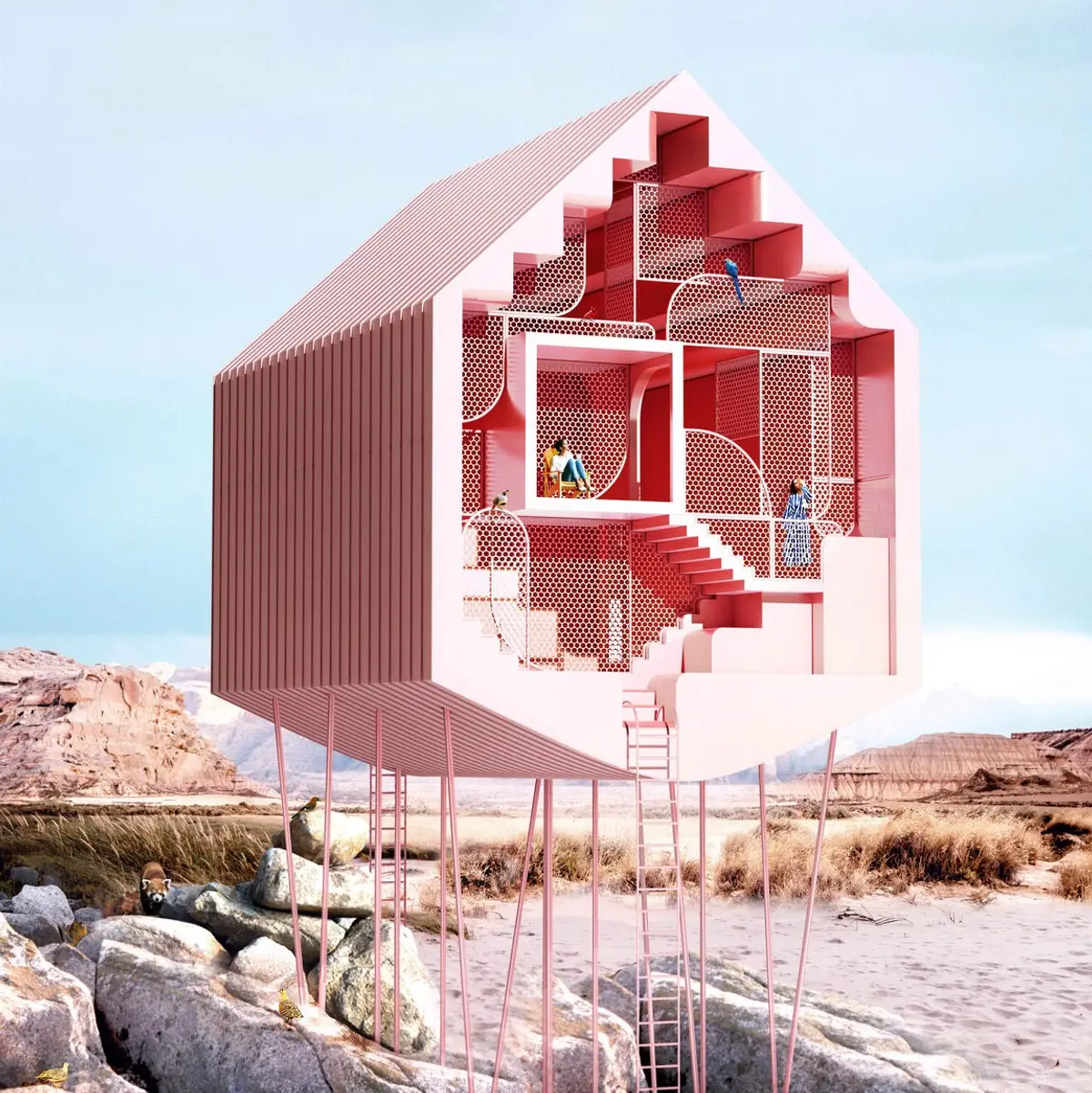
Eco-Homes: Enhancing the Urban Poor
Site: Sattola, Dhaka, Bangladesh

Introduction & Problem Statement
Rapid urbanization in Bangladesh has concentrated pressure on Dhaka, where the pace of migration and city expansion vastly outstrips the capacity of formal housing systems. In Dhaka, more than 5,000 slum communities exist, characterized by overcrowding and severely limited access to basic services (Habitat for Humanity). Across Bangladesh, slum dwellers also face significant risks of eviction and exposure to disasters, especially when residing in low-lying or marginal lands (Habitat for Humanity, “Housing Poverty in Bangladesh: Facing Slums & Disasters”.
These informal settlements are marked by severe tenure insecurity. Evictions are used periodically, sometimes violently, as a tool of urban redevelopment or “beautification,” often without adequate relocation or compensation (Rahman 2001); similarly, violent slum evictions in Bangladesh draw attention to whose voice is prioritized in such processes (IDS, “Violent slum evictions in Bangladesh: whose voice counts?”). In Dhaka specifically, perceived risk of eviction has been shown to negatively affect residential stability and residents’ willingness to invest in home improvements (Bashar 2022).
The conditions within these settlements exacerbate health and infrastructural vulnerabilities. Dense population, inadequate ventilation, and deficient infrastructure for water, sanitation, drainage, and waste management (Unplanned urbanization and health risks in Dhaka, PMC article) typify informal housing in Dhaka. Slum dwellers are also found to have higher socioeconomic and health vulnerability indices compared to non-slum populations: in a recent cross-sectional study, ~40% of Dhaka’s population live in slums and those dwellers exhibit significant deficits in housing quality, utility access, and health outcomes (Assessment of socioeconomic and health vulnerability among urban slum dwellers in Dhaka, Biomed Central).
In terms of housing cost burden, the paradox is especially acute: despite their low incomes, urban poor households in Dhaka often pay disproportionately high rent for substandard dwellings, reportedly spending 20-40% of total income for small, low-quality units. Morphological studies of Dhaka’s slum settlements reveal cramped rooms (100-150 ft²) housing entire households, with densities reaching ~1,000 people per acre in some areas (Iqbal, Shankar 2014)
Thus, the combined factors of:
- chronic eviction risk and tenure insecurity,
- poor infrastructure, health burdens, and deficient housing quality,
- disproportionate cost burden for the poor,
- and exclusion from formal planning processes
All these issues converge into a pressing challenge:
How can we deliver a healthy, affordable, and tenure-secure housing alternative for Dhaka’s urban poor, one that is sustainable and scalable, and how can redevelopment be structured to avoid evictions or displacement during construction, thereby preventing the spontaneous creation of new informal settlements?
In response to these issues, the Eco-Homes project seeks to provide an alternative solution - a sustainable, community-focused co-housing approach that addresses the unique challenges of the urban poor in Dhaka. Based in Sattola, an industrial area in Mohakhali, Dhaka, this project aims to offer a more humane, modular and scalable solution to housing informal settlements, while simultaneously preserving the cultural identity of the people who live there incorporating repurposed components.
Site Context & Needs Assessment
The Sattola, Dhaka informal settlement occupies 8 acres and shelters around 10,000 people. Identified among 57 target sites by the Dhaka Action Plan (DAP), its priority arises from being a “grey zone” tucked behind government quarters and hospital blocks, hard to access, undervalued, and socially marginalized. Over a six-month survey and workshop process including interviews, site mapping, focus groups, and consultations with RAJUK / National Housing Authority, key challenges emerged frequent evictions, recurrent fire hazards (5–6 major fires annually), inadequate water and sanitation, crime, and insecure tenure. Residents expressed a strong preference for concrete construction, perceiving it as durable, fire-resistant, and low-maintenance in Dhaka’s climate.
Design Approach
1. Incremental Eco-Homes (Modular, Community-Driven)
The housing model is a modular prefabricated frame (beams and columns) built using recycled concrete and construction & demolition (C&D) waste. Since 60% of C&D is concrete, repurposing this stream reduces costs and landfill burden. Doors, windows, and fittings are sourced from local resale markets in Mirpur, Dhaka, halving cost versus new stock.
Dwelling units are conceived as “core shells” (or structuring frames) into which residents can incrementally infill using materials like Zincalume, ferrocement panels, bricks, or ferrocement floor slabs. This flexibility allows residents to upgrade gradually in line with their incomes, alleviating the need for large up-front expenditure. This echoes the principle of incremental housing, long regarded as a strategy for affordability and empowerment (Wakely & Riley, 2011; van Noorloos, 2020).
2. Anti-Eviction Grid & Phased Redevelopment
To guard against wholesale displacement, the site is divided into multiple “grids,” each housing 1,000 people. Construction proceeds one grid at a time. Affected groups are relocated temporarily into nearby open grounds (e.g. schoolyards, parks) in modular shelters rented by the authority. Because prefabricated clusters can be completed in 7-8 months, disruption is limited and evictions avoided.
This phased approach ensures that as one grid moves into occupancy, the next can begin redevelopment, enabling continuity without the emergence of new informal sites elsewhere.
3. Rooted in Tradition & Community Participation
Community co-creation lies at the heart of Eco-Homes. Residents are engaged not only in decision-making but also in actual construction, reducing labor costs and engendering ownership. The design expresses a hybrid of tradition and modernity: blocks of four housing units wrap around a shared courtyard for social life, play, meetings. Rooftops are allocated for vegetable gardening, rainwater harvesting, and poultry; greywater treatment is decentralized but integrated into the master plan. Ground-level clusters include universally accessible toilets. Communal kitchens, micro-retail pods, and local enterprises are embedded to foster social cohesion and economic activity. By preserving vernacular patterns of interdependence and self-reliance, the project aspires to restore the dignity and social fabric often lost in top-down redevelopment.
Outcomes & Benefits
- Cost savings: Repurposed materials and modular techniques reduce construction costs by 22% compared to conventional methods.
- Affordability & flexibility: Residents can choose low-cost infill initially and upgrade incrementally.
- Social inclusion: Participatory building strengthens agency, pride, and community identity.
- Sustainability: Use of recycled C&D materials, water harvesting, rooftop farming, greywater reuse, and local employment promote resilience and reduce resource burdens.
- Replication potential: The modular and phased nature makes this model adaptable to other informal settlement sites globally.
Conclusion
Eco-Homes reimagines slum redevelopment not as clearance and replacement, but as an opportunity to rebuild from within, with dignity, agency, and sustainability. By combining a modular prefabricated frame, incremental infill, phased anti-eviction grids, and deep community participation, the project offers a pathway for transforming informal settlements into thriving, resilient, and equitable neighborhoods. While challenges remain, especially around financing and institutional capacity, the conceptual framework and on-the-ground strategy holds promise not just for Dhaka but also for other cities grappling with informal housing globally.

Popular Articles
Popular articles from the community


ETEH Reworks the Shared Spaces of São Domingos School in Brazil Around Timber, Color and Hanging Plants
At São Domingos School in Brazil, 436 m² of hall, refectory and library are recast with timber joinery, a yellow and blue code and trailing greenery.

graciastudio Turns a Viewless Tijuana Lot Inward Around a Courtyard of Concrete, Timber and Trees
In Tijuana, Jorge Gracia's GA2 House stacks a timber-clad private floor over exposed concrete and replaces a missing view with a planted interior patio.

FCC Arquitectura Expands a Portuguese Granite House with a Board-Marked Concrete Wing
In Portugal, JV House pairs a cleaned-up whitewashed and granite dwelling with a timber-shuttered concrete extension, courtyards and a garden pool.

David Ortega Stacks a Two-Story Mexico City Penthouse Around a Steel Stair and a Pergola-Shaded Roof Terrace
In Colonia Roma, a 300 m² penthouse uses oak joinery, a planted steel stair and a slatted roof pergola to make a new-build apartment feel like a house.

Similar Reads
You might also enjoy these articles

The Rhythm of Seasons
A Farmers' Market Connecting Nature and the City

More Than a Building-Designing a Living System
More Than a Building-Designing a Living System
Base Beyond
DESERT COMPOUND ARID: TOURISM OF ABSENCE AND ABUNDANCE


Comments (0)
Please login or sign up to add comments
No comments yet. Be the first to comment!