
Elemental Living Wraps a Multigenerational Bangkok Home Around a Spiral Stair and Courtyard Pool
A new house on the family compound in Bangkok grows vertically around a helical core, opening outward to water and sky.

Building a new home on an existing family compound is a loaded proposition. You inherit the landscape, the sight lines, and the social contract that comes with sharing a plot across generations. Elemental Living's Axis of Growth House in Bangkok takes that challenge as a design driver, producing a residence that is simultaneously introverted and generous, tightly planned yet surprisingly open to the sky.
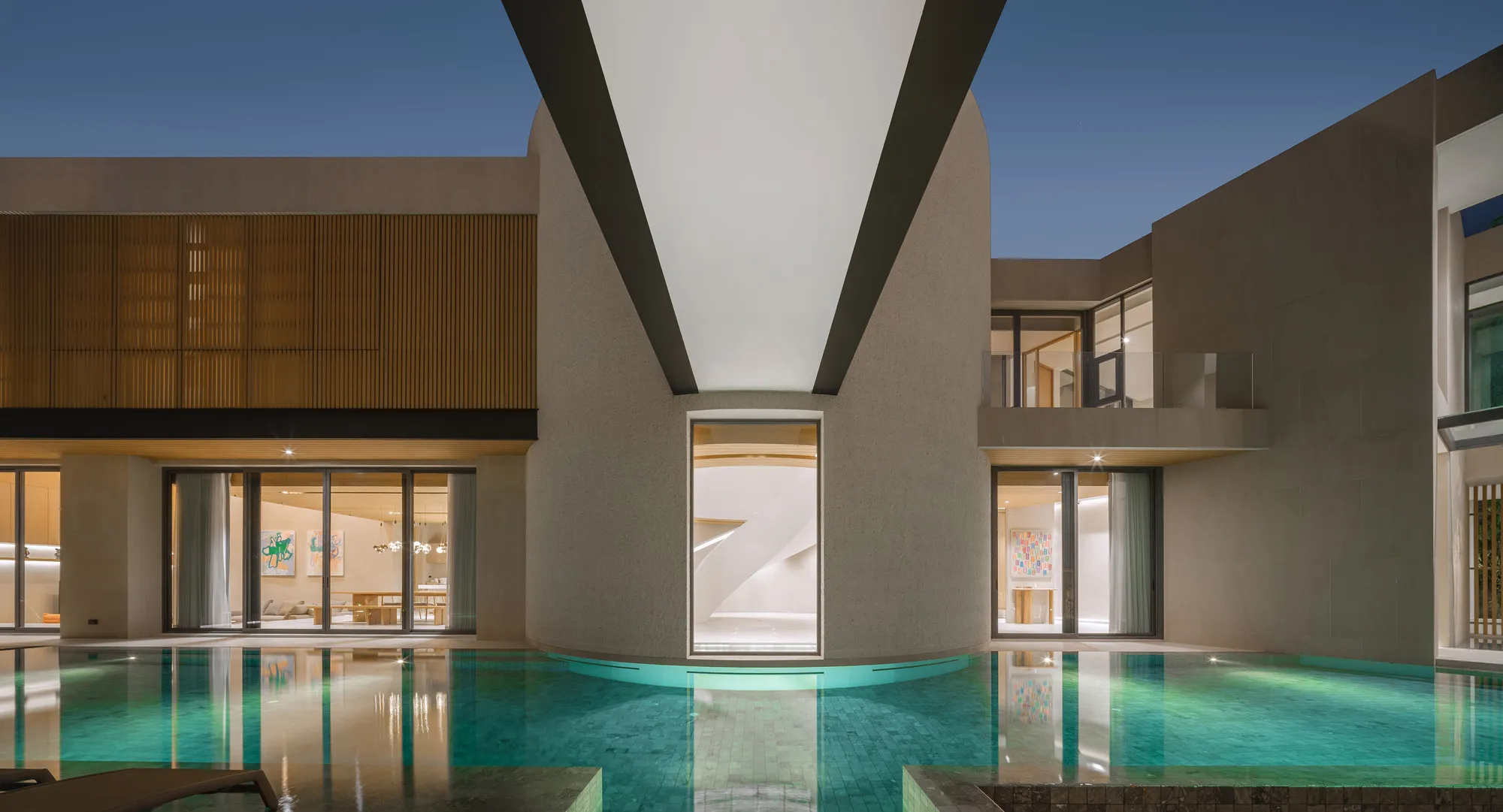
The organizing move is legible from every angle: a helical staircase serves as the vertical spine, while a narrow courtyard pool cuts through the plan to bring light, air, and a sense of distance between the home's interlocking volumes. Neither element is decorative. The staircase is a library, lined floor to ceiling with oak shelving that transforms circulation into occupation. The pool is a thermal buffer and a visual anchor, the thing every room either faces or reflects. Together they establish two axes, one vertical and one horizontal, that give the project its name and its internal logic.
A Quiet Street Presence
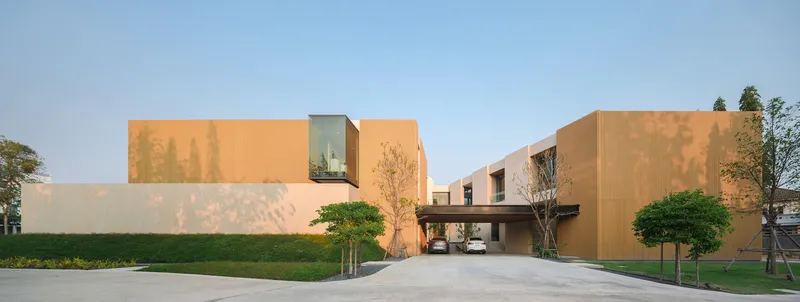
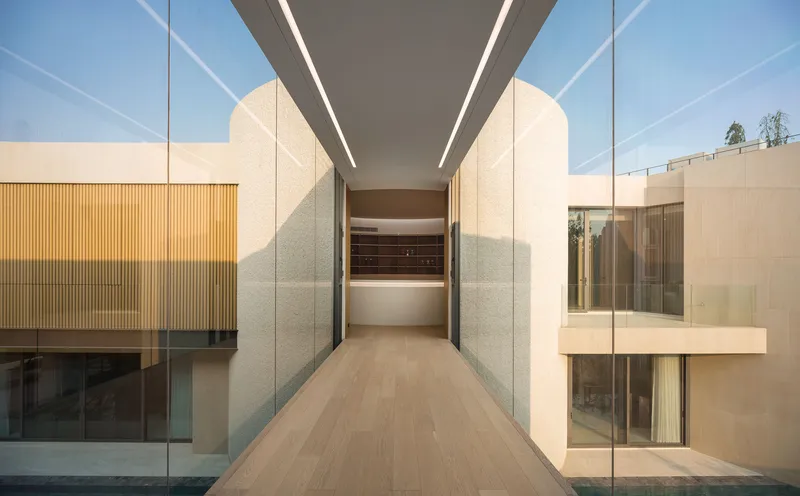
From the street, the house presents a composed, almost reticent face. Peach and cream stucco planes sit above a carport, giving little away about the spatial complexity inside. A covered walkway lined with textured stone walls leads from the entrance deeper into the plan, establishing a deliberate threshold between the public realm and the domestic interior. The material palette here is restrained: rough stone, smooth plaster, linear ceiling lights that pull you forward.
This kind of modesty reads as confidence. In a Bangkok context where residential architecture often announces itself loudly, the decision to hold back and let the courtyard do the talking once you cross the threshold is a mature choice.
The Spiral as Library
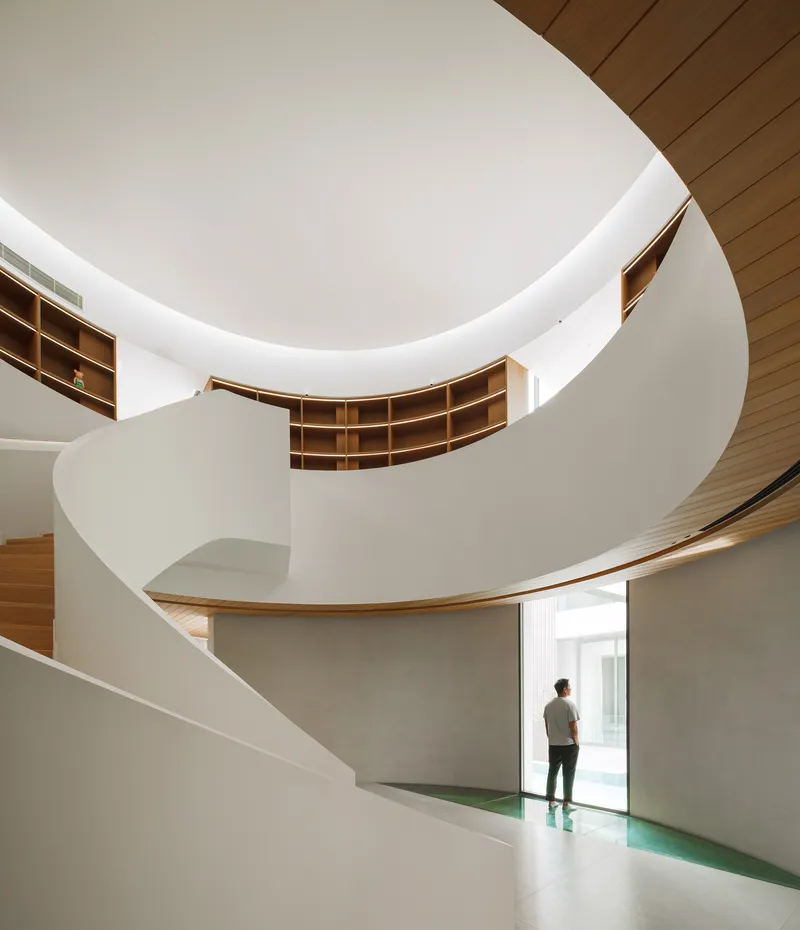
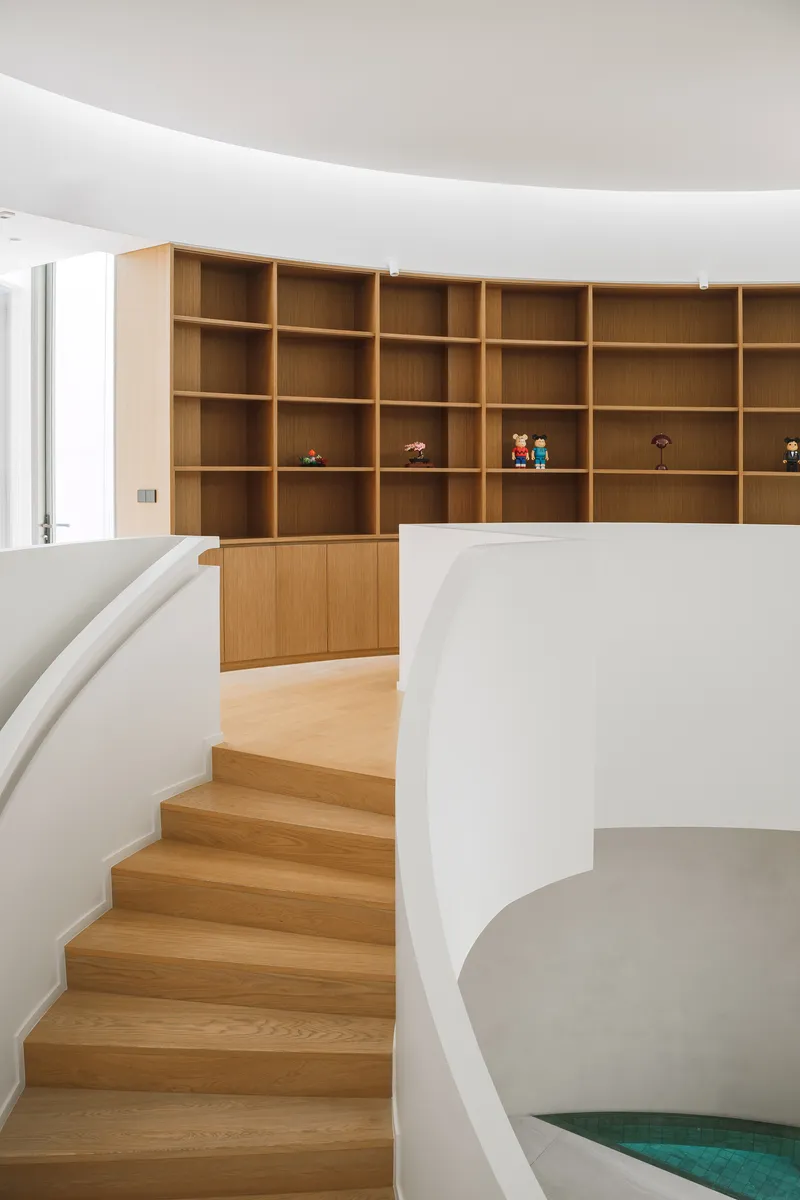
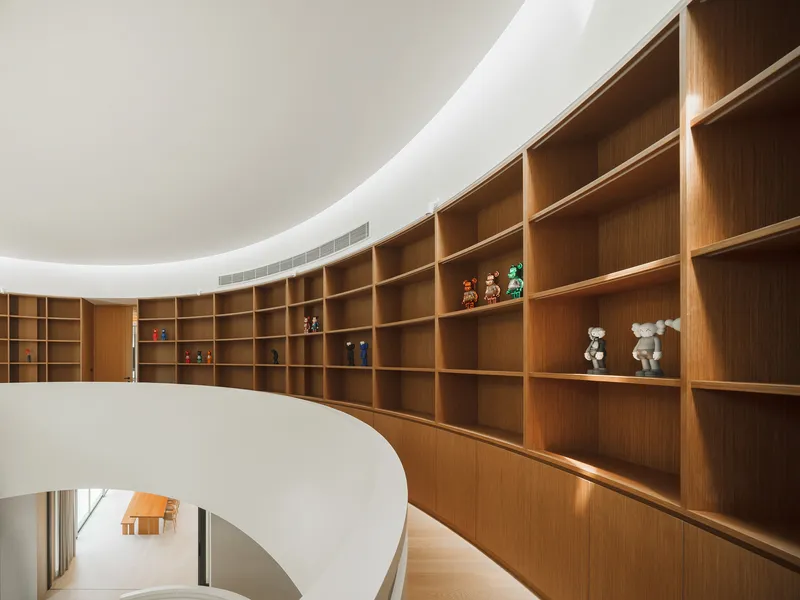
The helical staircase is the project's most photogenic element, but what makes it genuinely interesting is how it earns its drama through utility. Floor-to-ceiling oak shelves wrap the curved wall, turning every trip up or down into an encounter with books, figurines, and personal objects. The staircase is not just a connector between levels; it is the house's display cabinet and its most intimate room.
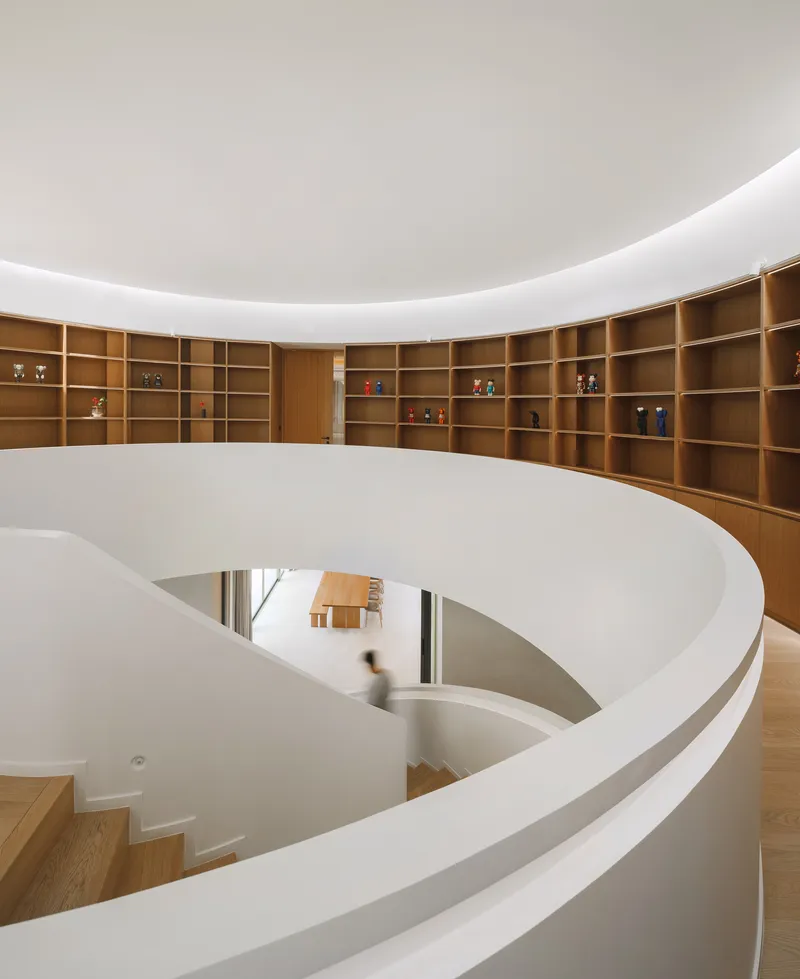
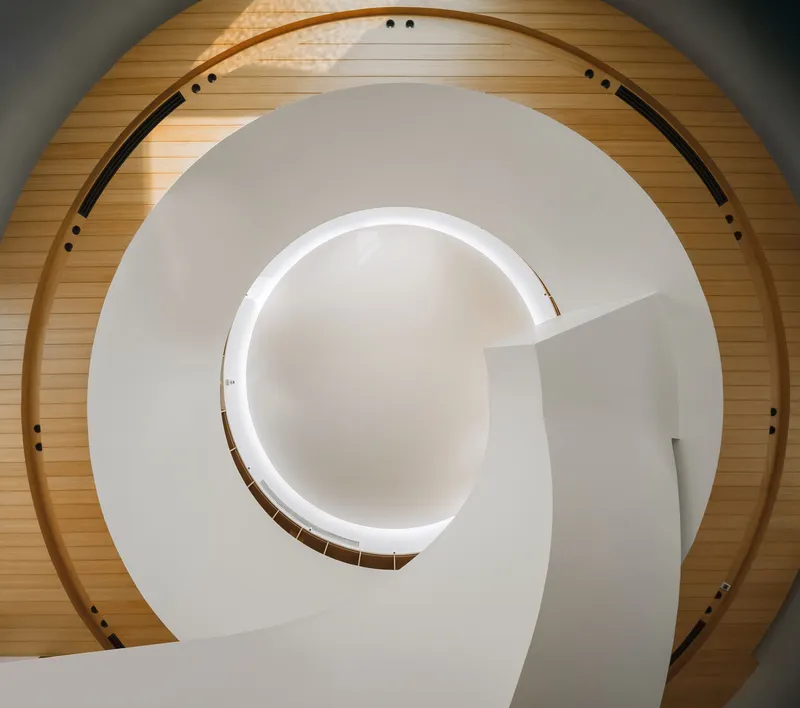
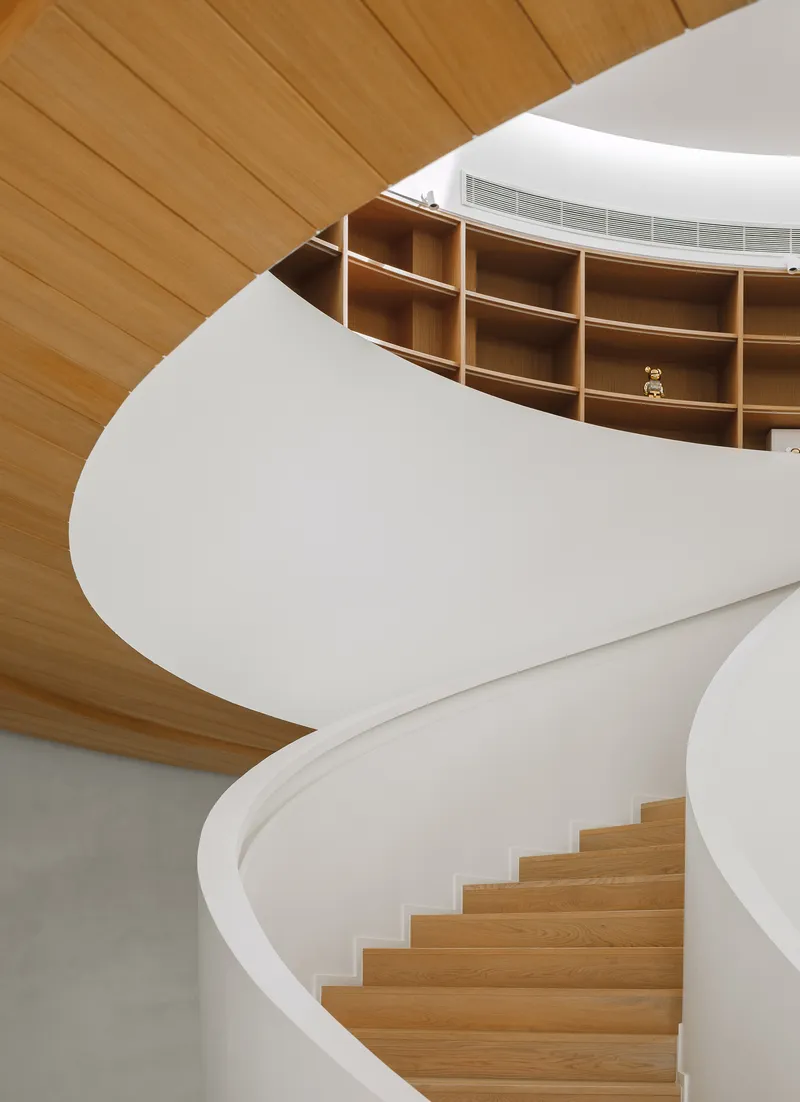
Seen from above, the geometry tightens into a clean spiral, the timber ceiling wrapping continuously around the white curved walls and handrail. The proportions are generous enough that you never feel squeezed, which is critical in a house designed for an extended family. The stair void also functions as a light well, pulling illumination down through the upper levels and keeping the core of the plan from going dark.
Courtyard Pool as Thermal Strategy
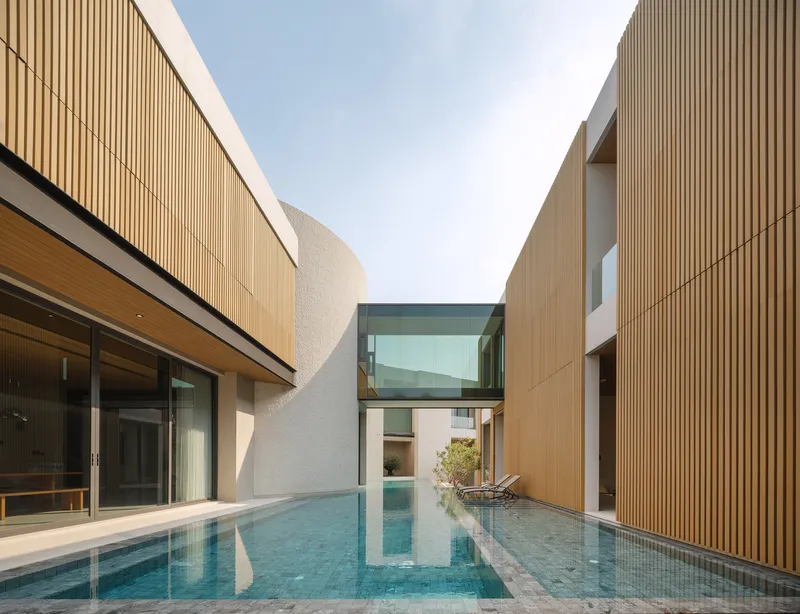
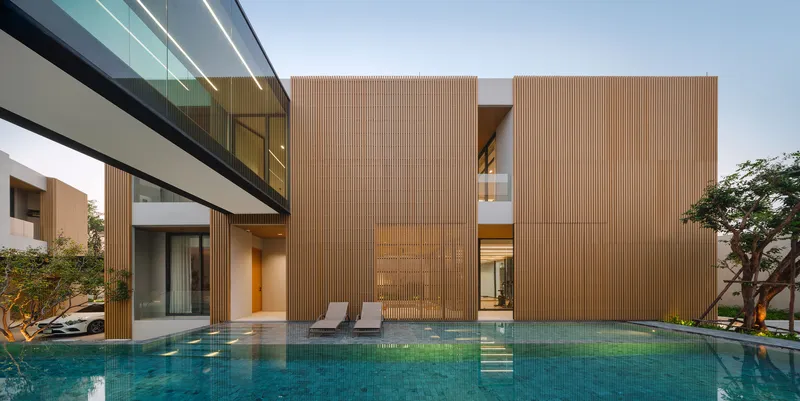
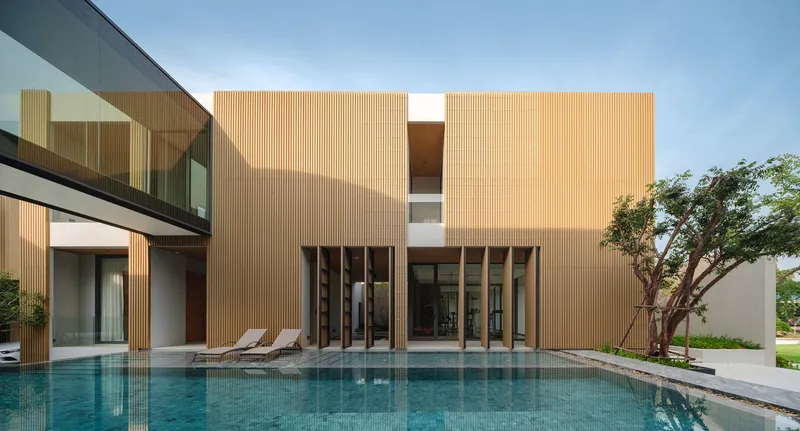
The narrow courtyard pool sits between two vertical timber-clad volumes, creating a canyon of water and air at the heart of the plan. Stepping stones cross the surface, a glazed bridge spans above, and lounge chairs line the edge. The effect at dusk, when the timber cladding catches warm light and the water goes still, is genuinely arresting.
But the pool is more than scenography. In Bangkok's humid tropical climate, an open water body between opposing facades generates convective airflow and lowers the perceived temperature of adjacent rooms. The vertical timber cladding on the courtyard faces doubles as a rain screen and a privacy filter, allowing rooms to open fully to the pool without being exposed to neighbors.
Bridges and Thresholds
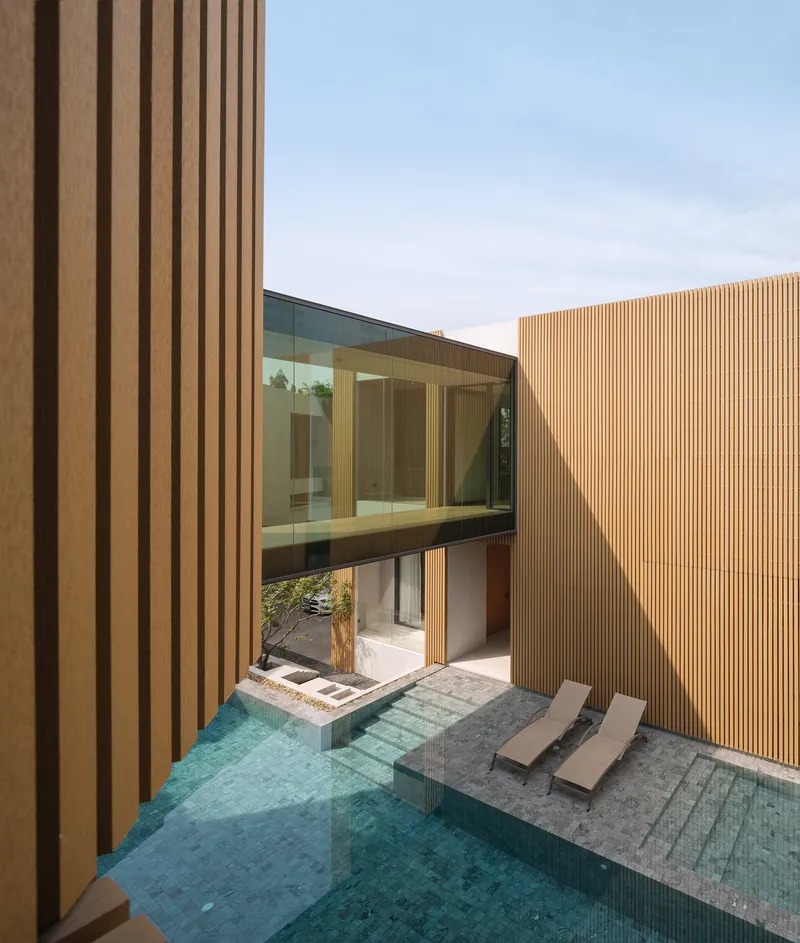
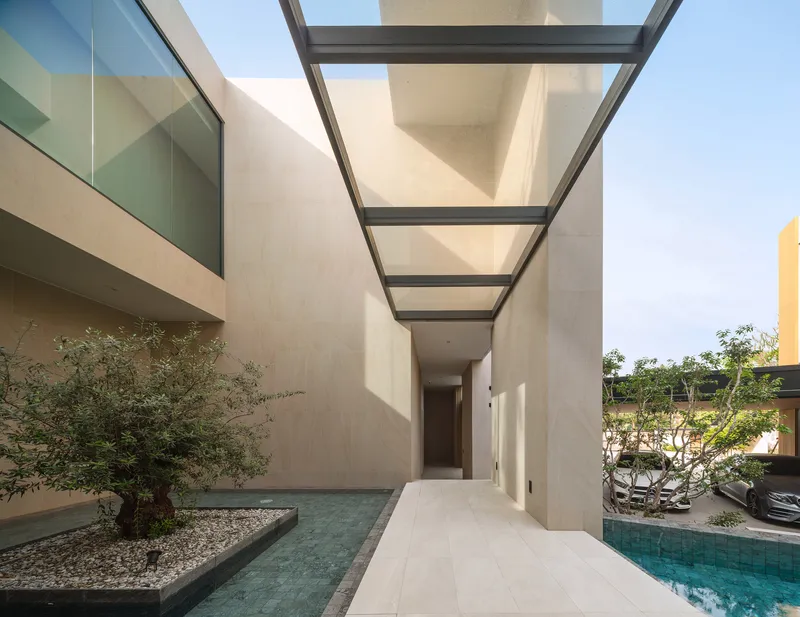
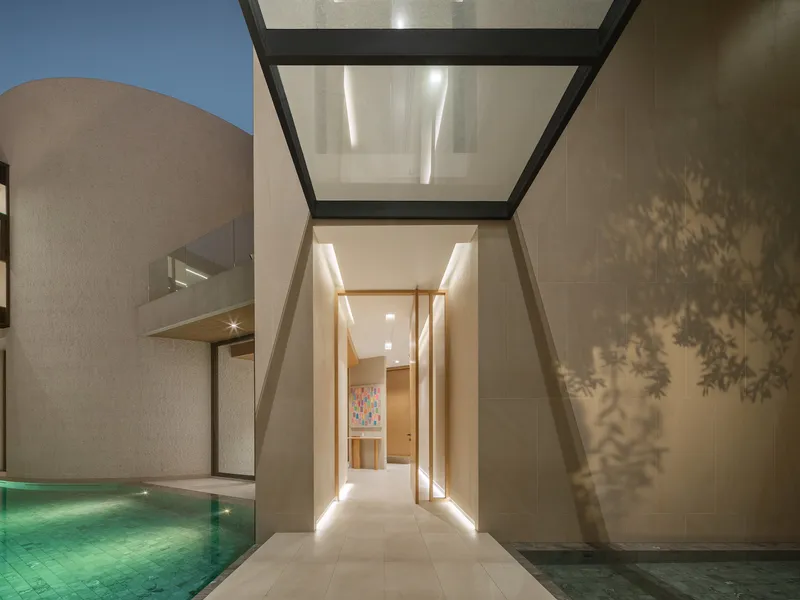
The glazed bridge spanning the courtyard is a small but telling detail. It connects the two main volumes at the upper level, preserving the courtyard's openness to the sky while allowing the house to function as a single dwelling rather than two disconnected blocks. Steel and glass keep the bridge visually light, and at twilight, tree shadows play across the limestone wall beside the pool edge, a cinematic moment that rewards the decision to keep this passage transparent.
The covered walkway with its steel and glass canopy at ground level does similar work: it stitches the volumes together without filling in the gap. An olive tree planted in the courtyard gives the circulation a point of focus and softens what could feel like a hard-edged corridor.
Timber Ceiling as Unifier
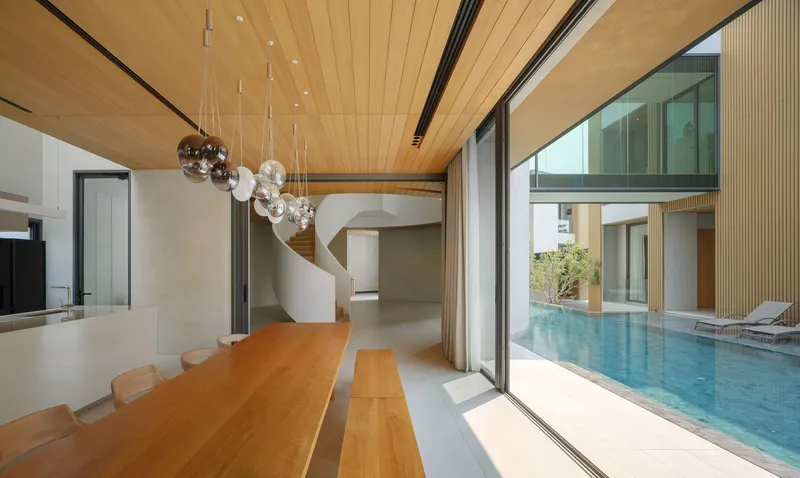
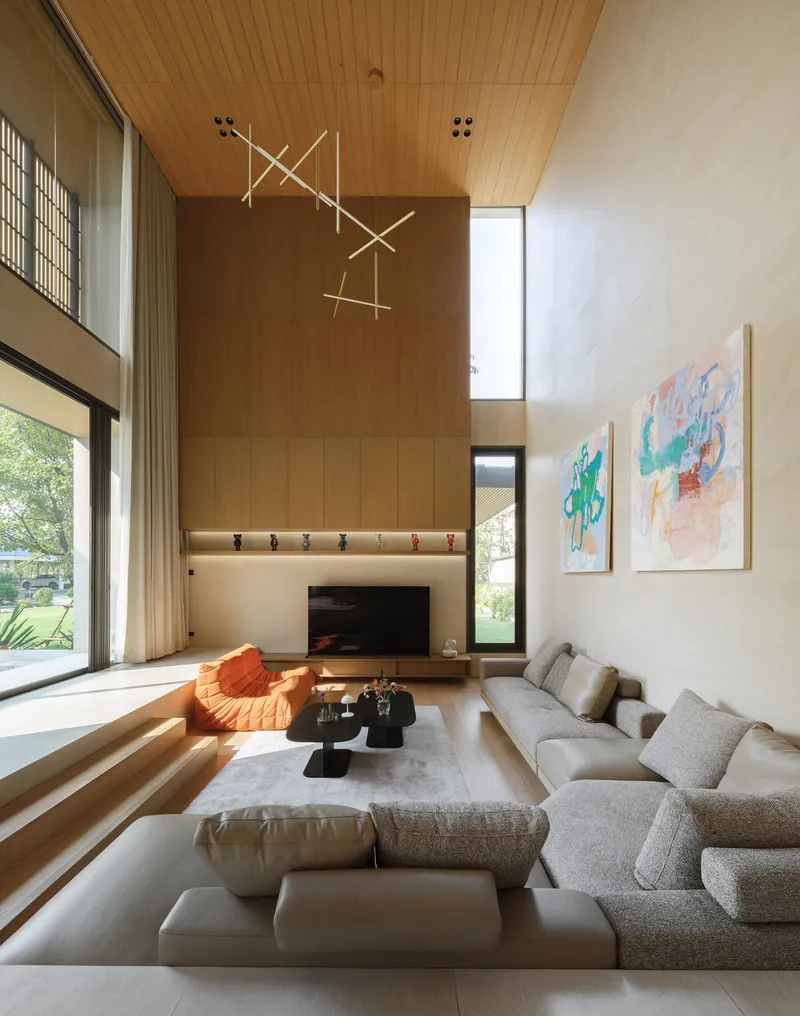
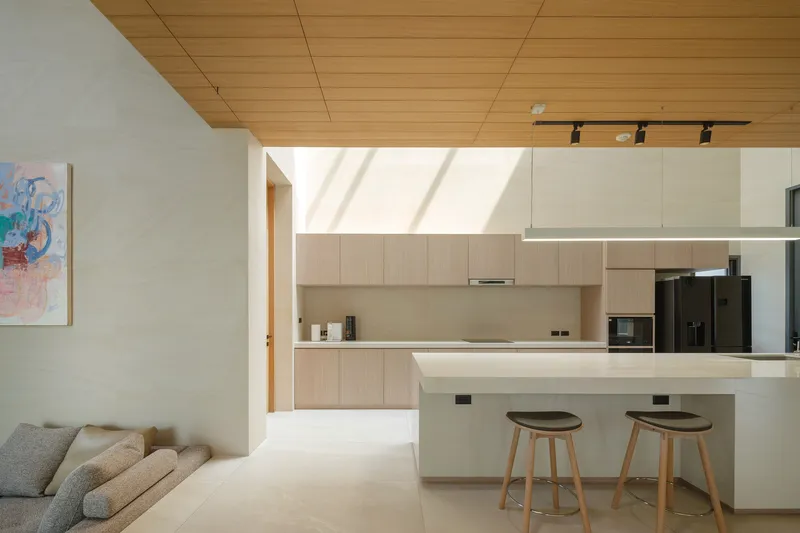
Inside, a continuous timber panel ceiling ties disparate rooms into a single spatial experience. The dining room, the double-height living room, and the open kitchen all share this warm overhead plane, which absorbs sound and provides a consistent datum against which walls, furniture, and art are read. Glass pendant lights in the dining area hang at varied heights, creating depth without clutter.
The double-height living room is the most expressive interior moment: stepped seating, abstract paintings, and a flood of natural light from the courtyard side produce a space that feels more like a gallery than a domestic room. The decision to keep the color palette neutral, whites, beiges, and natural oak, lets the architecture do the work rather than relying on decoration.
Private Rooms and Light Shafts
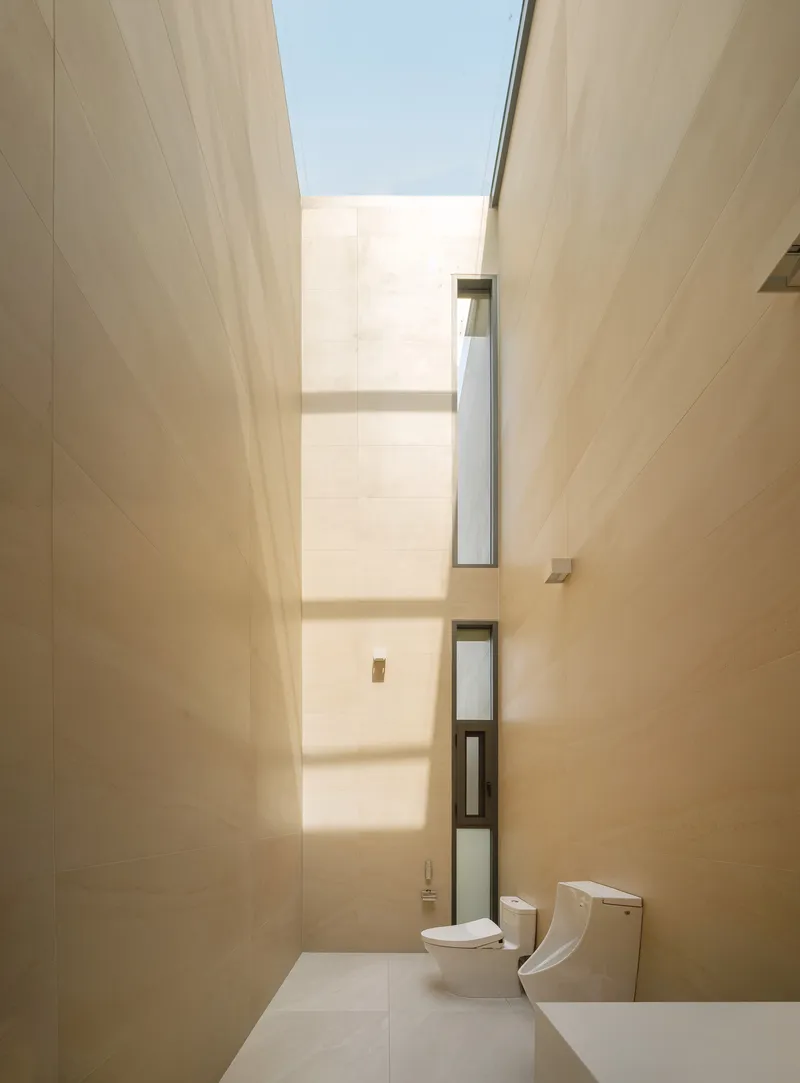
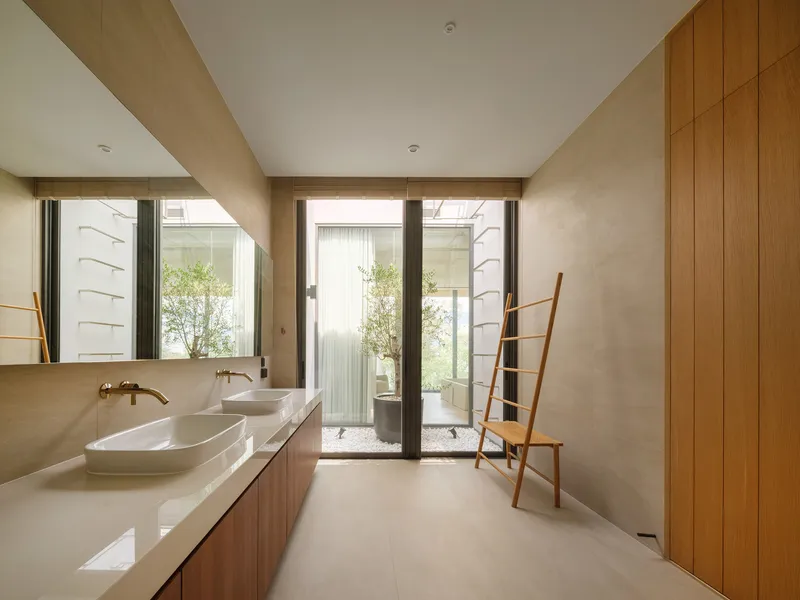
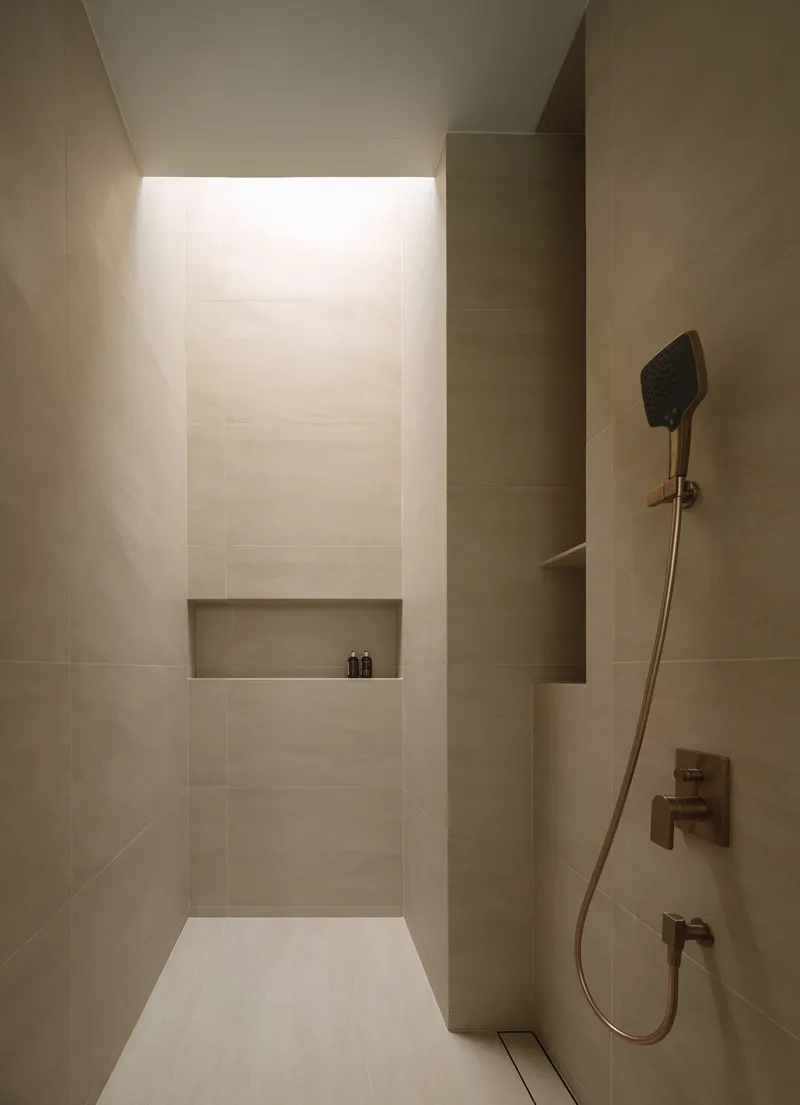
Even the bathrooms get their share of spatial generosity. A tall skylight shaft draws natural light down between beige tiled walls in one bathroom, turning a utilitarian space into something meditative. Another bathroom opens through glazed doors to a private courtyard with trees, blurring the line between bathing and garden. The recessed niche in the shower enclosure, lit from a concealed ceiling source, is a small detail that signals a level of care unusual in residential work.
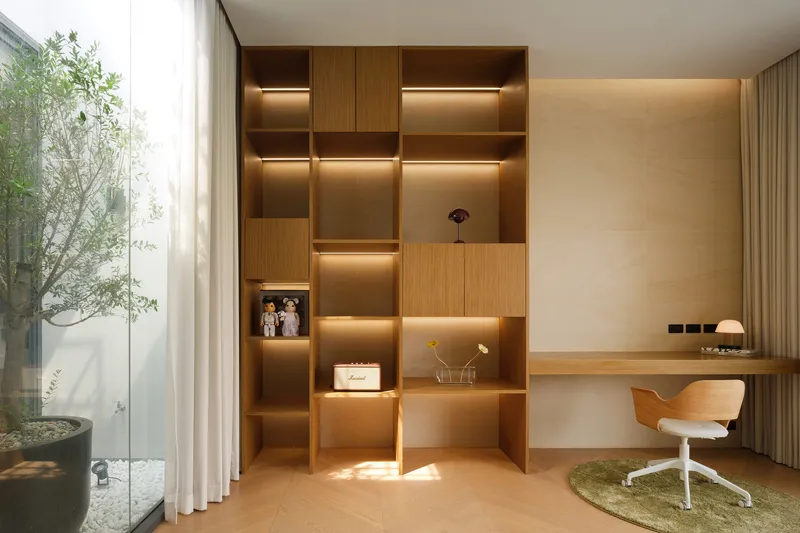
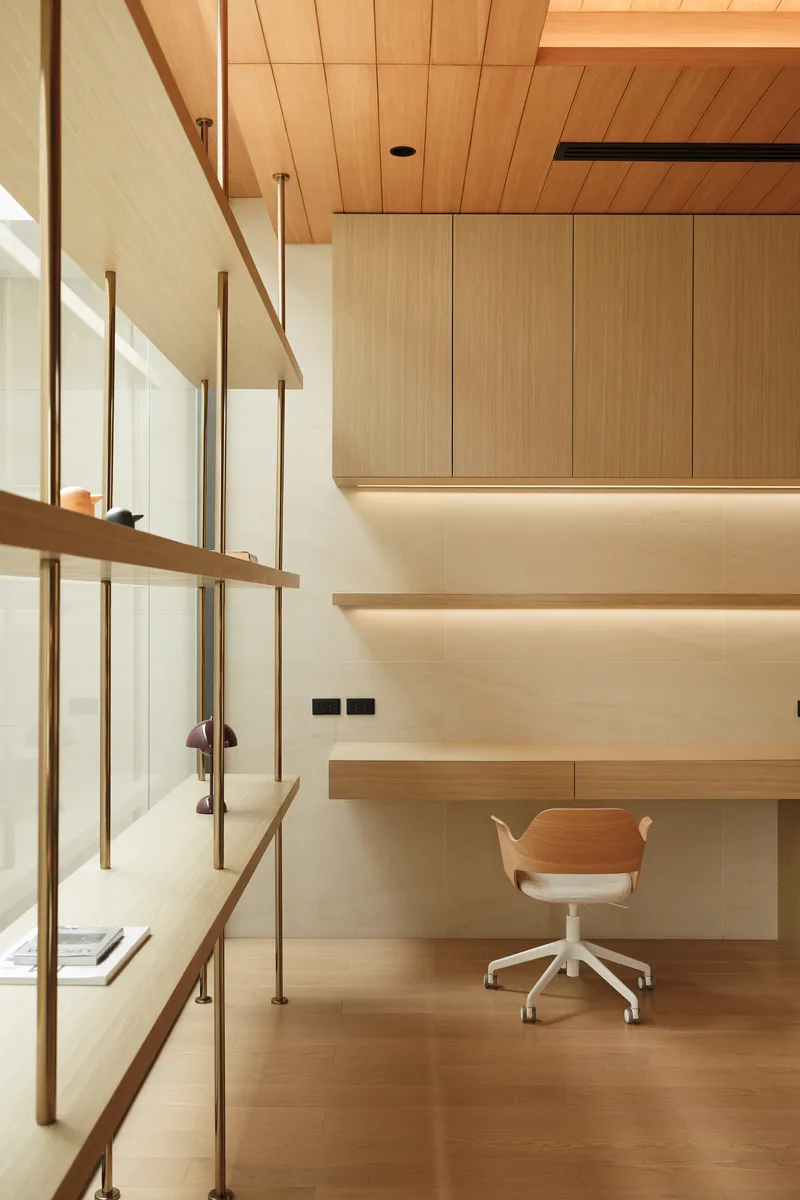
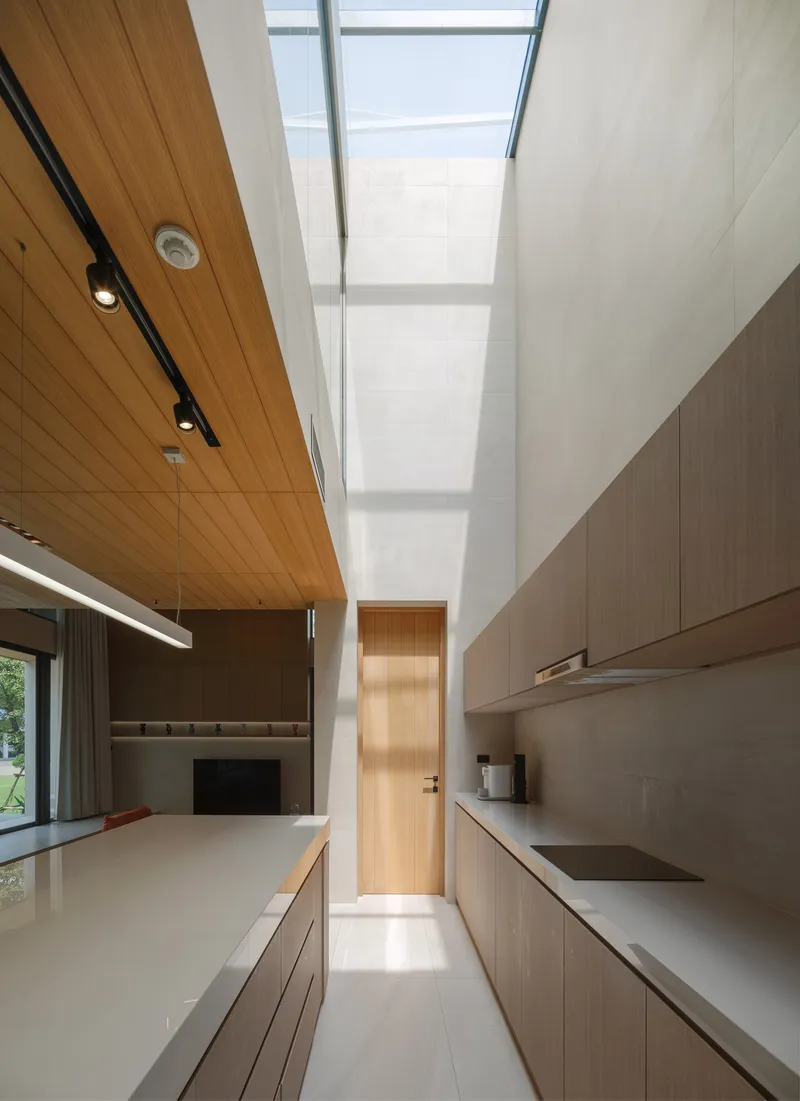
The study nook, tucked behind illuminated timber shelving with a direct view to the planted courtyard, and the double-height workspace with upper storage cabinets are tailored to specific routines rather than generic lifestyle imagery. These are rooms designed for people who actually live and work in the same building, a consideration that has become more relevant since 2020 but is still underserved in most residential design.
Dusk and the Courtyard as Stage
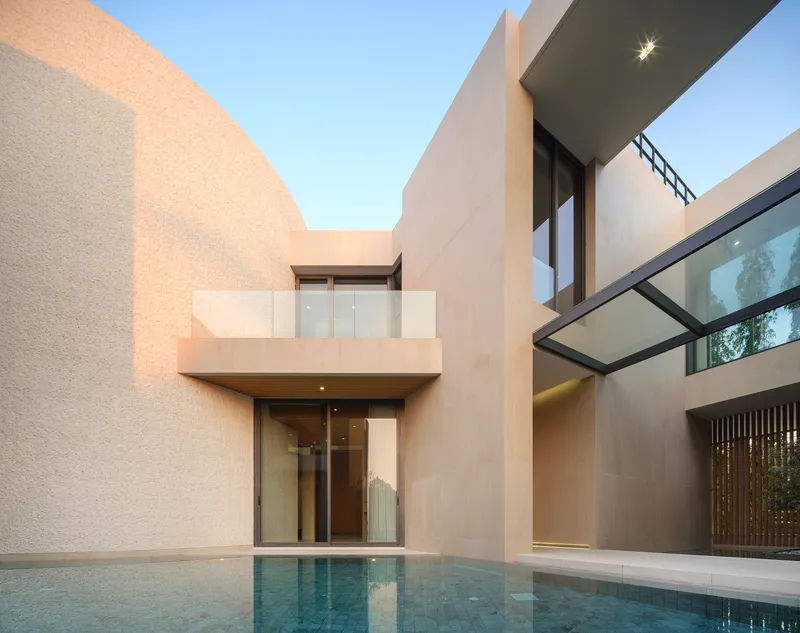
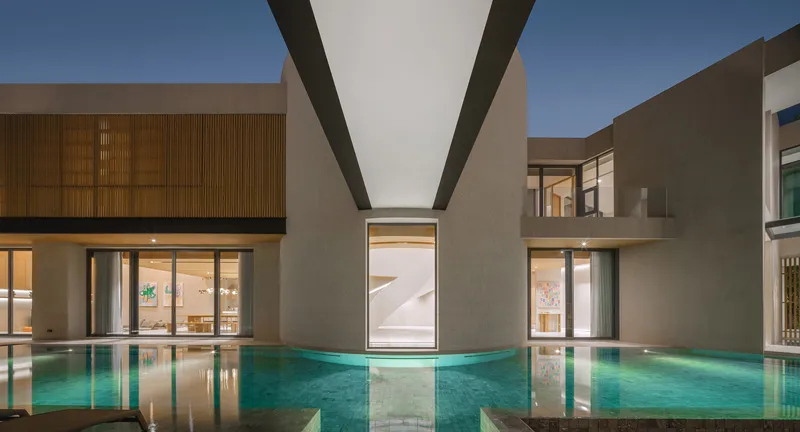
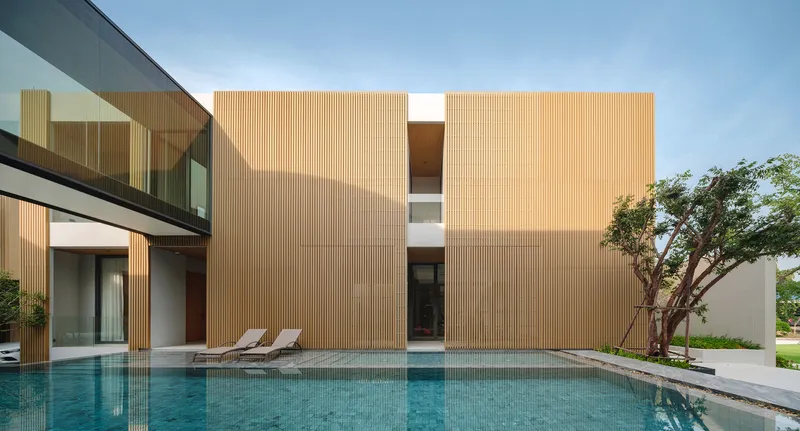
The house comes alive at twilight. The cantilevered balcony, the floor-to-ceiling glazed entrance, and the illuminated pool create a layered composition that reads differently from every vantage point. The mature tree beside the stucco wall anchors the courtyard in a way that new planting never could, suggesting that the design preserved existing landscape elements rather than clearing the site.
Photographed by Panoramic Studio, the dusk shots reveal how deliberately the lighting design was integrated. Every overhang conceals a linear fixture, every recess glows. The result is a house that does not depend on dramatic gestures but accumulates atmosphere through consistency.
The Entry Sequence
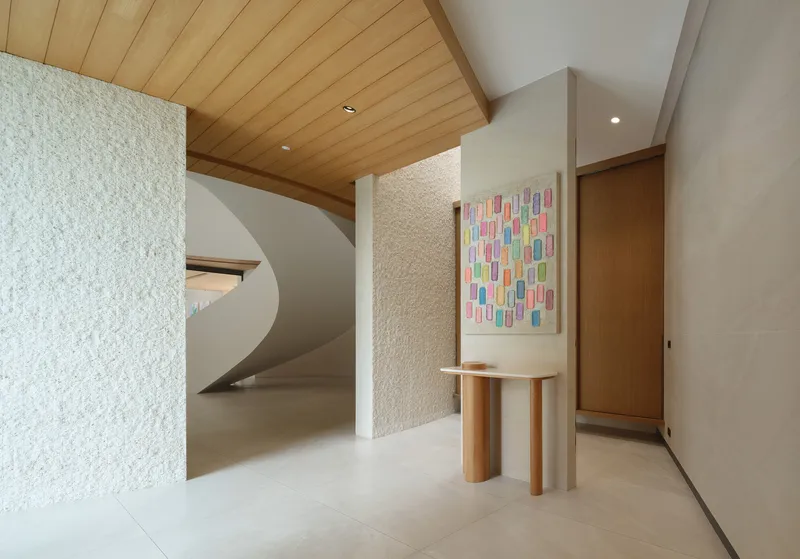
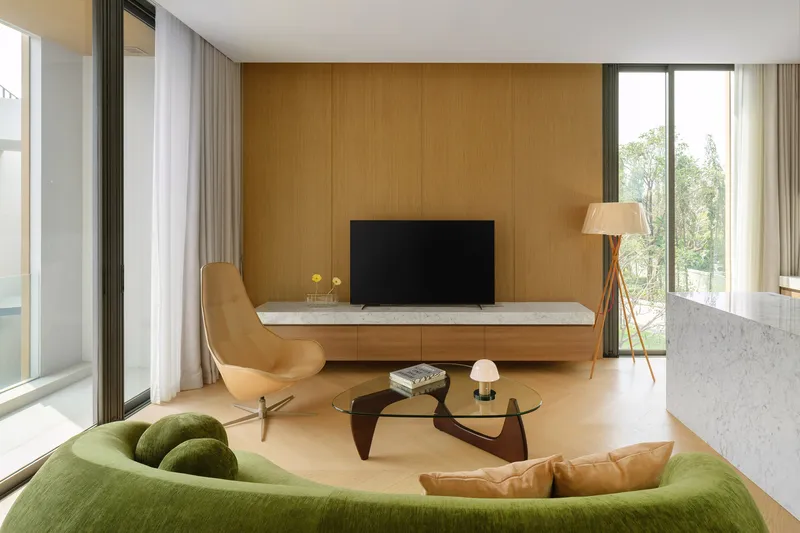
The entry hall sets expectations precisely. A textured white wall faces you as you arrive, with the timber ceiling overhead and the spiral staircase visible beyond under indirect lighting. The living room beyond, with its timber media wall flanked by curtained windows overlooking greenery, completes the sequence from compression to release. It is a sequence borrowed from hotel design, but executed with enough restraint that it feels domestic rather than performative.
Why This Project Matters
The Axis of Growth House succeeds because it treats two common residential elements, a staircase and a courtyard pool, as genuine design opportunities rather than afterthoughts. The spiral stair becomes a library and a light well. The pool becomes a thermal device, a privacy screen, and a spatial anchor. Neither innovation requires exotic materials or experimental construction; both rely on careful planning and consistent execution.
For architects working on multigenerational housing in dense tropical cities, the project offers a useful precedent. It proves that you can build on a shared family compound without sacrificing identity, privacy, or environmental performance. The courtyard-as-canyon strategy, the glazed bridge, and the integrated work-from-home spaces are all replicable ideas that address real conditions. That combination of ambition and pragmatism is exactly what contemporary residential architecture in Southeast Asia needs more of.
Axis of Growth House by Elemental Living. Located in Bangkok, Thailand. Completed in 2025. Photography by Panoramic Studio.
About the Studio
Share Your Own Work on uni.xyz
If projects like this are the kind of work you want to make, uni.xyz is a place to publish your own, find collaborators, and enter design competitions.




Popular Articles
Popular articles from the community

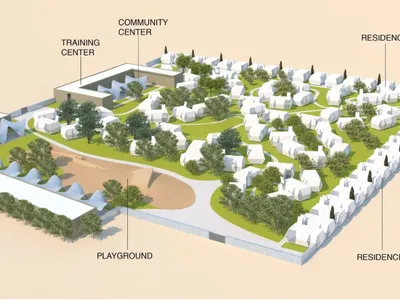
Garden of Hope: Sustainable Architecture for a Resilient Community in Qandahar
Garden of Hope reimagines sustainable architecture as secure, organic community where women rebuild lives through housing, work, and nature.

How Henri Picq's 1889 Paris Pavilion Traveled 11,000 Kilometers to Become Santiago's Artequín Museum
A prefabricated iron and glass pavilion built for the Paris Universal Exposition found a second life as a children's art museum in Chile.

AL-JANNAH: Sustainable Architecture and Permaculture for Afghan Widows
AL-JANNAH uses sustainable architecture and permaculture to create resilient oasis of housing, learning, work and renewal for Afghan widows.
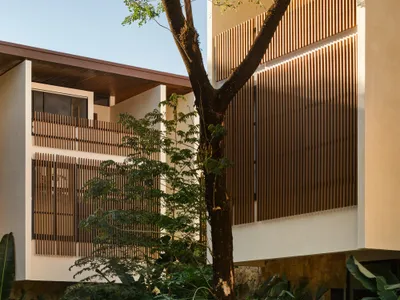
FAMM Arquitectura Organizes Ten Villas Around Courtyards and Jungle in Nosara, Costa Rica
El Molino pairs two elongated volumes with deep overhangs and timber louvers to build a compact coastal community five minutes from the beach.


Similar Reads
You might also enjoy these articles

Bao Huynh Watercolor Atelier: A Serene Art Retreat in Hội An
Bao Huynh Watercolor Atelier in Hội An blends multifunctional art spaces, sustainable design, local materials, and family-friendly living in a serene environment.

Atelier Macri Concept Store Interior Design by CASE-REAL
Atelier Macri store features a "ko" counter, walnut wood details, cork displays, blending retail, gallery, and seamless customer experiences.

Manuel Vargas Izquierdo Stadium and High-Performance Sports Center: Architectural Excellence in Jalpa de Méndez
The Manuel Vargas Izquierdo Stadium blends sustainable design, inclusive sports facilities, and cultural-inspired architecture, revitalizing Jalpa de Méndez’s public spaces.

KAKR Buluh Awar Hall: Revitalizing Community and Ecology Through Bamboo Architecture
Community built bamboo hall revitalizes Buluh Awar village, empowering youth, restoring ecology, celebrating vernacular craftsmanship through sustainable architecture and culture.


Explore Residential Building Competitions
Discover active competitions in this discipline




The Global Benchmark for Architecture Dissertation Awards


Challenge to design public laboratory


Challenge to design mud housing for contemporary communities
Comments (0)
Please login or sign up to add comments
No comments yet. Be the first to comment!